Category Archives: Spain

Medieval antecedents of Imperial Spain

From Imperial Spain: 1469-1716, by J. H. Elliott (Penguin, 2002), 2nd ed., Kindle Loc. 955-980:

Medieval Castile had built up a military, crusading tradition which was to win for it in the sixteenth century an overseas empire. But it had also developed another tradition too easily overlooked – a tradition of maritime experience which was the essential prelude to its acquisition of overseas territories. The discovery and conquest of the New World was, in reality, very far from being a lucky accident for Spain. In many respects the Iberian peninsula was the region of Europe best equipped for overseas expansion at the end of the fifteenth century. Although the opening up and settlement of the New World was to be a predominantly Castilian undertaking, the enterprise had a common Iberian foundation. Different parts of the peninsula each contributed their own skills to a common store on which the Castilians drew with such spectacular results. The medieval Catalans and Aragonese had acquired a long experience of commercial and colonial adventure in North Africa and the Levant. The Majorcans had established an important school of cartography, which had devised techniques of map-making invaluable for the charting of hitherto unknown lands. The Basques, with the experience of Atlantic deep-sea fishing behind them, were skilled pilots and ship-builders. The Portuguese had played a predominant part in the perfecting of the caravel, the stout, square-rigged vessel which was to be the essential instrument of European overseas expansion in the late fifteenth and sixteenth centuries.

But the Castilians also had acquired their own commercial and maritime experience, especially during the past two centuries. The growth of the Mesta and the expansion of the wool trade with northern Europe stimulated the development of the ports of north Spain – San Sebastian, Laredo, Santander, Corunna – which as early as 1296 banded together in a brotherhood, the so-called Hermandad de las Marismas, aimed at protecting their domestic and foreign commerical interests in the manner of the Hanseatic League. Similarly, the advance of the Reconquista in the late thirteenth century to Tarifa, on the straits of Gibraltar, had given Castile a second Atlantic seaboard, with its capital at Seville – itself recaptured by Ferdinand III in 1248. A vigorous commercial community established itself in Seville, including within its ranks influential members of the Andalusian aristocracy who were attracted by the new prospects of mercantile wealth. By the fifteenth century the city had become an intensely active commercial centre with thriving dockyards – a place where merchants from Spain and the Mediterranean lands would congregate to discuss new projects, form new associations and organize new ventures. It was Europe’s observation post from which to survey North Africa and the broad expanses of the Atlantic Ocean.

These developments occurred at a time when western Europe as a whole was displaying a growing interest in the world overseas. Portugal in particular was active in voyages of discovery and exploration. With its long seaboard and its influential mercantile community it was well placed to embark on a quest for the gold, slaves, sugar, and spices, for all of which there was an expanding demand. Short of bread, it was also anxious for new cereal-growing lands, which it found in the Azores (rediscovered in 1427) and in Madeira. Like Castile it was inspired, too, by the crusading tradition, and the occupation of Ceuta in 1415 was itself conceived as part of a crusade which might one day encircle the earth and take Islam in the rear.

Leave a comment

Filed under economics, Mediterranean, Portugal, religion, Spain, war

Mercantile constitutionalist Aragon before 1492

From Imperial Spain: 1469-1716, by J. H. Elliott (Penguin, 2002), 2nd ed., Kindle Loc. 528-549:

The Catalan Diputació was … an immensely powerful institution, backed by large financial resources; and its obvious attractions as a bulwark of national liberty had stimulated Aragonese and Valencians to establish similar institutions in their own countries by the early fifteenth century. As a result, all three states were exceptionally well protected at the end of the Middle Ages from encroachments by the Crown. In the Diputació was symbolized that mutual relationship between the King and a strong, free people so movingly expressed in the words of Martin of Aragon to the Catalan Corts of 1406: ‘What people is there in the world enjoying as many freedoms and exemptions as you; and what people so generous?’ The same concept was more astringently summarized in the famous Aragonese oath of allegiance to the king: ‘We who are as good as you swear to you who are no better than we, to accept you as our king and sovereign lord, provided you observe all our liberties and laws; but if not, not.’ Both phrases, one emotionally, one legalistically, implied that sense of mutual compact which was the foundation of the Catalan-Aragonese constitutional system.

It was typical of the medieval Catalans that their pride in their constitutional achievements should naturally prompt them to export their institutional forms to any territories they acquired. Both Sardinia (its conquest begun in 1323) and Sicily (which had offered the Crown to Peter III of Aragon in 1282) possessed their own parliaments, which borrowed extensively from the Catalan-Aragonese model. Consequently, the medieval empire of the Crown of Aragon was far from being an authoritarian empire, ruled with an iron hand from Barcelona. On the contrary, it was a loose federation of territories, each with its own laws and institutions, and each voting independently the subsidies requested by its king. In this confederation of semi-autonomous provinces, monarchical authority was represented by a figure who was to play a vital part in the life of the future Spanish Empire. This figure was the viceroy, who had made his first appearance in the Catalan Duchy of Athens in the fourteenth century, when the duke appointed as his representative a vicarius generalis or viceregens. The viceroyalty – an office which was often, but not invariably, limited to tenures of three years – proved to be a brilliant solution to one of the most difficult problems created by the Catalan-Aragonese constitutional system: the problem of royal absenteeism. Since each part of the federation survived as an independent unit, and the King could only be present in one of these units at a given time, he would appoint in Majorca or Sardinia or Sicily a personal substitute or alter ego, who as viceroy would at once carry out his orders and preside over the country’s government. In this way the territories of the federation were loosely held together, and their contacts with the ruling house of Aragon preserved.

Leave a comment

Filed under democracy, economics, Mediterranean, Spain

Warlike pastoralist Castile before 1492

From Imperial Spain: 1469-1716, by J. H. Elliott (Penguin, 2002), 2nd ed., Kindle Loc. 550-592:

The medieval Crown of Aragon, therefore, with its rich and energetic urban patriciate, was deeply influenced by its overseas commercial interests. It was imbued with a contractual concept of the relationship between king and subjects, which had been effectively realized in institutional form, and it was well experienced in the administration of empire. In all these respects it contrasted strikingly with medieval Castile. Where, in the early fourteenth century, the Crown of Aragon was cosmopolitan in outlook and predominantly mercantile in its inclinations, contemporary Castile tended to look inwards rather than outwards, and was oriented less towards trade than war. Fundamentally, Castile was a pastoral and nomadic society, whose habits and attitudes had been shaped by constant warfare – by the protracted process of the Reconquista, still awaiting completion long after it was finished in the Crown of Aragon.

The Reconquista was not one but many things. It was at once a crusade against the infidel, a succession of military expeditions in search of plunder, and a popular migration. All these three aspects of the Reconquista stamped themselves forcefully on the forms o Castilian life. In a holy war against Islam, the priests naturally enjoyed a privileged position. It was their task to arouse and sustain the fervour of the populace – to impress upon them their divinely appointed mission to free the country of the Moors. As a result, the Church possessed an especially powerful hold over the medieval Castile; and the particular brand of militant Christianity which it propagated was enshrined in the three Military Orders of Calatrava, Alcántara, and Santiago – three great creations of the twelfth century, combining at once military and religious ideals. But while the crusading ideal gave Castilian warriors their sense of participating in a holy mission as soldiers of the Faith, it could not eliminate the more mundane instincts which had inspired the earliest expeditions against the Arabs, and which were prompted by the thirst for booty. In those first campaigns, the Castilian noble confirmed to his own entire satisfaction that true wealth consisted essentially of booty and land. Moreover, his highest admiration came to be reserved for the military virtues of courage and honour. In this way was established the concept of the perfect hidalgo, as a man who lived for war, who could do the impossible through sheer physical courage and a constant effort of the will, who conducted his relations with others according to a strictly regulated code of honour, and who reserved his respect for the man who had won riches by force of arms rather than by the sweat of manual labour. This ideal of hidalguía was essentially aristocratic, but circumstances conspired to diffuse it throughout Castilian society, for the very character of the Reconquista as a southwards migration in the wake of the conquering armies encouraged a popular contempt for sedentary life and fixed wealth, and thus imbued the populace with ideals similar to those of the aristocracy.

The Reconquista therefore gave Castilian society a distinctive character in which militantly religious and aristocratic strains predominated. But it was equally important in determining the pattern of Castile’s economic life. Vast estates were consolidated in the south of Spain, and there grew up a small number of great urban centres like Córdoba and Seville, living off the wealth of the surrounding countryside. Above all, the Reconquista helped to ensure in Castile the triumph of a pastoral economy. In a country whose soil was hard and barren and where there was frequent danger of marauding raids, sheep-farming was a safer and more rewarding occupation than agriculture; and the reconquest of Estremadura and Andalusia opened up new possibilities for the migratory sheep industry of North Castile.

But the event which transformed the prospects of the Castilian sheep industry was the introduction into Andalusia from North Africa, around 1300, of the merino sheep – an event which either coincided with, or created, a vastly increased demand for Spanish wool. The Castilian economy during the fourteenth and fifteenth centuries steadily adapted itself to meet this demand. In 1273 the Castilian Crown, in its search for new revenues, had united in a single organization the various associations of sheepowners, and conferred upon it important privileges in return for financial contributions. This organization, which later became known as the Mesta, was entrusted with the supervision and control of the elaborate system whereby the great migratory flocks were moved across Spain from their summer pastures in the north to their winter pastures in the south, and then back again in the spring to the north.

The extraordinary development of the wool industry under the Mesta’s control had momentous consequences for the social, political, and economic life of Castile. It brought the Castilians into closer contact with the outer world, and particularly with Flanders, the most important market for their wools. This northern trade in turn stimulated commercial activity all along the Cantabrian coast, transforming the towns of north Castile, like Burgos, into important commercial centres, and promoting a notable expansion of the Cantabrian fleet. But during the fourteenth century and much of the fifteenth the full extent of the transformation which was being wrought in Castilian life by the European demand for wool was partially hidden by the more obviously dramatic transformations effected by the ravages of plague and war.

The Black Death of the fourteenth century, although less catastrophic in Castile than in the Crown of Aragon, provoked at least a temporary crisis of manpower, which may have helped to give the economy a further twist in the direction of sheep-farming.

Leave a comment

Filed under economics, military, religion, Spain

The Financial Ascent of the Dutch VOC

From: The Ascent of Money: A Financial History of the World, by Niall Ferguson (Penguin, 2008), Kindle Loc. 1780-1831:

The campaign for a reform of what would now be called the VOC’s corporate governance duly bore fruit. In December 1622, when the Company’s charter was renewed, it was substantially modified. Directors would no longer be appointed for life but could serve for only three years at a time. The ‘chief participants’ (shareholders with as much equity as directors) were henceforth entitled to nominate ‘Nine Men’ from among themselves, whom the Seventeen Lords were obliged to consult on ‘great and important matters’, and who would be entitled to oversee the annual accounting of the six chambers and to nominate, jointly with the Seventeen Lords, future candidates for directorships. In addition, in March 1623, it was agreed that the Nine Men would be entitled to attend (but not to vote at) the meetings of the Seventeen Lords and to scrutinize the annual purchasing accounts. The chief participants were also empowered to appoint auditors (rekening-opnemers) to check the accounts submitted to the States-General. Shareholders were further mollified by the decision, in 1632, to set a standard 12.5 per cent dividend, twice the rate at which the Company was able to borrow money. The result of this policy was that virtually all of the Company’s net profits thereafter were distributed to the shareholders. Shareholders were also effectively guaranteed against dilution of their equity. Amazingly, the capital base remained essentially unchanged throughout the VOC’s existence. When capital expenditures were called for, the VOC raised money not by issuing new shares but by issuing debt in the form of bonds. Indeed, so good was the Company’s credit by the 1670s that it was able to act as an intermediary for a two-million-guilder loan by the States of Holland and Zeeland.

None of these arrangements would have been sustainable, of course, if the VOC had not become profitable in the mid seventeenth century. This was in substantial measure the achievement of Jan Pieterszoon Coen, a bellicose young man who had no illusions about the relationship between commerce and coercion. As Coen himself put it: ‘We cannot make war without trade, nor trade without war.’ He was ruthless in his treatment of competitors, executing British East India Company officials at Amboyna and effectively wiping out the indigenous Bandanese. A natural-born empire builder, Coen seized control of the small Javanese port of Jakarta in May 1619, renamed it Batavia and, aged just 30, duly became the first governor-general of the Dutch East Indies. He and his successor, Antonie van Diemen, systematically expanded Dutch power in the region, driving the British from the Banda Islands, the Spaniards from Ternate and Tidore, and the Portuguese from Malacca. By 1657 the Dutch controlled most of Ceylon (Sri Lanka); the following decade saw further expansion along the Malabar coast on the subcontinent and into the island of Celebes (Sulawesi). There were also thriving Dutch bases on the Coromandel coast. Fire-power and foreign trade sailed side by side on ships like the Batavia – a splendid replica of which can be seen today at Lelystad on the coast of Holland.

The commercial payoffs of this aggressive strategy were substantial. By the 1650s, the VOC had established an effective and highly lucrative monopoly on the export of cloves, mace and nutmeg (the production of pepper was too widely dispersed for it to be monopolized) and was becoming a major conduit for Indian textile exports from Coromandel. It was also acting as a hub for intra-Asian trade, exchanging Japanese silver and copper for Indian textiles and Chinese gold and silk. In turn, Indian textiles could be traded for pepper and spices from the Pacific islands, which could be used to purchase precious metals from the Middle East. Later, the Company provided financial services to other Europeans in Asia, not least Robert Clive, who transferred a large part of the fortune he had made from conquering Bengal back to London via Batavia and Amsterdam. As the world’s first big corporation, the VOC was able to combine economies of scale with reduced transaction costs and what economists call network externalities, the benefit of pooling information between multiple employees and agents. As was true of the English East India Company, the VOC’s biggest challenge was the principal-agent problem: the tendency of its men on the spot to trade on their own account, bungle transactions or simply defraud the company. This, however, was partially countered by an unusual compensation system, which linked remuneration to investments and sales, putting a priority on turnover rather than net profits. Business boomed. In the 1620s, fifty VOC ships had returned from Asia laden with goods; by the 1690s the number was 156. Between 1700 and 1750 the tonnage of Dutch shipping sailing back around the Cape doubled. As late as 1760 it was still roughly three times the amount of British shipping.

The economic and political ascent of the VOC can be traced in its share price. The Amsterdam stock market was certainly volatile, as investors reacted to rumours of war, peace and shipwrecks in a way vividly described by the Sephardic Jew Joseph Penso de la Vega in his aptly named book Confusión de Confusiones (1688). Yet the long-term trend was clearly upward for more than a century after the Company’s foundation. Between 1602 and 1733, VOC stock rose from par (100) to an all-time peak of 786, this despite the fact that from 1652 until the Glorious Revolution of 1688 the Company was being challenged by bellicose British competition. Such sustained capital appreciation, combined with the regular dividends and stable consumer prices, ensured that major shareholders like Dirck Bas became very wealthy indeed. As early as 1650, total dividend payments were already eight times the original investment, implying an annual rate of return of 27 per cent. The striking point, however, is that there was never such a thing as a Dutch East India Company bubble. Unlike the Dutch tulip futures bubble of 1636-7, the ascent of the VOC stock price was gradual, spread over more than a century, and, though its descent was more rapid, it still took more than sixty years to fall back down to 120 in December 1794. This rise and fall closely tracked the rise and fall of the Dutch Empire. The prices of shares in other monopoly trading companies, outwardly similar to the VOC, would behave very differently, soaring and slumping in the space of just a few months.

Leave a comment

Filed under Britain, economics, Indonesia, Netherlands, piracy, Portugal, Spain, Sri Lanka, war

Disasters for Ottoman “Soft Power” in 1579

From the luridly titled “Global Politics in the 1580s: One Canal, Twenty Thousand Cannibals, and an Ottoman Plot to Rule the World” by Giancarlo Casale in Journal of World History 18(2007):277-281 (on Project MUSE):

During the lengthy grand vizierate of Sokollu Mehmed Pasha in the 1560s and 1570s—the Ottomans had pursued what we might define today as a policy of “soft empire” in the Indian Ocean. Under Sokollu Mehmed’s direction, this involved a strategy to expand Ottoman influence not through direct military intervention, but rather through the development of ideological, commercial, and diplomatic ties with the various Muslim communities of the region. Only in a few instances (most notably in the case of the Muslim principality of Aceh in western Indonesia) did Istanbul provide direct military assistance in exchange for a formal recognition of Ottoman suzerainty. Elsewhere, a much more informal relationship was the rule, even in places like Gujarat and Calicut where elites enjoyed extremely close commercial, professional, and sometimes familial relations with Istanbul. Despite this high level of contact, tributary relationships or other direct political ties between local states and the Ottoman empire were not normally encouraged.

In the absence of a formal imperial infrastructure, however, Sokollu Mehmed took steps to align the interests of these disparate Muslim communities with those of the Ottoman state in other ways. Evidence suggests, for example, that he established a network of imperial commercial factors throughout the region who bought and sold merchandise for the sultan’s treasury. And at the same time, the grand vizier also began financing pro-Ottoman religious organizations overseas, especially those in predominantly non-Muslim states with influential Muslim trading elites, such as Calicut and Ceylon. In exchange for annual shipments of gold currency from the Ottoman treasury, local preachers in such overseas mosques agreed to read the Friday call to prayer in the name of the Ottoman sultan, and in so doing acknowledged him, if not as their immediate overlord, as a kind of religiously sanctioned “meta-sovereign” over the entire Indian Ocean trading sphere. As “Caliph” and “Protector of the Holy Cities,” the Ottoman sultan thus acted as guarantor of the safety and security of the maritime trade and pilgrimage routes to and from Mecca and Medina, and in exchange could demand a certain measure of allegiance from Muslims throughout the region.

As long as it lasted, this strategy of “soft empire” seems to have worked remarkably well. During Sokollu Mehmed’s term in office (1565–1579), trade through the Red Sea and Persian Gulf flourished as never before, until by the 1570s the Portuguese gave up their efforts to maintain a naval blockade between the Indian Ocean and the markets of the Ottoman Empire. Additionally, the concept of the Ottoman sultan as “universal sovereign” became ever more widely recognized, such that the Sultan’s name was read in the Friday call to prayer of mosques from the Maldives to Ceylon, and from Calicut to Sumatra. Even in the powerful and rapidly expanding Mughal empire, whose Sunni Muslim dynasty was the only one that could legitimately compete with the Ottomans in terms of imperial grandeur, a certain amount of deference toward Istanbul appears to have been the rule.

But then, in 1579—perhaps the single most pivotal year in the political history of the early modern world—a series of cataclysmic and nearly simultaneous international events conspired to undermine this carefully constructed system from almost every conceivable direction. Most obviously, Sokollu Mehmed Pasha, the grand architect of the Ottomans’ “soft empire,” was unexpectedly struck down by an assassin’s blade while receiving petitions at his private court in Istanbul. At almost exactly the same time, in distant Sumatra, the Acehnese sultan ‘Ala ad-Din Ri’ayat Syah also died, ushering in an extended period of political and social turmoil that would deprive the Ottomans of their closest ally in Southeast Asia. Meanwhile, in Iberia, the Ottoman sultan’s archrival King Philip II of Spain was preparing to annex Portugal and all of her overseas possessions, following the sudden death of the heirless Dom Sebastião on the Moroccan battlefield of al-Kasr al-Kabir. And in the highlands of Abyssinia, again at almost exactly the same time, Christian forces handed the Ottomans a crushing and unexpected defeat at the battle of Addi Qarro, after which they captured the strategic port of Arkiko, re-established direct contact with the Portuguese, and threatened Ottoman control of the Red Sea for the first time in more than two decades.

All of these events, despite the vast physical distances that separated them, impinged directly on the Ottomans’ ability to maintain “soft power” in the Indian Ocean. Even more ominously, they all took place alongside yet another emerging menace from Mughal India, where the young and ambitious Emperor Akbar had begun to openly challenge the very basis of Ottoman “soft power” by advancing his own rival claim to universal sovereignty over the Islamic world.

Of all these newly emerging threats, the Mughal challenge was in many ways the most potentially disturbing. Unlike the others, it was also a challenge mounted incrementally, and as a result became gradually apparent only over the course of several years. In fact, it may have begun as early as 1573, the year Akbar seized the Gujarati port of Surat and thus gained control of a major outlet onto the Indian Ocean for the first time. Less than two years later, he sent several ladies of his court, including his wife and his paternal aunt, on an extended pilgrimage to Mecca, where they settled and began to distribute alms regularly in the emperor’s name. Concurrently, Akbar became involved in organizing and financing the hajj for Muslim travelers of more modest means as well: appointing an imperial official in charge of the pilgrimage, setting aside funds to pay the travel expenses of all pilgrims from India wishing to make the trip, and arranging for a special royal ship to sail to Jiddah every year for their passage. Moreover, by means of this ship Akbar began sending enormous quantities of gold to be distributed in alms for the poor of Mecca and Medina, along with sumptuous gifts and honorary vestments for the important dignitaries of the holy cities. In the first year alone, these gifts and donations amounted to more than 600,000 rupees and 12,000 robes of honor; in the next year, they included an additional 100,000 rupees as a personal gift for the Sharif of Mecca. Similar shipments continued annually until the early 1580s.

To be sure, none of this ostensibly pious activity was threatening to the Ottomans in and of itself. Under different circumstances, the Ottoman authorities may even have viewed largesse of this kind as a sign of loyalty, or as a normal and innocuous component of the public religious obligations of a ruler of Akbar’s stature. But in 1579, in the midst of the complex interplay of other world events already described above, it acquired a dangerous and overtly political significance—particularly because it coincided with Akbar’s promulgation of the so-called “infallibility decree” in September of that year. In the months that followed, Akbar’s courtiers began, at his urging, to experiment with an increasingly syncretic, messianic, and Akbar-centric interpretation of Islam known as the din-i ilahi. And Akbar himself, buttressed by this new theology of his own creation, soon began to openly mimic the Ottoman sultans’ posturing as universal sovereigns, by assuming titles such as Bādishāh-i Islām and Imām-i ‘Ādil that paralleled almost exactly the Ottomans’ own dynastic claims.

Against this incendiary backdrop, Akbar’s endowments in Mecca and his generous support for the hajj thus became potent ideological weapons rather than simple markers of piety—weapons that threatened to destabilize Ottoman leadership of the Islamic world by allowing Akbar to usurp the sultan’s prestigious role as “Protector of the Holy Cities.” Justifiably alarmed, the Porte responded by forbidding the distribution of alms in Akbar’s name in Mecca (it was nevertheless continued in secret for several more years), and by ordering the entourage of ladies from Akbar’s court to return to India with the next sailing season. These, however, were stopgap measures at best. In the longer term, it was clear that a more serious reorientation of Ottoman policy was in order if the empire was to effectively respond to Akbar’s gambit.

Thus, by the end of 1579, a perfect storm of political events in Istanbul, the Western Mediterranean, Ethiopia, Southeast Asia, and Mughal India had all conspired to bring an end to the existing Ottoman system of “soft empire” in the Indian Ocean. As a result, the Ottoman leadership was faced with a stark choice: to do nothing, and allow its prestige and influence in the region to fade into irrelevance; or instead, through aggressive military expansion, to attempt to convert this soft empire into a more concrete system of direct imperial rule. Because of an ongoing war with Iran, and because the 1580s were in general a period of political retrenchment and economic crisis in the Empire, many in Istanbul seem to have resigned themselves to the former option as the only feasible alternative.

Exactly 400 years later, Saudi “soft power” in the Islamic world would be similarly undermined by the Islamic Revolution in Iran and the Soviet invasion of Afghanistan, and it would respond similarly by sponsoring “hard” (violent) countermeasures.

1 Comment

Filed under Africa, Islam, Mediterranean, Middle East, Portugal, South Asia, Southeast Asia, Spain, Turkey

Religious Cleansings and an Early Modern World War

From Salonica, City of Ghosts: Christians, Muslims and Jews, 1430-1950, by Mark Mazower (Vintage, 2006), pp. 47-48:

WHEN THE ENGLISH expelled their Jews in 1290, they inaugurated a policy which spread widely over the next two centuries. In 1492 Ferdinand and Isabella’s edict of banishment forced thousands from a homeland where they had known great security and prosperity. Sicily and Sardinia, Navarre, Provence and Naples followed suit. By the mid-sixteenth century, Jews had been evicted from much of western Europe. A few existed on sufferance, while many others converted or went underground as Marranos and New Christians, preserving their customs behind a Catholic facade. The centre of gravity of the Jewish world shifted eastwards—to the safe havens of Poland and the Ottoman domains.

In Spain itself not everyone favoured the expulsions. (Perhaps this was why a different policy was chosen towards the far more numerous Muslims of Andalucia who were forcibly converted, and only expelled much later.) “Many were of the opinion,” wrote the scholar and Inquisitor Jeronimo de Zurita, “that the king was making a mistake to throw out of his realms people who were so industrious and hard-working, and so outstanding in his realms both in number and esteem as well as in dedication to making money.” A later generation of Inquisitors feared that the Jews who had been driven out “took with them the substance and wealth of these realms, transferring to our enemies the trade and commerce of which they are the proprietors not only in Europe but throughout the world.”

The expulsion of the Jews formed part of a bitter struggle for power between Islam and Catholicism. One might almost see this as the contest to reunify the Roman Empire between the two great monotheistic religions that had succeeded it: on the one side, the Spanish Catholic monarchs of the Holy Roman Empire; on the other, the Ottoman sultans, themselves heirs to the Roman Empire of the East, and rulers of the largest and most powerful Muslim empire in the world. Its climax, in the sixteenth century, pitted Charles V, possessor of the imperial throne of Germany and ruler of the Netherlands, the Austrian lands, the Spanish monarchy and its possessions in Sicily and Naples, Mexico and Peru, against Suleyman the Magnificent, who held undisputed sway from Hungary to Yemen, from Algiers to Baghdad. Ottoman forces had swept north to the gates of Vienna and conquered the Arab lands while Ottoman navies clashed with the Holy League in the Mediterranean and captured Rhodes, Cyprus and Tunis, wintered in Toulon, seized Nice and terrorized the Italian coast. The Habsburgs looked for an ally in Persia; the French and English approached the Porte. It was an early modern world war.

Leave a comment

Filed under Austria, Europe, Mediterranean, migration, religion, Spain, Turkey, war

Salonica Jewish Language Baggage

From Salonica, City of Ghosts: Christians, Muslims and Jews, 1430-1950, by Mark Mazower (Vintage, 2006), p. 51:

[Salonica’s Jews] worshipped in synagogues named after the old long-established homelands—Ispanya, Çeçilyan (Sicilian), Magrebi, Lizbon, Talyan (Italian), Otranto, Aragon, Katalan, Pulya, Evora Portukal and many others—which survived until the synagogues themselves perished in the fire of 1917. Their family names—Navarro, Cuenca, Algava—their games, curses and blessings, even their clothes, linked them with their past. They ate Pan d’Espanya (almond sponge cake) on holidays, rodanchas (pumpkin pastries), pastel de kwezo (cheese pie with sesame seed), fijones kon karne (beef and bean stew) and keftikes de poyo (chicken croquettes), and gave visitors dulce de muez verde (green walnut preserve). People munched pasatempo (dried melon seeds), took the vaporiko across the bay, or enjoyed the evening air on the varandado of their home. When Spanish scholars visited the city at the end of the nineteenth century, they were astonished to find a miniature Iberia alive and flourishing under Abdul Hamid.

For this, the primary conduit was language…. In Salonica there was a religious variant—Ladino—and a vernacular which was so identified with the Jews that it became known locally as “Jewish” (judezmo), and quickly became the language of secular learning and literature, business, science and medicine. Sacred and scholarly texts were translated into it from Hebrew, Arabic and Latin, because “this language is the most used among us.” In the docks, among the fishermen, in the market and the workshops the accents of Aragon, Galicia, Navarre and Castile crowded out Portuguese, Greek, Yiddish, Italian and Provençal. Eventually Castilian triumphed over the rest. “The Jews of Salonica and Constantinople, Alexandria, and Cairo, Venice and other commercial centres, use Spanish in their business. I know Jewish children in Salonica who speak Spanish as well as me if not better,” noted Gonsalvo de Illescas. The sailor Diego Galan, a native of Toledo, found that the city’s Jews “speak Castilian as fine and well-accented as in the imperial capital.” They were proud of their tongue—its flexibility and sweetness, so quick to bring the grandiloquent or bombastic down to earth with a ready diminutive.

Leave a comment

Filed under Greece, language, Mediterranean, migration, religion, Spain, Turkey

American Independence & Chinese Silver Imports

The June 2009 issue of Journal of World History has an enlightening bit of historical revisionism by Alejandra Irigoin entitled The End of a Silver Era: The Consequences of the Breakdown of the Spanish Peso Standard in China and the United States, 1780s–1850s (Project MUSE subscription required). Here are her conclusions (pp. 238-239).

This article argues for revision of traditional views of the global silver trade with China in the late eighteenth and early nineteenth centuries. Section I shows that the existing historiography tends to ignore that silver imports into China continued for longer than normally acknowledged and at increased levels up to the 1820s. New evidence shows that the structure of the silver trade changed substantially when US merchants became central intermediaries between Spanish American silver “producers” and Chinese “consumers,” when Chinese imports of silver consisted increasingly of Spanish American coins, the so-called pillar and bust dollars.

Section II explores the role of Americans as intermediaries who increased trade with Spanish America in order to obtain silver coins needed to trade with China. The timing of the flow of silver out of China to pay for opium purchases is challenged, as is opium as a cause for the desilverization of China. This article also questions received wisdom that reduction in the supply of silver owing to Spanish American independence was the root cause of silver scarcity in China in the early nineteenth century. This received wisdom ignores a fundamental fact: Spanish America itself was a significant reservoir of silver coins in the world. Thus, (relatively minor) interruptions in the production of silver—at different points in time and in distinct places—in South America during Independence were unlikely to account for supply shortages in China, and continued exports of silver into the United States confirm this view. Hence, the fall in Chinese silver imports must be a function of demand-side forces in addition to supply-side problems.

Spanish American independence presented a different problem to the global economy. The Spanish Empire broke up into a multitude of distinct states in the wake of independence, each fiscally and monetarily autonomous. In other words, the largest monetary union of the premodern world had collapsed. The resulting fragmentation of coinage and seigniorage across postindependent Spanish America terminated a silver standard that had organized international trade throughout the early modern world, East and West and in between. New republican governments, especially in regions with silver endowments, took over mint houses in the service of local and regional interests. Coins minted in various mint houses began to diverge in quality and fineness, whereupon the universal standard of the Spanish silver peso was definitively lost.

Section IV advances the central argument of this paper, namely that Chinese demand for silver, at least since the late eighteenth century, involved demand for a certified and reliable means of payment, as opposed to silver in some generic sense. “Good” colonial Spanish American coins traded at a premium over the sycee [ingot] equivalent, clearly confirming this point. Fragmentation of the Spanish monetary standard after independence had a devastating influence on Chinese demand. The impact of Spanish American independence on China’s economy operated through deterioration of coin quality, not through quantities of silver per se. By contrast, the United States used Spanish dollars as legal tender under the control of central monetary authorities, thereby succeeding in keeping new peso coins in circulation for a decade or more.

The end of the silver standard following independence in Spanish America during the 1810s and the 1820s had major consequences for development of the global economy before the gold standard. On one hand, termination of the silver era contributed to the poor economic performance of the Chinese economy. A lack of high-quality, reliable Spanish pesos between the 1820s and the 1850s, rather than insufficient silver mining, largely explains the fall in Chinese silver imports. Hence, I argue that the Chinese silver trade in these decades was demand-side rather than supply-side (mining) driven. Consequences for the internal market in China were manifold, including increased transaction costs, fragmentation of markets, and credit shortages. On the other hand, the United States reacted differently—and with a different timing—to termination of the silver standard. Immediate detrimental effects were weathered by workings of a well-integrated banking system, a quasi–monetary authority, and assay by the mint. Ultimately, this article poses an important comparative question for economic historians: in light of the US response, why did the Chinese empire never monopolize seigniorage, and why did it fail to provide reliable control of its currency system in the face of high costs for the domestic Chinese economy? Answers fall well beyond the scope of this article, of course, but the question should at least be framed in a global context.

Leave a comment

Filed under China, economics, Latin America, opium, Spain, U.S.

Pacific Annexations, 1840-1906

From Sailors and Traders: A Maritime History of the Pacific Peoples, by Alastair Couper (U. Hawai‘i Press, 2009), pp. 140-141:

The managers of the major merchant companies based at the main entrepôts in the [Pacific] islands were often ex-sailors. Several acted as consuls for their governments and supported the companies in many ways, including evoking gunboat diplomacy. A prime example is John Bates Thurston. He served at sea in the island trades, was wrecked at Rotuma in 1865, became British consul in Fiji in 1867, was highly influential in the negotiations for the ceding of Fiji to Britain in 1874, and became governor of Fiji in 1887. The companies, the new settlers, and their sympathetic consuls pressed for annexations. The French were the first to act [but Waitangi was 1840—J.] and took Tahiti, the Marquesas, and the Tuamotus as French protectorates in 1842 and New Caledonia in 1853. These were declared colonies in 1880, and the Australs and Wallis and Futuna in 1887.

The British annexed Fiji in 1874 and established protectorates over southeast New Guinea in 1884, Gilbert and Ellice in 1892, most of the Solomons soon after, and Ocean Island in 1900. They agreed that New Zealand would exercise authority over the Kermadecs in 1887, the Tokelaus in 1889, and the Cooks and Niue in 1901. The Dutch took western New Guinea in 1848. Germany annexed northeast New Guinea in 1885, along with the Bismarck Archipelago and the northwest Solomons; took possession of most of the Carolines in 1885; and ultimately purchased Yap and other islands in the Carolines and Marianas from Spain in 1899. The Germans also acquired the Marshall Islands in 1884 and took over Nauru in 1888. Chile obtained Easter Island in 1888.

America, after its disastrous Civil War, had not recovered a significant merchant fleet and showed little inclination for acquiring Pacific territory. American guano companies had already secured legislation in 1856–1860 that allowed claims over some small Pacific islands, and the US government went on to secure others, including Baker, Jarvis, Johnson, Midway, Palmyra, and Wake. In 1893 the influential American maritime geostrategist Alfred Mahan wrote that it was “imperative to take possession, when it can be righteously done, of such maritime positions as can contribute to secure command.” In 1898, Hawai‘i was annexed (US citizenships were granted in 1900), as was eastern Samoa with Pago Pago as a main naval coaling station, while Guam was captured from Spain by the US Navy in 1898.

The Pacific was now effectively divided between several colonial powers mainly by agreements. In the final carve-up, it was confirmed that Western Samoa was a German colony separated from American Samoa in the east. In turn Germany agreed to relinquish claims for Tonga. As a result, in the closing days Tonga appeared to survive as the only independent Polynesian kingdom, although not quite. It was declared a British protectorate in 1900, and in 1905 it was decreed mandatory for the king of Tonga to take advice from the British consul on all matters of importance. Finally, in 1906 New Hebrides was divided as a condominium between Britain and France.

I’m not sure why Couper omits the 1840 Treaty of Waitangi, which made British subjects of the Maori. Maybe he considered both New Zealand and Australia to be colonial powers by the 1840s, even though both were earlier annexed by another colonial power. (Like the Americas, of course.)

Leave a comment

Filed under Britain, Fiji, France, Germany, Hawai'i, Micronesia, Netherlands, New Zealand, Pacific, Papua New Guinea, Polynesia, Spain, U.S.

Asian Roles in New Spain

My favorite article in the latest issue of Journal of World History (on Project MUSE) is by Edward R. Slack Jr. on “The Chinos in New Spain: A Corrective Lens for a Distorted Image.” Here are a few excerpts (footnotes and references omitted).

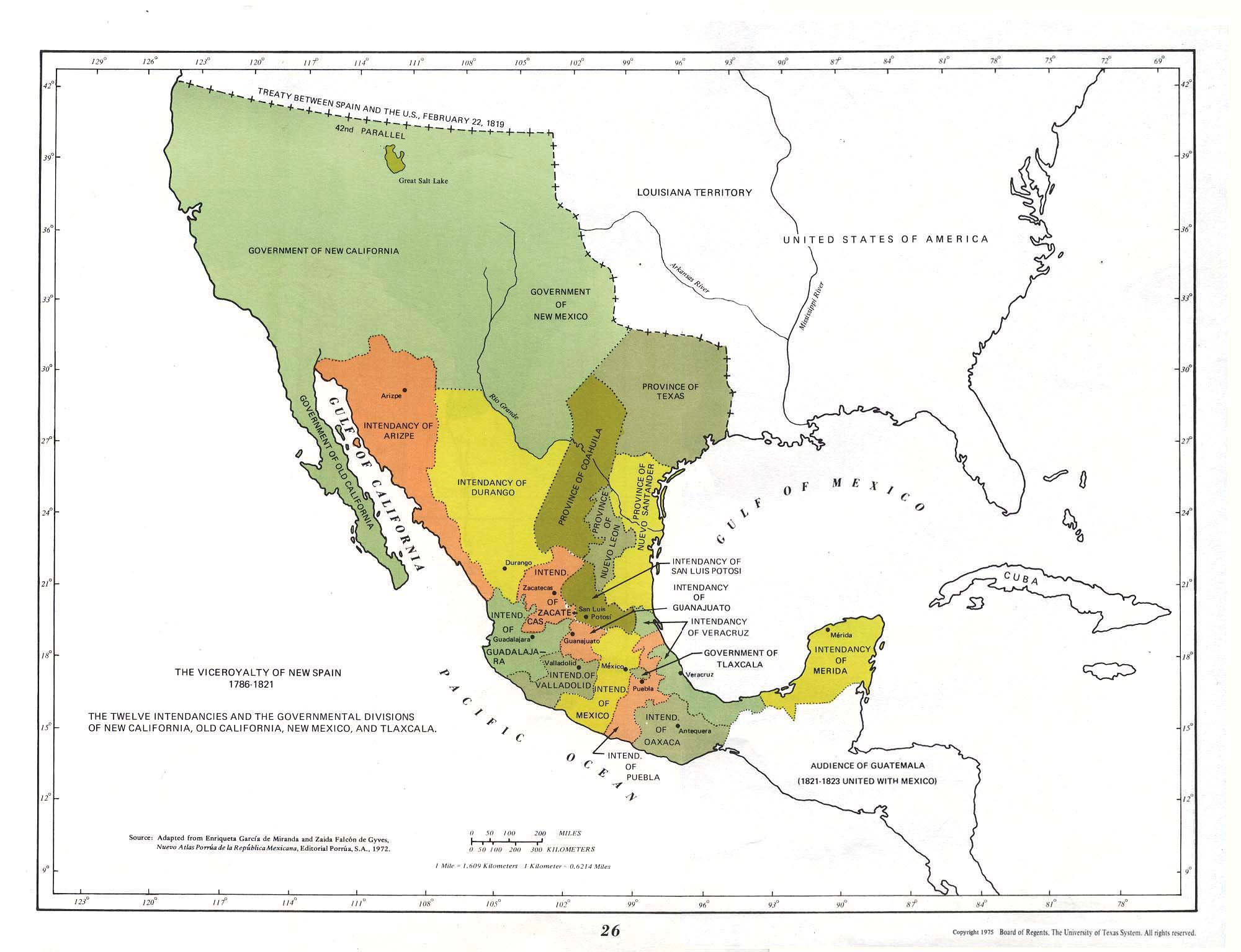
Spanish galleons transported Asian goods and travelers from Manila to colonial Mexico primarily through the port of Acapulco. During the two and a half centuries of contact between the Philippines and the Viceroyalty of New Spain, a minimum of 40,000 to 60,000 Asian immigrants would set foot in the “City of Kings,” while a figure double that amount (100,000) would be within the bounds of probability. From Acapulco they would gradually disperse to the far corners of the viceroyalty, from Loreto in Baja California to Mérida in Yucatan…. The majority, however, would eventually settle in two distinct zones: on the west coast in the districts of Guerrero, Jalisco, and Michoacán, and in the large, ethnically diverse municipalities of Mexico City and Puebla in the central valleys and the eastern port of Veracruz. The two zones were transversed by the most heavily traveled arteries that connected Acapulco to Mexico City (known colloquially as el camino de China) in the west; Veracruz with Puebla and Mexico City in the east; and several arterials linking the capital with Puerto Vallarta in the west and Guanajuato in the northwest.

For the most part, the chinos disembarked at Acapulco as sailors, slaves, and servants. Over the longue durée of Mexican-Asian cultural exchange, the largest contingent of Asians arrived as sailors on the galleons and smaller vessels (capitanas, pataches, and almirantes) that annually plied the long and perilous return voyage from Manila. The seamen were primarily Filipinos, Chinese mestizos (known in Manila as mestizos de Sangley), or ethnic Chinese from the fortified port of Cavite near Manila that served as the primary shipyard for Spaniards in the archipelago. In 1565, the first chino sailors from the islands of Cebu and Bohol arrived in Acapulco aboard Friar Andrés de Urdaneta’s trailblazing galleon, the San Pedro. During the late sixteenth century Iberian sailors constituted the majority of crewmen, but by the early 1600s Asians had surpassed them, accounting for 60–80 percent of the mariners from that time forward. A historical snapshot of galleon seafarers in the mid eighteenth century comes from a crew manifest of La Santissima Trinidad. In 1760, this vessel was manned by 370 sailors, consisting of 30 officers (Europeans or Mexican criollos), 40 artillerymen (27 chinos), 120 sailors (109 chinos), 100 “Spanish” cabin boys (96 chinos), and 80 “plain” cabin boys (78 chinos). In sum, 84 percent (310) of the crew were born and raised in Spain’s Asian colony, with 68 percent (250) hailing from the port of Cavite alone….

Along the Pacific coast, chino sojourners tended to congregate in the cities and pueblos of Acapulco, Coyuca, San Miguel, Zacatula, Tex pan, Zihuatenejo, Atoya, Navidad, and Colima. With the arrival of more ships from Manila, the number of sailors who either had no desire to return to the Philippines or were brought over as slaves married local Indian and mixed-race women increased. Consequently, a sizable population of chinos and their descendants made these cities and pueblos a popular destination for fellow Asians. Both freemen and slaves farmed rice (brought from the Philippines), corn, and cotton; tended cacao and coconut palm trees; fished in the seas and rivers; and transported people and goods to various ports along the coastline. Those who followed the royal highways to towns farther inland worked as muleteers or in the silver mines, haciendas, obrajes (textile workshops), or sugar mills….

Slaves and servants constituted the second largest group of Asian immigrants during the colonial era. Manila quickly became an important entrepôt for the commerce in human flesh during the first century of Spanish rule. The greater part were transported by Portuguese vessels from colonies and trading ports in Africa, India, the Malay peninsula, Japan, and China, although Chinese junks and Malay prahus also shipped large quantities to Manila. Non-Filipino slaves that fetched the highest price were from Timor, Ternate, Makassar, Burma, Ceylon, and India, because “the men are industrious and obliging, and many are good musicians; the women excellent seamstresses, cooks, and preparers of conserves, and are neat and clean in service.”…

The incorporation of Asian immigrants into the armed forces of New Spain represents another fascinating fragment of the chino mosaic from the colonial era. Similar to restrictions placed on other castas in Mexico, there were numerous prohibitions against Asians carrying weapons or riding horses….

The legion of similar antiweapons ordnances from the 1550s onward notwithstanding, from at least the 1590s free chinos not only were granted permission to carry weapons, but gradually incorporated into both the salaried companies of Españoles as well as local militias, especially those cities and towns along the Pacific coast. In several documents from the years 1591 and 1597, an “Indio Chino” from the silver mining town of Zultepec named Juan Alonzo, who earned his livelihood from buying and selling mules, was granted a license to ride a horse with a saddle and bridle and to carry a sword. A key determinant in this matter was his racial classification as a chino, since indios (unless they were elites) were forbidden such privileges….

Among the scores of Asian peoples that were widely defined as chinos, in the early decades of the 1600s Japanese converts were held in high esteem by Spaniards in the Philippines and New Spain for their bravery and loyalty. In 1603 and 1639 when Chinese residents in the Parián of Manila revolted against their Iberian overlords, Japanese swordsmen distinguished themselves in combat. Without their assistance, Sangleyes would surely have made the Philippines a colony of the Middle Kingdom. Thousands of Japanese converts, traders, and ronin made the Philippines their home prior to the closing of Cipango to Iberians in the 1630s. They lived in a suburb of Manila called Dilao, with a population estimated at 3,000 by 1624.

Thus it is not surprising that samurai converts were considered a more privileged subgroup of chinos in New Spain….

It is unclear exactly when chino militias were established on the west coast of New Spain. It is evident, however, that prior to 1729 Asian paramilitary units were routinely patrolling the regions adjacent to Acapulco. Tiburcio Anzalde, “captain of one of the militias of chinos and mulatos in the district of Atoya,” discussed the duties and obligations of militiamen in a 1746 document: repeated trips to Acapulco to deliver mail and other correspondences; to clear the roads (of bandits) while on patrol; and, most importantly, their heroic role in resisting the English pirate George Anson‘s invasion at the port of Zihuatenejo in 1741.

Leave a comment

Filed under Asia, China, economics, England, Japan, labor, Mexico, migration, Netherlands, Philippines, Portugal, Spain