Category Archives: Spain

Salonica Jewish Language Baggage

From Salonica, City of Ghosts: Christians, Muslims and Jews, 1430-1950, by Mark Mazower (Vintage, 2006), p. 51:

[Salonica’s Jews] worshipped in synagogues named after the old long-established homelands—Ispanya, Çeçilyan (Sicilian), Magrebi, Lizbon, Talyan (Italian), Otranto, Aragon, Katalan, Pulya, Evora Portukal and many others—which survived until the synagogues themselves perished in the fire of 1917. Their family names—Navarro, Cuenca, Algava—their games, curses and blessings, even their clothes, linked them with their past. They ate Pan d’Espanya (almond sponge cake) on holidays, rodanchas (pumpkin pastries), pastel de kwezo (cheese pie with sesame seed), fijones kon karne (beef and bean stew) and keftikes de poyo (chicken croquettes), and gave visitors dulce de muez verde (green walnut preserve). People munched pasatempo (dried melon seeds), took the vaporiko across the bay, or enjoyed the evening air on the varandado of their home. When Spanish scholars visited the city at the end of the nineteenth century, they were astonished to find a miniature Iberia alive and flourishing under Abdul Hamid.

For this, the primary conduit was language…. In Salonica there was a religious variant—Ladino—and a vernacular which was so identified with the Jews that it became known locally as “Jewish” (judezmo), and quickly became the language of secular learning and literature, business, science and medicine. Sacred and scholarly texts were translated into it from Hebrew, Arabic and Latin, because “this language is the most used among us.” In the docks, among the fishermen, in the market and the workshops the accents of Aragon, Galicia, Navarre and Castile crowded out Portuguese, Greek, Yiddish, Italian and Provençal. Eventually Castilian triumphed over the rest. “The Jews of Salonica and Constantinople, Alexandria, and Cairo, Venice and other commercial centres, use Spanish in their business. I know Jewish children in Salonica who speak Spanish as well as me if not better,” noted Gonsalvo de Illescas. The sailor Diego Galan, a native of Toledo, found that the city’s Jews “speak Castilian as fine and well-accented as in the imperial capital.” They were proud of their tongue—its flexibility and sweetness, so quick to bring the grandiloquent or bombastic down to earth with a ready diminutive.

Leave a comment

Filed under Greece, language, Mediterranean, migration, religion, Spain, Turkey

American Independence & Chinese Silver Imports

The June 2009 issue of Journal of World History has an enlightening bit of historical revisionism by Alejandra Irigoin entitled The End of a Silver Era: The Consequences of the Breakdown of the Spanish Peso Standard in China and the United States, 1780s–1850s (Project MUSE subscription required). Here are her conclusions (pp. 238-239).

This article argues for revision of traditional views of the global silver trade with China in the late eighteenth and early nineteenth centuries. Section I shows that the existing historiography tends to ignore that silver imports into China continued for longer than normally acknowledged and at increased levels up to the 1820s. New evidence shows that the structure of the silver trade changed substantially when US merchants became central intermediaries between Spanish American silver “producers” and Chinese “consumers,” when Chinese imports of silver consisted increasingly of Spanish American coins, the so-called pillar and bust dollars.

Section II explores the role of Americans as intermediaries who increased trade with Spanish America in order to obtain silver coins needed to trade with China. The timing of the flow of silver out of China to pay for opium purchases is challenged, as is opium as a cause for the desilverization of China. This article also questions received wisdom that reduction in the supply of silver owing to Spanish American independence was the root cause of silver scarcity in China in the early nineteenth century. This received wisdom ignores a fundamental fact: Spanish America itself was a significant reservoir of silver coins in the world. Thus, (relatively minor) interruptions in the production of silver—at different points in time and in distinct places—in South America during Independence were unlikely to account for supply shortages in China, and continued exports of silver into the United States confirm this view. Hence, the fall in Chinese silver imports must be a function of demand-side forces in addition to supply-side problems.

Spanish American independence presented a different problem to the global economy. The Spanish Empire broke up into a multitude of distinct states in the wake of independence, each fiscally and monetarily autonomous. In other words, the largest monetary union of the premodern world had collapsed. The resulting fragmentation of coinage and seigniorage across postindependent Spanish America terminated a silver standard that had organized international trade throughout the early modern world, East and West and in between. New republican governments, especially in regions with silver endowments, took over mint houses in the service of local and regional interests. Coins minted in various mint houses began to diverge in quality and fineness, whereupon the universal standard of the Spanish silver peso was definitively lost.

Section IV advances the central argument of this paper, namely that Chinese demand for silver, at least since the late eighteenth century, involved demand for a certified and reliable means of payment, as opposed to silver in some generic sense. “Good” colonial Spanish American coins traded at a premium over the sycee [ingot] equivalent, clearly confirming this point. Fragmentation of the Spanish monetary standard after independence had a devastating influence on Chinese demand. The impact of Spanish American independence on China’s economy operated through deterioration of coin quality, not through quantities of silver per se. By contrast, the United States used Spanish dollars as legal tender under the control of central monetary authorities, thereby succeeding in keeping new peso coins in circulation for a decade or more.

The end of the silver standard following independence in Spanish America during the 1810s and the 1820s had major consequences for development of the global economy before the gold standard. On one hand, termination of the silver era contributed to the poor economic performance of the Chinese economy. A lack of high-quality, reliable Spanish pesos between the 1820s and the 1850s, rather than insufficient silver mining, largely explains the fall in Chinese silver imports. Hence, I argue that the Chinese silver trade in these decades was demand-side rather than supply-side (mining) driven. Consequences for the internal market in China were manifold, including increased transaction costs, fragmentation of markets, and credit shortages. On the other hand, the United States reacted differently—and with a different timing—to termination of the silver standard. Immediate detrimental effects were weathered by workings of a well-integrated banking system, a quasi–monetary authority, and assay by the mint. Ultimately, this article poses an important comparative question for economic historians: in light of the US response, why did the Chinese empire never monopolize seigniorage, and why did it fail to provide reliable control of its currency system in the face of high costs for the domestic Chinese economy? Answers fall well beyond the scope of this article, of course, but the question should at least be framed in a global context.

Leave a comment

Filed under China, economics, Latin America, opium, Spain, U.S.

Pacific Annexations, 1840-1906

From Sailors and Traders: A Maritime History of the Pacific Peoples, by Alastair Couper (U. Hawai‘i Press, 2009), pp. 140-141:

The managers of the major merchant companies based at the main entrepôts in the [Pacific] islands were often ex-sailors. Several acted as consuls for their governments and supported the companies in many ways, including evoking gunboat diplomacy. A prime example is John Bates Thurston. He served at sea in the island trades, was wrecked at Rotuma in 1865, became British consul in Fiji in 1867, was highly influential in the negotiations for the ceding of Fiji to Britain in 1874, and became governor of Fiji in 1887. The companies, the new settlers, and their sympathetic consuls pressed for annexations. The French were the first to act [but Waitangi was 1840—J.] and took Tahiti, the Marquesas, and the Tuamotus as French protectorates in 1842 and New Caledonia in 1853. These were declared colonies in 1880, and the Australs and Wallis and Futuna in 1887.

The British annexed Fiji in 1874 and established protectorates over southeast New Guinea in 1884, Gilbert and Ellice in 1892, most of the Solomons soon after, and Ocean Island in 1900. They agreed that New Zealand would exercise authority over the Kermadecs in 1887, the Tokelaus in 1889, and the Cooks and Niue in 1901. The Dutch took western New Guinea in 1848. Germany annexed northeast New Guinea in 1885, along with the Bismarck Archipelago and the northwest Solomons; took possession of most of the Carolines in 1885; and ultimately purchased Yap and other islands in the Carolines and Marianas from Spain in 1899. The Germans also acquired the Marshall Islands in 1884 and took over Nauru in 1888. Chile obtained Easter Island in 1888.

America, after its disastrous Civil War, had not recovered a significant merchant fleet and showed little inclination for acquiring Pacific territory. American guano companies had already secured legislation in 1856–1860 that allowed claims over some small Pacific islands, and the US government went on to secure others, including Baker, Jarvis, Johnson, Midway, Palmyra, and Wake. In 1893 the influential American maritime geostrategist Alfred Mahan wrote that it was “imperative to take possession, when it can be righteously done, of such maritime positions as can contribute to secure command.” In 1898, Hawai‘i was annexed (US citizenships were granted in 1900), as was eastern Samoa with Pago Pago as a main naval coaling station, while Guam was captured from Spain by the US Navy in 1898.

The Pacific was now effectively divided between several colonial powers mainly by agreements. In the final carve-up, it was confirmed that Western Samoa was a German colony separated from American Samoa in the east. In turn Germany agreed to relinquish claims for Tonga. As a result, in the closing days Tonga appeared to survive as the only independent Polynesian kingdom, although not quite. It was declared a British protectorate in 1900, and in 1905 it was decreed mandatory for the king of Tonga to take advice from the British consul on all matters of importance. Finally, in 1906 New Hebrides was divided as a condominium between Britain and France.

I’m not sure why Couper omits the 1840 Treaty of Waitangi, which made British subjects of the Maori. Maybe he considered both New Zealand and Australia to be colonial powers by the 1840s, even though both were earlier annexed by another colonial power. (Like the Americas, of course.)

Leave a comment

Filed under Britain, Fiji, France, Germany, Hawai'i, Micronesia, Netherlands, New Zealand, Pacific, Papua New Guinea, Polynesia, Spain, U.S.

Asian Roles in New Spain

My favorite article in the latest issue of Journal of World History (on Project MUSE) is by Edward R. Slack Jr. on “The Chinos in New Spain: A Corrective Lens for a Distorted Image.” Here are a few excerpts (footnotes and references omitted).

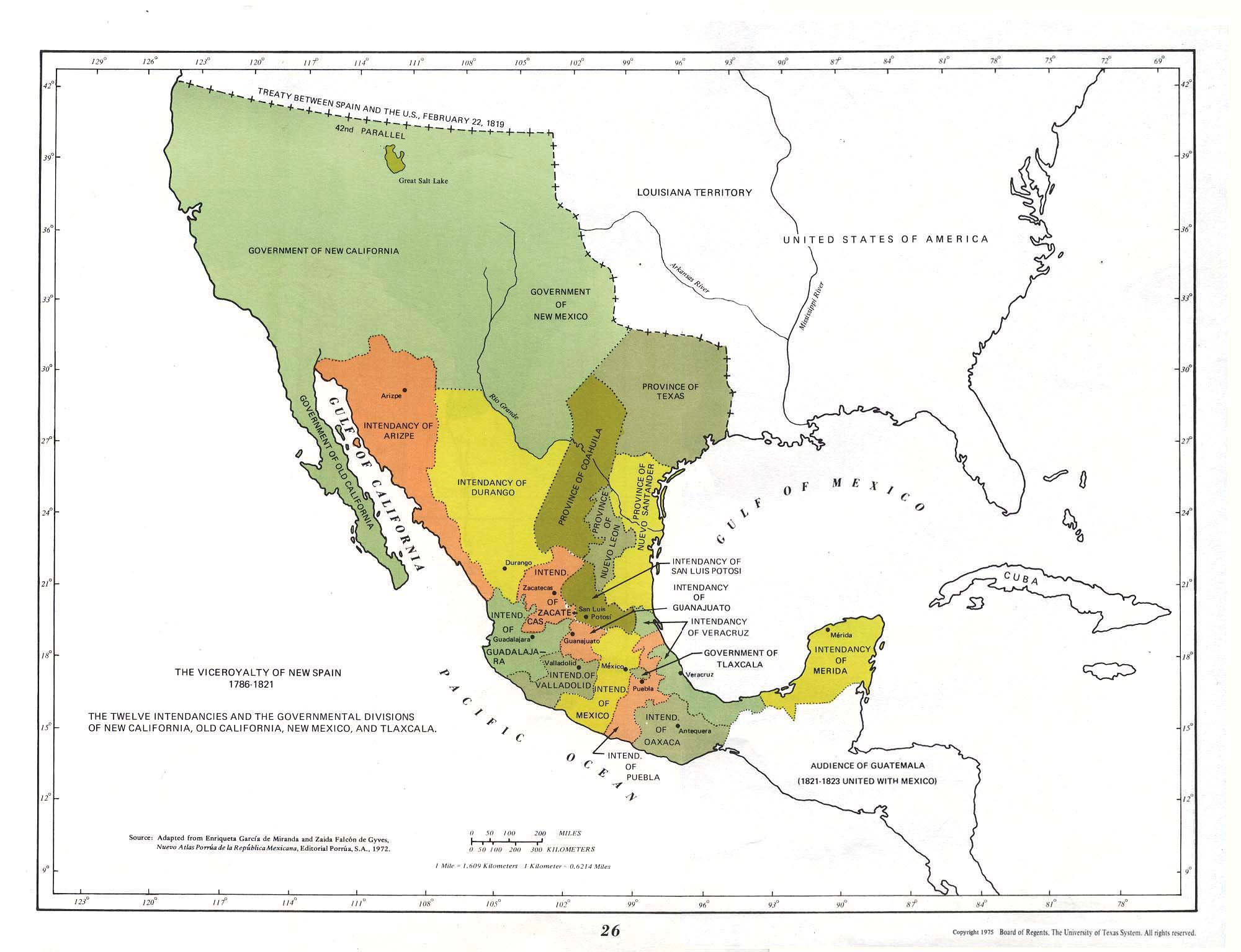
Spanish galleons transported Asian goods and travelers from Manila to colonial Mexico primarily through the port of Acapulco. During the two and a half centuries of contact between the Philippines and the Viceroyalty of New Spain, a minimum of 40,000 to 60,000 Asian immigrants would set foot in the “City of Kings,” while a figure double that amount (100,000) would be within the bounds of probability. From Acapulco they would gradually disperse to the far corners of the viceroyalty, from Loreto in Baja California to Mérida in Yucatan…. The majority, however, would eventually settle in two distinct zones: on the west coast in the districts of Guerrero, Jalisco, and Michoacán, and in the large, ethnically diverse municipalities of Mexico City and Puebla in the central valleys and the eastern port of Veracruz. The two zones were transversed by the most heavily traveled arteries that connected Acapulco to Mexico City (known colloquially as el camino de China) in the west; Veracruz with Puebla and Mexico City in the east; and several arterials linking the capital with Puerto Vallarta in the west and Guanajuato in the northwest.

For the most part, the chinos disembarked at Acapulco as sailors, slaves, and servants. Over the longue durée of Mexican-Asian cultural exchange, the largest contingent of Asians arrived as sailors on the galleons and smaller vessels (capitanas, pataches, and almirantes) that annually plied the long and perilous return voyage from Manila. The seamen were primarily Filipinos, Chinese mestizos (known in Manila as mestizos de Sangley), or ethnic Chinese from the fortified port of Cavite near Manila that served as the primary shipyard for Spaniards in the archipelago. In 1565, the first chino sailors from the islands of Cebu and Bohol arrived in Acapulco aboard Friar Andrés de Urdaneta’s trailblazing galleon, the San Pedro. During the late sixteenth century Iberian sailors constituted the majority of crewmen, but by the early 1600s Asians had surpassed them, accounting for 60–80 percent of the mariners from that time forward. A historical snapshot of galleon seafarers in the mid eighteenth century comes from a crew manifest of La Santissima Trinidad. In 1760, this vessel was manned by 370 sailors, consisting of 30 officers (Europeans or Mexican criollos), 40 artillerymen (27 chinos), 120 sailors (109 chinos), 100 “Spanish” cabin boys (96 chinos), and 80 “plain” cabin boys (78 chinos). In sum, 84 percent (310) of the crew were born and raised in Spain’s Asian colony, with 68 percent (250) hailing from the port of Cavite alone….

Along the Pacific coast, chino sojourners tended to congregate in the cities and pueblos of Acapulco, Coyuca, San Miguel, Zacatula, Tex pan, Zihuatenejo, Atoya, Navidad, and Colima. With the arrival of more ships from Manila, the number of sailors who either had no desire to return to the Philippines or were brought over as slaves married local Indian and mixed-race women increased. Consequently, a sizable population of chinos and their descendants made these cities and pueblos a popular destination for fellow Asians. Both freemen and slaves farmed rice (brought from the Philippines), corn, and cotton; tended cacao and coconut palm trees; fished in the seas and rivers; and transported people and goods to various ports along the coastline. Those who followed the royal highways to towns farther inland worked as muleteers or in the silver mines, haciendas, obrajes (textile workshops), or sugar mills….

Slaves and servants constituted the second largest group of Asian immigrants during the colonial era. Manila quickly became an important entrepôt for the commerce in human flesh during the first century of Spanish rule. The greater part were transported by Portuguese vessels from colonies and trading ports in Africa, India, the Malay peninsula, Japan, and China, although Chinese junks and Malay prahus also shipped large quantities to Manila. Non-Filipino slaves that fetched the highest price were from Timor, Ternate, Makassar, Burma, Ceylon, and India, because “the men are industrious and obliging, and many are good musicians; the women excellent seamstresses, cooks, and preparers of conserves, and are neat and clean in service.”…

The incorporation of Asian immigrants into the armed forces of New Spain represents another fascinating fragment of the chino mosaic from the colonial era. Similar to restrictions placed on other castas in Mexico, there were numerous prohibitions against Asians carrying weapons or riding horses….

The legion of similar antiweapons ordnances from the 1550s onward notwithstanding, from at least the 1590s free chinos not only were granted permission to carry weapons, but gradually incorporated into both the salaried companies of Españoles as well as local militias, especially those cities and towns along the Pacific coast. In several documents from the years 1591 and 1597, an “Indio Chino” from the silver mining town of Zultepec named Juan Alonzo, who earned his livelihood from buying and selling mules, was granted a license to ride a horse with a saddle and bridle and to carry a sword. A key determinant in this matter was his racial classification as a chino, since indios (unless they were elites) were forbidden such privileges….

Among the scores of Asian peoples that were widely defined as chinos, in the early decades of the 1600s Japanese converts were held in high esteem by Spaniards in the Philippines and New Spain for their bravery and loyalty. In 1603 and 1639 when Chinese residents in the Parián of Manila revolted against their Iberian overlords, Japanese swordsmen distinguished themselves in combat. Without their assistance, Sangleyes would surely have made the Philippines a colony of the Middle Kingdom. Thousands of Japanese converts, traders, and ronin made the Philippines their home prior to the closing of Cipango to Iberians in the 1630s. They lived in a suburb of Manila called Dilao, with a population estimated at 3,000 by 1624.

Thus it is not surprising that samurai converts were considered a more privileged subgroup of chinos in New Spain….

It is unclear exactly when chino militias were established on the west coast of New Spain. It is evident, however, that prior to 1729 Asian paramilitary units were routinely patrolling the regions adjacent to Acapulco. Tiburcio Anzalde, “captain of one of the militias of chinos and mulatos in the district of Atoya,” discussed the duties and obligations of militiamen in a 1746 document: repeated trips to Acapulco to deliver mail and other correspondences; to clear the roads (of bandits) while on patrol; and, most importantly, their heroic role in resisting the English pirate George Anson‘s invasion at the port of Zihuatenejo in 1741.

Leave a comment

Filed under Asia, China, economics, England, Japan, labor, Mexico, migration, Netherlands, Philippines, Portugal, Spain

Ferguson on the Appeal of Fascism vs. Nazism

From The War of the World: Twentieth-Century Conflict and the Descent of the West, by Niall Ferguson (Penguin Press, 2006), pp. 230-231, 239-240:

Considering the emphasis the new dictatorships laid on their supposedly distinctive nationalistic traditions, they all looked remarkably alike: the coloured shirts [German Brownshirts, Italian Blackshirts, Irish Blueshirts, Romanian Greenshirts], the shiny boots, the martial music, the strutting leaders, the gangster violence. At first sight, then, there was little to distinguish the German version of dictatorship from all the rest – except perhaps that Hitler was marginally more absurd than his counterparts. As late as 1939, Adolf Hitler could still be portrayed by Charlie Chaplin in his film The Great Dictator as an essentially comic figure, bawling incomprehensible speeches, striking preposterous poses and frolicking with a large inflatable globe. Yet there were in reality profound differences between National Socialism and fascism. Nearly all the dictatorships of the inter-war period were at root conservative, if not downright reactionary. The social foundations of their power were what remained of the pre-industrial ancien régime: the monarchy, the aristocracy, the officer corps and the Church, supported to varying degrees by industrialists fearful of socialism and by frivolous intellectuals who were bored of democracy’s messy compromises.* The main function the dictators performed was to crush the Left: to break their strikes, prohibit their parties, deny voice to their voters, arrest and, if it was deemed necessary, kill their leaders. One of the few measures they took that went beyond simple social restoration was to introduce new ‘corporate’ institutions supposed to regiment economic life and protect loyal supporters from the vagaries of the market. In 1924 the French historian Elie Halevy nicely characterized fascist Italy as ‘the land of tyranny … a regime extremely agreeable for travellers, where trains arrive and leave on time, where there is no strike in ports or public transport’. ‘The bourgeois’, he added, ‘are beaming.’ It was, as Renzo De Felice said in his vast and apologetic biography of the Duce, ‘the old regime in a black shirt’….

Contrary to the old claims that it was the party of the countryside, or of the north, or of the middle class, the NSDAP attracted votes right across Germany and right across the social spectrum…. It is true that places with relatively high Nazi votes were more likely to be in central northern and eastern parts, and those with relatively low Nazi votes were more likely to be in the south and west. But the more important point is that the Nazis were able to achieve some electoral success in nearly any kind of local political milieu, covering the German electoral spectrum in a way not seen before or since. The Nazi vote did not vary proportionately with the unemployment rate or the share of workers in the population. As many as two-fifths of the Nazi voters in some districts were working class, to the consternation of the Communist leadership. In response, some local Communists openly made common cause with the Nazis. ‘Oh yes, we admit that we’re in league with the National Socialists,’ said one Communist leader in Saxony. ‘Bolshevism and Fascism share a common goal: the destruction of capitalism and of the Social Democratic Party. To achieve this aim we are justified in using every means.’ It was a mark of Goebbels’ skill in making the party seem all things to all men that, simultaneously, dyed-in-the-wool Prussian Conservatives could regard the Nazis as potential partners in an anti-Marxist coalition. Thus were political rivals lured into what proved to be fatal forms of cooperation. The only significant constraint on the growth of the Nazi vote was the comparatively greater resilience of the Catholic Centre party compared with parties hitherto supported by German Protestants.

Other fascist movements, as we have seen, depended heavily on elite sponsorship to gain power. The Nazis did not need to. For all the attention that has been paid to them, the machinations of the coterie around Hindenburg were not the decisive factor, as those of the Italian elites had been in 1922. If anything, they delayed Hitler’s appointment as Chancellor, an office that was rightfully his after the July 1932 election. It was not the traditional elite of landed property that was drawn to Hitler; the real Junker types found him horribly coarse. (When Hitler shook hands with Hindenburg, one conservative was reminded ‘of a headwaiter closing his hand around the tip’.) Nor was it the business elite, who not unreasonably feared that National Socialism would prove a Trojan horse for socialism proper; nor the military elite, who had every reason to dread subordination to an opinionated Austrian corporal. The key to the strength and dynamism of the Third Reich was Hitler’s appeal to the much more numerous intellectual elite; the men with university degrees who are so vital to the smooth running of a modern state and civil society.

For reasons that may be traced back to the foundation of the Bismarckian Reich or perhaps even further into Prussian history, academically educated Germans were unusually ready to prostrate themselves before a charismatic leader.

(*A list of all the treasonous clerics who flirted or did more than flirt with fascism would be a book in its own right. If only to give an illustration of how widespread the phenomenon was, dishonourable mention may be made of the writer Gabriele D’Annunzio, who established his own tinpot tyranny in post-war Fiume; the poet T. S. Eliot, who wrote that ‘totalitarianism can retain the terms “freedom” and “democracy” and give them its own meaning’; the philosopher Martin Heidegger, who, as Rector of Freiburg University, lent his enthusiastic support to the Nazi regime; the political theorist Carl Schmitt, who devised pseudo-legal justifications for the illegalities of the Third Reich; the novelist Ignazio Silone, who shopped former Communist comrades to the fascists; and the poet W. B. Yeats, who wrote songs for the Irish Blueshirts. Thomas Mann, who had made his fair share of mistakes during the First World War and only with difficulty broke publicly with the Nazi regime, was not wrong when he spoke of ‘the thoroughly guilty stratum of intellectuals’.)

Leave a comment

Filed under Austria, democracy, economics, education, France, Germany, Ireland, Italy, nationalism, Portugal, Romania, Spain

Inciting Backlash in Spain, 1931

From: Sacred Causes: The Clash of Religion and Politics, From the Great War to the War on Terror, by Michael Burleigh (HarperCollins, 2007), pp. 128-129:

The newly elected left-Republican and Socialist coalition in June 1931 further provoked the religious with controversial articles in the new Constitution, Spain’s first experiment in democracy. This went much further than a legal separation of Church and state. It extruded the Church from education, restricted its property rights and investments, and dissolved the Jesuits, who played a role in liberal and leftist mythology equivalent to that of freemasons, Jews and Marxists in the demonology of their opponents. This last measure was a bitter pill to swallow in the homeland of St Ignatius Loyola. Civil marriage and divorce were legalised, while the agreement of the authorities was henceforth necessary for any public celebration of religion – another indigestible measure in a society where religious processions were a highly developed art form. A supplementary law in 1933 nationalised all Church property, including secularising the cemeteries by putting them under local authority control and dismantling the walls which separated the dead religious from their non-believing fellows. Having nationalised Church property, thereby ignoring the wishes of those who had donated it, the government then taxed the clergy who used it. Measures against Church charities simply hurt poor people. The government also closed all religious schools, which since they educated 20 per cent of Spanish children, and were not replaced by secular alternatives, sat oddly with the Republic’s expansion of education.

Although these measures were implemented with varying local intensities, there can be no doubt that preventing the ringing of church bells, removing religious symbols from classrooms, and bureaucratising the procedures for those wanting religious funerals grievously irked many Catholics. Officious insistence that dying people fill out forms to get the send-off they wanted failed to charm their friends and relatives. These measures were condemned by Pius XI in the forceful 3 June 1933 encyclical Dilectissima nobis, which, while carefully professing indifference to forms of government, stressed the hypocrisy of these measures in terms of ‘those declared principles of civil liberty on which the new Spanish regime declares it bases itself’. These laws were the product of ‘a hatred against the Lord and His Christ nourished by groups subversive to any religious and social order, as alas we have seen in Mexico and Russia’. Republican Spain had become part of a ‘terribile triangolo’ whose object was the eradication of religion. Anticlericals in the Cortes responded in kind, with snide remarks about the ‘Mercantile Society of Jesus’, while the Socialist leader Azaña crowed that with these 1931–3 measures Spain had ceased to be Catholic.

Of course, things had been tending that way far longer than the wave of measures introduced in 1931–3 may suggest. In 1881 the Churches had lost control of the universities. In 1901 religion had become optional within the curriculum leading to the school leavers’ certificate. In 1913 non-Catholic parents could exempt their children from religious instruction. With a few exceptions, the arts and intelligentsia were dominated by secular-minded people. The Catholic presence among the urban working class and the southern rural poor was also exiguous. In 1935 a Jesuit calculated that, taking the eighty thousand parishioners of a Madrid working-class suburb, 7 per cent attended mass on Sundays; 90 per cent died without the benefit of the sacraments; 25 per cent of children were unbaptised; and of couples marrying, 40 per cent could not recite the Lord’s Prayer. Similar levels of indifference and ignorance were revealed in studies of Bilbao and Barcelona. The Church was also like an alien presence in the villages of Andalucia, with anarchist and Socialist activists converting peasant indifference or quasi-pagan superstition into outright hostility. Churches were falling into disrepair, when they even existed, and priests were poorly paid with government stipends equivalent to the lowest grade of janitors. The priesthood was not an attractive career option, with recruitment for seminaries falling by 40 per cent between 1931 and 1934.

Is the lash or the backlash the driving force of history? Who was the Prime Lasher?

1 Comment

Filed under democracy, religion, Spain

On the Origins of Stalin’s Great Terror

From The Whisperers: Private Lives in Stalin’s Russia, by Orlando Figes (Metropolitan, 2007), pp. 234-236:

Extraordinary even by the standards of the Stalinist regime, the Great Terror was not a routine wave of mass arrests, such as those that swept across the country throughout Stalin’s reign, but a calculated policy of mass murder. No longer satisfied with imprisoning his real or imagined ‘political enemies’, Stalin now ordered the police to take people out of the prisons and labour camps and murder them. In the two years of 1937 and 1938, according to incomplete statistics, a staggering total of at least 681,692 people, and probably far more, were shot for ‘crimes against the state’ (91 per cent of all death sentences for political crimes between 1921 and 1940, if NKVD figures are to be believed). The population of the Gulag labour camps and colonies grew in these same years from 1,196,369 to 1,881,570 people (a figure which excludes at least 140,000 deaths within the camps themselves and an unknown number of deaths during transport to the camps). Other periods of Soviet history had also seen mass arrests of ‘enemies’, but never had so many of the victims been killed. More than half the people arrested during the Great Terror were later shot, compared to less than 10 per cent of arrests in 1930, the second highest peak of executions in the Stalin period, when 20,201 death sentences were carried out. During the ‘anti-kulak operation’ of 1929-32, the number of arrests was also very high (586,904), but of these victims only 6 per cent (35,689 people) were subsequently shot.

The origins of the Great Terror are not easy to explain. Nor is it immediately clear why it was so concentrated in these two years. To begin to understand it, we must look at the Great Terror not as an uncontrolled or accidental happening, a product of the chaos of the Stalinist regime that could have erupted at almost any time – a view occasionally put forward – but as an operation masterminded and controlled by Stalin in response to the specific circumstances he perceived in 1937….

The key to understanding the Great Terror as a whole lies perhaps in Stalin’s fear of an approaching war and his perception of an international threat to the Soviet Union. The military aggression of Hitler’s Germany, signalled by its occupation of the Rhineland in 1936, and the occupation of Manchuria by the Japanese, convinced Stalin that the USSR was endangered by the Axis powers on two fronts. Stalin’s fears were reinforced in November 1936, when Berlin and Tokyo united in a pact (later joined by Fascist Italy) against the Comintern. Despite his continuing support of ‘collective security’, Stalin did not place much hope in the Soviet alliance with the Western powers to contain the Axis threat: the Western states had failed to intervene in Spain; they appeared committed to the appeasement of Nazi Germany; and they reportedly gave Stalin the impression that it was their hidden aim to divert Hitler’s forces to the East and engage them in a war with the USSR rather than confront them in the West. By 1937, Stalin was convinced that the Soviet Union was on the brink of war with the Fascist states in Europe and with Japan in the East. The Soviet press typically portrayed the country as threatened on all sides and undermined by Fascist infiltrators – ‘spies’ and ‘hidden enemies’ – in every corner of society.

‘Our enemies from the capitalist circles are tireless. They infiltrate everywhere,’ Stalin told the writer Romain Rolland in 1935. Stalin’s view of politics – like many Bolsheviks’ – had been profoundly shaped by the lessons of the First World War, when the tsarist regime was brought down by social revolution in the rear. He feared a similar reaction against the Soviet regime in the event of war with Nazi Germany. The Spanish Civil War reinforced his fears on this account. Stalin took a close interest in the Spanish conflict, seeing it (as did most of his advisers) as a ‘valid scenario for a future European war’ between Communism and Fascism. Stalin put the military defeats of the Republicans in 1936 down to the factional infighting between the Spanish Communists, the Trotskyists, the Anarchists and other left-wing groups. It led him to conclude that in the Soviet Union political repression was urgently required to crush not just a ‘fifth column’ of ‘Fascist spies and enemies’ but all potential opposition before the outbreak of a war with the Fascists.

Leave a comment

Filed under Germany, Italy, Japan, Russia, Spain, USSR, war

First Catholic Church in Qatar

The first Catholic church, Our Lady of the Rosary, has opened its doors in Qatar, but lacks any external signs of being a church.

“The cross should not be raised in the sky of Qatar, nor should bells toll in Doha,” wrote Lahdan bin Issa al-Muhanada, a leading columnist in Doha’s Al-Arab newspaper.

But Abdul Hamid al-Ansari, the former dean of the Islamic law school at Qatar University, disagrees. He wrote that having “places of worship for various religions is a fundamental human right guaranteed by Islam.”…

In Doha, the call to build a Catholic church has grown as waves of migrant workers from South Asia and the Philippines arrived in the Gulf, answering the call for cheap labor to fuel the region’s runaway economy.

But the Christian immigrants have sometimes collided with the native Qatari population, which practices Wahhabism, a strict interpretation of Islam.

Native Qataris account for only 200,000 of the country’s population of 900,000.

The Vatican estimates there are 100,000 practicing Catholics in Qatar. They attended underground services until seven years ago, when Sheikh Hamad bin Khalifa al-Thani, the country’s current ruler, granted permission to five denominations to open churches.

I’m old enough to remember when new Protestant churches in Franco’s Spain were prohibited from displaying the usual church architecture, opening schools, or evangelizing in public.

Nowadays there’s a big shortage of mosques in Spain.

via Belmont Club

Leave a comment

Filed under Middle East, migration, Philippines, religion, Spain

Telefomin, Barcelona, and Bulmer’s Fruit Bat

From Throwim Way Leg: Tree-Kangaroos, Possums, and Penis Gourds—On the Track of Unknown Mammals in Wildest New Guinea, by Tim Flannery (Atlantic Monthly Press, 1998), pp. 153-154 (NYT book review here):

Afektaman is a pretty little village overlooking the range which lies to the south of Telefomin. It is situated at the entrance to the Sepik Gorge, and is only about thirty kilometres in a straight line from Luplupwintem, which had been, until 1977, the sole roosting place of Bulmer’s Fruit-bat.

On our arrival at Afektaman we immediately asked whether anyone called Woflayo lived there—and were led straight away, so easily, to a man of late middle-age who lived in a tiny collection of huts a kilometre or so from the village itself.

Woflayo invited us into his house, and offered us a cup of tea. As we talked, it became clear that Woflayo’s Pidgin was rather limited. He was a conservative Telefol who clung fiercely to his traditions. He did not deign to learn the new lingua franca.

After we had explained the purpose of our visit, Woflayo commented that it was a good thing we had arrived that day, for later in the week he was leaving for Batalona. I was at first nonplussed as to where exactly Woflayo might be going. Batalona did not sound like any Telefol place name I had heard. After some more discussion it became apparent that Woflayo was off on a very long trip indeed. He was headed for Barcelona, where he would lead a Telefol dance troupe as part of the 1992 Olympic Games celebrations!

Woflayo’s careful observance of tradition had clearly paid off. Of all Telefol, he was renowned as the one who knew the ancient dances best, and was thus the natural choice as leader of the troupe. What, I often wonder, did the good citizens of Barcelona make of Woflayo, bedecked in penis gourd, cane waistband and feathered head-dress, chanting and swaying to his Telefol rhythms?

After we drank our tea, Woflayo took us to a garden at the back of his hut. There, he showed us the stump of a small fig tree. It was in this tiup tree, he said, that he had shot the bat which he had sold to ‘Masta Steve’ [Van Dyke of the Queensland Museum] in 1984.

I was flattened. What an anticlimactic end to a journey which had begun with such excitement months ago and thousands of kilometres away!

A bat which Woflayo had shot in his back yard and thought nothing of had brought strangers to his door from another continent… And in a few days, he would dance to a crowd of tens of thousands on a continent as foreign to him as the far side of the moon.

Leave a comment

Filed under Australia, Papua New Guinea, science, Spain

Hogs, Ham, and (U.S.) History

Virginia hams hold a hallowed place in the culinary lore of my hard-eating heritage. During my childhood as a missionary kid in Japan, we would receive a smoked ham every Christmas from relatives back in Virginia and stretch out the eating of it as long as we could. The current issue of Common-Place now puts Virginia hams in fuller historical perspective in a fascinating article by David S. Shields entitled “The Search for the Cure: The quest for the superlative American ham“:

No food in colonial Anglo-America declared gustatory adequacy at the world table more forcefully than ham. Travelers to the English territories, such as Rev. Andrew Burnaby, declared American pork superior in flavor to any in the world. With the establishment of the republic, the ingenuity of a population of artisanal food producers fixed upon improving the most estimable of American products, ham. Eminence in the sociable world of the agricultural societies, distinction in the market place, and victory in the food contests at the burgeoning world of fairs stimulated innovation in the curing of hams. Here we will chronicle the articulation of two schools of ham production: the dry-cure sect, who would increasingly view themselves as purists and traditionalists, and the wet curists, who regarded themselves as experimentalists in taste, economy, and scientific agriculture, yet whose pork brined in a barrel was the staple of the common household.

Antiquity conveyed the ur-cure, the primordial method of preserving meat. Salting and drying meat prevented the decomposition of flesh because moisture is a requisite for most bacterial reproduction and salt (sodium chloride) draws moisture from flesh. Unfortunately, sweating meat in rock salt turned muscle tissue gray and tough. It was discovered, however, that certain types of rock salt—salt with impurities—kept meat red and somewhat moist. This impure form of salt—called saltpeter—was sought out and admixed with salt for meat preservation until the Middle Ages when smoking was added to salt and saltpeter to impart flavor and to counter insect depredations. The method practiced by Europeans at the time of the settlement of Jamestown—common to Westphalian ham and Jamon de Iberica—was the “three s method”: salt, saltpeter, smoke.

Ham modernity dates from the erection of what Wolfgang Shivelbusch has called the first global drug culture—the oceanic trading system that made the exchange of sugar, spice, tea, coffee, and chocolate the engine of the world system. Only after the explosion of the world sugar supply occasioned by the consolidation of the Brazilian cane plantations in the sixteenth century was the commodity cheap enough for trial and error in the kitchen and smokehouse. Indeed, there was decidedly a sugar moment in Western cuisine, when sucrose was added to everything as the pangustatory element. When added as the fourth s to the ancient cure, sugar mellowed the harshness of salted flesh. Sugar-cured hams became the bedrock of American porcine cuisine….

Ever since Hernando DeSoto brought his thirteen hogs into Florida, swine have flourished in North America. The earliest breeds did not resemble today’s industrial pink pig. Indeed, the first settled hogs, the Iberico Black hog, the Old English breed, do not resemble their breed descendents, the Spanish Black and the Hampshire. Of these early types there is only one extraordinarily rare example left in America: the Ossabaw Island pig, a mottled descendent of the pigs that Spaniards loosed on the islands of the Caribbean and along the southeastern coast. One population survived into the twenty-first century on Ossabaw Island off the coast of Georgia. Slow-growing, irritable, and the most efficient fat-producing mammal known to science, the breed has become the fascination of biologists working on obesity studies….

Testimonies about the quality of New World ham date from 1688 when Rev. John Clayton, reporting to the Royal Society his observations on the commodities of Virginia, declared the meat as good as any to be had in Westphalia. This is a far more informative claim than it might appear on the surface, for it reveals much about the mode of preparation. Traditional Westphalian ham is made from hogs fattened with acorns from the oak forests of western Germany and then dry cured and smoked over a cold fire of beechwood and juniper boughs. The original Virginia ham derived its flavor from an acorn mast and dry curing. It was smoked. This is worth noting because during the eighteenth century there would be disagreement about the proper feeding of pigs and a related alteration in the method of curing….

William Byrd (1674-1744), the Virginia gentleman who championed an ethic of agricultural improvement, criticized the habit among country farmers (typified, for him, by the lazy North Carolinians described in his Histories of the Dividing Line) of letting hogs roam free in the forests to graze on roots and acorns. The semi-wild hog developed stringy muscle from its robust wandering life, and the farmer lost the benefit of its manure. Byrd would keep his pigs penned and fed on dung heap scraps. But with this diet, the meat of his animals, while more tender, risked becoming less palatable. What mattered more, taste or economy?… Feeding hogs on corn was pioneered in Pennsylvania at the end of the eighteenth century. In Virginia, where the taste of the mast-fed pig haunted the gustatory imagination, traditionalists followed the old country practice of letting swine loose in the woods. The practice continued until the early twentieth century when peanut mast was found to instill in pork something like that piquant yet mellow flavor infused by acorns….

Saltpeter, while essential for the preservation of hams, proved equally if not more important as an ingredient of gunpowder. In June 1642 the General Court of Massachusetts ordered every town to erect a shed and “make saltpeter from urine of men, beastes, goates, hennes, hogs and horses dung.”…

Putting chilled, freshly butchered hams in salt was the only part of the process that did not suffer alteration in any of the schools of dry-cure preparation. European tradition usually had the slaughter of winter meat occur on St. Martinmass Day, November 11. But because of the importance of cool weather in the curing of hams, it took place substantially later in the American South: December in Virginia; January in the Carolinas. The fresh-butchered meat had to be cooled to about forty degrees Fahrenheit when salting was begun. Traditionalists would follow salting with the other two s‘s of the “dry cure”: saltpeter and smoke. The proportions varied, but J. Q. Hewlitt’s formula of one thousand pounds of meat, three pecks of Liverpool salt, and four pounds of saltpeter presented a norm. The hams were packed in tubs or casks. These were often perforated to allow liquid to drip out during the minimum of three weeks sitting. At the end of the salting period, during which fresh salt was often added to the tubs, the ham would be extracted and the salt coating washed off. Hewlitt then smoked the hams in a closed room using green hickory chips. It was important that the smoke be cool, so as not to cook the hams. Temperature in the smokehouse was not to exceed human body temperature. At the end of February the hams would be sewn up in bags for protection.

And that’s how they were shipped to us in Japan. We had to soak each ham about 24 hours before cooking and eating any of it.

via Arts & Letters Daily

Leave a comment

Filed under family, Germany, Spain, U.S., Virginia