Category Archives: religion

Wordcatcher Tales: Banrei-setsu, Bangu-setsu

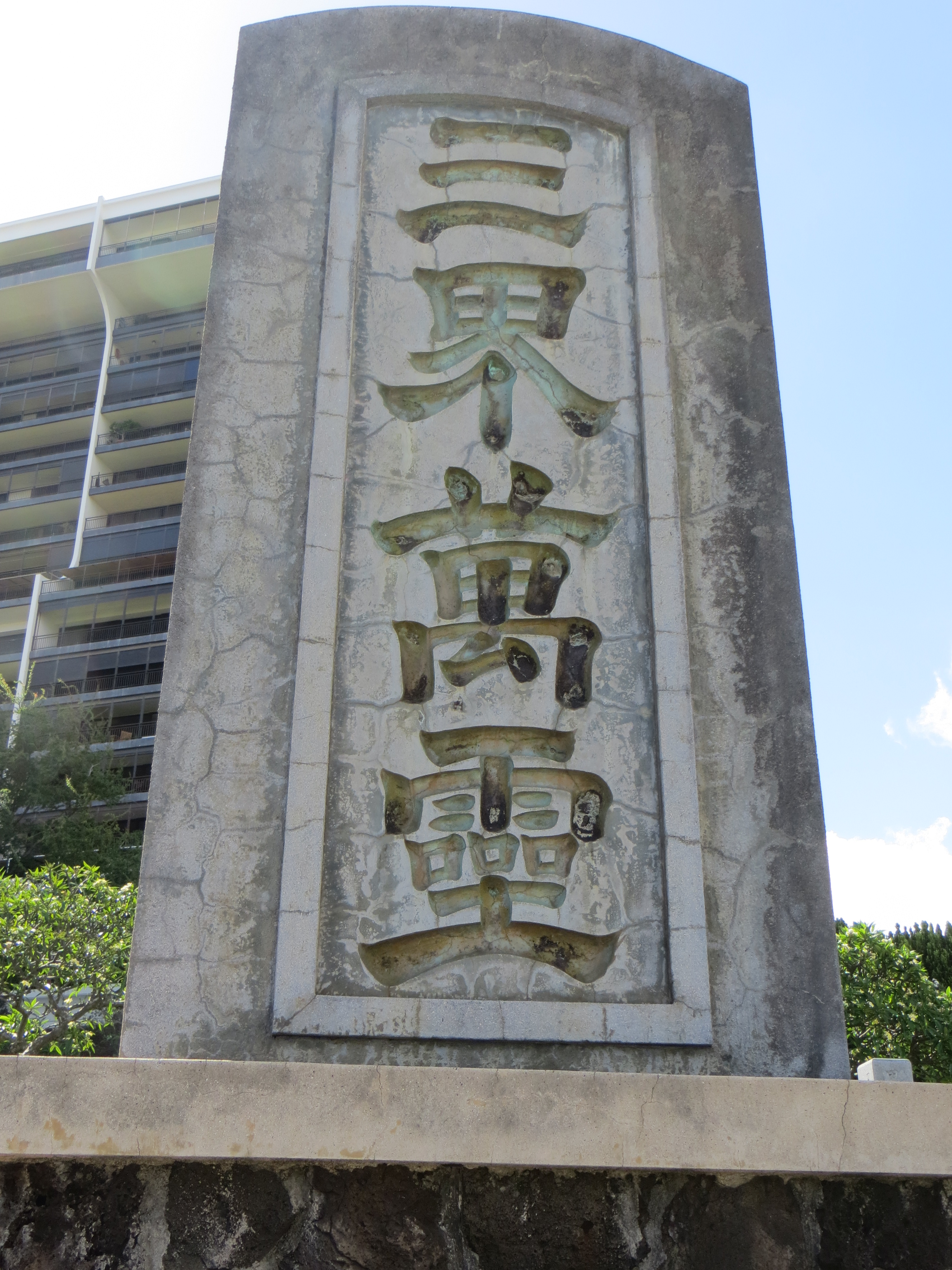
sangaibanreiWhile exploring Makiki Cemetery in Honolulu, I came across a 三界萬靈碑 sangai banrei hi, that is, a stone monument (碑 hi, or tateishi ‘standing stone’) inscribed with 三界萬霊 sangai banrei (3-worlds 10,000-souls), which retired University of Hawai‘i religion professor George Tanabe nicely explained to a former student of his for an article in Hana Hou! magazine (vol. 8, no. 1, February/March 2005, p. 5):

“One of the worst things that can happen to the dead in Japanese Buddhism is to be uncared for,” George says, looking at the weeds, “so these people are in real trouble.” But towering over the other tombstones stands a large stone George calls a sangai banrei. “It’s put up in commemoration of the 10,000 spirits of the three worlds: past, present and future,” he explains, my Buddhism teacher come to life again. “It’s nobody’s grave but it’s everybody’s grave, so even if individual graves are abandoned, there’s always the big one to take care of everybody.”

The kanji meaning ‘10,000, myriad‘ occurs in “10,000” expressions, like the following two, new to me:

萬霊節 banrei-setsu (10,000-spirit-season) ‘All Souls Day’
萬愚節 bangu-setsu (10,000-folly-season) ‘April Fools Day’

Leave a comment

Filed under Buddhism, Japan, language, migration

Japanese Slaughter of PNG Civilians, 1943

From Target: Rabaul: The Allied Siege of Japan’s Most Infamous Stronghold, March 1943–August 1945, by Bruce Gamble (Zenith, 2013) Kindle Loc. 925-960:

AMONG THE DOZENS of church-based missions in New Guinea, some of the oldest were German organizations established before World War I, when New Guinea was a territory of Imperial Germany. During World War II, Japanese forces in New Guinea did not regard German missionaries as allies, even though Nazi Germany and Japan shared a military allegiance. Instead, missionaries came under the jurisdiction of the minsei-bu as neutral civilians. Soon after the Japanese occupied Wewak, they rounded up the local missionaries and transported them to Saint John’s Catholic mission on Kairiru. At first the civilians were free to move about the island, but the situation soon changed.

Some missionaries and natives were willing to risk their lives for the Allied cause. At least two clergymen, Father Manion and Brother Victor Salois, members of the Society of the Divine Word, were American citizens. According to postwar testimonies, the Japanese discovered that several downed Allied airmen were not only hiding in the region, but had contacted the mission with the help of “local people who harbored anti-Japanese sentiment.” Mot’s visit to Kairiru fits this description precisely, and the timing of his trip is more than coincidental.

On the morning of March 17, a few days after the Japanese patrol failed to find the Americans on Wokeo, forty-two civilian men, women, and children were rounded up at Saint John’s and escorted to the destroyer Akikaze, anchored at Kairiru. Included among the mission staff were the two Americans; there were also Chinese nationals, at least one native girl, and two Chinese infants, thought to be orphans. All were treated as neutral civilians aboard Akikaze, which sailed from Kairiru at noon. Late that afternoon the warship stopped at Manus in the Admiralty Islands, where another twenty civilians boarded—again mostly European missionaries, including six women. The next day, Akikaze arrived in Kavieng Harbor, New Ireland, stopping only long enough to receive a message delivered by boat. Akikaze then steamed south, navigating a maze of small islands until it reached the Bismarck Sea. Once safely in open water, the warship headed toward its Eighth Fleet base at Rabaul.

Akikaze’s captain, Lt. Cmdr. Tsurukichi Sabe, evidently presumed he would deliver the civilians to New Britain. Several hundred missionaries and associates were already interned at Vunapope, the largest Catholic mission in the territory. But the message delivered at Kavieng rattled him. With a pale, somber expression, Sabe gathered his officers and informed them that Eighth Fleet Headquarters had issued orders “to dispose of all neutral civilians on board.”

No one would dare question the order. In the Japanese military, instructions from a superior were regarded as though issued by the Emperor himself.

Sabe directed his crew to carry out the orders. First, the civilians were moved to forward berthing spaces below the main deck. Then, within about an hour, a wooden rig was erected over the ship’s fantail. It consisted of a platform covered with mats and a simple hoisting structure. Canvas screens were spread amidships to keep the civilians from viewing the aft third of the ship.

When the preparations were complete, Akikaze throttled up to her maximum speed of twenty-four knots (approximately twenty-seven miles per hour). One at a time, beginning with the men, the civilians were escorted to the bridge. After an interpreter recorded each individual’s name and nationality, they were led aft. Suddenly, they were seized, blindfolded, and bound at the wrists. With no time to comprehend what was happening, they were led onto the platform, attached to the overhead rig, and then hoisted into the air.

At a signal from a junior officer on a nearby gun platform, each victim was shot by four crewmen: one armed with a light machine gun, the other three with rifles. The rig was designed so that the force of the wind from the destroyer’s high speed, together with the impact of the bullets, would swing the victims beyond the platform, where their bodies were released into the churning wake. In theory, at least, this would minimize the amount of gore that collected on the deck. It was also surmised that the sound of gunfire would not carry forward against the wind, thereby reducing psychological stress on the civilians.

The process dragged on for three hours as sixty individuals—priests, friars, nuns, staff, and family members—were systematically hauled into the air, riddled with gunfire, and dumped off the fantail. The two infants were simply thrown into the sea. Afterward, sailors unrigged the platform and hosed the bloodstains off Akikaze’s steel deck. Finally, the officers conducted a funeral ceremony for the souls of the dozens of Christians they had just murdered—almost certainly with a Shinto ritual. Perhaps that, too, was in response to orders.

Leave a comment

Filed under Australia, Germany, Japan, military, Papua New Guinea, religion, U.S., war

New Arab Kingdoms after 1919

From Lawrence in Arabia: War, Deceit, Imperial Folly and the Making of the Modern Middle East, by Scott Anderson (Doubleday, 2013), Kindle Loc. 10019-10072:

It’s hard to imagine that any of this [alternative history] could possibly have produced a sadder history than what has actually transpired over the past century, a catalog of war, religious strife, and brutal dictatorships that has haunted not just the Middle East but the entire world. That sad history began from almost the moment the negotiators in Paris packed their bags and declared their mission complete, leaving in their wake “a porcelain peace.”

Denied Lawrence’s assistance in the autumn of 1919, a desperate Faisal was forced to accept the few crumbs of compromise the French were willing to throw his way in Syria. When Faisal returned to Damascus, however, he found himself denounced as a traitor for selling the nation out to the European imperialists. Harnessing this popular rage, Faisal renounced his deal with the French and in March 1920 staged something of a palace coup by declaring himself king of Syria. That act, in conjunction with the San Remo conference the following month at which Great Britain and France formalized their partition of the region—Britain taking Iraq and a “greater” Palestine that included a broad swath east of the Jordan River, or Transjordan, France the rest of Syria—set Faisal on a collision course with the French. That collision came in July; after a brief and one-sided battle on the outskirts of Damascus, the French ousted Faisal and cast him into exile. By the close of 1920, the French at last had much of their Syrie intégrale (with the exception of the British mandate in Palestine and Transjordan), but they now faced a populace seething with rage. They also now confronted an external threat; in the deserts of Transjordan, Faisal’s brother Abdullah was massing his followers with the intention of marching on Damascus.

But whatever problems the French had at the end of 1920 were dwarfed by those of the British. In Palestine, tensions between Zionist immigrants and the resident Arab population had escalated into bloodshed. In Arabia, ibn-Saud was once again pushing to oust King Hussein. The worst crisis point was in Iraq. The previous year, Lawrence had predicted full-scale revolt against British rule there by March 1920 “if we don’t mend our ways,” but he had been off by two months; by the time the May rebellion in Iraq was put down, some one thousand British and nine thousand natives were dead. As Lawrence would explain in his 1929 letter to William Yale, at Paris, Great Britain and France had taken the discredited Sykes-Picot Agreement and fashioned something even worse; how much worse was evidenced by the myriad fires that had spread across the region almost immediately.

To combat these crises, in December 1920 Lloyd George turned to a man who had become something of a pariah in British ruling circles, former first lord of the admiralty, Winston Churchill. One of Churchill’s first acts upon assuming the position of Colonial Office secretary was to enlist the help of another recent outcast, former lieutenant colonel T. E. Lawrence.

At least initially, Lawrence had little interest in rejoining the fray. Immersed in writing his memoirs, and undoubtedly still smarting over his shabby treatment by Lloyd George’s government the previous year, he told Churchill he was too busy and that he had left politics behind. He only relented when the new colonial secretary assured him that he would have a virtually free hand in helping fundamentally reshape the British portion of the Middle Eastern chessboard at the upcoming Cairo Conference. As a result, the Cairo deliberations were little more than a formality, with Lawrence and Churchill having worked out ahead of time, as Lawrence told a biographer, “not only [the] questions the Conference would consider, but decisions they would reach.”

Iraq was now to be consolidated and recognized as an Arab kingdom, with Faisal placed on the throne. In Arabia, the British upheld Hussein’s claim to rule in the Hejaz, while simultaneously upholding ibn-Saud’s authority in the Arabian interior. Surely the most novel idea to come out of Cairo was the plan designed to stay Abdullah from attacking the French in Syria. At the close of the conference, Lawrence journeyed to Abdullah’s base camp in Amman and convinced the truculent Arab leader to first try to establish a government in the Transjordan region of Britain’s Palestine mandate. To Lawrence’s great surprise—and perhaps to Abdullah’s as well—this most indolent of Hussein’s four sons actually proved to be a remarkably good administrator; in the near future, Transjordan was to be officially detached from the rest of Palestine and made an independent Arab kingdom—today’s Jordan—with Abdullah as its ruler. By the time Lawrence returned to England in the autumn of 1921, his one-year service to the Colonial Office nearly over, he had quite literally become the unseen kingmaker of the Middle East.

But if all this brought a measure of stability to the center of the old Ottoman Empire map, it did little to improve matters to the north and south. There, the situation remained uncertain and bloody for some time to come.

In Anatolia, the former Turkish general Mustafa Kemal, the hero of Gallipoli, had refused to accept the dismemberment of Turkey as outlined by the Allies. Over a four-year period, he led his army of Turkish nationalists into battle against all those who would claim a piece of the Turkish heartland, before finally establishing the modern-day borders of Turkey in 1923. France’s turn in this round robin of war came in the autumn of 1921 when Kemal, soon to become better known as Ataturk, turned his attention to the French troops occupying the Cilicia region. Quickly routed, the French armies in Cilicia beat a hasty retreat back into Syria under the leadership of their commander, the unlucky Édouard Brémond.

At the same time, a bewildering arc of war extended from the Caucasus all the way to Afghanistan as various nationalist groups, Russian Reds and Whites, and remnants of the Young Turks battled for primacy, forming and reforming alliances with such dizzying regularity as to defy both logic and comprehension. Among the prominent aspirants in this crucible were both Enver and Djemal Pasha, and it was no more surprising than anything else going on in the region that Djemal Pasha should turn up in Kabul in the winter of 1921 as a military advisor to the king of Afghanistan.

And then, far to the south, it was King Hussein’s turn. With the British having long since tired of his mercurial rule and refusal to accept the political realities of the Middle East—in 1921, Lawrence had spent a maddening two months in Jeddah futilely trying to get Hussein to accept the Cairo Conference accords—he was all but defenseless when ibn-Saud and his Wahhabist warriors finally closed on Mecca in late 1924. Hustled to the coast and then onto a British destroyer, Hussein was first taken to exile in Cyprus, before finally joining his son Abdullah in his new capital of Amman, Jordan. The deposed king, who had once dreamt of a pan-Arab nation extending from Mecca to Baghdad, died there in 1931 at the age of seventy-six.

Leave a comment

Filed under Arabia, Britain, Central Asia, France, Iraq, Israel, Jordan, Lebanon, Middle East, nationalism, religion, Syria, Turkey, war

Djemal Pasha and the Armenians, 1915, 1922

From Lawrence in Arabia: War, Deceit, Imperial Folly and the Making of the Modern Middle East, by Scott Anderson (Doubleday, 2013), Kindle Loc. 2682-2700, 10156-10159:

As for where this potentially vast sea of internal deportees might be sent, Talaat and Enver had already selected a spot: gathered up from across Anatolia, most would be herded down to the barren reaches of northern Syria. The insanity inherent in this scheme, of uprooting a vast population and casting it into a land already devastated by the deprivations of war, would play out to obscene result: by best estimate, some 800,000 of the Armenian deportees were to perish—starved, shot, or beaten to death—en route.

The consensus among historians is that Djemal Pasha stood very much apart from his Young Turk coleaders in his response to the expulsions. In June, the first survivors of the death marches began to trickle into the north Syrian city of Aleppo, a way station toward their intended destination, the “relocation zone” of Deir al-Zour some one hundred miles to the east. Visiting Aleppo, Djemal Pasha was horrified by what he saw. Reiterating a March decree that commanded his army to protect the Armenians, he lobbied Constantinople to impose the order on military units where it really mattered, in Anatolia. That plea was ignored.

Getting no satisfaction from Constantinople, Djemal allowed thousands of Armenians to remain in Aleppo rather than continue their death march, and despite the deepening hunger and food shortages spreading through Syria, he ordered an increase of government food aid to the refugees. Testament to his love of order and regulations, he issued a rash of new edicts directing that the army regulate and maintain the food supply for the Armenians, that cars and horses be procured for their transportation, even that each refugee be given a financial allowance. But implicit in the stacks of documents that the Syrian governor signed in his office each day was the notion that his regime actually had the wherewithal to carry out these initiatives, never mind that all evidence—evidence that started just outside Djemal’s office windows and stretched to the farthest corners of his realm—argued otherwise. It was as if he fancied himself the administrator of a canton of peacetime Switzerland, rather than of a poor and highly fractured region the size of Italy that was being ravaged by war, hunger, and disease. In the face of the Armenian crisis, as with so many other problems that came his way, Djemal responded with a mixture of bluster, threats, and pleas, and when none of that worked, he simply averted his gaze. By September, with the crisis worsening, he issued a new edict, making it a criminal offense to photograph the Armenians.

Djemal Pasha continued his adventurous life in the postwar era, if only briefly. Having escaped from Constantinople along with his two co-pashas, Talaat and Enver, aboard a German torpedo boat in the last days of the war, Djemal wandered the battlegrounds of Central Asia, falling in and out of alliances with a bewildering array of factions. His luck finally ran out in July 1922 when he and an aide were gunned down in the streets of Tbilisi, Georgia. Claiming credit for the assassination was a shadowy Armenian nationalist organization that had vowed to liquidate those responsible for the Armenian slaughters of 1915-16, and which had earlier assassinated Talaat Pasha in Berlin. The following month, Enver, the last of the Three Pashas and Djemal’s coadventurer in the Caucasus, also passed from the scene, shot in a Russian Red Army ambush in Tajikistan.

Leave a comment

Filed under Armenia, Middle East, migration, military, nationalism, religion, Turkey, war

Basque Pioneers in the Philippines

From Basques in the Philippines, by Marciano R. de Borja (U. Nevada Press, 2012), pp. 40-41:

Discussions of the outstanding Basque missionaries in the Philippines commonly start with reference to the apostolic work of Saint Francis Xavier, a Navarrese and a famous Jesuit missionary, on the island of Mindanao. Standard Philippine history books, however, do not contain any reference to Saint Francis Xavier’s exploits, since the veracity of his travel and missionary work in Mindanao has yet to be confirmed.

What is certain is that the first Spanish cleric, Fray Pedro de Valderrama, arrived in the islands during the Magellan expedition in March 1521. (There were supposed to be two clerics, but the other, a Frenchman, was left on the coast of Brazil.) His achievement was obviously limited. Although he celebrated the first Catholic mass and officiated the first baptisms, the seeds of Christianity never took root. The impact of the new religion on the natives probably dissipated right after the departure of the remnants of the Magellan expedition. The same thing happened with following Spanish expeditions.

It was only after the successful expedition of Legazpi and Urdaneta [both Basques] in 1565 that the Catholic Church was permanently established in the archipelago, starting in Cebu. As previously described, Urdaneta brought with him to the Philippines a contingent of fellow Augustinian missionaries, all of whom were Basques. Andrés de Aguirre, Pedro de Gamboa, Diego de Herrera, and Martín de Rada. Actually, Lorenzo Jiménez, a non-Basque, was also enlisted by Urdaneta, but he died in the port of Navidad before the expedition disembarked. Thus the Basques became the real pioneers in preaching the gospel and teaching catechism in the archipelago.

Leave a comment

Filed under migration, Philippines, religion, Spain, travel

Berber Awakenings in the Maghreb

In the wake of the Tunisian Revolution in 2011, The American Interest published a backgrounder article headlined The Berber Awakening by Bruce Maddy-Weitzman, who had just published a book on The Berber Identity Movement and the Challenge to North African States (University of Texas Press, 2011). Here are a few excerpts from the article.

North Africa has long been the neglected stepchild of Anglo-American Middle East academe and policy institutes. This region, commonly known as the Maghreb, was traditionally the near-exclusive preserve of European (mainly French) policymakers and scholars, owing to proximity, colonial experiences, linguistic familiarity and economic interests.

This neglect is now coming to end. North African studies have flourished recently in the scholarly realm, in English as well as French. On the policy side, the wake-up call came for some with the radical Islamist challenge and bloodletting in Algeria during the 1990s. For others, it came with the discovery of young men of Moroccan and Algerian origins in the ranks of al-Qaeda. For democracy and civil society promoters, Morocco under King Mohamed VI offered a model to emulate. But if any of these didn’t happen to grab your attention, there was Tunisia 2011, which provided the spark for the explosions of popular protest rumbling across the entire Arab world and parts of the Muslim world beyond….

Constitutionally, Algeria and Morocco are certainly Arab-Islamic states, with Arabic being the sole official language. Organizationally, they are both members of the 22-nation League of Arab States, as well as the largely moribund five-nation Arab Maghreb Union (along with Tunisia, Libya and Mauritania). Beginning in the 1930s, the ideologues of Algeria’s national movement proclaimed the Arabic language, along with Islam and territorial nationalism, as the central pillars of their challenge to a century of French settler-colonialism and incorporation into metropolitan France. Morocco’s urban nationalist elite had a similar Arab-Islamic orientation.

Upon achieving independence, both countries directed their educational and cultural nation-building efforts toward the east, toward the Mashriq, linking their societies’ roots to the rise of Islam and the spread of its Arabic-language civilization across North Africa beginning in the late 7th century. Both Algeria and Morocco had to work hard at “becoming Arab”, importing thousands of teachers from the Mashriq to instill a standardized version of written Arabic to replace French as the language of administration. This Arabic differed sharply from the North African dialectical Arabic (darija) spoken in daily life—let alone from the widely spoken Berber dialects. There are three primary dialects in Morocco, and two primary ones in Algeria, along with two additional ones spoken by smaller groups.

So who are the Berbers, and why are they worthy of attention? Simply put, the Berbers are North Africa’s “natives”, the population encountered by the region’s various conquerors and “civilizers”: Carthaginians, Romans, Byzantines, Vandals, Arab-Muslims and Europeans. Berber social organization was classically tribal, and they spoke varieties of a single, mainly unwritten language classified today as Afro-Asian. Their encounters with foreign forces, which generally were more powerful, produced a variety of responses ranging from resistance and retreat to acceptance and assimilation. Overall, Berbers straddled multiple worlds, assimilating the “other” with whom they were engaged in one form of accommodation or another, but retaining distinct attributes of their own.

Inevitably, given their relative weakness, this collection of tribal groupings was branded by a derogatory term: “Berbers”, from the Greek and Roman appellations for “barbarians.” Subsequent Arab-Muslim conquerors quickly adopted the term, and it has stuck ever since. Not surprisingly, modern-day Berber militants reject such stigmatization imposed from the outside, and prefer to call themselves Amazigh, which translates into “free men.”

The Amazigh are worthy of our attention for several reasons, one of which is their underappreciated demographic significance. Speakers of one of the Berber/Tamazight dialects constitute approximately 40–45 percent of the population in Morocco, 20–25 percent in Algeria, 8–9 percent in Libya and about 1–5 percent in Tunisia. They total some 15–20 million persons, a number that exceeds the total population, for the sake of comparison, of Greece or Portugal. These numbers, while considerable, are significantly lower as a percentage than they were a century ago, thanks to complex processes of economic and political integration that have occurred throughout the region.

Indeed, it is this very decline that has helped spur the modern Amazigh identity movement, one which explicitly foregrounds a collective Amazigh “self”, complete with a flag, anthems, collective memory sites (lieux de memoire), a “national” narrative and ancient and modern icons. Thus the movement seeks to renegotiate the terms of Berber accommodation with various “others”: the nation-state, Islam and modernity. The movement’s central demands are recognition by state authorities of the existence of the Amazigh people as a collective and of the historical and cultural Amazighité of North Africa. The most immediate and concrete manifestations of that recognition would be to make Tamazight an official language equal to Arabic and to begin redressing the multitude of injustices which they say have been inflicted on the Berbers in both the colonial and independence eras through corrective educational, social and economic policies. More generally, the movement challenges the fundamental national narratives of these countries, which until recently consigned Berber cultural expressions to state-sponsored folklore festivals, complemented by National Geographic-type television programs on remote and exotic mountain villages, on par with the nomadic Touareg “blue men” of the desert.

In their efforts to fashion a “modern” ethno-cultural collective identity out of the older building blocks of their societies, the Amazigh activists are part of a more general trend that challenges hegemonic Arab-centered nationalism. Ironically, the ever-accelerating processes of globalization, which some thinkers have heralded as the harbinger of a long-awaited post-national age, are also generating an intensified “politics of identity.” The new politics of identity in the Muslim world is marked by the ethno-cultural assertion of formerly marginalized minority groups, combined with a demand for the democratization of political life. For some, like the Kurds, this has reached a critical mass, morphing into full-fledged nationalism. For others, like the Muslim residents of Ethiopia’s Ogaden region, this kind of nationalism is forming fast. Berbers have not yet reached that stage, and they may never reach it. But they, too, have achieved a measure of recognition and self-definition that was inconceivable a generation ago.

Leave a comment

Filed under democracy, Islam, language, Maghreb, Mediterranean, Middle East, nationalism

Irreconcilable Goals of the Young Turks

From Lawrence in Arabia: War, Deceit, Imperial Folly and the Making of the Modern Middle East, by Scott Anderson (Doubleday, 2013), Kindle Loc. 717-728:

By 1911, the Young Turks had begun to solidify their hold on power, and had come up with three main rallying points in hopes of keeping their fractious empire together: modernization, the defense of Islam, and a call for a rejoining of the greater Turkic-speaking world, or Turanism. All of which sounded good, except that these three planks stood in direct opposition to one another.

The very progressivism of many of the Young Turks’ social decrees may have played well with secularists and the empire’s Jewish and Christian minorities, but they simultaneously enraged huge numbers of Muslim traditionalists. Similarly, while their increasingly jingoistic Turanist rhetoric surely excited the ethnic Turk populace, it just as surely alienated the non-Turkish populations—Arabs, Slavs, Armenians, Greeks—who now constituted a majority within the empire. As for wrapping themselves in the mantle of Islam’s defenders, that might conceivably win over Turkish, Kurdish, and Arab Muslims, but it didn’t do much for everyone else—including, for that matter, the sizable minority of Arabs who were Christians. In effect, by trying to find something to appeal to every segment of their polyglot society, the Young Turks were giving all of them something to hate and fear.

For Lawrence, a young man increasingly attuned to the political and social currents swirling around him, an inescapable conclusion began to form: little by little, the Ottoman Empire was coming apart at the seams.

Leave a comment

Filed under Middle East, military, nationalism, religion, Turkey

Germans Fomenting Jihad in the Early 1900s

From Lawrence in Arabia: War, Deceit, Imperial Folly and the Making of the Modern Middle East, by Scott Anderson (Doubleday, 2013), Kindle Loc. 768-786:

The count was a man of catholic enthusiasms, and in addition to archaeology and horse racing and slave girls, there was one that Germany’s imperial rivals in the Near East found particularly irksome: Max von Oppenheim wanted to rearrange the regional political chessboard through stoking the fires of Islamic jihad.

He had begun formulating the idea shortly after taking up his consular position in Cairo. In Oppenheim’s estimation, the great Achilles’ heels of Germany’s principal European competitors—Great Britain, France, and Russia—were the Muslim populations to be found within their imperial borders, populations that deeply resented being under the thumb of Christian colonial powers. As the only major European power never to have attempted colonization in the Muslim world, Oppenheim propounded, Germany was uniquely positioned to turn this situation to its advantage—especially if it could forge an alliance with the Ottoman Empire. If it came to a Europe-wide war, Oppenheim posited in a flurry of reports to the German foreign ministry, and the Ottoman authorities in Constantinople could be persuaded to call for a holy war against the Christian occupiers of their former lands, what would happen in British-ruled Egypt, or French Tunisia, or the Russian Caucasus?

One person who was itching to find out was Kaiser Wilhelm II. Forwarded some of Oppenheim’s “war by revolution” treatises, the German emperor quickly became a committed proponent of the jihad notion. Wilhem saw to it that Oppenheim, “my feared spy,” was promoted at the Cairo embassy, assuming the somewhat ironic title of chief legal counsel.

Until the blessed day of pan-Islamic jihad came, there was plenty of work to be done in British Egypt. Through the early 1900s, Oppenheim spent much of his time—and not a little of his personal fortune—quietly wooing a broad cross section of the Egyptian elite opposed to British rule: tribal sheikhs, urban intellectuals, nationalists, and religious figures. While he had already won the kaiser to his jihadist ideas, in 1907 Oppenheim gained another adherent in the form of his new subordinate, Curt Prüfer. Enough with scholarly articles and Egyptian shadow plays; under the tutelage of his charismatic supervisor, Prüfer now saw the opportunity to spread gasoline over the region, put a match to it, and see what happened.

Leave a comment

Filed under Britain, Germany, Middle East, nationalism, religion, war

‘The Good War’ Included Many Bad

From Savage Continent: Europe in the Aftermath of World War II, by Keith Lowe (St. Martin’s, 2012), Kindle Loc. 6735-6779:

In his memoirs of the late 1940s and 50s, published after his death following the famous ‘umbrella assassination’ in London in 1978, the Bulgarian dissident writer Georgi Markov told a story that is emblematic of the postwar period – not only in his own country, but in Europe as a whole. It involved a conversation between one of his friends, who had been arrested for challenging a Communist official who had jumped the bread queue, and an officer of the Bulgarian Communist militia:

‘And now tell me who your enemies are?’ the militia chief demanded.
K. thought for a while and replied: ‘I don’t really know, I don’t think I have any enemies.’
‘No enemies!’ The chief raised his voice. ‘Do you mean to say that you hate nobody and nobody hates you?’
‘As far as I know, nobody.’
‘You are lying,’ shouted the Lieutenant-Colonel suddenly, rising from his chair. ‘What kind of a man are you not to have any enemies? You clearly do not belong to our youth, you cannot be one of our citizens, if you have no enemies! … And if you really do not know how to hate, we shall teach you! We shall teach you very quickly!’

In a sense, the militia chief in this story is right – it was virtually impossible to emerge from the Second World War without enemies. There can hardly be a better demonstration than this of the moral and human legacy of the war. After the desolation of entire regions; after the butchery of over 35 million people; after countless massacres in the name of nationality, race, religion, class or personal prejudice, virtually every person on the continent had suffered some kind of loss or injustice. Even countries which had seen little direct fighting, such as Bulgaria, had been subject to political turmoil, violent squabbles with their neighbours, coercion from the Nazis and eventually invasion by one of the world’s new superpowers. Amidst all these events, to hate one’s rivals had become entirely natural. Indeed, the leaders and propagandists of all sides had spent six long years promoting hatred as an essential weapon in the quest for victory. By the time this Bulgarian militia chief was terrorizing young students at Sofia University, hatred was no longer a mere by-product of the war – in the Communist mindset it had been elevated to a duty.

There were many, many reasons not to love one’s neighbour in the aftermath of the war. He might be a German, in which case he would be reviled by almost everyone, or he might have collaborated with Germans, which was just as bad: most of the vengeance in the aftermath of the war was directed at these two groups. He might worship the wrong god – a Catholic god or an Orthodox one, a Muslim god, or a Jewish god, or no god at all. He might belong to the wrong race or nationality: Croats had massacred Serbs during the war, Ukrainians had killed Poles, Hungarians had suppressed Slovaks, and almost everyone had persecuted Jews. He might have the wrong political beliefs: both Fascists and Communists had been responsible for countless atrocities across the continent, and both Fascists and Communists had themselves been subjected to brutal repression – as indeed had those subscribing to virtually every shade of political ideology between these two extremes.

The sheer variety of grievances that existed in 1945 demonstrates not only how universal the war had been, but also how inadequate is our traditional way of understanding it. It is not enough to portray the war as a simple conflict between the Axis and the Allies over territory. Some of the worst atrocities in the war had nothing to do with territory, but with race or nationality. The Nazis did not attack the Soviet Union merely for the sake of Lebensraum: it was also an expression of their urge to assert the superiority of the German race over Jews, Gypsies and Slavs. The Soviets did not invade Poland and the Baltic States only for the sake of territory either: they wanted to propagate communism as far westwards as they were able. Some of the most vicious fighting was not between the Axis and the Allies at all, but between local people who took the opportunity of the wider war to give vent to much older frustrations. The Croat Ustashas fought for the sake of ethnic purity. The Slovaks, Ukrainians and Lithuanians fought for national liberation. Many Greeks and Yugoslavs fought for the abolition of the monarchy – or for its restoration. Many Italians fought to free themselves from the shackles of a medieval feudalism. The Second World War was therefore not only a traditional conflict for territory: it was simultaneously a war of race, and a war of ideology, and was interlaced with half a dozen civil wars fought for purely local reasons.

Given that the Germans were only one ingredient in this vast soup of different conflicts, it stands to reason that their defeat did not bring an end to the violence. In fact, the traditional view that the war came to an end when Germany finally surrendered in May 1945 is entirely misleading: in reality, their capitulation only brought an end to one aspect of the fighting. The related conflicts over race, nationality and politics continued for weeks, months and sometimes years afterwards. Gangs of Italians were still lynching Fascists late into the 1940s. Greek Communists and Nationalists, who first fought one another as opponents or collaborators with Germany, were still at each other’s throats in 1949. The Ukrainian and Lithuanian partisan movements, born at the height of the war, were still fighting well into the mid-1950s. The Second World War was like a vast supertanker ploughing through the waters of Europe: it had such huge momentum that, while the engines might have been reversed in May 1945, its turbulent course was not finally brought to a halt until several years later.

Leave a comment

Filed under Baltics, Bulgaria, democracy, Europe, Germany, Greece, Hungary, migration, nationalism, Poland, religion, Slovakia, Ukraine, USSR, war, Yugoslavia

Global Causes of the Singapore Mutiny of 1915

Heather Streets-Salter brings a lot of fascinating historical threads together in The Local Was Global: The Singapore Mutiny of 1915, in Journal of World History 24 (2013): 539-576 (Project MUSE subscription required). Here is her summary of the mutiny:

On the early afternoon of 15 February, about half of the 850 soldiers in the 5th Light Infantry had risen against their British officers while loading ammunition at the Alexandra regimental barracks. After firing shots to signal the start of the mutiny, the rebels split into three groups. The first headed straight for a German POW camp at Tanglin—where the officers and men of the German ship Emden, which had been sunk off the coast of Malaya, were being held—and released the prisoners, in the process killing fourteen British and Indian officers and men. The second headed toward the center of Singapore, killing six soldiers and civilians along the way. The third proceeded to the barracks of the Malay States Guides artillery unit, where they attempted to force the soldiers there to join them. At various points along the way, this third group killed ten British civilians—nine men and one woman.

As news of the mutiny spread in Singapore, panic broke out among the Europeans. They realized with horror that a significant portion of the only regular army regiment garrisoned for the defense of Singapore was now in open rebellion, which of course meant that the colony was almost completely undefended. A year earlier there had been a British regiment—the King’s Own Light Infantry—stationed there, but those troops had been shipped back to Europe at the start of the war in 1914. There was a civilian volunteer force (the Singapore Volunteer Corps, or SVC), which in August 1914 was composed of about 450 Malay and Chinese men but no European corps. In any case, the SVC troops were not well trained. At the outbreak of the war a European infantry corps, called the Singapore Volunteer Rifles, was formed, but since all of the men who joined were professionals with full-time positions, their training had been sporadic. Finally, Singapore maintained a police force of about 1,200 strong, which was comprised of Malay, Chinese, and Indian men who were not trained to routinely carry arms. The only contingent of the police who were trained in the use of arms was a group of about 220 Sikhs. In any case it was Chinese New Year, and thus nearly all of the Chinese volunteers and police were in the midst of celebrating. There were no regular Malay regiments, partly because British authorities disparaged the military potential of Malay men and partly because officials had long been confident that troops from the vast Indian Army would more than suffice for defending Singapore. So when the 5th Light Infantry—ironically called the “Loyal 5th” for their role in suppressing the Indian Revolt of 1857—mutinied on 15 February, the colony appeared to be in real danger.

And here are some of the global threads she weaves together:

Prior to being sent back to Malaya, however, a corporal in the [Malay States] Guides persuaded Kasim Mansur, a pro-German Indian nationalist merchant living in Singapore, to write a letter to the Turkish consul at Rangoon indicating that the Guides were ready to turn against the British, and asking the Turkish authorities to send a warship to Singapore to support them. The letter was intercepted by British authorities in Rangoon, and on 23 January 1915 Mansur was arrested in Singapore….

Moreover, statements made by individuals within the Guides clearly demonstrate that they conceived their discontent not only in terms of local, individual problems within the regiment, but also in terms of global events outside the immediate orbit of Singapore. One of the most important of these was the fate of the Japanese ship Komagata Maru. The ship had been chartered in early 1914 by an Indian man, Gurdit Singh, to carry 376 Indian passengers (of whom 340 were Sikhs and 24 Muslim) from Hong Kong to Vancouver, with the purpose of deliberately challenging Canadian laws restricting Indian immigration. However, once the ship arrived in the port of Vancouver it was not allowed to dock, nor were its passengers allowed to disembark. The passengers were forced to wait on board ship for two months in difficult conditions while their fate was decided, only to discover at the end that the entire ship had been ordered back to India. The ship left Vancouver under escort by the Canadian military on 23 July 1914. When it finally reached Calcutta on 26 September, the outraged and weary passengers tousled with British authorities, who were intent on treating them as prisoners. The altercation resulted in gunfire by the authorities, during which nineteen of the Indians on board were killed.

The Komagata Maru incident galvanized anti-British sentiment among many Indians around the world, particularly Sikhs and Punjabis. Soldiers in the Indian army were particularly outraged, since many of the potential settlers aboard the ship had served in the army themselves. News of the Komagata Maru easily reached the Malay States Guides, who informed their officers that the treatment of Sikhs and other Punjabis on the ship indicated that the colonial government did not hold the service of Indians in high regard and that they therefore were not willing to sacrifice their lives abroad….

The likelihood that the events of the Komagata Maru helped sow the seeds of discontent among Indian sepoys in Singapore was greatly enhanced by the actions of individuals associated with a radical Indian nationalist movement known as Ghadar. The movement itself began in 1913 with Indian expatriates in California—many of them Sikhs from the Punjab—who had come to the western coast of North America in the early years of the twentieth century to escape conditions of poverty. In both the United States and Canada, however, these expatriates experienced increasingly hostile discrimination, not only at the state level but also from white communities….

Ghadar activists did not just send literature from North America: they also sent people. The specific purpose of Ghadar agents was no less than to foment revolution in India and to overthrow colonial rule, using whatever means possible. Beginning in September and October 1914—just months before the Singapore Mutiny—Ghadarites left San Francisco for India and the Far East. Specific target areas included Hong Kong, the Malay States, Rangoon, and Singapore—each of which had Indian Army garrisons that Ghadarites were eager to penetrate….

We know that German agents in the United States did offer material support for the Ghadarites, including the transport of Ghadar propaganda from San Francisco to points east. In recognition of their shared program of British destruction, the Ghadar paper explicitly and regularly exhorted Indians to support Germany in any way possible during the war. On 18 August 1914, an article titled “O Hindus, Help the Germans” encouraged Indians to take the opportunity of Britain’s weakness to mutiny….

In addition to appealing to Indian sepoys’ potential sense of exploitation as colonized Indians more generally, both the Germans and the Ghadarites made special efforts to appeal to Indian Muslims—especially after the Ottoman Empire’s entrance into the war on the side of Germany in November 1914. Indeed, Germans, Turks, and Ghadarites worked together in a self-conscious program of encouraging disloyalty among the Allies’ Muslim subjects—of which the largest population in the world was Indian. Upon entering the war, the Ottomans declared the liberation of occupied Muslim lands as a specific war aim. Almost immediately, on 11 November 1914, the Ottoman sultan extracted from the highest religious authority in his empire a declaration of jihad, in which all loyal Muslims were to fight on behalf of their religion against the Allied infidels….

News spread through these propaganda channels that Kaiser Wilhelm had converted to Islam and that large segments of the German population had converted as well. That these or similar efforts had an impact on at least some men of the 5th Light Infantry can be gauged by several letters intercepted by the censor in the days surrounding the mutiny. As Lance Naik Fateh Mohammed wrote to his father in the Punjab: “The Germans have become Mohammedans. Haji Mahmood William Kaiser and his daughter has married the heir to the Turkish throne, who is to succeed after the Sultan. Many of the German subjects and army have embraced Mohammedism. Please God that the religion of the Germans (Mohammedism) may be promoted or raised on high.”

1 Comment

Filed under Britain, Canada, Germany, Islam, migration, military, nationalism, South Asia, Southeast Asia, Turkey, U.S., war