Category Archives: Micronesia

Kubary: From Naturalist to Land Grabber in the German Pacific

From Mikloucho-Maclay: New Guinea Diaries 1871–1883, trans. & ed. by C.L. Sentinella (Madang, PNG: Kristen Pres, 1975), pp. 324-329:

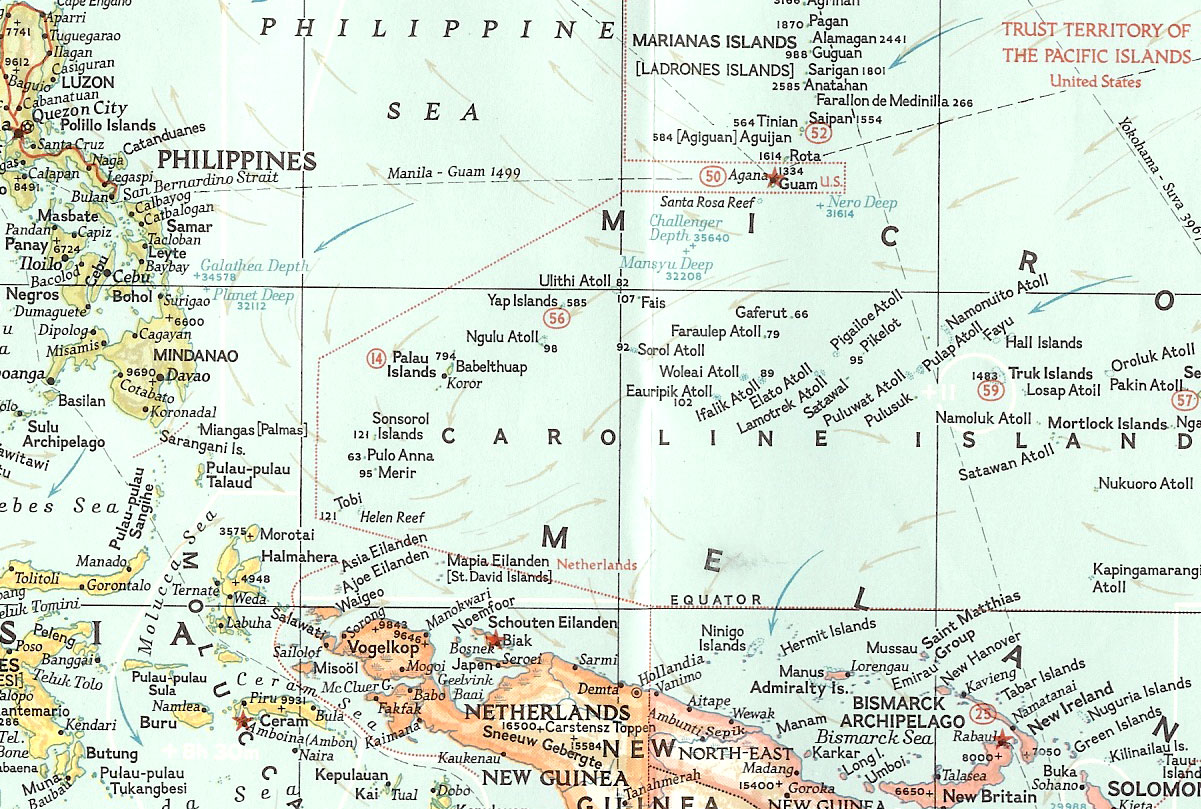
The administration of the Kompanie on the Maclay Coast was put in the hands of a certain Herr Kubary, a Polish national of Hungarian origin with a British passport which he had acquired while on a brief visit to Sydney. He had spent many years in Micronesia as an ornithologist and naturalist collecting for German museums. He had been collecting very successfully in the Caroline Islands for the Museum fuer Voelkerkunde in Berlin when in September, 1885, his contract with the museum was suddenly terminated for the flimsiest of reasons, leaving him stranded on the island of Yap. It is difficult to believe that this sudden loss of his livelihood was accidental. It seems more probably that this was manipulated by the German foreign office. The dismissal notice had come with the visit to Yap of a German warship, the Albatross, which was in the Pacific for the specific purpose of planting the German flag on the various islands of the Carolines. Kubary was offered employment as interpreter and guide on the Albatross, and for this he was ideally suited as there was no one with a more intimate knowledge of this area of the Pacific. Stranded in Yap as he was, he had little choice but to accept.

After the islands had been formally annexed by Germany, Kubary and his family, consisting of a half-caste wife and two children, were landed at Matupit [Rabaul] in New Britain, where he was put in charge of a plantation. After a time, he was transferred to take charge of the Neu Guinea Kompanie possessions in Astrolabe Bay [now in Madang Province] and he established himself in Bongu. Later he was transferred a few miles up the coast to Bogatim when the administration headquarters was transferred from Finschhafen. The latter had been abandoned, more or less in panic, as a result of the fearful mortality from tropical diseases among the Kompanie officials there.

Herr Kubary, who boasted that he was “the Lord God of Astrolabe Bay,” proceeded ruthlessly with the acquisition of land in pursuance of the policy of the Neu Guinea Kompanie for the expansion of plantations. The Kompanie was quite unscrupulous in its methods of acquiring land. The officials superficially inspected large areas which appeared suitable, sometimes merely climbing a tree and inspecting with binoculars, and then displaying a quantity of European goods — axes, knives, beads, cloth, etc. — they offered to purchase the land. The natives, not understanding what was really involved, appeared to agree, and a document was drawn up only vaguely defining the area and magnanimously excluding the village and an undefined piece of land for native cultivation. Each adult male member of the village or villages was required to touch the pen before his name was appended to the document. By such methods the Kompanie became the “legal” owners of vast areas of land, although it was many years before any actual survey was made. In a similar way Kubary acquired large areas around Bogadjim for a few axes and some tobacco. The level fertile land behind Gorendu and Gumbu was soon taken from the natives right up to the Gabenau River, leaving the natives of those villages without land for cultivation. Bongu was somewhat more fortunate in that the land was not so level but had a series of rather steep ridges running down in the direction of the sea and was therefore not so acceptable for Kompanie plantations. The Gorendu and Gumbu people, face with lack of garden land, had to turn to Bongu land and ultimately were compelled to be aggregated with Bongu village, where their descendants live to the present day, still retaining their Gorendu and Gumbu identity.

The concept of individual ownership and free disposal of land was quite an alien one to the natives, and, in any case, they themselves did not own this land. They had been granted the right to use it for cultivation purposes and to dig for clay for pottery-making for which they were famous.

Kubary was discharged from the Kompanie in 1895 and went back to Ponape in the Caroline Islands. It seems to be in the nature of poetic justice that the right to his own plantation on Ponape was disputed, and while on a visit to the Spanish authorities in Manila to appeal for his rights, the plantation was completely devastated in a native uprising against the Spaniards.

In Astrolabe Bay, Kubary left a legacy that was the cause of unending trouble for the German authorities. The natives had been warned by Maclay that white men might come who would not be like him and were not to be trusted, but he also warned that to resist them by force would be hopeless and would only invite disaster. Now, faced with white men whose behaviour at best was unpredictable and often baleful, the only alternative seemed to be to offer as little cooperation as possible without displaying any open hostility.

Leave a comment

Filed under Australia, disease, economics, Germany, Micronesia, migration, Papua New Guinea, science

Wordcatcher Tales: Babanuki, Shinkan, Yashizake

Initially spurred by finding the names of two couples killed in Saipan during the Pacific War on an Okinawan family tombstone in the Mo‘ili‘ili Japanese Cemetery, I just finished reading a novelized war story about the Saipan campaign, Oba, the Last Samurai, by Don Jones (Jove, 1988), a book passed on to me by an old friend with long Micronesia ties. It contained a few Japanese words of interest.

ババ抜き babanuki (lit. ‘granny-draw’) ‘Old Maid‘. As soon as I read that this was a children’s card game, I knew it must mean the game called Old Maid in English (and a variety of interesting names in other languages).

神官 shinkan (lit. ‘god-manager’) is an older term for ‘Shinto priest’, the person who serves as caretaker of a Shinto shrine and officiates at Shinto rites there. The more common term nowadays seems to be 神主 (native Japanese) kannushi or (Sino-Japanese) jinshu lit. ‘god-master’, or 神職 shinshoku lit. ‘god-employee’. These days, it is very rarely a full-time job.

椰子酒 yashizake (lit. ‘coconut/palm-sake’) ‘palm wine, coconut toddy’. On Saipan, this would almost certainly be coconut toddy, and not some other kind of palm wine, but the author only describes it as derived from a native plant, without mention of coconuts.

Leave a comment

Filed under Japan, language, Micronesia, U.S., war

Military Importance of Truk Lagoon to Japan’s Navy

From “Importance of Japanese Naval Bases Overseas,” by Masataka Chihaya (written on 14 January 1947), in The Pacific War Papers: Japanese Documents of World War II, edited by Donald M. Goldstein and Katherine V. Dillon (Potomac Books, 2006), pp. 63-65 (paraphrased freely):

Truk Lagoon is one of the greatest, forming a rough triangle more than 30 miles on each side. Inside the lagoon are many islands, not sand islands or coral reefs, of which more than eight are more than one square mile in size. It provided not just sufficient anchorage for a whole Japanese fleet during that era, but also enough area to allow several vessels to maneuver for training. The islands also provide enough room for several airstrips. In fact, by the end of the war, the Japanese Navy had built at least four such strips. The climate is also tropical but mild. In addition to these advantages, Truk occupies a key position in the middle Pacific area, able to control Midway to the north, the Marshalls in the east, and Rabaul and New Britain to the south. From every point of view, Truk was one of Japan’s most important bases in the Pacific.

When it occupied Micronesia in World War I, and during the League of Nations mandated administration that followed, the Japanese Navy was well aware of Truk’s importance. However, in strict observance of the postwar naval treaties, it did little to establish a naval base there. It may be hard to believe, but it is true. At the outbreak of the Pacific War there was only one half of a completed airstrip on Takeshima (Bamboo Island), a small island less than 1,000 meters long. There was no underground oil storage, nor any repair facilities on land. The only naval facility worthy of the name was that half-completed airstrip.

Even after war broke out, the Japanese Navy was rather slow to strengthen Truk Naval Base. As soon as the U.S. Navy began its offensive on Guadalcanal in the summer of 1942, and the Solomon Islands became the main theater of fighting for both navies, Truk became the center of Japanese naval operations. Almost all naval vessels gathered there before making sorties into the Solomons, and returned there for refueling and repair when damaged. Never before had the need for oil storage and repair facilities been more urgent, and the Japanese Navy concentrated its oil tankers and repair ships there while quickly trying to build such facilities on land as well. But it was too late. This concentration of oil tankers in Truk disrupted the flow of oil from Southeast Asia back to the Japanese homeland. Even the giant battleships Yamato and Musashi, which should have been at the center of the Japanese fleet, were often nicknamed “the tankers Yamato and Musashi” because they served as tankers supplying fuel to smaller warships instead of engaging in combat operations.

As there were not enough repair facilities on Truk, Japanese naval vessels sometimes had to go all the way back to the homeland for repairs, thus reducing the size of the naval forces available for the Solomons campaign.

It was not until the summer of 1943 that the Japanese Navy began to construct three more airstrips at Truk, two on Harushima (Spring Island) and one of Kaedeshima (Maple Island). By the time the U.S. Navy made a surprise attack on Truk on 17 February 1944, those three bases were almost complete, but they lacked adequate radar and command-and-control equipment, which would have made them more useful.

As a result, during the surprise attack on Truk in February 1944, U.S. Navy carrier-borne aircraft came out of the blue, destroying one light cruiser, 4 destroyers, 26 transport ships, 3 oil tanks, 2,000 tons of food, and more than 180 airplanes, of which more than 100 were lost on the ground.

This fiasco, together with the loss of the Gilberts and Marshalls, suddenly lessened the importance of Truk as a naval base. The Japanese fleet, which had long gathered at Truk, moved westward into the Carolines, Singapore, and even the homeland. Soon afterward, the Japanese Navy withdrew its land-based aircraft to the Marianas and western Carolines. Truk was no longer a vital naval base, just a stepping stone between the Marianas and Rabaul.

The bad situation on Truk got worse when U.S. forces invaded the Marianas in June 1944. Truk could contribute little to the Japanese defense, and the fall of the Marianas left Truk largely isolated, except for very few small visits by submarines and flying boats. From that time on, Japanese forces on Truk had to endure not just Allied air attacks, but mounting starvation and disease until the war ended in August 1945.

1 Comment

Filed under Japan, Micronesia, military, Papua New Guinea, U.S., war

Changing Demographics in Pacific Seafaring

From Sailors and Traders: A Maritime History of the Pacific Peoples, by Alastair Couper (U. Hawai‘i Press, 2009), pp. 178-180, 188:

As well as improvements in maritime education and training under IMO regulations, there has also been a veritable social revolution in Fiji. The young generation of Pacific sailors no longer seriously ascribes to the old tradition that females bring “bad luck” to a ship. Pacific women have shown considerable strength of character, as well as new professionalism, in taking charge of crews and in coping with family….

The other change in human relations in Fiji has been an amelioration within the maritime sector of the sensitive issue of race relations. The exclusion of all but indigenous Fijians from the Waterside Workers and Seamen’s Union, which was registered in 1946 with a specific racial limitation clause, continued until a rival unsegregated seamen’s union emerged in 1992. The reasons for the initial segregation are deeply embedded in colonial history. However, with the increase of Fijians as wage earners in ports and shipping, trade union exclusiveness seemed as much a matter of class as race. Ports and shipping had Fijian laborers and ratings, while Europeans and part-Europeans were officials and officers. Capital in turn came from the United Kingdom and Australasia and locally from Indo-Fijian commercial sources. The more class-conscious union organizers saw the Fijians as “workers” and the others as “bosses” who were not eligible for union membership.

The mobility of a few Fijian ratings with sufficient education to junior officer levels and the increase of indigenous Fijians serving as cadets and officers on local vessels have reduced the basis for class resentment. There are still racial problems, but younger Fijian sailors recognize the merits of Indo-Fijians as mariners. For example, the Khan family on the island of Nairai have long been regarded as good sailors, running their own cutters with Fijian officers and crew….

The global hierarchical structure is broadly 40 percent officers from countries in the OECD (Organisation for Economic Co-operation and Development), plus Russia, Poland, and some of the eastern European states, and most of the ratings from eastern Europe and developing countries, including some Pacific islands.

Increasingly, young men and a few women from the Pacific are moving to officer ranks on foreign-flag ships, as there is a dire shortage of officers in the developed ship-owning states. The shortage is due to both declining interest in careers at sea and the losses of trained personnel arising from demands ashore in business, technology, and administration for well-qualified mariners. One of the several advantages to Germany, for example, of recruiting lower-cost sailors in Kiribati and training some of them to officer levels is the lack of well-paid employment in islands for their skills, which would attract officers ashore. Thus there is a minimizing of wastage from manpower training investments. There are twelve maritime training institutions in the Pacific Islands. Only Fiji and Papua New Guinea provide the full range of education and training from pre-sea, rating, and officer courses to Class 1 foreign-going masters and chief engineers. Several other places offer training of ratings and/or junior officers. There is mobility in training, with concentrations for special courses under the coordination of the SPC Regional Maritime Programme….

Kiribati in 1959 (as part of the Gilbert and Ellice Islands crown colony, GEIC) was already supplying seafarers to the China Navigation Company of Britain. There were also crews and a few I-Kiribati nationals serving as officers, usually with European captains, on colony ships sailing on long-distance interisland routes. In terms of distance, Kiribati shipping was virtually foreign-going…. Kiribati is now the principal country in the Pacific island region for supplying seafarers.

Leave a comment

Filed under economics, education, Fiji, labor, Micronesia, Pacific, Papua New Guinea

Pacific Annexations, 1840-1906

From Sailors and Traders: A Maritime History of the Pacific Peoples, by Alastair Couper (U. Hawai‘i Press, 2009), pp. 140-141:

The managers of the major merchant companies based at the main entrepôts in the [Pacific] islands were often ex-sailors. Several acted as consuls for their governments and supported the companies in many ways, including evoking gunboat diplomacy. A prime example is John Bates Thurston. He served at sea in the island trades, was wrecked at Rotuma in 1865, became British consul in Fiji in 1867, was highly influential in the negotiations for the ceding of Fiji to Britain in 1874, and became governor of Fiji in 1887. The companies, the new settlers, and their sympathetic consuls pressed for annexations. The French were the first to act [but Waitangi was 1840—J.] and took Tahiti, the Marquesas, and the Tuamotus as French protectorates in 1842 and New Caledonia in 1853. These were declared colonies in 1880, and the Australs and Wallis and Futuna in 1887.

The British annexed Fiji in 1874 and established protectorates over southeast New Guinea in 1884, Gilbert and Ellice in 1892, most of the Solomons soon after, and Ocean Island in 1900. They agreed that New Zealand would exercise authority over the Kermadecs in 1887, the Tokelaus in 1889, and the Cooks and Niue in 1901. The Dutch took western New Guinea in 1848. Germany annexed northeast New Guinea in 1885, along with the Bismarck Archipelago and the northwest Solomons; took possession of most of the Carolines in 1885; and ultimately purchased Yap and other islands in the Carolines and Marianas from Spain in 1899. The Germans also acquired the Marshall Islands in 1884 and took over Nauru in 1888. Chile obtained Easter Island in 1888.

America, after its disastrous Civil War, had not recovered a significant merchant fleet and showed little inclination for acquiring Pacific territory. American guano companies had already secured legislation in 1856–1860 that allowed claims over some small Pacific islands, and the US government went on to secure others, including Baker, Jarvis, Johnson, Midway, Palmyra, and Wake. In 1893 the influential American maritime geostrategist Alfred Mahan wrote that it was “imperative to take possession, when it can be righteously done, of such maritime positions as can contribute to secure command.” In 1898, Hawai‘i was annexed (US citizenships were granted in 1900), as was eastern Samoa with Pago Pago as a main naval coaling station, while Guam was captured from Spain by the US Navy in 1898.

The Pacific was now effectively divided between several colonial powers mainly by agreements. In the final carve-up, it was confirmed that Western Samoa was a German colony separated from American Samoa in the east. In turn Germany agreed to relinquish claims for Tonga. As a result, in the closing days Tonga appeared to survive as the only independent Polynesian kingdom, although not quite. It was declared a British protectorate in 1900, and in 1905 it was decreed mandatory for the king of Tonga to take advice from the British consul on all matters of importance. Finally, in 1906 New Hebrides was divided as a condominium between Britain and France.

I’m not sure why Couper omits the 1840 Treaty of Waitangi, which made British subjects of the Maori. Maybe he considered both New Zealand and Australia to be colonial powers by the 1840s, even though both were earlier annexed by another colonial power. (Like the Americas, of course.)

Leave a comment

Filed under Britain, Fiji, France, Germany, Hawai'i, Micronesia, Netherlands, New Zealand, Pacific, Papua New Guinea, Polynesia, Spain, U.S.

Insider vs. Outlier Stereotypes in Pohnpei

From Michael D. Lieber’s chapter “Lamarckian Definitions of Identity on Kapingamarangi and Pohnpei” in Cultural Identity and Ethnicity in the Pacific, edited by Jocelyn Linnekin and Lin Poyer (U. Hawai‘i Press, 1990), pp. 88-90:

Pohnpeians [main-islanders] describing other ethnic groups focus on observable patterns of activity or predilections for particular arenas of activity. They describe Kapinga [Polynesian outliers], for example, as good fishermen and craftsmen and as strong, hard workers. But they also think of Kapinga as lacking in ambition and foresight, as unable to plan ahead. From a Pohnpeian perspective, this is a reasonably accurate description. Other than a few men who are active in feasting, even titled Kapinga avoid participation in feasts on Pohnpei, a participation that presupposes careful planning and allocation of one’s time and resources over a period of years. Pohnpeians also point out that very few Kapinga have prepared themselves for administrative or teaching jobs.

Pohnpeians see Pingelapese [Micronesian outliers] as messy, clannish, devout and active in church affairs, and both shrewd and very aggressive. Examples of their clannishness are their preference for en bloc voting whenever a Pingelapese runs for public office against a non-Pingelapese and their purported tendency to route administrative jobs to other Pingelapese whenever they are in a position to do so. What Pohnpeians appear to mean by aggressiveness is the often-mentioned Pingelapese preference for achieving middle-echelon administrative jobs, the vigor with which they pursue those positions, and their consequent prominence in those positions on Pohnpei.

Mokilese [Micronesian outliers] are described by most Pohnpeian informants as ambitious, skilled, and crafty. What is so intriguing about this description is the use of aggressive for Pingelapese and ambitious for Mokilese. When I asked for examples, informants pointed to the prominence of Mokilese in upper echelons of colonial administration—particularly in the former Congress of Micronesia and the present Congress of the Federated States of Micronesia—and in highly skilled technical jobs over which they have a virtual monopoly, such as machinists and mechanics. They are considered very subtle and charming while being very manipulative, particularly in political contexts.

If one takes all of these stereotypes together, they do in fact describe something about the larger Pohnpei social order. Kapinga, to the extent that they are visible at all, are people of the marketplace. They are the suppliers of fish and the purveyors of handicrafts and are otherwise not very visible. Pingelapese have been prominent in church affairs on Pohnpei and in middle-level administration in various agencies, including the hospital and the education department. Mokilese are in fact prominent in upper-echelon administration, especially in Congress. For example, during elections for the Congress of the Federated States of Micronesia in 1979, Mokilese men were candidates for 60 percent of the seats allotted to Pohnpei State. Pohnpeians are prominent at all these levels. From their point of view, that is to be expected, for Pohnpeians consider Pohnpei to be very much their island. Their ethnic descriptions identify whom they believe to be their competitors for control over affairs on the island, and they allude to the contexts of competition. In each case, descriptions focus on the issue of control in the colonial arena. Pingelapese and Mokilese people have been and still are active in the feasting and title system, some having very high titles. Yet no Pohnpeian ever mentioned this in discussions about them. When asked why Kapinga, Pingelapese, and Mokilese are the way they are, Pohnpeian informants responded with answers such as, “They do what their parents did,” or “They grow up with the tiahk ‘customs’ of their island.”

Kapinga descriptions of other island groups put no emphasis on political position and greater emphasis on skills and interpersonal proclivities than do Pohnpeian descriptions. Pingelapese are considered dirty and “careless” in their personal habits, easily angered, clannish, vengeful, very enterprising, and very religious. They are considered powerful curers and sorcerers, good organizers of businesses, and hard workers for their families and friends. Kapinga never pointed to Pingelapese administrative positions in their descriptions.

Mokilese, according to Kapinga, are good at fishing, working, learning mechanical skills (such as boat building), and organizing. Several Kapinga referred to Mokilese as being very personable, but said that one never knows if a Mokilese is really one’s friend. In discussing Mokilese organizing abilities, Kapinga informants pointed to their work in reorganizing the Kolonia Protestant church in 1980. While Kapinga recognize the prominence of Mokilese in Congress, they appear not to think of that fact as particularly definitive of Mokilese.

What strikes Kapinga as being distinctive about Pohnpeians is their haughtiness (putting themselves before others), their capacity for being extremely generous, and their unpredictable displays of almost gratuitous hostility. The charge of haughtiness has to do with the condescension with which Pohnpeians often treat Kapinga and with the ways that Kapinga see higher and lower ranking people interact. Kapinga cite numerous examples of Pohnpeian generosity, both on the part of chiefs and of ordinary people, particularly during World War II, when Kapinga had to leave Porakied and seek shelter in U and Kiti. At the same time, Kapinga fear Pohnpeians as sorcerers. They cite several deaths over the past few years that they attribute to sorcery by Pohnpeians who were supposedly friends of the deceased.

I asked about one other group, the Nukuoro [Polynesian outliers], with whom the Kapinga have long had close relations of reciprocity and intermarriage. While Kapinga gave detailed descriptions, Pohnpeians ventured no opinions whatever, saying only that they did not know anything about them. One can predict that Nukuoro do not form a politically or socially visible group on Pohnpei, and this is in fact the case.

We see that three Pohnpeian ethnic stereotypes (and one category empty of content) concentrate attention on the place that each ethnic group holds in the larger colonial arena of commercial and administrative control over persons, resources, and policies. Each stereotype is referable to the particular sorts of contexts in which members of each out-island enclave exercise political and economic control in the colonial administrative domain. Kapinga concentrate their attention on those observable patterns of interaction that are relevant to face-to-face dyadic interaction, such as visiting, friendship, hospitality, and reciprocity. Generosity, fairness, and trustworthiness are attended to, while political position in the larger order is not.

A similar divergence of reference points seems to show up in urban elitist vs. small-town egalitarian patterns of stereotyping each Other in the U.S. and other larger societies.

Leave a comment

Filed under Micronesia, Polynesia, U.S.

Yap’s Role in the Saipan Campaign, June 1944

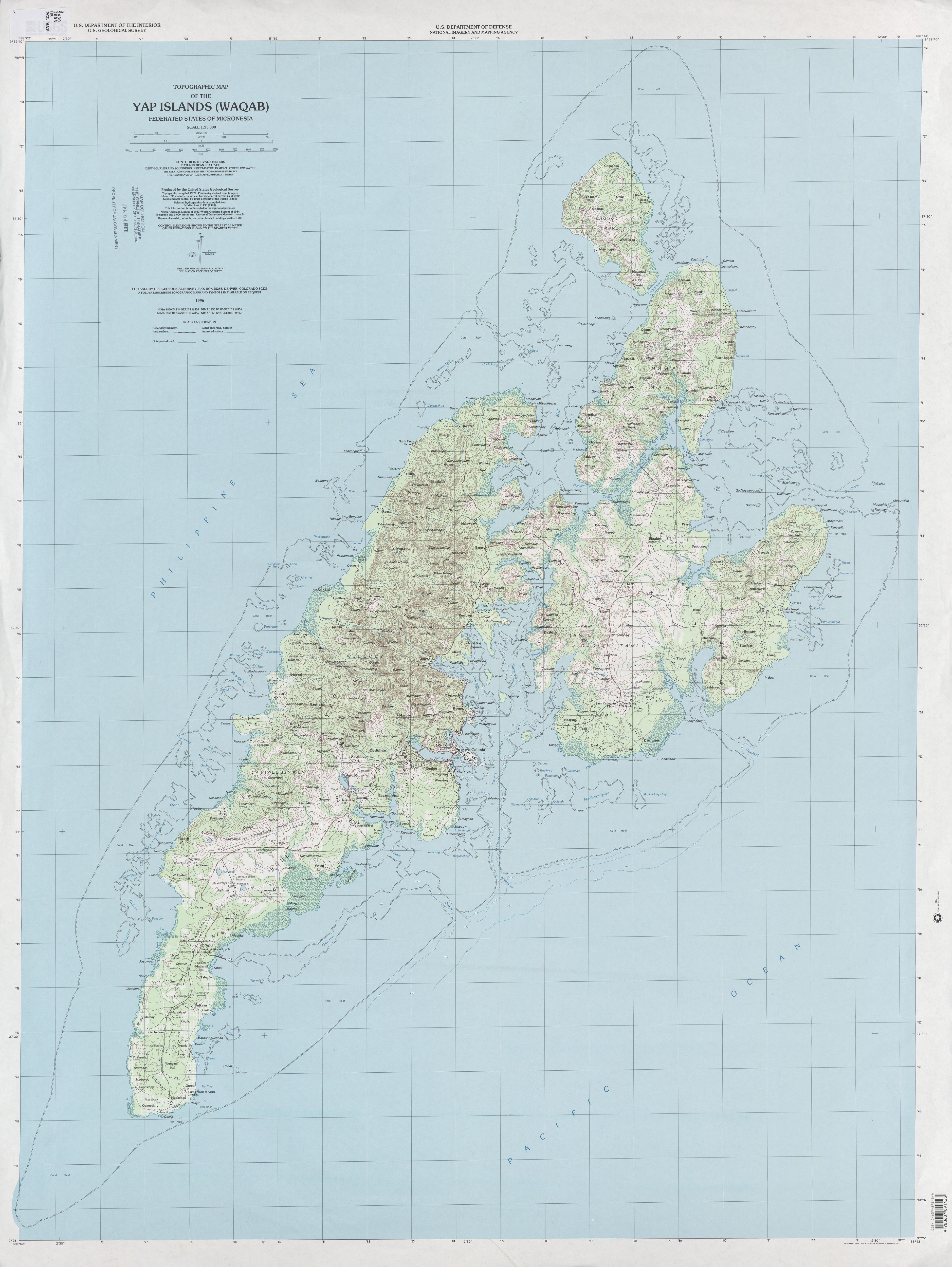
When I was looking up stuff about Yap, Micronesia, for a recent post, I came across a very informative website, with both photographs courtesy of the Micronesian Seminar and the National Archives—and even video—about the bombing of Yap during the Pacific War, about which I heard many stories during my time there in 1974. I have corrected obvious spelling errors in the following extract.

At dawn, on the 15th of June 1944, American amphibious forces swept into Saipan to begin the hard ground fighting that was to bring the Japanese homeland within range of our Superfortresses. For more than two weeks prior to the landings, Thirteenth Air Force Liberators, based on Los Negros, had been pounding Truk to neutralize the strategic Japanese base and to prevent the enemy from reinforcing Saipan by air.

A large Japanese task force, estimated at 40 ships or more, was sighted some distance north of Yap Island, on the 19th of June 1944. Carrier planes from this task force lashed out at the powerful units of the United States Pacific Fleet which were then supporting Allied ground forces on Saipan. The conflict that followed was the first major battle between elements of the Japanese and United States fleets in nearly two years. As at Midway, two years earlier, all of the offensive action was by carrier-based aircraft. By the time the Japanese fleet broke off the engagement, U.S. Task Force “58” had destroyed nearly 400 enemy aircraft and had sunk or damaged 14 Japanese ships.

Liberators of the Thirteenth Air Force were called upon to reach out more than 1,000 statute miles from their Los Negros base to hit Japanese warships that might seek refuge or fuel in Yap Harbor. On 22 June, 33 Liberators were over Yap in the longest mass mission the Thirteenth had yet flown. Trained eyes peered down on the harbor far below. There were no warships to be seen. The heavies wheeled and made their run on the secondary target, Yap Airdrome. Their 33-ton bomb load struck the runway and the dispersal areas with devastating effect.


View a large Yap Area Map

The Japanese were caught completely by surprise; not a single one of the more than 40 planes on the ground was able to take off and fly into the air. Nineteen enemy planes were definitely destroyed, and 15 were damaged; the runway was cratered and rendered unserviceable.

For six consecutive days after the raid of the 22nd of June, the Liberators blasted Yap, keeping the runway unserviceable and preventing its use in ferrying planes from the Philippines to the Marianas to aid the hard-pressed defenders of Saipan.

Leave a comment

Filed under Japan, Micronesia, U.S., war

Wordcatcher Tales: Huarachudo, Ejido, Municipio, Piloncillo

From True Tales from Another Mexico: The Lynch Mob, the Popsicle Kings, Chalino, and the Bronx, by Sam Quinones (U. New Mexico Press, 2001), pp. 206-210:

The municipio of Turicato [in the State of Michoacán] has always divided along these town-rural lines. The hill folks resented the power, money, and education, relatively speaking, of the people in town. The city folk feared the hillbillies but saw no reason to extend power, or municipal services, to people they considered ignorant and barbaric. In these years the Barajas family—a family of local merchants—dominated Turicato politics….

In this atmosphere “Los Villa,” as the Villaseñor family was known, emerged first as rebels. They took up the cause of the “huarachudos,” the “sandal wearers”—whom they rallied to their cause against the city folk…. The Villaseñores were huarachudos themselves. They were sixteen children whose father, Tomás, had been born a peon on the hacienda San Rafael. In the 1930s President Lázaro Cárdenas ordered a section of the hacienda transformed into a communal farm—an ejido—owned by those who had worked it as peons….

The Villaseñor piloncillo operation also grew. Piloncillo is a small cone of brown sugar about an inch in diameter, processed by a simple mill. It is used to sweeten coffee, in household cooking, or by the soft-drink industry. In the 1990s, piloncillo has all but vanished as a product from the Turicato region. But in the 1970s and 1980s, many sugar cane growers were producing piloncillo. In the Turicato region in the 1970s and 1980s, owning a piloncillo mill was the difference between a life of comfort and one of hopeless poverty….

The emergence of a hillbilly family brought with it the kind of abuses that town residents had feared all along. “What happens is they form into groups,” says Trigo. “There’s one who’s a leader, and around him form people who like to fight and look for trouble. They like to walk into a cantina and throw everybody out. They figure that’s a real achievement. This grows; the group gets larger. Then it becomes, ‘Let’s take over this land.’”…

Yet the Villaseñor family never did fully dominate local politics. They proved in the end to be poor politicians. Their frequent warring—“their bellicose nature” as one man put it—earned them many enemies. By 1989 a significant part of the municipio nurtured in dark silence a pure and vital hatred of the Villaseñores, and among them were many of the same poor peasants—the huarachudos—that the family once rallied to its side….

In 1994 the military put a roadblock between Turicato and Puruarán and set about arresting or killing off the bandit gangs. Others saw that the military meant business and laid down their guns. So five years after the Nueva Jerusalén vote threw Turicato into a civil war, a version of peace came to the municipio.

The chapter from which these excerpts come is a well-told tale, but one sadly familiar in its broad outlines: ambitious évolués (sponsored by distant elites, in this case the PRI) lead others among the oppressed to overthrow and replace an oppressive elite, only to impose a new kind of thugocracy at least as violent and oppressive as the old one. Sort of a Zimbabwe in microcosm. (Zimbabwe, whose independence I long ago celebrated at a big gathering of African students in Honolulu.)

But I want to comment on just two of the four words italicized in the extract.

The Spanish term municipio may have survived in the form of an English calque more than a century after the Spanish ceded Micronesia to the Germans. Each of the Federated States (formerly Districts) of Micronesia is divided into what are now called municipalities, a term that no subsequent German, Japanese, or American administrator would likely have come up with, although the Americans are credited with introducing the term by the anthropologist Lingenfelter, who worked in Yap during the early postwar years. If so, U.S. Navy administrators probably calqued on the basis of usage in the Philippines. Micronesian municipalities have never been centered around a town and its hinterland. Instead, they seem to be more like alliances of contiguous villages.

I’m old enough to have purchased a pair of Mexican huarache sandals in the 1970s, when I was a grad student in Hawai‘i. The dye made my feet break out, so I stayed with rubber slippers (zori). (I hardly owned a pair of shoes all through grad school.) The relation between Spanish huarache ‘sandal’ and huarachudo ‘sandaled’ is parallel to that between English beard and bearded. Spanish and English are both related languages. But the same parallel can be observed between, for example, Chamorro sapatos ‘shoes’ (from Spanish) and sinapatos ‘shod, wearing shoes’, or Chamorro relós ‘wristwatch’ (also from Spanish) and rinelós ‘wearing a wristwatch’. Among its myriad functions, the -in- infix in Philippine languages can form adjectives out of nouns in a manner similar to that of participial affixes in Spanish and English.

UPDATE: The Micronesian Seminar‘s Francis X. Hezel, S.J., weighs in on the antecedents of the term municipality in Micronesia.

The term as used in Micronesia after the war has no direct relationship to the Spanish colonial period in these islands. The Spanish weren’t here long enough and they weren’t influential enough to have the term stick. There are very few Spanish loan words that have made their way into the island languages. Actually, islanders used the Japanese term kumi to describe a segment of the island, even well after the war. Muncipality came into the languages through the English term, via the Navy.

The usage of Japanese kumi ‘club, association, gang’ is very interesting, and seems a much more appropriate term for the traditional political alliances before they were recast by the U.S. Navy as local-government structures. The Yapese dictionary translates municipality into Yapese nuug ‘net’ (presumably meaning ‘network’ of political alliances). Other Micronesian dictionaries I’ve consulted don’t list municipality in the English finder list. So it seems U.S. Navy administrators were influenced by Spanish local-government terminology already long-established in the Philippines.

The U.S. Census Bureau glossary does not list the term municipality at all, but it does list and gloss municipio as: “Primary legal divisions of Puerto Rico. These are treated as county equivalents.” The Wikipedia entry for Municipalities of the Philippines begins thus: “A municipality (bayan, sometimes munisipyo, in Tagalog) is a local government unit in the Philippines. Municipalities are also called towns (which is actually a better translation of bayan).”

SHARP DETOUR: My wife and I taught University of Hawai‘i extension courses on Yap, Micronesia, in the summer of 1983, just before heading off to spend a year in Romania on a Fulbright research grant. In fact, she was still there when I got the word that my nearly forgotten application from a year earlier had been approved and that the orientation in Washington, D.C., would begin before she got back to Honolulu. Trying to place a telephone call through to Yap was not easy in those days.

Anyway, for my introductory linguistics course on Yap I used the first edition of Peter Trudgill’s little Penguin paperback Sociolinguistics: An Introduction to Language and Society. Even the main islands of Yap have a good deal of regional variation in pronunciation and word choice, and the outer islands speak dialects of the far-flung Trukic language continuum, only distantly related to Yapese. The variety of Yapese spoken in the major municipality (Rull) closest to Colonia—the capital and only urban center—provided the basis for the standard orthography, but the pilot school for testing Yapese language curriculum materials (with bilingual education funding from the U.S. DOE) was located in the major municipality (Tomil) with the most divergent pronunciation. The three major municipalities were those chiefly alliances (called kumi in Japanese) dominant at the time the Germans took control: Gagil, Tomil, and Rull.

My wife and I first met while we were both assigned to that school in the fall of 1974—she as a new Peace Corps teacher for two years, me as a visiting linguist for one semester—and we both learned our Yapese in that very rural municipality. (Mine faded much more quickly than hers.) So we were quite aware of regional variation and of the principal shibboleths of Tomil dialect, chief among them being the pronunciation of standard /ae/ as /ee/, as in the pronoun gaeg vs. geeg ‘me’ or the plural marker on verbs -gaed vs. -geed, both high-frequency items.

For my introduction to linguistics course in 1983, I decided that the most important things I should focus on were the respective relationships between writing and pronunciation, on the one hand, and between dialects and standard languages, on the other. One of my assignments was for my students to assemble a list of common words for which there were regional variants, then track down the boundaries between those variants (the isoglosses). The most interesting findings involved variants whose isoglosses failed to align with the existing boundaries between municipalities, perhaps revealing earlier linguistic and political fault lines.

1 Comment

Filed under language, Mexico, Micronesia, Philippines, U.S.

Wordcatcher Tales: Dawasi, Kousapw, Sakau

Three words from the Micronesian language Pohnpeian (aka Ponapean) that surfaced in my background reading about the church shootings in Neosho, Missouri, tell stories of distant connections across time and space.

Dawasi – When I first heard about the Neosho church shooting, I assumed the Micronesians involved were from the Marshall Islands, because I know that many Marshallese work for Tyson Foods in nearby Springdale, Arkansas. But one key term (which I’ve italicized) in the following passage cited in a posting on the Marshallese YokweOnline network hinted that the Micronesians involved were from the state of Pohnpei, not the Marshalls. (They were actually from the outer islands of Pingelap, not the main island of Pohnpei.)

Kernel [Rehobson] owns a retail store that is a gathering place for Micronesians from dozens of miles around since he stocks his store with the type of down-home items that are so difficult to find in the US: the large plastic combs that women wear in their hair, zoris, dawasi and brushes for showers, and island-style skirts with embroidered hems.

Dawasiscrub brush’ (made of coir bristle) is the official Pohnpeian spelling for a word borrowed from Japanese before the Pacific War. The same word was borrowed by Palauans, who spell it tauas(i). In current Japanese, tawashi (束子) can refer to scouring pads made of acrylic yarn, but the bristle brush variety is such a Japanese cultural icon that tiny replicas dangle from cellphones and backpacks.

The passage above cited on YokweOnline comes from the article on Micronesians Abroad by Francis X. Hezel, S.J., and Eugenia Samuel, that I blogged about earlier. The two words italicized in the next passage from the same article tell of very different connections.

Our team intended to visit Kansas City, home of a growing Micronesian community, largely Pohnpeian, that sprang from students who attended Park College during the 1970s and 1980s. Small colleges, once well attended by Micronesian students, have frequently served as the seedbeds for migrant communities in the US, accounting in part for the seemingly odd locations of Micronesian strongholds. Kansas City is said to have been constituted a kousap by a Pohnpeian chief not long ago when he paid a visit to his compatriots who had settled in that city. He was feted with sakau—the type made from powder rather than pounded—and left a week or two later with several thousand dollars, which had been collected as tribute from Pohnpeians who are now living 8,000 miles from their own island.

Kousapw – The kousapw (sapw means ‘land’) is a Pohnpeian land unit—translated ‘section’ below—intermediate between a farmstead and a district (or “municipality”). According to Douglas Oliver’s (1988) Oceania: The Native Cultures of Australia and the Pacific Islands, p. 983:

Most sections extended from coast to island center, and consisted of from fifteen to thirty-eight farmsteads. Each section had a meeting house of its own, and was headed by an official known as a kaun or soumas, who was usually the senior male member of the section’s senior sub-clan. The section functioned mainly as an administrative subdivision of the district.

This raises several questions. (1) There seem to be many old cultural connections between chiefly high-island Polynesians (possibly from Samoa) and Pohnpei. Is it just coincidence that the kousapw in Pohnpei usually runs from seashore to mountaintop, like the ahupua‘a of Hawai‘i (and presumably other large islands in Polynesia)? (2) Which of the major districts on the island of Pohnpei was the Kansas City kousapw assigned to? (3) Does this mean we now have a third Kansas City to contend with: one in Missouri, one in Kansas, and one in Pohnpei?

Sakau – One strong indication of old Polynesian influence on Pohnpei is the cultivation and use of Piper methysticum, known in Pohnpei as sakau, in Hawaiian as ‘awa, and in Samoan as ‘ava. In fact, the Pohnpeian word sakau derives by regular sound correspondences from the earlier Polynesian article+noun combination *te kawa.

4 Comments

Filed under Japan, language, Micronesia, Polynesia, U.S.

Micronesian Emigration Rising

The Micronesian Seminar regularly publishes articles on issues facing Micronesians under a series called Micronesian Counselor. The latest in the series is on HIV/AIDS in Micronesia. In December 2006 MicSem published an article on Micronesians Abroad by Francis X. Hezel, S.J., and Eugenia Samuel. Here’s just the introduction.

Today there are over 30,000 FSM citizens and 20,000 Marshallese living in the United States and its territories. Add to that possibly another 10,000 Palauans, and you have a total of 60,000 Micronesians living away from home. These are not students, young people away for a short time, or islanders who are doing a brief stint with the military. These are people-young and old, fluent English-speakers and those who know no more than a few words of the language-who have chosen to take up residence abroad.

Emigration is not an entirely new phenomenon. Palauans have been leaving home since the late 1940s. Already in 1953, there were a hundred Palauans on Guam with their own Palau Association. As their numbers grew in subsequent years, they would meet in a Palauan bai and worship in a local language Protestant church. From the early 1970s, as hundreds of Micronesian students began heading for college in the US, thanks to the extension of the Pell Grant, emigration from Palau stepped up to about 250 a year. These were not young men and women on their way to college for a few years before returning home; they were people with a one-way ticket out. By the late 1970s, individuals from other parts of Micronesia as well were dribbling into Guam and the US with the intention of staying. The 1980 US Census recorded several hundred people from what was then coming to be known as FSM, most of them Outer Island Yapese, living in the US. These mostly educated, young people were loathe to return to their atolls where there was no wage employment, but reluctant to settle in Yap where they lacked status and land.

Then, in 1986 with the formal implementation of the Compact of Free Association in FSM and the Republic of the Marshalls, Micronesians were granted the right to live and work in the US for an unlimited period. The ensuing emigration was limited at first: the emigration from FSM was only about one percent a year, half of what it is today, and the early migrants were heavily Chuukese. The main destinations in those early years were Guam and Saipan. As both places suffered from a recession in the early 1990s and new jobs became scarce, more and more Micronesians headed for Hawaii. The migrant outflow increased sharply in the mid-1990s as the effects of the stepdown in Compact funding for FSM and RMI were felt and as the government reforms, initiated by Asian Development Bank, lopped jobs from the public sector.

Today we are witnessing an emigration comparable to those that other Pacific islands—Tonga, Samoa, the Cook Islands and Guam—have been experiencing for years. A decade or two ago, writers took delight in pointing out that the emigration population of, say, Samoans in California was half the size of its resident population, or that the Guamanians on the West Coast outnumbered those on their home island. Now Micronesia is rapidly moving in the same direction. With 2,000 FSM citizens, 1,000 Marshallese, and a couple hundred Palauans leaving home each year to live abroad, one out of every four Micronesians is now living in the US or its territories. If migration continues at this same pace, we can expect that the number of emigrants will be about half the size of the resident population just ten years from now.

1 Comment

Filed under Micronesia, U.S.