Category Archives: Spain

Missing Date in Philippines History: 31 December 1844

From A History of the International Date Line:

European explorers who approached the Pacific Ocean by sailing to the east such as the Portuguese, and in their wake the Dutch, the English and the French, naturally kept their ship’s journals and diaries according to the day count of their home land and this was of course also adopted by the colonists who settled along the Asian perimeter of the Pacific Ocean.

However, the colonisation of the Pacific Ocean by the Spanish occurred from the opposite direction and more specifically from the Spanish possessions in America. The Philippine archipelago was discovered in March 1521 by Ferdinand Magellan and Spanish dominion over the islands was first firmly established in 1565 by Miguel López de Legazpi (c. 1510 – 1572), the conquistador and first Spanish governor general of the Philippines….

Most of the shipping from the Philippines to Spain went over the Pacific Ocean to the Mexican port of Acapulco, was transported over land to the port of Veracruz, and then shipped to Spain. In order that the Spanish ships crossing the Pacific Ocean between the Philippines and the Spanish Americas would not have to adjust the dates in their journals whenever they sighted land, the Philippines observed the same day count as that of the Spanish Americas….

During the early 1840s the commercial interests of the Philippine Islands turned more and more away from the Spanish Americas (which for a large part had severed their relations with the motherland Spain) and trading with the Chinese mainland (engendered by the ignominious but lucrative ‘Opium Wars’), the Malay peninsula, the Dutch East Indies and Australia became increasingly important.

In order to facilitate communication and trading with its western and southern neighbours, the secular and religious authorities of the Philippines agreed that it would be advantageous to abolish the American day reckoning and adopt the Asian day reckoning.

This was achieved in 1844 when Narciso Claveria, the governor general of the Philippines, issued a proclamation announcing that Monday, 30 December 1844, was to be immediately followed by Wednesday, 1 January 1845.

The 1867 conversion from Russian to American time in Alaska was much more complicated.

5 Comments

Filed under Mexico, Pacific, Philippines, Spain

Suppression of Piracy in the Philippines After 1848

From Iranun and Balangingi: Globalization, Maritime Raiding and the Birth of Ethnicity, by James Francis Warren (Singapore U. Press, 2002), pp. 345-346, 363-364:

By the first quarter of the nineteenth century, the sea war in the Philippines between Spain and the Iranun and Balangingi had taken on a permanent and normal character of a stalemate in which each party recognized the other as an equal with authority generally limited to the territory each controlled. But in 1848 the combined forces of the Spanish navy and army laid waste to the Samal forts at Balangingi, dispersed the survivors, and forcefully relocated the prisoners of war. This was the decisive moment, the turning point in the history of the century-long conflict between Spain and the slave raiders. The Balangingi were on the brink of climbing out of their Samal identity after nearly half a century of constant upheaval, and, according to Frake, “establishing themselves as a different kind of people.” But, in the aftermath of the Spanish devastation of their island stronghold in 1848, they did not succeed. After that event the Balangingi, as ‘notorious pirates’ and a construed single ethnic group, disappeared from the pages of the historical literature and geographical reports. Balangingi fortunes changed in the 1840s and with them the pattern of maritime raiding in Southeast Asia. The destruction of Tempasuk and Marudu by the English in 1845 also forced Iranun groups to relocate on the east coast at Tunku. The loss of these confederate communities made it more difficult for the Balangingi to conduct slave raids in the western sector of the archipelago. This event, coupled with the founding of Labuan by James Brooke and the appearance of steam gunboats on the northwest coast of Borneo, forced them to gradually withdraw from that area and increasingly concentrate their activities on the Dutch possessions.

At the same time, the Spanish adopted a far more aggressive policy in the south. The new governor of the Philippines, Narciso Claveria, understood the strategic importance of the control of Balangingi which became the focal point of a new Spanish strategy. A daring naval attack aimed at the throat of the Sulu, namely Balangingi, was the key to cutting the sultanate in two and stopping slave raiding in the Philippines….

After the destruction of Balangingi in 1848, the Spanish first used the Samal women and children as hostages to force their husbands and kindred to surrender and make peace. The political ploy did not work. So after a short time, the Spanish assembled their steamers and regularly swept the Visayas and the Sulu archipelago from one end to the other. Repeated punitive campaigns ended with a series of major sea battles off the coasts of Samar and Mindanao and attacks on Taupan’s bases to the south. [Julano Taupan was war leader of the Balangingi at Tawi-Tawi.] Hundreds of Balangingi were killed during the six year long war, many of their ships captured, and others destroyed. Taupan sent his raiders to prey on shipping in less troubled waters in the Moluccas, the Banda Sea, the Java Sea, and along the Bornean coasts. But their activities were short-lived. The British and Dutch dealt with the Balangingi menace by joining forces across the region, stationing steamers in all the key straits of the archipelago at certain times of the year when the slave raiders traditionally appeared in those waters. The Dutch navy concentrated on Taupan’s Balangingi operations around Sulawesi and Bonerate, and the British, with James Brooke’s full support, stationed ships at Labuan to protect the Borneo coasting fleets in the South China Sea.

Leave a comment

Filed under Britain, Netherlands, Philippines, piracy, Southeast Asia, Spain, war

Japanese and Other Loanwords in Palauan

I got a little carried away this weekend extracting Japanese, English, German, and Spanish loanwords from the New Palauan–English Dictionary, ed. by Lewis S. Josephs (U. Hawaii Press, 1990). The nature of the words borrowed from each language tells a lot about the nature of the interactions between Palauans and their successive colonizers: Spain until 1899, Germany until 1914, Japan until 1945, and the U.S. after that. By 1940, there were 3 Japanese colonists (including Okinawans, Koreans, and Taiwanese) in the islands for each indigenous Palauan.

The current Palauan orthography originated under the Germans, but has continued to evolve since then. There are only five vowel symbols, i u e o a, but e represents the eh sound when stressed and the uh sound (schwa) when unstressed. Vowel length is indicated by doubling the vowel. Palatal and velar glides are written with the vowel symbols i and u.

Consonants show much greater variation. The obstruents /b/ and /d/ are basically voiced, but are devoiced next to other consonants or in word-final position. The obstruents /t/ and /k/ and are basically voiceless, and are strongly aspirated in word-final position. Glottal stop is written with a ch. The fricative /s/ is slightly palatalized (in the direction of sh). There are only two orthographic nasals, bilabial m and velar ng, but ng is pronounced [n] before the dental consonants t, d, s, and r. The flap /r/ and lateral /l/ can each be doubled, and the /l/ corresponds to /n/ in other related and unrelated languages. The consonants h and z are only found in loanwords.

The underlying morphology of Palauan is very complex, but looks a lot like that of Philippine and other western Austronesian languages once you correct for a lot of strange behavior on the part of the nasals (like infixed -l- and the me- prefixes that end up as o- on certain stems). Perhaps I’ll provide a few glimpses in a future blogpost.

babier ‘paper, letter, book’ (G)
badre ‘priest’ (S)
baeb ‘pipe’ (E)
baias ‘bias or slant (in sewing)’ (E)
baiking ‘disease, germs’ (J)
baket ‘bucket, pail’ (E)
bakudang ‘dynamite; bomb; explosion; air raid; bombardment’ (J)
bakuhats ‘explode’ (J)
bakutsi ‘gambling; card game’ (J)
balas ‘ballast’ (E)
bambuu ‘bamboo’ (E)
bando ‘belt’ (J)
bangd ‘bounce; rebound; suspension (of car)’ (E)
bangd ‘musical band; orchestra’ (E)
bangderang ‘flag, banner’ (S)
bangk ‘bank; safe; strongbox’ (E)
bangk ‘get punctured, blow out’ (J)
bangkeik ‘pancake’ (E)
bar ‘crowbar; coconut husking spike’ (E)
bar ‘bar, tavern’ (E)
bara ‘rose’ (J)
barb ‘valve’ (E)
barikang ‘hair clipper’ (J)
baror ‘table lamp’ (S)
barrill ‘wooden barrel’ (S)
bas ‘bus’ (E)
bas ‘bass (in singing)’ (E)
basio ‘place’ (J)
basket ‘basket’ (E)
Baskua ‘Easter’ (S)
bastaor ‘bath towel’ (J)
bastor ‘pastor’ (E)
bat ‘bat’ (E)
bata ‘butter’ (J)
baterflai ‘fickle’ (E)
batrol ‘patrol; guardian; supervisor’ (S)
batteri ‘battery’ (E, J)
beek ‘bake’ (E)
bek ‘sack, bag’ (E)
bengngos ‘lawyer’ (J)
benia ‘plywood’ (J)
benster ‘window’ (G)
bento ‘food eaten away from home’ (J)
bentobako ‘lunchbox’ (J)
benzio ‘toilet’ (J)
berangdang ‘veranda’ (E)
beragu ‘spark plug’ (J fr E)
berib ‘letter’ (G)
bet ‘bed’ (E)
biang ‘beer’ (E?)
bib ‘bib’ (E)
Biblia ‘Bible’ (S)
bid ‘auction, bidding’ (E)
bilt ‘holy picture’ (G)
bings ‘beans’ (E)
bioing ‘hospital’ (J)
bioingseng ‘hospital ship’ (J)
birhen ‘virgin’ (S)
Biskor ‘Peace Corps’ (E)
bisob ‘bishop’ (E)
bistong ‘piston’ (E)
blaks ‘cement blocks’ (E)
blangtalos ‘plaintain (bark used for cord)’
blasbabier ‘sandpaper’ (G)
blauang ‘flour’ (E)
blok ‘pulley’ (G)
bloridang ‘pomade’ (S brandname?)
boi ‘servant’ (J)
boi ‘buoy; property marker’ (E)
bokket ‘pocket’ (E)
boks ‘large wooden tray with legs’ (J?)
bokso ‘elephant grass (used as animal feed)’ (J)
bokungo ‘storage pit, air-raid shelter’ (J)
bomado ‘pomade’ (J)
bomb/bomk ‘pump; small boat engine’ (E)
bongd ‘pound’ (E)
bongkura ‘dull or slow-witted’ (J)
bor ‘ball (in baseball)’ (J fr E)
borhua ‘walk (in baseball)’ (J fr E)
boruu ‘(head) completely shaved’ (J)
bos ‘(motorless) boat’ (E)
bos ‘boss’ (E)
bost ‘post-office’ (E, G)
Bostol ‘apostle’
botang ‘button; flower similar to peony’ (J)
boteto ‘potato’ (E)
bozu ‘(head) completely shaved’ (J)
bresengt ‘present’ (E)
bud ‘booth’ (E)
budo ‘Panama cherry; capulin’ (J)
buk ‘book’ (E)
bul ‘(swimming) pool; pool (game), billiards’ (E)
bulis ‘police’ (E)
bumpo ‘grammar’ (J)
bung ‘minute’ (J)
bungsu ‘fraction’ (J)
buraia ‘pliers’ (E)
burek ‘brake’ (E)
burgatorio ‘purgatory’ (S)
bus ‘puss, cat’ (E)
bussonge ‘red hibiscus’ (J)
butabutabuta ‘way of calling pigs’ (J)
butiliang ‘bottle; glass’ (S)
buts ‘boots’ (E)

chabarer ‘get angry, get violent’ (J)
chabunai ‘dangerous’ (J)
chaburabang ‘fried bean paste bun’ (J)
chaburasasi ‘oil-can (with long spout)’ (J)
chaiamar ‘apologize to’ (J)
chaikodetsiu ‘tie [breaker] in game of ziangkempo’ (J)
chainoko ‘half-caste child’ (J)
chais ‘ice’ (E, J)
chaiskeeki ‘popsicle’ (J)
chaiskurim ‘ice cream’ (E, J)
chakimer ‘surrender; give up’ (J)
chaltar ‘altar’ (E)
chamatter ‘plenty; more than enough’ (J)
chambang ‘baked bean paste bun’ (J)
chambelangs ‘ambulance’ (E)
chameiu ‘wheat gluten?, coconut syrup?’ (J)
chami ‘screen’ (J)
chamonia ‘ammonia’ (E)
chanakangari ‘button hole’ (J)
changar ‘(salary) increase; (person) get excited or nervous; promote’ (J)
changari ‘rise; increase’ (J)
changhel ‘angel’ (S)
changko ‘bean paste’ (J)
changtena ‘antenna’ (E)
chansing ‘feel relaxed, at ease’ (J)
chanzang ‘add; do sums’ (J)
chanzeng ‘[safety] razor blade’ (J)
charai ‘strict or harsh sounding’ (J)
charuminium ‘aluminum’ (J)
chas ‘ace (in cards)’ (E)
chasagao ‘morning glory’ (J)
chasbering ‘aspirin’ (E, J)
chasiba ‘scaffolding’ (J)
chasuart ‘asphalt’ (J)
chatter ‘appropriate, suitable’ (J)
chauanai ‘inappropriate, unsuitable’ (J)
chausbengdik ‘know thoroughly; memorize’ (G)
chautomatik ‘automatic’ (E)
chauts ‘out (in baseball)’ (E)
chazi ‘flavor, taste’ (J)
chazinomoto ‘flavor enhancer; MSG’ (J)
chea ‘air (for tire)’ (J fr E)
cheisei ‘sanitation (inspection); hygiene’ (J)
chi ‘stomach’ (J)
chihukuro ‘(pouch of) stomach’ (J)
chikes ‘place for storing live bait or fish in boat’ (J)
chimi ‘meaning; implication (of one’s words)’ (J)
chiro ‘color’ (J)
chirochiro ‘many-colored; fathered by different men’ (J)
chomotenangio ‘territory outside of Japanese Pacific mandate’ (vs. utsinangio) (J)
chos ‘holding tight (when dancing); making a play for; getting too close’ (J)
chosarai ‘girls’ game juggling cloth balls filled with seeds’
chotemba ‘flirtatious; loose or fast (woman)’ (J)
choto ‘noise or sound (usu. mechanical)’ (J)
chotobai ‘motorcycle’ (J)
chuki ‘life-preserver’ (J)
chundo ‘physical exercise’ (J)
chundongutsu ‘athletic shoes’ (J)
chuntens ‘driver’ (J)
churi ‘muskmelon’ (J)
chusangi ‘rabbit’ (J)
chuts(i)us ‘take (photo)’ (J)

dai ‘platform; support’ (J)
daia ‘diamond suit (in cards)’ (J)
daikong ‘radish; turnip’ (J)
daiksang ‘carpenter’ (J)
dainamait ‘dynamite’ (E)
dainamo ‘generator’ (J)
daigak ‘university’ (J)
daitai ‘general; fine; all right; okay’ (J)
daiziob ‘fine; all right; okay’ (J)
dangs ‘dance’ (E)
datsio ‘disease of testicles aggravated by the cold’ (J)
dempo ‘telegram’ (J)
dengki ‘electricity’ (J)
dengkibasira ‘telephone pole’ (J)
dengkibu ‘power plant’ (J)
dengkiskongi ‘electric phonograph’ (J)
dengu ‘dengue fever; rheumatism’ (J)
dengua ‘telephone’ (J)
deser ‘diesel’ (G)
diab(e)long ‘devil; Satan’ (S)
diakon ‘deacon’ (S)
Dios ‘God’ (S)
Dois ‘Germany’ (J)
dokurits ‘independent; capable of taking care of oneself’ (J)
donats ‘doughnut’ (E)
dongu ‘tool’ (J)
doraib ‘drive around (in car)’ (E)
dorobo ‘robber; thief’ (J)
dosei ‘anyway; at any rate; after all’ (J)
dotei ‘rampart; terrace’ (J)

haburasi ‘tootbrush’ (J)
hadaka ‘bare-breasted; nude; naked’ (J)
hadasi ‘bare-footed’ (J)
haibio ‘tuberculosis; tubercular’ (J)
haisara/haizara ‘ashtray’ (J)
haisia ‘dentist’ (J)
haitsio ‘cabinet’ (J)
hake ‘paintbrush’ (J)
hall ‘Halt! Stop!’ (G)
hambung ‘half; half-witted’ (J)
hanabi ‘fireworks; firecracker’ (J)
hanahuda ‘Japanese card game’ (J)
hang ‘hamlet; part of town’ (J)
hangkats ‘handkerchief’ (J)
hansubong ‘(walking) shorts’ (J)
hantai ‘opposite; opposed or disagreeing’ (J)
harau ‘pay’ (J)
hasi ‘chopsticks’ (J)
hatoba ‘pier; dock’ (J)
hats ‘bee; wasp’ (J)
heya ‘room’ (J)
hanzi ‘answer’ (J)
hermet ‘helmet’ (E)
Hesus ‘Jesus’ (S)
himbiokai ‘fair; exhibition’ (J)
himits ‘secret’ (J)
hokori ‘dust’ (J)
homrang ‘home run (in baseball)’ (J fr E)
hong ‘book’ (J)
honto ‘Babeldaob (main island of Palau)’ (J)
hos ‘hose (of automobile)’ (E)
hosengka ‘garden balsam’ (J)
hotai ‘bandage’ (J)
hoter ‘hotel’ (J fr E?)
huda ‘identification or name tag’ (J)
Hu(i)ribing ‘Philippines’ (J)
Hurans ‘France’ (J)
huseng ‘balloon; condom’ (J)
huto ‘envelope’ (J)
hutsu ‘common; usual; ordinary’ (J)

iakiu ‘baseball’ (J)
iaksok ‘promise’ (J)
iama ‘raise hairdo at front of hair’ (J)
ianagi ‘Formosa koa tree; willow’ (J)
iasai ‘vegetable’ (J)
iasaibune ‘vegetable boat’ (J)
iasui ‘cheap’ (J)
iasumba ‘resting place’ (J)
iings ‘inch’ (E)
iings ‘hinge’ (E)
ikelesia ‘church’ (S)
Ingklis ‘England’ (E, J?)
iorosku ‘regards; greetings’ (J)
iosiharu ‘spring (season)’ (J)
iosiuki ‘winter’ (J)
iotei ‘schedule; plan’ (J)
iotsieng ‘kindergarten’ (J)
iudoraib ‘rent-a-car; U-drive car; loose woman’ (E)

kab ‘curve; curve-ball’ (J fr E)
kaba ‘armor; protective covering’ (J)
kabaiaki ‘broiled canned fish’ (J)
kabitel ‘captain’ (G)
kabur ‘flip someone over one’s shoulder (when wrestling)’ (J)
kadenia ‘gardenia; carnation’ (E)
kaer ‘return’ (J)
kahol ‘wooden box; coffin’ (S)
kai ‘shell’ (J)
kaisia ‘company; business’ (J)
kamang ‘sickle; twisted, crippled’ (J)
kambalang ‘bell’ (S)
kanadarai ‘large basin’ (J)
kanaria ‘gonorrhea’ (E)
kangdalang ‘candle’ (S)
kangkei ‘relationship; connection’ (J)
kangkeister ‘related to; connected with’ (J)
kangkodang ‘tourist’ (J)
kangngob ‘nurse’ (J)
kanibisket ‘Crab biscuit’ (J brandname)
kansok ‘meteorological survey’ (J)
kansume/kanzume ‘canned goods’ (J)
kantang ‘simple; plain’ (J)
karas ‘glass’ (J fr E)
kardina ‘cardinal’ (E)
kare ‘curry’ (J fr E)
kas ‘gas; gasoline’ (E)
kasinoma ‘cancer’ (E)
kasorin ‘gasoline’ (J)
kastera ‘yellow pound cake’ (J)
kat ‘playing cards’ (E)
kata ‘shape; form; body form; frame for weaving’ (J)
katangami ‘sewing pattern’ (J)
katai ‘stubborn, inflexible or unyielding’ (J)
kataki ‘revenge’ (J)
katate ‘dextrous; needing only one hand to do things’ (J)
katatsumuri ‘African (land) snail’ (J)
kateng ‘curtain’ (E)
katolik ‘Catholic’ (S)
kats ‘winner; win’ (J)
katsudo ‘movie’ (J)
katsudokang ‘movie theater’ (J)
katsuo ‘bonito’ (J)
katsuobusi ‘dried bonito meat’ (J)
katsuoseng ‘bonito-fishing boat’ (J)
kaua ‘leather’ (J)
kauar ‘change’ (J)
keik ‘cake’ (E)
keikak ‘(economic or political) plan’ (J)
keis ‘court or legal case’ (E)
keisang ‘calculate’ (J)
keizai ‘economics’ (J)
kelebus ‘jail, prison’ (S)
kembei ‘police’ (J)
kengri ‘right; privilege’ (J)
kensa ‘inspection; medical examination’ (J)
kerebou ‘cow; carabao; water-buffalo; beef; corned beef’ (S fr Philippines)
kerisil ‘kerosene’ (G)
keristiano ‘Christian’ (S)
kerus ‘cross; crucifix’ (S)
kes ‘erase; obliterate’ (J)
keskomu ‘pencil eraser’ (J)
kets ‘stingy’ (J)
kia ‘gear’ (E)
kiab ‘carburetor’ (J fr E)
kiabets ‘head cabbage’ (J fr E)
kiande ‘candy’ (J fr E?)
kil/kir ‘keel’ (E)
kilo ‘kilogram’ (G?)
kimots ‘feeling’ (J)
king ‘king (also in cards)’ (E)
kigatsakani ‘be unaware of; miss import or implication’ (J)
kigatsku ‘notice; be aware of; understand import or implication’ (J)
kingko ‘safe; strongbox’ (J)
kintama ‘testicles; exclamation uttered when batter strikes out’ (J)
kirioke ‘projecting eave of roof’ (J)
kiro ‘kilogram’ (J)
kisets ‘faint; lose consciousness’ (J)
kisu ‘scar’ (J)
kita ‘guitar’ (E)
kiter ‘effective or strong (words, medicine); convincing (argument); in working order’ (J)
kitsingai ‘crazy; obsessed with’
kitte ‘postage stamp’ (J)
kiubio ‘heart attack’ (J)
klab ‘club; association’ (E)
klas ‘class; classroom’ (E)
klas ‘drinking glass; eyeglass; diving glass’ (E)
klok ‘clock, watch’ (E)
kobito ‘midget; dwarf’ (J)
kohi ‘coffee’ (J)
koi ‘thick or strong (liquid); dark in color’ (J)
koibito ‘sweetheart’ (J)
kokubang ‘blackboard’ (J)
kolt ‘gold’ (E)
komakai ‘stingy; detailed; thorough; accurate’ (J)
komatter ‘inconvenienced or in trouble or hard-pressed financially’ (J)
kombalii ‘company; helpers in preparing food; food so prepared’ (E)
kombas ‘compass’ (E)
komeng ‘sorry; excuse me’ (J)
komi ‘trash, garbage’ (J)
komibako ‘trash can’ (J)
komisteba ‘trash dump’ (J)
komu ‘rubber’ (J)
komunion ‘Holy Communion’ (S)
komunoki ‘India rubber tree; banyan tree’ (J)
komuteib ‘elastic band for clothing’ (J)
kona ‘powdered soap; detergent’ (J)
Kongkong ‘Hong Kong’ (J)
kongro ‘kerosene stove’ (J)
korira ‘gorilla’ (J)
korona ‘crown’ (S)
kort ‘court of law’ (E)
kosi ‘buttocks; hips’ (J)
kosio ‘out of order; broken; get stuck; stop working; have a fit’ (J)
kosui ‘perfume’ (J)
kotai ‘answer (to math problem); (written) solution’ (J)
kotsiosensei ‘high school teacher’ (J)
koziak ‘bald-headed person’ (E name)
kozukai ‘spending money; pocket money’ (J)
Kristo ‘Christ’ (S)
Kristus ‘Christ’ (G)
ksai ‘bad-smelling’ (J)
ksari ‘neck chain (for holding keys, medal, etc.)’ (J)
kuabang ‘guava’ (S)
kudamono ‘passion flower; grandilla’ (J)
kukobokang ‘aircraft carrier’ (J)
kuma ‘bear’ (J)
kumade ‘rake’ (J)
kumi ‘rubber; elastic’ (G)
kumi ‘group; association’ (J)
kungreng ‘military training’ (J)
kurangd ‘playground’ (E)
kureiong ‘crayon’ (E)
Kurismas ‘Christmas’ (J, E)
kurob ‘baseball glove’ (J fr E)
kusarang ‘spoon’ (S)
kutsibeni ‘lipstick’ (J)
kuzira ‘whale’ (J)

mado ‘window’ (J)
mael ‘mile’ (E)
mahobing ‘thermos’ (J)
mahongani ‘mahogany’ (J, E?)
mahura ‘muffler; scarf’ (J)
maikake ‘apron’ (J)
Maikronesia ‘Micronesia’ (E)
maingami ‘bangs’ (J)
mais ‘corn [maize]’ (S)
mak ‘fifty cents’ (G)
make ‘loser; loss’ (J)
makit ‘(produce) market’ (E)
mame ‘beans’ (J)
manaita ‘cutting board; chopping block’ (J)
mang ‘ten thousand’ (J)
mangnga ‘cartoon’ (J)
mangtang ‘black cloth’ (S)
mangtekang ‘lard’ (S)
manguro ‘yellowfin tuna’ (J)
manneng ‘fountain pen’ (J)
Marialas ‘Marianas’ (S)
Marsial ‘Marshall Islands’ (E)
mases ‘matches’ (E)
masku ‘mask; sanitary mask’ (J fr E)
mastang ‘master; leader’ (E)
matsi ‘capital; main town’ (J)
mauar ‘turn’ (J)
mauas ‘turn (something)’ (J)
mazegohang ‘rice mixed with vegetables, meat, etc.’ (J)
mazui ‘bad-tasting; unskilled or unsuccessful (in persuasion)’ (J)
mihong ‘sample; example’ (J)
milk ‘milk’ (E)
minatobasi ‘harbor bridge between Koror and Ngemelachel’ (J)
misang ‘Mass’ (S)
mitsumata ‘three-pronged farming implement’ (J)
miuzium ‘museum’ (E)
mokar ‘gain profit from’ (J)
mongk ‘complaint; criticism’ (J)
motsio ‘appendicitis’ (J)
musiba ‘cavity; rotted tooth’ (J)
musing ‘cooperative enterprise’ (J)

nakas ‘sink’ (J)
namari ‘lead weight; molded lead’ (J)
namer ‘challenge; hold in contempt; make a fool of’ (J)
nangiosakura ‘flame tree’ (J)
nappa ‘long cabbage’ (J)
nas ‘eggplant’ (J)
neibi ‘navy’ (E)
nengi ‘green onion’ (J)
nenneng ‘sleep’ (J baby talk)
nezi ‘screw’ (J)
nezimauas ‘screwdriver’ (J)
nikibi ‘pimple; acne’ (J)
niku ‘meat (esp. beef)’ (J)
nimots ‘baggage; luggage’ (J)
ningio ‘doll’ (J)
ninzin ‘sweet potato with orange flesh’ (J)
nitske ‘fish simmered with sugar and vegetables’ (J)
niziu ‘twenty’
nori ‘glue; paste; starch’
nurs ‘nurse’ (E)

oiakodomburi ‘chicken and eggs with rice’ (J)
okane ‘money’ (J)
okasi ‘candy; sweets’ (J)
oni ‘demon; “it” in games of tag’ (J)
osbitar ‘hospital’ (E)
osime ‘diaper’ (J)
osimekaba ‘diaper cover’ (J)
otsir ‘fail (a test)’ (J)
otsuri ‘change (from purchase); benefit; recompense; advantage’ (J)
otsuringanai ‘having no benefit’ (J)
ouasi ‘walk or go on foot’ (J)

raiskare ‘rice curry’ (J)
rakket ‘racquet’ (E)
rami ‘rummy’ (E)
ranningngu ‘tank-top’ (J fr E)
razieta ‘radiator’ (E, J)
razio ‘radio’ (J, E)
rekodo ‘phonograph record’ (J)
rimbio ‘venereal disease’ (J)
ringngo ‘apple’ (J)
roba ‘donkey; ass’ (J)
rosario ‘rosary’ (S)
Rosia ‘Russia’ (J)
rot ‘piston rod’ (E)
rrat ‘bicycle’ (G)
rrom ‘liquor; alcoholic drink’ (E)
rum ‘room’ (E)

sabis ‘bonus; special service; tip’ (J)
sabisi ‘lonely’ (J)
sablei ‘long knife; machete’ (S)
sabtbol/sobtbol ‘softball’ (E)
saidang ‘cider; soft-drink’ (J)
saing ‘sign’ (E)
saingo ‘last time; end (of relationship)’ (J)
saireng ‘siren’ (J)
sak ‘unit of measure; foot’ (J)
salad ‘salad’ (E)
saladaoil ‘salad oil’ (J, E)
sambas ‘dock with piers’ (J)
samui ‘cold’ (J)
sandei ‘week; Sunday’ (E)
sandits ‘arithmetic’ (J)
sangdiang ‘type of watermelon’ (S)
sangkak ‘triangle’ (J)
sangklas ‘sunglasses’ (E)
sangta ‘female saint’ (S)
sangto ‘male saint’ (S)
sao ‘pole for fishing or support’ (J)
sar ‘salt’ (S)
sarmetsir ‘liniment’ (J brandname)
sarumata ‘panties, underpants’ (J)
sasimi ‘sashimi; raw fish’ (J)
Satan ‘Satan’ (S)
sausab ‘soursop (tree or fruit)’ (E)
sbiido ‘speed (up)’ (J)
sbots ‘sports’ (J)
seb ‘safe (in baseball)’ (J fr E)
sebadong ‘Saturday’ (S)
Sebangiol ‘Spain’ (S)
sebel ‘shovel’ (E)
sebulias ‘green onion’ (S)
seikats ‘life’ (J)
seiko ‘succeed; prosper’ (J)
seinendang ‘youth group’ (J)
seizi ‘politics’ (J)
sembuki ‘electric fan’ (J)
semmong ‘expert; specialist’ (J)
seng ‘insulated wire; electrical wire; cable’ (J)
sengk ‘money gift’ (G)
sengkio ‘election’ (J)
sengko/katorisengko ‘mosquito coil’ (J)
sensei ‘teacher’ (J)
serangk ‘bookcase; cupboard; shelf’ (G)
seraub ‘screw’ (G)
Siabal ‘Japan’ (E)
siasing ‘photo’ (J)
siasingki ‘camera’ (J)
siats ‘shirt’ (J)
sib ‘sheep’ (E)
sidosia ‘car; automobile’ (J)
sikang ‘hour’ (J)
sikar ‘cigar’ (E)
simang ‘vain; boastful’ (J)
simpai ‘worry’ (J)
simbung ‘newspaper’ (J)
simer ‘strangle; choke; close; turn off’ (J)
Sina ‘China’ (J)
singyo ‘trust’ reputation’ (J)
sintsiu ‘brass, copper’ (J)
sinzo ‘heart (= internal organ)’ (J)
siobai ‘business’ (J)
siobang ‘loaf of bread’ (J)
siokumins ‘farm colony’ (J)
sionga ‘ginger’ (J)
sioning ‘witness’ (J)
sioningdai ‘witness stand’ (J)
siorai ‘future’ (J)
siraber ‘investigate or interrogate (someone)’ (J)
sirangkao ‘face feigning ignorance; innocent face’ (J)
sisiu ‘embroidery’ (J)
sister ‘nun; sister’ (E)
sits ‘(linen) sheet’ (J)
siukang ‘custom; (bad) habit; idiosyncrasy’ (J)
skak ‘square’ (J)
skamaer ‘confront; face; corner; catch; get hold of’ (J)
skareter ‘tired’ (J)
skarister ‘serious, conservative or self-controlled or strait-laced or not easily swayed’ (J)
skato ‘skirt’ (J)
skemono ‘pickles; condiments’ (J)
skeng ‘test; examination’ (J)
skidas ‘drawer (of desk, table, etc.)’ (J)
skoki ‘airplane’ (J)
skongki ‘(manual) phonograph’ (J)
skozio ‘airport’ (J)
skuul ‘school’ (E)
slibs ‘necktie’ (G)
sobdringk ‘soft drink’ (E)
sodang ‘discussion’ (J)
soko ‘storage area; shed’ (J)
soldau ‘soldier’ (S)
song ‘take a loss; waste time’ (J)
songngai ‘(financial) loss’ (J)
sorobang ‘abacus’ (J)
sos ‘sauce; soy sauce’ (E)
sotets ‘cycad [palm]’ (J)
sotsungiosei ‘graduate’ (J)
sotsungioski ‘graduation ceremony’ (J)
stamb ‘rubber stamp; seal’ (E)
stangi ‘underwear’ (J)
statmota ‘(engine) starter’ (E)
stengles ‘stainless’ (E)
stereo ‘stereo’ (E)
stoang ‘store’ (E)
stob ‘stove’ (E)
stob ‘stop’ (E)
sub ‘soup’ (E)
sudare ‘rolling bamboo curtain’ (J)
suester ‘nun; sister’ (G)
sukal ‘sugar’ (S)
suklatei ‘chocolate’ (S)
sumi ‘charcoal’ (J)
sumitsubo ‘carpenter’s tool for marking lumber’ (J)
sung ‘unit of measure (close to inch)’ (J)

tabasko ‘tabasco’ (E)
taber ‘blackboard’ (G)
tabi ‘canvas shoe’ (J)
tada ‘free of charge’ (J)
taem ‘time; occasion’ (E)
taia ‘tire’ (J fr E)
taib ‘typewriter’ (E)
Taiheio ‘Pacific Ocean’ (J)
taiko ‘drum’ (J)
Taiuang ‘Taiwan’ (J)
takai ‘expensive; high status’ (J)
taki ‘waterfall’ (J)
tama ‘marble; fried dough ball; ball bearing’ (J)
tamanengi ‘onion; shaved head’ (J)
tamango ‘egg’ (J)
tamangodomburi ‘rice topped with egg’ (J)
tamangongata ‘egg-shaped’ (J)
tamangoudong ‘noodles topped with egg’ (J)
tana ‘shelf’ (J)
tane ‘seed’ (J)
tangk ‘water tank or drum’ (E)
tansiobi/tanziobi ‘birthday’ (J)
taor ‘towel’ (J)
taorer ‘faint; collapse’ (J)
tarai ‘large basin’ (J)
tatami ‘tatami’ (J)
tatemai ‘action of building frame of house’ (J)
tauas(i) ‘scrubbing brush’ (J)
te ‘ability; skill; style’ (J)
tebel ‘table; desk; chair’ (E)
teb(u)kuro ‘glove; mitten’ (J)
teng ‘grade; point; score’ (J)
tengki ‘weather’ (J)
tengus ‘cat-gut; plastic fishing line’ (J)
tenis ‘tennis’ (E, J?)
tenor ‘tenor’ (E)
tento ‘tent’ (J fr E)
tenzio ‘ceiling’ (J)
teppo ‘hand of cards in hanahuda’ (J)
tibi ‘television’ (E)
todai ‘lighthouse’ (J)
tokas ‘make (something) melt’ (J)
toker ‘melt; die of embarrassment’ (J)
tokoia ‘barber’ (J)
toktang ‘doctor’ (E)
tokuni ‘especially; particularly’ (J)
tomato ‘tomato’ (J fr E?)
tongang ‘squash’ (J)
torak ‘truck’ (J fr E)
torangk ‘trunk; suitcase’ (E)
toseng ‘ferry-boat’ (J)
Trinidad ‘Holy Trinity’ (S)
trombetang ‘trumpet; bugle’ (S)
tsesa ‘chaser; snack to accompany beer’ (E)
tsiok ‘chalk’ (E)
tsiokkolet ‘chocolate’ (E)
tsios ‘condition’ (J)
tsitsibando ‘brassiere’ (J)
tsiub(u) ‘inner tube’ (J fr E)
tsiui ‘be careful; warn (someone)’ (J)
tsizim ‘shrink’ (J)
tsubame ‘barn swallow’ (J)
tsuingam ‘chewing gum’ (E)
tsunami ‘tidal wave’ (J)
tsurubasi ‘pick-axe’ (J)
turm ‘church tower; steeple’ (G)

uaia ‘wire’ (E)
uaks ‘wax’ (E)
uata ‘cotton’ (J)
uatasibune ‘ferry-boat’ (J)

zeitak/seitak ‘luxurious; high-class; select’ (J)
ziabong ‘pomelo; shaddock’ (J)
ziakki ‘jack (for car)’ (J fr E)
ziangkempo ‘game [paper-scissors-rock]’ (J)
zibiki ‘dictionary’ (J)
ziteng ‘dictionary’ (J)
ziu ‘gun; rifle’ (J)
ziu ‘freedom (to do as one wishes)’ (J)
zori ‘rubber slippers’ (J)
zubong/subong ‘trousers’ (J)
zunga/sunga ‘picture; drawing’ (J)
zurui/surui ‘sly; sneaky; shrewd’ (J)

17 Comments

Filed under Germany, Japan, language, Micronesia, Spain, U.S.

New Madrid: Spanish Influence at the Confluence

The Mississippi at Trail of Tears State Park, MissouriThe name of New Madrid is but one indication that the Spanish once controlled the Mississippi River as far north as its confluence with the Ohio. A plaque erected by the Missouri Marquette Tercentenary Commission at Trail of Tears State Park on the river between Ste. Genevieve and Cape Girardeau reminds us of why Marquette and Joliet turned around near that point on the river.

In 1672, Louis Joliet and Father Jacques Marquette were commissioned by King Louis XIV to discover the course of the Mississippi River. On June 17, 1673, the expedition entered the Mississippi via the Wisconsin river and began their descent by canoe.

On July 4, 1673, the seven-man expedition passed the mouth of the turbulent and later observed the confluence of the Ohio and Mississippi. On reaching an Arkansas Indian village near present Helena, July 17, they were certain that the Mississippi flowed into the Gulf of Mexico. Fearful of the Spanish if they continued southward, at this point Father Marquette and Joliet turned back.

A dedicated and gentle priest, Father Marquette first brought the Word of God into the Mississippi Valley, gave the world an account of its lands and, with Joliet, laid the basis for France’s claims to the area.

Born in Laon, France, June 1, 1637, Father Marquette died April 18, 1675, on the eastern shore of Lake Michigan from the hardships of his missionary life.

The Spanish were still influential at the time of the Meriwether Lewis and William Clark expedition in 1804–1806, as a State Historical Society of Missouri signboard at the Trail of Tears State Park notes.

Writing in 1803, Nicholas de Finiel, a French military engineer, described the Shawnee villages along Apple Creek that Lewis mentioned: “These villages were more systematically and solidly constructed than the usual Indian villages. Around their villages the Indians soon cleared the land, which was securely fenced around in the American style in order to protect the harvest from animals. The first of these villages is located five or six leagues from Cape Girardeau, along the road to Ste. Genevieve…”

Shawnee presence in the area was a matter of international politics. Shawnee and Delaware Indians from Ohio were invited to Cape Girardeau in the 1780s by Spain’s district commandant, Louis Lorimier, who had traded with those tribes in Ohio. Spain, which governed the Louisiana territory then, welcomed the “Absentee Shawnee” with ulterior motives. It believed they would be a buffer against the Osage and against American ambitions to expand their borders. Coincidentally, Gen. George Rogers Clark, William Clark’s older brother, had burned Lorimier’s Ohio post because Lorimier sided with the British during the American Revolution.

An historical marker on the levee at New Madrid calls it “The first American town in Missouri”:

Founded in 1789 by George Morgan, Princeton graduate and Indian trader, on the site of Francois and Joseph Le Sieur’s trading settlement, L’Anse a la Graise (Fr. Cove of Fat). Flood and caving banks have destroyed the first town site.

Named for Madrid, Spain, the town was to be an American colony. Morgan was promised 15 million acres by the Spanish ambassador, eager to check U.S. expansion with large land grants. Spain did not confirm his grant but gave land to colonists. Morgan left but he had started American immigration to Missouri.

French and American settlers contributed to town growth. Here were founded a Catholic church, 1789; a Methodist church, 1810; and here was the southern [northern?] extent of El Camino Real or King’s Highway, 1789. There are over 160 Indian mounds in the county, two near town.

“Boot Heel” counties, including a strip of New Madrid, are said to be part of Missouri through efforts of J. H. Walker (1794-1860), planter at Little Prairie (Caruthersville), Pemiscot Co. In nearby Mississippi Co. is Big Oak Tree State Park, a notable hardwood forest.

2 Comments

Filed under France, Spain, travel, U.K., U.S.

New Religious Terms in Two Pacific Languages

How have local languages in the Pacific handled the new lexical requirements of foreign religious traditions? Much seems to depend on the language and sect of the first foreign evangelists.

The island of Yap in Micronesia was first evangelized by Spanish Catholics long before German Protestants arrived about 1898. Yapese is still largely Catholic, and religious loans are mostly from Spanish. Shinto seems to have left no lexical traces from the Japanese colonial era (1914–1945), but loanwords from Japanese remain well represented in the more profane contexts of the new clothing, containers, diseases, foods, tools, and means of transport introduced during those decades.

The following examples of Christian terms do considerable violence to the vowels of Yap’s new orthography, which would take too long to explain—and would also make the words look more Dutch than Spanish.

  • bibliya ‘Bible’ (Span.)
  • galasya ‘church’ (Span.)
  • kiristiyano ‘Christian’ (Span.)
  • komunyon ‘communion’ (Span.)
  • kuruth ‘cross, crucifix’ (Span.)
  • infiyarno ‘hell’ (Span.)
  • misa ‘(Catholic) mass’ (Span.)
  • padrey ‘priest’ (Span.)
  • rosaryo ‘rosary’ (Span.)
  • baynag ‘Christmas’ (Ger. Weihnacht)
  • næp’ ni-b thothup ‘Christmas Eve, Holy Night’ (lit. ‘night that’s holy’)

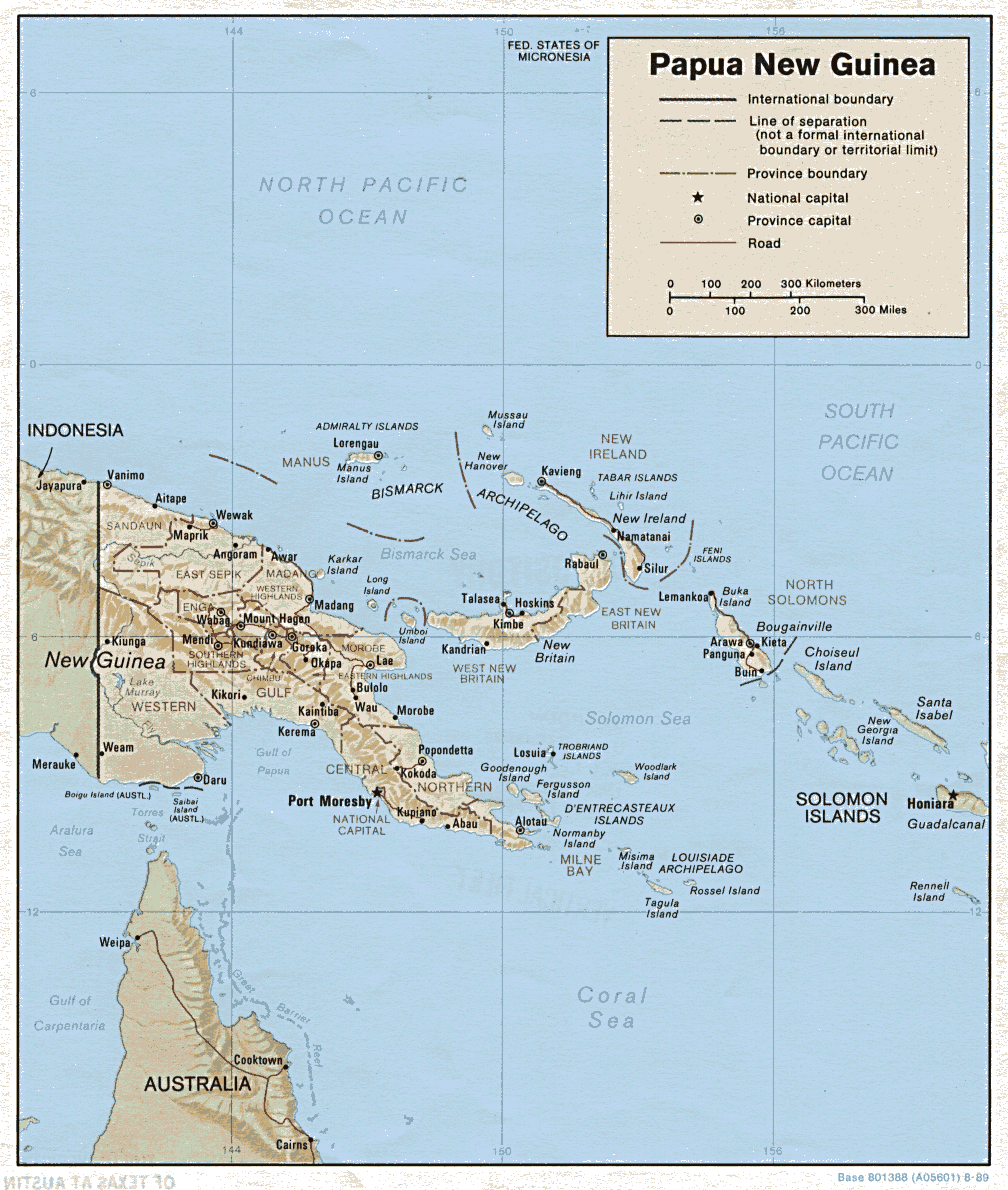
Morobe Province in Papua New Guinea was evangelized by German Lutheran missionaries beginning in 1886. The Germans adapted two local languages for evangelical and educational purposes, Jabêm for the Austronesian circuit along the coast and islands, and Kâte for the Papuan circuit in the interior of the Huon Peninsula. (Many, if not most, of the other interior languages of Morobe Province have since proven to be Austronesian, not Papuan.)

The German Lutheran strategy for communicating new Christian concepts was to adapt the local vernaculars rather than to introduce foreign words—not unlike the strategy of Martin Luther himself during the Protestant Reformation. The following examples are from Jabêm, in whose German-inspired orthography j represents a palatal glide (like English y), ŋ represents a velar nasal (like English -ng), and -c represents a glottal stop.

  • biŋsu ‘foreign missionary’ (also ‘admonition, commandment’)
  • biŋ gôliŋ ‘parable, proverb’ (lit. ‘talk steer’)
  • gôlôàc ‘congregation’ (also ‘clan, relatives, kinfolk’)
  • gêbêcauc dabuŋ ‘Christmas Eve’ (lit. ‘night holy/taboo’)
  • moasiŋ dabuŋ ‘holy communion’ (lit. ‘benefit/blessing holy’)
  • ŋalau dabuŋ ‘Holy Spirit’
  • kêdôŋwaga ‘teacher’ (lit. ‘3sg-teach-agent’)
  • sakiŋwaga ‘minister, servant’ (lit. ‘service-agent’)
  • jàeŋwaga ‘catechist, local missionary’ (lit. ‘message-agent’)

SOURCES: Yapese–English Dictionary, by John Thayer Jensen with the assistance of John Baptist Iou, Raphael Defeg, Leo David Pugram (U. Hawai‘i Press, 1977); Jabêm–English Dictionary, rev. by J. F. Streicher (Pacific Linguistics, 1982).

Leave a comment

Filed under Germany, language, Micronesia, Pacific, Papua New Guinea, religion, Spain

Earliest Filipino Immigrants to North America

In 2006, the State of Hawai‘i celebrated its centennial of Philippine immigration, but the earliest Filipino immigrants to North America arrived in 1763, and their story was first brought to the attention of Americans by a writer chiefly famous for his ties to Japan, Lafcadio Hearn, according to The Filipino Americans (1763–Present): Their History, Culture, and Traditions, by Veltisezar Bautista (Bookhaus, 2002), excerpted at length here.

About 235 years ago, a settlement was established by Filipino deserters from Spanish ships at Saint Malo in the bayous of Louisiana, near the city of New Orleans, Louisiana. The people who settled there were called Manilamen, who jumped ship during the galleon trade era off New Orleans, Louisiana, and Acapulco, Mexico, to escape Spanish brutalities. Known as Tagalas, they spoke Spanish and a Malay dialect. They lived together—governing themselves and living in peace and harmony—without the world knowing about their swamp existence.

Thus, they became the roots of Filipinos in America.

It was only after a journalist by the name of Lafcadio Hearn published an article in 1883 when their marshland existence was exposed to the American people. It was the first known written article about the Filipinos in the U.S.A.

(Note: This write-up was adapted from Hearn’s article entitled Saint Malo: A Lacustrine Village in Louisiana, published in the Harper’s Weekly, March 31, 1883.)

The Times-Democrat of New Orleans chartered an Italian lugger—a small ship lug-rigged on two or three masts—with Hearn and an artist of the Harper Weekly on board. The journey began from the Spanish fort across Lake Ponchartrain. After several miles of their trip, Hearn and the artist saw a change in scenery. There were many kinds of grasses, everywhere along the long route. As Hearn described it, “The shore itself sinks, the lowland bristles with rushes and marsh grasses waving in the wind. A little further on and the water becomes deeply clouded with sap green—the myriad floating seeds of swamp vegetation. Banks dwindle away into thin lines; the greenish, yellow of the reeds changes into misty blue.”

UPDATE: In the comments, Lirelou expresses some doubts about the location and date of this account.

There are some definite disconnects here. First, no treasure galleons operated anywhere near Louisiana. Spanish treasure from the Philippines was off-loaded at Acapulco and transported across the country (through Mexico City) to Veracruz, from where it travelled to La Habana, and after that, off to Spain. Second, Filipinos were not unknown in Mexico. Indeed, the Mexican national dress (la Poblana) is generally agreed to have been inspired by the the Filipina wife of a prominent colonial official in Puebla, who was known throughout the city as “la china poblana”. The “chinese” allusion is in reference to her race. Filipinos were classified as “chinos” in Mexican colonial records. More to the point, when the city of Los Angeles was founded in the 1780s, one of the founding families was listed as “chinos” whose place of birth was “Manila, Islas Filipinas”. So, Filipinos played some minor roles in Mexican colonial history as far north as California. The tone of the original article suggests that it was written at a time when tales of Spanish atrocities against their colonial subjects abounded. This does not mean that Saint Malo was not founded by Filipinos who had jumped ship from Mexico. Spain received Louisiana from France in compensation for the loss of Havana in the Seven Years War (1[7]63), and had a tough time recruiting colonists. After several failed attempts in Spain, they turned to Acadians recently paroled to France, with the end result that enough of these latter volunteered to leave us the Cajuns of today. The colony was, until its return to France, sustained and supplied out of Mexico.

4 Comments

Filed under Hawai'i, Japan, North America, Philippines, Spain

The ICC: An International (Neo-)Colonial Court?

In June 1998 the treaty for the International Criminal Court was signed in Rome…. Despite the positive publicity the court has already received from the human rights movement, it can only magnify the dangers of the ad hoc tribunals. The standard of justice that will be delivered has already been widely questioned, as the odds will be stacked high against defendants with the court structured to enable close co-operation between the judges and prosecution at the expense of impartiality and even-handed justice. The dependence of the court on the support of the major powers indicates that those brought to account for ‘international crimes’ will be little different than under the present ad hoc system. Like its ad hoc predecessors, it will be little more than the backdrop for show trials against ‘countries like Rwanda and former Yugoslavia where none of the combatants have superpower support’.

The human rights NGOs have been heavily involved in these international institutional developments. Amnesty International and Human Rights Watch led the lobbying of nearly 200 NGOs with delegates involved at the 1998 Rome Conference. The main message of the NGO reports was summed up by Human Rights Watch: ‘Delegates are urged to ensure that the Rules do not add to the burdens of the Prosecutor, create additional procedural steps or further limit the Court’s jurisdiction.’ Even legal commentators supportive of the new court were taken aback by the desire of these groups to abandon judicial neutrality in the search for ‘justice’. Geoffrey Robertson QC notes ‘what was truly ironic was their zeal for a court so tough that it would actually violate the basic human rights of its defendants’. Amnesty International, an NGO that established its reputation by prioritising the rights of defendants, has even called for the abolition of traditional defences, such as duress, necessity and even self-defence, for those accused of crimes against humanity. The rapidity with which established human rights NGOs, such as Amnesty, which previously defended the rights of all defendants, have taken up the agenda of international institutions, illustrates the shift away from universalist approaches to ‘justice’ today….

The developments in international law since 1990 have been greeted by the human rights community as universalising and extending the law, providing greater protections for the least powerful…. In fact, the reverse is true. Attempts to strengthen international law, without the development of any global authority able to stand above powerful nation-state interests, have instead reinforced the political and economic inequalities in the world. Removing the rights of non-Western states to formal equality in international law has not led to a redistribution of power away from the powerful to the weak, but reinforced existing social and economic inequalities, institutionalising them in law and politics. Despite their rhetorical critiques of the old Westphalian order, the advocates of ‘international justice’ have done much to resurrect it. As we have seen in the Middle East, Africa, the Balkans and Afghanistan, the development of new international jurisdictions has heralded a return to the system of open Great Power domination over states which are too weak to prevent external claims against them. As Simon Jenkins notes:

Augusto Pinochet of Chile is seized from the authority of his own people for inquisition by Chile’s former ruler, Spain. President Saddam Hussein [was] being bombed by Iraq’s one-time overlord, Britain … Post-colonial warlords are summoned from Africa to stand trial for ‘war crimes’ in once-imperial European capitals.

What is different in the twenty-first century is that this open domination is not legitimised by a conservative elite, on the basis of racial superiority and an imperial mission, but by a liberal elite, on the basis of ethical superiority and a human rights mission.

SOURCE: From Kosovo to Kabul and Beyond: Human Rights and International Intervention, new ed., by David Chandler (Pluto Press, 2006), pp. 147-148, 155-156 (reference citations removed)

1 Comment

Filed under Afghanistan, NGOs, Spain

The Real Dracula’s Contemporaries

The real Dracula, who ruled the territories that now constitute Romania, was born in 1431, the year that Joan of Arc was burned as a witch at the stake in Rouen, France. He died in 1476, two years before Spain was united as a kingdom under the rule of Isabella of Castile and Ferdinand of Aragon. He was very much the by-product of the Europe of his day — the Renaissance, essentially a period of transition….

It was in the age of Dracula that the notion was introduced of Balkan crusading, the efforts of the lands on the fringes of the Ottoman conquest, the borderlands of Europe, to resist the power of Islam in the name of the cross. It represented a struggle in defense of Europe quite as significant as the Spanish resistance to the Moors, which had preceded it….

One of the more tragic aspects of the Turkish onslaught on Europe was the western powers’ reluctance to defend the frontiers of their culture in eastern Europe. This extraordinary failure of moral fortitude was not intelligible in the fifteenth century, since French ruling families had originally consolidated the Polish and Hungarian states; Venetians, Pisans, Genoese, and Spaniards ruled in the eastern Mediterranean and Aegean seas; and countless western adventurers occupied a string of threatened colonies along the disputed eastern coast and on the islands near what are now Yugoslavia and Greece.

The pretexts for the fifteenth-century failure of the west to respond to successive crusading appeals were no different from those that had awakened such deep emotional response during the heyday of the crusades, in the age of faith. Charles VII, king of France, the oldest daughter of the Catholic church and foremost crusading power, had just emerged from one of the most crucial conflicts in his country’s history, the Hundred Years’ War. He and his soon-to-be successor, Louis XI, “the Spider King,” who had a predilection for hanging young boys from the branches of trees and placing his enemies in cages to consolidate royal power, had just liberated their country from the English. The French kings were also busy fighting the dukes of Burgundy for supremacy in the French state. The semiroyal dukes of Burgundy were in fact the only rulers within the actual territories of what is now France who for a time remained true to the crusading tradition. Their generous participation in Dracula’s father‘s crusade in 1446 atoned somewhat for the ineffectiveness of their cousins in Paris.

England was to be no more closely drawn than France into fighting the Muslims; the traditions of Richard the Lionhearted were entirely forgotten. Two rival families there were locked in a desperate struggle for survival, the Wars of the Roses (1455–1485). (The white rose was the symbol of the followers of the Duke of York and the red rose represented the House of Lancaster.) This last of England’s feudal wars dragged on throughout Dracula’s lifetime. The only Englishmen connected in any way to our plot were individual soldiers of fortune who enrolled as volunteers in various crusading armies. (One of these veterans, John Tiptoft, Earl of Worcester, later used the impalement technique that he had learned in eastern Europe to kill his Lancastrian enemies. He was executed for his crimes.) …

Of the lands of the future Kingdom of Spain, only Aragon faces eastward. In particular, the Catalans of Barcelona, an important Mediterranean port, were concerned by the Turkish menace, because it threatened ancient commercial routes and their appetite for eastern expansion. Even before Dracula’s time, an effective group of military adventurers had been formed, the famous Catalan Company, to defend the Byzantine emperors against all their enemies, though in effect the Catalans fought for themselves. The Aragonese wished, through Balkan crusading, to forge commercial and political contacts with the Aegean, the Adriatic, and the Black Sea. The ambitions of the Aragonese king, Alfonso V, are best exemplified by the decision of his bastard son Ferrante to make Naples — closer to the eastern theater of war — the center of his power. Ferrante managed to perpetuate his rule through the use of terror: having killed most of his political opponents, he had his victims mummified and placed in the royal museum, where they were shown to his guests.

Fifteenth-century Italy was the headquarters of the Renaissance. Although Niccolo Machiavelli was not born until 1469, the amoral principles he would set out in The Prince (1517) were being applied well ahead of publication. There was certainly little evidence then of Italian patriotism among the warring republics and city-states of northern Italy, and less evidence of crusading spirit, though the straits of Otranto, at the heel of the peninsula, separate Italy from the Balkans by only some thirty miles….

It was the pontificate (1458–1464) of Enea Silvio de’ Piccolomini, the future Pope Pius II, that most closely coincided with Dracula’s reign. Piccolomini began his career as a libertine not devoid of literary talent and changed his ways only when he became a priest in 1446. He was enough of a medievalist to understand the threat inherent in the Ottoman expansion. From 1459 onward the Pope repeatedly appealed to the Christian powers to join in a common crusade, and he raised the monies to subsidize such a concerted movement. Indeed, Pius II, although a “Europeanist,” saw the Ottoman menace not merely as a danger for eastern Europe but for Christianity itself. Dracula alone responded to his call.

SOURCE: Dracula, Prince of Many Faces: His Life and His Times, by Radu R. Florescu and Raymond T. McNally (Back Bay, 1989), pp. 13, 15, 20-21, 23-24

UPDATE: This book is certainly filling in a lot of gaps in my heretofore rather superficial Draculalogy, as well as my understanding of Romanian medieval history more generally. Although I had encountered during my Fulbright year there in 1983-84 many of the famous names in Romanian history—like Ştefan cel Mare, Mircea cel Bătrân, Vlad Dracul, and Dracula—I had not realized that Mircea the Elder (1386-1418), Vlad Dracul (r. 1436-1442), and Vlad Dracula (r. 1448, 1456-1462, 1476) were Father, Son, and the Unholy Impaler; nor that Vlad Dracul acquired his epithet from being named to the crusading Order of the Dragon (not Devil) by the Holy Roman Emperor, in whose court at Nuremberg he served as page; nor that Vlad the Impaler impaled almost as many Transylvanian Germans as he did Turks; nor that the Impaler may have been born in Sighişoara (pictured above, from our visit in 1984), but held court at Târgovişte, on the Wallachian side of the Carpathians and upriver from Bucharest.

Leave a comment

Filed under Romania, Spain

Mississippi River Flood, 1543

IN 1543, GARCILASO DE LA VEGA, a member of Hernando de Soto’s expedition, was one of the first white men to see the Mississippi River. He recorded its power: “Then God, our Lord, hindered the work with a mighty flood of the great river, which … came down with an enormous increase of water, which in the beginning overflowed the wide level ground between the river and the cliffs”—meaning the river’s banks, which towered above the river at low water—”then little by little it rose to the top of the cliffs. Soon it began to flow over the fields in an immense flood, and as the land was level, without any hills, there was nothing to stop the inundation. On the 18th of March, 1543, … the river entered with ferocity through the gates of the town of Aminoya [an Indian village near the present site of Greenville, Mississippi]. It was a beautiful thing to look upon the sea that had been fields, for on each side of the river the water extended over twenty leagues”—nearly 60 miles—”of land, and [within] all of this area … nothing was seen but the tops of the tallest trees…. These floods occur every fourteen years, according to what an old Indian woman told us, which can be verified if the country is conquered, as I hope it will be.”

SOURCE: Rising Tide: The Great Mississippi Flood of 1927 and How It Changed America, by John M. Barry (Touchstone, 1998), p. 173

Leave a comment

Filed under Spain, U.S.

T. G. Ash on the Luck of the Poles

Timothy Garton Ash, who did some of the best reporting (in English) from Poland during the rise of Solidarity and the Götterdämmerung of the Soviet Empire, recently published a catch-up piece in the New York Review of Books.

Peoples can be luckier than people. People are only young once. They seize their chances or miss them; then they grow old and die. Despite the anthropomorphic similes beloved of romantic nationalists—”young Italy,” “young Germany”—peoples “live,” in some important sense, for centuries, even millennia, sustained by real or imagined continuities of political geography and collective experience. They can be “sick” or “old” for hundreds of years, but then become renewed and youthful.

China today is one example, Spain another, and Poland a third. For two hundred years, from the end of the eighteenth century, when the first Polish rzeczpospolita, or republic (actually an elective monarchy), was divided up like a Christmas turkey between the Prussian, Russian, and Austrian empires, to Poland’s achievement of full independence (within very different frontiers) at the end of the twentieth century, the Poles had only two decades of fragile self-rule in a single state— their “second republic,” between 1918 and 1939….

Peoples can be luckier than people. But in a given time, what matters most is the happiness of the individual people who make up a given people. Honesty demands a plain acknowledgment that for millions of Polish men and women, especially among the workers, the poor, the old, and those living in the south and east, the years since 1989 have been painful and disappointing. For them, the reality of freedom has proved very different from the dream.

There is, however, another side to the story. One of the unexpected delights of the Solidarity anniversary reunion was to meet not just old friends and acquaintances, but their children —now, like my own, in their early twenties. Back in 1980, my Polish friends and I lived in different worlds. Not just the political possibilities but the life chances, in the broadest sense, of a young Pole were incomparably more limited than those of a young Brit. In the generation of our children, that is no longer true. Today, the life chances of an enterprising young Pole are altogether comparable with those of a young Brit, and by no means only for those from a privileged background, as I see every day among the Polish students and student-workers in Oxford. Something has been won.

via Arts & Letters Daily

Leave a comment

Filed under China, Spain