Category Archives: Spain

New Religious Terms in Two Pacific Languages

How have local languages in the Pacific handled the new lexical requirements of foreign religious traditions? Much seems to depend on the language and sect of the first foreign evangelists.

The island of Yap in Micronesia was first evangelized by Spanish Catholics long before German Protestants arrived about 1898. Yapese is still largely Catholic, and religious loans are mostly from Spanish. Shinto seems to have left no lexical traces from the Japanese colonial era (1914–1945), but loanwords from Japanese remain well represented in the more profane contexts of the new clothing, containers, diseases, foods, tools, and means of transport introduced during those decades.

The following examples of Christian terms do considerable violence to the vowels of Yap’s new orthography, which would take too long to explain—and would also make the words look more Dutch than Spanish.

  • bibliya ‘Bible’ (Span.)
  • galasya ‘church’ (Span.)
  • kiristiyano ‘Christian’ (Span.)
  • komunyon ‘communion’ (Span.)
  • kuruth ‘cross, crucifix’ (Span.)
  • infiyarno ‘hell’ (Span.)
  • misa ‘(Catholic) mass’ (Span.)
  • padrey ‘priest’ (Span.)
  • rosaryo ‘rosary’ (Span.)
  • baynag ‘Christmas’ (Ger. Weihnacht)
  • næp’ ni-b thothup ‘Christmas Eve, Holy Night’ (lit. ‘night that’s holy’)

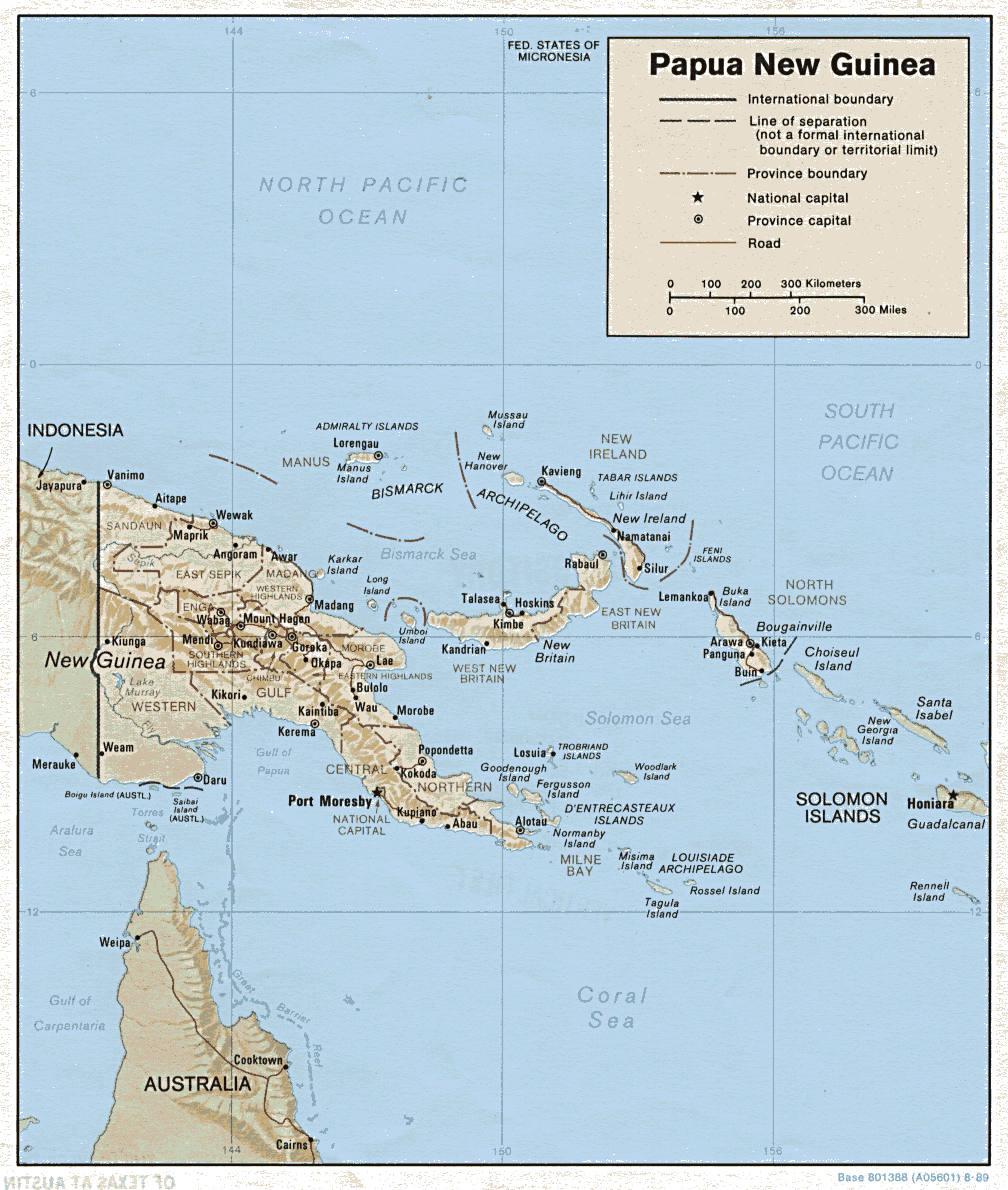
Morobe Province in Papua New Guinea was evangelized by German Lutheran missionaries beginning in 1886. The Germans adapted two local languages for evangelical and educational purposes, Jabêm for the Austronesian circuit along the coast and islands, and Kâte for the Papuan circuit in the interior of the Huon Peninsula. (Many, if not most, of the other interior languages of Morobe Province have since proven to be Austronesian, not Papuan.)

The German Lutheran strategy for communicating new Christian concepts was to adapt the local vernaculars rather than to introduce foreign words—not unlike the strategy of Martin Luther himself during the Protestant Reformation. The following examples are from Jabêm, in whose German-inspired orthography j represents a palatal glide (like English y), ŋ represents a velar nasal (like English -ng), and -c represents a glottal stop.

  • biŋsu ‘foreign missionary’ (also ‘admonition, commandment’)
  • biŋ gôliŋ ‘parable, proverb’ (lit. ‘talk steer’)
  • gôlôàc ‘congregation’ (also ‘clan, relatives, kinfolk’)
  • gêbêcauc dabuŋ ‘Christmas Eve’ (lit. ‘night holy/taboo’)
  • moasiŋ dabuŋ ‘holy communion’ (lit. ‘benefit/blessing holy’)
  • ŋalau dabuŋ ‘Holy Spirit’
  • kêdôŋwaga ‘teacher’ (lit. ‘3sg-teach-agent’)
  • sakiŋwaga ‘minister, servant’ (lit. ‘service-agent’)
  • jàeŋwaga ‘catechist, local missionary’ (lit. ‘message-agent’)

SOURCES: Yapese–English Dictionary, by John Thayer Jensen with the assistance of John Baptist Iou, Raphael Defeg, Leo David Pugram (U. Hawai‘i Press, 1977); Jabêm–English Dictionary, rev. by J. F. Streicher (Pacific Linguistics, 1982).

Leave a comment

Filed under Germany, language, Micronesia, Pacific, Papua New Guinea, religion, Spain

Earliest Filipino Immigrants to North America

In 2006, the State of Hawai‘i celebrated its centennial of Philippine immigration, but the earliest Filipino immigrants to North America arrived in 1763, and their story was first brought to the attention of Americans by a writer chiefly famous for his ties to Japan, Lafcadio Hearn, according to The Filipino Americans (1763–Present): Their History, Culture, and Traditions, by Veltisezar Bautista (Bookhaus, 2002), excerpted at length here.

About 235 years ago, a settlement was established by Filipino deserters from Spanish ships at Saint Malo in the bayous of Louisiana, near the city of New Orleans, Louisiana. The people who settled there were called Manilamen, who jumped ship during the galleon trade era off New Orleans, Louisiana, and Acapulco, Mexico, to escape Spanish brutalities. Known as Tagalas, they spoke Spanish and a Malay dialect. They lived together—governing themselves and living in peace and harmony—without the world knowing about their swamp existence.

Thus, they became the roots of Filipinos in America.

It was only after a journalist by the name of Lafcadio Hearn published an article in 1883 when their marshland existence was exposed to the American people. It was the first known written article about the Filipinos in the U.S.A.

(Note: This write-up was adapted from Hearn’s article entitled Saint Malo: A Lacustrine Village in Louisiana, published in the Harper’s Weekly, March 31, 1883.)

The Times-Democrat of New Orleans chartered an Italian lugger—a small ship lug-rigged on two or three masts—with Hearn and an artist of the Harper Weekly on board. The journey began from the Spanish fort across Lake Ponchartrain. After several miles of their trip, Hearn and the artist saw a change in scenery. There were many kinds of grasses, everywhere along the long route. As Hearn described it, “The shore itself sinks, the lowland bristles with rushes and marsh grasses waving in the wind. A little further on and the water becomes deeply clouded with sap green—the myriad floating seeds of swamp vegetation. Banks dwindle away into thin lines; the greenish, yellow of the reeds changes into misty blue.”

UPDATE: In the comments, Lirelou expresses some doubts about the location and date of this account.

There are some definite disconnects here. First, no treasure galleons operated anywhere near Louisiana. Spanish treasure from the Philippines was off-loaded at Acapulco and transported across the country (through Mexico City) to Veracruz, from where it travelled to La Habana, and after that, off to Spain. Second, Filipinos were not unknown in Mexico. Indeed, the Mexican national dress (la Poblana) is generally agreed to have been inspired by the the Filipina wife of a prominent colonial official in Puebla, who was known throughout the city as “la china poblana”. The “chinese” allusion is in reference to her race. Filipinos were classified as “chinos” in Mexican colonial records. More to the point, when the city of Los Angeles was founded in the 1780s, one of the founding families was listed as “chinos” whose place of birth was “Manila, Islas Filipinas”. So, Filipinos played some minor roles in Mexican colonial history as far north as California. The tone of the original article suggests that it was written at a time when tales of Spanish atrocities against their colonial subjects abounded. This does not mean that Saint Malo was not founded by Filipinos who had jumped ship from Mexico. Spain received Louisiana from France in compensation for the loss of Havana in the Seven Years War (1[7]63), and had a tough time recruiting colonists. After several failed attempts in Spain, they turned to Acadians recently paroled to France, with the end result that enough of these latter volunteered to leave us the Cajuns of today. The colony was, until its return to France, sustained and supplied out of Mexico.

4 Comments

Filed under Hawai'i, Japan, North America, Philippines, Spain

The ICC: An International (Neo-)Colonial Court?

In June 1998 the treaty for the International Criminal Court was signed in Rome…. Despite the positive publicity the court has already received from the human rights movement, it can only magnify the dangers of the ad hoc tribunals. The standard of justice that will be delivered has already been widely questioned, as the odds will be stacked high against defendants with the court structured to enable close co-operation between the judges and prosecution at the expense of impartiality and even-handed justice. The dependence of the court on the support of the major powers indicates that those brought to account for ‘international crimes’ will be little different than under the present ad hoc system. Like its ad hoc predecessors, it will be little more than the backdrop for show trials against ‘countries like Rwanda and former Yugoslavia where none of the combatants have superpower support’.

The human rights NGOs have been heavily involved in these international institutional developments. Amnesty International and Human Rights Watch led the lobbying of nearly 200 NGOs with delegates involved at the 1998 Rome Conference. The main message of the NGO reports was summed up by Human Rights Watch: ‘Delegates are urged to ensure that the Rules do not add to the burdens of the Prosecutor, create additional procedural steps or further limit the Court’s jurisdiction.’ Even legal commentators supportive of the new court were taken aback by the desire of these groups to abandon judicial neutrality in the search for ‘justice’. Geoffrey Robertson QC notes ‘what was truly ironic was their zeal for a court so tough that it would actually violate the basic human rights of its defendants’. Amnesty International, an NGO that established its reputation by prioritising the rights of defendants, has even called for the abolition of traditional defences, such as duress, necessity and even self-defence, for those accused of crimes against humanity. The rapidity with which established human rights NGOs, such as Amnesty, which previously defended the rights of all defendants, have taken up the agenda of international institutions, illustrates the shift away from universalist approaches to ‘justice’ today….

The developments in international law since 1990 have been greeted by the human rights community as universalising and extending the law, providing greater protections for the least powerful…. In fact, the reverse is true. Attempts to strengthen international law, without the development of any global authority able to stand above powerful nation-state interests, have instead reinforced the political and economic inequalities in the world. Removing the rights of non-Western states to formal equality in international law has not led to a redistribution of power away from the powerful to the weak, but reinforced existing social and economic inequalities, institutionalising them in law and politics. Despite their rhetorical critiques of the old Westphalian order, the advocates of ‘international justice’ have done much to resurrect it. As we have seen in the Middle East, Africa, the Balkans and Afghanistan, the development of new international jurisdictions has heralded a return to the system of open Great Power domination over states which are too weak to prevent external claims against them. As Simon Jenkins notes:

Augusto Pinochet of Chile is seized from the authority of his own people for inquisition by Chile’s former ruler, Spain. President Saddam Hussein [was] being bombed by Iraq’s one-time overlord, Britain … Post-colonial warlords are summoned from Africa to stand trial for ‘war crimes’ in once-imperial European capitals.

What is different in the twenty-first century is that this open domination is not legitimised by a conservative elite, on the basis of racial superiority and an imperial mission, but by a liberal elite, on the basis of ethical superiority and a human rights mission.

SOURCE: From Kosovo to Kabul and Beyond: Human Rights and International Intervention, new ed., by David Chandler (Pluto Press, 2006), pp. 147-148, 155-156 (reference citations removed)

1 Comment

Filed under Afghanistan, NGOs, Spain

The Real Dracula’s Contemporaries

The real Dracula, who ruled the territories that now constitute Romania, was born in 1431, the year that Joan of Arc was burned as a witch at the stake in Rouen, France. He died in 1476, two years before Spain was united as a kingdom under the rule of Isabella of Castile and Ferdinand of Aragon. He was very much the by-product of the Europe of his day — the Renaissance, essentially a period of transition….

It was in the age of Dracula that the notion was introduced of Balkan crusading, the efforts of the lands on the fringes of the Ottoman conquest, the borderlands of Europe, to resist the power of Islam in the name of the cross. It represented a struggle in defense of Europe quite as significant as the Spanish resistance to the Moors, which had preceded it….

One of the more tragic aspects of the Turkish onslaught on Europe was the western powers’ reluctance to defend the frontiers of their culture in eastern Europe. This extraordinary failure of moral fortitude was not intelligible in the fifteenth century, since French ruling families had originally consolidated the Polish and Hungarian states; Venetians, Pisans, Genoese, and Spaniards ruled in the eastern Mediterranean and Aegean seas; and countless western adventurers occupied a string of threatened colonies along the disputed eastern coast and on the islands near what are now Yugoslavia and Greece.

The pretexts for the fifteenth-century failure of the west to respond to successive crusading appeals were no different from those that had awakened such deep emotional response during the heyday of the crusades, in the age of faith. Charles VII, king of France, the oldest daughter of the Catholic church and foremost crusading power, had just emerged from one of the most crucial conflicts in his country’s history, the Hundred Years’ War. He and his soon-to-be successor, Louis XI, “the Spider King,” who had a predilection for hanging young boys from the branches of trees and placing his enemies in cages to consolidate royal power, had just liberated their country from the English. The French kings were also busy fighting the dukes of Burgundy for supremacy in the French state. The semiroyal dukes of Burgundy were in fact the only rulers within the actual territories of what is now France who for a time remained true to the crusading tradition. Their generous participation in Dracula’s father‘s crusade in 1446 atoned somewhat for the ineffectiveness of their cousins in Paris.

England was to be no more closely drawn than France into fighting the Muslims; the traditions of Richard the Lionhearted were entirely forgotten. Two rival families there were locked in a desperate struggle for survival, the Wars of the Roses (1455–1485). (The white rose was the symbol of the followers of the Duke of York and the red rose represented the House of Lancaster.) This last of England’s feudal wars dragged on throughout Dracula’s lifetime. The only Englishmen connected in any way to our plot were individual soldiers of fortune who enrolled as volunteers in various crusading armies. (One of these veterans, John Tiptoft, Earl of Worcester, later used the impalement technique that he had learned in eastern Europe to kill his Lancastrian enemies. He was executed for his crimes.) …

Of the lands of the future Kingdom of Spain, only Aragon faces eastward. In particular, the Catalans of Barcelona, an important Mediterranean port, were concerned by the Turkish menace, because it threatened ancient commercial routes and their appetite for eastern expansion. Even before Dracula’s time, an effective group of military adventurers had been formed, the famous Catalan Company, to defend the Byzantine emperors against all their enemies, though in effect the Catalans fought for themselves. The Aragonese wished, through Balkan crusading, to forge commercial and political contacts with the Aegean, the Adriatic, and the Black Sea. The ambitions of the Aragonese king, Alfonso V, are best exemplified by the decision of his bastard son Ferrante to make Naples — closer to the eastern theater of war — the center of his power. Ferrante managed to perpetuate his rule through the use of terror: having killed most of his political opponents, he had his victims mummified and placed in the royal museum, where they were shown to his guests.

Fifteenth-century Italy was the headquarters of the Renaissance. Although Niccolo Machiavelli was not born until 1469, the amoral principles he would set out in The Prince (1517) were being applied well ahead of publication. There was certainly little evidence then of Italian patriotism among the warring republics and city-states of northern Italy, and less evidence of crusading spirit, though the straits of Otranto, at the heel of the peninsula, separate Italy from the Balkans by only some thirty miles….

It was the pontificate (1458–1464) of Enea Silvio de’ Piccolomini, the future Pope Pius II, that most closely coincided with Dracula’s reign. Piccolomini began his career as a libertine not devoid of literary talent and changed his ways only when he became a priest in 1446. He was enough of a medievalist to understand the threat inherent in the Ottoman expansion. From 1459 onward the Pope repeatedly appealed to the Christian powers to join in a common crusade, and he raised the monies to subsidize such a concerted movement. Indeed, Pius II, although a “Europeanist,” saw the Ottoman menace not merely as a danger for eastern Europe but for Christianity itself. Dracula alone responded to his call.

SOURCE: Dracula, Prince of Many Faces: His Life and His Times, by Radu R. Florescu and Raymond T. McNally (Back Bay, 1989), pp. 13, 15, 20-21, 23-24

UPDATE: This book is certainly filling in a lot of gaps in my heretofore rather superficial Draculalogy, as well as my understanding of Romanian medieval history more generally. Although I had encountered during my Fulbright year there in 1983-84 many of the famous names in Romanian history—like Ştefan cel Mare, Mircea cel Bătrân, Vlad Dracul, and Dracula—I had not realized that Mircea the Elder (1386-1418), Vlad Dracul (r. 1436-1442), and Vlad Dracula (r. 1448, 1456-1462, 1476) were Father, Son, and the Unholy Impaler; nor that Vlad Dracul acquired his epithet from being named to the crusading Order of the Dragon (not Devil) by the Holy Roman Emperor, in whose court at Nuremberg he served as page; nor that Vlad the Impaler impaled almost as many Transylvanian Germans as he did Turks; nor that the Impaler may have been born in Sighişoara (pictured above, from our visit in 1984), but held court at Târgovişte, on the Wallachian side of the Carpathians and upriver from Bucharest.

Leave a comment

Filed under Romania, Spain

Mississippi River Flood, 1543

IN 1543, GARCILASO DE LA VEGA, a member of Hernando de Soto’s expedition, was one of the first white men to see the Mississippi River. He recorded its power: “Then God, our Lord, hindered the work with a mighty flood of the great river, which … came down with an enormous increase of water, which in the beginning overflowed the wide level ground between the river and the cliffs”—meaning the river’s banks, which towered above the river at low water—”then little by little it rose to the top of the cliffs. Soon it began to flow over the fields in an immense flood, and as the land was level, without any hills, there was nothing to stop the inundation. On the 18th of March, 1543, … the river entered with ferocity through the gates of the town of Aminoya [an Indian village near the present site of Greenville, Mississippi]. It was a beautiful thing to look upon the sea that had been fields, for on each side of the river the water extended over twenty leagues”—nearly 60 miles—”of land, and [within] all of this area … nothing was seen but the tops of the tallest trees…. These floods occur every fourteen years, according to what an old Indian woman told us, which can be verified if the country is conquered, as I hope it will be.”

SOURCE: Rising Tide: The Great Mississippi Flood of 1927 and How It Changed America, by John M. Barry (Touchstone, 1998), p. 173

Leave a comment

Filed under Spain, U.S.

T. G. Ash on the Luck of the Poles

Timothy Garton Ash, who did some of the best reporting (in English) from Poland during the rise of Solidarity and the Götterdämmerung of the Soviet Empire, recently published a catch-up piece in the New York Review of Books.

Peoples can be luckier than people. People are only young once. They seize their chances or miss them; then they grow old and die. Despite the anthropomorphic similes beloved of romantic nationalists—”young Italy,” “young Germany”—peoples “live,” in some important sense, for centuries, even millennia, sustained by real or imagined continuities of political geography and collective experience. They can be “sick” or “old” for hundreds of years, but then become renewed and youthful.

China today is one example, Spain another, and Poland a third. For two hundred years, from the end of the eighteenth century, when the first Polish rzeczpospolita, or republic (actually an elective monarchy), was divided up like a Christmas turkey between the Prussian, Russian, and Austrian empires, to Poland’s achievement of full independence (within very different frontiers) at the end of the twentieth century, the Poles had only two decades of fragile self-rule in a single state— their “second republic,” between 1918 and 1939….

Peoples can be luckier than people. But in a given time, what matters most is the happiness of the individual people who make up a given people. Honesty demands a plain acknowledgment that for millions of Polish men and women, especially among the workers, the poor, the old, and those living in the south and east, the years since 1989 have been painful and disappointing. For them, the reality of freedom has proved very different from the dream.

There is, however, another side to the story. One of the unexpected delights of the Solidarity anniversary reunion was to meet not just old friends and acquaintances, but their children —now, like my own, in their early twenties. Back in 1980, my Polish friends and I lived in different worlds. Not just the political possibilities but the life chances, in the broadest sense, of a young Pole were incomparably more limited than those of a young Brit. In the generation of our children, that is no longer true. Today, the life chances of an enterprising young Pole are altogether comparable with those of a young Brit, and by no means only for those from a privileged background, as I see every day among the Polish students and student-workers in Oxford. Something has been won.

via Arts & Letters Daily

Leave a comment

Filed under China, Spain

Chile’s Remarkably Unremarkable Election

Cuban-born columnist Carlos Alberto Montaner remarks in the Miami Herald on the remarkably unremarkable election of Michelle Bachelet (interviewed last night on the NewsHour) as Chile’s next president.

Michelle Bachelet and Sebastián Piñera carried out good election campaigns, both colorful and modern. Shortly before Election Day, the pollsters made their predictions: Bachelet, a 54-year-old socialist physician, multilingual, former minister of health and defense, should win by about five percentage points….

By now, of course, the news is not who won the presidency but that, in the electoral field, Chile behaves as a developed and predictable nation. This allows us to make the following observation: Chilean society happily has crossed the threshold of common sense….

The Left that rules Chile is the Left of Tony Blair and Felipe González. It is a Left that, instead of nationalizing the sources of production, stimulates private enterprise and adopts measures to facilitate the functioning of the market. A Left that signs treaties for trade openings with the United States, the Mercosur, the European Union and South Korea because it has learned that Chile’s growing prosperity depends, in large measure, on those intense exchanges. A Left, in sum, that governs honestly with the ideas of the Right — which explains why it is so difficult to defeat it.

What is that desirable “threshold of common sense” and how can it be reached? In essence, the threshold of common sense is that point in history when a decisive percentage of the ruling class agrees on the diagnosis of the ills that plague society and the measures that must be taken to excise them.

In Spain, for example, that point was reached in the late 1970s, after the death of Francisco Franco, when the Right and the Left agreed to respect the basic, successful economic rules of the capitalist model tried out by the dictator, beginning with the reforms of 1959. To those rules they added democracy as a way to form a government and make collective decisions.

Something similar happened in Chile in the early 1990s, during the administration of Patricio Aylwin, the first democratic government post-dictatorship, when the Christian Democrats had the good sense to not renounce the good aspects of Pinochet’s economic policy and to add to them the component of a liberal democracy.

That is why the Coalition for Democracy repeated its election victory for the fourth time: Chileans view Bachelet as a moderate and trustworthy person who will [not?] imperil with extravagant experiments the relative prosperity that Chileans have managed to achieve.

This is not to say that the Chile Bachelet will govern doesn’t face serious problems. Yes, Chile in its 16 years of democratic rule, and continuing a previous trend, reduced poverty from 42 percent to 18 percent. But it is becoming increasingly difficult to further reduce those levels of misery and to bridge the enormous gap that separates the poor from the rich.

In contrast, Montaner has nothing good to say about Cuba after 47 years of Castro.

At this point in history, only two interesting questions remain about the failed experiment staged by Castro on that poor island:

• First, why has a man as eccentric and absurd as he — capable of carrying out feats as improbable as the destruction of the centenary sugar industry, multiplying by 10 the number of prostitutes, executing or eliminating 16,000 people, and pushing into exile 15 percent of the Cuban population — lasted so long in power?

Nobody doubts that his administration is the worst the country has ever endured, incapable for the past half century of allowing Cubans to have drinking water, electricity, food and shelter in minimally reasonable amounts. [But what about the health care?]

• The second question also is obvious: What will happen when he disappears? After all, we’re talking about an ailing 79-year-old man with Parkinson’s disease who exhibits very clear symptoms of senile dementia and has been struck by several cerebral ischemias that have affected his ability to communicate. He mumbles, repeats himself, becomes incoherent and confused, and displays aggressively bad temper at the slightest contrariety.

He can still talk for eight consecutive hours without the slightest concern for his listeners’ bladders. What’s important is not his staying power but the content of his speeches. He is a pitiful man who never stops uttering nonsense, to the embarrassment of a ruling class that has been trained to obey a charismatic and presumably infallible leader and now doesn’t know what to do with this addlebrained and neurotic old geezer who just as blithely designs pygmy cows as he expounds on the unfathomable scientific secret of pressure cookers.

Leave a comment

Filed under Spain

Black Death Pogroms and Jews in Slavic Lands

The belief that the Jews were responsible for the Black Death first took root in southern France and neighboring Spain. In the fourteenth century there were only 2.5 million Jews in all of Europe, but a third of these lived in Spain and on the other side of the Pyrenees in southern France. The Jewish communities in this region were of long standing, in some parts going back to Roman times. There were relatively affluent, extremely literate, and in a relationship of growing tension with their Christian neighbors for both religious and economic reasons….

The Black Death pogroms against the German Jews had the inevitable effect of making them feel frightened and insecure. When Duke Casimir II of Poland not only tried to protect Jews in his domains from pogroms, but invited Jews to move eastward and settle in his vast, underpopulated domains, large numbers of Jews began to move en masse to Poland.

This immigration continued into the sixteenth century. Like many Western European rulers of the early Middle Ages (700-1000), the Polish duke and his successors saw the Jews as an economic asset, bringing credit facilities and long-distance trade to the country.

By 1500 the Jews had been assigned an additional role of importance in Polish society and the frontier Ukrainian lands also ruled by the Polish nobility. They were widely employed as estate agents for the Polish nobility, supervising thousands of peasants forced into serfdom and managing the exploitation of the rich Polish and Ukrainian soil. Jewish males became trilingual–Hebrew for liturgy and rabbinical learning, a Slavic language for business, and Yiddish, a late medieval German dialect written in Hebrew characters, for everyday life in their own communities (most Jewish women knew only Yiddish).

By the mid-sixteenth-century Jews were rewarded for their services. as estate agents with a lucrative monopoly in selling liquor to the peasants. This is the origin of the Yiddish folk song “a Gentile is a drunkard.” Jews also prospered as lumber and fur merchants. Great schools of rabbinical learning, many still in existence when night descended in September 1939, emerged in Poland and the Ukraine. By the early seventeenth century half of the Jewish world population of 3.5 million lived in Poland and the Ukraine.

The Jews came to love the Polish and Ukrainian physical environment and in the nineteenth century (if not much earlier) wrote poetry lavishly praising the farmland, forests, and climate of Eastern Europe. The rise of the great Jewish communities in Slavic Europe, remarkable for their enterprise and traditional learning, and also innovative in religious and literary expression, was a direct result of the Black Death.

SOURCE: In the Wake of the Plague: The Black Death & the World It Made, by Norman F. Cantor (Harper Perennial, 2002), pp. 150-151, 163-165

Leave a comment

Filed under Poland, Spain, Ukraine

From Aristotle via Arabic to Aquinas

The Thomist school grew from the consequences of the penetration into the Paris University around the middle of the twelfth century of the vast corpus of Aristotelian science and philosophy through the medium of Arabic and Jewish schools (also writing in Arabic) in Spain and Sicily.

The Aristotelian corpus was translated in the eastern Mediterranean by Byzantine monks and Arab Muslim scholars into Arabic between 800 and 1000 and found its way, accompanied by various mathematical and medical texts, into Cordoba, Spain, and Palermo, Sicily, by 1050. Previously only Aristotelian logic was available in the West, which was thoroughly dominated by the Platonic idealistic and mystical rather than the Aristotelian scientific and rational frame of thought. By the middle of the thirteenth century Aristotle’s writings were being translated directly from Greek into Latin rather than through Arabic mediation, and these improved translations were available to the corpulent and good-humored Dominican friar at Paris, Thomas Aquinas.

What drove the Thomist mission was a concern that Catholic doctrine was founded on the Bible, church authority, and the more mystical and irrational part of ancient culture, not on reason and Aristotelian science. It was to defend this established faith and high culture–something that the Cairo rabbi Maimonides had already attempted for Judaism, to deep resentment from the Orthodox rabbinate–that Thomas Aquinas, following his Parisian Dominican mentor Albert the Great, set out to show the large-scale compatibility of Catholic faith and Aristotelian reason and science.

SOURCE: In the Wake of the Plague: The Black Death & the World It Made, by Norman F. Cantor (Harper Perennial, 2002), pp. 116-117

Leave a comment

Filed under Spain

Hidden Family Heritages Unearthed in the New World

Regions of Mind directs attention to a very interesting post by Ann Althouse. Here’s Geitner’s summary.

One of the most affecting aspects of the Jewish experience in Inquisition-era Spain was how many Jews professed to have adopted Christianity but in secret maintained the rites of Judaism. Ann Althouse has a terrific post on a 21st-century tangent of this story: Some present-day Latino residents in the United States are discovering that, despite their Catholic heritage, they are the descendants of those Iberian Jews. The comments at Ann’s site are quite interesting, too.

One of Ann’s commenters notes that the hidden infidels who fled the Spanish Inquisition to the New World after 1492 were just as likely to have been Muslim as Jewish.

Leave a comment

Filed under Spain