Category Archives: Netherlands

Extraterritoriality for Everyone

From: Being “Dutch” in the Indies: A History of Creolisation and Empire, 1500–1920, by Ulbe Bosma and Remco Raben, tr. by Wendie Shaffer (National U. Singapore Press, 2008), pp. 4-5:

Segregation and extra-territoriality — the principle that foreign merchants were subject to their own laws — had many advantages. The local ruler had to negotiate with only a few representatives rather than each individual trader. Maintaining law and order — especially when it had to do with family and inheritance law — could be left to the internal authority of the immigrant community. And the advantages were all too clear for the foreign merchants: they were able to continue living under their own laws. “Legal pluralism” — that is, different groups falling under different legal systems and authorities — was characteristic of the fragmented power relations in the cities and states of South and Southeast Asia. The highest authority was the king, but he was not all-powerful. He had to deal with courtiers, regional governors, religious leaders and the representatives of foreign merchants. Each one of these had their own followers, their own servants and their own slaves who remained outsidethe reach of the central ruler.

The distribution of political power was reflected in urban space. In Ayutthaya large communities of foreign merchants lived in ban (villages or districts) situated just outside the city walls. At the close of the 17th century we find mention of communities from Gujarat (Hindustanis), Coromandel (Moors), Pegu, Malacca (Malays), Makassar, Cochin-China (Vietnamese), China, Japan, Portugal, France and the Netherlands. Each of these communities had its own headman; the large Chinese community even had two. However, although in theory the ethnic groups seemed juridically and spatially segregated, daily reality was somewhat more complicated than the above might suggest. Foreigners and their descendants were not prevented from gaining access to the Siamese community. The extensive “Portuguese” settlement — outside the city walls and facing the Dutch trading post — was peopled by “a Portuguese race descended from black women”; in other words, Mestizos, children with a Portuguese father and a Siamese mother. In other communities, too, there was considerable mixing between travellers from abroad and local women, again resulting in children of mixed parentage.

The mixing went beyond family relations; some foreigners even attained high-ranking posts at court. At the end of the 17th century, for instance, the royal guard of Ayutthaya was composed of a couple of hundred Persians, while for three successive generations the chief minister (chaopraya) came from a Persian family, only to be followed by a Greek. Other first ministers were of Indian, Chinese and Mon descent. The king of Siam also employed Englishmen — for instance, as harbour master. Evidently, the king preferred to employ foreigners in key positions, since they did not command a large band of followers who might pose a threat to the throne. But their difference stopped there. Nowhere do we find the suggestion that these families behaved as foreigners. On the contrary, it seems that they adapted themselves to the culture and customs of the Ayutthaya court. They married into Siamese families and ultimately became totally assimilated.

Along the coast of the Malay peninsula and in the Indonesian archipelago, the pattern of segregation and mediation was essentially no different from that in Siam. The city of Malacca, which during the 15th century thrived on the expanding international trade and attracted many foreigners, appointed four syahbandar (harbour masters) to maintain contacts between the local government and various trading communities, and also to administer justice and act as military commanders in times of war. The syahbandar appointed from the Gujaratis of northwest India was described by the Portuguese traveller Tome Pires as “the most important of them all”. Then there was a syahbandar for the merchants from Coromandel, Bengal, Pegu and Pasai (in north Sumatra); one for the foreigners from Java, the Moluccas, Banda, Palembang, Borneo and Luzon; and, finally, one for the Chinese and other traders from the East.

In the 16th and 17th centuries, Ayutthaya and Malacca were among the largest cities in Southeast Asia. Travellers from Europe estimated the population of these places to be as large as 200,000 — although in reality the number would have been closer to 10,000. But whatever the actual figure, there is no doubt that these were bustling emporiums, where a foreigner was not an uncommon sight. There was a prevailing pattern of segregation, but we cannot say with any accuracy how strictly this was applied.

Leave a comment

Filed under economics, Indonesia, Malaysia, Netherlands, Portugal, South Asia, Southeast Asia, Thailand

Borrowed Gender Distinctions in Malay

There was an interesting discussion a couple of weeks ago on the An-lang (Austronesian languages) listserv about how those languages distinguish gender. Here’s my heavily copyedited rendition of the posting by Waruno Mahdi, whose breadth and depth of knowledge about Malay is hard to match.

The situation in Malay is similar to that described by Paz Naylor for Tagalog/Cebuano/Hiligaynon in the Philippines. The language did not originally have gender-specific terms, other than for ‘man’, ‘woman’, ‘mother’, ‘father’, ‘aunt’, ‘uncle’, ‘elder brother’, perhaps also ‘elder sister’. There are also gender-specific honorific titles in Malay folklore, where hang appears before a man’s name and dang before a woman’s name.

Terms for animals can be made gender-specific by adding the attribute jantan ‘male’ or betina ‘female’ behind the gender-neutral noun. That usage is already widespread in the earliest (16th-century) manuscripts, and does not appear to reflect late external influence.

The corresponding pattern for distinguishing male and female human terms is to add lelaki ‘man’ or perempuan ‘woman’ after the head noun. This usage is likewise attested in early manuscripts, but not as frequently as the usage for animals. The most frequent headword with those attributes was anak ‘child’, and the resulting construction distinguished ‘boy/son’ and ‘girl/daughter’.

Another such headword in earliest sources was raja ‘king’, a loanword from Sanskrit. In the Sejarah Melayu (Malay Annals) one can find raja perempuan used to mean ‘female king, reigning queen’ (not simply ‘king’s wife’).

Malay borrowings from Sanskrit go back to the first millennium A.D., but the rise of word pairs marked specifically for gender in Malay did not occur until fairly recently. The term for ‘madam, milady’ in the earliest Malay manuscripts was tuan putri (‘master, sir, milord’ + Sanskrit loanword for ‘daughter’). The male equivalent of putri in Sanskrit is putra ‘son’, but the two words were used differently in Malay. Putra ‘son’ was fully incorporated into the language, giving rise to derived forms such as berputrakan ‘to have as son’, whereas the usage of putri was restricted almost exclusively to the expression tuan putri attached to the proper names of noble women. In a quick search of Ian Proudfoot’s MCP, I only came across a single deviant example in Hikayat Bayan Budiman, in which putri is used in both singular and plural to mean ‘princess’.

The rise of morphologically distinguished gender pairs dates to the 1930s in Indonesian Malay, where saudara ‘sibling’ had come to be used as term of address between indigenous Indonesians (somewhat like the word citoyen during the French Revolution). Political gender-correctness then demanded a term for female compatriots (equivalent to citoyenne), so the Sanskrit pattern of putra ‘son, prince’ vs. putri ‘daughter, princess’ (in their modern meanings) was extended to create saudari as the female counterpart to saudara. This pattern was later extended to create many more gender pairs, such as mahasiswa vs. mahasiswi for male vs. female students.

In response, David Gil notes Malay usage of mister (< English) to mean ‘white person’, whether male, female, singular, or plural. Whereupon Mahdi observes that similar antecedents, sinyor (< Portuguese senhor) and menir (from Dutch mijnheer), applied only to white males. A funny example he cites is a brand of Javanese herbal medicine (jamu) from the early 20th century known as jamu cap Nyonya-Meneer (lit. ‘missus-&-mister brand herbal-medicine’), with a picture of a Dutch couple on the package.

Leave a comment

Filed under India, Indonesia, language, Malaysia, Netherlands, Portugal

Rise and Fall of the Nutmeg Monopoly

From The Spice Islands Voyage: The Quest for Alfred Wallace, the Man Who Shared Darwin’s Discovery of Evolution, by Tim Severin (Carroll & Graf, 1997), pp. 117-119:

The conditions of soil and climate on Banda were so perfect for nutmeg trees that most of the trees were planted naturally by the same species of Tine and very handsome fruit pigeons’ which Wallace observed. These birds had such a wide-opening beak that they could swallow an entire nutmeg fruit and pass the round seed undamaged through the gut, so that it grew where it fell. The labourers had to keep the saplings free of weeds, tend the tall kenari trees which provided essential shade for the nutmeg trees, and pick the fruit. Obligingly, in that warm equatorial climate, the nutmegs gave their crop all year long. It is calculated that, in nearly two centuries of colonial rule, Holland produced a billion guilders’ worth of these spices from their tiny Banda holdings. The income from the Banda spice monopoly so dominated Dutch foreign policy that Holland offered the island of Manhattan to the British if they would drop their claim to the minuscule islet of Run in the Bandas barely three kilometres long and one and a half kilometres wide. Even more remarkably, Run itself grew no nutmeg trees. The Dutch ripped them up in order to concentrate virtually the entire world production of nutmeg and mace on the other Bandas.

Slavery in the Dutch Indies was not abolished until 1862, so there must have been slaves on Banda when Wallace visited there in the late 1800s. Yet he says nothing about them and – astonishingly for an Owenite socialist – he voiced his strong approval of the Dutch system of monopoly plantation though he knew this opinion would raise hackles in Victorian England. State monopolies, he argued, were the only way for a colony to be viable. The mother country had to find some way of paying the huge cost of its colonial efforts, bringing education, peace and a ‘civilising influence’ to unruly native peoples, and if the state controlled a lucrative monopoly, that cost could be met. It was far better, Wallace argued, for the state to reap the profits than to allow the local economy to pass into the hands of private businesses, who would exploit the natives and give nothing in return. The only condition which Wallace put forward was that the monopoly should be of a product not essential to the natives, who must be able to live without it. In this respect, of course, nutmeg was ideal; it was a luxury, not a subsistence food.

In truth, by Wallace’s time the state’s monopoly in nutmeg was in tatters. Nutmegs were being grown illegally elsewhere in the Moluccas, and the French had established nutmeg plantations in Mauritius, using seeds smuggled in from the Spice Islands. Corruption had been so widespread among the superintending officials in Banda and Amsterdam that tight control of the nutmeg trade was a sham. The Dutch authorities abandoned the system within a decade of Wallace’s visit, and handed over ownership of Banda’s nutmeg gardens to the perkiniers, the planters who had previously held them on licence. They in their turn would go under, unable to survive in world competition. The nutmeg plantations fell into neglect and Banda began a long, slow slide into obscurity while, ironically, the impoverished planters came to be replaced by a new generation of Bandanese orang kaya who re-established the age-old trade links. Twenty years after Wallace’s visit, the wealthiest man on the islands was a Javanese Arab trader, Bin Saleh Baadilla, who traded in pearls and bird products. His warehouse contained skins of Birds of Paradise prepared by the natives of Kai, Aru and New Guinea, as well as the feathers of other exotic and coloured species from the rainforest. Where his predecessors had sent the bird-skins to decorate the fans and turbans of a few Indian and Malay potentates, Bin Saleh now had a larger and more voracious market. He shipped his bird-skins to the milliners of Europe, who at the peak of the fashion craze were said to be importing 50,000 bird-skins a year to provide decorations for ladies’ hats.

Leave a comment

Filed under Britain, economics, food, France, Indonesia, Netherlands

Sultanate of Ternate as a Colony

From The Spice Islands Voyage: The Quest for Alfred Wallace, the Man Who Shared Darwin’s Discovery of Evolution, by Tim Severin (Carroll & Graf, 1997), pp. 183-185:

The volcanic island of Ternate, where Wallace first stepped ashore in January 1858, was at that time nominally ruled by an eccentric one-eyed Sultan. An octogenarian, he liked to be addressed by his full title of Tadjoel Moelki Amiroedin Iskandar Kaulaini Sjah Peotra Mohamad Djin. He was the twenty-third Sultan, and traced his authority back to the ruler of Ternate who had been on the throne when the English adventurer Francis Drake came there in 1579 looking for the fabled Spice Islands. Drake had found what he was seeking, because Ternate and the small islands to the south were then the main source of cloves, a spice which cost more than its weight in gold when brought to Europe. The Sultan of Ternate – with his equally autocratic neighbour the Sultan of Tidore, who ruled another little volcano island a mile away – controlled virtually the entire world’s supply of the spice, and a good proportion of the nutmeg and mace as well, because these spices happened to grow in domains which paid them tribute. In fact the suzerainty of Ternate and Tidore extended, in theory at least, as far as Waigeo, where nearly three centuries later Wallace found the natives still obliged to send a tribute of feathers from Birds of Paradise to decorate the turbans of the Sultans and their clusters of courtiers.

In Drake’s day the Sultan of Ternate had been a splendidly barbaric figure, wearing a cloth-of-gold skirt, thick gold rings braided into his hair, a heavy gold chain around his neck, and his fingers adorned with a glittering array of diamonds, rubies and emeralds. By the time Wallace arrived, the effective power of the Sultan had been eroded by more than two centuries of bullying by larger nations who coveted the spice trade. In the mid-nineteenth century Sultan Mohamad Djin was frail and very forgetful, living on a Dutch pension as a doddering semi-recluse who spent his days in his shabby and dusty palace surrounded by his wives, a brood of 125 children and grandchildren, the princes of the blood and their families, courtiers, servants and slaves. Most of them were poverty-stricken. A memory of the glamour remained, however. The Sultan himself would emerge from his palace, the kedaton, for state occasions or to call on the Dutch authorities in the town. These appearances were like mannequins come to life from a museum, and greatly enjoyed by the Sultan’s citizens who continued to ascribe semi-divine powers to their overlord. The Sultan and his court would sally forth dressed in a magpie collection of costumes which had been acquired piecemeal from earlier colonial contacts, or had been copied and recopied over the intervening centuries by local tailors. They donned Portuguese doublets of velvet, Spanish silk jackets, embroidered waistcoats and blouses, parti-coloured leggings and Dutch broadcloth coats. Their exotic headgear and weapons ranged from Spanish morions and halberds to swashbuckling velvet hats with drooping plumes and antique rapiers set with jewels. The pièce de résistance was the state carriage, which had been given to an earlier Sultan by the Dutch and was a period piece. It was so badly in need of repair that, to climb aboard it, the elderly Sultan had to mount a portable ladder. Safely ensconced, he was then pulled forward in his rickety conveyance by 16 palace servants harnessed instead of horses, who towed him slowly along to the Dutch Residency a few hundred metres distant.

The real power in Ternate when Wallace arrived was not even the Dutch Resident but the chief merchant, Mr Duivenboden. He was of Dutch family but born in Ternate, and had been educated in England. Locally known as the ‘King of Ternate’, he was extremely rich, owned half the town as well as more than 100 slaves, and operated a large fleet of trading ships. His authority with the Sultan and the local rajahs was considerable, and he was very good to Wallace who, with his help, was able to rent a run-down house on the outskirts of the town and fix it up well enough to serve as his base of operations. He kept this house for three years, returning there regularly from his excursions to the outer islands. Back in his Ternate house, he would prepare and pack his specimens for shipment to Europe, write letters to his family and to friends like Bates, and begin preparations for the next sortie into the lesser-known fringes of the Moluccas.

Leave a comment

Filed under economics, England, Indonesia, Netherlands, Portugal, slavery, travel

Christianity and Belanda Migrants in Indonesia’s Far East

From The Spice Islands Voyage: The Quest for Alfred Wallace, the Man Who Shared Darwin’s discovery of Evolution, by Tim Severin (Carroll & Graf, 1997), pp. 29-30:

The spread of Christianity and Islam was the greatest change to island life since [Alfred Russel] Wallace had been there. When Wallace had come to Kei, the islanders were pagans, with perhaps a few Muslims near the coast where they had met the Sulawesi traders. A century later, every village in the archipelago had become either Muslim or Christian, or both. Warbal was overwhelmingly Christian, with a small Muslim group living round a very discreet mosque near the main landing beach, and Christianity had altered Warbal’s village life even more than nationalism. The community was intensely and actively religious. A large church occupied the centre of the village, with ‘Immanuel’ spelt out in dark purple letters over its front entrance. Foundations were already dug and a first few pillars in place for a second, even more ambitious church on the outskirts. This new church would be huge. From the ground plan it seemed that it would accommodate at least twice the total congregation of Warbal, and the cost of the project must have been prodigious. Although Warbal’s Christians had pledged to give free labour, thousands of sacks of cement would have to be imported at huge cost to the community. Meanwhile the old church was thriving. It reverberated to prayer meetings and hymn singing; there were matins and evensongs, Sunday-school sessions and special thanksgiving services. And when the Warbal islanders did not go to church to pray, they met in one another’s homes; small groups of men and women could be seen entering one of the little houses, prayer books in hand, at almost any time of day.

Visitors to Warbal, if they were foreigners, were expected to be guests of Frans and Mima, who possessed the only house with an aluminium corrugated roof and had a spare room. Frans was a relic of the Dutch colonial days soon after the Pacific war with Japan. Just old enough to have been recruited for the Dutch colonial army, like thousands of other Moluccans he had gone to live in Holland when the Dutch withdrew from Indonesia, evacuating their supporters with them. For 30 years Frans had lived in Holland, working in a Phillips factory, before finally coming back home to retire in Warbal. In Holland he had divorced his first wife and married Mima, who also came from Kei and was perhaps 20 years younger than her husband. They had one young son, Tommy, who was extremely spoiled and went to the Warbal primary school. Their other children were older, and had to live in Tual to continue with their education because there was no secondary school on the island. Frans – short, friendly and losing both his hair and his memory – was the wealthiest man on the island, and a little lonely. The other islanders referred to him as the Belanda, the Hollander, and regarded him as being half-foreign and out of touch. Yet Frans’ monthly pension from Holland meant that he owned the newest and largest Johnson [outboard motor], and he could live out his retirement very comfortably in the sunshine, employing a maid and sending men out in his motorised dugout to catch fresh fish for his table. Mima, despite her frequent laugh and constant chatter, hankered after a more modern life in Holland. She admitted that, for all its warm climate and easy lifestyle, Warbal was a dull place to be a housewife after living in the suburbs of Amsterdam.

Leave a comment

Filed under Indonesia, migration, nationalism, Netherlands, religion

Pacific Annexations, 1840-1906

From Sailors and Traders: A Maritime History of the Pacific Peoples, by Alastair Couper (U. Hawai‘i Press, 2009), pp. 140-141:

The managers of the major merchant companies based at the main entrepôts in the [Pacific] islands were often ex-sailors. Several acted as consuls for their governments and supported the companies in many ways, including evoking gunboat diplomacy. A prime example is John Bates Thurston. He served at sea in the island trades, was wrecked at Rotuma in 1865, became British consul in Fiji in 1867, was highly influential in the negotiations for the ceding of Fiji to Britain in 1874, and became governor of Fiji in 1887. The companies, the new settlers, and their sympathetic consuls pressed for annexations. The French were the first to act [but Waitangi was 1840—J.] and took Tahiti, the Marquesas, and the Tuamotus as French protectorates in 1842 and New Caledonia in 1853. These were declared colonies in 1880, and the Australs and Wallis and Futuna in 1887.

The British annexed Fiji in 1874 and established protectorates over southeast New Guinea in 1884, Gilbert and Ellice in 1892, most of the Solomons soon after, and Ocean Island in 1900. They agreed that New Zealand would exercise authority over the Kermadecs in 1887, the Tokelaus in 1889, and the Cooks and Niue in 1901. The Dutch took western New Guinea in 1848. Germany annexed northeast New Guinea in 1885, along with the Bismarck Archipelago and the northwest Solomons; took possession of most of the Carolines in 1885; and ultimately purchased Yap and other islands in the Carolines and Marianas from Spain in 1899. The Germans also acquired the Marshall Islands in 1884 and took over Nauru in 1888. Chile obtained Easter Island in 1888.

America, after its disastrous Civil War, had not recovered a significant merchant fleet and showed little inclination for acquiring Pacific territory. American guano companies had already secured legislation in 1856–1860 that allowed claims over some small Pacific islands, and the US government went on to secure others, including Baker, Jarvis, Johnson, Midway, Palmyra, and Wake. In 1893 the influential American maritime geostrategist Alfred Mahan wrote that it was “imperative to take possession, when it can be righteously done, of such maritime positions as can contribute to secure command.” In 1898, Hawai‘i was annexed (US citizenships were granted in 1900), as was eastern Samoa with Pago Pago as a main naval coaling station, while Guam was captured from Spain by the US Navy in 1898.

The Pacific was now effectively divided between several colonial powers mainly by agreements. In the final carve-up, it was confirmed that Western Samoa was a German colony separated from American Samoa in the east. In turn Germany agreed to relinquish claims for Tonga. As a result, in the closing days Tonga appeared to survive as the only independent Polynesian kingdom, although not quite. It was declared a British protectorate in 1900, and in 1905 it was decreed mandatory for the king of Tonga to take advice from the British consul on all matters of importance. Finally, in 1906 New Hebrides was divided as a condominium between Britain and France.

I’m not sure why Couper omits the 1840 Treaty of Waitangi, which made British subjects of the Maori. Maybe he considered both New Zealand and Australia to be colonial powers by the 1840s, even though both were earlier annexed by another colonial power. (Like the Americas, of course.)

Leave a comment

Filed under Britain, Fiji, France, Germany, Hawai'i, Micronesia, Netherlands, New Zealand, Pacific, Papua New Guinea, Polynesia, Spain, U.S.

Asian Roles in New Spain

My favorite article in the latest issue of Journal of World History (on Project MUSE) is by Edward R. Slack Jr. on “The Chinos in New Spain: A Corrective Lens for a Distorted Image.” Here are a few excerpts (footnotes and references omitted).

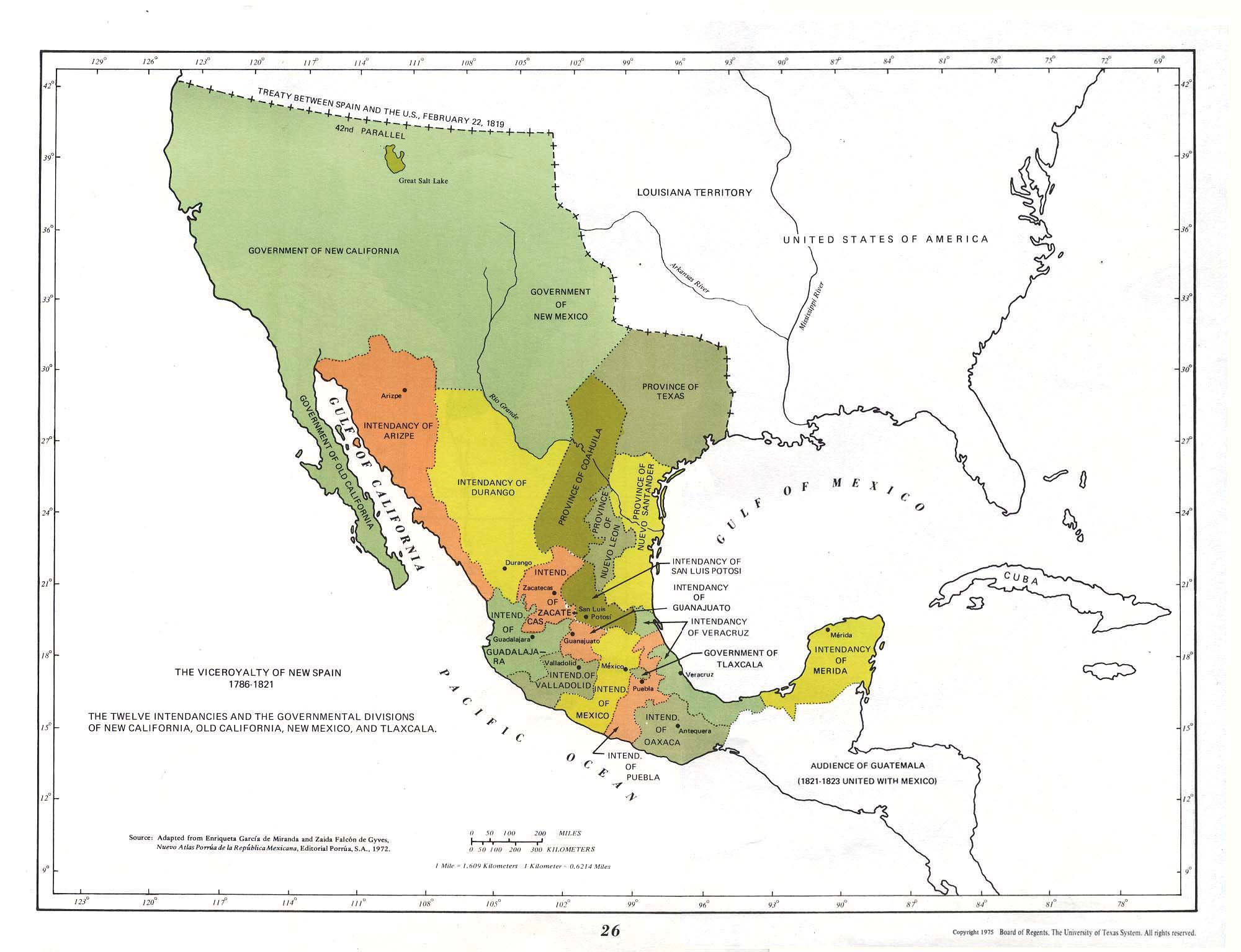
Spanish galleons transported Asian goods and travelers from Manila to colonial Mexico primarily through the port of Acapulco. During the two and a half centuries of contact between the Philippines and the Viceroyalty of New Spain, a minimum of 40,000 to 60,000 Asian immigrants would set foot in the “City of Kings,” while a figure double that amount (100,000) would be within the bounds of probability. From Acapulco they would gradually disperse to the far corners of the viceroyalty, from Loreto in Baja California to Mérida in Yucatan…. The majority, however, would eventually settle in two distinct zones: on the west coast in the districts of Guerrero, Jalisco, and Michoacán, and in the large, ethnically diverse municipalities of Mexico City and Puebla in the central valleys and the eastern port of Veracruz. The two zones were transversed by the most heavily traveled arteries that connected Acapulco to Mexico City (known colloquially as el camino de China) in the west; Veracruz with Puebla and Mexico City in the east; and several arterials linking the capital with Puerto Vallarta in the west and Guanajuato in the northwest.

For the most part, the chinos disembarked at Acapulco as sailors, slaves, and servants. Over the longue durée of Mexican-Asian cultural exchange, the largest contingent of Asians arrived as sailors on the galleons and smaller vessels (capitanas, pataches, and almirantes) that annually plied the long and perilous return voyage from Manila. The seamen were primarily Filipinos, Chinese mestizos (known in Manila as mestizos de Sangley), or ethnic Chinese from the fortified port of Cavite near Manila that served as the primary shipyard for Spaniards in the archipelago. In 1565, the first chino sailors from the islands of Cebu and Bohol arrived in Acapulco aboard Friar Andrés de Urdaneta’s trailblazing galleon, the San Pedro. During the late sixteenth century Iberian sailors constituted the majority of crewmen, but by the early 1600s Asians had surpassed them, accounting for 60–80 percent of the mariners from that time forward. A historical snapshot of galleon seafarers in the mid eighteenth century comes from a crew manifest of La Santissima Trinidad. In 1760, this vessel was manned by 370 sailors, consisting of 30 officers (Europeans or Mexican criollos), 40 artillerymen (27 chinos), 120 sailors (109 chinos), 100 “Spanish” cabin boys (96 chinos), and 80 “plain” cabin boys (78 chinos). In sum, 84 percent (310) of the crew were born and raised in Spain’s Asian colony, with 68 percent (250) hailing from the port of Cavite alone….

Along the Pacific coast, chino sojourners tended to congregate in the cities and pueblos of Acapulco, Coyuca, San Miguel, Zacatula, Tex pan, Zihuatenejo, Atoya, Navidad, and Colima. With the arrival of more ships from Manila, the number of sailors who either had no desire to return to the Philippines or were brought over as slaves married local Indian and mixed-race women increased. Consequently, a sizable population of chinos and their descendants made these cities and pueblos a popular destination for fellow Asians. Both freemen and slaves farmed rice (brought from the Philippines), corn, and cotton; tended cacao and coconut palm trees; fished in the seas and rivers; and transported people and goods to various ports along the coastline. Those who followed the royal highways to towns farther inland worked as muleteers or in the silver mines, haciendas, obrajes (textile workshops), or sugar mills….

Slaves and servants constituted the second largest group of Asian immigrants during the colonial era. Manila quickly became an important entrepôt for the commerce in human flesh during the first century of Spanish rule. The greater part were transported by Portuguese vessels from colonies and trading ports in Africa, India, the Malay peninsula, Japan, and China, although Chinese junks and Malay prahus also shipped large quantities to Manila. Non-Filipino slaves that fetched the highest price were from Timor, Ternate, Makassar, Burma, Ceylon, and India, because “the men are industrious and obliging, and many are good musicians; the women excellent seamstresses, cooks, and preparers of conserves, and are neat and clean in service.”…

The incorporation of Asian immigrants into the armed forces of New Spain represents another fascinating fragment of the chino mosaic from the colonial era. Similar to restrictions placed on other castas in Mexico, there were numerous prohibitions against Asians carrying weapons or riding horses….

The legion of similar antiweapons ordnances from the 1550s onward notwithstanding, from at least the 1590s free chinos not only were granted permission to carry weapons, but gradually incorporated into both the salaried companies of Españoles as well as local militias, especially those cities and towns along the Pacific coast. In several documents from the years 1591 and 1597, an “Indio Chino” from the silver mining town of Zultepec named Juan Alonzo, who earned his livelihood from buying and selling mules, was granted a license to ride a horse with a saddle and bridle and to carry a sword. A key determinant in this matter was his racial classification as a chino, since indios (unless they were elites) were forbidden such privileges….

Among the scores of Asian peoples that were widely defined as chinos, in the early decades of the 1600s Japanese converts were held in high esteem by Spaniards in the Philippines and New Spain for their bravery and loyalty. In 1603 and 1639 when Chinese residents in the Parián of Manila revolted against their Iberian overlords, Japanese swordsmen distinguished themselves in combat. Without their assistance, Sangleyes would surely have made the Philippines a colony of the Middle Kingdom. Thousands of Japanese converts, traders, and ronin made the Philippines their home prior to the closing of Cipango to Iberians in the 1630s. They lived in a suburb of Manila called Dilao, with a population estimated at 3,000 by 1624.

Thus it is not surprising that samurai converts were considered a more privileged subgroup of chinos in New Spain….

It is unclear exactly when chino militias were established on the west coast of New Spain. It is evident, however, that prior to 1729 Asian paramilitary units were routinely patrolling the regions adjacent to Acapulco. Tiburcio Anzalde, “captain of one of the militias of chinos and mulatos in the district of Atoya,” discussed the duties and obligations of militiamen in a 1746 document: repeated trips to Acapulco to deliver mail and other correspondences; to clear the roads (of bandits) while on patrol; and, most importantly, their heroic role in resisting the English pirate George Anson‘s invasion at the port of Zihuatenejo in 1741.

Leave a comment

Filed under Asia, China, economics, England, Japan, labor, Mexico, migration, Netherlands, Philippines, Portugal, Spain

Wordcatcher Tales: Kara-e/Kōmō-e Mekiki

I came across a few interesting terms, two of them new to me, while browsing through a beautiful and fascinating book: Japan Envisions the West: 16th–19th Century Japanese Art from Kobe City Museum edited by Yukiko Shirahara (Seattle Art Museum, 2007).

唐絵目利き kara-e mekiki ‘Chinese art inspectors’ – When Japan was keeping the outside world at arm’s length during the Tokugawa era, the Shogun employed inspectors to appraise, catalog, and often copy samples of all goods coming from China and the West, perhaps as much to make sure the Shogun got the best goods as to keep harmful influences out. The characters that make up mekiki are 目 me ‘eye’ and 利 ki(ki) ‘efficacy, expertise’. But the latter also occurs in other contexts: ri ‘advantage, profit’; ki(ku) ‘to take effect, operate’; ki(kasu) ‘to use (one’s head), exert (influence)’; ki(keru) ‘be influential’; and ki(kaseru) ‘to season’.

唐絵 kara-e ‘Chinese painting’ – Kara is written with the character for the Tang dynasty, otherwise read (< Tang), as in 唐画 tōga ‘Chinese painting’, a synonym of kara-e. However, 唐 means not just ‘Tang’ or even ‘Chinese’, but ‘foreign’, especially when pronounced kara- in native Japanese compounds, as in 唐行き karayuki ‘going abroad’ (lit. ‘Tang-going’), 唐草 karakusa ‘arabesque’ (lit. ‘Tang grass=flowing style’), and 唐黍 karakibi/tōmorokoshi ‘maize, Indian corn’ (lit. ‘Tang millet/sorghum’).

Compare the wal- (cognate with Welsh) on English walnut (once ‘foreign nut’); or the 胡 hu (once ‘barbarian’) on Chinese 胡桃 hutao ‘walnut’ (‘foreign peach’) or 胡椒 hujiao ‘black pepper’ (‘foreign pepper’ vs. 辣椒 lajiao ‘hot pepper’), or 胡麻 huma ‘sesame’ (‘foreign hemp’).

紅毛絵 kōmō-e ‘Dutch painting’ – By Tokugawa times, the Japanese had to deal with a new kind of foreigner very different from the Asians lumped together as kara. The character abbreviation for the Dutch is 蘭 ran (lit. ‘orchid’), short for Oranda ‘Holland’, as in 蘭学 Rangaku, ‘Dutch learning’, but by extension ‘Western learning’ more generally. So Western-style paintings can be called 蘭画 ranga, just as Chinese-style paintings can be called 唐画 tōga. But this book refers to the more specifically Dutch-style paintings from Nagasaki as 紅毛絵 kōmō-eRed Hair painting’—a term I found especially engaging, as a former redhead myself (now mostly white), married to another former redhead (now more brunette with strands of gray), and the parent of a red-haired daughter.

By the way, Katsumori Noriko, whose chapter on “The Influence of Ransho [‘Western books’] on Western-style Painting” compares Japanese paintings copied from originals in European books imported through Nagasaki, starts by correcting the conventional history that Dutch-language books were banned between 1630 (the beginning of sakoku) and 1720 (during the reign of Yoshimune). She says (p. 99):

In fact, these policies applied only to Chinese translations of Western books. Books in Dutch, presented as gifts from foreign visitors, had been preserved over the decades in the shogunal library but were largely disregarded. When the bibliophile shogun Yoshimune opened his library in 1720, Japanese scholars had the opportunity to reencounter and study ransho firsthand.

3 Comments

Filed under art, China, Japan, language, Netherlands, publishing

Early Research on New Guinea-area Preposed Genitives

In my dissertation on word-order change in the Austronesian languages of New Guinea, I reviewed some of the earliest published typological research in the area. Here is a glimpse of what obsessed some of the earliest European researchers.

Over most of the territory occupied by Austronesian (AN) languages, genitive (or “possessor”) nominals (= GEN) follow head (or “possessed”) nominals (= N) in noun–noun genitive constructions. However, the reverse order (GEN + N) prevails in the neighborhood of New Guinea and nearby islands of Indonesia (from Sulawesi and Flores east). The distinctive “preposition of the genitive” in the AN languages of the latter area engendered much discussion by European scientists during the earliest era of their work in the area, when hardly any other syntactic information was available.

Various explanations were offered. Kanski and Kasprusch (1931) reviewed some of these explanations and concluded that the preposed genitive most likely resulted from the influence of Papuan languages, which also have preposed genitives and which share a very similar geographical range. This still seems the most likely explanation, although it remains a mystery why the preposed genitive has a wider distribution than any of the other grammatical features attributed to Papuan influence.

Even leaving Papuan influence aside, however, the narrower and contiguous geographical distribution of the preposed genitive, when compared with the unrestricted distribution of the postposed genitive, suggests that the former is innovative and originated somewhere in “extreme eastern Indonesia” (Blust 1974:12). (Genitives may have been optionally preposed in Proto-Austronesian, as they are in many Philippine languages. This would have made it easier for preposed genitives to become the dominant pattern in New Guinea-area Austronesian languages.)

The boundary between languages with preposed genitives and those with postposed genitives forms a wide arc running to the west, north, and east of the island of New Guinea. The southwest-to-northwest portion of this arc is frequently referred to as the “Brandes line” (after Brandes 1884), and the northwest-to-southeast portion has been called the “line of Friederici” (after Friederici 1913). (See, for example, Kanski and Kasprusch 1931, Cowan 1952).

The Brandes line was first assumed to be a genetic boundary (a linguistic analog of the Wallace Line perhaps). However, there was some disagreement about which genetic units it separated. Brandes (1884) himself thought it set off two groups of Indonesian languages. Jonker (1914) argued that two such Indonesian subgroups could not be distinguished. Schmidt (1926) thought the Brandes line marked the border between Indonesian and Melanesian languages.

(Brandes and Jonker were more familiar with the languages of Indonesia and were impressed with how similar in other respects the languages with preposed genitives were to Indonesian languages in general. Schmidt was more familiar with Melanesian languages and was impressed with how similar the genitive-preposing languages were to Melanesian languages in general. See Kanski and Kasprusch 1931:884.)

Kanski and Kasprusch (1931) offered a compromise. They identified four groups of languages:

    1. Indonesian, west of the Brandes line
    2. Papuan-influenced Indonesian, east of the Brandes line
    3. Papuan-influenced Melanesian, west of Friederici’s line
    4. Melanesian, east of Friederici’s line

Like Kanski and Kasprusch (and Jonker), most scholars today would not consider genitive word order to be a valid criterion for subgrouping. Another feature of genitive constructions was put forth as a better basis for distinguishing Indonesian from Melanesian languages. In western Austronesian (“Indonesian”) languages, genitive pronouns can be suffixed (or encliticized) to all nouns. In eastern Austronesian (“Melanesian”) languages, genitive pronouns can be suffixed directly to nouns only in case the possessed entity is an inalienable relationship to the possessor. In practice, this means that most body-part and kin terms are directly suffixed. Most other nouns are not. Instead, head nouns (denoting possessed entities) in constructions expressing an alienable relationship are preceded by genitive pronouns.

Schmidt (1926:424) and Kanski and Kasprusch (1931:889) regarded the influence of Papuan languages as responsible for the origin of the grammatical distinction between alienable and inalienable possession in eastern Austronesian languages as a whole. Under Papuan influence, they argued, the AN languages in transition from Indonesia to Melanesia began to lose their original postposed genitives and to acquire preposed ones. Nouns denoting alienables formed the vanguard of this change. Nouns denoting inalienables, such as body parts and kin terms (which involve animate—usually human—possessors, one could add), were slower to lose the original genitive pronouns because reference to an inalienable almost always requires reference to a possessor as well. The inalienables retained their postposed pronouns long enough for the latter to become an integral part of the noun itself. The general change was thus arrested, with inalienables forming a relic category.

One major weakness of this hypothesis is that it ignores the distinction between pronominal and nominal genitives. In eastern AN languages generally, it may be more common for independent genitive pronouns to precede head nominals in cases of alienable possession. (There is considerable variation.) In all but the more narrowly defined “Papuan-influenced” languages, however, genitive nominals follow head nominals (N + GEN), whether or not alienable possession is involved. This hypothesis, then, leads one to the false expectation that genitive nominals precede head nominals in all languages in which the alienable–inalienable distinction exists.

The alienable–inalienable distinction is reconstructible for Proto-Oceanic (Pawley 1973:153–169), the ancestor of most of the languages of eastern Austronesia. However, it is not unique to that group. It also occurs in many languages of eastern Indonesia that are not daughters of Proto-Oceanic (Collins 1980:39 ff., Stresemann 1927:6). So even the presence or absence of the alienable–inalienable distinction does not adequately indicate genetic affiliation.

The traditional recognition of differences between “Indonesian” and “Melanesian” languages is now generally phrased in terms of “Oceanic” and “non-Oceanic” languages. The former term denotes what is generally recognized as a genetic unit (primarily on the basis of phonological criteria). The negative term “non-Oceanic” lumps together all other AN languages without implying that they form a single genetic unit. The boundary between the two groups of languages distinguished by the new phraseology has also shifted somewhat farther to the east since the time of Brandes, Schmidt, and Friederici. The new boundary, which in an earlier era would have been called “Grace’s line” (after Grace 1955:338, 1971:31), is assumed to have a firmer genetic basis than the two earlier boundaries. Grace’s line, separating Oceanic from non-Oceanic languages, runs north-northeast to south-southwest, intersecting 140° E longitude between New Guinea and Micronesia. The scope of this thesis is restricted to the AN languages west of Friederici’s line and east of Grace’s line. These languages can be characterized as “Papuan-influenced Oceanic.” However, before restricting discussion to these languages, it will be helpful to review the various boundaries and the nature of the groups of languages they set apart.

The Brandes line marks the western boundary of a group of languages with innovative genitive word order. This group of typologically similar, but genetically not so closely related, languages is bounded on the east by Friederici’s line. Somewhere east of the Brandes line is the western boundary of a group of languages showing an innovative grammatical distinction between alienable and inalienable genitives. Most of these languages are members of the Oceanic subgroup, a genetic unit, but the westernmost languages are not. East of this boundary lies Grace’s line, the western boundary of the Oceanic subgroup. The eastern boundary of the Oceanic subgroup, and of all AN languages showing the alienable–inalienable distinction, is the eastern border of Austronesian as a whole (east of Easter Island). (I am assuming that the distinction between a and o genitives in Polynesian can be considered somewhat akin, semantically but not structurally, to the alienable–inalienable distinction in the rest of Oceanic.)

References

Blust, Robert A. 1974. Proto-Austronesian syntax: The first step. Oceanic Linguistics 13:1–15.

Brandes, Jan Lourens Andries. 1884. Bijdrage tot de vergelijkende Klankleer der westersche Afdeeling van de Maleisch-Polynesische Taalfamilie. Utrecht, P.W. van der Weijer. 184 pp.

Collins, James. 1980. The historical relationships of the languages of Central Maluku, Indonesia. Ph.D. dissertation, University of Chicago.

Cowan, H. K. J. 1951–1952. Genitief-constructie en Melanesische talen. Indonesië 5:307–313.

Friederici, Georg. 1912. Wissenschaftliche Ergebnisse einer amtlichen Forschungsreise nach dem Bismarck-Archipel im Jahre 1908, vol. 2, Beiträge zur Völker und Sprachenkunde von Deutsch-Neuguinea. Mitteilungen aus den Deutschen Schutzgebieten, Ergänzungsheft 5. Berlin, Mittler und Sohn.

Friederici, Georg. 1913. Wissenschaftliche Ergebnisse einer amtlichen Forschungsreise nach dem Bismarck-Archipel im Jahre 1908, vol. 3, Untersuchungen über eine melanesische Wanderstrasse. Mitteilungen aus den Deutschen Schutzgebieten, Ergänzungsheft 7. Berlin, Mittler und Sohn.

Grace, George W. 1955. Subgrouping Malayo-Polynesian: A report of tentative findings. American Anthropologist 57:337–339.

Grace, George W. 1971. Notes on the phonological history of the Austronesian languages of the Sarmi coast. Oceanic Linguistics 10:11–37.

Jonker, J. C. G. 1914. Kan men bij de talen van den Indischen Archipel eene westelijke en eene oostlijke afdeeling onderscheiden? Mededeelingen der Koninklijk Akademie van Wetenschappen, afdeeling Letterkunde, 4e Reeks, deel 12, pp. 314–417.

Kanski, P., and P. Kasprusch. 1931. Die indonesisch melanesischen Übergangssprachen auf den Kleinen Molukken. Anthropos 26:883–890.

Klaffl, Johanne, and Friederich Vormann. 1905. Die Sprachen des Berlinhafen-Bezirks in Deutsch-Neuguinea. Mitteilungen des Seminars für Orientalische Sprachen 8:1–138. (With additions by Wilhelm Schmidt.)

Pawley, Andrew K. 1973. Some problems in Proto-Oceanic grammar. Oceanic Linguistics 12:103–188.

Schmidt, Wilhelm. 1900, 1902. Die sprachlichen Verhältnisse von Deutsch Neuguinea. Zeitschrift für afrikanische und oceanische Sprachen 5(1900):354–384; 6(1902):1–99.

Schmidt, Wilhelm. 1926. Die Sprachfamilien und Sprachenkreise der Erde. Heidelberg, C. Winter. 595 pp.

Stresemann, Erwin. 1927. Die lauterscheinungen in den ambonischen Sprachen. Zeitschrift für Eingeborenensprachen, Beiheft 10. Berlin, Reimer. 224 pp.

Leave a comment

Filed under Germany, Indonesia, language, Netherlands, Papua New Guinea, scholarship

Fates of Resistance to the Partition of Africa

From The Fate of Africa: A History of Fifty Years of Independence, by Martin Meredith (PublicAffairs, 2005), pp. 3-4:

Scores of African rulers who resisted colonial rule died in battle or were executed or sent into exile after defeat. Samori of the Mandingo was captured and died in exile two years later; the Asantehene, King Agyeman Prempeh, was deposed and exiled for nearly thirty years; Lobengula of the Ndebele died in flight; Behazin of Dahomey and Cetshwayo of the Zulu were banished from their homelands.

In the concluding act of the partition of Africa, Britain, at the height of its imperial power, set out to take over two independent Boer republics, the Transvaal and the Orange Free State, and incorporate them into the British Empire, assuming that a war of conquest would take at most a matter of months. It turned into a gruelling campaign lasting three years, required nearly half a million imperial troops to finish it, and left a legacy of bitterness and hatred among Afrikaners that endured for generations. Faced with guerrilla warfare for which they were unprepared, British military commanders resorted to scorched-earth tactics, destroying thousands of farmsteads, razing villages to the ground and slaughtering livestock on a massive scale, reducing the Boers to an impoverished people. Women and children were rounded up and placed in what the British called concentration camps, where conditions were so appalling that some 26,000 died there from disease and malnutrition, most of them under the age of sixteen. All this became part of a Boer heritage passed in anger from one generation to the next, spawning a virulent Afrikaner nationalism that eventually took hold of South Africa.

Small-scale revolts against colonial rule continued for many years. The Baoulé of Côte d’Ivoire fought the French village by village until 1911; the Igbo of Nigeria were not fully defeated until 1919; the Jola of Senegal not until the 1920s; the Dinka of southern Sudan not until 1927. In the desert wastelands of Somaliland a fiery Muslim sheikh, Muhammad ’Abdille Hassan, dubbed by his adversaries the ‘Mad Mullah’, led Dervish warriors in a holy war against the British for twenty years until his death in 1920. Bedouin resistance against Italian rule in Libya ended only in 1931 after nine years of guerrilla warfare. By the 1930s, however, the colonial states of Africa were firmly entrenched; they had, moreover, acquired a legitimacy in the eyes of their inhabitants.

Leave a comment

Filed under Africa, Britain, France, Italy, nationalism, Netherlands, war