
Category Archives: Japan

Tessaku Seikatsu, December 1941

From Life behind Barbed Wire [鉄柵生活 Tessaku Seikatsu]: The World War II Internment Memoirs of a Hawai‘i Issei, by Yasutaro Soga [1873–1957] (U. Hawai‘i Press, 2008), pp. 34-35:

On December 24, our first Christmas Eve since our arrest, Mr. Masaji Marumoto arrived at the camp accompanied by an FBI agent. This was the first time someone from the outside (other than military personnel) had visited us. Mr. Marumoto, a lawyer, had come to write powers of attorney, and I asked to meet with him. We were allowed to speak in Japanese, but of course the FBI agent present was fluent in Japanese. Upon his arrival, Mr. Marumoto’s face became deathly pale, perhaps because he saw our surroundings and old friends badly in need of a shave and a change of clothes. I asked Mr. Marumoto to contact my wife about sending me some clothes. Half a month had passed since our arrival at the camp, and Mr. Daizo Sumida, Dr. Takahashi, and I had yet to receive a letter or parcel. We later found out that our letters had crossed with those from home, but at the time we felt somewhat frustrated and suffered from a lack of spare underwear. The day after Mr. Marumoto’s visit, all three of us received parcels of clothes from home.

For Christmas, we were treated to turkey at lunch. The Germans and Italians hastily put up a simple Christmas tree in the mess hall. That night one of the German detainees, a lecturer at the University of Hawaii, gave a talk, and many Japanese attended. He said that he would pray for a quick end to the war and everyone’s good health and that we be reunited with our families for Christmas next year….

On the first day of 1942, our first New Year’s Day since our arrest, we did not get even a piece of mochi (rice cake) and did not feel festive at all. We were filled with anxiety, frustration, and hopelessness—not only for ourselves, but also for the families we had left behind. Unless a man was extremely confident and optimistic, it was to be expected that here he might develop “nerves” or begin to display odd behavior. I noticed that men who had been fond of “talking big” outside were now depressed, turning into shadows of their former selves. Still others, refusing to face reality, clung to their prewar social status, which created problems for everyone.

When we are reduced to living at the most basic level, our good and bad points are clearly exposed. On the whole, educators and priests showed themselves to be the worst of the lot. I was not the only one who felt this way. Of course there are always exceptions: There are many respectable teachers and priests. I regret to say, however, that in the camp I was disappointed in most of them.
Leave a comment

Filed under Hawai'i, Japan, U.S., war

Ogasawara Mixed Language: English in Japanese

From English on the Bonin (Ogasawara) Islands, by Daniel Long (Duke U. Press, 2007; Publication of the American Dialect Society, no. 91; Supplement to American Speech, vol. 81), chap. 10:

At the end of the Pacific War, the U.S. Navy occupied the Ogasawara Islands and permitted only the families of Western descent to return, along with their spouses and children, whether Japanese, Western, or mixed. These families were all bilingual and mixed Japanese and English in their speech. Before the war, monolingual Japanese officials stigmatized the mixed language as “English,” but after the war, monolingual American officials stigmatized it as “Japanese.” However, the islanders took pride in their bilingual heritage, and some of this “Navy generation” of Ogasawara Islands claim they purposely created Ogasawara Mixed Language (OML). Here are some examples from interviews recorded with some of these baby boomers during the 1990s.

Pronouns

  • Me no sponsor no, anō, nan to yū no? Sono French door, anō glass door ga warete, water ga up to the knee datta. ‘My sponsor’s—that, what do you call it? Their French door, that glass door broke and water was up to the knee.’
  • Uchi no Mama was no leg man mo mita-zutta zo. Anoo, heitai no clothes kite. You no ojiisan, too, he had lots of stories. ‘My mama said she even saw a one-legged man, uh, wearing army clothes. Your grandpa too, he had lots of stories.’

Temporal expressions

  • I remember I was only about twelve da kedo. Kinky tachi saa, Kinky to ka aretachi. Guam kara kaette kita ja, sugu. Sou darou? May, May no twentieth da to omou n da yo ne. May twentieth ka May twenty-fourth gurai da to omou. ‘I remember I was only about twelve, but Kinky and them, um, Kinky and all of them had come back from Guam, you know. About May twentieth or May twenty-fourth, I think.’
  • Every year. Mada aru yo, decorations, sukoshi. Twelve years old gurai no toki, chotto Christmas tree kazari hazimete. ‘Every year—I still have them, the decorations, a few. When I was about twelve years old, we started Christmas tree decorating a bit.’

Wraparound structures

  • It’s about three times gurai yatta ne. ‘It did it about three times, huh?’
  • We bought about two pounds gurai katte kita no. ‘We bought about two pounds.’

Basic vocabulary

  • Dakara face to name ga chigau kara. ‘It’s because the face and name don’t match up.’

Phrases as well as words

  • Aa, tsunami no toki? Me to mama wa last one to get out of there, yama ni nobotte. ‘The time of the tsunami? Me and Mama were the last ones to get out of there, climbing up the hill.’

OML versus code-mixing

OML differs in many significant ways from normal code-mixing or code-switching between English and Japanese. When Japanese code-mix, for example, they generally do NOT: (a) ignore honorifics (keigo), (b) ignore polite forms (teineigo), (c) use English pronouns, (d) incorporate English whole phrase structure, (e) use English phonology, or (f) use English counters. These are all significant features of OML.

Passing of a transient language

Since the reversion of the islands to Japan in 1968 and the subsequent incursion of ethnic-Japanese (now outnumbering the Westerners ten fold), OML has fallen deeper and deeper into disuse. For elderly (those raised before the war) and middle-aged (raised in the Navy Era) Westerners, the decreasing usage of OML seems to correspond to a decreasing desire to distinguish themselves from their new and returned ethnic-Japanese neighbors. Even when they do wish to assert their uniqueness, there is less need to rely on language to accomplish that. The Westerners had many things in common with the Navy personnel, but they relied on OML (or on Japanese) to distinguish themselves from the Americans. These days, they have many nonlinguistic aspects which they can employ. These include their non-Japanese given and family names, their participation in the Christian church, their non-Asian physical appearances, and their common heritage and shared experiences.

2 Comments

Filed under Japan, language, Pacific, U.S.

Mongolians, Estonian Dominate Sumo Tourney

In the absence of Asashoryu, who has been under suspension, the junior and better-behaved Mongolian yokozuna, Hakuho (12-3), won his 5th Grand Sumo Tournament, while the smallest Mongolian, Ama (10-5), won his 2nd Outstanding Performance Award; the giant Estonian, Baruto (11-4), won his 2nd Fighting Spirit Award; and Fukuoka native Kotoshogiku (9-6) won his 2nd Technique Prize. I think they should hold the Natsu Basho (in May) in Ulan Bator instead of Tokyo each year. There are now seven Mongolians in the Makuuchi ranks and five in the Juryo ranks.

Leave a comment

Filed under Eastern Europe, Japan, Mongolia, sumo

Multilingual Name Changes in the Bonin Islands

From English on the Bonin (Ogasawara) Islands, by Daniel Long (Duke U. Press, 2007; Publication of the American Dialect Society, no. 91; Supplement to American Speech, vol. 81), pp. 125-128

There is something of a misconception among Japanese—or at least among that minute percentage of the population that has any knowledge of the subject—that the Westerners of Ogasawara acquired Japanese family names when they were naturalized as Japanese citizens back in the early Meiji era. This is not true….

When the original inhabitants of the islands began to be naturalized in 1877, only a few took Japanified names. Among these was the almost legendary German figure Frederick Rohlfs (1823–98), who settled on Hahajima and aided subsequent Japanese arrivals when they were on the verge of starvation. He was commonly called “Rose,” probably because this is how his name sounded to Japanese listeners when pronounced by English speakers. His legal Japanese name was composed of five kanji (Sino-Japanese) characters chosen strictly for their pronunciation. Although they convey no coherent meaning, when combined the characters (pronounced as Rōsu Rarufu) sounded something like the two pronunciations of his family name. Rohlfs was in the minority, however; most of the Westerners (referred to as kikajin ‘naturalized people’ in those days) used katakana renderings of their own Western family names as the official names in their koseki, or Official Lineage Registries. These were not Japanese family names, nor Japanified versions of their Western names, but simply adaptations of them to the Japanese phonology and representations of them in the Japanese script (e.g., Gilley became Gērē, Savory became Sēborē, Webb became Uebu, Washington became Washinton, Gonzales became Gonzaresu).

The usage of kata[ka]na names continued for a couple of generations. It was not until the Sōshi Kaimei (創氏改名‘Establishment of Family Names and Alteration in Given Names’) law that people with non-Japanese surnames were forced to change them. This 1940 law is mainly known for its effect on the millions of colonized people in Korea, but it also affected the Bonin Islanders. Elderly islanders today recall choosing their own last names, often hurriedly and quite randomly….

Some of the islanders chose kanji characters that either sounded like their original names or expressed some significant meaning. The Savorys became Sebori (瀬堀[‘rapids-ditch’]), and the Ackermans, the Akaman (赤満 [‘red-full’) family. The Webbs chose characters that could be read as Uebu (上部 [‘upper-part’]) (though the name is pronounced Uwabe today). Other families decided on a name with some symbolic value. The Gilleys, proud of the “South Sea Islander” part of their roots, chose the name Minami (南 ‘lit. south’). Other families abandoned the idea of names in which either the sound or the meaning of the kanji held significance. In most cases, different family names were chosen by distant branches of the family tree, so that the Gonzales family descendants became either Ogasawara (小笠原 [‘little-hatshade-field’]) or Kishi (岸 ‘shore’).

During the war years, Westerners gave their children Japanese names. Children born after World War II (during the U.S. Navy period) were given only English names, and they use these today—written in katakana—as their official Japanese names.

Following the reversion to Japan, Westerners adopted the practice of giving Japanese names—written in kanji—to their children, but even here, we find cases of islanders identifying with their cultural roots. One case of this is Nasa Sēborē (セーボレー那沙), born in the 1980s, whose name, although written in kanji, is an homage to his ancestor Nathaniel (pronounced “Nasanieru” in Japanese).

Some of the Westerners legally changed their surnames back (from Japanese ones forced upon them in 1941) to their older katakana names following the changes in the Japanese law in the 1980s.

In many cases, a single individual has possessed four legal names in the span of his or her life. A case in point is Able Savory. He was born Sēborē Ēburu (in katakana, セーボレーエーブル), was forced to changed his name to Sebori Eiichi (in kanji, 瀬堀栄一) at the start of the war, and used Able Savory (in the Roman alphabet) during the Navy Era. After the 1968 reversion, he reverted to his wartime kanji family name, but used the katakana “first name” given to him at birth, resulting in the name Sebori Ēburu. In the 1980s, when some of the Savory clan changed their surname back to the katakana Sēborē, he decided four names in one lifetime were enough and retained the kanji surname.

In Ogasawara today, one finds many interesting name-related phenomena. Nicknames—in both Japanese and English—are the norm. Then, most of the Westerners have two names; many have both Japanese and English surnames and given names, which means there often are at least five or six ways to refer to most Westerners.

This reminds me my favorite comment thread ever on Language Hat, in reaction to a post about a poem entitled Peaches in Cluj.

3 Comments

Filed under anglosphere, Japan, Korea, language

Wordcatcher Tales: Katatsumuri, Otamajakushi

Which word is more poetic? Snail or tadpole? Escargot ou têtard? Melc sau mormoloc? Schnecke oder Kaulquappe? (Jeez!) Much depends on the poetic traditions of the language in which one is writing—whether rhyme and meter are important, for instance.

What got me wondering was the original Japanese version of that famous haiku by Kobayashi Issa:

かたつぶりそろそろ登れ富士の山
katatsuburi soro-soro nobore fuji no yama
‘Snail, slowly climb Fuji’s mountain!’

(You may prefer R.H. Blyth‘s translation: “O snail / Climb Mount Fuji, / But slowly, slowly!”)

The more common form for ‘snail’ is katatsumuri, so in Japanese the choice offered above is: Katatsumuri ka? Otamajakushi ka?

One thing katatsumuri has going for it is its five syllables (or moras), perfect for an opening or closing line of haiku. (Snails feature in 53 out of Issa’s 8000 haiku.) But snails seem to lack any specific seasonal association, at least according to Yamamoto Kenkichi’s The Five Hundred Essential Japanese Season Words.

Otamajakushi ‘tadpole’, on the other hand, has good seasonal associations. But its six syllables can only fit well into the middle line of haiku, with the help of a filler particle like ya. Maybe that’s why Issa wrote 166 haiku about frogs (… tobu kawazu ‘jumping frog’, … naku kawazu ‘croaking frog’, kawazu kana ‘frog …’ etc.), but apparently none about tadpoles. It’s not really that hard. Here’s one I made up.

羹にお玉杓子や蛙哉
atsumono ni / otamajakushi ya / kawazu kana

In the broth / Is it a tadpole / Or a frog …

Regardless of their poetic qualities, these two words have interesting etymologies.

お玉杓子 otamajakushi literally means a ball (otama) ladle, scoop, or rice paddle (shakushi), which well describes the shape of a tadpole. Well, okay, a giant tadpole.

蝸牛 lit. ‘snail-cow’ can be pronounced kagyū in its Sino-Japanese reading, but the kanji have no relation to the several native Japanese words for ‘snail’: katatsumuri, katatsuburi, dedemushi, dendenmushi. When I was a kid, I learned dendenmushi, but I had forgotten whether it meant ‘snail’ or ‘caterpillar’. If I had to guess at the native Japanese etymologies for the two principal words for ‘snail’, I would propose that dendenmushi comes from dandan ‘little by little’ + mushi ‘bug’ (i.e., a slow-moving creepy-crawly); while katatsumuri comes from kata- ‘hard’ + tsumuri ‘head’ (i.e., a hard-shelled creepy-crawly).

I await further instruction from Matt of No-sword.

UPDATE: And Matt comes through with a much more thorough and enlightening post! He finds support for the same etymology for katatsumuri (‘hard head’), but explains that de(n)de(n)mushi comes from a recent song appealing to the snail to come out (hence 出 de-) of its shell. Better yet, the latter term, the only one I had heard, seems to have arisen in Kyoto, where I spent my elementary school years.

UPDATE 2: Matt of No-sword follows up with a wonderfully clarifying post on one of the murkiest issues in contemporary herpetological poetics, the difference between two types of frogs in Japanese: the poetic kawazu and the aquatic pedestrian kaeru.

Before I repeat Matt’s far more poetic conclusion (which Language Hat has already done, dammit ribbit!), I should add that Japanese kaeru has been borrowed into at least one language in Micronesia: Yapese kaeyruu, where it seems to refer mostly to the decidedly prosaic and invasive marine toad (Bufo marinus), a species more fit for senryū than haiku.

Only three amphibians are native to the [Polynesia-Micronesia biodiversity] hotspot, and all are ranid frogs of the genus Platymantis. Two species are endemic to Fiji, the Fiji tree frog (Platymantis vitiensis) and Fiji ground frog (P. vitiana, EN), and one, the Palau frog (P. pelewensis), is endemic to Palau. All three species are related to other Platymantis species in the Solomon Islands and in New Guinea.

This explains why, of all the Micronesian dictionaries I consulted, I could only find a native word for ‘frog’ in the Palauan Dictionary: bechébech, where the unaccented e represents a schwa (uh, er sound) and the ch represents a glottal stop. (By the way, the E[uro]speranto words for ‘frog’ and ‘toad’ are rano and bufo, respectively.)

So here’s the enlightening conclusion to Matt’s follow-up frog post, which cites one of the most famous haiku of all by perhaps the most famous haiku poet of all.

古池や かはづ飛び込む 水の音
Furuike ya/ Kawazu tobikomu/ mizu no oto
Old pond/ Frog jumps in/ Sound of water

Bonus fact: Bashō was actually consciously playing with the kawazu tradition here by attributing the sound to the water rather than the frog. The frog’s implied silence, after centuries of naku kawazu [‘croaking frog’], is a crucial part of the stillness that allows the sound of water to make its impact.

4 Comments

Filed under Japan, language

Hawaiian Words in Bonin (Ogasawara) Speech

From English on the Bonin (Ogasawara) Islands, by Daniel Long (Duke U. Press, 2007; Publication of the American Dialect Society, no. 91; Supplement to American Speech, vol. 81), pp. 65, 67:

Many words in use in the Bonins even in the late twentieth century are thought to be derived from the contact with Pacific Island languages that occurred from the 1830s until the end of the nineteenth century. Today these lexemes are used not only in the English of the Bonins, but in Ogasawara Japanese and the Ogasawara Mixed Language as well. Hawaiian words form the majority of the Oceanic-language words we find in the Bonins. Since Polynesian migration to the islands occurred only in the early history of the settlement, it seems clear that most of these words came to the island during the first half of the nineteenth century.

I’ll list some of the most straightforward examples, where the meanings and the sounds correspond most closely. The following list presents the Hawaiian word first, then its various derivatives in the Bonins, where the pronunciation has been influenced not just by Japanese and English phonology (and the lack of orthographic standards), but by varieties of Hawaiian that are now nonstandard (for instance, those that retained t in place of King Kamehameha’s k).

  • Haw. kamani, tamani ‘hardwood tree, Calophyllum inophylum’ > Bonin tamana, tamena, tremana
  • Haw. lahaina ‘type of sugarcane’ > Bonin rahaina ‘sugarcane’
  • Haw. lau hala ‘pandanus leaf’ > Bonin rawara, rawarawa, rauhara, rowara, rohara, roharo, rūwara, rohawo, lohala ‘pandanus tree’
  • Haw. moe ‘sleep’ > Bonin moe-moe, moi-moi ‘sex, copulation’
  • Haw. puhi ‘moray eel’ > Bonin puhi
  • Haw. uhu ‘parrotfish’ > Bonin ūfū, uhu
  • Haw. wiliwili ‘leguminous tree, Erythrina sandwicensis’ > Bonin biide-biide, bari-bari, uri-uri, ude-udeErythrina boninensis

Leave a comment

Filed under Hawai'i, Japan, language, Polynesia

The 1st and 2nd Filipino Regiments in the Pacific War

I have heard endlessly about the exploits of the Japanese American units during World War 2, the 100th Battalion and 442d Regimental Combat Team, but I had never heard about the 1st and 2nd Filipino Regiments. Here are a few excerpts from a much longer account at the California State Military Museum website.

The Tydings-McDuffie Act of 1934 treated the Filipinos in the U.S. as aliens. Although the Philippine Commonwealth Constitution permitted the United States to draft Filipinos in the Philippines to defend American interests there, Filipinos in the United States, quite ironically, were exempt from military service.

Thousands of Filipinos had petitioned for the right to serve in the U.S. military immediately after December 7, 1941. On January 2, 1942, President Franklin Delano Roosevelt signed a law revising the Selective Service Act. Filipinos in the United States could now join the U.S. Armed Forces and they were urged to volunteer for service. President Roosevelt quickly authorized the founding of a Filipino battalion, which would be organized for service overseas. It estimated the number of available Filipino volunteers between 70,000 and 100,000.

The 1st Filipino Battalion was formed on March 4, 1942 and activated in April 1 at Camp San Luis Obispo, California. Lieutenant Colonel Robert H. Offley, who had served in the Philippines and spoke passable Tagalog, volunteered to be assigned to the unit as its first commander. He assumed command in April 8, 1942. The War Department also directed Philippine army officers and soldiers who were stranded in the United States at the start of the war to report to the unit. An unusual point is the designation of the unit. Previous Filipino units in the U.S. Army had been designated “Philippine” such as the Philippine Scouts. All units raised in the U.S. during the war were designated “Filipino.” Also, it would not be until the end of the war that the Filipino military units would carry the designation “Infantry” in their title although their regimental colors from the very beginning were displayed on a blue field, the traditional color of the infantry branch of the army.

A number of wounded Philippine Army and Philippine Scouts had escaped to Australia from the Philippines on board the USS Mactan in December 1941. Some remained in Australia to form the nucleus of what would eventually become the 1st Reconnaissance Battalion, but the rest were sent to the United States for further medical treatment. These men eventually reported to the 1st Filipino Battalion.

Contrary to popular belief, the 1st Filipino Battalion was not established as a result of the American policy of social segregation. Only Filipinos who volunteered for assignment to the unit were sent to it. Many others, such as Eutiquio V. “Vic” Bacho, served with distinction in “American” (white) units in the European theater of operations during the war. Doroteo Vite wrote in a national magazine that Filipinos should take the opportunity to serve in all-white units to educate them so that at the end of the war, white Americans would support the Filipino American agenda of equality….

In April 1942, Lieutenant General John L. Dewitt, Western Defense Commander, ordered the Japanese on the West Coast into concentration camps. Miguel Ignacio, secretary of the Filipino American community of San Francisco, called attention to several American-born Japanese women, citizens of the United States, who had Filipino husbands, and Filipino-Japanese children who were U.S. citizens by birth. Despite the efforts of the American Civil Liberties Union, Dewitt ordered the women and children to spend the duration of the war in the internment camps. Many of these Filipino husbands went on to serve in the 1st and 2nd Filipino Regiments, defending the nation whose racist policies held their families hostage.

In September 1942, the first group of qualified Filipino enlisted men was sent to the Officer Candidate School, Fort Benning, Georgia. Upon graduation, they were commissioned second lieutenants in the U.S. Army. The War Department planned to have Filipino officers eventually command the majority of the combat units in the 1st and 2nd Filipino Regiments. Events beyond the control of the military planners in Washington, D.C. intervened to prevent this from being fully implemented.

So many Filipino volunteers came from all over the United States that the 2nd Filipino Infantry Regiment was formed at Fort Ord, California on November 22, 1942. In January 1943, the 1st Regiment was reassigned to Camp Beale, near Sacramento and the 2nd Regiment to Camp Cooke, near Santa Maria. The two regiments were to be joined by a third regiment consisting of Filipinos from the Hawaiian National Guard. However, the Hawaiian Sugar Plantation Association argued successfully with the martial law commanders in Hawaii that not only was cheap labor on the plantations necessary to support the war effort, the Filipinos in Hawaii were forbidden by the Tydings-McDuffie Act from going to the continental U.S. The men could not leave the sugar plantations and were paid substandard wages for the duration of the war. This would have serious consequences in 1946 when the militant Filipino labor unions shut down the islands until their demands for wage increases and better working conditions were met.

As a result of a May 1942 Gallup Poll showing strong support for the naturalization of Filipinos, the Filipino Naturalization Bill was passed. Pinoy GI’s were urged to apply for U.S. citizenship. A mass swearing in of over 1,000 soldiers was held at Camp Beale on February 20, 1943. Many of the men, however, resisted becoming citizens. T-5 Julius B. Ruiz stated that although he had lived in the United States for many years and was now serving in the U.S. Army, his goal was to liberate his country, the Philippines. by the time the 1st Regiment left for the western Pacific in May 1944, over half of the men in the unit were U.S. citizens….

Before the 1st Regiment departed for the western Pacific in May 1944, Colonel Offley had a major dilemma on his hands. Even though his regimental chaplains were prepared to perform marriage ceremonies between the Filipino soldiers and their white girlfriends, the strict anti-miscegenation laws in California prevented the men from applying for marriage licenses. Colonel Offley solved this by sending his soldiers and their sweethearts to Gallup, New Mexico on chartered buses that soon came to be called the “honeymoon express.”

Meanwhile in New Guinea, the 1st Regiment quickly integrated its first batch of replacements consisting of Filipino Americans from Hawaii. Colonel Offley gave Lt. Col. Leon Punsalang, a West Point graduate, command of the 1st Battalion. This was the first time in the history of the U.S. Army that Asian Americans commanded white troops in combat.

130 Comments

Filed under Japan, Philippines, U.S., war

Yap’s Role in the Saipan Campaign, June 1944

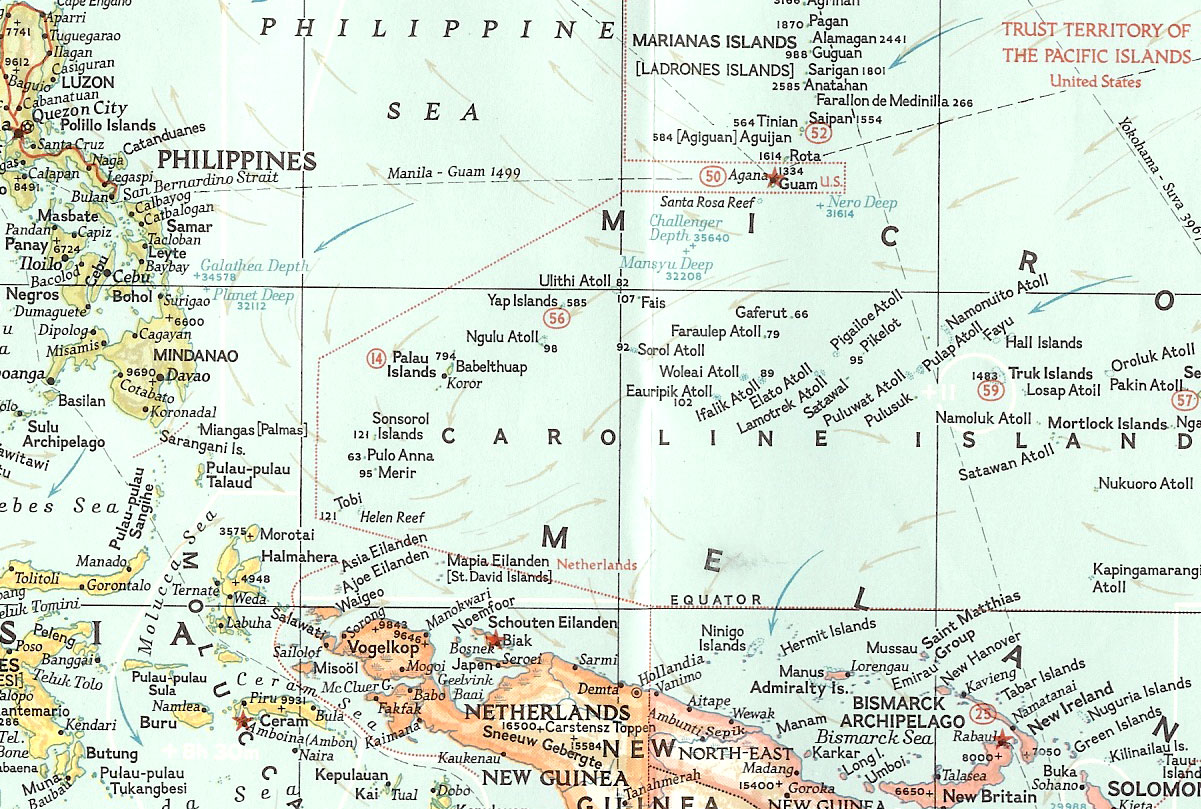
When I was looking up stuff about Yap, Micronesia, for a recent post, I came across a very informative website, with both photographs courtesy of the Micronesian Seminar and the National Archives—and even video—about the bombing of Yap during the Pacific War, about which I heard many stories during my time there in 1974. I have corrected obvious spelling errors in the following extract.

At dawn, on the 15th of June 1944, American amphibious forces swept into Saipan to begin the hard ground fighting that was to bring the Japanese homeland within range of our Superfortresses. For more than two weeks prior to the landings, Thirteenth Air Force Liberators, based on Los Negros, had been pounding Truk to neutralize the strategic Japanese base and to prevent the enemy from reinforcing Saipan by air.

A large Japanese task force, estimated at 40 ships or more, was sighted some distance north of Yap Island, on the 19th of June 1944. Carrier planes from this task force lashed out at the powerful units of the United States Pacific Fleet which were then supporting Allied ground forces on Saipan. The conflict that followed was the first major battle between elements of the Japanese and United States fleets in nearly two years. As at Midway, two years earlier, all of the offensive action was by carrier-based aircraft. By the time the Japanese fleet broke off the engagement, U.S. Task Force “58” had destroyed nearly 400 enemy aircraft and had sunk or damaged 14 Japanese ships.

Liberators of the Thirteenth Air Force were called upon to reach out more than 1,000 statute miles from their Los Negros base to hit Japanese warships that might seek refuge or fuel in Yap Harbor. On 22 June, 33 Liberators were over Yap in the longest mass mission the Thirteenth had yet flown. Trained eyes peered down on the harbor far below. There were no warships to be seen. The heavies wheeled and made their run on the secondary target, Yap Airdrome. Their 33-ton bomb load struck the runway and the dispersal areas with devastating effect.


View a large Yap Area Map

The Japanese were caught completely by surprise; not a single one of the more than 40 planes on the ground was able to take off and fly into the air. Nineteen enemy planes were definitely destroyed, and 15 were damaged; the runway was cratered and rendered unserviceable.

For six consecutive days after the raid of the 22nd of June, the Liberators blasted Yap, keeping the runway unserviceable and preventing its use in ferrying planes from the Philippines to the Marianas to aid the hard-pressed defenders of Saipan.

Leave a comment

Filed under Japan, Micronesia, U.S., war

English as an Indigenous Pacific Island Language

From English on the Bonin (Ogasawara) Islands, by Daniel Long (Duke U. Press, 2007; Publication of the American Dialect Society, no. 91; Supplement to American Speech, vol. 81), pp. 3, 9-10:

IT IS A LITTLE KNOWN LINGUISTIC FACT that among a group of Western Pacific islands English is maintained as a community language of the indigenous population. These are the Bonin Islands. Today, these islands (also called Ogasawara Islands) are part of Japan and their population, Japanese citizens, but the English language has survived there, as both a tool of communication and a marker of their unique identity. This book attempts to provide an outline of the English of the Bonin Islands in its various forms and incarnations from 1830 to the present….

The Bonin Islands appear to have lain completely uninhabited until Pacific Islander women and European and American men of widely varying linguistic backgrounds began to settle there in the early 1800s (see sections 2.1 and 2.2). Evidence from a variety of sources indicates that a Pidgin English (with a substratum formed from the other settlers’ native languages) developed as the community’s common tongue. Later the children born and raised in this language environment are thought to have acquired this as their native language (i.e., creoloidization occurred).

In the 1860s and 1870s, Japan laid claim to the islands and they experienced a huge influx of Japanese settlers. The Japanese established the first-ever schools on the islands, initiating bilingual (English and Japanese) education. Increasingly intense bilingualism initiated the processes of SYNTACTIC CONVERGENCE, leading to the development of a second contact language (a Mixed Language) comprised of a Japanese substratum and a lexicon supplied by the earlier English-based creoloid.

After World War II, the linguistic situation on the islands took another sharp turn when the U.S. Navy took control, allowing only those islanders of “Western” ancestry to live on the islands and subsequently establishing a school conducted in English. This period of American occupation and absolute isolation from Japanese ended abruptly in 1968 when the islands were returned to Japanese rule and the displaced Japanese islanders (living then in mainland Japan for a quarter century) were allowed to return home. The Ogasawara Mixed Language and Ogasawara Creoloid English have long coexisted with Japanese and English acrolects, but increasing mobility and improved communication technology seem to be accelerating decreoloidization and (dare I say) “de-mixed-language-ization.”

In the 170-year linguistic history of the Bonin Islands, the dominant language has shifted from English (from 1830) to Japanese (1876), back to English (1946), and back again to Japanese (1968).

1 Comment

Filed under Japan, language, Pacific, U.S.

Lumpy Japanese Diaspora in a Well

Jonathan Dresner has a tantalizing post about lesser-known participants in the Japanese diaspora at Frog in a Well. Here’s the introduction.

I’m always interested in interesting tales and connections regarding the Japanese diaspora. Here’s a couple that I’ve run across: New research on Japanese settlers in Korea; Jorge Luis Borges, the great surrealist, married a Nikkei Argentinian woman late in life; Japanese post-WWII settlers in the Dominican Republic abandoned by both governments. I love being part — a small part, but nonetheless — of the diaspora studies movement. We’re complicating the history of the world, chronicling the wonderful diversity of seemingly simple things.

I followed Konrad’s note about Sayaka’s new blog and the post at the top points me to this Asahi report about a new research conference about “Japantowns” in colonial Korea. The tendency of Japanese migrations to be … lumpy? maybe there’s a better word… anyway, they often involve a lot of people from the same region ending up in the same place. It happened in the Hokkaido settlement, it happened in the migration to Hawai‘i, it was deliberately built into the Manchurian settlement program.

Leave a comment

Filed under Caribbean, Japan, Latin America, migration