Category Archives: Europe

Heydey of Dutch Wampum Trade

From Indigenous Continent: The Epic Contest for North America, by Pekka Hämäläinen (Liveright, 2022), Kindle pp. 74-76:

IMPERIAL RIVALRIES among the European powers exacerbated the tense situation in New England. More quietly than the Spanish, French, and English, the Dutch had entered the contest for North America in 1609, when Henry Hudson, having failed to find a sea route to China through North America, came to a river that still bears his name. When Dutch merchants arrived in the Hudson Valley in the 1610s, they realized it was a place of vast advantages. The Hudson was navigable for 160 miles into the interior, allowing access to bustling Native markets along the Saint Lawrence Valley and in the Great Lakes. Uninterested in converting and “civilizing” the Indians, the business-minded Dutch treated Indians as customers and trading partners.

The Dutch Indian policy was persistently practical. Dutch merchants quickly determined where the power lay and acted accordingly, forging close ties with the Mahican Nation, which dominated the interior trade. The Dutch built Fort Nassau in 1614 on the Hudson and, through the Mahicans, sold guns, powder, and iron tools across an enormous hinterland. In return, Fort Nassau was flooded with beaver pelts, North America’s most coveted commodity, making a fortune for the Dutch. The fort had only about four dozen employees, half of them traders and the other half soldiers. This kind of light colonialism was not exactly by design—Dutch imperial ambitions in Asia drew most of the available resources—but the relative modesty of their operations in North America would serve the Dutch well.

Dutch commercial prowess alarmed the English, triggering an unexpected imperial contest centered on processed clamshells. Clamshells were the raw material for wampum beads, which were sacred to many eastern Indians. They painted them with various colors and strung them into belts that were used in religious ceremonies, to proclaim social status, to stabilize border relations, and as mnemonic devices in relating traditional stories. Wampum also served as currency, and there the entrepreneurial Dutch merchants spotted an opportunity. They began to supply the coastal Indians with metal lathes that enabled them to manufacture wampum on an industrial scale. Native women could produce five to ten feet of wampum belt a day, and soon some three million monetized wampum beads were circulating in the Northeast, fueling an expanding exchange economy. Europeans had accepted a currency that a moment earlier meant next to nothing to them.

Struggling to enter into the lucrative wampum trade and to pay their European debts—building colonies was extremely expensive—the still fragile Puritan colonies approached the Wabanakis, who were expert mariners and trappers equally capable of producing great quantities of prime beaver pelts, swordfish, cod, or right whales. Living far to the north of the main clamshell-farming area, Wabanakis were eager for access to wampum; the Puritans began to demand it from their Native neighbors to buy Wabanaki furs. Their methods were harsh, ranging from naked extortion to thinly disguised tribute payments. New Englanders and the Dutch began using wampum belts as currency in their internal trade. In 1637, the Massachusetts General Court declared wampum legal tender, exchangeable for shillings and pennies. Weetamoo, a saunkskwa—female sachem—of the Pocasset people of the Wampanoag Confederacy, relied almost exclusively on wampum in her expansive diplomacy with colonists. It was a precarious dynamic, and the Wabanakis began to carefully consider the extent to which they should engage with the Indians in the interior. For them the interior was a terrifying place where the contest over territory unbalanced the world. The amphibious Mi’kmaqs, not the English, were their most dangerous neighbors. Mi’kmaqs traded with Europeans, accumulating guns and powder and projecting their power deep into the interior and far out into the sea, securing a near monopoly on fisheries and other maritime resources around the Saint Lawrence Bay. They became the foremost maritime power along the Northeast Coast. In their slipstream, the Wabanakis extended their operations in the Saint Lawrence Valley and New France, unnerving New England traders and officials.

Leave a comment

Filed under Britain, economics, France, labor, migration, nationalism, Netherlands, North America, Spain

J. Chamberlain on Annexing Colonies

From Britain at War with the Asante Nation, 1823–1900: “The White Man’s Grave” by Stephen Manning (Pen & Sword Books, 2021), Kindle pp. 201-202:

A change of government saw the appointment of Joseph Chamberlain as the new Colonial Secretary. Chamberlain was arguably the most expansionist secretary the Colonial Office had ever seen, and he was a devotee of all the political intrigue that surrounded the Scramble for Africa. He saw events in Asante as being part of the process by which Britain would extend its influence and empire. Chamberlain had anticipated a French challenge into Asante and this he was not going to permit. Thus, he latched onto [Gold Coast Governor] Maxwell’s proposal and replied by cable in September 1895 that [Asante King] Prempeh must be told that the government now expected the 1874 treaty to be met and honoured in full. In addition, he informed Maxwell that Prempeh must also be told that Asante must refrain from attacking neighbouring tribes and that he had to accept a British resident at Kumasi. Crucially, Chamberlain was prepared to back his words with military intervention.

This tougher stance was fully supported by the British Chamber of Commerce as well as many of the British newspapers. For example, The Times of 21 January 1896 claimed that Asante had long formed a block of savagery between the British coast and the interior. This had prevented trade and that the French were taking advantage of the situation by opening their own markets, which may now be lost to Britain.

On receiving Chamberlain’s instructions, the governor despatched Vroom to Kumasi with an ultimatum for Prempeh which required of him either a written reply or a personal interview with the governor before the end of October. Although treated with courtesy, Vroom received no direct answer from Prempeh, and he returned to the coast. It seems Prempeh was putting all his hope in his deputation that had been sent to London and he sent a sword bearer and court crier to the coast to inform the British that he was awaiting a response from his messengers to Queen Victoria. As no written response was received to the ultimatum it was taken by Maxwell, Scott and Chamberlain as a rejection. Maxwell had already informed Scott that he would be in command of the proposed military expedition and preparations were well under way.

Chamberlain had already warned the Cabinet in November 1895 that private enterprise was now inadequate for opening Britain’s vast ‘underdeveloped estates’, and that the government must lead the way with money and troops. Without consulting the prime minister, he announced a punitive expedition to Asante.

Leave a comment

Filed under Britain, economics, France, Ghana, migration, military, nationalism

Who Led the Scramble for Africa?

From Britain at War with the Asante Nation, 1823–1900: “The White Man’s Grave” by Stephen Manning (Pen & Sword Books, 2021), Kindle pp. 193-195:

When examining the British government’s actions before 1895, it seems evident that ministers felt no urgent requirement to expand British influence in West Africa. They were not interested in using imperial power and capital to work in West Africa for the purpose of investing in new markets and resources. It is often thought that the empire existed to create more business for Britain, yet, according to Robinson and Gallagher in the seminal work Africa and the Victorians, in the Gold Coast, before 1895, it would be truer to say that the merchants were expected to create empire and that the British government expected them to do so without imperial rule, to make do with the limited protection and to pioneer their own way inland.

The ‘Scramble for Africa’ was to change that thinking. This term refers to a period in the late 1880s and 1890s during which many European powers, including Britain, France, Belgium and Germany, sought to expand their own empires or spheres of influence across the African continent. The motives behind such actions were often economic enhancement or dominance, but the nations were equally driven by the desire for their European rivals to be excluded from a region. Although this was true across Africa, West Africa was to be dominated by a strong rivalry between the British and the French.

At the height of the Scramble it was common that local officials were several steps ahead or even led opinion as to what action should be taken. Often the Colonial Office in London was slow in offering definitive guidance and policy could be made by the officials in situ. This was certainly true of the Gold Coast. The Governor Brandford Griffith had already alerted London that French colonial ambitions were being extended by exploration westwards into the hinterland of the Gold Coast, from their colony of the Ivory Coast. In 1886 a French officer, Captain Louis-Gustave Binger, had been tasked by the French government to lead a reconnaissance mission along the Niger River. To avoid arousing British suspicions he started from the interior and by 1889 he had covered a huge area between Bamako, Kong and Wagadugu and he encroached on British influence in Salaga and Kintampo. In 1888, Binger even managed to secure a treaty of protection with the Bontuku under the noses of a British mission. Brandford Griffith feared that the French might even penetrate into northern Asante and so in 1886 he informed the Colonial Office that Asante territory should be quickly brought under British jurisdiction.

The following year the governor gave a further warning to London of German encroachment into Asante from Togo in the east. These warnings were not, initially, taken very seriously and the secretary of state, Henry Holland, 1st Baron of Knutsford, even wrote, ‘If Ashanti is to be annexed to any European power let it be by the Germans.’ However, over the next few years such complacency disappeared from the Colonial Office in light of further European penetration of the interior of West Africa and diplomatic disagreements in Europe. It was felt that some action, at least to the north of Asante, would have to be considered. Here diplomacy within Europe secured two important agreements. The Anglo-French Agreement of 1889 defined the western boundary of the Gold Coast according to treaties made with the local chiefs. Similarly, the Anglo-German Treaty of 1890 established a neutral zone to the north east of Asante in which European nations bound themselves not to acquire protectorates. The treaty also defined the southern Gold Coast–Togoland boundary in general terms, but detailed interpretation on the ground aroused local resentment and the king of Krepi was outraged that the new boundary split his lands. Furthermore, the creation of the neutral zone merely heightened colonial rivalries in the adjacent territories. When the king of Attabubu approached the British seeking protection from German encroachment, the governor was delighted to recommend that a treaty of friendship and protection should be drawn up and this was executed in 1890, much to the annoyance of the Germans.

Leave a comment

Filed under Belgium, Britain, economics, France, Germany, Ghana, Ivory Coast, Mali, migration, military, nationalism, Niger, Nigeria

Dutch-British Swap in the Gold Coast

From Britain at War with the Asante Nation, 1823–1900: “The White Man’s Grave” by Stephen Manning (Pen & Sword Books, 2021), Kindle pp. 74-76:

The Dutch had first traded on the Gold Coast in 1580 and in 1637 they had attacked the castle at Elmina and seized it from the Portuguese. From Elmina the Dutch continued the slave trade begun by its former owners and developed a strong relationship with both the king of Elmina, who controlled the surrounding lands, as well as the Asantes who supplied the Dutch with slaves in exchange for European goods and weapons. The king of Elmina had secured a supportive relationship with the Asantes over the years, which was based on trade and a mutual distrust of the British. The people of Elmina traded fish and salt to their immediate neighbours, in exchange for food stuffs, such as maize and cassava, as well as cattle. There was also an important trade with much of the Akan hinterland, including the Asante, in which the traders of Elmina exchanged goods, such as cotton cloth, leather goods, powder, ammunition and weapons for palm oil, food stuffs, animal skins and slaves.

Over the following centuries, the Dutch, working alongside Elmina traders, very much concentrated their efforts on economic activity. Although the abolition of slavery severely limited the trade in human cargo, it did not eradicate it and the Dutch continued to play a part in this trade, but not in such an overt manner as before. The Dutch maintained a neutrality in conflicts between the Asante nation and the British and their native allies and this can be partly explained by the fact that the Asantes, through conquest, held the ‘Notes’ to Elmina Castle and the Dutch would pay a yearly rent to the court at Kumasi in return for good relations between the two. Yet, this placid relationship was to alter as the nature of trade changed throughout the nineteenth century. The Dutch found it more and more difficult to make their economic activities along the Gold Coast financially viable and in the 1860s they began to negotiate with the British as to how both countries could benefit by working together.

In March 1867, in the hope of introducing and operating an effective tariff along the whole of the Gold Coast, and to reduce budgetary losses, the Dutch and the British agreed to consolidate their trading interests into two blocks. Elmina was used as the dividing line and the British took the area to the east and the Dutch to the west of the castle. In true imperial style, neither country gave any thought as to how the local population might react to a change in governance and none of the local chiefs were consulted. The treaty came into effect on 1 January 1868 and in its terms the British handed over control of the forts and trading posts of Apollonia, Dixcove, Sekondi and Kommenda and in return gained Dutch Accra, Moree, Apam and Kormantine. Crucially, the British also relinquished to the Dutch the protectorate over the peoples of Eastern and Western Wassa, Apollonia and Denkyira.

Leave a comment

Filed under Britain, economics, Ghana, military, nationalism, Netherlands, slavery

Asante Army Structure, 1800s

From Britain at War with the Asante Nation, 1823–1900: “The White Man’s Grave” by Stephen Manning (Pen & Sword Books, 2021), Kindle pp. 27-32:

The Asante army was not a regular force, although there did exist a small trained cadre stationed in Kumasi to protect the capital and the Asantehene. This formed the nucleus of any expeditionary force. However, in other respects the army was more akin to a feudal levy of the European Middle Ages in that most of the manpower was assembled at the outbreak of war from troops raised by the twenty-four tribal heads and later from tribes that had been annexed into the Asante Empire. At its maximum, the Asante army was said to have been up to 100,000-strong. However, most armies were not as large as this; for example, around 40,000 warriors opposed the British in 1874. The fact that such a force could maintain its cohesiveness and discipline, especially as its ranks did include men taken from recently vanquished tribes, is miraculous and its success can be attributed to several factors.

The Asante military leaders quickly realised the important advantage that firearms gave them over their foes and the leadership generated a winning mentality and even a sense of superiority amongst their troops that they had a share in a glorious military tradition. This went even further in that the Asante nation, with each victory and conquest, rapidly gained amongst its people and from those of other tribes and nations, even European ones, a reputation as a self-governing, independent state that was wholly indigenous and not one that had evolved as a result of outside influences.

Once war was declared against another tribal state the decision to do so would be made by the Asantehene, his privy council, the chiefs of the twenty-four individual states that comprised the nation, and, as time went on, the chiefs of the newly acquired vassal states that had been brought into the Asante nation by conquest.

If war was declared, then the chiefs, who also served as the captains of the various states, would return to their lands and call their people to arms. Every male citizen was a soldier and all able-bodied men were expected to ready themselves for military service. However, a quota system existed so that only a proportion of men were called for action with the remainder left at home to provide security as well as, crucially, manpower to ensure that the farming systems continued, and future famines were avoided.

There was a large element of discipline, even subjugation, which was used to maintain the army’s effectiveness. There were severe punishments, including death, for failure to report for duty, for desertion and cowardice. A military police force armed with whips and swords had to be used to encourage some into battle and those few that refused were despatched on the spot with an axe. Yet, overall the command structure centred on the king, his privy council and the army general staff was incredibly effective not only on the battlefield but also in bringing the army to readiness and for ensuring that logistically it was able to fight and achieve victories. Each army group took its own supplies of food and ordnance on campaign. Uniquely amongst African armies, the Asante boasted a corps of medical orderlies, the Esumankwafo, who accompanied the army into battle. This corps attended to wounded troops as well as removing the dead from the battlefield, for immense trouble was taken to conceal losses from the enemy.

A typical Asante battle column was said to have originated by observing ants on a march and comprised a body of scouts, an advance guard, the main body, in which the army commander was found and secured, left and right wings and a rear or home guard. Certainly, in wars with tribal states the battle could be effectively won if the opposing king or general was either killed or captured so the Asante army ensured that their battlefield commanders were well protected in the centre of the formation. The home guard was tasked either with staying in the capital Kumasi or returning immediately to the capital after a battlefield victory, or a rare defeat, to ensure that the security of the capital was maintained. The scouts would first engage with the enemy who would then be drawn in towards the main body. As this was happening the left and right wings would endeavour to surround the enemy for, although the principal aim was to defeat their foe, the secondary one was to capture as many as possible so as to sell them to the slavers on the coast. In addition, in a society in which fetishism and the worship of ancestors was important a number of the recently captured enemy were diverted to human sacrifice, a practice that continued right up to the late nineteenth century.

The Asante army was composed entirely of infantry for the inhospitable forest zone, and the presence of the tsetse fly there meant that horses and ponies would soon succumb. Most Asante troops were equipped with standard European trade muskets, which were poorly made with a limited range. On the West African coast such weapons had the common name of ‘Long Danes’, supposedly named as it was the Danes who first introduced them to the Gold Coast. This weapon was over 6ft in length and weighed nearly 20lb and a more unsuitable musket for forest warfare could not have been designed. In theory such guns had a range of 200yd but were rarely accurate beyond 30yd and although the enemy might be frightened by the explosive fire, it was unlikely to hurt them unless hit at very close range. Yet, the nature of the jungle fighting meant that if the enemy had not already fled at the sound of the approaching Asante army, then fire would often be at close proximity as the two protagonists were unable to see each other through the near-impenetrable forest.

Leave a comment

Filed under Britain, Ghana, military, nationalism, Scandinavia, slavery, war

Early Chinese Telegraph Codes

From Kingdom of Characters: The Language Revolution That Made China Modern, by Jing Tsu (Riverhead Books, 2022), Kindle pp. 91-92, 106-108, 110-111, 123-124:

In Morse code, the basic symbols were dots and dashes. The system’s twenty-six combinations of dots and dashes, ranging from one to four symbols, were meant to accommodate the twenty-six letters of the alphabet, with another ten combinations of five symbols each for numbers zero to nine.

To send a message, a telegraph operator pressed an electric switch, in the form of a key: a short tap for a dot and a long one for a dash. The message was converted into an electric current that traveled along the wires and was reverse translated into letters and numbers on the receiving end. The sound of clicking patterns could become so familiar that an experienced telegrapher could tell what word was being coded from its distinct rhythm. Telegraph costs were determined by how long they took to transmit—each dot or space was a single unit, and a dash—three times as long as a dot—was three units. As Morse explained early on, his system was designed to be cost-efficient. The most frequently used letter in English, “e,” was also the least expensive: It was represented by a single dot. The high frequency of “e” holds true for most European languages, from Italian to Dutch. But Morse code clearly favored the American English alphabet. An English letter takes up somewhere between one and thirteen units. To add even a single diacritical mark to the letter “a”—as when making the French “à”—required ten more units. So there was already plenty to disagree about among Roman alphabet users.

The inequities of Morse code were on a different scale for the Chinese. International telegraphy recognized only the Roman alphabet letters and Arabic numerals used by the majority of its members, which meant that Chinese, too, had to be mediated via letters and numbers. Whereas English could be English, and Italian mostly Italian, Chinese had to be something other than itself. Every Chinese character was transmitted as a string of four to six numbers, each of which cost more than a letter. The assigned code for a Chinese character first had to be looked up in a codebook before being converted to the dots and dashes of Morse code. Coding and converting Chinese characters into an ordinary telegram of twenty-five words required at least half an hour, whereas a comparable message in English took only about two minutes. Untold opportunity costs accrued with every telegraph that was delayed when the operator had to pause to check a character against its assigned number in a codebook or had to take extra time to correct an error.

[Septime Auguste] Viguier possessed the confidence and skill set that Great Northern [Telegraph Company (大北電報公司 / 大北电报公司 Dàběi Diànbào Gōngsī)] was looking for. He had already worked on developing a code for Chinese telegraphy years earlier for the French government in support of their failed efforts to interest the Chinese Empire in their telegraph cables. He was well versed in early word-copying machines like the Caselli pantelegraph, a precursor to the modern-day fax machine. When the French project was shelved, Viguier ended up in Shanghai—ripe for the Danes’ recruitment. He was the best candidate but not well-liked. Colleagues immediately noted his preening and boastfulness—the French way, they sneered. Viguier later also had a nasty exchange with the managing director Suenson, and his relationship with the company soured over questions of compensation and credit. Nonetheless, Viguier was able to work quickly enough to build out the Danish professor’s incomplete scheme. By June 1870, he had the first version. In 1872, he delivered the final, standardized telegraphic code table for 6,899 characters in The New Book for the Telegraph (Dianbao xinshu).

Viguier came up with a tabular form of twenty rows and ten columns per page. He assigned an arbitrary four-digit code from 0001 to 9999 to each character, with empty spaces left for potentially 3,000 more codes to accommodate customized vocabulary for individual business purposes. Each page contained 200 square spaces for listing 200 characters and their numerical codes. The code only included a relatively small number of characters out of the 45,000 or so that were extant. The mass scaling of telegraphy meant that it was geared toward the common person and the common tongue, so restricting the number of characters was not only efficient but also practical.

But Viguier’s telegraphic code did not go unchallenged. Almost immediately, the Chinese tried to outdo and improve upon it. A quiet young Chinese translator who had been part of that diplomatic mission to Europe in 1868, Zhang Deyi, became the first Chinese to do so. Zhang noted the pain of having to send Chinese messages back to the Chinese office in China in “foreign letters” whenever more urgent service was required. He also saw how Western telegrams were more secure, as secret messages were sent in numbers. That inspired Zhang to construct his own Chinese telegraphic codebook by following a similar format.

While the published version of Viguier’s work was an important landmark, Zhang zeroed in on its sloppiness. Viguier’s numbering of characters did not make them terribly easy to use for the Chinese. The continuous numbers did not separate out characters into groups, which was how the Chinese were accustomed to searching for characters in a dictionary. He decided to trim down the format of Viguier’s system and do some reorganization to make its content clearer. Zhang’s own New Method of Telegraphy (Dianxin xinfa) was published two years after Viguier came up with a draft of his telegraphic code in 1873. It reordered the characters so that the numbers were less arbitrary. Zhang used the same 214 radicals, but reselected about 7,000 characters from the Kangxi Dictionary and assigned them numbers from 0001 to 8000.

Westerners like Viguier had mapped Chinese onto numbers. Then the Chinese themselves had tried to use numbers to remap the alphabet. They kept bending the stick back and forth. Wang [Jingchun] was increasingly of the mind that one could put the Western alphabet in service of Chinese Romanization more permanently. He turned to Bopomofo, the Chinese phonetic alphabet approved at the 1913 National Language Unification Conference in Beijing, and its idea of an auxiliary phonetic alphabet formed from different styles and parts of Chinese characters. Working from this basis, Wang designed a use for Roman letters that was Latin in name but readapted to signal the three linguistic properties of Chinese characters: the phonetic representation of sound, tone, and the radical.

To indicate sound in his New Phonetic System, Wang mapped the sounds of Bopomofo—represented by symbols ㄅ, ㄆ, ㄇ, ㄈ, etc.—onto alphabet letters that shared similar starting consonant sounds. So ㄅ, ㄆ, ㄇ, ㄈ would match the letters “b,” “p,” “m,” and “f.” To show tone, Wang picked five letters to represent the five tones used in traditional and medieval phonology: “B” stands for the level or even tone; “P” marks the second or rising tone; “X” represents the third tone, which falls first then rises; “C” is fourth or falling tone; and “R” denotes the fifth or neutral tone. The last property, the radical, takes up two letters—a consonant and a vowel. Wang used two letters to spell the pronunciation of the radical part of the character only; e.g., tu for 土, li for 力, ko for 口, etc., in a way that was not dissimilar to what Wang Zhao had done with the Mandarin Alphabet. With one letter for sound, another letter for tone, and two more for phoneticizing the radical’s spelling, this system yielded a four-letter code for every character. The Chinese character could then be transmitted via telegraphy without using numbers at all. Wang’s idea took after other Romanization systems of the time, which were developed not for telegraphy per se, but to address the broader question of literacy. He borrowed from that conversation, run by linguists and ethnographers, to design a solution for what he had seen in the diplomatic arena.

During the year the Far Outliers spent in China in 1987-88, we had occasion to send a telegram to fellow teachers who were spending winter holidays in their hometown of Jingdezhen, famous for its pottery. They had written most of the text of the telegram and all we had to do was add the day and time when our train would arrive. So before we boarded the train for Jingdezhen, I handed the text of the telegram to a clerk at the telegraph office who proceeded to rewrite the message in a series of 4 digits for each Chinese character. It was very short and she had probably memorized some of the most frequent codes for ‘arrive’, ‘depart’, and dates and times, but it still looked like a tedious chore.

This interesting chapter includes a very misleading table, shown below. It shows American Morse code (also called Railroad Morse) that was standardized in 1844 and used by American railroads as late as the 1970s. Also called Morse landline code, its variable spacing and variable lengths did not travel well through undersea cables. Central Europeans used a modified code, the Hamburg alphabet, that evolved into the International Morse Code standardized in 1865. Working in the 1870s, Viguier and Zhang almost certainly used the international standard, the one where ‘SOS’ is rendered by the familiar dit dit dit dah dah dah dit dit dit.

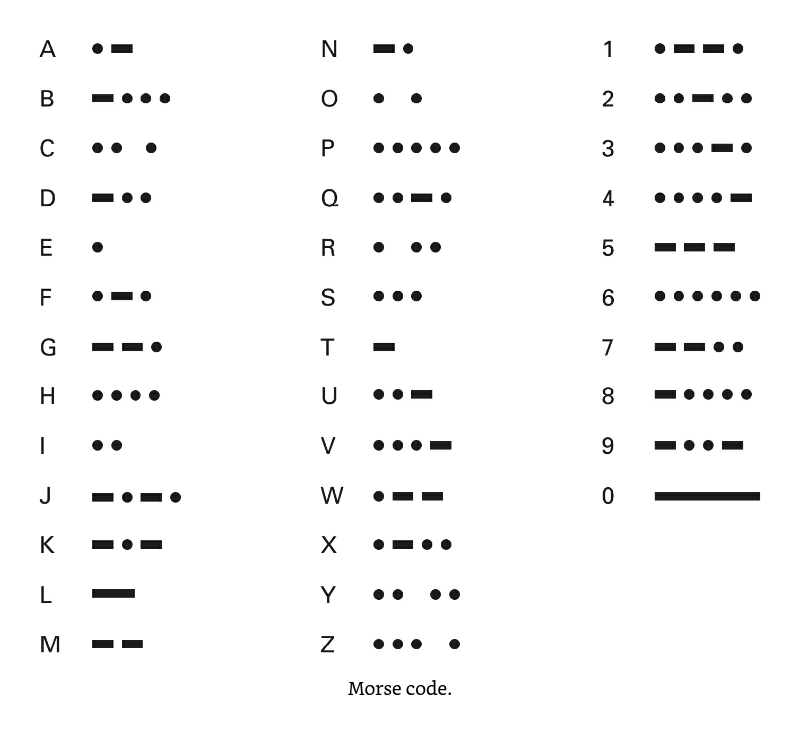
Erroneous Morse Code


Leave a comment

Filed under China, economics, Europe, language, nationalism, North America, publishing, travel

Losing Your First Language: Portuguese

From Face[t]s of First Language Loss, by Sandra G. Kouritzin (Routledge, 1999), pp. 164-165:

After immigrating to Toronto from Portugal at the age of 1 or 2, Michael didn’t learn to speak English until he began Grade 1. When he started school, it became obvious to his teacher that Michael couldn’t speak English very well, and so she encouraged his parents to speak to him in that language at home. They tried, but by the time Michael was in Grade 3 and able to function well in school, they reverted to Portuguese in the home. The pattern was well-established however, and Michael continued to reply to them in English.

Apart from his language difficulties, Michael doesn’t recall much of his early years of school except that he was in trouble a lot. He “spent a lot of time in the corner” (November 17th, 1995, p. 1), which he attributes to “language issues,” and to the fact that he didn’t get a lot of support at school. Later, his language issues were multiplied when, during puberty, he simultaneously returned to Portugal for a visit, and also began having speech difficulty when his voice started changing. According to his speech therapist, he began using his false vocal chords; he began feeling very self-conscious using the English language. When he visited Portugal during the summer vacation, he began to feel more comfortable around the Portuguese language, and, at the same time, he stopped using his false vocal chords. It is a chicken-and-egg question whether he feels more comfortable with the sounds and rhythm of Portuguese than with English because his language difficulty was solved in Portugal, or if his language difficulty was solved in Portugal because he felt more comfortable with the language. Either way, it is a moot point; he can no longer speak the language, even having difficulty in retrieving single words.

Leave a comment

Filed under Canada, education, language, migration, Portugal

Losing Your First Language: German

From Face[t]s of First Language Loss, by Sandra G. Kouritzin (Routledge, 1999), pp. 158-159:

Alexandra asserted many times that she was unaffected by the loss of the German language which she had spoken until she was about 9 or 10, that in fact, the loss of German had been extremely beneficial to her.* She insisted that the only loss she felt was the loss of opportunity to speak a second language. She told me these things so many times, and so force­fully, that I stopped believing her.

Born on the prairies, Alexandra was the youngest of six children in a German-speaking household. Her mother was her father’s second wife; her three oldest siblings were half-brothers. When Alexandra was 10 years old, her own mother died and her father couldn’t manage both his family and his farm. Her three oldest brothers, aged 16, 18, and 20, moved out on their own, while the three youngest children became wards of the state and were placed in foster care with families who did not speak or understand German. When her family split up, Alexandra did not maintain contact with her father because she felt betrayed.

Instead, she considered the family that she lived with and grew up with to be her family, and she never even discussed her former family with her foster family. Although she had some desire to maintain contact with her siblings, because she felt no need to see them, and because her foster parents would have found it difficult to accommodate her desire to see her former siblings, she seldom had any contact with them.

She remembers speaking German at her brother’s wedding 4 months after her family broke up, but that is the last recollection she has of being in a German-speaking environment. At this time she doesn’t remember any German words at all; in fact, she says she can’t even count to 10 in German.

*[Author’s note:] I have come to be very suspicious of such claims, which are often used to contradict research directed at heritage language maintenance. Through this project, after close questioning of subjects who initially said similar things, I have come to realize that they do not mean they are glad to have lost the first language, but rather that, if they had to be monolingual, then they are glad to be monolingual in English rather than in some other language.

Leave a comment

Filed under Canada, education, Germany, language, migration

Eastern Europe After Mohacz

From The Making of Eastern Europe: From Prehistory to Postcommunism, by Philip Longworth (Lume Books, 2020), Kindle pp. 250-252:

The political consequences of the battle of Mohacz were also considerable. Louis II had died childless; and the Habsburgs of Austria, long-sighted dynastic politicians and shrewd diplomatists, became the leading contenders for the thrones of both Hungary and Bohemia, and soon gained both. But in Hungary there was strong backing for a local candidate, John Zapolyai, and he, too, was crowned king. This political division weakened resistance to the Turks, who by the end of 1541 had occupied the southern and central parts of the country, including the capital Buda; and gained suzerainty over the east, which became a largely autonomous principality, Transylvania.

The death of Louis had ended one Eastern European dynasty. Two others failed to survive the sixteenth century. The last Jagiellonian King of Poland-Lithuania died in 1572; the last of Russia’s ancient Riurikid dynasty in 1591. In both instances political hiatus encouraged tumults, though, as we have seen, the long-term outcomes were quite dissimilar. While Russia returned to dynastic rule, Poland abandoned it. In this respect she came to resemble the smaller polities in the region, the Danubian Principalities, self-governing tributaries to the Turk, which also lacked dynastic rule: The instability of their domestic politics is suggested by the fact that, in the course of one century Wallachia had twenty-four, and Moldavia no fewer than forty, changes of ruling prince, or hospodar.

These religious and political changes were obvious to contemporaries. But there were other shifts, no less profound in their effects, which were much less noticeable at the time, or recognized only in retrospect.

Europe’s centre of economic gravity had been moving from the Mediterranean to the countries bordering on the North Atlantic; from the basin of the River Po to that of the Rhine (where it has remained); and from the emporia of Istanbul and Venice to that of Amsterdam. Furthermore, a surge in the population of Western Europe, and in particular of its cities, was stimulating a sharply increasing demand, and hence higher prices, for imported foodstuffs which Eastern Europe was able to supply. This was to have marked social as well as economic effects, especially on those regions with access to the Baltic, not least in encouraging the rise of serfdom.

At the same time the importation of silver from the Americas was promoting a sharp increase in the money supply and hence serious inflation. This was to throw the finely-tuned mechanisms of the Ottoman state out of kilter and prove a major factor in its subsequent decline. And there was one change perceived by very few, if at all, the indirect effects of which were felt by almost everyone. This was ‘the little ice age’, a slight but insidious drop in the average temperature beginning late in the sixteenth century. By restricting the latitude and height at which agriculture was viable this precipitated famines, population movements and the great disorders which were to overtake most of Eastern Europe at the turn of the century, turning the frontier lands especially into a crucible of violence.

And there was a plethora of other factors which intervened at various points with varying intensity to influence the course things took. Linguistic differences, for example, sometimes fed into religious and political struggles; and social classes sometimes gained or lost constitutional rights according to the religion they embraced at a particular moment. Low population density in Poland-Lithuania contributed to the enserfment of the peasant; yet high population density in the Ottoman Empire contributed to the disruption of that state. Sometimes the effects seem paradoxical. The Turkish presence, so often assumed to be a wholly negative influence, slowed down and even reversed the process of enserfment in Hungary for a time. The Baltic grain boom had helped to promoted serfdom, yet the end of the boom around the turn of the century served not to remove serfdom, but to entrench it. And though Protestantism is often associated with the origins of modern science Copernicus was a priest whom Polish Protestants rejected, while the patron of Tycho Brahe and Kepler was a Habsburg. The interactions of circumstances and catalysts that shaped Eastern Europe in the period from 1526 to 1648 far exceeded in complexity the most complicated transmutation process in any alchemists’ laboratory.

Leave a comment

Filed under Britain, Eastern Europe, economics, food, Germany, migration, military, nationalism, Netherlands, religion, science, slavery, Spain, Turkey

The Ramshackle Habsburg Empire

From The Making of Eastern Europe: From Prehistory to Postcommunism, by Philip Longworth (Lume Books, 2020), Kindle pp. 225-227:

Like the Hohenzollerns of Prussia, the Habsburgs had a variety of rights and powers in many different lands. They were Archdukes of Austria, hereditary Kings of Bohemia, traditional candidates to the elective throne of Hungary (though the Turks occupied much of it and Transylvania was an autonomous principality); and, besides holding a plethora of other titles, were Emperors of the Holy Roman Empire (again as hereditary candidates), a position which gave them little direct power, but a great deal of prestige and not a little patronage. The Habsburgs, then, governed in various ways at once – sometimes exerting direct authority backed up by force; more often abiding by precedents, negotiating, persuading, exerting influence through their powers to grant titles and make appointments.

Theirs was a ramshackle empire, which had expended much of its wealth and sustained much damage during the Thirty Years’ War; and it was still threatened by powerful enemies, notably Ottoman Turkey and France. Furthermore, although the Habsburgs had been the chief protagonist of the Catholic cause in the war, and although the peace sanctioned their imposing it on all their subjects, it was not practicable to do so in Hungary, where there were many Protestants; and the suppression of Protestantism elsewhere, as in Bohemia, tended to promote sullen resentment which might be exploited in the cause of rebellion. How, then, were these obstacles to Habsburg authority to be overcome? What glue could be found to bind these disparate peoples and territories into a cohesive body politic?

According to a leading authority the recipe called for the mutual support of the dynasty, the Counter-Reformation Church and a cosmopolitanized aristocracy, who formed a community of interest; and the use of religious mysteries, the mystique of kingship and the magic of the arts to hold people in thrall. But the military was also important.

The Habsburgs emerged from the war with a permanent standing army and thereafter strove to enlarge it, though as late as 1683 the establishment was only 36,000. Since this was a professional, disciplined, force which did not normally live off the land, it did not arouse the resentment of the population in the localities where it was stationed, as had formerly been the case. Indeed, in time, the army came to promote loyalty to the dynasty not only among those who served in it (the new permanent armies presented welcome new career opportunities to gentlemen and commoners alike), but among a wider public. The sight of neat ranks of men in attractive uniforms marching by to the invigorating sound of flutes and drums tended to arouse popular enthusiasm, and when the army won victories the dynasty gained prestige.

Nonetheless, as in Russia, the practice of religion and the institution of the Church were recognized as being of prime importance in legitimating the dynasty and promoting deference among its subjects. Both Ferdinand III and his successor Leopold I (1657–1705) were personally devout and, like Alexis of Russia, made public show of it. Leopold often made pilgrimages, visited monasteries three or four times a week and dispensed a great deal of charity to the needy. He also believed oaths, including those he himself swore, to be binding. Yet, like Alexis, insofar as he showed himself to be as pious as any prelate, he felt entitled to interfere in church affairs. Not only did he control the more important ecclesiastical appointments, order special prayers to be said and proclaim religious holidays by decree, he imposed taxes on the clergy and milked the church of funds, plate and valuables as the need arose. One can therefore understand the wry comment of the papal nuncio who wished the Emperor were not quite so pious.

Leave a comment

Filed under Austria, Eastern Europe, military, nationalism, religion, Russia