
Category Archives: U.S.

Destruction of Manila, 1945

From Asian Armageddon, 1944–45, by Peter Harmsen (War in the Far East, Book 2; Casemate, 2020), Kindle pp. 189-191:

The 11th Airborne Division also moved towards Manila from the south but still met with determined opposition and some of the most formidable hardware prepared by the Japanese in expectation of the assault. At Nichols Field, a US military airfield established before the war, they were shelled by five-inch naval guns, removed from warships and placed in strategic positions. Being forced to halt, a company commander messaged back to headquarters, “Tell Bill Halsey to stop looking for the Jap fleet. It’s dug in on Nichols Field.”

In parts of the city, the fight proceeded Stalingrad-style, with protracted combat building for building, floor for floor, room for room. When soldiers of the 1st Cavalry entered into Manila Hotel, they were met with a hail of bullets from Japanese positions on the stairs leading to the upper floors. Deadly combat ensued, as the Americans worked their way up, while the Japanese counterattacked from one floor to the next. One group of defenders held on to the mezzanine floor for 24 hours, and it was three days before every Japanese in the building had been killed, leaving it in American hands.

Shortly afterwards, Eichelberger moved into the annex of the hotel, taking in the view of Manila. “I could see the city of Manila gleaming whitely in the sunshine. I could see Corregidor, and the hook of the Cavite peninsula, which curves into Manila Bay. In another direction I could see Balayan and Batangas Bays on the sea, and, inland, Lake Taal in the crater of an extinct volcano and the shimmer of Laguna de Bay,” he wrote in his memoirs. “It was strangely like a homecoming. But soon tall plumes of smoke began to rise in Manila, and at evening the tropical sky was crimsoned by many fires. The Japanese were deliberately destroying the magical town which had been traditionally called ‘the Pearl of the Orient’.”

The almost complete devastation of Manila, including the picturesque Intermuros [sic] district dating back to the 16th century, took place despite MacArthur’s express wishes to spare the city and its people. He had told Kenney, the commander of his air corps, to avoid bombing the city from the air: “You would probably kill off the Japs all right, but there are several thousand Filipino civilians in there who would be killed, too. The world would hold up its hands in horror if we did anything like that.” However, deliberate Japanese arson, a kind of urban scorched-earth tactics, combined with artillery fire on both sides to lay waste to the city. “Every beautiful public building is in ruin, and there is no roof on any building in the Intramuros,” Eichelberger wrote in a letter to his wife. “It is all just graveyard.”

It bore a resemblance to the fate that had befallen Warsaw the year before, and the same could be said of the senseless killing of civilians. Just as the most brutal units of the German SS somehow found time to massacre the population of the Polish capital, the Japanese, too, went on a bloody rampage among defenseless men, women, and children. “Crazed with alcohol, Japanese officers and men raged through the city in an orgy of lust and destruction that brought back memories of their conduct at the capture of Nanking several years before, when their actions had horrified the civilized world,” Kenney wrote later.

Leave a comment

Filed under Japan, military, nationalism, Philippines, U.S., war

Roles of Nadzab and Ulithi in 1944

From Asian Armageddon, 1944–45, by Peter Harmsen (War in the Far East, Book 2; Casemate, 2020), Kindle pp. 134-136:

If one were to point to one vital factor that tilted the balance against the Axis across the globe, it was, in addition to the Soviet willingness to shed blood, the juggernaut of American industrial might. To be of any use it had to be taken from the assembly lines in the United States to where it was needed, and by 1944, it was reaching the farthest corners of the Pacific. It was a miracle of transportation, but it did not come easy or cheap: for every combat division that was deployed in the war against Japan, twice the number of service troops was needed to ship it to the region and keep it supplied. This was a feat that probably no other power could accomplish but the United States, skilled in the operation of a modern continent-sized economy, with maritime commercial ties spanning across the globe to match. The war in the Pacific was a logistical contest as much as a military conflict, and America was uniquely prepared for it.

The peculiar nature of the war changed the face of the Pacific, and it brought the 20th century, with all its technological prowess and organized violence, to areas that sometimes were just emerging from the Stone Age. At Nadzab in New Guinea, originally a mission station with a tiny airfield for small planes, one of the world’s largest airports and transportation hubs had emerged from practically nothing. It was the western terminus of the Air Transport Command’s trans-Pacific flights, and by 1944, it was a beehive of frantic activity, as Navy airman Charles Furey later recalled: “During the daylight hours, the sky is filled with hovering airplanes, and airplanes taking off and landing. Hardly a day goes by when there isn’t a fiery crash on one of the runways. We hear a deep rumble, and then an obelisk of black smoke appears in the sky, a brief monument to some unlucky flight crew.”

Later in the year, Ulithi atoll in the Carolines became for a period the world’s largest fleet base. It was seized against no opposition on September 23, and within weeks, it was home to not only harbor facilities, but also an airstrip and a hospital, and shortly afterwards “Radio Ulithi” began broadcasting. The base even boasted modest facilities for rest and recreation for weary soldiers and sailors, on the small island of Mogmog, ruled by the Micronesian King Ueg, who agreed to move his people to the neighboring island of Fassarai for the duration of the war. At one point when the lagoon was particularly crowded, Mogmog was “so full of bluejackets in shoregoing whites that from a distance it looked like one of those Maine islands where seagulls breed,” according to the official US Navy historian. Still, there was little entertainment: “You would sit around and drink beer and that was about it, and maybe try to go for a swim. But the coral was so sharp that it would cut your legs up and you couldn’t even get in the water,” a serviceman recalled.

Michael Bak, quartermaster on board the destroyer USS Franks, remembered the immense size of Ulithi, which seemed large enough to hold the entire US Navy: “One of the interesting things about Ulithi was that there were so many ships in the fleet coming in that everybody aboard ship had a buddy on another ship. They would come up to the bridge, where the signal gang had a record of the ships in the lagoon. The signalmen always knew, because we had to watch our division commander’s mast for signal messages which were given off on the yardarms. And one of the fellows from our crew would come to the bridge and ask if we could call different ships to see if so-and-so was aboard, and maybe get him to talk,” he said.

Leave a comment

Filed under industry, Japan, Micronesia, military, Papua New Guinea, U.S., war

Chinese Troops in Burma, 1944

From Asian Armageddon, 1944–45, by Peter Harmsen (War in the Far East, Book 2; Casemate, 2020), Kindle pp. 51-53:

General Tanaka Shin’ichi, commander of the Japanese Army’s 18th Division, was on a mission in northern Burma in early 1944 directly linked to the attempt at Imphal and Kohima to cut through the British lines and reach the Indian border. With his battle-hardened men, he was to cover the right flank of the Japanese forces engaged in the main offensive and tie down as many Allied forces as possible. At the same time, he was to pursue a separate and arguably more important objective, penetrating as deeply into enemy territory as possible. For him, too, the ultimate objective was to disrupt the supply lines between India and China.

Like the Japanese further south, Tanaka was up against a multinational enemy, but of a different kind. Facing him in the north Burmese hills and jungles were the products of one of the most precarious and unwieldy alliances of the entire war—that between China and America. He was an experienced officer who had taken part in most of Japan’s conflicts since the early 1930s, but he had never before confronted the Chinese in battle. When he finally had the opportunity in the spring of 1944 near the village of Yupang Ga, he was surprised. “The unexpected stubbornness of the Chinese troops in the fighting around Yupang Ga,” he wrote in post-war comments, “led the Japanese to believe the troops that faced them were far superior in both the quality of their fighting and in their equipment to the Chinese troops they had been fighting in China for years.”

The Chinese troops fighting at Yupang Ga were from the New 38th Division, the result of long months of Sino-American cooperation following the US entry into the war. The most visible sign of this cooperation was the trademark M1 helmet worn by the Chinese soldiers, as well as the many examples of state-of-the-art equipment and weaponry they were carrying into battle. More importantly, the soldiers had been through months of US-led training at camps in India and had been instructed in the methods of modern warfare. The hard work was not wasted and the Chinese pushed the Japanese back at Yupang Ga. To the young Chinese soldiers, it was an immense morale boost, and likewise to their officers, who still remembered the first humiliating battles with the technologically superior Japanese during the preceding decade. “The Chinese soldiers talked of it over and over again,” according to the official history. “The first victory is never forgotten.”

The Japanese, under pressure from the Chinese divisions, retreated back south. In this situation, General Joseph Stilwell, the senior US officer on the Asian mainland, decided to bring to bear what American forces were available to him, in the shape of the newly formed 5307th Composite Unit (Provisional). Dubbed “Merrill’s Marauders” after its commander, Brigadier General Frank Merrill, it was the first major US Army unit to go into combat in Stilwell’s area of responsibility. The Marauders represented an attempt to beat the Japanese at their own game, as its members were trained to infiltrate through enemy lines and roam deep inside hostile territory.

The British had pioneered this effort on the Allied side with their Long-Range Penetration Groups, known unofficially as the Chindits, under the command of the unorthodox Major General Orde Charles Wingate. The Chindits had first been placed into battle in 1943, and by 1944 they had built up enough skill and experience to arguably have an impact on the overall conduct of the war. Elements of two Japanese divisions were engaged in fighting the Chindits, and Japanese General Mutaguchi, who led the offensives against Imphal and Kohima, argued that if either division had been able to release just one regiment from these operations, it “would have turned the scales at Kohima.”

Leave a comment

Filed under Britain, Burma, China, Japan, military, nationalism, South Asia, U.S., war

Japanese Homefront Mood, Jul. 1944

From Asian Armageddon, 1944–45, by Peter Harmsen (War in the Far East, Book 2; Casemate, 2020), Kindle pp. 115-118:

The sun was shining from a bright Pacific sky, but Admiral Ugaki Matome’s mood was much more accurately reflected in the dreary seasonal showers that he knew were now hitting the Japanese home islands. As commander of one of the fleets that had been beaten so profoundly off Saipan, he was fully aware of the implications. “It will be extremely difficult to recover from this disaster and rise again,” he wrote in his diary. “When I think the prospect of a victory is fading out gradually, it’s only natural that my heart becomes as gloomy as the sky of the rainy season.”

Back in Tokyo, the humiliation was felt equally intensely. Retired Admiral Yonai Mitsumasa was in despair. “Although I do not know [the] exact details, Japan has lost the war,” he told a colleague. “We have been defeated beyond doubt. Whoever leads the war, there is nothing to be done.” Hirohito was in a daze and spent his time gazing at fireflies in the Fugiake Garden of the Imperial Palace. “Under the circumstances, there is nothing better for him than to divert himself and to recuperate,” his second cousin Irie Sukemasa wrote in his diary.

Vice Admiral Miwa Shigeyoshi spoke for many when he commented: “Our war was lost with the loss of Saipan. I feel it was a decisive battle. The loss of Saipan meant [the Allies] could cut off our shipping and attack our homeland.” Rear Admiral Takata Toshitane, the deputy chief of Military Affairs at the Navy Ministry added, “We knew that from then on the war was going to be pretty tough. We realized that with the destruction of our industrial capacity, our production would naturally drop to practically zero.” Nagano Osami, the emperor’s supreme naval advisor, put it succinctly: “Hell is on us.”

The few foreigners left in Japan felt the different atmosphere. The Vice Admiral Paul Werner Wenneker, German Naval attaché to Tokyo, noted a clear change in the mood of the Japanese governing elite after the debacle at Saipan, an actual piece of Japan, and not recently conquered territory. “Saipan was really understood to be a matter of life and death,” he said. “About that time they began telling people the truth about the war. They began preparing them for whatever must happen. Before that, they had been doing nothing but fooling the people.” A few days after the loss of Saipan, Tōjō did indeed tell the public that “Imperial Japan has come to face an unprecedentedly great national crisis.”

Prime Minister Tōjō came under pressure over the loss of Saipan. His wife received phone calls from people who did not give their names and simply asked, “Hasn’t Tōjō committed hara-kiri yet?” In an indication that after years of war Japan was nowhere near becoming a hard dictatorship like Germany, Tōjō faced criticism that he was amassing too much power in his own hands. Some even compared him with Adolf Hitler, arguing that it was the German dictator’s insistence on making all the big decisions himself that had led to the disaster at Stalingrad in early 1943. Tōjō was unperturbed: “Chancellor Hitler was a corporal. I am a general.”

In what could have been an almost perfect parallel to the attempted assassination of Hitler in July 1944, two Japanese officers in the same month planned to throw a bomb at Tōjō’s car as it passed through the grounds of the Imperial Palace in Tokyo, but their plan was thwarted, and they were sentenced to death—and later granted a stay of execution. Instead, political pressure built on Tōjō to resign from his post. An alliance of court officials and senior naval officers had been seeking to oust him for months but had been prevented from achieving their aim by Emperor Hirohito’s strong support of Tōjō.

They had been waiting for the right moment to strike, and now with the fall of Saipan, the opportunity was there. They acted by the middle of July, preparing a resolution to Hirohito stating that “the minds and hearts of the people must be infused with new life if the empire is to survive… a powerful new cabinet must be formed that will surge forward unswervingly.” With the loss of the emperor’s backing, Tōjō was doomed. On July 18, a deeply disappointed Tōjō was forced to tender his resignation. He was replaced by General Koiso Kuniyaki, who was not Hirohito’s first choice as head of the Cabinet, being seen as too easy to sway and with a dangerous penchant for mystical nationalism, probably the last thing Japan needed at this particular time.

Leave a comment

Filed under Japan, Micronesia, military, nationalism, U.S., war

Japanese Homefront Mood, Jan. 1944

From Asian Armageddon, 1944–45, by Peter Harmsen (War in the Far East, Book 2; Casemate, 2020), Kindle pp. 39-41:

Admiral Yamamoto Isoroku, the architect of the Japanese attack on Pearl Harbor, had made only limited promises before committing to the offensive against US and Western possessions in the Asia Pacific in late 1941 and early 1942. He would be able to deliver one victory after the other during the first months of the war while the enemy was still reeling from the initial shock of being attacked, he said, but once that early advantage had been exhausted, the going would become much harder. Now, two years into the war, Yamamoto was dead, shot down by American pilots over the South Pacific, and the US counteroffensive had picked up, pushing back at the fringes of Hirohito’s vast empire.

At the dawn of the new year 1944, therefore, many of the emperor’s subjects were concerned about the future, and some put their bewildered thoughts on paper. “An important year has come. The days are coming that will decide history,” wrote liberal journalist Kiyosawa Kiyoshi in his diary on January 1. There was a pervasive sense that things might not stay the same. In every home in Japan when breakfast was served, he noted, people asked the same question: “Will we really be able to eat in this way next year also?” Yabe Teiji, a political science professor at the Tokyo Imperial University, was more straightforward in his diary entry: “The coming year will be Japan’s year of disaster.”

The Tokyo Metropolitan Police was keenly interested in the public mood and remarked in a secret report that although some clung on to a vague sense of optimism about the war, a note of caution was clearly discernible. “There are some who are frankly amazed at the quick and mighty strategy of the enemy and fear the threat of invasion of the mainland, some who desire the announcement of the truth, and some who fear for the safety of our fleet,” the anonymous author of the report wrote, adding that people who held these views were not few in number. There were other categories of opinion, all reflecting the fact that any early enthusiasm put on display at the start of the war was long gone: “Those who go to the extreme criticize military strategy, exaggerate the announcement of our losses, and consider the war to have already been decided. Also, those who are totally unconcerned with the war situation and show a trend toward defeat and war-weariness, just longing for speedy end of war, have been seen here and there.”

By early 1944, even the most optimistic among the 73 million Japanese could no longer fool themselves into believing that life went on as before. In February, the government issued “Outline of Decisive War Emergency Measures,” closing high-end entertainment and causing life in the big cities to take on an even drabber appearance overnight. The new rules were expanded to the entire empire with immediate effect, as Admiral Ugaki Matome found out when he stayed over in Japanese-occupied Shanghai and was entertained one evening by Japan’s governor general. “Banquets, restaurants, and geishas have been banned, as in Japan proper, but the governor general still seemed as full of life as before,” Ugaki wrote in his diary. The kimono, the colorful traditional Japanese dress, was also largely gone from the streets of Japan. As one observer noted, “to be a woman, basically, is not patriotic.”

As the war economy gradually caused an increasing share of available resources to be allocated to the military, getting enough to eat was suddenly a daily struggle for average Japanese families. There were lines of usually about a hundred people outside Tokyo food shops, and on any given day thousands of residents would leave the capital to buy supplies directly from farmers. The hard times were felt particularly keenly by the Westerners who had been caught inside the borders of the Japanese Empire when war broke out. In January, Red Cross delegate H. C. Angst visited a camp for civilian internees set up inside a Catholic monastery near Yokohama and subsequently described the poor conditions that the inmates lived under: “Space is insufficient and overcrowded. Some sleeping on tables. Light sufficient. No heating.” The anti-foreign mood showed up in other ways as well. Baseball, a favorite sport for the Japanese in the prewar years, was allowed to continue but was being cleansed of English-sounding vocabulary. Sutoraiki, an attempt to reproduce the word “strike” in Japanese, was replaced with the much more indigenous-sounding honkyū.

Actually, sutoraiki is a labor term; sutoraiku is the baseball term. I haven’t been able to find confirmation for honkyū, but it was probably 本球 ‘true/real/original ball’. Umpires had to call strikes with よし yoshi ‘good’ and balls with ダメ dame ‘not good’. Strikes were counted 一本, 二本 ippon, nihon, with the counter for long straight things, while balls were counted 一つ, 二つ hitotsu, futatsu, with generic numbers.

Two more nativized terms for balls and strikes, according to Japanese Wikipedia, were 悪球 akkyū ‘bad ball’ and 正球 seikyū ‘correct ball’, and the phrase 悪球打ち akkyū uchi ‘bad ball hitting’ is still used to describe batters who rarely walk because they swing at balls out of the strike zone. Anglicized terms for the same type of batter are バッドボール・ヒッター baddobōru hittā and フリー・スウィンガー furī suingā.

1 Comment

Filed under baseball, economics, Japan, language, military, nationalism, Pacific, U.S., war

Missouri River Travelogue: ND

The first stops in North Dakota on our 4250-mile road trip up the Missouri River and back were the tiny towns of Hague and Strasburg, not because the latter was the hometown of Lawrence Welk (another German via Odessa), but because it contained one of several cemeteries in Emmons County that contained distinctive wrought-iron crosses, whose National Register of Historic Places listing in Wikipedia had no photos. The crosses were made by German-Russian blacksmiths in central North Dakota who developed individual styles and whose work was known for miles around.

Our next stop was in Bismarck at the North Dakota Heritage Center and State Museum, which had a special exhibit on Native American storytellers in addition to its many exhibits on natural history, including lots of dinosaurs whose fossils are abundant in the Dakotas.

On our way to Minot the next day, we stopped to photograph (for Wikipedia) historic (1885) Ingersoll School in Underwood and later to view the Garrison Dam and Lake Sakakawea, the largest water storage reservoir in the U.S. (Lake Oahe in SD is the second largest.) In Minot, where Ms. Outlier spent her college years, we visited the attractive Scandinavian Heritage Center.

The next day we drove US2 west to Williston, stopping at Stanley and Ross in Mountrail County to photograph two NRHP sites for Wikipedia: the (1937) Great Northern Railway Underpass (very helpful when long freight trains are passing) and the unexpected (1929) Assyrian Muslim Cemetery. The Great Northern Railway (now merged into BNSF) was extended from Minot as far as Tioga, ND, in 1887, thanks primarily to Japanese immigrant labor. (US2 follows the railroad.) It brought many immigrant settlers onto the northern plains and carried enormous quantities of grain out. In 1951, Amerada Petroleum Corporation (now Hess Corp) discovered oil near Tioga and the resulting oil boom has made Mountrail and Williams counties the richest in North Dakota. Nearly every large farm has an oil well on it.

That afternoon, we took ND1804 (named for the year Lewis and Clark went upriver) to Fort Buford Historical Site at the confluence of the Yellowstone and Missouri Rivers, then drove farther to Fort Union Trading Post National Historic Site right at the state line. (The parking lot is in Montana.) For dinner, we enjoyed big servings of northern pike at the Williston Brewing Company in the old but renovated El Rancho Hotel.

On our way back to Bismarck the next day, we drove through the north unit of Theodore Roosevelt National Park, with lovely vistas of the North Dakota Badlands, the Little Missouri River, and herds of bison. After a long drive on I-94, we had fish again for dinner that night with one of Ms. Outlier’s old school friends, and lunch with another on our way south on US83 the next day.

Halibut en papillote

Leave a comment

Filed under education, energy, family, food, labor, migration, travel, U.S.

Missouri River Travelogue: SD

Back on the Lewis and Clark National Historic Trail, we followed the Missouri River into South Dakota, stopping first at Vermillion to photograph the fine architecture of the University of South Dakota. We made another stop in downtown Yankton to visit the waterfront before driving across Gavins Point Dam to see the hydroelectric plant and the visitor center on the Nebraska side of the river. After many attempts, I managed to get a clean shot of one of the many pelicans fishing and basking there.

From there, we headed north to visit the Corn Palace and eat lunch at the Cattleman’s Club Steakhouse in Mitchell before stopping for the night at Huron, where Ms. Outlier was born. In Huron, we photographed the world’s largest pheasant and visited the State Fair Grounds, where we found a monument to La Société de Quarante Hommes et Huit Chevaux Grand du South Dakota (a.k.a. French Boxcar), whose history was entirely new to me. After our meaty lunch, we were not very hungry that evening, but the rich aroma of South Asian spices coming from the motel owner’s suite enticed us to walk to a neighboring steakhouse where we ordered salads and wine.

The next day, we drove up to Aberdeen, where we visited the Dakota Prairie Museum and other historic sites downtown, including a building that had collapsed under heavy snowfall in March. We had dinner with cousins and lunch the next day with Ms. Outlier’s last remaining aunt. Our convention-oriented Ramkota Motel was hosting several high school graduation parties. (The Super 8 motel chain originated in Aberdeen, but we were not impressed with it on an earlier visit there.)

On our way to Bismarck, ND, we passed through Leola, SD (Rhubarb Capital of the World), and Eureka, SD (Kuchen Capital), once filled with Germans from Bessarabia. Ms. Outlier’s German ancestors had a farm in Eureka but there was no sign of it now. They immigrated to the Dakotas from Neudorf, now called Carmanova in Transnistria. There is a Neudorf cemetery outside Eureka, but it is not accessible to the public.

On our way back downriver several days later, we overnighted at another, much emptier Ramkota Motel in pleasant little Pierre, SD, the second least populous state capital in the U.S. (Montpelier, VT, is smaller.) Its capitol building is modeled on the one in Helena, MT. We drove across the river to Fort Pierre to visit Oahe Dam, which generates power for Minnesota, Montana, and Nebraska, as well as the Dakotas. The Missouri River usually marks the boundary between the Central and Mountain time zones in the Dakotas, but all businesses in Fort Pierre observe Central time—except the bars, which allow patrons to enjoy another hour of drinking before Mountain closing time.

Leave a comment

Filed under energy, food, industry, labor, migration, travel, U.S.

Missouri River Travelogue: NE & IA

We detoured from our flexible Lewis and Clark National Historic Trail itinerary to visit Lincoln, NE, on our way from St. Joseph, MO, to Sioux City, IA, for the night. Here are a few highlights of our long midday break in Lincoln.

We parked in a public parking garage and took a walking tour of downtown, heading first to the impressive State Capitol building, then strolling down Centennial Mall full of memorials toward the university, where we stopped in at the Nebraska History Museum because it had a special exhibit on Japanese Americans (sponsored by Kawasaki). Nebraska had several POW camps during World War II, but no Japanese internment camps. Ben Kuroki, a nisei Boy from Nebraska, became a war hero, flying bombing missions over Europe, North Africa, and Japan, and writing a book about it published in 1946. In the Museum’s gift shop we bought the book about Nebraska POW Camps that I blogged a bit about, and I browsed enough of Homesteading the Plains to buy a Kindle version so I could blog passages from it. I’ve blogged many passages from University of Nebraska Press books over the years, including several about baseball in Asia and Australia and a few in their Bison Books (general interest) series.

We were late getting out of Lincoln because we lost our car! We first looked in the wrong one of two similarly configured parking structures within two blocks of each other. When, after walking by each stall in all 6 floors, we asked about whether our car might have been towed, the attendants pointed us to the other structure two blocks away, where we found our car just where we had left it. After consoling ourselves with a late lunch, we lit out on I-80 and I-29 into Sioux City, IA, where we checked into Stoney Creek Hotel, a rustic, cowboy-themed midwestern chain we had never heard of before. It was pleasant enough, and convenient enough that we spent another night there on the way back down river. That night, we ate at Famous Dave’s barbecue restaurant nearby, our last major overindulgence in meat on this trip.

Leave a comment

Filed under baseball, democracy, Japan, migration, publishing, travel, U.S.

Missouri River Travelogue: MO

Last month the Far Outliers took a long road trip up the Missouri River and back to visit a few of the old friends, family, and stomping grounds of Ms. Outlier’s youth. We roughly followed the Lewis and Clark National Historic Trail. Our new Honda CR-V hybrid recorded 90 hours of driving time over 4230 miles between the time we picked it up at Nashville airport and the time we turned it back in. Here are a few notes about Missouri, with links mostly to photos on my Flickr site.

From Paducah, KY, we drive I-24, I-64, and I-44 right through St. Louis until we reached the scenic route along the Missouri River, MO100 and MO94, with stops at the well-maintained German  town of Hermann and the once bustling riverboat port of New Haven. We stopped for the night in Jefferson City. The next day we explored historic Arrow Rock, where the Santa Fe Trail crossed the Missouri River, then took I-70 and I-29 right through Kansas City up to the faded glory of St. Joseph, where we had drinks at The Angry Swede and spent the night at the (1885) Whiskey Mansion B&B. Missouri’s many wooded roadsides generated an enormous number of roadkills: not just the occasional deer, but lots of raccoons, opossums, and armadillos!

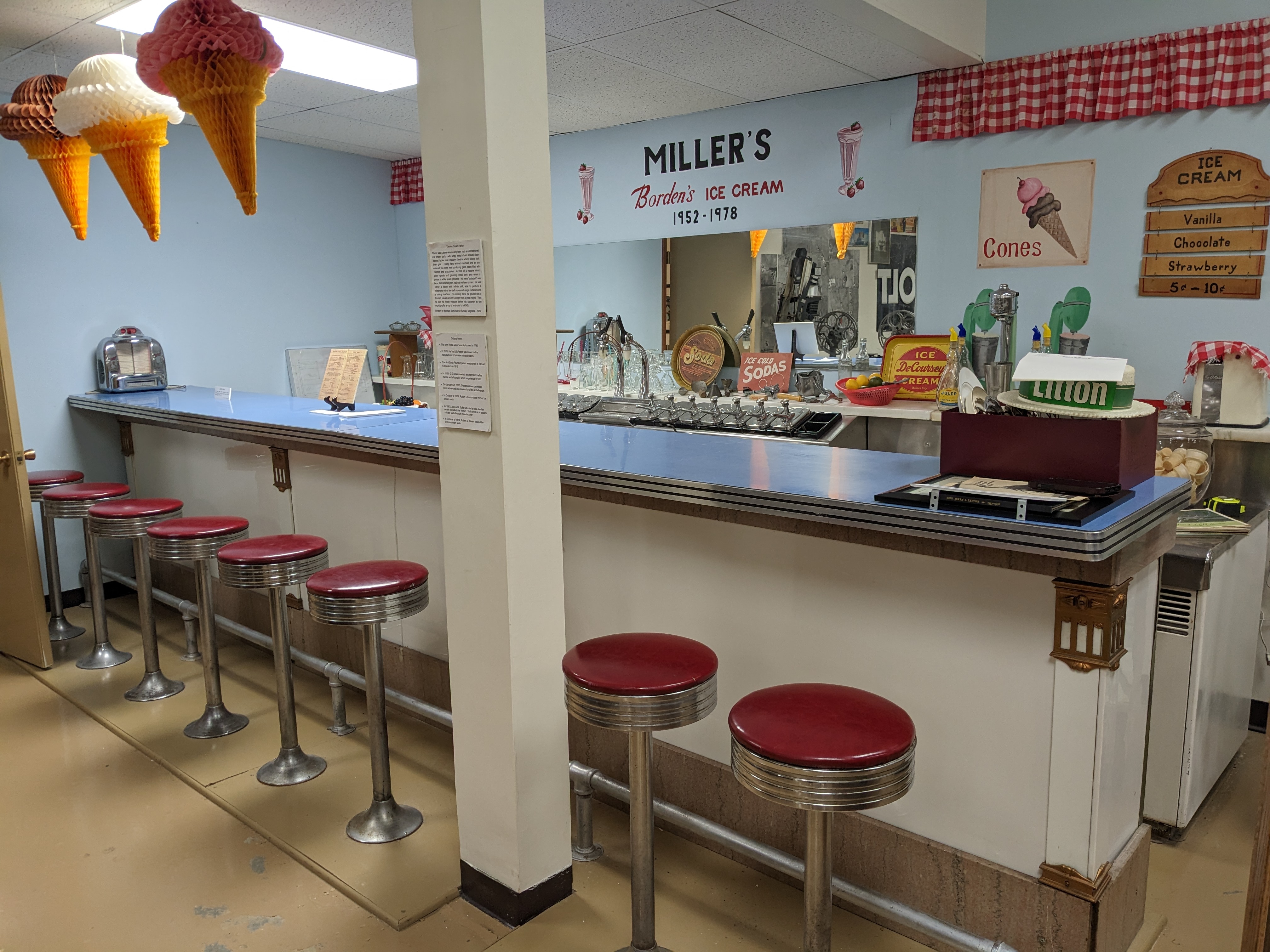
On the way back through Missouri on the Saturday of Memorial Day weekend, ladies at the first Visitor Center on I-29 warned us about traffic through Kansas City, which was hosting a Royals game, and advised us to take US36 from St. Joe across to Macon, then US63 down to Columbia, where we were booked for the night. The drive was far more pleasant than the Interstates, and we very much enjoyed exploring the quirky Grand River Historical Society Museum in Chillicothe, MO, where Otto Rohwedder invented the first automated bread-slicing machine for commercial use. A 1928 model of the Breadslicer was on display, on long-term loan from the Smithsonian. They also had a full display of an old-style ice cream and soda fountain.

Miller's ice cream and soda fountain, 1952-1978Miller’s ice cream and soda fountain, 1952-1978

Leave a comment

Filed under food, industry, migration, travel, U.S.

Homesteader Community Building

From Homesteading the Plains: Toward a New History, by Richard Edwards, Jacob K. Friefeld, and Rebecca S. Wingo (University of Nebraska Press, 2017), Kindle pp. 199-202:

4. Community policing of homestead claims was an effective mechanism to deter fraud. Homesteading scholars focused on what they assumed must have been paltry enforcement by overworked land office clerks and the miniscule force of GLO field investigators. In these conditions, they concluded, homestead claims must have been shot through with fraud; indeed, this conclusion buttressed the larger narrative to which they had already committed.

But it turns out that the Homestead Act also created a local network of watchful eyes. Mapping community relationships in the study area shows the emergence of keystone individuals in homesteading communities who helped create a local-community policing structure when no other existed. Neighbors, extended family members, would-be settlers in nearby towns, and others knew the ground, may have wanted it for themselves or their children, and didn’t want it stolen by swindlers and cheats. Just as in farming country today, where neighbors, family members, and others watch closely when ground in their vicinity becomes available due to the owner’s death or bankruptcy, so too it was in the homesteading regions. Indeed, [William G.] Comstock’s and [Bartlett] Richards’s attempted fraud came to disaster precisely because there were too many countervailing watchful eyes. What might have seemed anonymous and beyond scrutiny and hence ripe for fraud when viewed from Washington or New York or New Haven, or even from central Nebraska in the Comstock-Richards case, was in fact far more closely policed than expected.

6. The Homestead Act was not only a “single women’s law”; widows also participated at a high rate. In our study area, nearly as many widows filed initial entry claims as single women. But what greatly increased widows’ solitary participation—their unintended solitary participation—in homesteading was the deaths of their husbands. Women homesteaders succeeded by forming reciprocal socioeconomic relationships through employment and witness testimony between themselves and males in the wider community; they also created networks with other women that were crucial to their success. Our analysis highlights the need for scholars to further enrich this field.

7. Homesteading was not a solitary activity; it was a process of Americans from different backgrounds and regions mixing together to settle and form communities. They depended deeply on each other for survival and success. In our communities, keystone individuals emerged to provide economic, social, and political leadership in their neighborhoods. Immigrants from northwestern Europe tended to stake claims alongside native-born citizens, entering the social order of their new land. Central European immigrants, by contrast, more frequently created their own communities with their own leadership, thereby reproducing cultural landscapes more reminiscent of their homelands.

Settlement patterns and cultural differences thus separated communities of homesteaders. Different languages, religions, civic customs, community expectations, and patterns of family life all served to create distinctions. As Eric Foner noted, “In the late nineteenth century the most multicultural state in the Union was North Dakota,” but modern scholars have tended retrospectively to recategorize these varied peoples simply as “white,” thereby washing away their diversity. And while the walls between them were never as impermeable as those of race, these groups often required decades to overcome their differences and for diverse communities to become integrated. Even today we are left with certain communities that continue to proudly reflect their ethnic heritage in significant ways.

Leave a comment

Filed under democracy, economics, labor, migration, nationalism, U.S.