Category Archives: travel

Columbus as Portuguese Wannabe

From Seven Myths of the Spanish Conquest, by Matthew Restall (Oxford, 2004), Kindle Loc. 348-399:

Columbus had profound Portuguese connections. Although he was Genoese and the sponsor of his voyages across the Atlantic was Queen Isabella of Castile, Columbus spent much of his life from the 1470s on in Portugal. In the late 1470s he married the daughter of a Portuguese Atlantic colonist, and he repeatedly sought royal Portuguese patronage before and after first approaching the Castilian monarch….

This context is so important because it is by looking at Portugal before and during Columbus’s years there that one can see the degree to which the transplanted Genoese navigator had neither a a unique plan nor a unique vision nor a unique pattern of previous experience. Many others created and contributed to the expansion process of which Columbus became a part. Beginning 200 years before Columbus crossed the Atlantic, southern European shipping broke out of the Mediterranean into the Atlantic. The Vivaldi brothers, most notably, set off from Genoa in 1291 on what turned out to be a one-way voyage west across the Atlantic. Then, in the fourteenth and early fifteenth centuries a new zone of navigation was created that was bordered by the Azores in the north, the Canary Islands in the south, and the Iberian-African coasts in the east.

Finally, from the 1420s on, a further stretch of exploration and navigation into the mid- and west Atlantic was created and charted. In the 1450s and 1460s, Flores, Corvo, the Cape Verde Islands, and the islands of the Gulf of Guinea were explored. The Madeiras and Canaries were settled and turned into sugar-plantation colonies and by 1478 the former was the largest sugar producer in the Western world. Maps of the time show how important and extensive was the discovery of Atlantic space; speculation about the lands and features of the ocean was the most noteworthy feature of fifteenth-century cartography.

Although men from Italian city-states were involved from the start, and Castilians increasingly participated in the process (especially, from the late-fourteenth century on, in hostile competition for control of the Canaries), it was Portugal that dominated this expansion. Italian navigators were systematically and most effectively co-opted by the Portuguese monarchy (later joined by the Flemish), permitting the new Portuguese empire to control Atlantic settlement (except for the Canaries) and the agenda of expansion….

Columbus tried to become part of this process with growing desperation in the 1480s and 1490s. He failed for so long because he lacked the connections and persuasive ideas of other navigators. Even after he succeeded in crossing the Atlantic and returning, the extent of his success was questioned and questionable within the context of the time. The islands he had found (in the Caribbean) fell within the zone assigned to the Portuguese by the 1486 papal bull. And although in 1494 the papacy brokered a Portuguese-Castilian treaty that redefined these zones, it became increasingly apparent during the 1490s that Columbus had not found the much-sought sea route to the East Indies—but had been lying about it to Queen Isabella. Then, in 1499, Vasco da Gama returned from his successful voyage around the Cape and it became clear that the Portuguese had won the competition after all.

Columbus’s career was irreversibly damaged. His claim to have found islands off the coast of Asia, and thus the coveted sea route to that continent, rang hollow in the face of mounting evidence that these were new lands entirely. Columbus seemed to be lying for the sake of his contractual rewards. Perceiving the extent of his failure and his duplicity, the Castilian crown dispatched an agent to the Caribbean to arrest Columbus and bring him back to Spain in chains. Although he was later permitted to cross the Atlantic, he was forbidden to revisit the Caribbean and was stripped of the titles of Admiral and Viceroy of the Indies—titles he had fought to be included in his original contract and arguably the chief goal of his career. Meanwhile, those titles were conferred by the Portuguese crown upon da Gama.

The fact that it was Columbus’s voyages, not da Gama’s, that would lead to the changing of world history was not to the Genoese’s credit. His discoveries were an accidental geographical byproduct of Portuguese expansion two centuries old, of Portuguese-Castilian competition for Atlantic control a century old, and of Portuguese-Castilian competition for a sea route to India older than Columbus himself. Furthermore, had Columbus not reached the Americas, any one of numerous other navigators would have done so within a decade. Most obviously, the Portuguese Pedro Álvares Cabral explored the Brazilian coast in 1500, likewise arriving there in an attempt to reach Asia (by rounding the Cape).

2 Comments

Filed under Africa, Brazil, Caribbean, Latin America, migration, Portugal, scholarship, Spain, travel

Wordcatcher Tales: Menbei, Yuzusco, Hakugei

While we were shopping for light, comestible omiyage (souvenirs) to bring back from Japan this summer, we came across three products of linguistic as well as gustatory interest.

mentai + senbei = menbeiMenbei < mentai senbei – Korea is the source of one well-known item of Hakata (Fukuoka) cuisine, 辛子明太子 karashi mentaiko ‘spicy cod/pollock roe’. The name mentai apparently derives from Korean 명태 myeongtae ‘Alaskan pollock’. Its genus (Theragra) is different from that of the Atlantic pollock (Pollachius), but both fall within the highly prolific family Gadidae (< Gadus ‘cod’) ‘cod, haddock, pollock, whiting’. We bought a few boxes of spicy mentai-flavored rice crackers to share with our colleagues at work. Their pungent aroma caused some comment.

Yuzusco & ShogascoYuzusco < yuzu ‘citrus’ + (taba)sco – The fresh taste of yuzu (柚子) is very popular in Japanese cuisine and is used to flavor many different things: from savory chawanmushi to sweet honey, bitter tea, vinegar, wine, and even bath oil. We brought back some tiny jars of yuzu pepper paste and two hot sauces marketed as under the brand names Yuzusco and Shogasco (< shouga ‘ginger’ + -sco). I’m not sure if the makers of Tabasco have licensed just the last three letters of their registered trademark, but they apparently encourage co-branding. Nor am I sure where these products rank on the Scoville scale of spicyness.

Sampler of five types of shochuHakugei ‘White Whale’ – At a duty-free shop at Fukuoka Airport, we got a sampler of five small bottles of shochu, a longtime Satsuma (Kagoshima) specialty. (The cashier unboxed them and put them in little transparent baggies so we could take them through security!) They included 麦わら帽子 Mugiwara Boushi ‘barley-straw hat’, made from barley; two types of Satsuma 白波 Shiranami ‘white wave’ made from sweet potato (my favorite) with dark and light molds; 白鯨 Hakugei ‘white whale’, made from white rice; and 蕎麦蔵 Sobagura ‘buckwheat granary’, made from buckwheat. Shiranami is perhaps the most famous brand name of Satsuma shochu, but the other brand names were well chosen to reflect their ingredients. As one might expect, Hakugei tasted the most like sake. I prefer sweet potato shochu myself.

Leave a comment

Filed under food, Japan, language, travel

Wordcatcher Tales: Dorui, Kangou, Funkyuubo, Fujo

The first tourist site we visited on our most recent trip to Japan was Yoshinogari Historical Park in Saga Prefecture, on a stretch of open countryside that turned up lots of artifacts from the Yayoi-period (roughly 300 B.C. to A.D. 300), including many large burial jars, when developers began to prepare the ground for a large shopping center. The site was then turned into an historical park featuring “one of Japan’s largest moat-encircled villages and ancient ruins.” In fact, another pair of visitors we met there were from Perth, Australia, a mother and her daughter who had won a national essay contest by presenting the case for Yoshinogari to be designated a UNESCO World Heritage Site.

The signs describing the major features of the park were quadrilingual—in Japanese, English, Korean, and Chinese (simplified characters)—and one of the guides we met was a young lady from Dalian, China, who spoke some English and Russian in addition to Chinese and Japanese. (She was eager to practice her English, which was full of reading pronunciations.) Thanks to the helpful furigana on those signs, I learned a few new Japanese words and readings that were not even in my old Canon Wordtank G55 electronic dictionary. Here’s a sample.

土塁 dorui ‘earth fort, earthworks’ – The earliest forts in Japan apparently consisted of earthworks, palisades, and moats. The character 塁 ‘fort, rampart’ can be a synonym for 砦 toride ‘fort, stronghold, entrenchment’, but is now much more common in baseball, where it means ‘base’, as in 塁審 ruishin ‘base umpire’ or 塁打 ruida ‘base hit’.

環濠 kangouring trench‘ – The usual word for the ‘moat’ around Japanese castles is 堀 hori ‘ditch, canal’, related to the verb horu ‘to dig’. By itself, 濠 gou is better translated ‘trench’ (also ‘dugout, foxhole’), another product of digging. The character 環 kan ‘ring, circle, loop’ also occurs in 環境 kankyou ‘environment, circumstances’ (lit. ‘circle boundary’) and 環礁 kanshou ‘atoll’ (lit. ‘fringing sunken-rock’).

墳丘墓 funkyuubomound-hill-grave‘ – The common word for ‘grave’ is 墓 haka (Sino-Japanese bo) as in 墓石 boseki, hakaishi ‘tombstone’ or 墓堀 hakahori ‘grave digger’. A normal-sized grave mound is 墳墓 funbo ‘mound grave, tomb’, but a seriously hill-sized grave mound is 墳丘墓 funkyuubo (with 丘 ‘hill’, read oka in many placenames). Grave-mound building was carried to even greater extremes during the next major period of Japanese history, the Kofun 古墳 (‘old tomb’) period (c. 250–538).

巫女 fujo, miko ‘shaman, sorceress, shrine maiden’ – After immigration from the Korean peninsula began, but before Buddhism was established (during the 8th century), the chief spiritual practitioner in Japanese villages was a shaman, who was usually female, although the etymology of 神子 miko lit. ‘god-child’ is gender-neutral.

Leave a comment

Filed under baseball, Japan, language, military, travel

Wordcatcher Tales: Japanese Fish Names

During our recent travels to far-outlying corners of Japan we came across several local specialties that I had never heard of before. When I solicit the names for new dishes in Japanese, I often end up learning new fish names in English, just as I did long ago doing linguistic fieldwork in a coastal village in Papua New Guinea. Here is a sample of new fish we tried at izakaya last month.

Slender sprat sashimi

At the fine Umaya Restaurant beside JR Kumamoto Station, we ordered kibinago sashimi. After failing to find kibinago in my old Canon Wordtank G55 electronic dictionary, I asked the waitress if she could find out what to call it in English. She came back and showed me the gloss in her electronic dictionary, ‘silver-stripe round herring’. This slender sprat, Spratelloides gracilis, is often used as a bait fish, but also makes a very attractive dish of sashimi.

Mantis shrimp sashimi

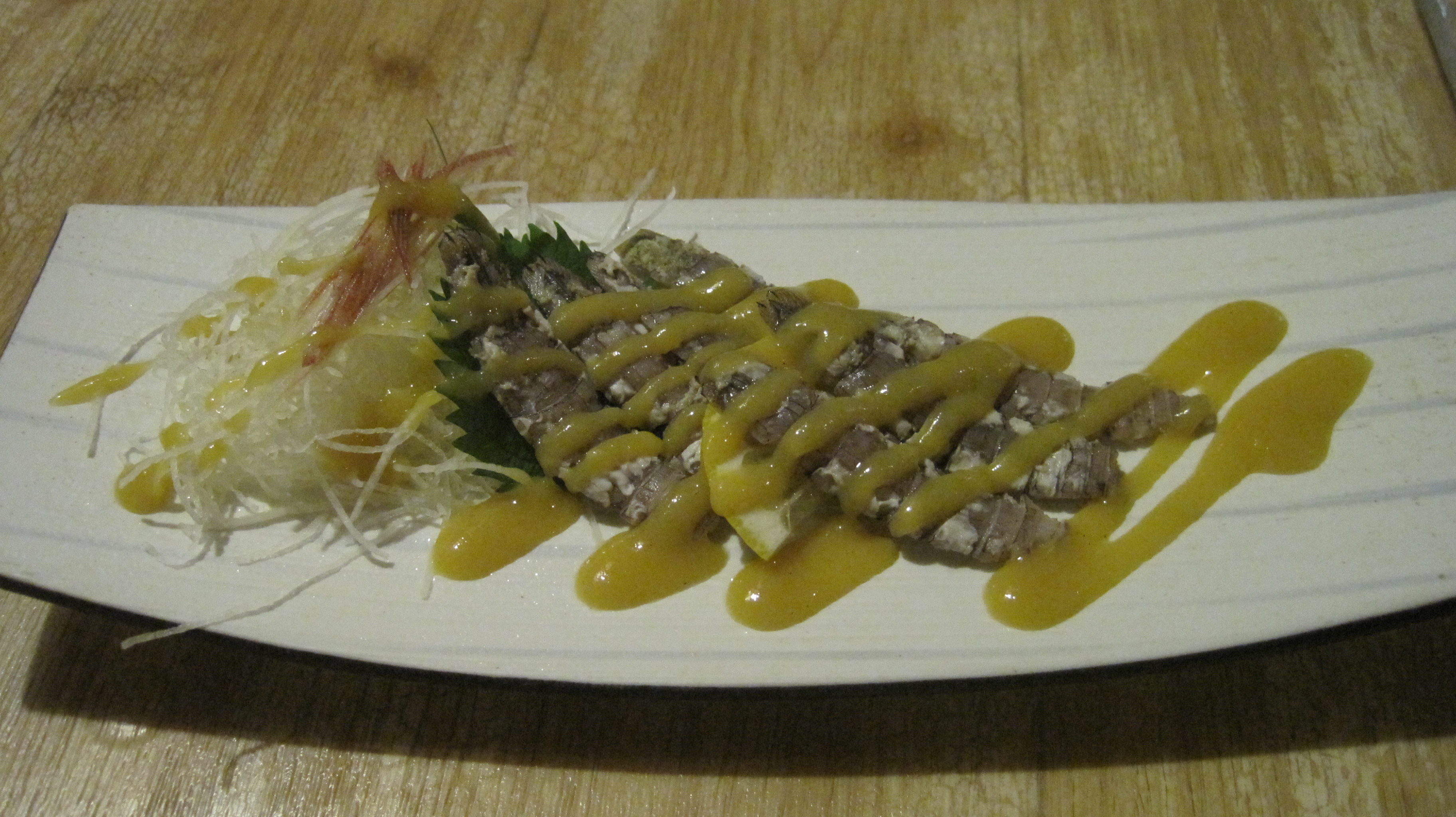
On the way up from Kyushu, we stopped overnight at Shin-Yamaguchi, an old railway junction city (Ogōri) that was renamed and upgraded to a Shinkansen station but still proudly displays memorabilia from the old days. The owner of the izakaya we had dinner at was a train buff and the walls of our booth were covered with posters and photos of old steam locomotives. Among the novelties we ate there was shako sashimi, mantis shrimp (Squilla sp.) with ginger mustard sauce to counter the fishy taste. This creature I could find in my electronic dictionary, so I tortured the waitress with questions about old trains. We both recalled the days when the steam locomotive whistle would signal an upcoming tunnel, and we would quickly close the window so as not to get a faceful of soot. The next day we boarded the Super-Oki limited express bound for the Japan Sea coast and up the San’in Main Line.

Dojou karaage

Deep-fried dojo loach

After making a quick visit to Tottori’s famous sand dunes just in time for the sunset, our taxi driver called his contacts at Daizen, a busy new izakaya that he recommended when I asked where we could find a place that served local specialties. We ordered fried gobo chips, which are gaining popularity, and we ate two fish that were new to us.

Broiled rosy sea bass

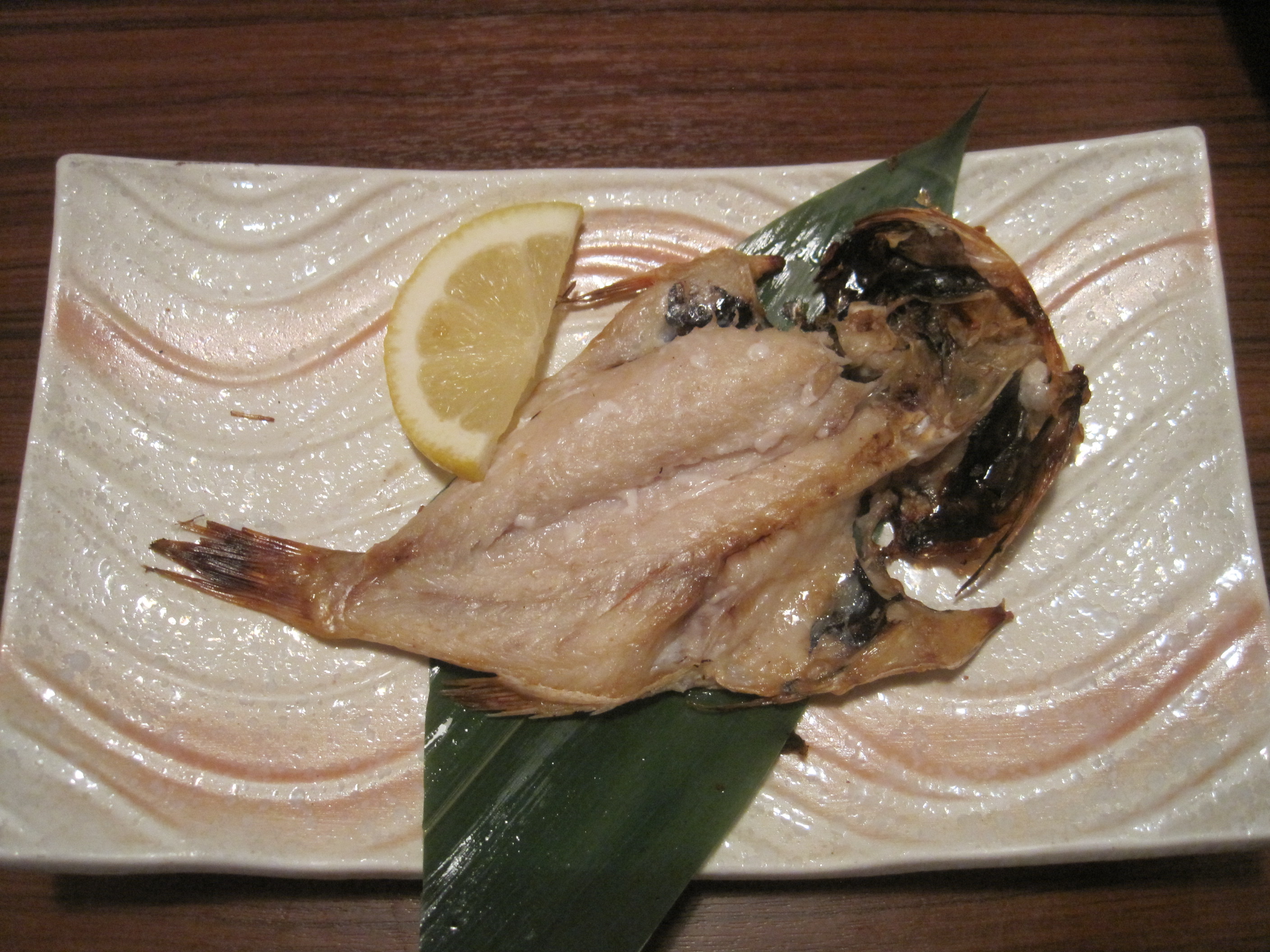
One was loach, 泥鰌 dojou (lit. ‘mud-loach’) ‘dojo loach’, Misgurnus anguillicaudatus, also called ‘weatherloach’, a member of the carp order (Cypriniformes). The other was broiled nodoguro (lit. ‘black throat’) ‘rosy sea bass’, Doederleinia berycoides (also called 赤鯥 akamutsu ‘red gnomefish’) in the family Acropomatidae (lanternbellies, Jp. hotarujako ‘firefly fry’).

Poached nibbler

At a small mamasan-without-papasan izakaya next to our hotel in Tsuruga, we tried mejina nitsuke ‘poached nibbler’. The Japanese name, 眼仁奈 mejina, applies to both the genus Girella and the subfamily Girellinae ‘nibblers’, members of the Kyphosidae (sea chub) family in the order Perciformes. We spent a long time talking with everyone else there: the very hospitable self-employed proprietor, who served as her own buyer, cook, and waitress (and single mother); a very talkative traveling digger and inspector of wells and tunnels; and three ladies from Shikoku on a hiking trip, one of whom had a daughter just back from Ethiopia with JICA.

Sea bass sashimi

Our second evening in Tsuruga we went to a much larger izakaya that had been too busy by the time we showed up the night before. There we had suzuki sashimi, which our waitress described as light and tasty when I asked what kind of fish it was. I hadn’t heard suzuki as a fish name, but in Japanese taxonomy, 鱸 suzukiJapanese sea bass or sea perchLateolabrax japonicus seems to be the type species or genus for a whole suborder and order of bony fish, the equivalent of Perc- in Percoidei (スズキ亜目) and Perciformes (スズキ目).

Leave a comment

Filed under food, Japan, language, travel

Wordcatcher Tales: Tetchan, Mitchan, Noritetsu, Toritetsu

Last month Mr. & Mrs. Outlier made good use of our Japan Rail passes to visit several of the more far-outlying places on Japan’s extensive rail network. We flew in and out of Fukuoka, so we started with JR Kyushu, riding its brand new Shinkansen trains as well as some of the older express trains.

On the way up to Nagoya, we stopped for a night at Shin-Yamaguchi, the starting point for the Yamaguchi Line, which connects the Sanyō Main Line along the Inland Sea with the San’in Main Line along the Japan Sea. Originally called Ogōri, the old station dates from 1913 and now caters to railway nostalgists, among whom I would have to count myself.

The next day we rode the 1-driver, 2-car Super-Oki Limited Express as far as Tottori, famous for its sand dunes. The following day we continued on to Toyooka, where we had to change to the non-JR Kitakinki Tango Railway‘s Miyazu Line in order to cross off my bucket list Amanohashidate, the third of Japan’s three most famous scenic views. Then we hopped back on the KTR to its terminus at Nishi-Maizuru, back on the JR network. Then we rode the local-only JR Obama Line the rest of the way to Tsuruga, the terminus of one of Japan’s earliest railway lines (1882), connecting the port of Osaka to the Japan Sea and crossing Lake Biwa by ship between Ōtsu (‘Big Harbor’) and Nagahama (‘Long Beach’).

In a small railway museum that used to be the Tsuruga Port train station building, we encountered a Japanese railway buff of the first order, a young businessman who was spending holiday time riding trains and visiting railway museums. When I told him we had come from riding the new Kyushu Shinkansen, he told me JR Kyushu had won awards for their new bullet train designs. When I said we were headed for Nagoya, he recommended I visit the new JR SCMAGLEV and Railway Park there. Our paths crossed again when he came out of the Tsuruga City Museum as we were going in, and he and I exchanged a final wave as he was entering and I was leaving the Nagoya Shinkansen station.

It was in Nagoya that Mrs. Outlier learned several words used in Japanese to refer to train buffs. The Japanese word for ‘railroad’ is 鉄道 tetsudou lit. ‘iron-road’, and railroad enthusiasts can be somewhat mockingly referred to as 鉄ちゃん Tetchan ‘railies’ if male and 道ちゃん Mitchan ‘roadies’ if female. (The native Japanese pronunciation of 道 is michi ‘road’.) More neutral terms for them in Japanese are 乗り鉄 nori-tetsu ‘ride-rail’ for those who seek to ride particular trains, or 撮り鉄 tori-tetsu ‘take-rail’ for those who seek to take photographs of particular trains.

3 Comments

Filed under Japan, language, travel

On the Road Again

We’re traveling the rails of southwestern and central Japan for the rest of the month.

1 Comment

Filed under blogging, travel

Curing Capt. Cook’s Costiveness with Clysters

From: Blue Latitudes: Boldly Going Where Captain Cook Has Gone Before, by Tony Horwitz (Picador, 2002), pp. 218-219:

Cook resumed his polar probe during the next southern summer [1773], after wintering in Polynesia. The second approach to Antarctica proved even more wretched than the first. Livestock perished, tropical provisions ran out, and the men—eating little except weevil-ridden biscuits and salt rations—began to show signs of scurvy and depression.

“Salt Beef & pork, without vegetables for 14 weeks running, would probably cure a Glutton, even in England,” wrote William Wales, the ship’s astronomer. According to George Forster, even the resilient Cook became “pale and lean, entirely lost his appetite, and laboured under a perpetual costiveness [constipation].”…

Three weeks later, Cook collapsed. He doesn’t reveal much about this in his journal, except to note that he was confined to his cot for a week because of a gastric affliction he called “Billious colick.” George Forster makes it clear that the captain’s condition was much graver than Cook suggests. The captain suffered from “violent pains” and “violent vomiting,” Forster wrote. “His life was entirely despaired of.”

The treatment given Cook—opiates, clysters (suppositories), plasters on his stomach, “purges” and emetics to induce vomiting—probably didn’t help. When Cook finally recovered, his first meal in a week was the only fresh meat on the ship: the Forsters’ dog. “Thus I received nourishment and strength from food which would have made most people in Europe sick,” Cook wrote.

Leave a comment

Filed under anglosphere, Britain, food, language, science, travel

Capt. Cook, Guugu Yimidhirr, and Kangaroos

From: Blue Latitudes: Boldly Going Where Captain Cook Has Gone Before, by Tony Horwitz (Picador, 2002), pp. 182-184:

Guns weren’t the settlers’ only weapons. Aborigines had little resistance to Western disease, or to alcohol. Chinese immigrants introduced opium, which Aborigines consumed by mixing the drug’s ash with water and drinking it. The Guugu Yimidhirr, like many Aboriginal clans, appeared headed for extinction—a fate little mourned by white Australians….

In the case of the Guugu Yimidhirr, it was Cook who proved their salvation, albeit indirectly. A German translation of Cook’s voyages inspired a young Bavarian, Johann Flierl, to set off in the 1880s “as a missionary to the most distant heathen land with its still quite untouched peoples.” He created a Lutheran mission near Cooktown that became a refuge for Aborigines. Flierl named the mission Elim, after an oasis the Israelites found during their exodus from Egypt. As oases went, Queensland’s Elim wasn’t much: a sandy, infertile patch north of Cooktown. But it grew into a stable community, and its school educated scores of Aborigines, some of whom became nationally prominent.

One such success story was Eric Deeral, who served in the 1970s as the first Aboriginal representative in Queensland’s parliament. I tracked him down late one afternoon at his daughter’s modest bungalow a few blocks from Cooktown’s main street. A small, very dark-skinned man, he met my knock at the door with a wary expression and a curt “May I help you?” When I burbled about my travels, his face widened into a welcoming smile. “Come in, come in, I love talking about Cook!” After several days of conversing about little except “ferals,” rooting crocodiles, and rugby league, it was a relief to find someone who shared my passion for the navigator.

Eric showed me into a small office he kept at the front of the bungalow. The bookshelf included several volumes about Cook. Like Johann Flierl, Eric had been fascinated since childhood by the image of first contact between Europeans and native peoples untouched by the West. He’d quizzed Aboriginal elders about stories they’d heard of Cook and his men. “At first, our people thought they were overgrown babies,” he said. Aboriginal newborns, Eric explained, are often much paler than adults. But once the Guugu Yimidhirr saw the newcomers’ power, particularly the noise and smoke of their guns, they came to believe the strangers were white spirits, or ghosts of deceased Aborigines. “Lucky for Cook, white spirits are viewed as benign,” Eric said. “If they’d been seen as dark spirits, my ancestors probably would have speared them.”…

Listening to Eric, I felt the giddy thrill of unlocking small mysteries that had been sealed inside the English journals for more than two centuries. Blind Freddy might know the answers, but no books I’d read had provided them. Eric ran his finger down the list of native words Parkinson had collected. “If you read closely, you can almost see these men, groping to understand each other,” he said. Yowall, for instance, meant beach, not sand, as Parkinson had written. “One of our men probably pointed across the river at the sandy shore on the other side,” Eric said. Similarly, wageegee meant scar, not head—perhaps the man who had told it to the English was pointing to a cut brow when he said the word.

As for kangooroo, this was a fair approximation of the Guugu Yimidhirr word, which Eric rendered gangurru. But Aborigines, unlike Maori and Tahitians, didn’t have a shared language; living in small, widely scattered groups, they spoke scores of different tongues. The English failed to recognize this. The result was a comically circular instance of linguistic transmission. Officers of the First Fleet, familiar with the Endeavour‘s journals, used the words Cook and his men had collected in Queensland to try and communicate with Botany Bay Aborigines eighteen years later.

“Whatever animal is shown them,” a frustrated officer on the Fleet reported, “they call kangaroo.” Even the sight of English sheep and cattle prompted the Gwyeagal to cheerfully cry out “Kangaroo, kangaroo!” In fact, the Gwyeagal had no such word in their vocabulary (they called the marsupial patagorang). Rather, they’d picked up “kangaroo” from the English and guessed that it referred to all large beasts. So a word that originated with an encounter between Cook and a small clan in north Queensland traveled to England with the Endeavour, then back to Botany Bay with the First Fleet, and eventually became the universal name for Australia’s symbol. There was an added twist. The Guugu Yimidhirr had ten different words for the marsupials, depending on their size and color. “Gangurru means a large gray or black kangaroo,” Eric said. “If Cook had asked about a small red one, the whole world would be saying nharrgali today.”

5 Comments

Filed under anglosphere, Australia, Britain, education, Germany, language, religion, science, travel

Cook’s Endeavour: Victualled, Flogged, & Pickled

From: Blue Latitudes: Boldly Going Where Captain Cook Has Gone Before, by Tony Horwitz (Picador, 2002), pp. 16-17, 28-29:

ON MY FIRST night aboard the replica Endeavour, I sat down with my watchmates to a dinner advertised on galley blackboard as “gruel.” This turned out to be a tasty stew, with pie and fruit to follow It was also a marked improvement on the fare aboard the original Endeavour. Before leaving port. Cook complained to the Navy Board that the cook assigned his ship was “a lame infirm man, and incapable of doing his Duty.” The board granted his request for a replacement sending John Thompson, who had lost his right hand. Cook’s request for still another man was denied. The Navy gave preference to cripples and maimed persons” in its appointment of cooks, a fair indicator of its regard for sailors’ palates.

“Victualled” for twelve months, the Endeavour toted thousands of pounds of ship’s biscuit (hardtack), salt beef, and salt pork: the sailors staples. On alternate days, the crew ate oatmeal and cheese instead of meat. Though hearty—a daily ration packed 4,500 calories—the sailors’ diet was as foul as it was monotonous. “Our bread indeed is but indifferent,” the Endeavour‘s botanist, Joseph Banks, observed, “occasioned by the quantity of Vermin that are in it. I have often seen hundreds nay thousands shaken out of a single bisket.” Banks catalogued five types of insect and noted their mustardy and “very disagreeable” flavor, which he likened to a medicinal tonic made from stags’ horns.

On the replica, we also enjoyed a considerable luxury denied Cook’s men: marine toilets and showers tucked discreetly in the forward hold. Up on the main deck, Todd showed us what the original sailors used: holed planks extending from the bow, utterly exposed in every sense. These were called heads, or seats of ease. On Cook’s second voyage, an unfortunate sailor was last seen using the heads, from which he fell and drowned….

On our first-day tour of the replica, Todd had showed us a canvas bag; inside it was a heavy knotted rope—the cat-o’-nine-tails, so named for the number of its cords and the catlike scratches it left on a man’s back. This was also the origin of the phrases “let the cat out of the bag” and “not enough room to swing a cat.” The cat came out of the bag with depressing regularity during the Endeavour‘s long passage to the Pacific. On one day alone, three men were lashed, the last for “not doing his duty in punishing the above two.” Before the trip was over. Cook would flog one in four of his crew, about average for eighteenth-century voyages.

If Cook didn’t spare the lash, he also didn’t stint sailors their most treasured salve: alcohol. The Endeavour sailed with a staggering quantity of booze: 1,200 gallons of beer, 1,600 gallons of spirits (brandy, arrack, rum), and 3,032 gallons of wine that Cook collected at Madeira. The customary ration for a sailor was a gallon of beer a day, or a pint of spirits, diluted with water to make a twice-daily dose of “grog.” Sailors also mixed beer with rum or brandy to create the debilitating drink known as flip. Cook’s notes on individual crewmen include frequent asides such as “more or less drunk every day.”

Leave a comment

Filed under Britain, food, military, Pacific, science, travel

Railroad Depot Architecture, 1830–1860

From A Most Magnificent Machine: America Adopts the Railroad, 1825-1862, by Craig Miner (U. Press of Kansas, 2010), p. 92:

Railroad depots came to dominate urban architecture, and their size brought much comment. The Boston & Maine depot in Boston, constructed in 1846, was 200 feet long and 80 feet wide. It had Corinthian columns, and on its upper story was the largest meeting hall in the city. Behind it was a freight depot 500 feet long and 50 feet wide. The Union depot at Troy, New York constructed in 1853, was 400 feet long and 150 feet wide. The distance from the top of the roof arch to the floor was 65 feet. The roof was made entirely of iron supported by twenty trusses.

Former B&O Camden Station

Former Baltimore & Ohio Railroad's Camden Station, built in 1856, now the Babe Ruth/Sports Legends Museum next to Camden Yards

Time only increased the impressiveness of these structures. A reporter for the Chicago Daily Tribune visited the new buildings constructed by the Illinois Central Railroad along the lakeshore in 1854. The passenger depot at the foot of Water Street was all of stone. It was 500 feet long, 166 feet wide and 60 feet high to the top of its towers. Its windows were 16 feet high. The walls looked like they would “remain in all their strength when the final ‘wreck of matter and the crash of worlds’ shall come. The turntable there would hold eighteen locomotives.

The depots were the entry to a new world of travel, every aspect of which became a subject for travelogue comments. John Daggett riding the B&O in 1834, thought the beginning of his rail journey was its highlight:

One of the happiest effects of traveling on railroads is the freedom it gives you from the impertinence and impositions of porters, cartmen, et omne id genus, who infest common steamboat landings. A long and solitary row of carriages was standing on the shore awaiting our arrival; not a shout was heard, scarcely any thing was seen to move except the locomotive, and the arms of the man who caught the rope from our boat. The passengers were filed off along a planked walk to the carriages through one gangway, while their luggage, which had already been stowed safely away, was rolled on shore by another, in two light wagons; and almost without speaking a word, the seats were occupied, the wagons attached behind, the half-locomotive began to snort, and the whole retinue was on the way with as little ado and as little loss of time as I have been guilty of in telling the story.

Others, however, were not so impressed with the stressful experience of boarding a train. A Frenchman, Michel Chevalier, thought that the pandemonium at the railroad station reflected the nervousness and disorder of American society itself. The American, he wrote, was “devoured with a passion for locomotion” and could not stay still.

Leave a comment

Filed under industry, travel, U.S.