Category Archives: Philippines

Lankov on the Origins of Commercialized Prostitution in Korea

In my reduced blog-reading of late, I’ve been a little slow to note an interesting take, by Andrei Lankov in the Korea Times, on the origins of what is now a highly developed industry in Korea (and elsewhere, in both supply and demand): commercialized prostitution.

Traditionally, most East Asian countries have had few scruples with regard to extramarital sex as far as males were concerned, but before 1900, Japan was remarkable in the development of commercial prostitution on a grand scale.

In this regard it was different from Korea, where in old times only the rich and famous could afford to buy expensive sexual services from gisaeng girls, while the “low orders” usually had no access to commercial sex whatsoever.

The Korean nationalists love to stress this fact, explaining it as another indication of the alleged “spiritual purity” of Koreans. Well, less lofty explanations are more likely, but it is difficult to deny that the large-scale prostitution industry was created by the Japanese presence.

In the 1850s, Japan was “opened” to the world, but for decades afterward it remained a very poor place, so “export-oriented” prostitution became a major industry there.

The Japanese working girls, known as “karayuki-san” (“those going overseas”), plied their trade across Asia, from Sydney to Vladivostok, from Shanghai to Singapore, usually supervised by Japanese brothel owners.

A Japanese prostitute and brothel remained ubiquitous components of urban life in the Asia-Pacific for the decades between 1870 and 1920, and remittances from these girls, who duly sent their earnings back home, were said to be the third biggest foreign currency earner for Japan at the turn of the 20th century.

Of course, neighboring Korea became one of the areas where Japanese prostitution flourished. Contrary to the now common misperception, typical commercial sexual encounters in Korea before 1900 did not involve a poor Korean girl serving some lusty Japanese male.

If anything, the situation in which a Korean male purchased sex from a Japanese female was probably more common. Until the 1910s, the vast majority of prostitutes operating in the country were Japanese.

Koreans may want to blame Japan for commercializing prostitution in Korea, but Japan can hardly be blamed for the growth of prostitution everywhere else in East, Southeast, and South Asia, except insofar as it led the way in creating a model of economic growth that spread the wealth beyond a narrow elite.

via The Marmot

Leave a comment

Filed under China, economics, industry, Japan, Korea, Philippines, Southeast Asia

First Catholic Church in Qatar

The first Catholic church, Our Lady of the Rosary, has opened its doors in Qatar, but lacks any external signs of being a church.

“The cross should not be raised in the sky of Qatar, nor should bells toll in Doha,” wrote Lahdan bin Issa al-Muhanada, a leading columnist in Doha’s Al-Arab newspaper.

But Abdul Hamid al-Ansari, the former dean of the Islamic law school at Qatar University, disagrees. He wrote that having “places of worship for various religions is a fundamental human right guaranteed by Islam.”…

In Doha, the call to build a Catholic church has grown as waves of migrant workers from South Asia and the Philippines arrived in the Gulf, answering the call for cheap labor to fuel the region’s runaway economy.

But the Christian immigrants have sometimes collided with the native Qatari population, which practices Wahhabism, a strict interpretation of Islam.

Native Qataris account for only 200,000 of the country’s population of 900,000.

The Vatican estimates there are 100,000 practicing Catholics in Qatar. They attended underground services until seven years ago, when Sheikh Hamad bin Khalifa al-Thani, the country’s current ruler, granted permission to five denominations to open churches.

I’m old enough to remember when new Protestant churches in Franco’s Spain were prohibited from displaying the usual church architecture, opening schools, or evangelizing in public.

Nowadays there’s a big shortage of mosques in Spain.

via Belmont Club

Leave a comment

Filed under Middle East, migration, Philippines, religion, Spain

The 1st and 2nd Filipino Regiments in the Pacific War

I have heard endlessly about the exploits of the Japanese American units during World War 2, the 100th Battalion and 442d Regimental Combat Team, but I had never heard about the 1st and 2nd Filipino Regiments. Here are a few excerpts from a much longer account at the California State Military Museum website.

The Tydings-McDuffie Act of 1934 treated the Filipinos in the U.S. as aliens. Although the Philippine Commonwealth Constitution permitted the United States to draft Filipinos in the Philippines to defend American interests there, Filipinos in the United States, quite ironically, were exempt from military service.

Thousands of Filipinos had petitioned for the right to serve in the U.S. military immediately after December 7, 1941. On January 2, 1942, President Franklin Delano Roosevelt signed a law revising the Selective Service Act. Filipinos in the United States could now join the U.S. Armed Forces and they were urged to volunteer for service. President Roosevelt quickly authorized the founding of a Filipino battalion, which would be organized for service overseas. It estimated the number of available Filipino volunteers between 70,000 and 100,000.

The 1st Filipino Battalion was formed on March 4, 1942 and activated in April 1 at Camp San Luis Obispo, California. Lieutenant Colonel Robert H. Offley, who had served in the Philippines and spoke passable Tagalog, volunteered to be assigned to the unit as its first commander. He assumed command in April 8, 1942. The War Department also directed Philippine army officers and soldiers who were stranded in the United States at the start of the war to report to the unit. An unusual point is the designation of the unit. Previous Filipino units in the U.S. Army had been designated “Philippine” such as the Philippine Scouts. All units raised in the U.S. during the war were designated “Filipino.” Also, it would not be until the end of the war that the Filipino military units would carry the designation “Infantry” in their title although their regimental colors from the very beginning were displayed on a blue field, the traditional color of the infantry branch of the army.

A number of wounded Philippine Army and Philippine Scouts had escaped to Australia from the Philippines on board the USS Mactan in December 1941. Some remained in Australia to form the nucleus of what would eventually become the 1st Reconnaissance Battalion, but the rest were sent to the United States for further medical treatment. These men eventually reported to the 1st Filipino Battalion.

Contrary to popular belief, the 1st Filipino Battalion was not established as a result of the American policy of social segregation. Only Filipinos who volunteered for assignment to the unit were sent to it. Many others, such as Eutiquio V. “Vic” Bacho, served with distinction in “American” (white) units in the European theater of operations during the war. Doroteo Vite wrote in a national magazine that Filipinos should take the opportunity to serve in all-white units to educate them so that at the end of the war, white Americans would support the Filipino American agenda of equality….

In April 1942, Lieutenant General John L. Dewitt, Western Defense Commander, ordered the Japanese on the West Coast into concentration camps. Miguel Ignacio, secretary of the Filipino American community of San Francisco, called attention to several American-born Japanese women, citizens of the United States, who had Filipino husbands, and Filipino-Japanese children who were U.S. citizens by birth. Despite the efforts of the American Civil Liberties Union, Dewitt ordered the women and children to spend the duration of the war in the internment camps. Many of these Filipino husbands went on to serve in the 1st and 2nd Filipino Regiments, defending the nation whose racist policies held their families hostage.

In September 1942, the first group of qualified Filipino enlisted men was sent to the Officer Candidate School, Fort Benning, Georgia. Upon graduation, they were commissioned second lieutenants in the U.S. Army. The War Department planned to have Filipino officers eventually command the majority of the combat units in the 1st and 2nd Filipino Regiments. Events beyond the control of the military planners in Washington, D.C. intervened to prevent this from being fully implemented.

So many Filipino volunteers came from all over the United States that the 2nd Filipino Infantry Regiment was formed at Fort Ord, California on November 22, 1942. In January 1943, the 1st Regiment was reassigned to Camp Beale, near Sacramento and the 2nd Regiment to Camp Cooke, near Santa Maria. The two regiments were to be joined by a third regiment consisting of Filipinos from the Hawaiian National Guard. However, the Hawaiian Sugar Plantation Association argued successfully with the martial law commanders in Hawaii that not only was cheap labor on the plantations necessary to support the war effort, the Filipinos in Hawaii were forbidden by the Tydings-McDuffie Act from going to the continental U.S. The men could not leave the sugar plantations and were paid substandard wages for the duration of the war. This would have serious consequences in 1946 when the militant Filipino labor unions shut down the islands until their demands for wage increases and better working conditions were met.

As a result of a May 1942 Gallup Poll showing strong support for the naturalization of Filipinos, the Filipino Naturalization Bill was passed. Pinoy GI’s were urged to apply for U.S. citizenship. A mass swearing in of over 1,000 soldiers was held at Camp Beale on February 20, 1943. Many of the men, however, resisted becoming citizens. T-5 Julius B. Ruiz stated that although he had lived in the United States for many years and was now serving in the U.S. Army, his goal was to liberate his country, the Philippines. by the time the 1st Regiment left for the western Pacific in May 1944, over half of the men in the unit were U.S. citizens….

Before the 1st Regiment departed for the western Pacific in May 1944, Colonel Offley had a major dilemma on his hands. Even though his regimental chaplains were prepared to perform marriage ceremonies between the Filipino soldiers and their white girlfriends, the strict anti-miscegenation laws in California prevented the men from applying for marriage licenses. Colonel Offley solved this by sending his soldiers and their sweethearts to Gallup, New Mexico on chartered buses that soon came to be called the “honeymoon express.”

Meanwhile in New Guinea, the 1st Regiment quickly integrated its first batch of replacements consisting of Filipino Americans from Hawaii. Colonel Offley gave Lt. Col. Leon Punsalang, a West Point graduate, command of the 1st Battalion. This was the first time in the history of the U.S. Army that Asian Americans commanded white troops in combat.

130 Comments

Filed under Japan, Philippines, U.S., war

Wordcatcher Tales: Huarachudo, Ejido, Municipio, Piloncillo

From True Tales from Another Mexico: The Lynch Mob, the Popsicle Kings, Chalino, and the Bronx, by Sam Quinones (U. New Mexico Press, 2001), pp. 206-210:

The municipio of Turicato [in the State of Michoacán] has always divided along these town-rural lines. The hill folks resented the power, money, and education, relatively speaking, of the people in town. The city folk feared the hillbillies but saw no reason to extend power, or municipal services, to people they considered ignorant and barbaric. In these years the Barajas family—a family of local merchants—dominated Turicato politics….

In this atmosphere “Los Villa,” as the Villaseñor family was known, emerged first as rebels. They took up the cause of the “huarachudos,” the “sandal wearers”—whom they rallied to their cause against the city folk…. The Villaseñores were huarachudos themselves. They were sixteen children whose father, Tomás, had been born a peon on the hacienda San Rafael. In the 1930s President Lázaro Cárdenas ordered a section of the hacienda transformed into a communal farm—an ejido—owned by those who had worked it as peons….

The Villaseñor piloncillo operation also grew. Piloncillo is a small cone of brown sugar about an inch in diameter, processed by a simple mill. It is used to sweeten coffee, in household cooking, or by the soft-drink industry. In the 1990s, piloncillo has all but vanished as a product from the Turicato region. But in the 1970s and 1980s, many sugar cane growers were producing piloncillo. In the Turicato region in the 1970s and 1980s, owning a piloncillo mill was the difference between a life of comfort and one of hopeless poverty….

The emergence of a hillbilly family brought with it the kind of abuses that town residents had feared all along. “What happens is they form into groups,” says Trigo. “There’s one who’s a leader, and around him form people who like to fight and look for trouble. They like to walk into a cantina and throw everybody out. They figure that’s a real achievement. This grows; the group gets larger. Then it becomes, ‘Let’s take over this land.’”…

Yet the Villaseñor family never did fully dominate local politics. They proved in the end to be poor politicians. Their frequent warring—“their bellicose nature” as one man put it—earned them many enemies. By 1989 a significant part of the municipio nurtured in dark silence a pure and vital hatred of the Villaseñores, and among them were many of the same poor peasants—the huarachudos—that the family once rallied to its side….

In 1994 the military put a roadblock between Turicato and Puruarán and set about arresting or killing off the bandit gangs. Others saw that the military meant business and laid down their guns. So five years after the Nueva Jerusalén vote threw Turicato into a civil war, a version of peace came to the municipio.

The chapter from which these excerpts come is a well-told tale, but one sadly familiar in its broad outlines: ambitious évolués (sponsored by distant elites, in this case the PRI) lead others among the oppressed to overthrow and replace an oppressive elite, only to impose a new kind of thugocracy at least as violent and oppressive as the old one. Sort of a Zimbabwe in microcosm. (Zimbabwe, whose independence I long ago celebrated at a big gathering of African students in Honolulu.)

But I want to comment on just two of the four words italicized in the extract.

The Spanish term municipio may have survived in the form of an English calque more than a century after the Spanish ceded Micronesia to the Germans. Each of the Federated States (formerly Districts) of Micronesia is divided into what are now called municipalities, a term that no subsequent German, Japanese, or American administrator would likely have come up with, although the Americans are credited with introducing the term by the anthropologist Lingenfelter, who worked in Yap during the early postwar years. If so, U.S. Navy administrators probably calqued on the basis of usage in the Philippines. Micronesian municipalities have never been centered around a town and its hinterland. Instead, they seem to be more like alliances of contiguous villages.

I’m old enough to have purchased a pair of Mexican huarache sandals in the 1970s, when I was a grad student in Hawai‘i. The dye made my feet break out, so I stayed with rubber slippers (zori). (I hardly owned a pair of shoes all through grad school.) The relation between Spanish huarache ‘sandal’ and huarachudo ‘sandaled’ is parallel to that between English beard and bearded. Spanish and English are both related languages. But the same parallel can be observed between, for example, Chamorro sapatos ‘shoes’ (from Spanish) and sinapatos ‘shod, wearing shoes’, or Chamorro relós ‘wristwatch’ (also from Spanish) and rinelós ‘wearing a wristwatch’. Among its myriad functions, the -in- infix in Philippine languages can form adjectives out of nouns in a manner similar to that of participial affixes in Spanish and English.

UPDATE: The Micronesian Seminar‘s Francis X. Hezel, S.J., weighs in on the antecedents of the term municipality in Micronesia.

The term as used in Micronesia after the war has no direct relationship to the Spanish colonial period in these islands. The Spanish weren’t here long enough and they weren’t influential enough to have the term stick. There are very few Spanish loan words that have made their way into the island languages. Actually, islanders used the Japanese term kumi to describe a segment of the island, even well after the war. Muncipality came into the languages through the English term, via the Navy.

The usage of Japanese kumi ‘club, association, gang’ is very interesting, and seems a much more appropriate term for the traditional political alliances before they were recast by the U.S. Navy as local-government structures. The Yapese dictionary translates municipality into Yapese nuug ‘net’ (presumably meaning ‘network’ of political alliances). Other Micronesian dictionaries I’ve consulted don’t list municipality in the English finder list. So it seems U.S. Navy administrators were influenced by Spanish local-government terminology already long-established in the Philippines.

The U.S. Census Bureau glossary does not list the term municipality at all, but it does list and gloss municipio as: “Primary legal divisions of Puerto Rico. These are treated as county equivalents.” The Wikipedia entry for Municipalities of the Philippines begins thus: “A municipality (bayan, sometimes munisipyo, in Tagalog) is a local government unit in the Philippines. Municipalities are also called towns (which is actually a better translation of bayan).”

SHARP DETOUR: My wife and I taught University of Hawai‘i extension courses on Yap, Micronesia, in the summer of 1983, just before heading off to spend a year in Romania on a Fulbright research grant. In fact, she was still there when I got the word that my nearly forgotten application from a year earlier had been approved and that the orientation in Washington, D.C., would begin before she got back to Honolulu. Trying to place a telephone call through to Yap was not easy in those days.

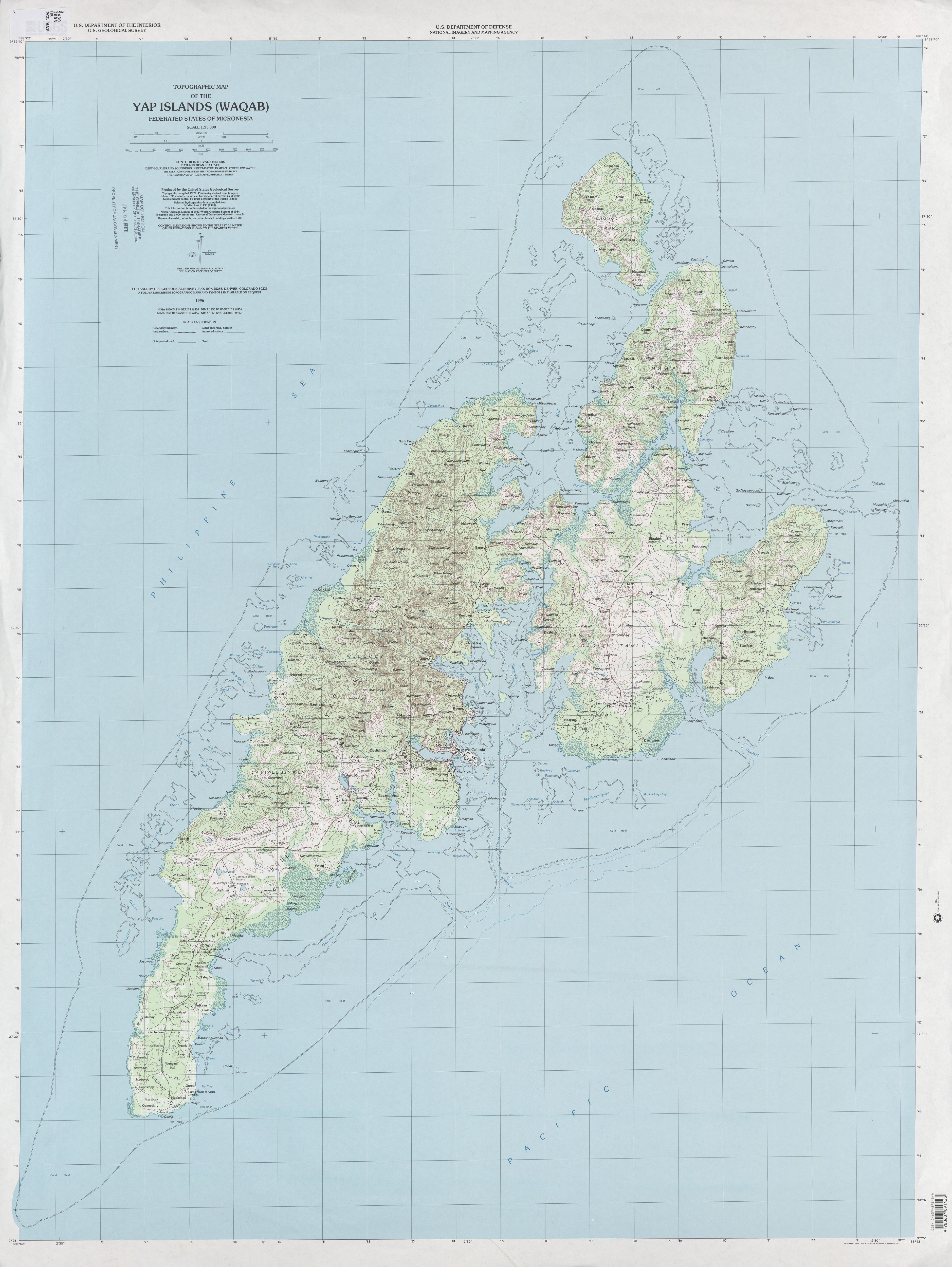
Anyway, for my introductory linguistics course on Yap I used the first edition of Peter Trudgill’s little Penguin paperback Sociolinguistics: An Introduction to Language and Society. Even the main islands of Yap have a good deal of regional variation in pronunciation and word choice, and the outer islands speak dialects of the far-flung Trukic language continuum, only distantly related to Yapese. The variety of Yapese spoken in the major municipality (Rull) closest to Colonia—the capital and only urban center—provided the basis for the standard orthography, but the pilot school for testing Yapese language curriculum materials (with bilingual education funding from the U.S. DOE) was located in the major municipality (Tomil) with the most divergent pronunciation. The three major municipalities were those chiefly alliances (called kumi in Japanese) dominant at the time the Germans took control: Gagil, Tomil, and Rull.

My wife and I first met while we were both assigned to that school in the fall of 1974—she as a new Peace Corps teacher for two years, me as a visiting linguist for one semester—and we both learned our Yapese in that very rural municipality. (Mine faded much more quickly than hers.) So we were quite aware of regional variation and of the principal shibboleths of Tomil dialect, chief among them being the pronunciation of standard /ae/ as /ee/, as in the pronoun gaeg vs. geeg ‘me’ or the plural marker on verbs -gaed vs. -geed, both high-frequency items.

For my introduction to linguistics course in 1983, I decided that the most important things I should focus on were the respective relationships between writing and pronunciation, on the one hand, and between dialects and standard languages, on the other. One of my assignments was for my students to assemble a list of common words for which there were regional variants, then track down the boundaries between those variants (the isoglosses). The most interesting findings involved variants whose isoglosses failed to align with the existing boundaries between municipalities, perhaps revealing earlier linguistic and political fault lines.

1 Comment

Filed under language, Mexico, Micronesia, Philippines, U.S.

Missing Date in Philippines History: 31 December 1844

From A History of the International Date Line:

European explorers who approached the Pacific Ocean by sailing to the east such as the Portuguese, and in their wake the Dutch, the English and the French, naturally kept their ship’s journals and diaries according to the day count of their home land and this was of course also adopted by the colonists who settled along the Asian perimeter of the Pacific Ocean.

However, the colonisation of the Pacific Ocean by the Spanish occurred from the opposite direction and more specifically from the Spanish possessions in America. The Philippine archipelago was discovered in March 1521 by Ferdinand Magellan and Spanish dominion over the islands was first firmly established in 1565 by Miguel López de Legazpi (c. 1510 – 1572), the conquistador and first Spanish governor general of the Philippines….

Most of the shipping from the Philippines to Spain went over the Pacific Ocean to the Mexican port of Acapulco, was transported over land to the port of Veracruz, and then shipped to Spain. In order that the Spanish ships crossing the Pacific Ocean between the Philippines and the Spanish Americas would not have to adjust the dates in their journals whenever they sighted land, the Philippines observed the same day count as that of the Spanish Americas….

During the early 1840s the commercial interests of the Philippine Islands turned more and more away from the Spanish Americas (which for a large part had severed their relations with the motherland Spain) and trading with the Chinese mainland (engendered by the ignominious but lucrative ‘Opium Wars’), the Malay peninsula, the Dutch East Indies and Australia became increasingly important.

In order to facilitate communication and trading with its western and southern neighbours, the secular and religious authorities of the Philippines agreed that it would be advantageous to abolish the American day reckoning and adopt the Asian day reckoning.

This was achieved in 1844 when Narciso Claveria, the governor general of the Philippines, issued a proclamation announcing that Monday, 30 December 1844, was to be immediately followed by Wednesday, 1 January 1845.

The 1867 conversion from Russian to American time in Alaska was much more complicated.

5 Comments

Filed under Mexico, Pacific, Philippines, Spain

Suppression of Piracy in the Philippines After 1848

From Iranun and Balangingi: Globalization, Maritime Raiding and the Birth of Ethnicity, by James Francis Warren (Singapore U. Press, 2002), pp. 345-346, 363-364:

By the first quarter of the nineteenth century, the sea war in the Philippines between Spain and the Iranun and Balangingi had taken on a permanent and normal character of a stalemate in which each party recognized the other as an equal with authority generally limited to the territory each controlled. But in 1848 the combined forces of the Spanish navy and army laid waste to the Samal forts at Balangingi, dispersed the survivors, and forcefully relocated the prisoners of war. This was the decisive moment, the turning point in the history of the century-long conflict between Spain and the slave raiders. The Balangingi were on the brink of climbing out of their Samal identity after nearly half a century of constant upheaval, and, according to Frake, “establishing themselves as a different kind of people.” But, in the aftermath of the Spanish devastation of their island stronghold in 1848, they did not succeed. After that event the Balangingi, as ‘notorious pirates’ and a construed single ethnic group, disappeared from the pages of the historical literature and geographical reports. Balangingi fortunes changed in the 1840s and with them the pattern of maritime raiding in Southeast Asia. The destruction of Tempasuk and Marudu by the English in 1845 also forced Iranun groups to relocate on the east coast at Tunku. The loss of these confederate communities made it more difficult for the Balangingi to conduct slave raids in the western sector of the archipelago. This event, coupled with the founding of Labuan by James Brooke and the appearance of steam gunboats on the northwest coast of Borneo, forced them to gradually withdraw from that area and increasingly concentrate their activities on the Dutch possessions.

At the same time, the Spanish adopted a far more aggressive policy in the south. The new governor of the Philippines, Narciso Claveria, understood the strategic importance of the control of Balangingi which became the focal point of a new Spanish strategy. A daring naval attack aimed at the throat of the Sulu, namely Balangingi, was the key to cutting the sultanate in two and stopping slave raiding in the Philippines….

After the destruction of Balangingi in 1848, the Spanish first used the Samal women and children as hostages to force their husbands and kindred to surrender and make peace. The political ploy did not work. So after a short time, the Spanish assembled their steamers and regularly swept the Visayas and the Sulu archipelago from one end to the other. Repeated punitive campaigns ended with a series of major sea battles off the coasts of Samar and Mindanao and attacks on Taupan’s bases to the south. [Julano Taupan was war leader of the Balangingi at Tawi-Tawi.] Hundreds of Balangingi were killed during the six year long war, many of their ships captured, and others destroyed. Taupan sent his raiders to prey on shipping in less troubled waters in the Moluccas, the Banda Sea, the Java Sea, and along the Bornean coasts. But their activities were short-lived. The British and Dutch dealt with the Balangingi menace by joining forces across the region, stationing steamers in all the key straits of the archipelago at certain times of the year when the slave raiders traditionally appeared in those waters. The Dutch navy concentrated on Taupan’s Balangingi operations around Sulawesi and Bonerate, and the British, with James Brooke’s full support, stationed ships at Labuan to protect the Borneo coasting fleets in the South China Sea.

Leave a comment

Filed under Britain, Netherlands, Philippines, piracy, Southeast Asia, Spain, war

Outburst of Piracy in Southeast Asia, 1754-1838

From Iranun and Balangingi: Globalization, Maritime Raiding and the Birth of Ethnicity, by James Francis Warren (Singapore U. Press, 2002), pp. 53-56:

The Iranun burst quite suddenly into Southeast Asian history in the second half of the eighteenth century with a series of terrifying raids and attacks on the coasts and shipping of the Philippines, the straits of Malacca and the islands beyond Sulawesi. Their primary targets were unprotected coastal settlements and sailing boats that travelled throughout Southeast Asia bringing valuable commodities from China and the West back to the most remote parts of the archipelago. Many of these marauders were sponsored by rulers from the trading states of Cotabato, Sulu, Siak, and Sambas. They were soon described as ‘Lanun’ or ‘Illanoon’—‘pirates’—by those who suffered their depradations or either travelled with or hunted them and wrote about their widespread impact on the Southeast Asian world.

It is estimated that during the last quarter of this century (1774–1798) of maritime raiding and conflict against the Dutch and Spanish, between 100 and 200 seaworthy raiding prahus set out from the Mindanao-Sulu area each year. The sheer size of the vessels—the largest joanga measuring upward of 130 feet in length—and the scale of the expeditions dwarfed most previous efforts, marking a significant departure in the naval strategy of Malay maritime raiding as it had been traditionally understood. The Iranun were far more than mere ‘pirates’ or brigands. The colonial powers and precolonial Malay trading states had to reckon with a dominant force in their own right; a force that was capable of inflicting major defeats on the Spanish and Dutch and toppling local kingdoms. The huge numbers of these skilled sea raiders and slavers that the sultanate of Sulu could mobilize during the heyday of the China trade would henceforth have a profound impact upon Southeast Asia’s history.

The geographical range of Iranun-Balangingi slave raiding activity was enormous, spanning all of Southeast Asia and beyond. Until the latter part of the eighteenth century, the joanga of the Cotabato and Sulu Sultanates were more or less integrated into fleets belonging to the respective sultanates, but by the end of the century many Iranun vessels were also operating independently. Iranun prahus sponsored by both states had their own target areas but inevitably, there was some overlap. Cotabato and Sulu raiding vessels cruised between the Visayas and Luzon, and out into the South China Sea. Those from Tempasuk, on the northwest coast of Borneo, harassed shipping to the west of the huge island itself. Samal Balangingi, situated midway between the Iranun communities in Mindanao and those on Borneo, operated vessels throughout the Philippines and in the central and eastern parts of the Netherlands Indies.

Iranun maritime raids affected virtually the entire coastline of Southeast Asia, and even stretches of New Guinea and the Bay of Bengal were not secure from slave raids. In the east, the Iranun sailed down the Makassar Strait to cross the Java Sea and South China Sea to attack the north coast ports on Java and the large tin mining island of Banka. Iranun raided extensively in the Sangir Islands, Halmahera and, to a lesser extent, in the Moluccas. They also pushed beyond the defended limits of the Southeast Asian world, crossing the South China Sea to attack undefended stretches of the coastlines of Thailand and Cochin China. At the opposite extremity they also raided, but failed to dominate, the dangerous coasts of New Guinea. In the 1790s, Iranun slave hunters in search of captives extended the limits of their known world even further, sailing far into the waters of the Bay of Bengal, touching at the Andaman Islands and perhaps exploring the southern coast of Burma. There seemed no practical way for the colonial powers to link their respective ‘dominions’ together in an island-wide network of defense and communication, and consequently the Iranun made the most of the ill-defended seas and ravaged the coastal populations and commerce….

In the second half of the eighteenth century many Philippine ports, towns, shipyards, and monasteries were not adequately defended while others were totally defenseless. From the mid-1750s onward, the scale, ferocity and unexpected nature of the initial wave of Iranun attacks were deeply disturbing. Thousands of Filipinos perished or were seized as captives; the more so as the Iranun were Muslims and recognized none of the accepted conventions and taboos that were meant to protect the property and personnel of the Catholic Church in times of war between Christians…. This terrifying period of Iranun slave raiding activity, which lasted more than 70 years from roughly 1752 to 1832, severely hampered the overall social and material well-being and growth of the Philippine island world and the colonial state.

4 Comments

Filed under economics, Philippines, piracy, Southeast Asia, war

POWs Not Quite Ready for Liberation, 1945

[Robert J.] Body finally got the picture—his planned escape had been trumped by a full-scale rescue. The American Army had beaten him to the draw by no more than a half hour. Yet like many of the other prisoners, Body wasn’t sure where he was supposed to go. Some Rangers were yelling, “Head for the cut fence!” while others were saying, “Head for the main gate!” Not only that, the prisoners were thoroughly confused about what the Rangers meant by the “main gate.” It was a basic orientation problem. For the past three years, the main gate had always meant the gate to the American compound, not the central exit of the entire prison. This ultimate portal to the outside world was generally viewed as a forbidden concept, something one didn’t talk about because it was depressing and futile and could all too easily lead to subversive thoughts that might get a prisoner shot. The area around the main gate was strictly out of bounds, a dangerous piece of real estate, a dangerous idea….

As the precious minutes ticked by, the Rangers became more and more irritated by the strange stubbornness of the POWs. They didn’t seem to understand the urgency of the situation. “I was getting annoyed,” recalled Alvie Robbins. “I’d say to them, ‘Listen, I’ve got a job to do here. I can’t spend a lot of time arguing with you. There’s thousands of Japanese just up the road. We gotta get out of here in a hurry.’ ” In some cases, the Rangers actually had to use physical force. “We just turned them around and booted ’em,” said Lester Malone. “We couldn’t fool around and explain nothing. They just didn’t want to believe we were Americans.” One of the prisoners Malone “booted” was Herbert Ott, the camp veterinarian. “I told him, get the hell out of here. I just turned him toward the gate and kicked him on out.”

Dr. Ralph Hibbs was another prisoner who needed a little physical convincing. “What the hell is going on?” Hibbs shouted at three Rangers who came bounding down the path toward him “with their tommy guns blazing” from their hips. “Where’d you come from? Are you guerrillas?”

“We’re Rangers—General Krueger’s boys.”

“What are Rangers?” Hibbs demanded. He was taxing their patience. Finally, one of them picked up the doctor, muscled him around, and gave him “a ten-foot kick squarely in the ass.”

The most recalcitrant prisoner of all was Hibbs’s immediate superior, Colonel Duckworth, the American commander of Cabanatuan. Duckworth was digging in his heels, refusing to go, even refusing to let the Rangers escort others out. The colonel, who’d been suddenly awakened by the shooting and still seemed perplexed by the whole fracas, was strutting through the compound buttonholing Rangers and shouting in their faces. He seemed unwilling to surrender authority to people whose identities and motives had been inadequately explained to him. Alvie Robbins was almost shocked by Duckworth’s belligerence. “He says, ‘I’m Colonel Duckworth, and I’m in charge here! Who the hell are you!’ I said, ‘We’re Americans. We’ve come for you.’ He said, ‘You can’t do this! You’re going to get us killed. The Japanese told us no escapes! No one leaves here until I say they do.’ I said, ‘You go see Captain Prince,’ and I went on about my business.” Duckworth continued storming about the camp, demanding explanations, imploring the raiders to cease and desist. Finally, another Ranger grabbed him by the arm and said, “With all due respect, you are not in charge here, General MacArthur is. Now I suggest you head to the main gate before we kick your ass there. I’ll apologize in the morning.'” Still grousing about the situation, Duckworth shambled out the American gate. Plagued by night blindness like so many others, he promptly fell into a ditch and fractured his right arm.

SOURCE: Ghost Soldiers: The Epic Account of World War II’s Greatest Rescue Mission, by Hampton Sides (Anchor Books, 2002), pp. 276-278

Leave a comment

Filed under Japan, Philippines, U.S., war

POW Camp Interregnum, Philippines, 1945

For a brief period in early January, the men of Cabanatuan camp ate quite well, principally as a result of their having robbed the Japanese stores [after most of the Japanese garrison moved out]. And eating well, they found, could work miracles. The sap of life was returning. Astonishing things began to happen to their bodies. For some, the sharp throbbing aches of beriberi diminished. Their night blindness improved. With stronger immune systems, the men recovered from all sorts of miscellaneous low-grade infections that had persistently tormented them. Tropical ulcers shrank, rheumy eyes cleared up. Odd sounds—whistling, humming, laughter—were heard around camp. Here and there, one could see small instances of wasted motion, the superfluous dips and gesticulations of a spirit that abides in vitamins and calories. Atrophied interests revived. The men began to think about sex, and in the mornings they noticed with some curiosity that they were occasionally waking up with erections again.

Mainly, though, they put on weight, as much as a pound a day. It seemed impossible that a body could accrue mass and girth so quickly, but nursed on a steady diet of canned fish and syrupy Pet milk, everyone in camp experienced almost miraculous gains. Ralph Rodriguez, who ordinarily weighed 150 pounds but had plummeted to 90, was back to 120 in the two short weeks following the storehouse raids.

With new stamina, the prisoners grew bolder. One day a few of the men spotted a Brahma cow grazing in the fields outside the fence. Its Filipino owner was nowhere in evidence, and the Japanese, cloistered in their barracks, didn’t seem to be paying attention. All the guard towers were empty. The large-humped cow quietly cropped what little grass it could find in the dry field, its hide spasmodically twitching to shoo off the flies. With the peculiar malice of the protein-starved, the men strode out the gate, slipped a rope around the animal’s neck, and pulled it into camp. This first step seemed like a move of Promethean audacity: No one had set foot outside the Cabanatuan fence on his own before and lived to tell of it.

Straightaway, Dr. Ott was summoned. The veterinarian looked the animal over to make sure it wasn’t obviously diseased. The cow was stunned with a large hammer and then Ott slit its throat. A bucket was placed under the dying animal to collect every ounce of blood. A large group of prisoners looked on as the Brahma cow was cut open, and some of the men wept with joy as they joined in the butchering. Dr. Ott inspected the condition of the organs to look for infections or other abnormalities. When he sliced open the liver, trematode worms boiled out by the hundreds. These writhing parasites were better known as liver flukes, common in the Philippines and harmless when ingested as long as the meat was thoroughly cooked.

Dr. Ott gave the cow his seal of approval and a feast was planned on the spot. Standing in a circle around the fire, the men cooked and ate the flesh within a few hours. They prepared an immense vat of beef stew. They fried up the clotted blood or simmered it to make a consomme. They sucked the marrow from the bones, and boiled the hooves to make a broth. By the day’s end, every part had been eaten. “We couldn’t imagine it, a whole animal for five hundred people,” Dr. Hibbs wrote. “The soup even had fat floating on top of it.”

Savoring the foreign sensation of full bellies, some of the men spontaneously threw a party. They sang songs and passed around bottles of confiscated sake. Conversation turned appreciatively to women, their shapes and smells and other attributes. Someone brought out a radio that had been swiped from the Japanese side of the camp and they listened to KGEI out of San Francisco. In the glow of good food and drink, the men of Cabanatuan caught glimpses of a life with grace notes. They were surrounded by Japanese who seemed to wish them no harm. The war was radically tilting in their favor. Even as they listened to a radio signal from home, the vast American armies were coming, after long delay, to fetch them. They were drinking a wine made from a grain they hated, the distillate of a culture they hated even more, and yet somehow they found pleasure in it.

Then a news bulletin on the radio confirmed a rumor they’d been hearing for two days—that General Krueger’s Sixth Army had landed on Luzon and was driving south toward Manila. Liberation could be any day. “There were prayers and tears of rejoicing,” recalled Abie Abraham. “Many people danced, or at least they tried to. It was quite a startling sight to see those skeletons stand up and make brave attempts at clogging and Highland flings as the Japanese radio blared through the night.”

The morning after the party, life at Cabanatuan continued more or less as usual. As welcome as it was, the new dispensation left the prisoners acutely suspicious. They sensed that the favorable situation in camp, the seeming beneficence or at least indifference of the several dozen Japanese in residence, was but a temporary aberration to be enjoyed while it lasted.

And they were right: In mid-January, the picture began to change abruptly. The population on the Japanese side dramatically swelled.

SOURCE: Ghost Soldiers: The Epic Account of World War II’s Greatest Rescue Mission, by Hampton Sides (Anchor Books, 2002), pp. 243-245

Leave a comment

Filed under Japan, Philippines, U.S., war

The Bataan "Hike": Premeditated or Negligent?

Yet for all its horrors, the march was not a premeditated atrocity. For the most part, the brutalities occurred in a piecemeal fashion against a backdrop of escalating confusion and seething racial hatred. Miscues, bad intelligence, cultural misunderstandings, sweltering heat, and a devolution of Imperial Army discipline all conspired to create an environment of tragic drift. The Bataan Death March, as the event later came to be called by the American media (most prisoners at the time simply called it, with characteristic understatement, “the Hike”), took place not according to plan, but rather as a result of the chaos that flourished under a plan that was fatally flawed. Once it became apparent that the original evacuation scheme was radically out of step with the circumstances on the ground, the Japanese failed to alter the plan to accommodate new facts. Their estimate of the number of prisoners was off, incredibly, by as many as 60,000 people, and their assessment of the health and stamina of the Fil-American forces was equally off base.

Realizing this, the Japanese should have instantly begun a wholesale rethinking of the logistics. Arrangements would have to be made for more vehicles, more food, more hospitals. Most obvious of all, more time would be needed to complete the move. But the Japanese Army, for all its many strengths, had rarely demonstrated a talent for reversing course in midstream once an error was recognized. Steeped in a rigid Confucian-influenced culture in which an order was considered final and any attempt to change it impugned the wisdom of the superior who conceived and issued it, the Japanese war planners were bold in action but often deficient in the improvisational skills needed for quick and supple reaction. Instead of alerting General Homma to the new exigencies on Bataan, the planners forcibly tried to make the old provisions—and timetables—work. The results were catastrophic.

For whatever reason, the Japanese elected not to honor General King’s request that American vehicles be used to transport his men to prison camp. In truth, some of the trucks had been irreparably sabotaged by Americans who mistakenly thought they were supposed to destroy everything of potential value the day before the surrender. Many of the American vehicles were confiscated for military purposes, and were later seen towing Japanese artillery pieces toward southern Bataan. The Japanese Army was not heavily motorized; it remained, to a great extent, a foot army. This was partly a matter of choice and partly a matter of necessity, for Japan suffered from a desperate shortage of oil and enjoyed access to few outside sources of petroleum. Japan’s extreme oil scarcity, exacerbated by the oil embargo that had been put in place by the United States and other Western powers before the war, had been one of the major factors that precipitated the outbreak of hostilities. Capturing the oil wells of the Dutch East Indies became Japan’s paramount goal upon initiating the war. Because every drop of gasoline was considered virtually sacred, the Japanese Army chose to invest little in troop-carrying trucks, jeeps, and other modes of ground transport. What little gasoline existed was reserved primarily for planes, ships, and tanks. Soldiers were expected to hike long distances—twenty-five or thirty miles a day—as a matter of course. Marching represented a much more significant part of theJapanese training regimen than it did for the American foot soldier. Japanese troops generally marched more often, for longer duration, and at a faster pace than did the Americans, who relied heavily on vehicles in large part due to the U.S. Army’s ready access to cheap and plentiful gas. This major difference in the two armies contributed to a gulf in the perception of what constituted a reasonable distance for a day’s march. The Japanese unrealistically expected the starved and diseased Filipino-American forces to meet the Imperial Army’s norms for marching—again, with tragic consequences.

There was another major cultural difference that influenced many encounters between the Japanese and their new captives: The two armies entertained radically different views on the matter of corporal punishment. Beating had long been an acceptable and routine method of discipline within the Japanese Army. Soldiers could strike subordinates with no questions asked and no explanation warranted. The slightest distinction between ranks was of critical importance because it meant the difference between who could inflict blows, and who could expect to receive them. This sort of institutionalized brutality had a tendency to work its way down the ranks to the lowliest private. One can imagine what would happen when an enlisted man, hardened by this psychology of top-down violence, found himself suddenly thrown into a foreign and not altogether distasteful situation in which he was the superior, in charge of a group of helpless prisoners. For some, the temptation to beat proved irresistible. For others, beating was only the beginning.

It was also true that many of the Imperial Army soldiers were themselves desperately hungry and ravaged by the same diseases that ravaged their captives. Although they hadn’t deteriorated as far as the Americans had, many Japanese soldiers were showing signs of emaciation and battle fatigue. “We were all starving,” recalled Shiro Asada, a Fourteenth Army soldier on Bataan. “We had dried fish paste and pickles to eat, that was all. Canned goods like the Americans had were a luxury to us. It seemed to us that some of the Americans were better fed than we were.” As a matter of official policy, the Imperial Army showed a remarkable reluctance to provision its own troops. Army quartermasters provided only a bare minimurn of such staples as miso and rice, but soldiers were expected to forage and steal to make up the caloric deficit. Thus, swiping rations or canteens from American prisoners wasn’t merely a matter of the strong taking advantage of the weak—it was practically an Imperial Army imperative. The Americans, already living so close to the bone, would have to make do with even less, for how could an army that barely fed its own be expected to provide adequate meals for 78,000 enemy prisoners?

SOURCE: Ghost Soldiers: The Epic Account of World War II’s Greatest Rescue Mission, by Hampton Sides (Anchor Books, 2002), pp. 91-93

Leave a comment

Filed under Japan, Philippines, U.S., war