Category Archives: language

First English Usages of ‘Barbecue’

The latest issue of Southern Culture (vol. 13, no. 4, pp. 138-146; Project Muse subscription required) contains an article by John Shelton Reed entitled There’s a Word for It—The Origins of “Barbecue” that contains this little gem.

The earliest use of the English word that I’ve encountered comes from 1661, when Edmund Hickeringill’s Jamaica Viewed reported that animals “are slain, And their flesh forthwith Barbacu’d and eat,” but by 1689 in a play called THE Widdow Ranter OR, The HISTORY of Bacon in Virginia, “the rabble” fixing to lynch one Colonel Wellman cry, “Let’s barbicu this fat rogue.” That the word could be used casually on the stage shows that by then it must have been familiar to London audiences. (The play was written by the remarkable Aphra Behn, the first Englishwoman to be a professional writer, and “Bacon” in the title refers to the leader of Bacon’s Rebellion of 1676, not to side meat.) About the same time, the Boston Puritan Cotton Mather used the word in the same gruesome sense when he reported that several hundred Narragansetts slaughtered by New England troops in 1675 (among them women, children, and elders burned in their lodges) had been “terribly Barbikew’d.”

Leave a comment

Filed under anglosphere, Caribbean, language, U.S.

Judt on Belgian Identity Politics

From Postwar: A History of Europe Since 1945, by Tony Judt (Penguin, 2005), pp. 708-712:

Belgium, in short, combined all the ingredients of nationalist and separatist movements across Europe: an ancient territorial division reinforced by an equally venerable and seemingly insuperable linguistic gulf (whereas many residents of the Dutch-speaking regions have at least a passive acquaintance with French, most Walloons speak no Dutch) and underpinned by stark economic contrasts. And there was a further complication: for most of Belgium’s short history the impoverished communities of rural Flanders had been dominated by their urban, industrialized, French-speaking Walloon compatriots. Flemish nationalism had been shaped by resentment at the obligation to use French, at the French-speakers’ apparent monopoly of power and influence, at the francophone elite’s arrogation to itself of all the levers of cultural and political authority.

Flemish nationalists, then, had traditionally taken for themselves a role comparable to that of Slovaks in pre-divorce Czechoslovakia—even to the extent of actively collaborating with the occupiers during World War Two in the forlorn hope of some crumbs of separatist autonomy from the Nazi table. But by the 1960s the economic roles had been reversed: Flanders was now presented by its nationalist politicians not in the image of backward, under-privileged Slovakia but rather as Slovenia (or—as they might prefer—Lombardy): a dynamic modern nation trapped in an anachronistic and dysfunctional state.

These two self-ascribed identities—repressed linguistic minority and frustrated economic dynamo—were now both woven into the fabric of Flemish separatist politics, such that even after the old injustices had been swept away and the Dutch-speaking provinces of the north had long since won the right to the use of their own language in public affairs, the remembered resentments and slights simply attached themselves to new concerns instead, bequeathing to Belgian public policy debates an intensity—and a venom—which the issues alone could never explain.

One of the crucial symbolic moments in the ‘language war’ came in the Sixties—fully half a century after Dutch had been officially approved for use in Flemish schools, courts and local government, and four decades after its use there was made mandatory—when Dutch-speaking students at the University of Leuven (Louvain) objected to the presence of French-speaking professors at a university situated within the Dutch-speaking province of Flanders-Brabant. Marching to the slogan of ‘Walen buiten!’ (‘Walloons Out!’) they succeeded in breaking apart the university, whose francophone members headed south into French-speaking Brabant-Wallon and established there the University of Louvain-la-Neuve (in due course the university library, too, was divided and its holdings redistributed, to mutual disadvantage).

The dramatic events at Leuven—a curiously parochial and chauvinist echo of contemporary student protests elsewhere—brought down a government and led directly to a series of constitutional revisions (seven in all) over the course of the ensuing thirty years. Although devised by moderate politicians as concessions to satisfy the demands of the separatists,the institutional re-arrangements of Belgium were always understood by the latter as mere stepping stones on the road to ultimate divorce. In the end neither side quite achieved its aims, but they did come close to dismantling the Belgian unitary state.

The outcome was byzantine in its complexity. Belgium was sub-divided into three ‘Regions’: Flanders, Wallonia, and ‘Brussels-Capital’, each with its own elected parliament (in addition to the national parliament). Then there were the three formally instituted ‘Communities’: the Dutch-speaking, the French-speaking, and the German-speaking (the latter representing the approximately 65,000 German speakers who live in eastern Wallonia near the German border). The communities, too, were assigned their own parliaments.

The regions and the linguistic communities don’t exactly correspond—there are German speakers in Wallonia and a number of French-speaking towns (or parts of towns) within Flanders. Special privileges, concessions, and protections were established for all of these, a continuing source of resentment on all sides. Two of the regions, Flanders and Wallonia, are effectively unilingual, with the exceptions noted. Brussels was pronounced officially bilingual, even though at least 85 percent of the population speaks French.

In addition to the regional and linguistic communities, Belgium was also divided into ten provinces (five each in Flanders and Wallonia). These, too, were assigned administrative and governing functions. But in the course of the various constitutional revisions real authority came increasingly to lie either with the region (in matters of urbanism, environment, the economy, public works, transport and external commerce) or the linguistic community (education, language) culture and some social services).

The outcome of all these changes was comically cumbersome. Linguistic correctness (and the constitution) now required, for example, that all national governments, whatever their political color, be ‘balanced’ between Dutch- and French-speaking ministers, with the prime minister the only one who has to be bilingual (and who is therefore typically from Flanders). Linguistic equality on the Cour d’Arbitrage (Constitutional Court) was similarly mandated, with the presidency alternating annually across the language barrier. In Brussels, the four members of the executive of the capital region would henceforth sit together (and speak in the language of their choice) to decide matters of common concern; but for Flemish or Francophone ‘community’ affairs they would sit separately, two by two.

As a consequence Belgium was no longer one, or even two, states but an uneven quilt of overlapping and duplicating authorities. To form a government was difficult: it required multi-party deals within and across regions, ‘symmetry’ between national, regional, community, provincial, and local party coalitions, a working majority in both major language groups, and linguistic parity at every political and administrative level. And when a government was formed it had little initiative: even foreign policy—in theory one of the last remaining responsibilities of the national government—was effectively in the hands of the regions, since for contemporary Belgium it mostly means foreign trade agreements and these are a regional prerogative.

The politics of this constitutional upheaval were just as convoluted as the institutional reforms themselves. On the Flemish side, extreme nationalist and separatist parties emerged to press for the changes and benefit from the new opportunities to which they gave rise. When the Vlaams Blok, spiritual heir to the wartime ultranationalists, rose to become the leading party in Antwerp and some Dutch-speaking suburbs north of Brussels, the more traditional Dutch-speaking parties felt obliged to adopt more sectarian positions in order to compete.

Similarly, in Wallonia and Brussels, politicians from the French-speaking mainstream parties adopted a harder ‘communitarian’ line, the better to accommodate Walloon voters who resented Flemish domination of the political agenda. As a result, all the mainstream parties were eventually forced to split along linguistic and community lines: in Belgium the Christian Democrats (since 1968), the Liberals (since 1972), and the Socialists (since 1978) all exist in duplicate, with one party of each type for each linguistic community. The inevitable result was a further deepening of the rift between the communities, as politicians now addressed only their own ‘kind’.*

*The main newspapers, Le Soir and De Standaard, have almost no readers outside the French- and Dutch-speaking communities, respectively. As a result, neither takes much trouble to report news from the other half of the country. When someone speaks Dutch on Walloon television (and vice versa) subtitles are provided. Even the automatic information boards on interregional trains switch back and forth between Dutch and French (or to both, in the case of Brussels) as they cross regional frontiers. It is only partly a jest to say that English is now the common language of Belgium.

Wow. It’s almost as if Belgium has been governed by a bunch of enlightened North American university administrators with ever-expanding budgets.

UPDATE: Judt provides useful background to the report last month by Elaine Sciolino in the New York Times entitled Calls for Breakup Grow Ever Louder, filed in the wake of a celebration of “100 dagen belgische Chaos” by the Flemish Bloc.

1 Comment

Filed under Belgium, economics, language, nationalism

Multilingual Name Changes in the Bonin Islands

From English on the Bonin (Ogasawara) Islands, by Daniel Long (Duke U. Press, 2007; Publication of the American Dialect Society, no. 91; Supplement to American Speech, vol. 81), pp. 125-128

There is something of a misconception among Japanese—or at least among that minute percentage of the population that has any knowledge of the subject—that the Westerners of Ogasawara acquired Japanese family names when they were naturalized as Japanese citizens back in the early Meiji era. This is not true….

When the original inhabitants of the islands began to be naturalized in 1877, only a few took Japanified names. Among these was the almost legendary German figure Frederick Rohlfs (1823–98), who settled on Hahajima and aided subsequent Japanese arrivals when they were on the verge of starvation. He was commonly called “Rose,” probably because this is how his name sounded to Japanese listeners when pronounced by English speakers. His legal Japanese name was composed of five kanji (Sino-Japanese) characters chosen strictly for their pronunciation. Although they convey no coherent meaning, when combined the characters (pronounced as Rōsu Rarufu) sounded something like the two pronunciations of his family name. Rohlfs was in the minority, however; most of the Westerners (referred to as kikajin ‘naturalized people’ in those days) used katakana renderings of their own Western family names as the official names in their koseki, or Official Lineage Registries. These were not Japanese family names, nor Japanified versions of their Western names, but simply adaptations of them to the Japanese phonology and representations of them in the Japanese script (e.g., Gilley became Gērē, Savory became Sēborē, Webb became Uebu, Washington became Washinton, Gonzales became Gonzaresu).

The usage of kata[ka]na names continued for a couple of generations. It was not until the Sōshi Kaimei (創氏改名‘Establishment of Family Names and Alteration in Given Names’) law that people with non-Japanese surnames were forced to change them. This 1940 law is mainly known for its effect on the millions of colonized people in Korea, but it also affected the Bonin Islanders. Elderly islanders today recall choosing their own last names, often hurriedly and quite randomly….

Some of the islanders chose kanji characters that either sounded like their original names or expressed some significant meaning. The Savorys became Sebori (瀬堀[‘rapids-ditch’]), and the Ackermans, the Akaman (赤満 [‘red-full’) family. The Webbs chose characters that could be read as Uebu (上部 [‘upper-part’]) (though the name is pronounced Uwabe today). Other families decided on a name with some symbolic value. The Gilleys, proud of the “South Sea Islander” part of their roots, chose the name Minami (南 ‘lit. south’). Other families abandoned the idea of names in which either the sound or the meaning of the kanji held significance. In most cases, different family names were chosen by distant branches of the family tree, so that the Gonzales family descendants became either Ogasawara (小笠原 [‘little-hatshade-field’]) or Kishi (岸 ‘shore’).

During the war years, Westerners gave their children Japanese names. Children born after World War II (during the U.S. Navy period) were given only English names, and they use these today—written in katakana—as their official Japanese names.

Following the reversion to Japan, Westerners adopted the practice of giving Japanese names—written in kanji—to their children, but even here, we find cases of islanders identifying with their cultural roots. One case of this is Nasa Sēborē (セーボレー那沙), born in the 1980s, whose name, although written in kanji, is an homage to his ancestor Nathaniel (pronounced “Nasanieru” in Japanese).

Some of the Westerners legally changed their surnames back (from Japanese ones forced upon them in 1941) to their older katakana names following the changes in the Japanese law in the 1980s.

In many cases, a single individual has possessed four legal names in the span of his or her life. A case in point is Able Savory. He was born Sēborē Ēburu (in katakana, セーボレーエーブル), was forced to changed his name to Sebori Eiichi (in kanji, 瀬堀栄一) at the start of the war, and used Able Savory (in the Roman alphabet) during the Navy Era. After the 1968 reversion, he reverted to his wartime kanji family name, but used the katakana “first name” given to him at birth, resulting in the name Sebori Ēburu. In the 1980s, when some of the Savory clan changed their surname back to the katakana Sēborē, he decided four names in one lifetime were enough and retained the kanji surname.

In Ogasawara today, one finds many interesting name-related phenomena. Nicknames—in both Japanese and English—are the norm. Then, most of the Westerners have two names; many have both Japanese and English surnames and given names, which means there often are at least five or six ways to refer to most Westerners.

This reminds me my favorite comment thread ever on Language Hat, in reaction to a post about a poem entitled Peaches in Cluj.

3 Comments

Filed under anglosphere, Japan, Korea, language

Wordcatcher Tales: Katatsumuri, Otamajakushi

Which word is more poetic? Snail or tadpole? Escargot ou têtard? Melc sau mormoloc? Schnecke oder Kaulquappe? (Jeez!) Much depends on the poetic traditions of the language in which one is writing—whether rhyme and meter are important, for instance.

What got me wondering was the original Japanese version of that famous haiku by Kobayashi Issa:

かたつぶりそろそろ登れ富士の山
katatsuburi soro-soro nobore fuji no yama
‘Snail, slowly climb Fuji’s mountain!’

(You may prefer R.H. Blyth‘s translation: “O snail / Climb Mount Fuji, / But slowly, slowly!”)

The more common form for ‘snail’ is katatsumuri, so in Japanese the choice offered above is: Katatsumuri ka? Otamajakushi ka?

One thing katatsumuri has going for it is its five syllables (or moras), perfect for an opening or closing line of haiku. (Snails feature in 53 out of Issa’s 8000 haiku.) But snails seem to lack any specific seasonal association, at least according to Yamamoto Kenkichi’s The Five Hundred Essential Japanese Season Words.

Otamajakushi ‘tadpole’, on the other hand, has good seasonal associations. But its six syllables can only fit well into the middle line of haiku, with the help of a filler particle like ya. Maybe that’s why Issa wrote 166 haiku about frogs (… tobu kawazu ‘jumping frog’, … naku kawazu ‘croaking frog’, kawazu kana ‘frog …’ etc.), but apparently none about tadpoles. It’s not really that hard. Here’s one I made up.

羹にお玉杓子や蛙哉
atsumono ni / otamajakushi ya / kawazu kana

In the broth / Is it a tadpole / Or a frog …

Regardless of their poetic qualities, these two words have interesting etymologies.

お玉杓子 otamajakushi literally means a ball (otama) ladle, scoop, or rice paddle (shakushi), which well describes the shape of a tadpole. Well, okay, a giant tadpole.

蝸牛 lit. ‘snail-cow’ can be pronounced kagyū in its Sino-Japanese reading, but the kanji have no relation to the several native Japanese words for ‘snail’: katatsumuri, katatsuburi, dedemushi, dendenmushi. When I was a kid, I learned dendenmushi, but I had forgotten whether it meant ‘snail’ or ‘caterpillar’. If I had to guess at the native Japanese etymologies for the two principal words for ‘snail’, I would propose that dendenmushi comes from dandan ‘little by little’ + mushi ‘bug’ (i.e., a slow-moving creepy-crawly); while katatsumuri comes from kata- ‘hard’ + tsumuri ‘head’ (i.e., a hard-shelled creepy-crawly).

I await further instruction from Matt of No-sword.

UPDATE: And Matt comes through with a much more thorough and enlightening post! He finds support for the same etymology for katatsumuri (‘hard head’), but explains that de(n)de(n)mushi comes from a recent song appealing to the snail to come out (hence 出 de-) of its shell. Better yet, the latter term, the only one I had heard, seems to have arisen in Kyoto, where I spent my elementary school years.

UPDATE 2: Matt of No-sword follows up with a wonderfully clarifying post on one of the murkiest issues in contemporary herpetological poetics, the difference between two types of frogs in Japanese: the poetic kawazu and the aquatic pedestrian kaeru.

Before I repeat Matt’s far more poetic conclusion (which Language Hat has already done, dammit ribbit!), I should add that Japanese kaeru has been borrowed into at least one language in Micronesia: Yapese kaeyruu, where it seems to refer mostly to the decidedly prosaic and invasive marine toad (Bufo marinus), a species more fit for senryū than haiku.

Only three amphibians are native to the [Polynesia-Micronesia biodiversity] hotspot, and all are ranid frogs of the genus Platymantis. Two species are endemic to Fiji, the Fiji tree frog (Platymantis vitiensis) and Fiji ground frog (P. vitiana, EN), and one, the Palau frog (P. pelewensis), is endemic to Palau. All three species are related to other Platymantis species in the Solomon Islands and in New Guinea.

This explains why, of all the Micronesian dictionaries I consulted, I could only find a native word for ‘frog’ in the Palauan Dictionary: bechébech, where the unaccented e represents a schwa (uh, er sound) and the ch represents a glottal stop. (By the way, the E[uro]speranto words for ‘frog’ and ‘toad’ are rano and bufo, respectively.)

So here’s the enlightening conclusion to Matt’s follow-up frog post, which cites one of the most famous haiku of all by perhaps the most famous haiku poet of all.

古池や かはづ飛び込む 水の音
Furuike ya/ Kawazu tobikomu/ mizu no oto
Old pond/ Frog jumps in/ Sound of water

Bonus fact: Bashō was actually consciously playing with the kawazu tradition here by attributing the sound to the water rather than the frog. The frog’s implied silence, after centuries of naku kawazu [‘croaking frog’], is a crucial part of the stillness that allows the sound of water to make its impact.

4 Comments

Filed under Japan, language

Hawaiian Words in Bonin (Ogasawara) Speech

From English on the Bonin (Ogasawara) Islands, by Daniel Long (Duke U. Press, 2007; Publication of the American Dialect Society, no. 91; Supplement to American Speech, vol. 81), pp. 65, 67:

Many words in use in the Bonins even in the late twentieth century are thought to be derived from the contact with Pacific Island languages that occurred from the 1830s until the end of the nineteenth century. Today these lexemes are used not only in the English of the Bonins, but in Ogasawara Japanese and the Ogasawara Mixed Language as well. Hawaiian words form the majority of the Oceanic-language words we find in the Bonins. Since Polynesian migration to the islands occurred only in the early history of the settlement, it seems clear that most of these words came to the island during the first half of the nineteenth century.

I’ll list some of the most straightforward examples, where the meanings and the sounds correspond most closely. The following list presents the Hawaiian word first, then its various derivatives in the Bonins, where the pronunciation has been influenced not just by Japanese and English phonology (and the lack of orthographic standards), but by varieties of Hawaiian that are now nonstandard (for instance, those that retained t in place of King Kamehameha’s k).

  • Haw. kamani, tamani ‘hardwood tree, Calophyllum inophylum’ > Bonin tamana, tamena, tremana
  • Haw. lahaina ‘type of sugarcane’ > Bonin rahaina ‘sugarcane’
  • Haw. lau hala ‘pandanus leaf’ > Bonin rawara, rawarawa, rauhara, rowara, rohara, roharo, rūwara, rohawo, lohala ‘pandanus tree’
  • Haw. moe ‘sleep’ > Bonin moe-moe, moi-moi ‘sex, copulation’
  • Haw. puhi ‘moray eel’ > Bonin puhi
  • Haw. uhu ‘parrotfish’ > Bonin ūfū, uhu
  • Haw. wiliwili ‘leguminous tree, Erythrina sandwicensis’ > Bonin biide-biide, bari-bari, uri-uri, ude-udeErythrina boninensis

Leave a comment

Filed under Hawai'i, Japan, language, Polynesia

Etymologically, Myanmar = Burma: Round Two

I’ve blogged on Myanmar = Burma before, but it seems to bear repeating before that sad country once again fades from international consciousness. Here’s the email I sent to the PBS NewsHour last week.

As a regular NewsHour watcher, I find it painful to hear Jim Lehrer pronounce Myanmar as ME-and-Mar, for two reasons.

(1) One is the same reason English speakers insist on pronouncing Kyoto in three syllables. They can pronounce kyu in one syllable (as in ‘cue ball’), but not kyo. I’m sure Jim can pronounce myu in one syllable, as in ‘musing’, but can’t get mya out in one syllable.

(2) But I wouldn’t bother to write you about it if I hadn’t heard Jim offer a lame bit of newsroom CW to explain why he insists on using the name he can’t pronounce rather than the name he can pronounce. Etymologically, Myanmar and Burma are the same word, just pronounced differently. One is formal and literary, the other more common and colloquial. Here’s what a reputable academic specialist says on the matter: “Myanmar/Burma,” by Bertil Lintner, in Ethnicity in Asia, ed. by Colin Mackerras (RoutledgeCurzon, 2003), p. 174:

In 1989, Burma‘s military government changed the name of the country to Myanmar. The reason, it said, was that the British colonial power had named it ‘Burma’ after the main ethnic group in the country, the Burmese, who inhabit the central plains. ‘Myanmar’, it was argued, included the Burmese and all other ‘ethnic races’, including the Shan, the Karen, the Mon, the Kachin and more than 100 other nationalities. This is, however, historically and linguistically highly dubious. The once-British colony has always been called Burma in English and bama or myanma in Burmese.

The best explanation of the difference between bama and myanma is to be found in the Hobson-Jobson Dictionary, which remains a very useful source of information. ‘The name [Burma] is taken from Mran-ma, the national name of the Burmese people, which they themselves generally pronounce Bam-ma, unless speaking formally and emphatically.’

Both names have been used interchangeably throughout history, with Burma being more colloquial and Myanmar more formal. Burma and Myanmar (and Burmese and Myanmar) mean exactly the same thing, and it is hard to argue that the term ‘Myanmar’ would include any more people within the present union than the name ‘Burma’.

There is no term in the language that includes both the Burmans and the minority peoples, since no country with the borders of present-day Burma existed before the arrival of the British in the nineteenth century. Burma, with its present boundaries, is a colonial creation rife with internal contractions and divisions.

If an academic source is too arcane, then perhaps Jim will listen to what a fellow journalist, James Fallows, has to say. He, too, insists on saying Burma not Myanmar [but for political reasons].

The BBC has also weighed in on the topic, favoring the alternative Burma, but its pronunciation guide for those who insist on using Myanmar lists several possibilities—MYAN-mar, my-uhn-MAR, MEE-and-mar, and mi-AN-mar—but recommends myan-MAR (all without pronouncing the final r).

For more discussion, visit Language Hat.

UPDATE: I’m way out of my depth on the issue of Burmese orthography, but from what I understand, written Burmese and spoken Burmese are in a diglossic relationship perhaps akin to that between Classical Arabic and the rich diversity of contemporary colloquial Arabic, or between Classical Chinese and modern spoken Chinese languages and dialects. Written Chinese underwent drastic reforms during the early 20th century to reflect modern spoken Mandarin, but Burmese still awaits such orthographic reforms. So people may write Burmese as it was spoken 1000 years ago (e.g., Mran-ma) but pronounce the same words the way they have turned out after 1000 years of sound change (e.g., Bam-ma), even writing millennium-old grammatical elements that are now archaic or obsolete in the spoken language. It would be as if all English speakers shared no writing system except a Runic version of Anglo-Saxon.

2 Comments

Filed under Burma, language

English as an Indigenous Pacific Island Language

From English on the Bonin (Ogasawara) Islands, by Daniel Long (Duke U. Press, 2007; Publication of the American Dialect Society, no. 91; Supplement to American Speech, vol. 81), pp. 3, 9-10:

IT IS A LITTLE KNOWN LINGUISTIC FACT that among a group of Western Pacific islands English is maintained as a community language of the indigenous population. These are the Bonin Islands. Today, these islands (also called Ogasawara Islands) are part of Japan and their population, Japanese citizens, but the English language has survived there, as both a tool of communication and a marker of their unique identity. This book attempts to provide an outline of the English of the Bonin Islands in its various forms and incarnations from 1830 to the present….

The Bonin Islands appear to have lain completely uninhabited until Pacific Islander women and European and American men of widely varying linguistic backgrounds began to settle there in the early 1800s (see sections 2.1 and 2.2). Evidence from a variety of sources indicates that a Pidgin English (with a substratum formed from the other settlers’ native languages) developed as the community’s common tongue. Later the children born and raised in this language environment are thought to have acquired this as their native language (i.e., creoloidization occurred).

In the 1860s and 1870s, Japan laid claim to the islands and they experienced a huge influx of Japanese settlers. The Japanese established the first-ever schools on the islands, initiating bilingual (English and Japanese) education. Increasingly intense bilingualism initiated the processes of SYNTACTIC CONVERGENCE, leading to the development of a second contact language (a Mixed Language) comprised of a Japanese substratum and a lexicon supplied by the earlier English-based creoloid.

After World War II, the linguistic situation on the islands took another sharp turn when the U.S. Navy took control, allowing only those islanders of “Western” ancestry to live on the islands and subsequently establishing a school conducted in English. This period of American occupation and absolute isolation from Japanese ended abruptly in 1968 when the islands were returned to Japanese rule and the displaced Japanese islanders (living then in mainland Japan for a quarter century) were allowed to return home. The Ogasawara Mixed Language and Ogasawara Creoloid English have long coexisted with Japanese and English acrolects, but increasing mobility and improved communication technology seem to be accelerating decreoloidization and (dare I say) “de-mixed-language-ization.”

In the 170-year linguistic history of the Bonin Islands, the dominant language has shifted from English (from 1830) to Japanese (1876), back to English (1946), and back again to Japanese (1968).

1 Comment

Filed under Japan, language, Pacific, U.S.

Wordcatcher Tales: Huarachudo, Ejido, Municipio, Piloncillo

From True Tales from Another Mexico: The Lynch Mob, the Popsicle Kings, Chalino, and the Bronx, by Sam Quinones (U. New Mexico Press, 2001), pp. 206-210:

The municipio of Turicato [in the State of Michoacán] has always divided along these town-rural lines. The hill folks resented the power, money, and education, relatively speaking, of the people in town. The city folk feared the hillbillies but saw no reason to extend power, or municipal services, to people they considered ignorant and barbaric. In these years the Barajas family—a family of local merchants—dominated Turicato politics….

In this atmosphere “Los Villa,” as the Villaseñor family was known, emerged first as rebels. They took up the cause of the “huarachudos,” the “sandal wearers”—whom they rallied to their cause against the city folk…. The Villaseñores were huarachudos themselves. They were sixteen children whose father, Tomás, had been born a peon on the hacienda San Rafael. In the 1930s President Lázaro Cárdenas ordered a section of the hacienda transformed into a communal farm—an ejido—owned by those who had worked it as peons….

The Villaseñor piloncillo operation also grew. Piloncillo is a small cone of brown sugar about an inch in diameter, processed by a simple mill. It is used to sweeten coffee, in household cooking, or by the soft-drink industry. In the 1990s, piloncillo has all but vanished as a product from the Turicato region. But in the 1970s and 1980s, many sugar cane growers were producing piloncillo. In the Turicato region in the 1970s and 1980s, owning a piloncillo mill was the difference between a life of comfort and one of hopeless poverty….

The emergence of a hillbilly family brought with it the kind of abuses that town residents had feared all along. “What happens is they form into groups,” says Trigo. “There’s one who’s a leader, and around him form people who like to fight and look for trouble. They like to walk into a cantina and throw everybody out. They figure that’s a real achievement. This grows; the group gets larger. Then it becomes, ‘Let’s take over this land.’”…

Yet the Villaseñor family never did fully dominate local politics. They proved in the end to be poor politicians. Their frequent warring—“their bellicose nature” as one man put it—earned them many enemies. By 1989 a significant part of the municipio nurtured in dark silence a pure and vital hatred of the Villaseñores, and among them were many of the same poor peasants—the huarachudos—that the family once rallied to its side….

In 1994 the military put a roadblock between Turicato and Puruarán and set about arresting or killing off the bandit gangs. Others saw that the military meant business and laid down their guns. So five years after the Nueva Jerusalén vote threw Turicato into a civil war, a version of peace came to the municipio.

The chapter from which these excerpts come is a well-told tale, but one sadly familiar in its broad outlines: ambitious évolués (sponsored by distant elites, in this case the PRI) lead others among the oppressed to overthrow and replace an oppressive elite, only to impose a new kind of thugocracy at least as violent and oppressive as the old one. Sort of a Zimbabwe in microcosm. (Zimbabwe, whose independence I long ago celebrated at a big gathering of African students in Honolulu.)

But I want to comment on just two of the four words italicized in the extract.

The Spanish term municipio may have survived in the form of an English calque more than a century after the Spanish ceded Micronesia to the Germans. Each of the Federated States (formerly Districts) of Micronesia is divided into what are now called municipalities, a term that no subsequent German, Japanese, or American administrator would likely have come up with, although the Americans are credited with introducing the term by the anthropologist Lingenfelter, who worked in Yap during the early postwar years. If so, U.S. Navy administrators probably calqued on the basis of usage in the Philippines. Micronesian municipalities have never been centered around a town and its hinterland. Instead, they seem to be more like alliances of contiguous villages.

I’m old enough to have purchased a pair of Mexican huarache sandals in the 1970s, when I was a grad student in Hawai‘i. The dye made my feet break out, so I stayed with rubber slippers (zori). (I hardly owned a pair of shoes all through grad school.) The relation between Spanish huarache ‘sandal’ and huarachudo ‘sandaled’ is parallel to that between English beard and bearded. Spanish and English are both related languages. But the same parallel can be observed between, for example, Chamorro sapatos ‘shoes’ (from Spanish) and sinapatos ‘shod, wearing shoes’, or Chamorro relós ‘wristwatch’ (also from Spanish) and rinelós ‘wearing a wristwatch’. Among its myriad functions, the -in- infix in Philippine languages can form adjectives out of nouns in a manner similar to that of participial affixes in Spanish and English.

UPDATE: The Micronesian Seminar‘s Francis X. Hezel, S.J., weighs in on the antecedents of the term municipality in Micronesia.

The term as used in Micronesia after the war has no direct relationship to the Spanish colonial period in these islands. The Spanish weren’t here long enough and they weren’t influential enough to have the term stick. There are very few Spanish loan words that have made their way into the island languages. Actually, islanders used the Japanese term kumi to describe a segment of the island, even well after the war. Muncipality came into the languages through the English term, via the Navy.

The usage of Japanese kumi ‘club, association, gang’ is very interesting, and seems a much more appropriate term for the traditional political alliances before they were recast by the U.S. Navy as local-government structures. The Yapese dictionary translates municipality into Yapese nuug ‘net’ (presumably meaning ‘network’ of political alliances). Other Micronesian dictionaries I’ve consulted don’t list municipality in the English finder list. So it seems U.S. Navy administrators were influenced by Spanish local-government terminology already long-established in the Philippines.

The U.S. Census Bureau glossary does not list the term municipality at all, but it does list and gloss municipio as: “Primary legal divisions of Puerto Rico. These are treated as county equivalents.” The Wikipedia entry for Municipalities of the Philippines begins thus: “A municipality (bayan, sometimes munisipyo, in Tagalog) is a local government unit in the Philippines. Municipalities are also called towns (which is actually a better translation of bayan).”

SHARP DETOUR: My wife and I taught University of Hawai‘i extension courses on Yap, Micronesia, in the summer of 1983, just before heading off to spend a year in Romania on a Fulbright research grant. In fact, she was still there when I got the word that my nearly forgotten application from a year earlier had been approved and that the orientation in Washington, D.C., would begin before she got back to Honolulu. Trying to place a telephone call through to Yap was not easy in those days.

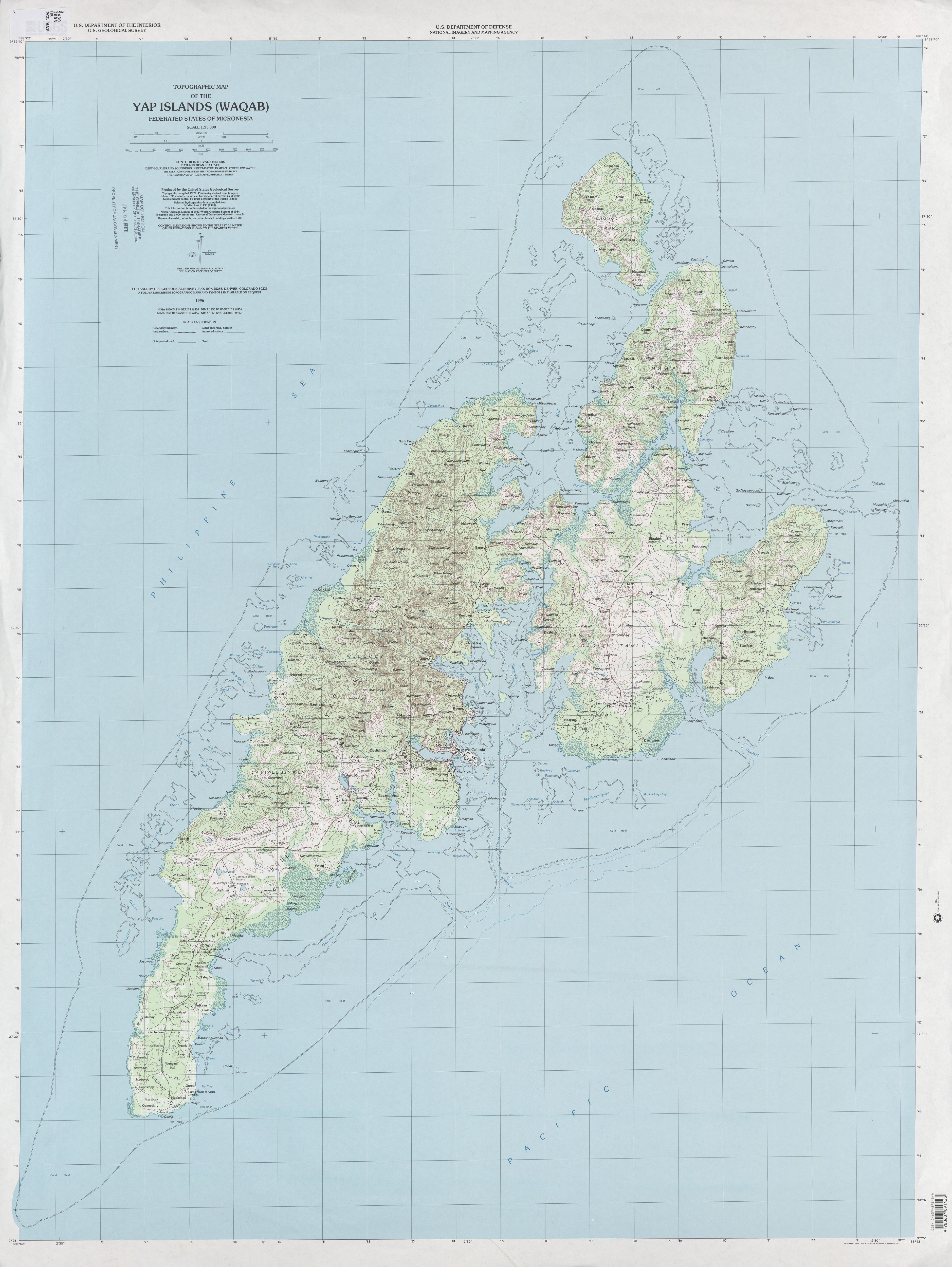
Anyway, for my introductory linguistics course on Yap I used the first edition of Peter Trudgill’s little Penguin paperback Sociolinguistics: An Introduction to Language and Society. Even the main islands of Yap have a good deal of regional variation in pronunciation and word choice, and the outer islands speak dialects of the far-flung Trukic language continuum, only distantly related to Yapese. The variety of Yapese spoken in the major municipality (Rull) closest to Colonia—the capital and only urban center—provided the basis for the standard orthography, but the pilot school for testing Yapese language curriculum materials (with bilingual education funding from the U.S. DOE) was located in the major municipality (Tomil) with the most divergent pronunciation. The three major municipalities were those chiefly alliances (called kumi in Japanese) dominant at the time the Germans took control: Gagil, Tomil, and Rull.

My wife and I first met while we were both assigned to that school in the fall of 1974—she as a new Peace Corps teacher for two years, me as a visiting linguist for one semester—and we both learned our Yapese in that very rural municipality. (Mine faded much more quickly than hers.) So we were quite aware of regional variation and of the principal shibboleths of Tomil dialect, chief among them being the pronunciation of standard /ae/ as /ee/, as in the pronoun gaeg vs. geeg ‘me’ or the plural marker on verbs -gaed vs. -geed, both high-frequency items.

For my introduction to linguistics course in 1983, I decided that the most important things I should focus on were the respective relationships between writing and pronunciation, on the one hand, and between dialects and standard languages, on the other. One of my assignments was for my students to assemble a list of common words for which there were regional variants, then track down the boundaries between those variants (the isoglosses). The most interesting findings involved variants whose isoglosses failed to align with the existing boundaries between municipalities, perhaps revealing earlier linguistic and political fault lines.

1 Comment

Filed under language, Mexico, Micronesia, Philippines, U.S.

Polynesian Languages: Useful for American Football QBs

I don’t have much interest in American football. I grew up paying more attention to baseball and sumo. But an intriguing off-topic comment by football fan BitterOldPunk in a thread on Language Hat pointed me to a story in today’s New York Times about a remarkable quarterback on the University of Hawai‘i football team.

HONOLULU — After every home game, Colt Brennan waves to his probation officer as he leaves Aloha Stadium….

Brennan, Hawaii’s star quarterback, is on the cusp of what could be a transcendent season in his senior year. He is projected to make a run at the Heisman Trophy, and his coach insists that he will be the first quarterback selected in the N.F.L. draft. His strong right arm, combined with a soft schedule, have people around college football’s most remote program believing that Hawaii’s chances of making a Boise State-like run to a Bowl Championship Series game are, well, not remote.

Those possibilities, for the player and for the team, are even more noteworthy considering the improbable, circuitous road that Brennan, 24, took to Hawaii.

Brennan backed up Matt Leinart in high school in Southern California, went 3,000 miles to a prep school in Massachusetts and was the fourth-string quarterback at Colorado as a walk-on before being arrested and thrown off the team. He then spent spring break in a Colorado jail during a year in junior college and landed at Hawaii only because a reporter showed an assistant coach there a film of one of Brennan’s junior college receivers.

The final twists in Brennan’s rise toward stardom and redemption may be the most compelling of all, however. If not for the anonymity of being a backup, the uncertainty of chasing a scholarship and the humiliation of wearing an orange jumpsuit, he probably would not have the thrill of a Heisman chase, the allure of being a possible first-round pick or the recipient of the affection of an entire state.

“The consensus between myself and Colt’s high school coaches is that Colt is the person he is today and the quarterback he is today because of the path he took,” said Dan Morrison, Hawaii’s quarterbacks coach. “I firmly believe he is who he is today because of the road he traveled.”

It’s a fine story of personal redemption and of those who had faith in him, but the bit that got notice on Language Hat was the following.

Soon after Brennan arrived, in the summer of 2005, Morrison, the quarterbacks coach, advised him that the culture of the island valued humility and character. Having spent spring break in jail that year, Brennan hardly needed a humility check.

“I had gone through a real embarrassing time in my life,” Brennan said. “I was humiliated and I needed to go find myself somewhere else. Hawaii had that appeal to it. It was my getaway, my escape.”

So he kept his mouth shut and did his best to blend in. He took three semesters of Samoan as a way to bond with his offensive linemen, all of whom are of Polynesian descent. (Morrison beamed when telling of Brennan calling an audible in Samoan last year.)

I suspect that Brennan has also learned a bit of New Zealand Māori, because Hawai‘i is one of a growing number of American football teams that psyche themselves up (and psyche their opponents out) before games by performing Māori-style haka, first introduced into international sports by New Zealand’s famed All-Blacks.

The blog A Nice Gesture has quite a compilation of commentary and video of haka being performed by, among others, New Zealand’s Tall Blacks before a basketball game against Argentina, and a whole range of American football teams from Hawai‘i to Utah to Texas.

Leave a comment

Filed under Hawai'i, language, Polynesia, U.S.

Wordcatcher Tales: Dawasi, Kousapw, Sakau

Three words from the Micronesian language Pohnpeian (aka Ponapean) that surfaced in my background reading about the church shootings in Neosho, Missouri, tell stories of distant connections across time and space.

Dawasi – When I first heard about the Neosho church shooting, I assumed the Micronesians involved were from the Marshall Islands, because I know that many Marshallese work for Tyson Foods in nearby Springdale, Arkansas. But one key term (which I’ve italicized) in the following passage cited in a posting on the Marshallese YokweOnline network hinted that the Micronesians involved were from the state of Pohnpei, not the Marshalls. (They were actually from the outer islands of Pingelap, not the main island of Pohnpei.)

Kernel [Rehobson] owns a retail store that is a gathering place for Micronesians from dozens of miles around since he stocks his store with the type of down-home items that are so difficult to find in the US: the large plastic combs that women wear in their hair, zoris, dawasi and brushes for showers, and island-style skirts with embroidered hems.

Dawasiscrub brush’ (made of coir bristle) is the official Pohnpeian spelling for a word borrowed from Japanese before the Pacific War. The same word was borrowed by Palauans, who spell it tauas(i). In current Japanese, tawashi (束子) can refer to scouring pads made of acrylic yarn, but the bristle brush variety is such a Japanese cultural icon that tiny replicas dangle from cellphones and backpacks.

The passage above cited on YokweOnline comes from the article on Micronesians Abroad by Francis X. Hezel, S.J., and Eugenia Samuel, that I blogged about earlier. The two words italicized in the next passage from the same article tell of very different connections.

Our team intended to visit Kansas City, home of a growing Micronesian community, largely Pohnpeian, that sprang from students who attended Park College during the 1970s and 1980s. Small colleges, once well attended by Micronesian students, have frequently served as the seedbeds for migrant communities in the US, accounting in part for the seemingly odd locations of Micronesian strongholds. Kansas City is said to have been constituted a kousap by a Pohnpeian chief not long ago when he paid a visit to his compatriots who had settled in that city. He was feted with sakau—the type made from powder rather than pounded—and left a week or two later with several thousand dollars, which had been collected as tribute from Pohnpeians who are now living 8,000 miles from their own island.

Kousapw – The kousapw (sapw means ‘land’) is a Pohnpeian land unit—translated ‘section’ below—intermediate between a farmstead and a district (or “municipality”). According to Douglas Oliver’s (1988) Oceania: The Native Cultures of Australia and the Pacific Islands, p. 983:

Most sections extended from coast to island center, and consisted of from fifteen to thirty-eight farmsteads. Each section had a meeting house of its own, and was headed by an official known as a kaun or soumas, who was usually the senior male member of the section’s senior sub-clan. The section functioned mainly as an administrative subdivision of the district.

This raises several questions. (1) There seem to be many old cultural connections between chiefly high-island Polynesians (possibly from Samoa) and Pohnpei. Is it just coincidence that the kousapw in Pohnpei usually runs from seashore to mountaintop, like the ahupua‘a of Hawai‘i (and presumably other large islands in Polynesia)? (2) Which of the major districts on the island of Pohnpei was the Kansas City kousapw assigned to? (3) Does this mean we now have a third Kansas City to contend with: one in Missouri, one in Kansas, and one in Pohnpei?

Sakau – One strong indication of old Polynesian influence on Pohnpei is the cultivation and use of Piper methysticum, known in Pohnpei as sakau, in Hawaiian as ‘awa, and in Samoan as ‘ava. In fact, the Pohnpeian word sakau derives by regular sound correspondences from the earlier Polynesian article+noun combination *te kawa.

4 Comments

Filed under Japan, language, Micronesia, Polynesia, U.S.