Category Archives: language

Language Documentation Hiatus

My slow and erratic progress on documenting Numbami, the language I did fieldwork on in Papua New Guinea in 1976, suddenly gained traction on October 1, when I imported my old Numbami dictionary file into a new software package I had just been introduced to. Now dictionary work has taken precedence over blogging, photography, and other hobbies as I tediously clean up the many import errors and add many cross-references and reverse-entry keywords. After the cleanup, I’ll have a printable Numbami-English and English-Numbami lexicon and be ready to digitize the text, glosses, and translations of several wonderful narratives I transcribed (in pencil) 35 years ago.

Before I imported the dictionary data, I had begun to retranscribe one of my best narratives whose pencil transcription had gone missing many years ago. A couple years ago, a language documentation specialist at the University of Hawai‘i (my old alma mater) had converted my old cassette tapes to digital media (.WAV and .MP3 format), so I could use Transcriber to align the audio with the transcription.

While underemployed in 1991, I had first input all my manual Numbami wordlist cards into Shoebox. In 2006, a friend helped me convert the Shoebox database into SIL’s new and improved Toolbox. Now I have imported the Toolbox data into SIL’s latest language documentation software package, FLEx, and have begun cleaning and recoding it.

One of the best things I did during my fieldwork was to record and transcribe in the field a good range of narratives: two well-organized procedural texts about women’s work cooking food and about the communal work of processing sago palm starch; two personal tales about experiences being civilians on the front lines during World War Two; and a couple of traditional tales, including an origin myth that combines elements from both coastal and inland cultures. (I translated and blogged a passage from one of the war stories here.)

My host father (long deceased) was a retired schoolteacher and village kaunsil (elected representative to the local government council). He told me that a portion of the timber royalties from village land was allocated to help pay for the education of village youths, who had to leave the village even to attend elementary school. Timber royalties also helped pay for the small diesel vessel that carried people and goods back and forth along the mountainous coast, which lacked an overland highway.

It was not until the 1990s that a Tok Ples (Vernacular) Skul was established in the village to teach basic literacy in the local language, before children went away to elementary school, where Tok Pisin was the lingua franca. I made a tiny contribution to getting it started by sending enough linguistic materials on Numbami to show that it had a workable orthography, which was a prerequisite for any Tok Ples Skul. But my work on the language was otherwise aimed at other linguists, for whom I hope eventually (after I retire) to finish a reference grammar of the language.

But my priorities shifted over the past year from language description to language documentation, thanks to new technologies and new relationships. One factor was the new language documentation software mentioned above. The other was making new contacts via Facebook with well-educated grandchildren of my host father who have mastered English and Tok Pisin well, but know very little Numbami. They are my new target audience, not linguists and not people in the village who still speak the language (to the extent they do).

Numbami is the village language of only one village on the face of the earth. In the 1970s, that village had fewer than 300 people, and even there more people spoke Tok Pisin than Numbami. If the elders had to write, they wrote in Jabêm, the Lutheran mission lingua franca in which all but one old lady had been educated. My host father was educated in Jabêm schools, had taught in them, was an acknowledged authority on the language, and managed to get me interested enough to make Jabêm the standard of reference for much of my analysis of Numbami. (Many years later, I sidelined my Numbami reference grammar to translate Otto Dempwolff‘s grammar of Jabêm after I met by chance online a potential cotranslator in Romania whose German was much better than mine.)

The first paper I published after returning from my fieldwork in Papua New Guinea was on multilingualism and language mixture among the Numbami. If village residents want to find spouses they’re not related to, they generally have to marry someone from a different language group. Unless both spouse and children live in the village, they don’t learn more than the rudiments of the village language. The kids grow up speaking Tok Pisin, in any case. If they pursue education and job opportunities in town, they learn English, too.

Nothing I can do will affect language use in the Numbami village. If people end up abandoning that language in favor of others more useful, I can’t blame them. Villagers have been shifting language loyalties throughout the human history of New Guinea, for all sorts of reasons. The articles I’ve published so far are of little use to anyone except other linguists. But the dictionary I’m now editing may be useful both to a few linguists and to a few educated, town-dwelling people of partial Numbami heritage who want to learn more about their lost ancestral language, but who are accustomed to learning through the medium of English. Finally, the narrative texts may also be of at least historical interest to a third tiny audience of people who learned to speak Numbami in the village and to read it in the Tok Ples Skul.
Leave a comment

Filed under language, Papua New Guinea, publishing, scholarship

Wordcatcher Tales: Menbei, Yuzusco, Hakugei

While we were shopping for light, comestible omiyage (souvenirs) to bring back from Japan this summer, we came across three products of linguistic as well as gustatory interest.

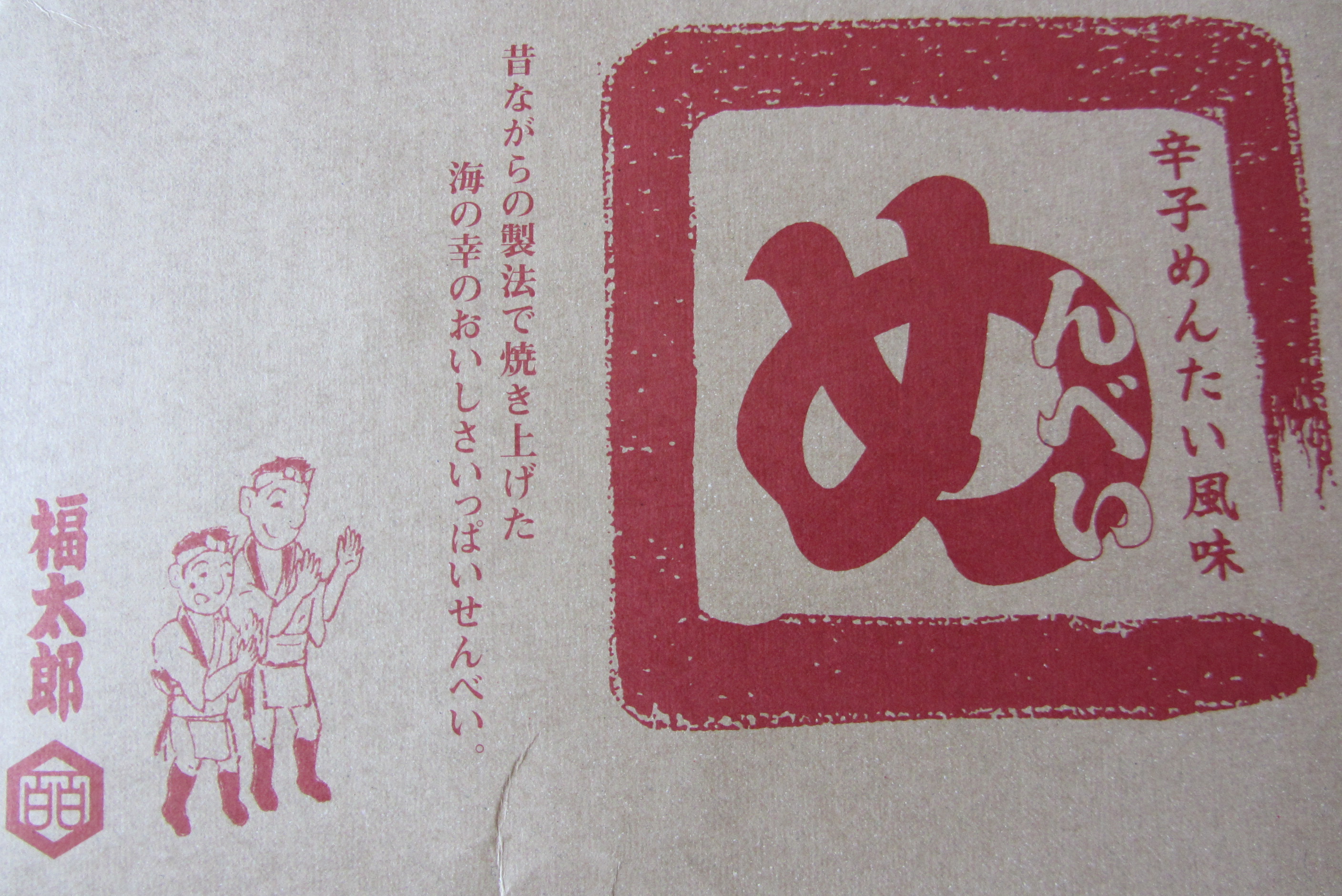
mentai + senbei = menbeiMenbei < mentai senbei – Korea is the source of one well-known item of Hakata (Fukuoka) cuisine, 辛子明太子 karashi mentaiko ‘spicy cod/pollock roe’. The name mentai apparently derives from Korean 명태 myeongtae ‘Alaskan pollock’. Its genus (Theragra) is different from that of the Atlantic pollock (Pollachius), but both fall within the highly prolific family Gadidae (< Gadus ‘cod’) ‘cod, haddock, pollock, whiting’. We bought a few boxes of spicy mentai-flavored rice crackers to share with our colleagues at work. Their pungent aroma caused some comment.

Yuzusco & ShogascoYuzusco < yuzu ‘citrus’ + (taba)sco – The fresh taste of yuzu (柚子) is very popular in Japanese cuisine and is used to flavor many different things: from savory chawanmushi to sweet honey, bitter tea, vinegar, wine, and even bath oil. We brought back some tiny jars of yuzu pepper paste and two hot sauces marketed as under the brand names Yuzusco and Shogasco (< shouga ‘ginger’ + -sco). I’m not sure if the makers of Tabasco have licensed just the last three letters of their registered trademark, but they apparently encourage co-branding. Nor am I sure where these products rank on the Scoville scale of spicyness.

Sampler of five types of shochuHakugei ‘White Whale’ – At a duty-free shop at Fukuoka Airport, we got a sampler of five small bottles of shochu, a longtime Satsuma (Kagoshima) specialty. (The cashier unboxed them and put them in little transparent baggies so we could take them through security!) They included 麦わら帽子 Mugiwara Boushi ‘barley-straw hat’, made from barley; two types of Satsuma 白波 Shiranami ‘white wave’ made from sweet potato (my favorite) with dark and light molds; 白鯨 Hakugei ‘white whale’, made from white rice; and 蕎麦蔵 Sobagura ‘buckwheat granary’, made from buckwheat. Shiranami is perhaps the most famous brand name of Satsuma shochu, but the other brand names were well chosen to reflect their ingredients. As one might expect, Hakugei tasted the most like sake. I prefer sweet potato shochu myself.

Leave a comment

Filed under food, Japan, language, travel

Wordcatcher Tales: Dorui, Kangou, Funkyuubo, Fujo

The first tourist site we visited on our most recent trip to Japan was Yoshinogari Historical Park in Saga Prefecture, on a stretch of open countryside that turned up lots of artifacts from the Yayoi-period (roughly 300 B.C. to A.D. 300), including many large burial jars, when developers began to prepare the ground for a large shopping center. The site was then turned into an historical park featuring “one of Japan’s largest moat-encircled villages and ancient ruins.” In fact, another pair of visitors we met there were from Perth, Australia, a mother and her daughter who had won a national essay contest by presenting the case for Yoshinogari to be designated a UNESCO World Heritage Site.

The signs describing the major features of the park were quadrilingual—in Japanese, English, Korean, and Chinese (simplified characters)—and one of the guides we met was a young lady from Dalian, China, who spoke some English and Russian in addition to Chinese and Japanese. (She was eager to practice her English, which was full of reading pronunciations.) Thanks to the helpful furigana on those signs, I learned a few new Japanese words and readings that were not even in my old Canon Wordtank G55 electronic dictionary. Here’s a sample.

土塁 dorui ‘earth fort, earthworks’ – The earliest forts in Japan apparently consisted of earthworks, palisades, and moats. The character 塁 ‘fort, rampart’ can be a synonym for 砦 toride ‘fort, stronghold, entrenchment’, but is now much more common in baseball, where it means ‘base’, as in 塁審 ruishin ‘base umpire’ or 塁打 ruida ‘base hit’.

環濠 kangouring trench‘ – The usual word for the ‘moat’ around Japanese castles is 堀 hori ‘ditch, canal’, related to the verb horu ‘to dig’. By itself, 濠 gou is better translated ‘trench’ (also ‘dugout, foxhole’), another product of digging. The character 環 kan ‘ring, circle, loop’ also occurs in 環境 kankyou ‘environment, circumstances’ (lit. ‘circle boundary’) and 環礁 kanshou ‘atoll’ (lit. ‘fringing sunken-rock’).

墳丘墓 funkyuubomound-hill-grave‘ – The common word for ‘grave’ is 墓 haka (Sino-Japanese bo) as in 墓石 boseki, hakaishi ‘tombstone’ or 墓堀 hakahori ‘grave digger’. A normal-sized grave mound is 墳墓 funbo ‘mound grave, tomb’, but a seriously hill-sized grave mound is 墳丘墓 funkyuubo (with 丘 ‘hill’, read oka in many placenames). Grave-mound building was carried to even greater extremes during the next major period of Japanese history, the Kofun 古墳 (‘old tomb’) period (c. 250–538).

巫女 fujo, miko ‘shaman, sorceress, shrine maiden’ – After immigration from the Korean peninsula began, but before Buddhism was established (during the 8th century), the chief spiritual practitioner in Japanese villages was a shaman, who was usually female, although the etymology of 神子 miko lit. ‘god-child’ is gender-neutral.

Leave a comment

Filed under baseball, Japan, language, military, travel

Wordcatcher Tales: Japanese Fish Names

During our recent travels to far-outlying corners of Japan we came across several local specialties that I had never heard of before. When I solicit the names for new dishes in Japanese, I often end up learning new fish names in English, just as I did long ago doing linguistic fieldwork in a coastal village in Papua New Guinea. Here is a sample of new fish we tried at izakaya last month.

Slender sprat sashimi

At the fine Umaya Restaurant beside JR Kumamoto Station, we ordered kibinago sashimi. After failing to find kibinago in my old Canon Wordtank G55 electronic dictionary, I asked the waitress if she could find out what to call it in English. She came back and showed me the gloss in her electronic dictionary, ‘silver-stripe round herring’. This slender sprat, Spratelloides gracilis, is often used as a bait fish, but also makes a very attractive dish of sashimi.

Mantis shrimp sashimi

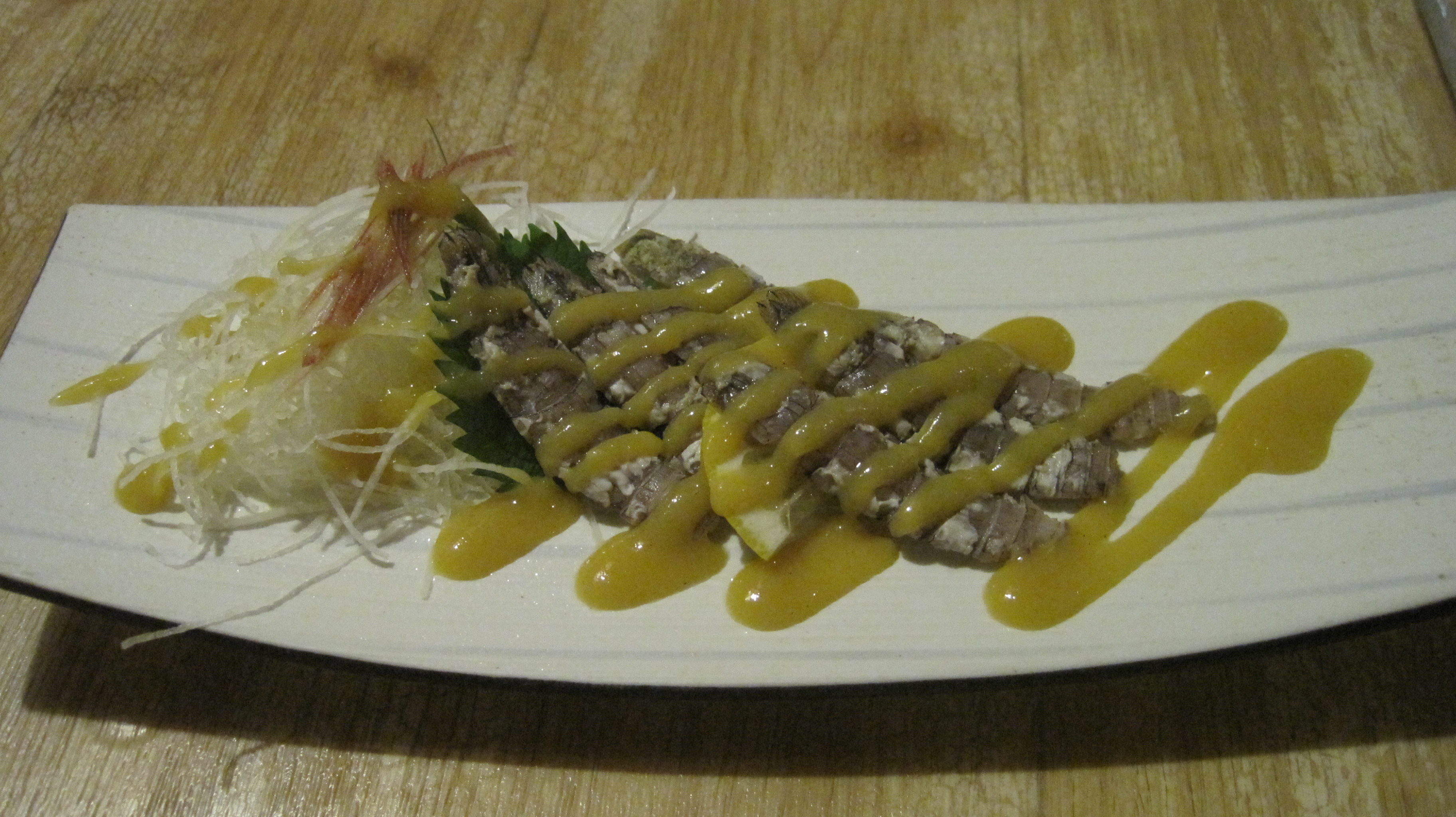
On the way up from Kyushu, we stopped overnight at Shin-Yamaguchi, an old railway junction city (Ogōri) that was renamed and upgraded to a Shinkansen station but still proudly displays memorabilia from the old days. The owner of the izakaya we had dinner at was a train buff and the walls of our booth were covered with posters and photos of old steam locomotives. Among the novelties we ate there was shako sashimi, mantis shrimp (Squilla sp.) with ginger mustard sauce to counter the fishy taste. This creature I could find in my electronic dictionary, so I tortured the waitress with questions about old trains. We both recalled the days when the steam locomotive whistle would signal an upcoming tunnel, and we would quickly close the window so as not to get a faceful of soot. The next day we boarded the Super-Oki limited express bound for the Japan Sea coast and up the San’in Main Line.

Dojou karaage

Deep-fried dojo loach

After making a quick visit to Tottori’s famous sand dunes just in time for the sunset, our taxi driver called his contacts at Daizen, a busy new izakaya that he recommended when I asked where we could find a place that served local specialties. We ordered fried gobo chips, which are gaining popularity, and we ate two fish that were new to us.

Broiled rosy sea bass

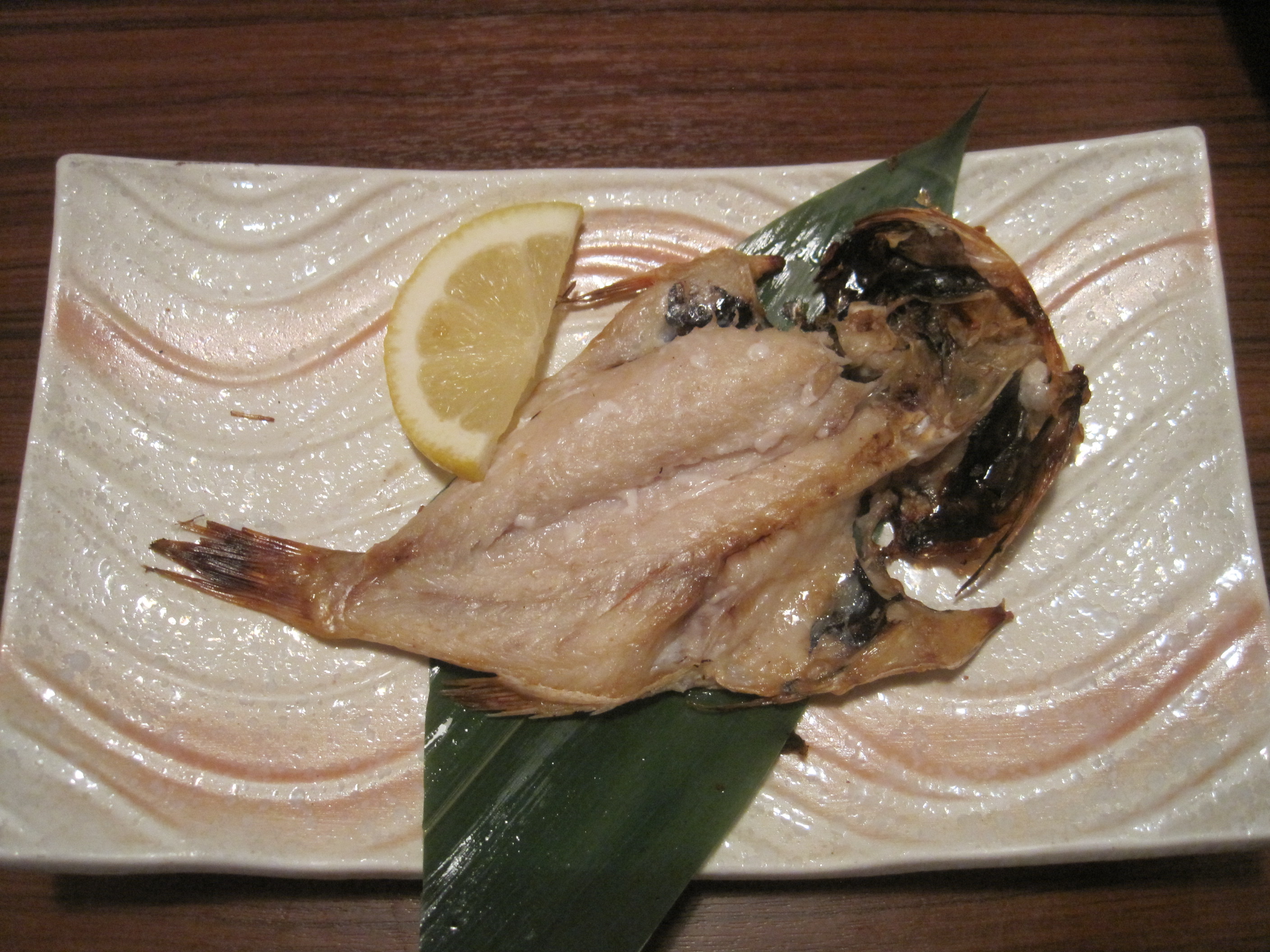
One was loach, 泥鰌 dojou (lit. ‘mud-loach’) ‘dojo loach’, Misgurnus anguillicaudatus, also called ‘weatherloach’, a member of the carp order (Cypriniformes). The other was broiled nodoguro (lit. ‘black throat’) ‘rosy sea bass’, Doederleinia berycoides (also called 赤鯥 akamutsu ‘red gnomefish’) in the family Acropomatidae (lanternbellies, Jp. hotarujako ‘firefly fry’).

Poached nibbler

At a small mamasan-without-papasan izakaya next to our hotel in Tsuruga, we tried mejina nitsuke ‘poached nibbler’. The Japanese name, 眼仁奈 mejina, applies to both the genus Girella and the subfamily Girellinae ‘nibblers’, members of the Kyphosidae (sea chub) family in the order Perciformes. We spent a long time talking with everyone else there: the very hospitable self-employed proprietor, who served as her own buyer, cook, and waitress (and single mother); a very talkative traveling digger and inspector of wells and tunnels; and three ladies from Shikoku on a hiking trip, one of whom had a daughter just back from Ethiopia with JICA.

Sea bass sashimi

Our second evening in Tsuruga we went to a much larger izakaya that had been too busy by the time we showed up the night before. There we had suzuki sashimi, which our waitress described as light and tasty when I asked what kind of fish it was. I hadn’t heard suzuki as a fish name, but in Japanese taxonomy, 鱸 suzukiJapanese sea bass or sea perchLateolabrax japonicus seems to be the type species or genus for a whole suborder and order of bony fish, the equivalent of Perc- in Percoidei (スズキ亜目) and Perciformes (スズキ目).

Leave a comment

Filed under food, Japan, language, travel

Wordcatcher Tales: Gyorai ‘fish thunder’

One of the most fun things about exploring far-outlying places in Japan is the conversations you fall into. We had several such conversations in Tsuruga, the Japan Sea port city closest to Osaka and Kyoto, which for that reason became the terminus of one of Japan’s first railway lines. (The other two connected the port of Yokohama with Tokyo and the port of Otaru with Sapporo.)

On a visit to the Kehi Matsubara pine grove and beach, we stopped at a shady refreshment stand to get some cool drinks. Near the vending machine sat two elderly men, one grizzled and talkative, the other silent and dignified. The grizzled man seemed to have saved up many things he wanted to share with English-speakers, starting with his futile attempts to learn our language. His teachers had concentrated too much on grammar, he said, and the only English phrase he could reliably remember for all his trouble was “I forgot.” He said Chinese speakers had much greater success learning English because of the similarities in word order between the two languages, and that Mongolian sumo wrestlers learned Japanese much more quickly than the European wrestlers for similar reasons.

He was originally from Kochi (formerly Tosa) in Shikoku, and when I asked about the famous Tosa fighting dogs, he launched into a long disquisition on their virtues (such as silently enduring pain like samurai) and superiority over Akita dogs, which might be larger but lacked the same degree of fighting temperament.

His dignified companion, who never got a word in edgewise, was a former officer in the Imperial Japanese Navy who was recruited by the Occupation authorities to clear mines from the harbor. The word (new to me) that Mr. Grizzly used for ‘naval mine’ was 魚雷 gyorai lit. ‘fish-thunder’, which more commonly refers to torpedoes, as in 魚雷艇 gyoraitei ‘torpedo boat’. (Torpedoes are also called “fish” in anglophone sailor slang.) Aerial torpedoes are 空雷 kuurai ‘air-thunder’ and a torpedo attack is 雷撃 raigeki ‘thunder-attack’.

The generic word for ‘mine’ is 機雷 kirai ‘device-thunder’. Naval mines are 水雷 suirai ‘water-thunder’ and land mines are 地雷 jirai ‘earth-thunder’, as in 地雷原 jiraigen ‘minefield’.

This encounter reminded me of a story my Uncle Murray told for the first time back in April, when I had the chance to attend a brief reunion of my father and his only two surviving brothers. Uncle Murray reached draft age right at the end of World War II and he was on his way to invade Japan in August 1945 when Japan surrendered and his ship put into Midway to await a change of orders. His unit was then rerouted to the Philippines, where they assembled Japanese POWs as they surrendered and then put them to work helping to dismantle and destroy military stockpiles near Manila. His POWs would load electrical equipment onto amphibious ducks, which he would then drive out to sea, where the POWs would drill holes in the batteries and dump them in the ocean, often getting very seasick in the process. Much of Manila had been destroyed during the war, and Uncle Murray said his unit’s battery disposals must have destroyed a lot of life in the surrounding seas as well.

Leave a comment

Filed under Japan, language, military, Philippines, U.S., war

Wordcatcher Tales: Tetchan, Mitchan, Noritetsu, Toritetsu

Last month Mr. & Mrs. Outlier made good use of our Japan Rail passes to visit several of the more far-outlying places on Japan’s extensive rail network. We flew in and out of Fukuoka, so we started with JR Kyushu, riding its brand new Shinkansen trains as well as some of the older express trains.

On the way up to Nagoya, we stopped for a night at Shin-Yamaguchi, the starting point for the Yamaguchi Line, which connects the Sanyō Main Line along the Inland Sea with the San’in Main Line along the Japan Sea. Originally called Ogōri, the old station dates from 1913 and now caters to railway nostalgists, among whom I would have to count myself.

The next day we rode the 1-driver, 2-car Super-Oki Limited Express as far as Tottori, famous for its sand dunes. The following day we continued on to Toyooka, where we had to change to the non-JR Kitakinki Tango Railway‘s Miyazu Line in order to cross off my bucket list Amanohashidate, the third of Japan’s three most famous scenic views. Then we hopped back on the KTR to its terminus at Nishi-Maizuru, back on the JR network. Then we rode the local-only JR Obama Line the rest of the way to Tsuruga, the terminus of one of Japan’s earliest railway lines (1882), connecting the port of Osaka to the Japan Sea and crossing Lake Biwa by ship between Ōtsu (‘Big Harbor’) and Nagahama (‘Long Beach’).

In a small railway museum that used to be the Tsuruga Port train station building, we encountered a Japanese railway buff of the first order, a young businessman who was spending holiday time riding trains and visiting railway museums. When I told him we had come from riding the new Kyushu Shinkansen, he told me JR Kyushu had won awards for their new bullet train designs. When I said we were headed for Nagoya, he recommended I visit the new JR SCMAGLEV and Railway Park there. Our paths crossed again when he came out of the Tsuruga City Museum as we were going in, and he and I exchanged a final wave as he was entering and I was leaving the Nagoya Shinkansen station.

It was in Nagoya that Mrs. Outlier learned several words used in Japanese to refer to train buffs. The Japanese word for ‘railroad’ is 鉄道 tetsudou lit. ‘iron-road’, and railroad enthusiasts can be somewhat mockingly referred to as 鉄ちゃん Tetchan ‘railies’ if male and 道ちゃん Mitchan ‘roadies’ if female. (The native Japanese pronunciation of 道 is michi ‘road’.) More neutral terms for them in Japanese are 乗り鉄 nori-tetsu ‘ride-rail’ for those who seek to ride particular trains, or 撮り鉄 tori-tetsu ‘take-rail’ for those who seek to take photographs of particular trains.

3 Comments

Filed under Japan, language, travel

Curing Capt. Cook’s Costiveness with Clysters

From: Blue Latitudes: Boldly Going Where Captain Cook Has Gone Before, by Tony Horwitz (Picador, 2002), pp. 218-219:

Cook resumed his polar probe during the next southern summer [1773], after wintering in Polynesia. The second approach to Antarctica proved even more wretched than the first. Livestock perished, tropical provisions ran out, and the men—eating little except weevil-ridden biscuits and salt rations—began to show signs of scurvy and depression.

“Salt Beef & pork, without vegetables for 14 weeks running, would probably cure a Glutton, even in England,” wrote William Wales, the ship’s astronomer. According to George Forster, even the resilient Cook became “pale and lean, entirely lost his appetite, and laboured under a perpetual costiveness [constipation].”…

Three weeks later, Cook collapsed. He doesn’t reveal much about this in his journal, except to note that he was confined to his cot for a week because of a gastric affliction he called “Billious colick.” George Forster makes it clear that the captain’s condition was much graver than Cook suggests. The captain suffered from “violent pains” and “violent vomiting,” Forster wrote. “His life was entirely despaired of.”

The treatment given Cook—opiates, clysters (suppositories), plasters on his stomach, “purges” and emetics to induce vomiting—probably didn’t help. When Cook finally recovered, his first meal in a week was the only fresh meat on the ship: the Forsters’ dog. “Thus I received nourishment and strength from food which would have made most people in Europe sick,” Cook wrote.

Leave a comment

Filed under anglosphere, Britain, food, language, science, travel

Capt. Cook, Guugu Yimidhirr, and Kangaroos

From: Blue Latitudes: Boldly Going Where Captain Cook Has Gone Before, by Tony Horwitz (Picador, 2002), pp. 182-184:

Guns weren’t the settlers’ only weapons. Aborigines had little resistance to Western disease, or to alcohol. Chinese immigrants introduced opium, which Aborigines consumed by mixing the drug’s ash with water and drinking it. The Guugu Yimidhirr, like many Aboriginal clans, appeared headed for extinction—a fate little mourned by white Australians….

In the case of the Guugu Yimidhirr, it was Cook who proved their salvation, albeit indirectly. A German translation of Cook’s voyages inspired a young Bavarian, Johann Flierl, to set off in the 1880s “as a missionary to the most distant heathen land with its still quite untouched peoples.” He created a Lutheran mission near Cooktown that became a refuge for Aborigines. Flierl named the mission Elim, after an oasis the Israelites found during their exodus from Egypt. As oases went, Queensland’s Elim wasn’t much: a sandy, infertile patch north of Cooktown. But it grew into a stable community, and its school educated scores of Aborigines, some of whom became nationally prominent.

One such success story was Eric Deeral, who served in the 1970s as the first Aboriginal representative in Queensland’s parliament. I tracked him down late one afternoon at his daughter’s modest bungalow a few blocks from Cooktown’s main street. A small, very dark-skinned man, he met my knock at the door with a wary expression and a curt “May I help you?” When I burbled about my travels, his face widened into a welcoming smile. “Come in, come in, I love talking about Cook!” After several days of conversing about little except “ferals,” rooting crocodiles, and rugby league, it was a relief to find someone who shared my passion for the navigator.

Eric showed me into a small office he kept at the front of the bungalow. The bookshelf included several volumes about Cook. Like Johann Flierl, Eric had been fascinated since childhood by the image of first contact between Europeans and native peoples untouched by the West. He’d quizzed Aboriginal elders about stories they’d heard of Cook and his men. “At first, our people thought they were overgrown babies,” he said. Aboriginal newborns, Eric explained, are often much paler than adults. But once the Guugu Yimidhirr saw the newcomers’ power, particularly the noise and smoke of their guns, they came to believe the strangers were white spirits, or ghosts of deceased Aborigines. “Lucky for Cook, white spirits are viewed as benign,” Eric said. “If they’d been seen as dark spirits, my ancestors probably would have speared them.”…

Listening to Eric, I felt the giddy thrill of unlocking small mysteries that had been sealed inside the English journals for more than two centuries. Blind Freddy might know the answers, but no books I’d read had provided them. Eric ran his finger down the list of native words Parkinson had collected. “If you read closely, you can almost see these men, groping to understand each other,” he said. Yowall, for instance, meant beach, not sand, as Parkinson had written. “One of our men probably pointed across the river at the sandy shore on the other side,” Eric said. Similarly, wageegee meant scar, not head—perhaps the man who had told it to the English was pointing to a cut brow when he said the word.

As for kangooroo, this was a fair approximation of the Guugu Yimidhirr word, which Eric rendered gangurru. But Aborigines, unlike Maori and Tahitians, didn’t have a shared language; living in small, widely scattered groups, they spoke scores of different tongues. The English failed to recognize this. The result was a comically circular instance of linguistic transmission. Officers of the First Fleet, familiar with the Endeavour‘s journals, used the words Cook and his men had collected in Queensland to try and communicate with Botany Bay Aborigines eighteen years later.

“Whatever animal is shown them,” a frustrated officer on the Fleet reported, “they call kangaroo.” Even the sight of English sheep and cattle prompted the Gwyeagal to cheerfully cry out “Kangaroo, kangaroo!” In fact, the Gwyeagal had no such word in their vocabulary (they called the marsupial patagorang). Rather, they’d picked up “kangaroo” from the English and guessed that it referred to all large beasts. So a word that originated with an encounter between Cook and a small clan in north Queensland traveled to England with the Endeavour, then back to Botany Bay with the First Fleet, and eventually became the universal name for Australia’s symbol. There was an added twist. The Guugu Yimidhirr had ten different words for the marsupials, depending on their size and color. “Gangurru means a large gray or black kangaroo,” Eric said. “If Cook had asked about a small red one, the whole world would be saying nharrgali today.”

5 Comments

Filed under anglosphere, Australia, Britain, education, Germany, language, religion, science, travel

Alien Encounter at Mercury Bay, 1769

From: Blue Latitudes: Boldly Going Where Captain Cook Has Gone Before, by Tony Horwitz (Picador, 2002), pp. 104-105:

Most scholars believe that sailing canoes set off from the Society Isles, or the nearby Cook Islands, between A.D. 800 and 1200, carrying pioneers as well as plants and animals. They landed on the unpopulated North Island and gradually spread out, making New Zealand the last major landmass on earth to be settled. Then, nothing—until Cook arrived, the first intruder on the North Island since roughly the time of the Crusades.

To me, this was the most extraordinary and enviable facet of Cook’s travels: the moment of first contact between the “discoverer” and the “discovered.” No matter how far a man traveled today, he couldn’t hope to reach a land and society as untouched by the West as the North Island was in 1769. Cook, at least, anticipated first contact; finding new lands and peoples was part of his job description. For those he encountered, the moment of European arrival must have been so strange as to defy modern comprehension. The only experience that might resemble it today would be to find an alien spacecraft touching down in your backyard—except that Hollywood has prepared us even for that. Pacific islanders had no basis for so much as imagining a tall-masted ship, much less one from the other end of the globe carrying white men speaking an unfamiliar tongue.

According to stories told long after Cook’s arrival in New Zealand, some natives thought the ship’s billowing sails were the wings of a giant bird. Others saw three trees sprouting from the vessel’s base and guessed it was a floating island. A much fuller account survives from Mercury Bay, up the coast from Cook’s first landfall, where the Endeavour visited a month later. A boy about the same age as Young Nick, named Te Horeta, stood watching the ship’s approach from shore and lived long enough to share his memory with colonists, several of whom recorded his words. Te Horeta’s vivid and poetic detail, corroborated by the journals of Cook and his men, makes his story one of the most remarkable accounts in the annals of exploration.

“In the days long past,” Te Horeta recalled, he went with his clan to gather oysters and cockles beside a calm bay known by the name Gentle as a Young Girl. One day, an apparition appeared on the water, a vessel much larger than any canoe Te Horeta had ever seen. Watching from the beach, the clan’s elders wondered if the ship had come from the spirit world. Then pale creatures climbed from the vessel and paddled small craft toward shore, with their backs to the land. At this, the clan’s aged men nodded and said, “Yes, it is so: these people are goblins; their eyes are at the back of their heads.” Te Horeta fled into the forest with the other children, leaving the clan’s warriors on the beach.

At first, the goblins did no harm. They gathered oysters and other food. One collected shells, flowers, and tree blossoms, and knocked on stones, putting them in bags. Curious, the children crept out of the woods. “We stroked their garments,” Te Horeta recalled, “and we were pleased by the whiteness of their skin, and the blue eyes of some of them.” The goblins offered food from their ship: hard, dry lumps that looked like pumice stones, and fatty meat so salty that even the warriors winced. Was it whale’s flesh? A man’s? One goblin pointed his walking stick in the air. “Thunder was heard to crash and a flash of lightning was seen,” Te Horeta said. Then a bird fell to the ground. “But what had killed it?” Later, a warrior offered to trade with the newcomers, then snatched a goblin’s cloth and paddled away without surrendering his own dogskin cloak. A walking stick flashed and the warrior fell with a hole in his back. The clan buried him in the goblin’s garment; because the warrior had caused his own death, there was no utu, no revenge. The site of his killing became known by the name A Warm Bad Day.

Leave a comment

Filed under anglosphere, Britain, language, New Zealand, Pacific, Polynesia

Cameroon Tales: Two Cooks

For most of his recent sabbatical in Cameroon, my brother stayed in a big hilltop white-elephant of a house overlooking a small village on the busy main highway between Yaoundé, the capital, and Douala, the main port city. The house was the ostensible headquarters of a personal NGO owned by an international businessman from that village, whom my brother had once helped get started in the business of importing cars from Europe into Cameroon. As village benefactor, he had later acquired overseas aid to build and maintain a village well, build a nursery school, and build his own seldom-used mansion.

My brother’s housemates there were three men from neighboring Central African Republic, speakers of a Gbaya language called Suma who were working on documenting their language, on a project funded almost entirely out of my brother’s own pocket. He has known the elder two men (now in their 50s) since the late 1970s, when he was working for the Peace Corps and then USAID in the then Central African Empire.

To feed himself and his team, my brother asked to hire a cook from the local village. The sleazy caretaker of the mansion, a childhood friend of the benefactor now in his 40s, recommended the 16-year-old girl living with him, who soon proved that she neither knew how to cook nor cared to learn, even when an older woman was hired to help teach her.

One day the young cook got a call from her elder sister telling her that the latter’s baby was very sick, and asking for help. My brother offered to give her an advance on her salary, since it was so near the end of the month anyway, so that she could send some money to her sister. But her man (the caretaker) took that money, beat her, and forbade her to visit her sister. The cook then came to my brother and asked for more help, but the caretaker swore that he never beat her (even claiming she had attacked him), and that he never took her money, only “put it aside” in order to prevent her leaving to go take of the sick baby.

Although the cook threatened to leave the caretaker—just as she had earlier infuriated her family by running away from home to be with him—she soon relented, made up with him, and returned to work as if nothing had happened. Nevertheless, her enthusiasm for cooking never improved, and my brother finally fired her a few weeks before we arrived for our visit.

The replacement cook was far from a spoiled brat. She was the devoutly religious, 30-something mother of four young children whose husband had abandoned her in Kribi, on the south coast, whereupon she tried to find her sister, who had married into the village where we stayed. She ran out of cash in the market and crossroads town nearest her sister’s village, but a taxi driver from the latter village was kind enough to give her and her brood a free ride to her sister’s house, which had only one room to spare for her and her four kids.

Lacking land and a husband, she resorted to gathering forest herbs for sale by the roadside to earn a little cash. The village chief’s unmarried son dallied with her for a while, but he was very likely scared off by the prospect of raising her four kids (although she blamed it on his inability to abide by her strict religious scruples). The chance to cook for a household of foreigners was a godsend—except for the jealousy it aroused among the other villagers.

She proved a diligent and capable cook who used her new supply of cash to rent some land and pay a crew to clear a field for planting—all just in time for the start of the rainy season. And she was finally able to pay the village medic to treat her two-year-old boy for worms.

When it came time for my brother and his team to leave the village, he promised her whatever food supplies remained in the kitchen. She didn’t show up for the good-bye party, however. Instead, she waited out behind the kitchen until after darkness fell and all the guests had left—so that no one would see her carry the extra food to her sister’s house, and then spread gossip about the passing good fortune of one of the most destitute women in the village.

Leave a comment

Filed under Cameroon, economics, labor, language, migration, religion