Category Archives: Japan

Early Japan’s Peaceful Foragers, Violent Farmers

From Japan to 1600: A Social and Economic History, by William Wayne Farris (U. Hawai‘i Press, 2009), pp. 13-14:

Yayoi society was constantly at war, as historians have known from brief citations about the islands in Chinese annals. For example, of the five thousand skeletons surviving from the Jōmon era, practically none suggests a violent death, whereas among the one thousand skeletons preserved from Yayoi times, about one hundred betray signs of gruesome ends, including beheading and piercing with a dozen or more arrowheads. Iron and stone arrowheads are among the most common finds in Yayoi sites, and by the middle and late Yayoi, iron arrowheads were heavier and more deadly than ever.

Settlement location and structure also imply that Yayoi society was violent. Scattered throughout upland areas, highland settlements for just a few people probably served as lookouts for attackers. Some of these hamlets have pits containing ash, which suggests a system of smoke signals. On the flatlands, one and sometimes two moats with a V-shaped cross section encircle large settlements; as of 1998, about eighty moated villages have been found for the Yayoi period. At Ōtsuka in the Kanto, a trench measured twenty by one hundred thirty meters and was two meters deep. At Ōgidani near Kyoto, there were two ditches one kilometer in length; it is estimated that it would have taken one thousand ten-ton dump trucks to haul away the earth. Many moated settlements also used stakes, twisted branches, and earthen walls as barricades.

Why did the Yayoi resort to war so frequently? The reason is probably related to the importation of agriculture, which, even though it diffused slowly over the archipelago, soon produced classes of haves and have-nots. Villagers resorted to violence when their harvest was inadequate or when they wanted to take over a neighbor’s surplus grain and the lands that had produced them. The discovery of similar moated and walled settlements around the world from an analogous period, when agriculture was just underway, also supports such a view.

The invention of war went along with famine to comprise new ways for agrarian peoples to die. Malnutrition had been a problem under forager regimes, of course, but with the advent of agriculture and the consequent population growth, many more people were dependent on a new subsistence system and liable to starve to death. Known as the “spring hungers,” famine usually beset a family or village whose crop had failed or whose reserves of grain had been exhausted by the late winter. Along with the greater chance of extensive famine came war, which was really just theft organized on a village-wide scale. Every system of subsistence has its advantages and disadvantages.

Leave a comment

Filed under economics, food, Japan, war

Rise of the American Sushi Chef

In the June issue of The Atlantic, sushi concierge and author Trevor Corson highlights the rise of American sushi chefs.

At Fin Sushi in Lenox [Massachusetts], Nick Macioge jokes with his diners and encourages them to get to know each other. Like a sushi bar in Japan, Fin is small and dominated by the counter. It’s not just the atmosphere. Macioge also tries to serve a more authentic meal. Instead of suggesting tuna, for example, he’ll talk his customers into sampling one of the most traditional sushi fish there is—saba, a mackerel that Macioge lightly marinates in salt and vinegar to bring the fish to the peak of flavor….

Macioge is one of a growing number of successful non-Asian sushi chefs. In 2005, Food & Wine magazine chose as one of its Best New Chefs a Caucasian sushi chef in Texas named Tyson Cole. A few months later, a San Diego chef named Jerry Warner was picked as California’s Sushi Master. Two years ago, one of the most high-profile Japanese restaurants in America, Morimoto, in New York City—operated by Masaharu Morimoto, an “Iron Chef” of Food Network fame—chose as its head sushi chef a young Caucasian named Robby Cook. And this year, one of the most talked-about sushi bars in San Francisco has been Sebo, run by chefs Daniel Dunham and Michael Black. (Black is half-Japanese and spent the first seven years of his life in Japan.) These chefs offer sushi fish so traditional that most Americans have never heard of them—which is why Dunham and Black chat across the fish case with customers about what they’re serving, just like the chefs I remember in Japan.

Exactly because these new chefs are rooted in American culture and society, they are well equipped to offer an experience that is, in important ways, authentically Japanese. Consider the case of Marisa Baggett, an African American chef based in Memphis. She told me her goal is to teach Americans in Tennessee and Mississippi to appreciate authentic sushi, but she approaches the task through the local idiom. She educates her customers about traditional sushi etiquette, using clever comparisons to southern manners. And she creates sushi with local ingredients such as smoked duck and pickled okra. This is a fair interpretation of authenticity—in Japanese, the word sushi can refer to just about any dish that includes rice seasoned with vinegar, sugar, and salt. Chefs like Baggett put the lie to claims by Japanese sushi-industry lobbyists that eating endangered bluefin tuna is essential to Japanese culture. Indeed, in Portland, Oregon, the head sushi chef at Bamboo Sushi, a Caucasian named Brandon Hill, has just had his menu certified by conservation groups.

Yum. Pickled okra or smoked duck sushi sounds pretty good to me. Pickled pig’s feet sushi might not be too bad, either. But let’s leave sushi and gravy to Hardee’s, shall we?

Leave a comment

Filed under food, Japan, U.S.

Harumafuji Wins Emperor’s Cup!

The Summer Grand Sumo Tournament in Tokyo was shaping up to be just another predictable romp by the two Mongolian yokozuna, Hakuho and Asashoryu, until the 14th day, when the Bulgarian ozeki, Kotooshu, toppled Hakuho, knocking him out of the lead and into a tie with the recently promoted Mongolian ozeki, Harumafuji (formerly Ama), at 13-1 going into the last day.

On the final day, the diminutive Harumafuji returned the favor by defeating Kotooshu, while Hakuho defeated his fellow yokozuna Asashoryu, leaving both leaders tied with records of 14-1. Harumafuji then defeated Hakuho in the final playoff bout to win his first Emperor’s Cup.

Mongolians now dominate Japan’s ancient sport, and Harumafuji is the latest to win a tournament. Hakuho has won 10 and Asashoryu has won 23. No Japanese rikishi has won the Emperor’s Cup since veteran ozeki Tochiazuma took it in January 2006. There are now nine Mongolian rikishi in the top Makuuchi division and four more in the Juryo division, plus six more foreign rikishi in the top division: one each from Bulgaria, Estonia, Russia, and South Korea; and two from Georgia.

2 Comments

Filed under Japan, Mongolia, sumo

Wordcatcher Tales: Irimoya, Shikorobuki

Since February this year, I’ve been doing a lot more Wikiputtering and Flickring than blogging, thanks to a few stimuli (about which more later) that led me to volunteer to add photos to Wikimedia Commons in order to illustrate as many of the landmarks as I can in Wikipedia’s National Register of Historic Places listings in Oahu. Well, one thing led to another, and now I’m editing or creating Wikipedia entries for some of those properties and for some of the architects who designed them.

Front view, Makiki Christian Church

Makiki Christian Church, Honolulu

In the process, I’ve learned a lot more about how WikiProject teams work, and a hell of a lot more about the local history and architecture of Oahu. While I don’t believe that people can’t see what they can’t name (an extreme version of the Sapir-Whorf hypothesis), I readily agree that linguistic categories help assign social significance to our perceptions. In fact, that’s what my little Wordcatcher Tales are all about. So here goes another.

By way of introduction, I have to confess that I have known the Japanese word yane ‘roof’ from when I was a child, but that it somehow never occurred to me—growing up subliterate in one of my childhood languages—to wonder about its etymology: 屋根 ‘house-root’, a roof over one’s head being the most basic of housing requirements. A more comprehensive list of glosses for 屋 ya would include ‘roof, house, shop, dealer’.  One of my favorite examples of the last gloss in the list is 何でも屋 nandemoya ‘(whateverer, dealer in whatever =) jack of all trades’.

Side view, Hawaii Shingon Mission, Honolulu

Hawaii Shingon Mission, Honolulu

入母屋 irimoya ‘entrance-mother-roof’ – It was photographing and then creating a separate Wikipedia entry for Hawaii Shingon Mission that sucked me into a miniresearch project on Japanese roof styles, especially the 入母屋 irimoya style, which seemed at first exotic but turns out to be pan-Buddhist, according to Japanese Wikipedia, which includes images from China, India, Korea, and Laos, and also mentions Indonesia, Thailand, and Vietnam.

The irimoya is a hip roof (sloping down on all four sides) integrated with a gable roof over the central portion. So it can be glossed as a hip-and-gable, gablet, or (more ambiguously) Dutch gable roof. According to JAANUS, the gabled part covers the central 母屋 moya ‘mother-hall’, while the hipped part covers the eaves (廂 hisashi) that shelter the corridor that often surrounds one of more sides of the main hall. So perhaps the 入 iri ‘enter’ refers to the portion of the roof that extends over the potential entrance ways.

錣葺 shikorobuki ‘neckguard-thatch’ (also 錣屋根 shikoroyane ‘neckguard-roof’) – A related hip-and-gable roof style consists of a central gabled roof surrounded by a separate protective hip roof. On samurai helmets, the shikoro is the extension that protects the nape of the neck (which I’ve also seen translated as havelock). One can see how the shikorobuki style might be easier to build than the irimoya style when working with thatch, but 葺 fuki no longer means just ‘thatch’. Now it applies to any roofing material, so that 葺き替える fuki-kaeru (‘roofing-change’) is much more likely these days to mean ‘retile’ or ‘reshingle’ than ‘rethatch’.

Corner view, Koganji Tendai Buddhist Temple, Honolulu

Koganji Tendai Buddhist Temple, Honolulu

Leave a comment

Filed under Hawai'i, Japan, language, religion

Ferguson on the Origins of World War II

From The War of the World: Twentieth-Century Conflict and the Descent of the West, by Niall Ferguson (Penguin Press, 2006), pp. 312-314:

For obvious reasons, we tend to think of the years from 1933 to 1939 in terms of the origins of the Second World War. The question we customarily ask is whether or not the Western powers could have done more to avert the war – whether or not the policy of appeasement towards Germany and Japan was a disastrous blunder. Yet this may be to reverse the order of events. Appeasement did not lead to war. It was war that led to appeasement. For the war did not begin, as we tend to think, in Poland in 1939. It began in Asia in 1937, if not in 1931, when Japan invaded Manchuria. It began in Africa in 1935, when Mussolini invaded Abyssinia. It began in Western Europe in 1936, when Germany and Italy began helping Franco win the Spanish Civil War. It began in Eastern Europe in April 1939, with the Italian invasion of Albania. Contrary to the myth propagated by the International Military Tribunal at Nuremberg that he and his confederates were its only begetter, Hitler was a latecomer to the war. He achieved his foreign policy objectives prior to September 1939 without firing a shot. Nor was it his intention to start a world war at that date. The war that broke out then between Germany, France and Britain was nearly as much the fault of the Western powers, and indeed of Poland, as of Hitler, as A. J. P. Taylor contended forty-five years ago in The Origins of the Second World War.

Yet Taylor’s argument was at best only half-right. He was right about the Western powers: the pusillanimity of the French statesmen, who were defeated in their hearts before a shot had been fired; the hypocrisy of the Americans, with their highfaluting rhetoric and low commercial motives; above all, the muddle-headedness of the British. The British said they wanted to uphold the authority of the League of Nations and the rights of small and weak nations; but when push came to shove in Manchuria, Abyssinia and Czechoslovakia, imperial self-interest trumped collective security. They fretted about arms limitation, as though an equality of military capability would suffice to avoid war; but while a military balance might secure the British Isles, it offered no effective security for either Britain’s continental allies or her Asian possessions. With withering irony, Taylor called the Munich agreement a ‘triumph for British policy [and] … for all that was best and most enlightened in British life’. In reality, war with Germany was averted at the price of an unfulfillable guarantee to the rump Czechoslovakia. If handing the Sudetenland to Hitler in 1938 had been the right decision, why then did the British not hand him Danzig, to which he had in any case a stronger claim, in 1939? The answer was that by then they had given another militarily worthless guarantee, to the Poles. Having done so, they failed to grasp what Churchill saw at once: that without a ‘grand alliance’ with the Soviet Union, Britain and France might find themselves facing Germany alone. As an indictment of British diplomacy, Taylor’s has stood up remarkably well to subsequent scholarship – though it must be said that he offers few clues as to why Britain’s statesmen were so incompetent.

Where Taylor erred profoundly was when he sought to liken Hitler’s foreign policy to ‘that of his predecessors, of the professional diplomats at the foreign ministry, and indeed of virtually all Germans’, and when he argued that the Second World War was ‘a repeat performance of the First’. Nothing could be more remote from the truth. Bismarck had striven mightily to prevent the creation of a Greater Germany encompassing Austria. Yet this was one of Hitler’s stated objectives, albeit one that he had inherited from the Weimar Republic. Bismarck’s principal nightmare had been one of coalitions between the other great powers directed against Germany. Hitler quite deliberately created such an encircling coalition when he invaded the Soviet Union before Britain had been defeated. Not even the Kaiser had been so rash; indeed, he had hoped he could avoid war with Britain. Bismarck had used colonial policy as a tool to maintain the balance of power in Europe; the Kaiser had craved colonies. Hitler was uninterested in overseas acquisitions even as bargaining counters. Throughout the 1920s Germany was consistently hostile to Poland and friendly to the Soviet Union. Hitler reversed these positions within little more than a year of coming to power. It is true, as Taylor contended, that Hitler improvised his way through the diplomatic crises of the mid-1930s with a combination of intuition and luck. He admitted that he was a gambler with a low aversion to risk (‘All my life I have played va banque’). But what was he gambling to win? This is not a difficult question to answer, because he answered it repeatedly. He was not content, like Stresemann or Brüning, merely to dismantle the Versailles Treaty – a task that the Depression had half-done for him even before he became Chancellor. Nor was his ambition to restore Germany to her position in 1914. It is not even correct, as the German historian Fritz Fischer suggested, that Hitler’s aims were similar to those of Germany’s leaders during the First World War, namely to carve out an East European sphere of influence at the expense of Russia.

Hitler’s goal was different. Simply stated, it was to enlarge the German Reich so that it embraced as far as possible the entire German Volk and in the process to annihilate what he saw as the principal threats to its existence, namely the Jews and Soviet Communism (which to Hitler were one and the same). Like Japan’s proponents of territorial expansion, he sought living space in the belief that Germany required more territory because of her over-endowment with people and her under-endowment with strategic raw materials.

Leave a comment

Filed under Austria, Britain, France, Germany, Japan, nationalism, Poland, U.S., USSR, war

Asian Roles in New Spain

My favorite article in the latest issue of Journal of World History (on Project MUSE) is by Edward R. Slack Jr. on “The Chinos in New Spain: A Corrective Lens for a Distorted Image.” Here are a few excerpts (footnotes and references omitted).

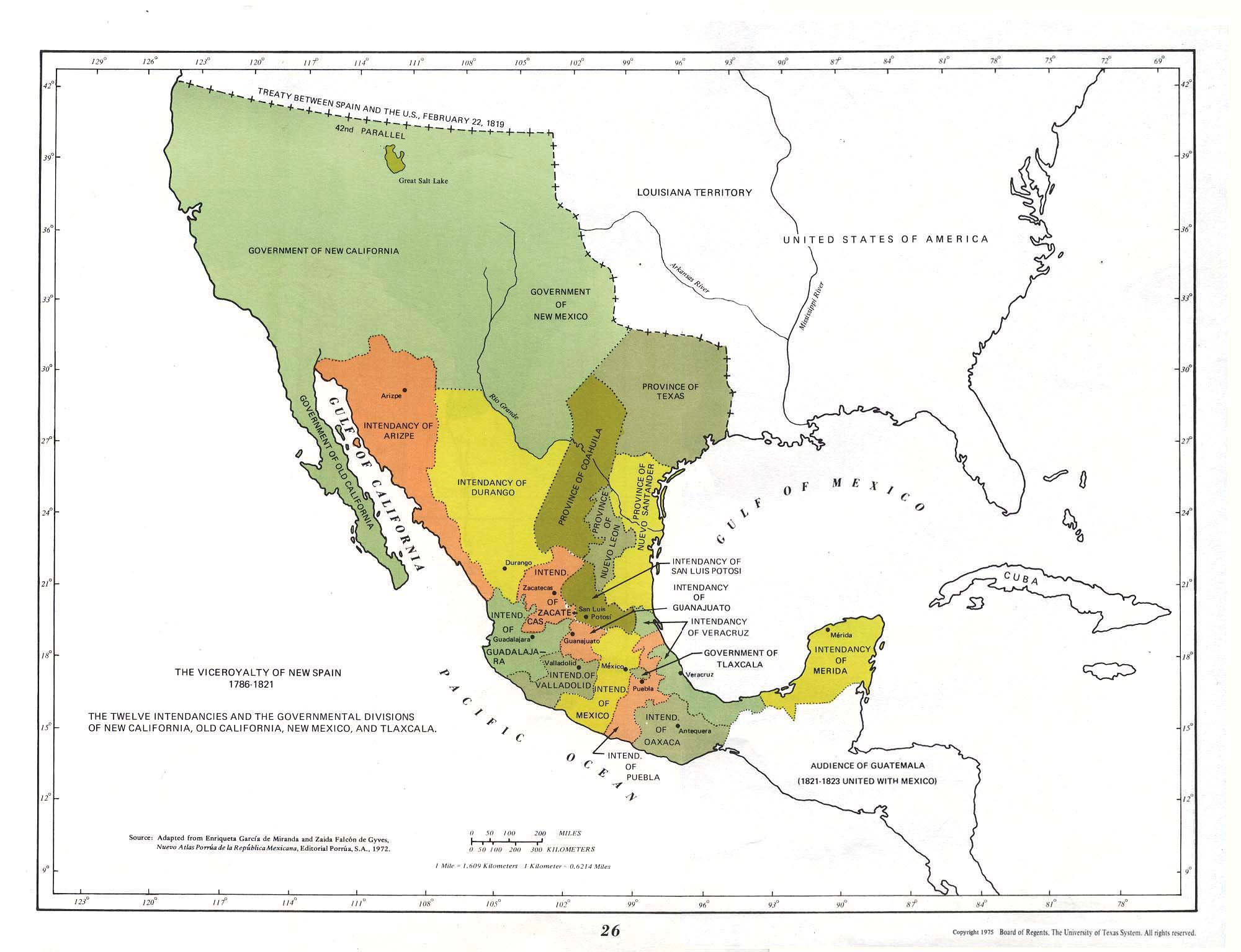
Spanish galleons transported Asian goods and travelers from Manila to colonial Mexico primarily through the port of Acapulco. During the two and a half centuries of contact between the Philippines and the Viceroyalty of New Spain, a minimum of 40,000 to 60,000 Asian immigrants would set foot in the “City of Kings,” while a figure double that amount (100,000) would be within the bounds of probability. From Acapulco they would gradually disperse to the far corners of the viceroyalty, from Loreto in Baja California to Mérida in Yucatan…. The majority, however, would eventually settle in two distinct zones: on the west coast in the districts of Guerrero, Jalisco, and Michoacán, and in the large, ethnically diverse municipalities of Mexico City and Puebla in the central valleys and the eastern port of Veracruz. The two zones were transversed by the most heavily traveled arteries that connected Acapulco to Mexico City (known colloquially as el camino de China) in the west; Veracruz with Puebla and Mexico City in the east; and several arterials linking the capital with Puerto Vallarta in the west and Guanajuato in the northwest.

For the most part, the chinos disembarked at Acapulco as sailors, slaves, and servants. Over the longue durée of Mexican-Asian cultural exchange, the largest contingent of Asians arrived as sailors on the galleons and smaller vessels (capitanas, pataches, and almirantes) that annually plied the long and perilous return voyage from Manila. The seamen were primarily Filipinos, Chinese mestizos (known in Manila as mestizos de Sangley), or ethnic Chinese from the fortified port of Cavite near Manila that served as the primary shipyard for Spaniards in the archipelago. In 1565, the first chino sailors from the islands of Cebu and Bohol arrived in Acapulco aboard Friar Andrés de Urdaneta’s trailblazing galleon, the San Pedro. During the late sixteenth century Iberian sailors constituted the majority of crewmen, but by the early 1600s Asians had surpassed them, accounting for 60–80 percent of the mariners from that time forward. A historical snapshot of galleon seafarers in the mid eighteenth century comes from a crew manifest of La Santissima Trinidad. In 1760, this vessel was manned by 370 sailors, consisting of 30 officers (Europeans or Mexican criollos), 40 artillerymen (27 chinos), 120 sailors (109 chinos), 100 “Spanish” cabin boys (96 chinos), and 80 “plain” cabin boys (78 chinos). In sum, 84 percent (310) of the crew were born and raised in Spain’s Asian colony, with 68 percent (250) hailing from the port of Cavite alone….

Along the Pacific coast, chino sojourners tended to congregate in the cities and pueblos of Acapulco, Coyuca, San Miguel, Zacatula, Tex pan, Zihuatenejo, Atoya, Navidad, and Colima. With the arrival of more ships from Manila, the number of sailors who either had no desire to return to the Philippines or were brought over as slaves married local Indian and mixed-race women increased. Consequently, a sizable population of chinos and their descendants made these cities and pueblos a popular destination for fellow Asians. Both freemen and slaves farmed rice (brought from the Philippines), corn, and cotton; tended cacao and coconut palm trees; fished in the seas and rivers; and transported people and goods to various ports along the coastline. Those who followed the royal highways to towns farther inland worked as muleteers or in the silver mines, haciendas, obrajes (textile workshops), or sugar mills….

Slaves and servants constituted the second largest group of Asian immigrants during the colonial era. Manila quickly became an important entrepôt for the commerce in human flesh during the first century of Spanish rule. The greater part were transported by Portuguese vessels from colonies and trading ports in Africa, India, the Malay peninsula, Japan, and China, although Chinese junks and Malay prahus also shipped large quantities to Manila. Non-Filipino slaves that fetched the highest price were from Timor, Ternate, Makassar, Burma, Ceylon, and India, because “the men are industrious and obliging, and many are good musicians; the women excellent seamstresses, cooks, and preparers of conserves, and are neat and clean in service.”…

The incorporation of Asian immigrants into the armed forces of New Spain represents another fascinating fragment of the chino mosaic from the colonial era. Similar to restrictions placed on other castas in Mexico, there were numerous prohibitions against Asians carrying weapons or riding horses….

The legion of similar antiweapons ordnances from the 1550s onward notwithstanding, from at least the 1590s free chinos not only were granted permission to carry weapons, but gradually incorporated into both the salaried companies of Españoles as well as local militias, especially those cities and towns along the Pacific coast. In several documents from the years 1591 and 1597, an “Indio Chino” from the silver mining town of Zultepec named Juan Alonzo, who earned his livelihood from buying and selling mules, was granted a license to ride a horse with a saddle and bridle and to carry a sword. A key determinant in this matter was his racial classification as a chino, since indios (unless they were elites) were forbidden such privileges….

Among the scores of Asian peoples that were widely defined as chinos, in the early decades of the 1600s Japanese converts were held in high esteem by Spaniards in the Philippines and New Spain for their bravery and loyalty. In 1603 and 1639 when Chinese residents in the Parián of Manila revolted against their Iberian overlords, Japanese swordsmen distinguished themselves in combat. Without their assistance, Sangleyes would surely have made the Philippines a colony of the Middle Kingdom. Thousands of Japanese converts, traders, and ronin made the Philippines their home prior to the closing of Cipango to Iberians in the 1630s. They lived in a suburb of Manila called Dilao, with a population estimated at 3,000 by 1624.

Thus it is not surprising that samurai converts were considered a more privileged subgroup of chinos in New Spain….

It is unclear exactly when chino militias were established on the west coast of New Spain. It is evident, however, that prior to 1729 Asian paramilitary units were routinely patrolling the regions adjacent to Acapulco. Tiburcio Anzalde, “captain of one of the militias of chinos and mulatos in the district of Atoya,” discussed the duties and obligations of militiamen in a 1746 document: repeated trips to Acapulco to deliver mail and other correspondences; to clear the roads (of bandits) while on patrol; and, most importantly, their heroic role in resisting the English pirate George Anson‘s invasion at the port of Zihuatenejo in 1741.

Leave a comment

Filed under Asia, China, economics, England, Japan, labor, Mexico, migration, Netherlands, Philippines, Portugal, Spain

The League of Nations vs. Japan

From The War of the World: Twentieth-Century Conflict and the Descent of the West, by Niall Ferguson (Penguin Press, 2006), pp. 301-303:

Despite its poor historical reputation, the League of Nations should not be dismissed as a complete failure. Of sixty-six international disputes it had to deal with (four of which had led to open hostilities), it successfully resolved thirty-five and quite legitimately passed back twenty to the channels of traditional diplomacy. It failed to resolve just eleven conflicts. Like its successor the United Nations, it was capable of being effective provided some combination of the great powers – including, it should be emphasized, those, like the United States and the Soviet Union, who were not among its members – had a common interest in its being effective. Remarkably, given Manchuria’s role as an imperial fault line earlier in the century, this was not the case in 1931. So uninterested was Stalin in the Far East at this point that in 1935 he offered to sell the Soviet-owned Chinese Eastern Railway to Japan and to withdraw all Soviet forces to the Amur River. If the Soviets were not interested in Manchuria, it was hard to see why Britain or the United States should be, especially at a time when both were reeling from severe financial crises.

On September 30, 1931, the Council of the League issued a resolution calling for ‘the withdrawal of Japanese troops to the railway zone’ where they had originally and legitimately been stationed. However, it set no deadline for this withdrawal and added the caveat that any reduction in troop numbers should only be ‘in proportion as the safety of the lives and property of Japanese nationals is effectively assured’. Eight days later Japanese planes bombed Jinzhou on Manchuria’s south-western frontier with China proper. On October 24 a new resolution was passed setting November 16 as the date by which the Japanese should withdraw. At the end of that month Japanese ground forces advanced towards Jinzhou. In early December, at the Japanese delegate’s suggestion, the League Council decided to send a commission of inquiry under the chairmanship of the Earl of Lytton, the former Governor of Bengal (and son of the Victorian Viceroy). Without waiting for its report, the us Secretary of State, Henry L. Stimson, warned Japan that the United States would refuse to recognize any separate agreement that Tokyo might reach with China; in his opinion, Japan was acting in breach not only of the Kellogg-Briand Pact signed in Paris in 1928 (under which the signatories had made ‘a frank renunciation of war as an instrument of national policy’) but also of the earlier Nine-Power Agreement to maintain the Open Door system in China.

The Japanese were unimpressed by American ‘non-recognition’. In March 1932 they proclaimed ‘Manchukuo’ as an independent state, with the former Chinese Emperor, Puyi, as its puppet ruler – another initiative by the men on the spot which was ratified by Tokyo only after a six-month delay. A week later Lytton submitted his voluminous report, which dismissed the Japanese claim that Manchukuo was a product of Manchurian self-determination and condemned Japan for ‘forcibly seiz[ing] and occupy[ing] … what was indisputably Chinese territory’. The Japanese pressed on with their policy of conquest. They bombed targets in the province of Rehe in the summer of 1932. In January 1933 there was yet another ‘incident’ at Shanhaiguan, the strategic pass where the Great Wall reaches the sea. After a few days it too was in Japanese hands. A week’s fighting added Rehe to Japan’s domain. In February 1933 the League of Nations Assembly accepted Lytton’s report and endorsed all but unanimously his proposal to give Manchuria a new autonomous status. Once again Japan was politely asked to withdraw her troops. In March the Japanese finally announced their intention to withdraw – from the League. Two months later they concluded a truce with Chinese military representatives that confirmed Japan’s control over Manchuria and Inner Mongolia. It also created a large demilitarized zone running through Hebei province, which the Japanese were soon running on an informal basis.

It is sometimes said that this was a fatal turning point in the history of the 1930s; the beginning of that policy of appeasement which was to culminate in 1939. But that is to misread the Manchurian crisis. It was unquestionably a turning point in Japan’s domestic politics. But internationally all that had happened was that the Japanese had achieved their long-standing objective of being treated as an equal by the other imperial powers.

Leave a comment

Filed under China, Japan, U.N., USSR, war

Aboard the Yasukuni Maru to London, March 1939

From Orwell’s Diaries (On Board SS. Yasukunimaru (NYK) Crossing Bay of Biscay, 28.3.39):

Yasukuni is 11,950 tons. Do not yet know, but from the vibrations judge that she is a motor-ship. Apart from the bridge, only 3 decks above water-level. Cabins and other appointments pretty good, but certain difficulties in that [the] entire crew and personnel are Japanese and apart from the officers the majority do not speak much English. Second-class fare Casablanca-London £6.10. As the boat normally goes straight to London from Gibraltar & on this occasion went out of her way to deliver a load of tea, fare from Gilbraltar would probably be the same. P. & O. tourist class is £6.10 London-Gibraltar. Food on this ship slightly better than on the P. & O. & service distinctly better, but the stewards here have the advantage that the ship is almost empty. Facilities for drinking not so good, or for deck games, owing to comparatively restricted space.

Do not know what the accomodation° for passengers would be, but presumably at least 500. At present there are only 15 in the second class, about 12 in the third, & evidently not many in the 1st, though I don’t know how many. One or two of the 2nd & 3rd classes are Danes or other Scandinavians, one or two Dutch, the rest English, including some private soldiers who got on at Gibraltar. It appears that for its whole voyage the ship has been as empty as this. Since the Chino-Japanese war English people from the far east will not travel on the Japanese boats. All the P. & O. boast said to be crowded out in consequence.

Leave a comment

Filed under China, Europe, Japan, war

Japan Through Ethiopian Eyes, early 1900s

From Mutual Interests? Japan and Ethiopia before the Italo-Ethiopian War, 1935-36, by J. Calvitt Clarke III, presented at the Florida Conference of Historians in 2000 (endnote references omitted):

Many Japanese wished to join the West in Africa’s exploitation, and some saw Ethiopia as a potential gateway. In 1899, Dr. Tomizu Hirondo, a professor of law at Tokyo Imperial University, published a short pamphlet, Afurika no Zento [The Future of Africa]. Admiring Cecil Rhodes and Harry Johnson, he concluded that Japan had to expand its influence and profit in Africa before Europeans completely controlled the continent. During the First World War, recalling Tomizu, some Japanese wanted to send troops to occupy Germany’s African territories [just as the Japanese Navy occupied Germany’s Micronesian colonies in 1914—J.].

The Japan Mail Steamship Company began regular service to Europe via the Suez Canal when the Tosa Maru left Japan in March 1896 and arrived in London in May. Stopping at Port Said, Japanese merchantmen set up direct commercial connections with Africa for the first time. Tokyo got first hand information on Africa by sending official economic missions, establishing consular offices, and by using the information networks established by shipping companies and trading houses. Japan designed its economic penetration to secure a cheap and stable supply of raw materials, especially cotton, as well as to capture markets. By 1899, silk thread from Japan was entering Ethiopia through Harar. And by 1918, Japanese cloth had superseded American unbleached muslin, which had dominated Ethiopia’s imports.

European colonialism in Africa, however, blocked Japan’s military and political penetration and confined Japan’s African relations to trade and commerce. Not necessarily by choice, Japan could and did claim “clean hands in Africa.”…

Young, educated Ethiopians responded. One of them, the future foreign minister Heruy Wolde Sellassie, published in 1932 Dai Nihon [Great Japan] in which he explained that, “Ethiopia was not knowledgeable of the situation in the East until the [Russo-Japanese] war. Because of the war, we learned tremendous amount about Japan from Russians living in Ethiopia, and our Ethiopian people started to admire courageous Japan.”

An Eritrean intellectual, Blatta Gabra Egziabher … was one of many young Ethiopians who saw Japan as a living example for Ethiopia in liquidating feudalism and developing capitalism through the agency of the modern state and revolution from above. Called “Progressive Intellectuals,” “Young Ethiopians,” or simply “Japanizers,” these foreign educated, young intellectuals stressed the similarities bonding the two non-Western nations. These included myths of eternal dynasties and similar histories in overcoming European powers. Japan’s dramatic and rapid transformation from a feudal society—like Ethiopia’s—into an industrial power by the end of the nineteenth century attracted Ethiopians. Further, Japan’s military victories convinced these Japanizers that they too could master western scientific and technological skills and turn them against Europeans. The appearance of the Japanizers created contradictions within the feudal ruling classes, enlightening some while hardening others. Hence arose the conflict between what one Marxist scholar has called the “liberal,” “enlightened feudalists” on the one hand and “ultra feudalists” on the other.

Gebre Heywet Baykedagn well-represents the ideas of the Japanizers. Born in 1886, he studied in Germany and Austria, and returned to Ethiopia in 1905. Exiled in 1909, he returned in 1911 to become palace treasurer and head of customs for Menelik’s grandson and heir, Lidj Iyasu. Convinced of the need for sweeping administrative and fiscal measures, by 1914, Gebre Heywet had become a confidant of Täfäri Makonnen—the future Emperor Hayle Sellase….

Japan’s victory over Russia impressed Prince Täfäri, an ardent student of military matters, and his trusted adviser, Heruy. Täfäri, whose original interest in Japan probably had been inspired by his father, Ras Makonnen, understood that Japan and the United States were the new centers of the world economy. By 1906 when Ras Makonnen died, the thirteen year-old Täfäri clearly had developed his goal, an essential part of which was to draw on the Japanese model. Japan had proved that a non-European nation could embrace modernization and stand as a cultural and technical equal to Europe….

As emperor, [RasHead’] Täfäri imitated the Japanese Emperor in his “attitude of exclusiveness,” because he thought it would help create “an imperial dignity lacking in Ethiopia.” Later as the Italo-Ethiopian war was brewing, the British Minister to Ethiopia, Sir Sidney Barton, explained: “the Emperor has always been interested in the achievements of Japan and his imagination sees similarities between the two countries which—however incredible it may seem to foreign observers—lead him to dream of Ethiopia as the Japan of Africa.”…

Ethiopia’s constitution of 1931 shows Japanese influence. Modeled on the Meiji Constitution of 1889, it concentrated and made more emphatic imperial power than did the Japanese. A Russian-educated intellectual and “Japanizer,” Takle-Hawaryat Takla-Maryam, wrote the draft of the Ethiopian Constitution, and the Emperor with his advisers Heruy and Ras Kasa modified it.

Even more dramatically, Foreign Minister Blaten Geta Heruy, special envoy of the Ethiopian emperor, left Addis Ababa on September 30, 1931, bound for Japan. Officially, his party was visiting to repay the Japanese Emperor for Japan’s representation at the recent coronation in Addis Ababa. In cultivating mutual relations, Heruy also wanted to see if the Ethiopians could carry out their plan for modernization along Japanese lines. Heruy and his mission were grandly treated. He later wrote: “Upon our arrival in Japan, I heard people’s joyful cries. Many Japanese citizens awaited us at the port waving Ethiopian and Japanese flags. The route to the hotel was flooded with people acclaiming us. Everywhere we went, it was the same phenomenon.”…

The Japanese welcome had impressed Heruy. After returning to Ethiopia, in 1932 he published a book to introduce Japan to his countrymen. Entitled Mahdara Berhan Hagara Japan [Japan: The Source of Light], it was probably the first book by an African to make a serious attempt to introduce Japan to Africans. It was translated into Japanese as Dai Nippon [Great Japan] and published with a preface by the former foreign minister Sidehara in Tokyo in 1934….

It would seem the true reason for Heruy’s journey to Japan in 1931, however, was to seek arms and munitions from the Japanese government. But then, Japan was dealing with the Manchurian Incident and had worries other than supplying arms and munitions to Ethiopia.

Heruy’s admiration for Japan as a model alarmed the Western powers that had no wish to see a second Japan—this one in Africa. One European wrote in 1935 that during the previous four years Ethiopia had “embarked, with the close cooperation of Japan, on a life-and-death struggle with the white race, the consequences of which are incalculable.” He added that Italy was fighting the battle for sake of all colonial powers in Africa….

Despite the fervent adulation by Japanese civilians, in the end Heruy got none of the tangible aid he had hoped to get. Japan’s government eventually adapted itself to Italy’s conquest of the Ethiopian Empire by exchanging recognitions with Italy—Ethiopia for Manchukuo. This led in turn to the Anti-Comintern Pact, a wartime alliance, and, ultimately, to mutual devastation and defeat for Italy and Japan. Ethiopia, on the other hand, in 1941 became the first Axis-occupied country to be liberated.

Leave a comment

Filed under Ethiopia, Japan, nationalism

Commissar Trotsky’s Military Tactics

From The War of the World: Twentieth-Century Conflict and the Descent of the West, by Niall Ferguson (Penguin Press, 2006), pp. 145-148:

Between May and June [1918], the Czechs swept eastwards, capturing Novo-Nikolaevsk, Penza, Syzran, Tomsk, Omsk, Samara and finally Vladivostok. Meanwhile, Russia’s former allies sent expeditionary forces, whose primary aim was to keep Russia in the war. The British landed troops at Archangel and Murmansk, as well as at Vladivostok; the French sent men to Odessa, the Americans to Vladivostok. The Allies also supplied the White armies with weapons and other supplies. The Japanese seized the opportunity to march across the Amur River from Manchuria. Meanwhile, the cities that were supposed to be the headquarters of the Revolution emptied as factories closed and supplies of food and fuel dried up. When Denikin called on all the White forces to converge on Moscow in July 1918, it seemed more than likely that the Bolshevik regime would be overthrown.

On August 6, 1918, White forces in combination with the renegade Czech Legion captured Kazan. The Bolshevik 5th Army was haemorrhaging deserters. Ufa had fallen; so too had Simbirsk, Lenin’s own birthplace. Another step back along the Volga would bring the forces of counter-revolution to the gates of Nizhny-Novgorod, opening the road to Moscow. Having resigned his post as Commissar for Foreign Affairs in favour of Military Affairs, Trotsky now had the daunting task of stiffening the Red Army’s resolve. He was, as we have seen, by training a journalist not a general. Yet the goatee-bearded intellectual with his pince-nez had seen enough of war in the Balkans and on the Western Front to know that without discipline an army was doomed. It was Trotsky who insisted on the need for conscription, realizing that volunteers would not suffice. It was Trotsky who brought in the former Tsarist NCOs and officers – many of them hitherto languishing in jail – whose experience was to be vital in taking on the Whites.

Trotsky had two advantages. Firstly, the Bolsheviks controlled the central railway hubs, from which he could deploy forces at speed. Indeed, it was from his own specially designed armoured railway carriage that he himself directed operations, travelling some 100,000 miles in the course of the war. Secondly, though the Bolsheviks lacked experience of war, they did have experience of terrorism; like the Serbian nationalists, they too had employed assassination as a tactic in the pre-war years. It was to terror, in the name of martial law, that Trotsky now turned.

When he arrived at Kazan, the first thing he did was to uncouple the engine from his train; a signal to his troops that he had no intention of retreating. He then brought twenty-seven deserters to nearby Syvashsk, on the banks of the Volga, and had them shot. The only way to ensure that Red Army recruits did not desert or run away, Trotsky had concluded, was to mount machine-guns in their rear and shoot any who failed to advance against the enemy. This was the choice he offered: possible death in the front or certain death in the rear. ‘We must put an end once and for all’, he sneered with a characteristically caustic turn of phrase, ‘to the papist-Quaker babble about the sanctity of human life.’ Units that refused to fight were to be decimated. It was a turning point in the Russian civil war – and an ominous sign of how the Bolsheviks would behave if they won it. In the bitter fighting for the bridge over the Volga at Kazan, Trotsky’s tactics made that outcome significantly more likely. The bridge was saved, and on September 10 the city itself was retaken. Two days later Simbirsk also fell to the Reds. The White advance faltered as they found themselves challenged not only by a rapidly growing Red Army, but also by recalcitrant Ukrainians and Chechens to their rear. The Czechs were weary of fighting; the Legion disintegrated as it was driven back to Samara and then beyond the Urals…. By the end of November Denikin had lost Voronezh and Kastornoe.

The end of the war on the Western Front was well timed for the Bolsheviks. It undermined the legitimacy of the foreign powers’ intervention, especially as they now had left-wing outbreaks of their own to deal with. Only the Japanese showed any inclination to maintain an armed presence on Russian soil, and they were content to stake out new territorial claims in the Far East and leave the rest of Russia to its fate.

Leave a comment

Filed under Britain, Czechia, France, Japan, Slovakia, U.S., USSR, war