
Category Archives: education

One Child’s Language: at 30 months (and abroad)

Social notes: Rachel is a full member of the family now. She has her own independent moods, desires, habits, hobbies, and insights. Her many observations intrigue and delight us and her usually buoyant mood lifts us when we are feeling cold and discouraged. She is more and more articulate about the specialness of our family relationship. She likes to repeat “Mama, Daddy, Rachel” as she points to each of us, sometimes misnaming us for our collective amusement. She often calls Daddy “Mama” and vice versa. When she does, she just smiles and repeats her error to reaffirm it. She has also discovered our given names and sometimes uses them to amuse us. She likes to sit us all next to each other and often calls for three-person hugs. She gives nice strong hugs now. She likes to refer to us as “this baby’s Mama” and the like. When we were travelling, she once said, “If Rachel goes to Guangzhou by Rachel’s self, Rachel will cry.”

She continues to feel more comfortable with familiar people. She warms up to students and people we visit much quicker than she used to, and is willing to show off a bit for them when she’s in the mood. She readily waves goodbye to everyone and anyone—even the most obnoxious of the “hello, hello” types. She really likes her teachers at school and knows them all by name. They really like her too, and spend a lot of time teaching her Chinese and eliciting English words from her. Rachel recognizes her classmates when we run into them around town, and knows many of their names. She has also become much more attached to and affectionate toward her stuffed animals, and likes to arrange them around her when she’s sitting on her potty chair or lying down to sleep.

Intellectual notes: Rachel’s compulsion about arranging things has reached the stage where she will take every loose object in the house and make long lines across the floor. When she finishes a line she calls us to come look, and then spends some time sucking her thumb, rubbing her belly button, and surveying her work with an artist’s eye.

She also likes her routines to be just so. When Daddy doesn’t do exactly what Mama did the day before, she will object. One day, Daddy sang Old King Cole as he stirred Rachel’s milk into her oatmeal, inadvertently establishing a ritual. Only the living room will serve for the nighttime milk-drinking and teeth-brushing routine.

Right before we took our winter trip, Rachel started to ask WHY everything. “Oh, that boy has no shoes on! Why?” “Oh, that’s a steam locomotive! Why?” Now, about three weeks later, she is trying out “that’s why” constructions: “Rachel’s cold, that’s why Rachel has no pants on.” (She still gets it backwards sometimes.)

She has begun to exercise her imagination and sense of humor a lot. She will turn herself into a roaring lion, an old lady with a walking stick, a vendor and shopper at the market, or a train passenger with bags and ticket. One night, she said “Rachel is sleeping with Rachel’s eyes open because Rachel doesn’t have eyelids.” She laughs “Rachel made a moo-take!” when she slips up, and likes to deliberately set out to make us laugh with funny faces, words, or movements.

Language notes: Rachel makes a clear distinction between occasions to use Chinese and English. Sometimes when we use Chinese, she will protest, “But Daddy’s an English speaker!” She is still not very talkative at school, but gets chatty in English as soon as we show up. She frequently asks “How Rachel say X in Chinese?” Sometimes she gets confused: “How Rachel say China in English?” She has learned to read a few more characters: 中国 (Zhongguo, China), 美国 (Meiguo, the US), 中山大学 (Zhongshan Daxue, Zhongshan Univ.), and 园林管理处 (Yuanlin Guanlichu, Forest Park Management). [Well, the last only in the context of the sign in the photo that we passed on the way to her school and back everyday.] She sat up in bed one night and said “Apple is pingguo” and then lay back down to sleep.

Reading park rules, Shiqi, Zhongshan City, Guangdong, China

Her teachers were astounded to find that she knew all the letters of the English alphabet. (They seem rather easily astounded.) She knows how to spell her own name, and can say the 7 syllables of her full name pretty fluently. Her grammar is coming along nicely: “Rachel thought this walrus had a blue shirt on.” “If Rachel runs down this ramp slowly, Rachel won’t fall down.”

CHILD’S SCHOOL RECORD
OFFICIAL NO. 2 KINDERGARTEN – SMALL CLASS
NAME BO LIQIU, WEIGHT 29 lbs. HEIGHT 89 cm. (35 inches)
CHILD’S SCHOOL PERFORMANCE
Able to adapt very quickly to kindergarten life. Comes to school on time everyday. Asks for leave when needed. Able to play together with her little playmates. Likes to listen to stories. Can chant simple nursery songs. Can do morning exercise and play games. With teacher’s guidance, can do drawing exercises. Ability to get along independently has improved. Regularly washes her hands before eating and wipes her mouth afterwards. Can eat by herself. Noon nap normal. But usually drinks little water. Hope next semester to strive for even greater improvement.
TEACHER: ZHOU
HEAD OF HOUSEHOLD’S OPINION
SIGNATURE: BO DEXIAO

UPDATE: This child is now a 24-year-old teacher in Boston’s Chinatown.
1 Comment

Filed under China, education, family, language, travel, U.S.

One Child’s Language: at 24 months (and abroad)

Rachel celebrated her birthday in China this year. We used the occasion to invite all of our sophomore class students over to our apartment for tea and snacks. Rachel was overwhelmed. But two people brought cakes (most of which we prevented ourselves and Rachel from eating) and she got to blow out two candles. Shortly after her birthday, she started going to the Number 2 Kindergarten in Shiqi town, Zhongshan City, Guangdong Province. It is about a 10-minutes walk from home, but Rachel can stretch it into 30 or more minutes when she walks home. She examines puddles, ramps, steps, curbs, passing vehicles (especially walking tractors), the chickens in one front yard, and the regulars who wave at her or come out to touch her.

Culture shock: For a long time Rachel would just stick her thumb in her mouth and and ask us to pick her up when anyone else wanted to talk to her or pick her up. She has been subjected to a lot of physical and vocal attention here; we had expected as much. But she has gradually begun to deal with the attention a bit more confidently. After our students assault her, she will ask us “They just want to be Rachel’s friends?” She dodges or brushes aside most passing maulers now, and lets one or two of the more familiar people pick her up. But for the first two months or so, she was in deep culture shock and very fussy and clingy. She still won’t say “thank you” or “good-bye” to anyone in either Chinese or English.

It was as hard for us as it was for her the first day we dropped her off at kindergarten. It was really sink or swim. She had had some setbacks in her toilet-training because of all the travel and stress she went through just before her second birthday. The first week of kindergarten, she wet her pants at least once a day, she wasn’t napping the required three hours [!] each day, and she was clinging pretty close to the principal all day. But now, she talks happily about “Rachel’s new aunties” and “Rachel’s school” (it helps that Mama and Daddy also have a school), rarely comes home with wet clothes, and is almost always in a pleasant, curious, and talkative mood all the way home and into the evening. She enjoys us a lot more when she isn’t with us all day long. She’s had a rough time but she’s grown up a lot in the last two months. She won’t even suck her thumb (considered a vile habit in this dirty environment) while she’s at school anymore. It may get worse, but the terrible twos don’t seem so terrible now that she’s actually two.

Physical development: She is increasingly confident—even reckless—on her feet: running, climbing, jumping, sliding down long slides. She almost has a swagger when she walks by herself. She loves to swim. We’ve been several times to hotel pools and she’s enjoyed leaping or falling off the side into our arms. She has very good control in her hands now. She can put up one finger or two fingers easily, and just recently managed to put up three fingers (the last 3) on the first try. We were all quite proud.

Intellectual notes: She is delightfully curious about all the new things around us, and wants to “see” every noise she hears. She loves to stop and inspect the snails, dragonflies, grasshoppers, and butterflies we encounter in our walks. She has an amazing memory. She can remember exactly where she put something hours ago, can remember what she saw where on a previous walk, and can remember who gave her things. We’ll say “Do you want to walk on the sand?” And she’ll say “Rachel want to walk on sand with Rachel’s new pink shoes from Rachel’s Grandma Grandpa.” She often asks “What’s that from?”—even about the toothpaste.

One of her games is to tell you one thing (“That Winnie Pooh”), then tell you something contradictory (“That not Winnie Pooh”). If you react with appropriate surprise, she will exclaim delightedly, “Rachel tricking Mama!” She can keep it up until you have trouble feigning surprise. Daddy said to her one day, “Rachel’s a talking trickster and a walking tractor.” She adapted that to “Rachel trickster, Rachel tractor, Rachel walking tractor.”

Language notes: Over the past two months, Rachel has been filling in a lot of the unstressed words she hears between the major words: prepositions, pronouns, adverbs, and conjunctions. One week it would be from, the next week with, the next w’out. She hasn’t got the and a figured out, and still uses Rachel instead of I, me, my but her English is more and more grammatical. She has now got the /s/ sound under control, so she distinguishes Rachel and Rachel’s, but she still has trouble with /p, b/ and /k, g/. She also just recently managed to make her Dayto sound a little more like Rayto, but the old habit of saying Dayto will take a while to break. Recently she has been playing with doubling words: “This Rachel Rachel; that Daddy Daddy.” [In retrospect, I think this may have been prompted by Chinese usage in her kindergarten, where she was called Qiuqiu, from her Chinese name Liqiu ‘beautiful autumn’. She was greeted every day like a visiting celebrity, with shouts of Qiuqiu lai le ‘Qiuqiu has come!’—J.] Not much progress in Chinese yet, but she can count from 1 to 5 (sometimes 10) in Chinese, and can follow simple directions at school.

We are amazed by her eagerness to read. She knows all the letters of the alphabet by name. We bought her a little magnetic board with all 26 letters and she plays with it each time she sits on the potty. It makes for some long potty sessions. She’ll keep playing with the letters long after she has done her business. Her demand as soon as she sits down is, “Rachel want to play with these letters,” followed shortly now with “Spell something, spell something.”

UPDATE: This child is now a 24-year-old teacher in Boston’s Chinatown.

1 Comment

Filed under China, education, family, language

One Child’s Language: at 22 months

For several weeks, durai (dry) was Rachel’s antonym for we’, diti, ‘ow (wet, dirty, ouch). She would talk about dirty and dry hands, or ouch (sore) and dry knees. Lately, she has started to use deen (clean) sometimes. Di and dido (big, little) sometimes occur instead of her old favorites wow, wee. She is beginning to use location words hia, dea, roro dea (here, there, over there), and when she bruises herself, she lets us know where to kiss by pointing and saying rai dea (right there), usually several times. Just today she started tagging otay?, dat rait? onto sentences to make them questions.

She does constant pattern drills, making the same sentence using Rachel one time, Mama the next, and Daddy the next—a standard substitution drill. She does endless repetition drills. We don’t drill her, she drills herself. She also does expansion drills: we say “Let’s brush our teeth” and she says Daydo dah Daydo dee’, Daddy dah Daddy dee’, Mama dah Mama dee’. If we tell her we’re going home, she’ll expand it to dodi Daydo ‘ous, Mama ‘ous, Daddy ‘ous (going to Rachel’s house, Mama’s house, Daddy’s house). And then, of course, she also does negation drills: we say “Not that!” and she says yes, dat; we say “Rachel drink water?” and she says Not Daydo dwin’ wawa; we say “Don’t throw your noodles” and she says yes, dwow noonoh. She never uses yes to answer simple questions, only to contradict a no. She’s definitely showing signs of nearing the Twos.

UPDATE: This child is now a 24-year-old teacher in the Boston Public Schools.

1 Comment

Filed under education, family, language

One Child’s Language: at 20 months

Reading is now the rage with Rachel. In one short week, she has nearly memorized Theodore LeSieg’s The Eye Book, one of the “Bright and Early Books for Beginning Beginners,” with a Cat-in-the-Hat trademark. Not that she can actually say all the words, but she knows what to expect from each page and can fill in at least the last word for every line. Of course, a person has to be familiar with her language and the situation in which she is using it to appreciate it because her articulation of consonants still has a long way to go. However, the vowels and the intonation are there. For example “airplanes in the sky” comes out as dayday die. Her other favorite books include Richard Scarry’s Best Word Book Ever, with its zillion little pictures to name, and Hand, Hand, Finger, Thumb, which features rhythmical text and monkeys drumming on drums. So she drums on an empty oatmeal box, not quite keeping beat with the text. She especially likes the line “Dum ditty, dum ditty, whack, whack, whack.”

She devised another game for herself involving books this week. From a big chair in our living room, she found out she could reach a stack of pocket books on a high shelf. Her routine is to pull one book off the stack, name the colors on its cover, open it up and “read” the numbers 1-5, lose it and put it down beside her, and then reach for the next one. Sometimes, she will try to put the books back on the shelf, too.

Her vocabulary and the speech sounds she uses change daily. We never know what words she considers manageable enough to try out. Once she tries something, she looks for ways to practice it over and over. She often talks quietly to herself saying things like: Daddy wey, Mama dey (Daddy’s away, Mama’s staying); Daydo ow, Daddy rey, Mama bdu (Rachel’s [toothbrush is] yellow, Daddy’s is red, Mama’s is blue). Her favorite topics of conversation are the color and size of objects and comments on who (mostly her) is doing what.

She loves to be asked silly questions like “Does Rachel have a tail?” and sometimes starts the silly game herself. For example, she will point to her rabbit’s tail asking us to name it, then point to herself and ask uh?, so we get the hint and ask the question. Language seems to be on her mind all the time; she even talks in her sleep. Her dad caught a glimpse of her attempt to communicate recently. As we left our apartment one evening, we met the family next door. They have a two-year old daughter. Rachel was standing face-to-face with the little girl and knew she was in a situation that called for some kind of linguistic interaction. She thought quickly, pointed to her shirt, and said bdu (blue)!

Of course, we are glad that books and language are important to Rachel now, but we are also glad to see her working on physical strength and dexterity. Her climbing has become more routine and confident. She will climb onto a box or chair and proclaim doe-day, which seems to mean something like “look at me.” She has been observing older children who can jump and hop for some time; now she is beginning to see what she must do to make a jump happen, though she can’t quite execute one yet. She likes to stretch and hang from the rings at the park.

We see signs of the stubbornness that accompanies the “twos.” Rachel uses no fairly frequently and often repeats Mama, no! Daddy, no! for no apparent reason. She repeats that latter often enough and reflexively enough that she sometimes gets tongue-tied. When she catches herself saying Mama no! to Daddy, she might try again with Dama no! or Madi mo! We think that we often find positive ways of encouraging her to do or not to do things, but of course, we don’t always succeed, and she gets input from other sources, too. She deliberately tests her limits: Yesterday, I let her throw paper wads and balls and clothes but drew the line at books. She tried it a couple of times but didn’t protest when I put the books out of reach. This morning she tried again, but when I put the books up again, she seemed to say, “Just checking.”

UPDATE: This child is now a 24-year-old teacher in the Boston Public Schools.

1 Comment

Filed under education, family, language

One Child’s Language: at 19 months

Rachel has turned into a real neatnik these days. She not only informs us immediately when she has a “dudu” diaper, she also stops whatever else she is doing to close an open door, to push in a protruding drawer, to put down the toilet lid, or to clear the sidewalk of little twigs and gravel. She also shows a lot more initiative in trying to bring other aspects of her environment under control. She likes to choose one outfit over another when it’s time to dress. She starts fetching shoes and saying waw’ when she’s ready to go out. She heads for Uncle Barry’s car and says rye when she spots the car in our slot as she comes out the elevator. She’d rather push her stroller than ride in it when she’s feeling energetic.

One evening, she pushed the stroller almost all the way home (about 10 blocks) from the Italian ice cream shop we walked to. She tested every metal cover embedded in the sidewalk to see if it made any noise. If it didn’t, she would say no-o-o and move on. If it did, she would try stomping on it again several times. She also labelled every down-and-up driveway slope we passed over, with a down and an uh. (She also uses down and uh for upside down and rightside up, respectively.)

You may have guessed that language has begun to come thick and fast. We had thought that this might be the last complete listing of the words Rachel can produce, but she has already gotten ahead of us. She surprises us with at least one new word every day. She has even begun to talk in her sleep a bit. We’ll have to be content to list some of her favorites.

She can count to five, but tends to start with two unless you remind her. She likes the symmetry of tu, ti, tow, tai. She has the primary colors pretty well under control. Her favorite is doo (blue), followed by rey (red), oh (yellow), and dee (green). She has all of our names down pat: mama, dadi, and daydo. Her nasals, m and n, actually started when she named the nama (llama) that she petted at the zoo one day. Within a day or two, she started to rave about her mama, about checking the mayno (mail), about her nano (Anno’s Journey) book, and about things that aren’t true or don’t exist (no-o-o). So far, her use of no-o-o (it doesn’t exist) far outweighs her use of no-no-no (this is off-limits). That pleases us.

Some words are far enough beyond the frontiers of her pronunciation that she relies on sign language. Her word turn is signed by rotating her wrist and fingers. She uses that sign for revolve, twist, roll, turn over, turn around, turn a corner. When she’s feeling talkative, she signs turn and says wheel whenever any wheeled vehicle strikes her fancy. Open is signed with an open hand, close with a clenched fist. She will signal close before she closes doors, pushes in drawers, and restores seatbacks and tray tables to their upright position. She signs flash and squeak by repeatedly opening and closing her hand.

Rachel has also mastered several pairs of antonyms. One of her most charming pairs is wow (big) vs. wee (small). (Wee she picked up from her Three Bears book, wow probably from our comments about large spoonfuls on their way to her mouth.) She delights in comparing things wow and wee. Another pair, we’ and dwy, get pretty regular use at diaper-changing time. One pair consists of a spoken awake (wey’) and a signed asleep (the sh sign, but with forefinger across her forehead instead of her lips).

One time when she was playing in her crib, she composed a small compare-and-contrast sentence about two little stuffed gingerbread men. It is herewith quoted in full, with accompanying interpretation and commentary provided by a member of the rapt audience of one: rey wey’, oh sh [the last word was signed, not spoken]. The red gingerbread man was face up, the yellow one face down. (She puts her things to sleep by laying them face down.) Not quite “Give me liberty or give me death,” but a memorable utterance in its own time and place, nevertheless.

UPDATE: This child is now a 24-year-old teacher in the Boston Public Schools.

1 Comment

Filed under education, family, language

Salonica’s Heterodox Modernizers

From Salonica, City of Ghosts: Christians, Muslims and Jews, 1430-1950, by Mark Mazower (Vintage, 2006), pp. 74-76:

The Ottoman authorities clearly regarded their [Ma’min] heterodoxy with some suspicion and as late as 1905 treated a case of a Ma’min girl who had fallen in love with her Muslim tutor, Hadji Feyzullah Effendi, as a question of conversion. Yet with their usual indifference to inner belief, they left them alone. A pasha who proposed to put them all to death was, according to local myth, removed by God before he could realize his plan. In 1859, at a time when the Ottoman authorities were starting to worry more about religious orthodoxy, a governor of the city carried out an enquiry which concluded they posed no threat to public order. All he did was to prevent rabbis from instructing them any longer. A later investigation confirmed their prosperity and honesty and after 1875 such official monitoring lapsed. Ma’min spearheaded the expansion of Muslim—including women’s—schooling in the city, and were prominent in its commercial and intellectual life. Merchant dynasties like the fez-makers, the Kapandjis, accumulated huge fortunes, built villas in the European style by the sea and entered the municipal administration. Others were in humbler trades—barbers, coppersmiths, town-criers and butchers.

Gradually—as with the Marranos of Portugal, from whom many were descended—their connection with their ancestral religion faded. High-class Ma’min married into mainstream Muslim society, though most resided in central quarters, between the Muslim neighbourhoods of the Upper Town and the Jewish quarters below, streets where often the two religions lived side by side. “They will be converted purely and simply into Muslims,” predicted one scholar in 1897. But like many of Salonica’s Muslims at this time, the Ma’min also embraced European learning, and identified themselves with secular knowledge, political radicalism and freemasonry. By a strange twist of fate it was thus the Muslim followers of a Jewish messiah who helped turn late-nineteenth-century Salonica into the most liberal, progressive and revolutionary city in the empire.

The juxtaposition of old and new outlooks in a fin-de-siècle Ma’min household is vividly evoked in the memoirs of Ahmed Emin Yalman. His father, Osman Tewfik Bey, was a civil servant and a teacher of calligraphy. Living in the house with him and his parents were his uncle and aunt, his seven siblings, two orphaned cousins and at least five servants. “The strife between the old and the new was ever present in our house,” he recollects. His uncle was of the old school: a devout man, he prayed five times a day, abhorred alcohol, and disliked travel or innovation. For some reason, he refused to wear white shirts; “a coloured shirt with attached collar was, for him, the extreme limit of westernization in dress to which he felt that one could go without falling into conflict with religion … He objected to the theatre, music, drinking, card playing, and photography—all new inventions which he considered part of Satan’s world.” Yalman’s father, on the other hand—Osman Tewfik Bey—was “a progressive, perhaps even a revolutionary,” who wore “the highest possible white collars,” beautiful cravats and stylish shoes in the latest fashion, loved poetry, theatre and anything that was new, taking his children on long trips and photographing them with enthusiasm. He adorned his rooms with their pictures and prayed but rarely.

Esin Eden’s memoir of the following generation shows Europeanization taken even further. Hers was a well-to-do family of tobacco merchants which combined a strong consciousness of its Jewish ancestry with pride in its contemporary achievements as part of a special Muslim community, umbilically linked to Salonica itself. The women were all highly educated—one was even a teacher at the famous new Terakki lycée—sociable, energetic and articulate. They smoked lemon-scented cigarettes in the garden of their modern villa by the sea, played cards endlessly and kept their eyes on the latest European fashions. Their servants were Greek, their furnishings French and German, and their cuisine a mix of “traditionally high Ottoman cuisine as well as traditional Sephardic cooking,” though with no concern for the dietary laws of Judaism.

When the Young Turk revolt broke out in Salonica in 1908, Ma’min economics professors, newspaper men, businessmen and lawyers were among the leading activists and there were three Ma’min ministers in the first Young Turk government. Indeed conspiracy theorists saw the Ma’min everywhere and assumed any Muslim from Salonica must be one. Today some people even argue that Mustafa Kemal Ataturk must have been a Ma’min (there is no evidence for this), and see the destruction of the Ottoman empire and the creation of the secular republic of Turkey as their handiwork—the final revenge, as it were, of Sabbatai Zevi, and the unexpected fulfilment of his dreams. In fact, many of the Ma’min themselves had mixed feelings at what was happening in nationalist Turkey: some were Kemalists, others opposed him. In 1923, however, they were all counted as Muslims in the compulsory exchange of populations and packed off to Istanbul, where a small but distinguished community of businessmen, newspaper magnates, industrialists and diplomats has since flourished. As the writer John Freely tells us, their cemetery, in the Valley of the Nightingales above Üsküdar, on the Asian side of the Bosphorus, is still known as the Selanikliler Mezarligi—the Cemetery of Those from Salonica.

1 Comment

Filed under Balkans, economics, education, Europe, Greece, Islam, Judaism, Mediterranean, migration, nationalism, Turkey

One Child’s Language: at 13 months

You can hardly sit down and read in her vicinity without her bringing one of her books over for you to read with her. She loves her books and can obviously match pictures in the book to analogous pictures in other contexts, or to real life.

She is making good headway now with language. She isn’t saying much that resembles English words, but she has gotten a lot more consonants and vowels under control and she strings together several groups of authentic-sounding syllables into play words. She does a lot of singing and babbling to herself, especially when we are out for a walk in the evenings or driving somewhere. She may just be on the verge of trying to parrot words we say to her, but she has already mastered the concept of labeling. She loves to extract labels from us for the things she points to. The relationship between fixed labels and the varied items those labels refer to is very clear to her. Her favorite game is to point to one thing for us to label, then point to another, then move her head and finger back and forth too fast for us to keep repeating the two labels in succession.

UPDATE: This child is now a 24-year-old teacher in Boston Public Schools.

3 Comments

Filed under education, family, language, U.S.

Changing Demographics in Pacific Seafaring

From Sailors and Traders: A Maritime History of the Pacific Peoples, by Alastair Couper (U. Hawai‘i Press, 2009), pp. 178-180, 188:

As well as improvements in maritime education and training under IMO regulations, there has also been a veritable social revolution in Fiji. The young generation of Pacific sailors no longer seriously ascribes to the old tradition that females bring “bad luck” to a ship. Pacific women have shown considerable strength of character, as well as new professionalism, in taking charge of crews and in coping with family….

The other change in human relations in Fiji has been an amelioration within the maritime sector of the sensitive issue of race relations. The exclusion of all but indigenous Fijians from the Waterside Workers and Seamen’s Union, which was registered in 1946 with a specific racial limitation clause, continued until a rival unsegregated seamen’s union emerged in 1992. The reasons for the initial segregation are deeply embedded in colonial history. However, with the increase of Fijians as wage earners in ports and shipping, trade union exclusiveness seemed as much a matter of class as race. Ports and shipping had Fijian laborers and ratings, while Europeans and part-Europeans were officials and officers. Capital in turn came from the United Kingdom and Australasia and locally from Indo-Fijian commercial sources. The more class-conscious union organizers saw the Fijians as “workers” and the others as “bosses” who were not eligible for union membership.

The mobility of a few Fijian ratings with sufficient education to junior officer levels and the increase of indigenous Fijians serving as cadets and officers on local vessels have reduced the basis for class resentment. There are still racial problems, but younger Fijian sailors recognize the merits of Indo-Fijians as mariners. For example, the Khan family on the island of Nairai have long been regarded as good sailors, running their own cutters with Fijian officers and crew….

The global hierarchical structure is broadly 40 percent officers from countries in the OECD (Organisation for Economic Co-operation and Development), plus Russia, Poland, and some of the eastern European states, and most of the ratings from eastern Europe and developing countries, including some Pacific islands.

Increasingly, young men and a few women from the Pacific are moving to officer ranks on foreign-flag ships, as there is a dire shortage of officers in the developed ship-owning states. The shortage is due to both declining interest in careers at sea and the losses of trained personnel arising from demands ashore in business, technology, and administration for well-qualified mariners. One of the several advantages to Germany, for example, of recruiting lower-cost sailors in Kiribati and training some of them to officer levels is the lack of well-paid employment in islands for their skills, which would attract officers ashore. Thus there is a minimizing of wastage from manpower training investments. There are twelve maritime training institutions in the Pacific Islands. Only Fiji and Papua New Guinea provide the full range of education and training from pre-sea, rating, and officer courses to Class 1 foreign-going masters and chief engineers. Several other places offer training of ratings and/or junior officers. There is mobility in training, with concentrations for special courses under the coordination of the SPC Regional Maritime Programme….

Kiribati in 1959 (as part of the Gilbert and Ellice Islands crown colony, GEIC) was already supplying seafarers to the China Navigation Company of Britain. There were also crews and a few I-Kiribati nationals serving as officers, usually with European captains, on colony ships sailing on long-distance interisland routes. In terms of distance, Kiribati shipping was virtually foreign-going…. Kiribati is now the principal country in the Pacific island region for supplying seafarers.

Leave a comment

Filed under economics, education, Fiji, labor, Micronesia, Pacific, Papua New Guinea

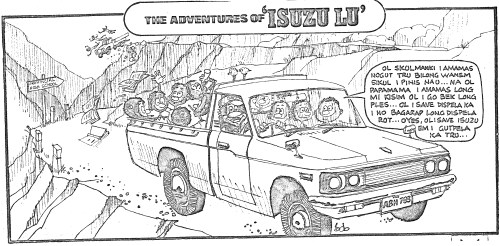
Tok Pisin with Isuzu Lu: Ol Skulmanki

Isuzu Lu: Ol Skulmanki

Isuzu Lu: Ol Skulmanki

Lu: “Ol skulmanki i amamas nogut tru bilong wanem sikul i pinis nau … na ol papamama i amamas long mi kisim ol i go bek long ples … Ol i save dispela ka i no bagarap long dispela rot … Oyes, ol i save Isuzu em i gutpela ka tru …”

Lou: “The schoolkids are awfully happy because school is over now … and the parents are happy for me to bring them back to the village … They know this car won’t break down on this road … Oh yes, they know Isuzu is a very good car …”

This is a scan from a faded old photocopy of a cartoon ad by Bob Browne for New Guinea Motors in the Papua New Guinea Post-Courier, 1976. I’ve got a lot more, but I’ll have to limit my scanning to just a sample because I see that the author/illustrator has published a collection of these cartoons. I just bought the last copy of Isuzu Lu Book 5 available on Amazon.com.

Leave a comment

Filed under education, language, Papua New Guinea

Ferguson vs. Krugman, Recession vs. Depression

In the Financial Times of 29 May, Niall Ferguson offers a History lesson for economists in thrall to Keynes.

I think perhaps Mr Krugman would benefit from a refresher course about [the] historical context [of Keynes’s (1937) General Theory]. Having reissued his book The Return of Depression Economics, he clearly has an interest in representing the current crisis as a repeat of the 1930s. But it is not. US real GDP is forecast by the International Monetary Fund to fall by 2.8 per cent this year and to stagnate next year. This is a far cry from the early 1930s, when real output collapsed by 30 per cent. So far this is a big recession, comparable in scale with 1973-1975. Nor has globalisation collapsed the way it did in the 1930s.

Credit for averting a second Great Depression should principally go to Fed chairman Ben Bernanke, whose knowledge of the early 1930s banking crisis is second to none, and whose double dose of near-zero short-term rates and quantitative easing – a doubling of the Fed’s balance sheet since September – has averted a pandemic of bank failures. No doubt, too, the $787bn stimulus package is also boosting US GDP this quarter.

But the stimulus package only accounts for a part of the massive deficit the US federal government is projected to run this year. Borrowing is forecast to be $1,840bn – equivalent to around half of all federal outlays and 13 per cent of GDP. A deficit this size has not been seen in the US since the second world war. A further $10,000bn will need to be borrowed in the decade ahead, according to the Congressional Budget Office. Even if the White House’s over-optimistic growth forecasts are correct, that will still take the gross federal debt above 100 per cent of GDP by 2017. And this ignores the vast off-balance-sheet liabilities of the Medicare and Social Security systems.

It is hardly surprising, then, that the bond market is quailing. For only on Planet Econ-101 (the standard macroeconomics course drummed into every US undergraduate) could such a tidal wave of debt issuance exert “no upward pressure on interest rates”….

The policy mistake has already been made – to adopt the fiscal policy of a world war to fight a recession. In the absence of credible commitments to end the chronic US structural deficit, there will be further upward pressure on interest rates, despite the glut of global savings. It was Keynes who noted that “even the most practical man of affairs is usually in the thrall of the ideas of some long-dead economist”. Today the long-dead economist is Keynes, and it is professors of economics, not practical men, who are in thrall to his ideas.

Leave a comment

Filed under economics, education, U.S.