Category Archives: China

Nationalist, not Moralist, Conflict in Asia

From Asia’s Cauldron: The South China Sea and the End of a Stable Pacific, by Robert D. Kaplan (Random House, 2014), Kindle Loc. 322-333, 585-592:

There is nothing romantic about this new front line. Whereas World War II was a moral struggle against fascism, the Cold War a moral struggle against communism, the post-Cold War a moral struggle against genocide in the Balkans, Africa, and the Levant, as well as a moral struggle against terrorism and in support of democracy, the South China Sea shows us a twenty-first-century world void of moral struggles, with all of their attendant fascination for humanists and intellectuals. Beyond the communist tyranny of North Korea, a Cold War relic, the whole of East Asia simply offers little for humanists. For there is no philosophical enemy to confront. The fact is that East Asia is all about trade and business. Even China, its suffering dissidents notwithstanding, simply does not measure up as an object of moral fury.

The Chinese regime demonstrates a low-calorie version of authoritarianism, with a capitalist economy and little governing ideology to speak of. Moreover, China is likely to become more open rather than closed as a society in future years. China’s leaders are competent engineers and regional governors, dedicated to an improving and balanced economy, who abide by mandatory retirement ages. These are not the decadent, calcified leaders of the Arab world who have been overthrown. Rather than fascism or militarism, China, along with every state in East Asia, is increasingly defined by the persistence, the rise even, of old-fashioned nationalism: an idea, no doubt, but not one that since the mid-nineteenth century has been attractive to liberal humanists.

Truly, in international affairs, behind all questions of morality lie questions of power. Humanitarian intervention in the Balkans in the 1990s was possible only because the Serbian regime was not a great power armed with nuclear weapons, unlike the Russian regime, which at the same time was committing atrocities of a similar scale in Chechnya where the West did nothing; nor did the West do much against the ethnic cleansing in the Caucasus because there, too, was a Russian sphere of influence. In the Western Pacific in the coming decades, morality may mean giving up some of our most cherished ideals for the sake of stability. How else are we to make at least some room for a quasi-authoritarian China as its military expands? (And barring a social-economic collapse internally, China’s military will keep on expanding.) For it is the balance of power itself, even more than the democratic values of the West, that is often the best preserver of freedom. That also will be a lesson of the South China Sea in the twenty-first century—one more that humanists do not want to hear.

Leave a comment

Filed under China, democracy, economics, energy, Japan, Korea, military, nationalism, philosophy, Russia, Southeast Asia

Geostrategic South China Sea

From Asia’s Cauldron: The South China Sea and the End of a Stable Pacific, by Robert D. Kaplan (Random House, 2014), Kindle Loc. 222-253:

The South China Sea functions as the throat of the Western Pacific and Indian oceans—the mass of connective economic tissue where global sea routes coalesce. Here is the heart of Eurasia’s navigable rimland, punctuated by the Malacca, Sunda, Lombok, and Makassar straits. More than half of the world’s annual merchant fleet tonnage passes through these choke points, and a third of all maritime traffic worldwide. The oil transported through the Malacca Strait from the Indian Ocean, en route to East Asia through the South China Sea, is triple the amount that passes through the Suez Canal and fifteen times the amount that transits the Panama Canal. Roughly two thirds of South Korea’s energy supplies, nearly 60 percent of Japan’s and Taiwan’s energy supplies, and 80 percent of China’s crude oil imports come through the South China Sea. Whereas in the Persian Gulf only energy is transported, in the South China Sea you have energy, finished goods, and unfinished goods.

In addition to centrality of location, the South China Sea has proven oil reserves of seven billion barrels, and an estimated 900 trillion cubic feet of natural gas. If Chinese calculations are correct that the South China Sea will ultimately yield 130 billion barrels of oil (and there is some serious doubt about these estimates), then the South China Sea contains more oil than any area of the globe except Saudi Arabia. Some Chinese observers have called the South China Sea “the second Persian Gulf.” If there really is so much oil in the South China Sea, then China will have partially alleviated its “Malacca dilemma”—its reliance on the narrow and vulnerable Strait of Malacca for so much of its energy needs coming from the Middle East. And the China National Offshore Oil Corporation has invested $20 billion in the belief that such amounts of oil really do exist in the South China Sea. China is desperate for new energy. Chinese oil reserves account for only 1.1 percent of the world total, while it consumes over 10 percent of world oil production and over 20 percent of all the energy consumed on the planet.

It is not only location and energy reserves that promise to give the South China Sea critical geostrategic importance, it is the territorial disputes surrounding these waters, home to more than two hundred small islands, rocks, and coral reefs, only about three dozen of which are permanently above water. Yet these specks of land, buffeted by typhoons, are valuable mainly because of the oil and natural gas that might lie nearby in the intricate, folded layers of rock beneath the sea. Brunei claims a southern reef of the Spratly Islands. Malaysia claims three islands in the Spratlys. The Philippines claims eight islands in the Spratlys and significant portions of the South China Sea. Vietnam, Taiwan, and China each claims much of the South China Sea, as well as all of the Spratly and Paracel island groups. In the middle of 2010 there was quite a stir when China was said to have called the South China Sea a “core interest.” It turns out that Chinese officials never quite said that: no matter. Chinese maps have been consistent. Beijing claims to own what it calls its “historic line”: that is, the heart of the entire South China Sea in a grand loop—the “cow’s tongue” as the loop is called—surrounding these island groups from China’s Hainan Island south 1,200 miles to near Singapore and Malaysia. The result is that all of these littoral states are more or less arrayed against China, and dependent upon the United States for diplomatic and military backing. For example, Vietnam and Malaysia are seeking to divide all of the seabed and subsoil resources of the southern part of the South China Sea between mainland Southeast Asia and the Malaysian part of the island of Borneo: this has elicited a furious diplomatic response from China. These conflicting claims are likely to become more acute as energy consumption in developing Asian countries is expected to double by 2030, with China accounting for half of that growth.

Leave a comment

Filed under China, economics, energy, industry, Japan, Korea, nationalism, Southeast Asia, Taiwan

Deng Xiaoping in Singapore

From Asia’s Cauldron: The South China Sea and the End of a Stable Pacific, by Robert D. Kaplan (Random House, 2014), Kindle Loc. 1569-1586:

In the heart of Singapore, along the Singapore River, near to the perfectly engineered design statement that is the Asian Civilizations Museum, stands a diminutive and elegant monument to the late Chinese leader Deng Xiaoping. Deng was arguably among the greatest men of the twentieth century, because he dramatically lifted the living standards of close to a billion people throughout East Asia by introducing a version of capitalism to the Chinese economy. No man in history improved the quality of life for more people in a shorter time than Deng. But Deng elicits mixed feelings in the West. He was a ruthless authoritarian, who was the driving force behind the massacre of perhaps thousands of protesting students at Tiananmen Square in Beijing in 1989. Only in Singapore would he be so openly honored—at so appropriate a measured level, and for the right reasons. “Singapore has raised pragmatism to the level of a philosophy,” explained retired local diplomat Tommy Koh, whose idea it was to erect the monument to Deng. Singapore, he told me, stands against the beauty of ideas in favor of what works.

Standing next to the monument to Deng, I looked out at downtown Singapore: a dull grayish and blue-slate corporate park built on the scale of a megacity, the product of a meticulous mind, with sharp puzzle pieces of skyscrapers all neatly fitting together, maddening in their mathematical logic. At work was the abstract genius of the Chinese, who understand the conceptual utility of empty spaces; as opposed to the Indianized Malay mind, which is more at home in the world of thickly colored and deliciously cluttered textiles, with their floral and cartouche patterns (as evidenced by the displays in the nearby museum). But to call Singapore cold and impersonal is too easy a judgment. For everywhere there is civilizing greenery, starting with the dazzling bougainvillea bushes that line the road from the airport. Singapore is the only place in the Indo-Pacific, other than Japan, where traffic stops voluntarily for pedestrians.

At the end of history there is somnolence: that is the lesson of Singapore. Pragmatism carried to the furthest degree may not inspire the Western humanist mind, but it has been the only way for Singapore to survive as a physical speck of a city-state at the southern tip of the Malay Peninsula, whose location is coveted by the great powers. Singapore’s inner logic follows from its geographical vulnerability.

Leave a comment

Filed under China, economics, nationalism, philosophy, Southeast Asia, U.S.

Singapore’s Formidable Military

From Asia’s Cauldron: The South China Sea and the End of a Stable Pacific, by Robert D. Kaplan (Random House, 2014), Kindle Loc. 1619-1641:

Singapore’s independence began less with a declaration of such than with the building of a formidable military. “Spider-Man needs a suit to make him strong; we needed an outsized armed forces,” explained a defense official. While Singapore has only 3.3 million citizens, it boasts an air force the same size as Australia’s, whose population is 23 million. “Like the Israelis, the Singaporeans believe in air superiority. They pay their pilots well. They have AWACS,” a defense official from a neighboring country told me. In addition to its one hundred or so fighter jets, Singapore has twenty missile-carrying ships, six frigates, and, notably, six submarines—an extraordinary number given that far more populous countries in the region like Indonesia, Malaysia, and Vietnam each have fewer. “Nobody can squeeze us through a blockade.”

It is not enough that Singapore has these air and sea platforms. For it is deadly serious about using them effectively. Because Singapore lacks empty space for military training, it regularly has four air squadrons training in the United States, ground troops training in Taiwan, and helicopter crews training in Australia. It allots sixty-five days a year for army maneuvers with leopard tanks. “We will not be hemmed in by our neighbors.” Too, Singapore has a conscript military. Said the same defense official: “There are only three developed countries in the world that are very serious about national service—South Korea, Israel, and us.” But the vast latent power of China still unsettles the Singaporeans, so much so that they feel they have no choice but to rely directly on the United States. As another diplomat told me: “We see American hard power as benign. The U.S. Navy defends globalization by protecting the sea lanes, which we, more than any other people, benefit from. To us, there is nothing dark or conspiratorial about the United States and its vast security apparatus.”

In 1998, the Singaporeans built Changi Naval Base solely to host American nuclear-powered aircraft carriers and submarines. “We designed the piers to meet the dimensions of American warships,” a high-ranking military man here told me, in order to lure American naval platforms to Singaporean waters. “It’s kind of like, if you serve good coffee and tea, people will come.” Indeed, in 2011 there were 150 American warship visits to Singapore. Then there were the three American littoral combat ships that, it was announced in 2011, would be stationed in Singapore.

Finally, beyond military might, there is the power of diplomacy. Singapore externalizes its security not only through the American navy and air force, but through an alliance like the Association of Southeast Asian Nations. ASEAN is about “socializing other states to a set of core values.” Those core values revolve around the independence of small and medium-sized states banding together in the face of a rising great power like China, even though no diplomat in the region will ever say that on the record.

Leave a comment

Filed under Australia, China, military, nationalism, Southeast Asia, U.S.

How Yunnan Became Chinese, and Muslim

From Where China Meets India: Burma and the New Crossroads of Asia, by Thant Myint-U (Farrar, Straus and Giroux, 2011), Kindle Loc. 2475-2501:

Seven hundred years before the present wave of tourists was an altogether different wave, of Mongols, Turks and Islam. The Mongol conquest of Yunnan in the thirteenth century brought this hitherto independent kingdom for the first time under Beijing’s control and began a process of integration into ‘China proper’ that has continued to today. The Mongol conquest also brought an astonishingly diverse influx of mainly Muslim peoples, from across their Eurasian domains.

Though the invasion forces were ultimately under Mongol command, many of the officers and most of the soldiers were Turks or people from further west. The force that invaded Burma for example is said to have included no fewer than 14,000 men of the erstwhile Persian Khwarezmid empire, under their own commander Yalu Beg. Others came to garrison the new possession. They included Turks from Samarkand, Bokhara, Merv and Nishpur. They also included tribal peoples like the Kipchaks and even Bulgars from the lower Volga. Yunnan itself had been conquered by the Mongol Prince Uriyangkadai who had also conquered Baghdad, and his forces most likely included captive soldiers from the Abbasid caliphate as well as southern Russia and the Ukraine.

There were even more exotic immigrants. They included the Alans–a Sarmatian tribe today known as the Ossetians–who had submitted to the Mongols and had provided a thousand warriors for the personal body guard of the Great Khan. A son of the Alan chief, Nicholas, took part in the conquest of Yunnan, and men from the North Caucasus were posted along the Burmese borderland.

A member of the Mongol imperial clan, Prince Hugeshi, was appointed ‘prince of Yunnan’ whilst the old ruling family, the Duans, were allowed to stay in Dali and keep the title of ‘maharaja’. The Muslim newcomers, based at Dali, became extremely powerful and the most powerful of them all was a native of Bokhara named Sayyid Ajall Shams al-Din Omar. He claimed descent from the emir of Bokhara (though some say his family were originally from Cairo) and by the late 1250s he was a rising star in the Mongol establishment. He served in Baghdad and in China and was appointed as the top administrator in Yunnan in the 1270s. Today the Muslims of Yunnan regard him as the founder of their community, a wise and benevolent ruler who ‘pacified and comforted’ the peoples of Yunnan.

Sayyid Ajall was officially the Director of Political Affairs of the Regional Secretariat of Yunnan, about as bureaucratic a title as one can imagine in medieval times. According to Chinese records, he introduced new agricultural technologies, constructed irrigation systems, and tried to raise living standards. Though a Muslim, he built or rebuilt Confucian temples and created a Confucian education system. His contemporary, He Hongzuo, the Regional Superintendent of Confucian Studies, wrote that through his efforts ‘the orang-utans and butcherbirds became unicorns and phoenixes and their felts and furs were exchanged for gowns and caps’. There were many other civilizing missions on China’s periphery but only in Yunnan was one conducted under Muslim (and essentially Turkish Muslim) leadership.

In this way, Yunnan became known to the Islamic world. When Sayyid Ajall died in 1279 he was succeeded by his son Nasir al-Din who governed for five years and led the invasion of Burma. His younger brother became the Transport Commissioner and the entire family entrenched their influence. There were still very few Han Chinese in Yunnan and the growing Muslim community began to excel as long-distance traders as well. In the early fourteenth century, the great Persian Jewish historian Rashid al-Din Hamadani stated that the Dali region had become exclusively Muslim.

Leave a comment

Filed under Burma, Central Asia, China, Islam, migration, Mongolia, Turkey

Manchuria Again a Promised Land

From Escape from Camp 14: One Man’s Remarkable Odyssey from North Korea to Freedom in the West, by Blaine Harden (Penguin, 2012), Kindle Loc. 1886-1905:

The capacity of the Chinese borderlands to absorb North Koreans is significant—and significantly underappreciated outside of Northeast Asia. The area is not all that foreign—or unwelcoming—to Korean-speaking migrants.

When defectors cross into China, the first “foreigners” they encounter are usually ethnic Koreans who speak the same language, eat similar food, and share some of the same cultural values. With a bit of luck, they can, like Shin, find work, shelter, and a measure of safety.

This has been going on since the late 1860s, when famine struck North Korea and starving farmers fled across the Tumen and the Yalu rivers into northeast China. Later, China’s imperial government recruited Korean farmers to create a buffer against Russian expansion, and Korea’s Choson Dynasty allowed them to depart legally. Before World War II, the Japanese who occupied the Korean Peninsula and northeast China pushed tens of thousands of Korean farmers across the border to weaken China’s hold on the region.

Nearly two million ethnic Koreans now live in China’s three northeast provinces, with the highest concentration in Jilin, which Shin entered when he crawled across the frozen river. Inside Jilin Province, China created the Yanbian Korean Autonomous Prefecture, where forty percent of the population is ethnic Korean and where the government subsidizes Korean-language schools and publications.

Korean speakers living in northeast China have also been an unsung force for cultural change inside North Korea. They have affected this change by watching South Korean soap operas on home satellite dishes, recording low-quality video CDs, and smuggling hundreds of thousands of them across the border into North Korea, where they sell for as little as fifteen cents, according to Rimjin-gang, the Osaka-based magazine that has informants based in the North.

South Korean soaps—which display the fast cars, opulent houses, and surging confidence of South Korea—are classified as “impure recorded visual materials” and are illegal to watch in North Korea. But they have developed a huge following in Pyongyang and other cities, where police officers assigned to confiscate the videos are reportedly watching them and where teenagers imitate the silky intonations of the Korean language as it is spoken by upper-crust stars in Seoul.

These TV programs have demolished decades of North Korean propaganda, which claims that the South is a poor, repressed, and unhappy place, and that South Koreans long for unification under the fatherly hand of the Kim dynasty.

Leave a comment

Filed under China, economics, Japan, Korea, labor, language, migration

Hawai‘i Chinese Baseball Team at the Far Eastern Games, 1915

From The Barnstorming Hawaiian Travelers: A Multiethnic Baseball Team Tours the Mainland, 1912-1916, by Joel S. Franks (McFarland, 2012), Kindle Loc. 2220-2242:

Luck Yee told readers that China needed a baseball team to represent it adequately at the Far Eastern games. Thus, sports-minded Chinese authorities went to Hawai’i for help because they knew that “a Chinese baseball team” had made several successful journeys to the American mainland. Furthermore, “Manila people” were anxious to see a Chinese Hawaiian team in action.

The son of a Chinese immigrant father and a native-born Hawaiian mother, Luck Yee described the trip westward as pleasant. He said that he and his teammates would climb on deck to do some warming up. However, “It was a queer experience to get out there the first time, throwing the ball while the ship was dipping and rolling. All the boys, except one or two, held conferences with the sharks and other fishes for a day or more, and then were well, ate heartily and slept nicely.”

Luck Yee had generally kind things to say about Japan. After 11 days at sea, the Chinese Hawaiian ballplayers reached Yokohama. Upon arrival, the team roamed by foot the city’s streets because they could not communicate with the “jinrikisha men.” Eventually, they ate at a Chinese restaurant and spent the night at the Hotel De France. The team seemed to like “Tokio” more. There, they took an “enjoyable” ricksha trek around the city. “Wherever we stopped the people would gather around us wonderingly. We had a hard time trying to obtain information from the policemen. All we could get out of them was a shake of the head.”

Luck Yee expressed less warmth for China. Upon arrival in Hong Kong, the Hawaiians noted the Sampras harboring “poor women, carrying children on their backs and rowing the boats too. Some of them had clothes that were tattered and worn out – poor miserable things. They were hungry creatures.” Before actually setting foot on Hong Kong the Hawaiians were accosted by a disagreeable Chinese customs official, according to Luck Yee. The pitcher claimed this bureaucrat “had the hauteur of an absolute ruler of the place.” He searched the players’ trunks for opium, firearms, and cartridges, and his arrogance, Luck Yee stressed, almost led “to blows.”

Still, Hong Kong merchants entertained the visitors. Luck Yee recalled that during one feast put on by local merchants, “beautifully dressed girls” sang for the players. However, the Hawaiians could not understand the lyrics of what the entertainers were singing until the young women sang Mendelssohn’s “Spring Song” and the “famous Tipperary.”

A motorcade greeted the Chinese Hawaiian ballplayers upon their arrival in Manila. They were then driven to the local YMCA where they stayed. Unable to practice for the 26 days they were ship-bound, Luck Yee and his teammates tried to work out in Manila their first day. The Chinese Hawaiians drew a large crowd to their practice – a crowd that included several opposing players. However, the weather was so hot they decided to do something else with their time after 15 minutes of exercise.

The Manila sporting press, Luck Yee complained, generally “knock[ed] us” before the Chinese Hawaiians took the field. Luck Yee conceded that there was one “contrarian” among the local sportswriters who praised the visitors. Luck Yee wrote, “It was fun to see them jeer at each other through the columns of their respective papers. The more they knocked the harder we played.”

Even though the team played effectively, the Manila sportswriters continued to scoff, maintaining that the Hawaiians were more lucky than good. Still, the visitors drew well – hefty crowds of as many as 10,000. Luck Yee reported proudly that the team tied the “much touted” Manila nine and then savaged another nine of hometown heroes, 10-0. The Manila press started to change its tune, while the city’s Chinese community invited the Hawaiians to a dinner.

Returning to China, the Hawaiians were feted by Chinese President Yuan Shi Kai. The ballplayers received “little mementoes.” However, political trouble was brewing for the President and the Hawaiians were feeling sorry for Yuan Shi Kai. Luck Yee asserted, “Wonderful indeed must be that man who will eventually lead 500,000,000 countrymen.”

Leave a comment

Filed under baseball, China, Hawai'i, Philippines, U.S.

Japanese vs. Chinese Baseball in Hawai‘i, 1911

From The Barnstorming Hawaiian Travelers: A Multiethnic Baseball Team Tours the Mainland, 1912-1916, by Joel S. Franks (McFarland, 2012), Kindle Loc. 456-490:

The visits of Japanese baseball teams to the American mainland in 1905 and 1911 helped set the stage for the Hawaiian Travelers baseball team’s initial journey in 1912. In 1905, a contingent from Waseda University traveled eastward to the United States. Under the headline of “Japs as Ballplayers,” the Washington Post told readers that Waseda’s trip to America had enhanced baseball’s popularity in Japan as well as “future international contests between the universities of the Pacific Coast and the Orient.” The Japanese nine, moreover, had improved its play during its stay on the mainland. Waseda offered relatively little competition to Stanford, Cal, and St. Mary’s nines. But in Southern California, the Japanese contingent played better.”

Indeed, in Southern California, the Waseda nine managed to take part in the first baseball game played on the American mainland between two teams representing different non-white racial groups. At a Los Angeles ballpark, Waseda encountered a team from Sherman’s Institute, a Riverside County boarding school for Native Americans. Waseda beat the Sherman Institute nine, which included John Tortez, a talented Cahuilla Indian athlete who became better known as “Chief” Meyers, a solid catcher for the New York Giants. Waseda also defeated a Los Angeles High School nine and, more impressively, a team representing the University of Southern California. In all, according to the Seymours, Waseda won seven of 26 games in the U.S.

In 1911, the Waseda nine returned to the American mainland, as did a team from Keio. These Japanese ballplayers from Waseda had a hard time with Stanford but impressed observers. The Daily Palo Alto saw them as both skilled athletes and racialized exotics: “The Japanese proved their reputation for sportsmanlike playing…. They are a nine of small men and they have to work for everything they get. Their native smallness handicaps them in their playing, but what they lose in size is made up in quickness, and in their taking advantage of every opening offered by the opposing nine.”

The next year the “Chinese Traveling Team” left the islands for the U.S. mainland with the blessings of Honolulu’s Chinese community and haole business interests. The team, affiliated with Honolulu’s Chinese Athletic Club, had raised, according to the Hawaiian Star, $6,000 for the trip. Fortuitously, the notion of sending a team of Chinese Hawaiians to the American mainland brought together Honolulu’s Chinese and non-Chinese commercial
interests. The former wanted to divert white mainlanders from their frequently zealous support of anti-Chinese legislation. The latter wanted to entice mainland tourists and investment. The fact that Japanese teams had toured the American mainland in 1905 and again in 1911 with some success and apparently without any major incidents suggested that the logistics of sending a Chinese Hawaiian nine westward were secure and manageable.

Of course, no one wanted to ship off a contingent of incompetents to mainland baseball diamonds. But Honolulu’s small baseball world knew of a number of very good Chinese Hawaiian ballplayers – ballplayers that would be seen as surprisingly skilled curiosities by many mainlanders. Scattered on various Honolulu teams, players such as En Sue Pung, Lai Tin, and infielder Alex Asam were assembled into an All-Chinese nine just in time to greet the Keio University team when it came to the islands in 1911.

Before taking on the Keio nine, the All-Chinese team easily defeated the best team in the Oahu League, the Hawaiis, 8-2. The Pacific Commercial Advertiser bemoaned the inability of the “Celestials” to enter a team in the Oahu League. As it was, fans were surprised that the league champion could fall so readily to the Chinese Hawaiians.

Meanwhile, many Japanese and Chinese Hawaiians were excited about the Keio-All-Chinese game scheduled for July 12, 1911. The Pacific Commercial Advertiser lamented that the game between Keio and the All-Chinese was scheduled for mid-week. Accordingly, Japanese and Chinese Hawaiian working people, as well as other Hawaiian baseball fans, would be prevented from attending. Nevertheless, the game was slated for late in the afternoon and most Honolulu baseball fans, except for Honolulu’s Nikkei population, seemed to back the local team.

A relatively huge crowd arrived for the Keio-All-Chinese match-up. Apparently, feelings ran high. According to the Advertiser, spectators were warned in English, Japanese, and Chinese to refrain from fighting, a warning which was supposedly heeded. The Japanese team won, 6-3. However, a rematch was arranged and the Advertiser speculated on a possible victory this time for the Chinese Hawaiians. “It will be a great feather in the caps of the Chinese team if they can pull a victory from the Japanese players, and the rejoicing in the Chinese community will beat any Fourth of July and Chinese New Year rolled into one that Honolulu has ever seen.” Meanwhile, Chinese Hawaiian baseball fans persisted in attending and rooting against the Keio nine as the Japanese ballplayers opposed Honolulu’s various multi-ethnic teams.

In the rematch, the Chinese Hawaiians proved too much for the visitors. According to the Advertiser, Apau Kau, “the burly, good natured Chinese … pitched the game of his life.” The score was 5-2 to the advantage of the locals when the Keio players left the field to protest an umpire’s decision. The Advertiser surmised as well that violence was simmering between the Japanese and Chinese spectators. However, “the mounted and foot police came in on the lope and stopped the little `tea party’.”

Things had gotten too exciting for all concerned. A rubber match between the All-Chinese and Keio was, indeed, cancelled. Moreover, at least the Advertiser seemed concerned about Asian Pacific athletes assuming a prominent place in Hawaiian baseball. “Aliens” were hurting the sport on the islands, according to the daily, “and the sooner the Europeans and their descendants get busy, and start the best game on earth going like it used to be, years ago, the better for the peace of mind of the Honolulu people.” In truth, the Advertiser appeared most distressed over the behavior of those Nikkei baseball fans determined to boycott all games between Keio and Hawaiian nines because they believed the Japanese ballplayers got a raw deal in the second game against the All-Chinese.

Leave a comment

Filed under baseball, China, Hawai'i, Japan, U.S.

Wordcatcher Tales: Japanese nautical terms

I’ve always been fascinated by the great variety and complexity of nautical terminology, especially on sailing ships. I’ve encountered it mostly in my reading. I don’t really have much sailing experience, except as a passenger aboard ferries and ocean liners, plus the occasional opportunity to go aboard a museum ship. The four-masted, sail training ship Nippon Maru, which I explored last month in Yokohama, was a special treat because it offered a glimpse of sailing-ship terminology in two languages, Japanese and English.

rigging-types-signage

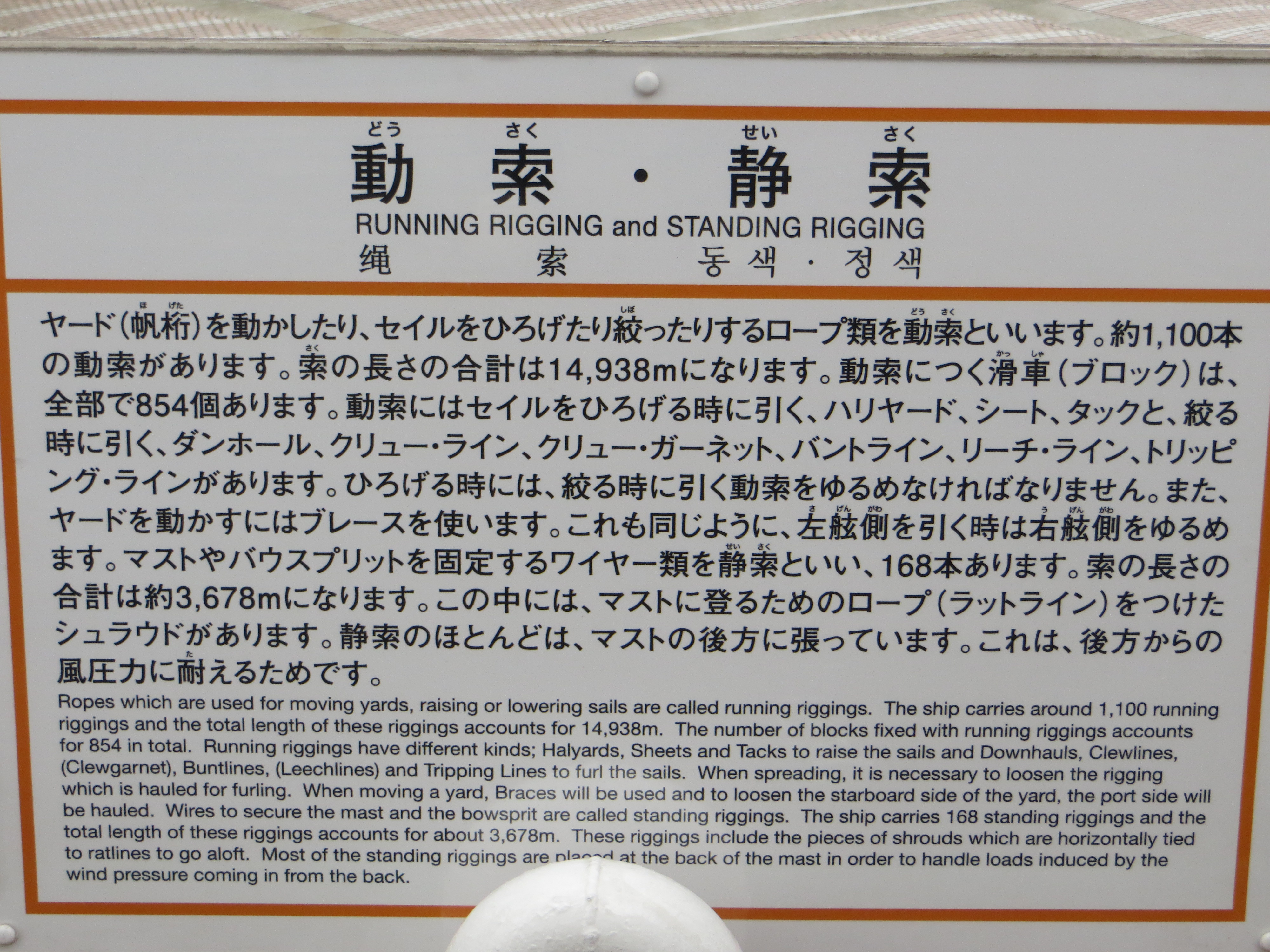
Running rigging and standing rigging


Here’s the text of the English translation on an explanatory sign about the rigging on the Nippon Maru. Though phrased rather awkwardly, it is very clear and instructive.

Running Rigging and Standing Rigging
Ropes which are used for moving yards, raising or lowering sails are called running riggings. The ship carries around 1,100 running riggings and the total length of these riggings accounts for 14,938m. The number of blocks fixed with running riggings accounts for 854 in total. Running riggings have different kinds: Halyards, Sheets and Tacks to raise the sails and Downhauls, Clewlines, (Clewgarnet), Buntlines, (Leechlines) and Tripping lines to furl the sails. When spreading, it is necessary to loosen the rigging which is hauled for furling. When moving a yard, Braces will be used and to loosen the starboard side of the yard, the port side will be hauled. Wires to secure the mast and the bowsprit are called standing riggings. The ship carries 168 standing riggings and the total length of these riggings accounts for about 3,678m. These riggings include the pieces of shrouds which are horizontally tied to ratlines to go aloft. Most of the standing riggings are placed at the back of the mast in order to handle loads induced by the wind pressure coming in from the back.

The Japanese terms for ‘running rigging’ and ‘standing rigging’ are 動索 dousaku ‘moving-rope’ and 静索 seisaku ‘still-rope’, respectively. (The matching Korean terms, dongsaek and jeongsaek, are cognate, and the suo ‘cable, rigging’ in Chinese shengsuo ‘rope-rigging’ is also cognate with J. saku and K. saek.) ‘Starboard’ is 右舷側 u-gen-gawa ‘right-gunwale-side’ and ‘port’ is 左舷側 sa-gen-gawa ‘left-gunwale-side’. (The kanji 舷 gen ‘gunwale’ also occurs in 舷灯 gen-tou ‘gunwale-lamp = running lights’ [on each side of the ship], 舷門 gen-mon ‘gunwale-gate = gangway’, and 舷窓 gen-sou ‘gunwale-window = porthole’.) The bow or fore part of the ship is 船首 sen-shu ‘ship-neck’ and the stern or aft part of the ship is 船尾 sen-bi ‘ship-tail’.

These terms were no doubt in use long before Japanese sailors became familiar with European-style sailing ships (before Date Masamune had his first Spanish galleon built in 1613). The same goes for terms like 帆柱 ho-bashira ‘sail-pillar = mast’ and 帆桁 ho-geta ‘sail-beam = yard(arm)’. Nevertheless, the Japanese text begins with the katakana synonym for ‘yard’ (yaado) followed by its kanji equivalent (帆桁) in parentheses, and employs exclusively katakana terms (borrowed from English) for ‘sail’ (seiru), ‘rope’ (roopu), and ‘mast’ (masuto). Why? Because the names for all the subcategories of nautical masts, sails, and rigging have been imported wholesale from English. At eye-level on each of the four masts is its name in katakana: foamasuto ‘foremast’, meinmasuto ‘mainmast’, mizunmasuto ‘mizzenmast’, and jigaamasuto ‘jiggermast’ (and ‘bowsprit’ is bausupritto). There are ways to write ‘front mast’ and ‘back mast’ in kanji, but it is much harder to differentiate four masts using traditional (Sino-Japanese) terminology.

Similarly, the name for every length of rigging on this modern square-rigged four-master is directly imported from English: ‘halyard’ is hariyaado, ‘sheet’ is shiito, ‘tack’ is takku, ‘downhaul’ is danhooru, ‘clewline’ is kuryuu rain, ‘clewgarnet’ is kuryuu gaanetto, ‘buntline’ is banto rain, ‘leechline’ is riichi rain, ‘tripping line’ is torippingu rain, ‘brace’ is bureesu, ‘ratline’ is rattorain, and ‘shroud’ is shuraudo.

The same goes for the names of every spar among the yards, as the following Yards chart shows. ‘Lower topsail yard’ is rowaa toppuseeru yaado, ‘upper (top)gallant yard’ is appaa geran yaado, ‘royal yard’ is roiyaru yaado, ‘spanker gaff’ is supankaa gafu, ‘spanker boom’ is supankaa buumu, and so on. The Korean translation (yadeu) of the chart title suggests that Koreans have also directly imported this specialized English terminology. (In the Chinese title, ‘yard’ is mistranslated as dui-huo-chang ‘stack-goods-place = freight yard’.)

yards-sign

Names of sailing yards

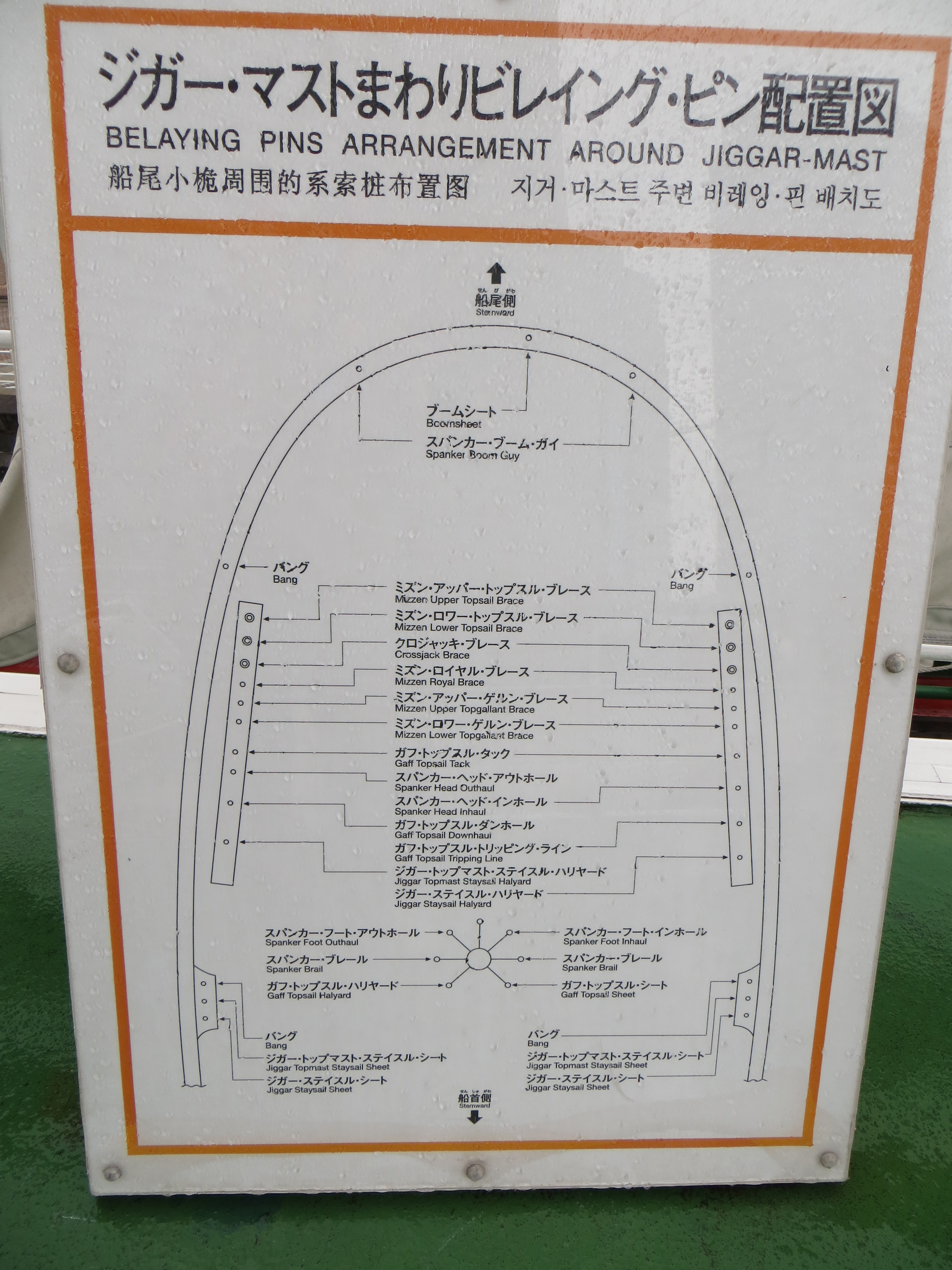
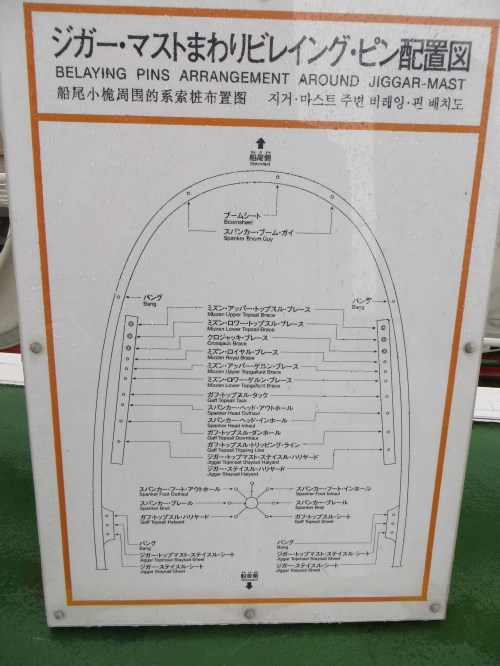
The last chart included here only confirms the extent to which English modern square-rigged sailing ship terminology has been imported wholesale into Japanese naval usage. Its title in Japanese is Jigaa masuto mawari bireingu pin haichizu ‘jigger mast around belaying pin arrangement-diagram’. The nautical terms of English origin, ‘jiggermast’ and ‘belaying pin’, are written in katakana, the native Japanese word for ‘around’ is written in hiragana, and the Sino-Japanese compound translated ‘arrangement-diagram’ is written in kanji. Although the Korean title is written entirely in the Korean alphabet, the breakdown of word origins is the same (and so is the word order): jigeo maseuteu ‘jiggermast’, jubyeon ‘around’, bireing pin ‘belaying pin’, baechido ‘arrangement diagram’.

In the Chinese translation, ‘jiggermast’ is rendered as 船尾小桅 chuanwei xiaowei ‘ship-tail small-mast’ to distinguish it from 后桅 houwei ‘rear-mast’ (= ‘mizzenmast’, cf. 前桅 qián wéi ‘fore-mast’, 主桅 zhuwei ‘main-mast’). ‘Belaying pin’ is translated rather directly as 系索桩 jisuozhuang ‘fasten-rope-stake’. These Chinese nautical terms do not render the English sounds, as the Japanese and Korean equivalents do.

By the way, there is a mistake in the English translation of the directions at the top and bottom of the chart. Both directions are labeled ‘sternward’ in English, but in Japanese only the top arrow points sternward (sen-bi-gawa ‘ship-tail-ward’), while the bottom arrow points foreward (船首側 sen-shu-gawa ‘ship-neck-ward’).
belaying-pin-chart

Jiggermast belaying pin chart

1 Comment

Filed under anglosphere, China, Japan, Korea, language, military, travel

Some Loanwords in Indonesian/Malay: A

From: Loan-Words in Indonesian and Malay, ed. by Russell Jones (KITLV Press, 2007), ignoring the far too numerous loans from Arabic, Dutch, and English.

Chinese

aci (Amoy) elder sister
ahsiu (Amoy) dried, salted duck
a i (Amoy) aunt (addressing younger than speaker’s mother)
akew (Hakka) term of address for boy (‘little dog’)
amah (Amoy) female servant
amho (Amoy) secret sign, password
amoi (Chiangchiu) younger sister; girl
ampai (Amoy) detective
angciu (Amoy) red wine
angco (Amoy) dried Chinese dates (Z. jujuba)
ancoa (Amoy) how can that be?
anghun (Amoy) shredded tobacco
angkak (Amoy) grains of red sticky rice (O. glutinosa)
angki (Amoy) persimmon (D. kaki)
angkin (Amoy) waist belt
angkong (Amoy) grandfather
angkong (Amoy) ricksha
anglo (Amoy) heating stove
anglung (Amoy) pavilion
angpai (Amoy) card game employing 56 cards
angpau (Amoy) present given at Chinese new year
angsio (Amoy) braise in soy sauce
angso (Amoy) red bamboo shoot
apa (Amoy) dad, father
apak (Hakka) old man, ‘uncle’ (lit. father’s elder brother)
apék (Amoy) old man, ‘uncle’ (lit. father’s elder brother)
apiun (Amoy) opium
asuk (Hakka) ‘uncle’, father’s younger brother

Hindi

abaimana anal and urethral orifices (with regard to ablution)
acita fine rice
anggerka gown
antari inner
arwa saw-edged knife
aruda rue (bot.)
ayah Indian nurse

Japanese

anata you
arigato thank you
aza hamlet

Persian

acar pickles
adas fennel
aftab sun
agar in order to
agha nobleman
ahli versed in; member of
aiwan hall
ajaibkhanah museum
akhtaj vassal
almas diamond
anggur grape
anjir fig
arzak beautiful gem
asa mint
asabat nerve
asmani heavenly
atisnyak fiery, glowing
azad faultless

Portuguese

alabangka lever
alketip carpet
alpayaté tailor
alpérés ensign, sublieutenant
andor (obs.) a litter on which images of saints were borne
antero whole
aria lower away (naut.)
arku bow (of a kite)
aria, aris-aris bolt rope, shrouds (naut.)
arkus arches (triumphal, with festoons)
armada armada, squadron, naval fleet
asar roast; barbecue

Sanskrit

acara program, agenda
adi beginning, first, best, superior
adibusana haute couture
adicita ideology
adidaya superpower
adikarya masterpiece
adimarga boulevard
adipati governor
adipura cleanest (etc.) city (chosen annually)
adiraja royal by descent
adiratna jewel, beautiful woman
adisiswa best student
adiwangsa of high nobility
adiwarna glowing with colour
agama religion
agamiwan religious person
ahimsa non-violence
aksara letter
amerta immortal
amerta nectar
amra mango
ancala mountain
anda musk gland
Andoman Hanuman
anduwan foot chain
anéka all kinds of
anékawarna multi-coloured
anggota member
angka number, figure
angkara insolence, cruel
angkasa sky
angkasawan astronaut; broadcaster
angkasawati astronaut; broadcaster (fem.)
angkus elephant-goad
angsa goose
aniaya violation
anjangkarya working visit
antakusuma cloth made from several pieces
antar- inter-
antara (in) between
antarabangsa international
antariksa sky
antariksawan astronaut
antariksawati astronaut (fem.)
antamuka interface (of computer)
antarnegara international
anugerah (royal) favour
anumerta posthumous
apsari nymph
arca image; computer icon
aria a high title
arti meaning
Arya Aryan race
aryaduta ambassador
asmara love
asmaraloka world of love
asrama hostel
asta cubit
asta eight
astagina eightfold
astaka octagonal bench
astakona octagon
astana palace
asusila immoral
atau or
atma(n) soul

Tamil

acaram wedding ring
acu mould, model
andai possibility
anéka various, diverse
anékaragam various kinds
apam rice flour cake
awa- free from
awanama anonymous
awatara incarnation
awawarna blanched, decolorized

1 Comment

Filed under China, India, Indonesia, Iran, Japan, language, Malaysia, Portugal