Category Archives: Caribbean

Che’s African Farce, 1965

From Looking for History: Dispatches from Latin America, by Alma Guillermoprieto (Vintage, 2001), pp. 81-82:

Che was unable to deal with his disapproval of the course that Fidel was taking and his simultaneous love for the man; with his disillusionment with the Soviet Union and the self-satisfaction of the burgeoning Cuban bureaucracy; with the palace intrigues of the new regime (particularly those of Fidel’s brother Raúl); and, probably, with the gnawing awareness of his own failings as a peacetime revolutionary. It seems reasonable to interpret his decision to leave Cuba as Castañeda does—as the result of his need to get away from so much internal conflict. (In the course of explaining this decision, Castañeda provides an extraordinary account of the ins and outs of Cuban state policy, Cuban-Soviet relations, and Castro’s dealings with the United States.) Che was leaving behind a second wife, six children, his comrades, his years of happiness, and the revolution he had helped give birth to; none of these were enough to convince him that he belonged.

Guevara’s original intention was to return to his homeland and start a guerrilla movement there. A 1965 expedition to the Congo, where various armed factions were still wrestling for power long after the overthrow and murder of Patrice Lumumba, and his last stand in Bolivia, Castañeda writes, followed improbably from Fidel’s anxious efforts to keep Che away from Argentina, where he was sure to be detected and murdered by Latin America’s most efficient security forces. Castro seems to have felt that the Congo would be a safer place, and the question of whether it was a more intelligent choice doesn’t seem to have been addressed either by him or by the man he was trying to protect. (In Cairo, Jon Lee Anderson notes, Gamal Abdel Nasser warned Che not to get militarily involved in Africa, because there he would be “like Tarzan, a white man among blacks, leading and protecting them.”)

As things turned out, the Congo episode was a farce, so absurd that Cuban authorities kept secret Che’s rueful draft for a book on it—until recently, that is, when one of his new biographers, Taibo, was able to study the original manuscript. Guevara was abandoned from the beginning by Congolese military leaders, such as Laurent Kabila, who had initially welcomed his offer of help. He was plagued by dysentery and was subject to fits of uncontrollable anger, and emerged from seven months in the jungle forty pounds lighter, sick, and severely depressed. If he had ever considered a decision to cut bait and return to Cuba, that option was canceled weeks before the Congo expedition’s rout: on October 5, 1965, Fidel Castro, pressed on all sides to explain Che’s disappearance from Cuba and unable to recognize that the African adventure was about to collapse, decided to make public Che’s farewell letter to him: “I will say once again that the only way that Cuba can be held responsible for my actions is in its example. If my time should come under other skies, my last thought will be for this people, and especially for you.”

Guevara was sitting in a miserable campsite on the shores of Lake Tanganyika, bored, frustrated, and in mourning for his mother, when he was told that Fidel had publicized the letter. The news hit him like an explosion. “Shit-eaters!” he said, pacing back and forth in the mud. “They are imbeciles, idiots.”

Guevara’s final trek began at this moment, because once his farewell to Fidel was made public, as Castañeda writes, “his bridges were effectively burned. Given his temperament, there was now no way he could return to Cuba, even temporarily. The idea of a public deception was unacceptable to him: once he had said he was leaving, he could not go back.” He could not bear to lose face.

A few months later, having taken full and bitter stock of his situation, he made the decision to set up a guerrilla base—intended as a training camp, really—in southern Bolivia, near the border with Argentina. From there, he convinced himself, he would ultimately be able to spark the revolutionary flame in Argentina and, from there, throughout the world.

Leave a comment

Filed under Argentina, biography, Congo, Cuba, military, war

India’s Diverse Diasporas

From India: The Rise of an Asian Giant, by Dietmar Rothermund (Yale U. Press, 2008), pp. 233-235:

The cultivation of sugar-cane in colonies such as Mauritius and the Natal province of South Africa, in Trinidad, Guyana and Surinam in the Caribbean and Fiji in the Pacific Ocean created settlements of Indian labourers as many stayed on as free labourers after their contracts had expired. In some of these places the Indians emerged as the majority of the population, but with few exceptions they did not rise above the position of labourers. Therefore the diaspora in the ex-sugar colonies is not much of an economic asset to India. Mauritius is an exception to this rule. It has shown encouraging signs of economic growth and its Indian majority dominates the politics of the island but has maintained equitable relations with the other ethnic groups. Mauritius has become a major offshore banking centre for investors who channel their investments in India through the island. This has led to the strange phenomenon whereby tiny Mauritius ranks high among the nations investing in India. Being well aware of the benefits of good relations with Mauritius, India is even prepared to protect the maritime economic zone of the island with the help of its navy….

The era of decolonization did not provide much scope for re-migration from the diaspora to India. Nor did the erstwhile colonial powers invite people of Indian origin to settle in their home countries. There were only two striking exceptions to this rule. The Netherlands became the target of a mass exodus of Indians from Surinam after that colony gained independence in 1975. This was due to the fact that the Dutch had granted citizenship to the people of Surinam and since the Indians did not get along with the Afro-American majority, they left for the Netherlands before their right of citizenship could be revoked. A similar exodus of Indians from Uganda to Great Britain had taken place after Idi Amin had established his tyrannical rule in 1971. The Indians of Uganda were not the offspring of indentured servants but had followed the Uganda railroad. The workers who built that railroad had also come from India, but almost all of them had returned to their homes in the Punjab. The subsequent immigrants from India were for the most part literate Gujaratis who manned the administrative posts of the railway or set up shops in the hinterland which had been opened up by the railway. When these people were persecuted by Idi Amin and shifted to Great Britain they did very well there as a result of their business acumen. This group of the Indian diaspora is of considerable importance for India. But, of course, the Indians who came from East Africa are only part of the Indian diaspora in Great Britain, which also consists of Indian professionals and businessmen who migrated from India to the ex-imperial country in search of greener pastures.

Another post-colonial migration which had some similarity to the export of Indian manpower in colonial times was the recruitment of Indian labour by the countries along the Persian Gulf when those countries earned millions of petro-dollars. This recruitment benefited all South Asian countries. Most of them sent unskilled labourers to the Gulf; India had the lion’s share of skilled administrative jobs. For quite some time the ample remittances of these skilled personnel filled the gap in India’s balance of payments which was usually affected by a negative balance of trade. When the first Gulf War of 1991 disrupted this profitable connection, India was hit very hard, the more so as the disaster was sudden and unexpected. When Indira Gandhi was asked in 1981 whether she could envision an Indian exodus from the Gulf similar to that from East Africa precipitated by Idi Amin, she jauntily replied: ‘The Arabs need US.’ Her successors also took this for granted and were rudely awakened by the Gulf War.

The Indian diaspora in the countries along the Persian Gulf was very different from that everywhere else. First of all it was of very recent origin. This diaspora had no second or third generation members born in the country of residence. Moreover, the Indians who came to the Gulf did not intend to settle there for any length of time. There were many educated people from Kerala among them who simply wanted to earn enough money to build a house back home. Busy construction work in the villages of Kerala provided striking evidence of this trend in the 1980s. Under such conditions there was hardly any incentive to establish Indian community centres in the Gulf countries. The Indian diaspora was not concentrated in anyone place and its members fluctuated. Nevertheless, this was the diaspora which was most important for India, due to the economic effect of its remittances. Other Indian diasporas would be less inclined to send money to India as they would rather invest it where they lived. The occasional support of poor relatives in India did not give rise to substantial remittances.

Today’s Wall Street Journal weighs in on one of the barriers to the expansion of India’s diaspora in the U.S., where “the American Association of Physicians of Indian Origin which was founded in 1984 has 42,000 members” (Rothermund, p. 235):

The Chandrayaan-I blasted off about dawn from the Satish Dhawan Space Center. It is expected to reach lunar orbit by November 8. The probe, whose principal goal is to “conduct mineralogical and chemical mapping of the lunar service,” carries five scientific payloads from India and others from NASA and the European Space Agency. With this achievement, India joins the U.S., Japan, Europe, Russia and China in the lunar club.

India deserves congratulations for the Chandrayaan-I, which attests further to that nation’s remarkable strides as an economic and scientific power. That said, we cannot fail to draw attention to how this event bears on the continuing lunacy of Congress in limiting visa quotas for highly skilled immigrants.

American universities are filled with foreign students, not least from India, getting degrees in engineering and science. Many dearly wish to stay and work in the U.S. Instead, we basically kick them out after training them, owing to the Congressional limit of 65,000 H-1B visas, which are used up the day they are released in March.

Would calling this the “pre-emptive export of jobs overseas” make it any less attractive to economic protectionists?

Leave a comment

Filed under anglosphere, Caribbean, economics, education, Fiji, India, migration, South Africa, U.K., U.S., Uganda

Ethiopia, 1978: One More Equal Than Others

From The Fate of Africa: A History of Fifty Years of Independence, by Martin Meredith (PublicAffairs, 2005), pp. 245-248:

In September 1976 the Ethiopian People’s Revolutionary Party (EPRP), drawing support from the labour unions, teachers and students, all vehemently opposed to military rule, embarked on a campaign of urban terrorism against the Derg and its civilian ally, the All-Ethiopian Socialist Movement, usually known by its Amharic acronym, Meison. An assassination attempt was made on Mengistu in the centre of Addis Ababa in September, the first of nine such attempts. Scores of officials and supporters of the Derg were murdered. The Derg in turn sent out its own murder squads…. By mid-1977 the EPRP was effectively destroyed. In the final phase of the red terror, to establish his own supremacy, Mengistu turned on his Meison allies, destroying them too. The young generation of intellectual activists, who had so avidly supported the revolution were all but wiped out.

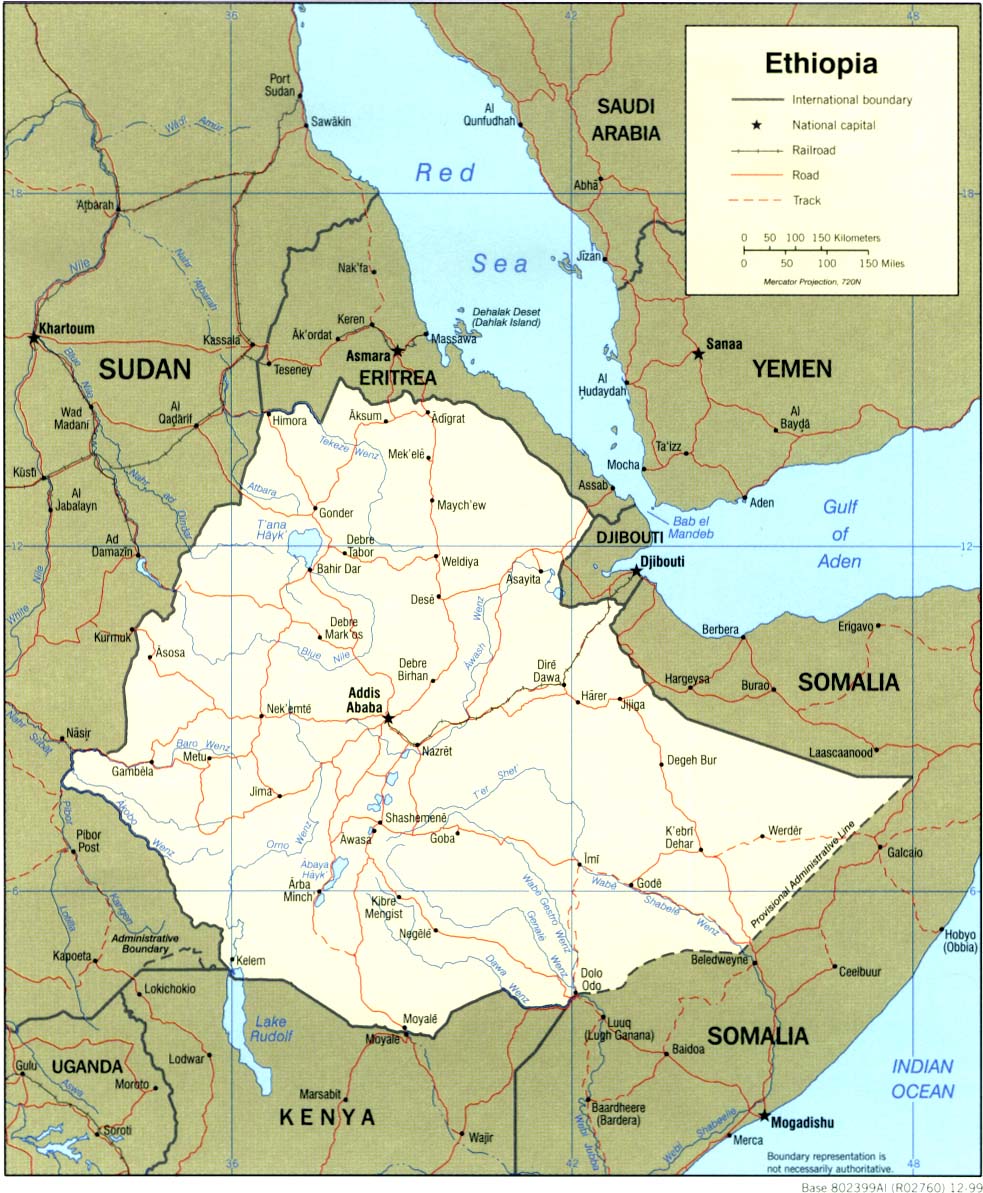
Mengistu’s hold over other parts of Ethiopia was nevertheless precarious. By mid-1977 the Ethiopian army in Eritrea had lost most major towns and controlled little more than Asmara and the ports of Massawa and Assab. In July 1977 Somalia, deciding the time was ripe to take advantage of the Derg’s preoccupation with Eritrea and other revolts, launched a full-scale invasion of the Ogaden. By August the Somalis controlled most of the Ogaden. In September they captured Jijiga, an Ethiopian tank base, and pressed on towards the town of Harar and the rail and industrial centre of Dire Dawa, the third largest city in Ethiopia.

What rescued Mengistu from military defeat was massive intervention by Soviet and Cuban forces, determined to prop up his Marxist regime. In November 1977 the Soviets mounted a huge airlift and sealift, ferrying tanks, fighter aircraft, artillery, armoured personnel carriers and hundreds of military advisers to Ethiopia. A Cuban combat force numbering 17,000 joined them. Led by Cuban armour, the Ethiopians launched their counter-offensive in the Ogaden in February 1978, inflicting a crushing defeat on the Somalis. The full force of the Ethiopian army, supported by the Soviet Union, was then turned on Eritrea.

At the fourth anniversary celebrations marking the overthrow of Haile Selassie in 1978, Mengistu sat alone in a gilded armchair covered with red velvet on a platform in Revolution Square in Addis Ababa watching a procession of army units and civilian groups pass before him. Then he returned to his headquarters at the Grand Palace. Having succeeded in holding the old empire together, he liked to portray himself as following a tradition of strong Ethiopian rulers. Indeed, Mengistu came to be compared with the Emperor Tewodros, a nineteenth-century ruler who started his career as a minor local chieftain, fought his way up to take the Crown and then strove to reunite the empire after a period of disintegration. At official functions at the Grand Palace, while members of the Derg stood respectfully to one side, Mengistu chose to preside from the same ornate chair that Haile Selassie had once favoured.

One of his ministers, Dawit Wolde Giorgis, once a fervent supporter of the revolution, recalled his growing sense of disillusionment.

At the beginning of the Revolution all of us had utterly rejected anything having to do with the past. We would no longer drive cars, or wear suits; neckties were considered criminal. Anything that made you look well-off or bourgeois, anything that smacked of affluence or sophistication, was scorned as part of the old order. Then, around 1978, all that began to change. Gradually materialism became accepted, then required. Designer clothes from the best European tailors were the uniform of all senior government officials and members of the Military Council. We had the best of everything: the best homes, the best cars, the best whisky, champagne, food. It was a compete reversal of the ideals of the Revolution.

He recalled, too, how Mengistu changed once he had gained complete control.

He grew more abrasive and arrogant. The real Mengistu emerged: vengeful, cruel and authoritarian. His conduct was not limited by any moral considerations. He began to openly mock God and religion. There was a frightening aura about him. Many of us who used to talk to him with our hands in our pockets, as if he were one of us, found ourselves standing stiffly at attention, cautiously respectful in his presence. In addressing him we had always used the familiar form of ‘you’, ante; now we found ourselves switching to the more formal ‘you’, ersiwo. He moved into a bigger, more lavish office in the Palace of Menelik. He got new, highly trained bodyguards – men who watched you nervously, ready to shoot at any time. We now were frisked whenever we entered his office. He began to use the Emperor’s cars and had new ones imported from abroad – bigger, fancier cars with special security provisions. Wherever he went he was escorted by these cars packed with guards, with more riding alongside on motorcycles.

He concluded: ‘We were supposed to have a revolution of equality; now he had become the new Emperor.’

You get the same result every single time a revolutionary thug promises equality—and begins to deliver it with the help of other revolutionary thugs. Every French Revolution yields a new Robespierre—and then a new Napoleon.

1 Comment

Filed under Cuba, Eritrea, Ethiopia, labor, language, military, USSR, war

First English Usages of ‘Barbecue’

The latest issue of Southern Culture (vol. 13, no. 4, pp. 138-146; Project Muse subscription required) contains an article by John Shelton Reed entitled There’s a Word for It—The Origins of “Barbecue” that contains this little gem.

The earliest use of the English word that I’ve encountered comes from 1661, when Edmund Hickeringill’s Jamaica Viewed reported that animals “are slain, And their flesh forthwith Barbacu’d and eat,” but by 1689 in a play called THE Widdow Ranter OR, The HISTORY of Bacon in Virginia, “the rabble” fixing to lynch one Colonel Wellman cry, “Let’s barbicu this fat rogue.” That the word could be used casually on the stage shows that by then it must have been familiar to London audiences. (The play was written by the remarkable Aphra Behn, the first Englishwoman to be a professional writer, and “Bacon” in the title refers to the leader of Bacon’s Rebellion of 1676, not to side meat.) About the same time, the Boston Puritan Cotton Mather used the word in the same gruesome sense when he reported that several hundred Narragansetts slaughtered by New England troops in 1675 (among them women, children, and elders burned in their lodges) had been “terribly Barbikew’d.”

Leave a comment

Filed under anglosphere, Caribbean, language, U.S.

Lumpy Japanese Diaspora in a Well

Jonathan Dresner has a tantalizing post about lesser-known participants in the Japanese diaspora at Frog in a Well. Here’s the introduction.

I’m always interested in interesting tales and connections regarding the Japanese diaspora. Here’s a couple that I’ve run across: New research on Japanese settlers in Korea; Jorge Luis Borges, the great surrealist, married a Nikkei Argentinian woman late in life; Japanese post-WWII settlers in the Dominican Republic abandoned by both governments. I love being part — a small part, but nonetheless — of the diaspora studies movement. We’re complicating the history of the world, chronicling the wonderful diversity of seemingly simple things.

I followed Konrad’s note about Sayaka’s new blog and the post at the top points me to this Asahi report about a new research conference about “Japantowns” in colonial Korea. The tendency of Japanese migrations to be … lumpy? maybe there’s a better word… anyway, they often involve a lot of people from the same region ending up in the same place. It happened in the Hokkaido settlement, it happened in the migration to Hawai‘i, it was deliberately built into the Manchurian settlement program.

Leave a comment

Filed under Caribbean, Japan, Latin America, migration

Naipaul on Writing Fiction and Nonfiction

In the Guardian V. S. Naipaul looks back on his evolution as a writer.

I had no great love for [Trinidad], no love for its colonial smallness. I saw myself as a castaway from the world’s old civilisations, and I wished to be part of that bigger world as soon as possible. An academic scholarship in 1950, when I was 18, enabled me to leave. I went to England to do a university course with the ambition afterwards of being a writer. I never in any real sense went back.

So my world as a writer was full of flight and unfinished experience, full of the odds and ends of cultures and migrations, from India to the New World in 1880-1900, from the New World to Europe in 1950, things that didn’t make a whole. There was nothing like the stability of the rooted societies that had produced the great fictions of the 19th century, in which, for example, even a paragraph of a fairytale or parable by Tolstoy could suggest a whole real world. And soon I saw myself at the end of the scattered island material I carried with me.

But writing was my vocation; I had never wished to be anything but a writer. My practice as a writer had deepened the fascination with people and narrative that I had always had, and increasingly now, in the larger world I had wanted to join, that fascination was turning into a wish to understand the currents of history that had created the fluidity of which I found myself a part. It was necessary for me as a writer to engage with the larger world. I didn’t know how to set about it; there was no example I could follow.

The practice of fiction couldn’t help me. Fiction is best done from within and out of great knowledge. In the larger world I was an outsider; I didn’t know enough and would never know enough. After much hesitation and uncertainty I saw that I had to deal with this world in the most direct way. I had to go against my practice as a fiction writer. To record my experience as truthfully as possible I had to use the tools I had developed. So there came this divide in my writing: free-ranging fiction and scrupulous non-fiction, one supporting and feeding the other, complementary aspects of my wish to get to grips with my world. And though I had started with the idea of the nobility of the writer of the imagination, I do not now rate one way above the other.

via Arts & Letters Daily

When I finished high school I wanted to be a writer, and I studied journalism when I first started college (before dropping out). But I had already discovered that I couldn’t write very convincing dialogue, and my journalism professor told me I wrote in a very “scientific” style. So I ended up writing analytical essays, academic arguments, and—much later—travelogues. My youngest brother is the fiction-writer in the family, as was our maternal grandmother, who alternated between school-teaching and (mostly religious) writing.

Leave a comment

Filed under India, literature, travel, Trinidad

Anglosphere Navies vs. Cuban Pirates, 1820s

The United States sent out a second pirate-hunting squadron in 1823, this time under the command of Commodore David Porter, a naval hero who had captured the first British warship taken in the War of 1812. There had been a debate during the winter as to the best method of combating the pirates and it was decided that, to be fully effective, the squadron ‘will require a particular kind of force, capable of pursuing them into the shallow waters to which they retire’, as President Monroe informed the Senate. And so, in addition to the ships which had sailed with Biddle in 1822, Commodore Porter was supplied with a fleet of vessels specifically tailored to the task in hand, the first time that such a sensible policy had been adopted in pirate-hunting history. These included ten fast schooners, with a draught of less than seven feet and fitted with twenty or twenty-four sweeps, and five light double-bank cutters or barges, each to row twenty oars and adapted to carry forty men, well armed with muskets, pistols, boarding pikes and cutlasses. The squadron was also graced by the presence of the US steam brig Sea Gull the first naval steamer of any country to serve in action. She was originally built as a New Jersey ferry and ‘the croakers predicted that she would founder at sea in the first blow’, as Porter told his son who later wrote his biography. But in fact the Sea Gull did good service, mainly as a mother ship to the rowing vessels, though she had a chance to use her powerful guns on occasion and in May 1825 was reported to have sunk a pirate ship after a two-hour gun battle off Matanzas.

Porter chose as his base Key West, American since 1819 and only a hundred miles from the coast of Cuba. The United States was now at last getting cooperation from the Spanish authorities in Cuba and his orders permitted him to pursue pirates ashore, having first given notice of his intentions, orders which shared the ambiguity of those given to the British commanders. American relations with these British counterparts were excellent, the British going so far as to replace the normal admiral commanding the Jamaica station by a commodore so that Porter would not be outranked and ‘we might meet on equal terms’, as the American commodore recorded with gratitude. There was a certain amount of division of labour, the British concentrating their searches on the south coast of Cuba and the Americans on the north, but men of the two navies also hunted together, as in March 1825 when the boats from the British frigate Dartmouth and the schooners Union and Lion joined up with boat crews from the Sea Gull in a successful pursuit of the pirate schooner Socorro. ‘I am happy to say,’ reported the British commodore Sir Lawrence Halsted, ‘the greatest harmony prevailed throughout the service, the men of either nation receiving orders from the officers of the other and obeying each with equal alacrity.’ This harmony was echoed by Lt. Com. McKeever of the Sea Gull who praised ‘the handsome manner in which we were seconded by the officers and crews of the boats of HMS Dartmouth. There had been a certain amount of cooperation between the British and French in previous anti-pirate campaigns, in both the Leeward Islands and West Africa, but nothing on the scale of this Anglo-American camaraderie, this being nicely epitomised by the kind and friendly treatment given to sick British sailors at Key West which included taking convalescent men for a trip round the Florida Keys in the steam brig.

Such cooperation, along with Spanish assistance and the choice of the right sort of vessels for the job, was to prove the doom of the Cuban pirates, but the service was quite incredibly arduous for the British and American sailors and marines involved. Nearly all the close-up work was done by men rowing in open boats who pursued the elusive pirates from cay to cay, through shoals and reefs and into hidden passages through the mangrove swamps, such close pursuit often being done under fire from the retreating pirates. Captain Godfrey of HMS Tyne reported a successful cruise by his men who had chased pirates ‘in open boats without any kind of shelter for thirty days and thirty nights’, a record beaten by Lieutenant Platt of the United States Navy who was employed for sixty-eight successive days in an open boat on the north-west coast of Cuba, ‘in the examination of the inlets, bays, keys, and other places of piratical resort’. A report to the House of Representatives in January 1825 stressed the perilous service being imposed on Americans engaged in anti-pirate duty, who faced disease as well as danger in vessels too small to maintain health on long cruises. But such sacrifice was justified by the result. ‘They enabled the commanders to scour the coast, to penetrate into the shoal waters of the creeks and inlets, to the very margin of the land.’ No pirate hunters in the past had ever shown such zeal, determination and courage as these truly professional British and American sailors and marines.

SOURCE: The Pirate Wars, by Peter Earle (Thomas Dunne Books, 2003), pp. 242-244

1 Comment

Filed under anglosphere, Britain, Cuba, piracy, U.S.

Dr. Paul Farmer’s Marxism

“For me to admire Cuban medicine is a given,” Farmer said. It was a poor country, and made that way at least in part by the United States’ long embargo, yet when the Soviet Union had dissolved and Cuba had lost both its patron and most of its foreign trade, the regime had listened to the warnings of its epidemiologists and had actually increased expenditures on public health….

One time he got in an argument about Cuba with some friends of his, fellow Harvard professors, who said that the Scandinavian countries offered the best examples of how to provide both excellent public health and political freedom. Farmer said they were talking about managing wealth. He was talking about managing poverty. Haiti was a bad example of how to do that. Cuba was a good one.

He had studied the world’s ideologies. The Marxist analysis, which liberation theology borrowed, seemed to him undeniably accurate. How could anyone say that no war among socioeconomic classes existed, or that suffering wasn’t a “social creation,” especially now, when humanity had developed a grand array of tools to alleviate suffering. And he was more interested in denouncing the faults of the capitalist world than in cataloging the failures of socialism. “We should all be criticizing the excesses of the powerful, if we can demonstrate so readily that these excesses hurt the poor and vulnerable.” But years ago he’d concluded that Marxism wouldn’t answer the questions posed by the suffering he encountered in Haiti. And he had quarrels with the Marxists he’d read: “What I don’t like about Marxist literature is what I don’t like about academic pursuits–and isn’t that what Marxism is, now? In general, the arrogance, the petty infighting, the dishonesty, the desire for self-promotion, the orthodoxy: I can’t stand the orthodoxy, and I’ll bet that’s one reason that science did not flourish in the former Soviet Union.”

SOURCE: Mountains Beyond Mountains: The Quest of Dr. Paul Farmer, a Man Who Would Cure the World, by Tracy Kidder (Random House, 2004), pp. 194-195

My biggest problem with Marxism–apart, of course, from “the arrogance, the petty infighting, the dishonesty, the desire for self-promotion, [and especially] the orthodoxy”–is that it takes wealth for granted (as Farmer does), and therefore assumes that poverty can only be eliminated by transferring existing wealth from rich people to poor people. The best way to destroy poverty is to enable poor people both to create new wealth and to accumulate it–and not just to rely on larger and larger transfers from those who have previously managed (legally) to create and accumulate it.

Leave a comment

Filed under Caribbean, economics

Justice vs. Due Process in Haiti, 1994

Six years after the fact, Dr. Paul Edward Farmer reminded me, “We met because of a beheading, of all things.”

It was two weeks before Christmas 1994, in a market town in the central plateau of Haiti, a patch of paved road called Mirebalais. Near the center of town there was a Haitian army outpost–a concrete wall enclosing a weedy parade field, a jail, and a mustard-colored barracks. I was sitting with an American Special Forces captain, named Jon Carroll, on the building’s second-story balcony…. I was in Haiti to report on American soldiers. Twenty thousand of them had been sent to reinstate the country’s democratically elected government, and to strip away power from the military junta that had deposed it and ruled with great cruelty for three years. Captain Carroll had only eight men, and they were temporarily in charge of keeping the peace among 150,000 Haitians, spread across about one thousand square miles of rural Haiti. A seemingly impossible job, and yet, out here in the central plateau, political violence had all but ended. In the past month, there had been only one murder. Then again, it had been spectacularly grisly. A few weeks back, Captain Carroll’s men had fished the headless corpse of the assistant mayor of Mirebalais out of the Artibonite River. He was one of the elected officials being restored to power. Suspicion for his murder had fallen on one of the junta’s local functionaries, a rural sheriff named Nerva Juste, a frightening figure to most people in the region. Captain Carroll and his men had brought Juste in for questioning, but they hadn’t found any physical evidence or witnesses. So they had released him.

The captain was twenty-nine years old, a devout Baptist from Alabama. I liked him. From what I’d seen, he and his men had been trying earnestly to make improvements in this piece of Haiti, but Washington, which had decreed that this mission would not include “nation-building,” had given them virtually no tools for that job. On one occasion, the captain had ordered a U.S. Army medevac flight for a pregnant Haitian woman in distress, and his commanders had reprimanded him for his pains. Up on the balcony of the barracks now, Captain Carroll was fuming about his latest frustration when someone said there was an American out at the gate who wanted to see him.

There were five visitors actually, four of them Haitians. They stood in the gathering shadows in front of the barracks, while their American friend came forward. He told Captain Carroll that his name was Paul Farmer, that he was a doctor, and that he worked in a hospital here, some miles north of Mirebalais…. He asked the captain if his team had any medical problems. The captain said they had some sick prisoners whom the local hospital had refused to treat. “I ended up buyin’ the medicine myself.”

Farmer flashed a smile. “You’ll spend less time in Purgatory.” Then he asked, “Who cut off the head of the assistant mayor?”

“I don’t know for sure,” said the captain. “It’s very hard to live in Haiti and not know who cut off someone’s head,” said Farmer.

A circuitous argument followed. Farmer made it plain he didn’t like the American government’s plan for fixing Haiti’s economy, a plan that would aid business interests but do nothing, in his view, to relieve the suffering of the average Haitian. He clearly believed that the United States had helped to foster the coup–for one thing, by having trained a high official of the junta at the U.S. Army’s School of the Americas. Two clear sides existed in Haiti, Farmer said–the forces of repression and the Haitian poor, the vast majority. Farmer was on the side of the poor. But, he told the captain, “it still seems fuzzy which side the American soldiers are on.” Locally, part of the fuzziness came from the fact that the captain had released the hated Nerva Juste.

I sensed that Farmer knew Haiti far better than the captain, and that he was trying to impart some important information. The people in this region were losing confidence in the captain, Farmer seemed to be saying, and this was a serious matter, obviously, for a team of nine soldiers trying to govern 150,000 people.

But the warning wasn’t entirely plain, and the captain got a little riled up at Farmer’s denunciation of the School of the Americas. As for Nerva Juste, he said, “Look, that guy is a bad guy. When I do have him and the evidence, I’ll slam him.” He slapped a fist into his hand. “But I’m not gonna stoop to the level of these guys and make summary arrests.”

Farmer replied, in effect, that it made no sense for the captain to apply principles of constitutional law in a country that at the moment had no functioning legal system. Juste was a menace and should be locked up.

So they reached a strange impasse. The captain, who described himself as “a redneck,” arguing for due process, and Farmer, who clearly considered himself a champion of human rights, arguing for preventive detention.

SOURCE: Mountains Beyond Mountains: The Quest of Dr. Paul Farmer, a Man Who Would Cure the World, by Tracy Kidder (Random House, 2004), pp. 3-5

Leave a comment

Filed under Caribbean, military, U.S., war

Haiti, 1993: The UN Bugout

The cook runs into the kitchen in a panic.

“They killed him, they killed him,” she screams, shaking and weeping.

I turn on the radio to find they’ve gunned down Guy Malary, Aristide’s justice minister, in the middle of town in broad daylight. I drive down there right away but it’s all over. His overturned car is riddled with bullets; his body, his driver’s, and his bodyguard’s are all lying inert among broken glass in the street in front of the church. I return home, nothing I can do. The cook says she wants to run into the hills. You can take to the hills, but there are no trees left to hide you. You can kneel in a church, or lie in a hospital bed, but there’s no sanctuary if the macoutes have orders to kill you. You might as well just put your affairs in order and wait for them at home.

The mission is imploding because of a tragedy in Mogadishu that has nothing to do with us. I receive a radio message to muster at the Hotel Christopher downtown. The parking lot is an ocean of white UN-marked Land Cruisers: it could be a Toyota convention. CNN is filming from the back of the meeting hall as the UN chief of mission announces that it is no longer safe for us to work and we are to evacuate immediately across the border to the Dominican Republic. Silence. Then as the news sinks in, an angry, confused buzz spreads across the room. Dozens of hands shoot up with a torrent of questions.

“What about our Haitian staff?”

“They’re staying?”

“What do we do with the computer files and the database of witness statements?”

“Destroy them quickly?”

“How do we protect the witnesses? The macoutes will kill them if we leave?” More silence. The staff are angry now and a young observer, shaking, voice cracking, leaps up and shouts, “Who made the evacuation decision, did you?” There’s a long, uncomfortable pause.

“UN Headquarters in New York together with UN Security here on the ground in coordination with the American Embassy.” He’s already being vague, trying to dilute the blame that will surely follow.

“Sorry, no more questions. The first plane leaves in three hours. We’re calling in all staff from around the country, and the second plane will leave tomorrow morning. And there’s a ten-pound baggage limit, so pack only essentials.”

The meeting breaks up and suddenly, from one minute to the next, life is totally changed. Observers are crying and you can feel the beginning of a roiling panic in the parking lot. Hysteria is contagious, so I get out of there quickly….

We just showed Haitians that our lives are more valuable than theirs. The logic of the mission was ours, not theirs, and so is the logic of our retreat. “Tell us the truth and we will seek justice” was our idea. “It’s too dangerous and we must evacuate” is our privilege. Neither applies to the Haitians. A ship with soldiers arrives at the dock and exits the dock. Haitians have no exit.

The most basic principle they teach you at medical school, years before you even get to touch your first patient, is “First, do no harm.” But harm is exactly what we’ve done, identifying the next victims for the assassins running Haiti. It was a vicious setup from the beginning.

SOURCE: Emergency Sex and Other Desperate Measures: A True Story from Hell on Earth, by Kenneth Cain, Heidi Postlewait, and Andrew Thomson (Miramax Books, 2004), pp. 172-174

Leave a comment

Filed under Caribbean, NGOs, war