Category Archives: Africa

Tanzania’s Economic Breakdown, 1970s

From The Fate of Africa: A History of Fifty Years of Independence, by Martin Meredith (PublicAffairs, 2005), pp. 256-259:

The disruption caused by the ‘villagisation’ programme nearly led to catastrophe. Food production fell drastically, raising the spectre of widespread famine. Between 1974 and 1977 the deficit recorded in cereals was more than 1 million tons. Drought compounded the problem. The shortfall was made up with imports of food, but the country’s foreign exchange reserves were soon exhausted. In 1975 the government had to be rescued by grants, loans and special facilities arranged with the assistance of the International Monetary Fund and the World Bank and by more than 200,000 tons of food aid. Far from helping Tanzania to become more self-reliant and to reduce its dependence on the international market economy, Nyerere‘s ujamaa programme made it dependent for survival on foreign handouts. Nor did the idea of communal farming take root. Although by 1979 some 90 per cent of the peasantry had been moved into ujamaa villages, a mere 5 per cent of agricultural output came from communal plots.

Other aspects of Nyerere’s socialist strategy were no more successful. His programme of state control spawned a multitude of state corporations that were inefficient, incompetently managed, overstaffed and mired in debt. By 1979 some three hundred parastatal organisations had been set up – state industries, state banks, state farms, state marketing boards, state shops. They were controlled by managers who acted more like bureaucrats than businessmen and ran their domains as civil service bureaucracies, exercising considerable patronage. Workers came to regard their jobs as guaranteed by the socialist state. In a candid speech in 1977 entitled ‘The Arusha Declaration Ten Years After’, Nyerere complained bitterly of the inefficiency, indifference and laziness of managers and workers in state-run enterprises. ‘It is essential that we should tighten up on industrial discipline. Slackness at work, and failure to give a hard day’s effort in return for wages paid, is a form of exploitation; it is an exploitation of the other members of society. And slackness has undoubtedly increased since the Arusha Declaration was passed.’

But state enterprises continued to operate in the same manner, incurring huge losses. Among the most notorious were ten state-owned crop authorities. The pyrethrum board, for example, spent more on its administrative costs in 1980 than the total value of the crop it purchased; the sisal board’s overheads in 1980 were higher than the amount Tanzania earned from exporting sisal. Farmers meanwhile were offered inadequate prices and faced long delays in payment, sometimes lasting up to one year, and eventually they resorted to using the black market or growing subsistence food. The production of export crops like sisal, cashew nuts and pyrethrum fell drastically in the 1970s.

By the end of the 1970s Tanzania was in dire straits. Its trade deficit was widening all the time: in 1980 exports covered only 40 per cent of the value of imports; its foreign debt had soared. With sharp increases in world oil prices, its terms of trade were constantly deteriorating. Oil imports, which used only 10 per cent of the value of exports in 1972, took 60 per cent in 1980; a ton of exported tea in 1970 bought 60 barrels of oil, but in 1980 only 4.5 barrels. The shortage of foreign currency hampered the running of factories and farms. For want of spare parts and materials, machinery and trucks were idle. Inflation and drought added to the toll. A shortage of basic commodities like soap, sugar and cooking oil and other consumer goods produced black markets, petty corruption and smuggling – magendo, as it was called. Manufacturing output in 1980 was reduced to less than one-third of capacity. Agriculture declined by 10 per cent between 1979 and 1982. National output between 1977 and 1982 declined by about one-third. The average standard of living between 1975 and 1983 fell by nearly 50 per cent. In a broadcast in December 1981 to mark the twentieth anniversary of Tanzania’s independence, Nyerere admitted: ‘We are poorer now than we were in 1972.’

Whatever difficulties Tanzania encountered, however, Nyerere held fast to his socialist strategy, dismissing all suggestions that the strategy itself might be at fault. He acknowledged that the country was neither socialist nor self-reliant, but he argued that government policy had prevented the worst excesses of capitalism, in particular the emergence of a rich and powerful elite. Comparing socialism to a vaccine, he said in 1977: ‘We are like a man who does not get smallpox because he has got himself vaccinated. His arm is sore and he feels sick for a while; if he has never seen what smallpox does to people, he may feel very unhappy during that period, and wish that he had never agreed to the vaccination.’ At a ruling party conference in 1982, Nyerere admitted that Tanzania had many ‘very serious’ and ‘very real’ problems, but socialism, he said, was not one of them. ‘We have good policies. We have good plans. We have good leadership.’

Throughout Nyerere’s tenure as president, few in Tanzania questioned the course on which he had embarked. It was held to be a matter of ideological faith. Indeed, no serious political discussion of any kind occurred. Under Tanzania’s one-party system, parliament remained impotent; the press muzzled. Real power lay in State House in Dar es Salaam, in party committees and with a ruling class of bureaucrats, all of them intolerant of opposition. Nyerere himself was by no means averse to using Tanzania’s Preventive Detention Act to silence political critics, and Tanzania for many years remained high on the list of African countries with political prisoners.

Much was achieved as a result of Nyerere’s efforts, notably in the fields of education, health and social services. Primary school enrolment increased from one-quarter of the school-age population to 95 per cent; adult literacy from 10 to 75 per cent; four in ten villages were provided with clean tap water, three in ten had clinics; life expectancy increased from forty-one years to fifty-one years.

Yet what progress was made was financed largely by foreign aid. During the 1970s Tanzania received no less than $3 billion, mostly from the West. In 1982 the annual level reached $600 million. Without such funds, Tanzania would have plunged into penury. Nyerere’s achievement, therefore, was related not to the success of his strategy, but to his ability to persuade foreign sponsors that his objectives were sincere.

1 Comment

Filed under economics, Tanzania

South Africa at Its Rebirth, 1994

From The Fate of Africa: A History of Fifty Years of Independence, by Martin Meredith (PublicAffairs, 2005), pp. 438-440:

It took two years of preliminary skirmishing before multi-party negotiations on the future of South Africa started and another two years of tortuous negotiations before agreement was reached on a new interim constitution, paving the way for national elections. There were many times along the way when it seemed that the whole exercise was doomed. As rival groups competed for ascendancy, South Africa was engulfed in prolonged bouts of violence. A mini civil war broke out between Chief Buthelezi’s Inkatha party, a Zulu nationalist movement, and Mandela’s ANC, erupting first in the KwaZulu homeland and Natal, then spreading to black townships on the Witwatersrand, South Africa’s industrial heartland. Elements of the security forces still wedded to the idea of ‘total strategy’ aided and abetted Inkatha, determined to thwart any prospect of the ANC coming to power. Massacres by one side or the other became commonplace. All sides used death squads. Armed groups belonging to the Azanian People’s Liberation Army, an Africanist faction opposed to negotiations, singled out white civilian targets for attack. White right-wing paramilitary organisations, seeking an Afrikaner volkstaat, embarked on their own vigilante action and threatened to wreck the whole negotiation process.

Time and again Mandela and de Klerk clashed over who was to blame for the violence. In public and private their exchanges became increasingly acrimonious. Even on the occasion when the two men were jointly awarded the Nobel Peace Prize in Oslo in 1993, the friction was still evident. In choosing them as ‘Men of the Year’ for 1993, Time magazine noted that ‘the mutual bitterness and resentments between de Klerk and Mandela are palpable’, and it asked rhetorically, ‘How could these two have agreed on anything – lunch, for instance, much less the remaking of a nation?’ At a political level, however, Mandela recognised how important de Klerk was to the whole settlement. ‘My worst nightmare is that I wake up and de Klerk isn’t there,’ Mandela told guests at a private dinner party. ‘I need him. Whether I like him or not is irrelevant. I need him.’

As the sun rose over the rolling green hills of Natal on 26 April 1994, Nelson Mandela walked up the steps of the Ohlange High School in Inanda near Durban to cast his vote. He emerged from the polling station, his face wreathed in smiles, and spoke of a bright future. ‘This is for all South Africans an unforgettable occasion; he said. ‘We are moving from an era of resistance, division, oppression, turmoil and conflict and starting a new era of hope, reconciliation and nation-building.’

In their millions, South Africans made their way to the polls, black and white citizens alike sharing a common determination to make the election a success. Many walked miles to reach a polling station. Some arrived on crutches and some in wheelchairs; some dressed in their Sunday-best clothes and some wore outfits they had made specially for the occasion. Long queues formed outside polling stations, circling around city blocks and winding back along dirt roads and across fields. Many arriving in the early morning were still waiting to vote late in the afternoon, tired and hungry; some in rural areas had to vote by candlelight. Yet, hour after hour, they remained patient. And when they returned home, having voted, it was with a profound sense of fulfilment, not just from participating in the election of a new government, but from exercising a right which had been denied to most South Africans for so long. Time and again, voters leaving polling stations spoke of how their dignity had been restored.

On each of the four polling days, South Africa was more peaceful than it had been for many years. The fever of violence that had affiicted the country for more than a decade abated. Even the killing fields of KwaZulu-Natal, where political warfare had caused more than 10,000 deaths, fell silent. On the Witwatersrand, members of rival factions found themselves joining the same queues in townships, swapping complaints about the long delays.

For many whites the experience of the election was as moving as it was for blacks. Standing side by side with blacks, waiting to vote, they felt a sense of their own liberation. The feelings of relief that the curse of apartheid had finally been lifted were as strong among the white community which had imposed it as among the blacks who suffered under it. The importance of the occasion was all the greater since for so many years it had seemed that a peaceful end to the apartheid system was beyond reach and that a more likely outcome would be revolutionary war.

The victory of the ANC at the polls in 1994 was as much a personal tribute to Mandela as it was to the movement he led. His ordeal of imprisonment had never been forgotten by the people for whom he spoke and was duly acknowledged when the time came for them to vote. Time and again it was said, ‘He went to prison for us.’ For blacks the election was, above all, about liberation – a celebration of their freedom from white rule – and it was to Mandela ‘s leadership that many attributed that liberation.

The transfer of power was accomplished in an atmosphere of much goodwill. Closing the book on three centuries of white rule, de Klerk chose words of encouragement fitting for such a historic moment. ‘Mr Mandela has walked a long road and now stands at the top of a hill. A man of destiny knows that beyond this hill lies another and another. The journey is never complete. As he contemplates the next hill, I hold out my hand to Mr Mandela in friendship and cooperation.’

The day of Mandela’s inauguration as president, 19 May 1994, was marked by the greatest celebrations ever seen in South Africa. From all over the world, visiting dignitaries – heads of state, royalty and government leaders representing some 170 countries – gathered in Pretoria to mark South Africa’s rite of passage. Taking the oath of office, Mandela promised South Africans a new covenant: ‘We enter into a covenant that we shall build a society in which all South Africans, both black and white, will be able to walk tall, without fear in their hearts, assured of their inalienable right to human dignity – a rainbow nation at peace with itself and the world.’

Mandela seems to be all too rare among political leaders in understanding that even those on the right side of history do well to compromise in order to show respect for and facilitate reconciliation with their defeated foes. And he seems equally rare among heads of state—in many parts of the world, but especially in Africa—in having been willing to step down when his term of office expired.

Leave a comment

Filed under democracy, South Africa

Sudan’s Second Civil War, 1980s

From The Fate of Africa: A History of Fifty Years of Independence, by Martin Meredith (PublicAffairs, 2005), pp. 358-360:

As in the case of Chad, Sudan’s second civil war drew in an array of foreign players. Mengistu‘s regime in Ethiopia supported the cause of the southern Sudanese in retaliation for Khartoum’s support for Eritrean secessionists and Tigrayan rebels. In Libya, Gaddafi, who had once supported the Eritreans but who switched sides when Mengistu came to power, joined Mengistu in supporting the southern Sudanese. Numeiri meanwhile supported an anti-Gaddafi Libyan group, the National Front for the Salvation of Libya, which set up offices in Khartoum in 1981 and broadcast propaganda programmes attacking Gaddafi. Numeiri also gave assistance to anti-Gaddafi groups from Chad. The United States, for its part, despite the repression Numeiri unleashed in southern Sudan, invested heavily in his regime to bolster him as a counter-weight to Gaddafi and Mengistu, both of whom it regarded as pro-Soviet activists; US assistance to Numeiri totalled $1.5 billion.

With American support, Numeiri was confident he could deal with any threat posed by rebels in the south. But he was beset by a host of other difficulties. Hoping to establish Sudan as the ‘breadbasket’ of the Middle East, Numeiri had encouraged massive investment in mechanised agriculture, but the overall result was a decline in agricultural production and a foreign debt of $12 billion that Sudan had no means of repaying. When drought struck in 1983 and again in 1984, causing mass hunger, Numeiri, like Mengistu in Ethiopia, ignored the consequences, desperately trying to avoid jeopardising Sudan’s image as a suitable destination for agricultural investment. Only after an estimated quarter of a million people had died was he prevailed upon to take action. Forced by foreign creditors to accept austerity measures, Numeiri found his grip on power slipping. Shortages, inflation, unemployment, deteriorating social services and rampant corruption caused widespread discontent. The famine itself provided a rallying point for organised protest. A coalition of trade unions and professional groups, including lawyers, doctors and civil servants, led the opposition. When urban strikes, riots and demonstrations erupted, not even the army was willing to stand by Numeiri. In April 1985, after sixteen years in power, he was overthrown.

An election in 1986 brought to power northern politicians fully committed to the establishment of an Islamic state. As prime minister, Sadiq al-Mahdi, the leader of the Umma Party, pronounced himself in favour of ‘the full citizen, human and religious rights’ of non-Muslims. But he also declared: ‘Non-Muslims can ask us to protect their rights – and we will do that – but that’s all they can ask. We wish to establish Islam as the source of law in Sudan because Sudan has a Muslim majority.’ The sharia code introduced by Numeiri in 1983 remained in force.

Under Sadiq’s regime the north experienced many of the benefits of liberal democracy – parliamentary debate, a vigorous press, an independent judiciary, active trade unions and professional associations. But for the south there was unrelenting warfare. The SPLM refused to accept a ceasefire or to take part in the election, demanding a constitutional convention. Sadiq responded by arming Baggara Arab militias in western Sudan – murahalin – licensing them to raid and plunder at will in the Dinka and Nuer areas of Bahr-al-Ghazal, just as their forefathers had done in the nineteenth century. Dinka and Nuer villages were attacked and burned, their livestock stolen, their wells poisoned; men, women and children were killed or abducted and taken back to the north where they were traded or kept as slaves. Atrocities were commonplace. In revenge for an SPLM attack on a Rizeigat militia group in March 1987, Rizeigat survivors attacked Dinka men, women and children in the town of Al Diein in southern Darfur, setting fire to six railway carriages where they were sheltering, killing more than 1,000; those who were not burned to death were stabbed and shot as they tried to escape. A report on the massacre, written by two Muslim academics at the University of Khartoum, blamed the killing on the government. ‘Government policy has produced distortions in the Rizeigat community such as banditry and slavery, which interacted with social conflicts in Diein to generate a massacre psychosis … Armed banditry, involving the killing of Dinka villagers, has become a regular activity for the government-sponsored militia.’ Rizeigat militias, they said, made a practice of selling Dinka women and children to Arab families for use as servants, farm workers and sex slaves. ‘All this is practised with the full knowledge of the government.’

Leave a comment

Filed under Darfur, religion, slavery, Sudan, war

Foreign Surgeons at the Birth of Zimbabwe, 1974-79

From The Fate of Africa: A History of Fifty Years of Independence, by Martin Meredith (PublicAffairs, 2005), pp. 321-326:

The coup in Lisbon in April 1974 changed the fortunes of Rhodesia irrevocably. The end of Portuguese rule in Mozambique not only deprived Rhodesia of a long-standing ally and brought to power there a left-wing nationalist movement; it meant that Rhodesia’s entire eastern border, some 760 miles long, was potentially vulnerable to infiltration by Zanu guerrillas operating freely from bases in Mozambique. Moreover, Frelimo‘s accession to power in Mozambique emboldened Rhodesian nationalists to believe that in Rhodesia too guerrilla warfare would succeed in overthrowing white rule.

The South Africans were quick to recognise, in the aftermath of the Lisbon coup, that an entirely new strategy was needed. Hitherto, they had looked on Angola, Mozambique and Rhodesia as a valuable buffer separating them from contact with black Africa, a cordon sanitaire which it was in their own interests to strengthen. But with the withdrawal of the Portuguese from Angola and Mozambique, Rhodesia was no longer important as a front-line defence, for the winds of change had finally reached South Africa’s own frontier. The South African prime minister, John Vorster, calculated that in the long run Smith’s position, without an open-ended South African military and financial commitment, was untenable. White rule in Rhodesia was ultimately doomed. In this new assessment, Smith, with his long history of intransigence, was no longer a useful partner but a potential liability. His stubborn resistance to change only served to magnify the dangers of communist involvement in southern Africa. An unstable white government in Rhodesia was less preferable than a stable black government, heavily dependent on South African goodwill.

With this objective in mind, Vorster set out to force Smith to come to terms with the Rhodesian nationalists. He was obliged to act circumspectly for fear of antagonising his own electorate and provoking an outcry in Rhodesia. Fortuitously, he found an ally in Zambia’s President Kaunda, who had become increasingly concerned about the disruption caused in Zambia by the Rhodesian imbroglio and about the dangers of a widening guerrilla war there. In conjunction with other African leaders, Vorster and Kaunda conspired to impose on Smith and the nationalists their own plan for a Rhodesian settlement. As a preliminary step, Smith was required, much against his better judgement, to release nationalist detainees, including Joshua Nkomo and Robert Mugabe….

Under pressure from South Africa, Smith went through the motions of attempting a negotiated settlement but, like Mugabe, saw no need to compromise. A conference in August 1975, held under the auspices of Vorster and Kaunda in railway carriages parked on the Victoria Falls bridge on the border between Rhodesia and Zambia, broke up in disarray after the first day….

In early 1976 the guerrilla war entered anew and more perilous phase. From bases in Mozambique, hundreds of Zanu guerrillas infiltrated into eastern Rhodesia, attacking white homesteads, robbing stores, planting landmines and subverting the local population. When Nkomo’s talks with Smith broke down, Zapu guerrillas joined the war, opening a new front in western Rhodesia, along the borders with Zambia and Botswana. Main roads and railways came under attack. White farmers bore the brunt, living daily with the risks of ambush, barricaded at night in fortified homes. A growing number of whites, rather than face military service, emigrated.

Though Rhodesia’s army commanders still expressed confidence in their ability to defeat the guerrilla menace, in many parts of the world it seemed that Smith was embarked upon an increasingly risky venture to sustain white rule which endangered the stability of the whole region. Among those whose attention was drawn to the Rhodesian war was Henry Kissinger. In the wake of the Angolan debacle, Kissinger was particularly alert to the dangers of how nationalist guerrilla wars could widen the circle of conflict, drawing in neighbouring countries and providing the Soviet bloc with opportunities for intervention. He found Vorster similarly worried and impatient with Smith’s intransigence. In tandem, they agreed on a plan to force Smith to accept majority rule. To make Smith amenable to the idea, Vorster cut back oil shipments and supplies of arms and ammunition, withdrew helicopter pilots and technicians from Rhodesia and delayed its import and export traffic through South Africa. Kissinger was left to present the terms of surrender.

At a meeting in Pretoria in September 1976, Kissinger handed Smith a typed list of five points that he said must be used as the basis for a Rhodesian settlement. Smith took the document and slowly read aloud the first point: ‘Rhodesia agrees to black majority rule within two years.’ He looked around the room and said: ‘you want me to sign my own suicide note.’…

When Smith finally left the stage as prime minister on the last day of white rule on 31 May 1979, his legacy was a state unrecognised by the international community, subjected to trade boycotts, ravaged by civil war that had cost at least 20,000 lives and facing a perilous future.

As the war intensified, Britain launched one last initiative to find a solution, calling for negotiations at a conference to be held in London. Muzorewa and Nkomo readily agreed to attend, but Mugabe saw no need. His guerrilla army was planning to embark on a new phase of urban warfare. ‘We felt we needed yet another thrust, and in the urban areas, in order to bring the fight home to where the whites had their citadels’, he recalled. The longer the war lasted, the greater were the prospects for achieving his revolutionary objectives.

Only under extreme pressure from Zambia ‘s Kenneth Kaunda and Mozambique’s Samora Machel did he eventually agree to attend. Both Zambia and Mozambique had suffered heavily as a result of Rhodesian raids on guerrilla bases and supply lines they harboured. Neither could afford to sustain the war any longer. Machel was blunt in his warnings: if Mugabe refused to go to London and explore negotiations, then Mozambique would withdraw its support….

Mugabe arrived in London in September 1979, a cold, austere figure who rarely smiled and seemed bent on achieving revolution, whatever the cost. While in exile he had repeatedly insisted on the need for a one-party Marxist state, threatened that Ian Smith and his ‘criminal gang’ would be tried and shot, and warned that white exploiters would not be allowed to keep an acre of land. His main hope was that the conference would break down.

Against all odds, however, the conference stumbled towards agreement. At the final hurdle, when Mugabe balked at accepting the ceasefire arrangements and made plans to fly to New York to denounce the whole proceedings at the United Nations, he was given a direct warning by an envoy from Machel that unless he signed the agreement, he could no longer count on using Mozambique as abase for operations; in other words, as far as Mozambique was concerned, the war was over. Mugabe was resentful about the outcome of the conference: ‘As I signed the document, I was not a happy man at all. I felt we had been cheated to some extent, that we had agreed to a deal which would to some extent rob us of [the] victory we had hoped we would achieve in the field.’…

Returning to Rhodesia in January 1980, nearly five years after his escape into exile, Mugabe was given a hero’s welcome by one of the largest crowds ever seen in Rhodesia. Banners portraying rockets, grenades, land mines and guns greeted him, and many youths wore T-shirts displaying the Kalashnikov rifle, the election symbol that Zanu wanted but the British had disallowed. But Mugabe himself was unexpectedly conciliatory. In Mozambique, shortly before Mugabe’s return to Salisbury, Samora Machel, still struggling to overcome the massive disruption caused by the exodus of whites at independence in 1975, had intervened to warn Zanu against fighting the election on a revolutionary platform. ‘Don’t play make-believe Marxist games when you get home,’ he said. ‘You will face ruin if you force the whites into precipitate flight.’ Consequently, Mugabe’s manifesto was stripped of all reference to Marxism and revolution.

Black Star Journal has an update on the latest reactions of African leaders to what Mugabe hath wrought.

Leave a comment

Filed under Britain, democracy, Mozambique, nationalism, Portugal, South Africa, U.S., war, Zambia, Zimbabwe

Ethiopia, 1978: One More Equal Than Others

From The Fate of Africa: A History of Fifty Years of Independence, by Martin Meredith (PublicAffairs, 2005), pp. 245-248:

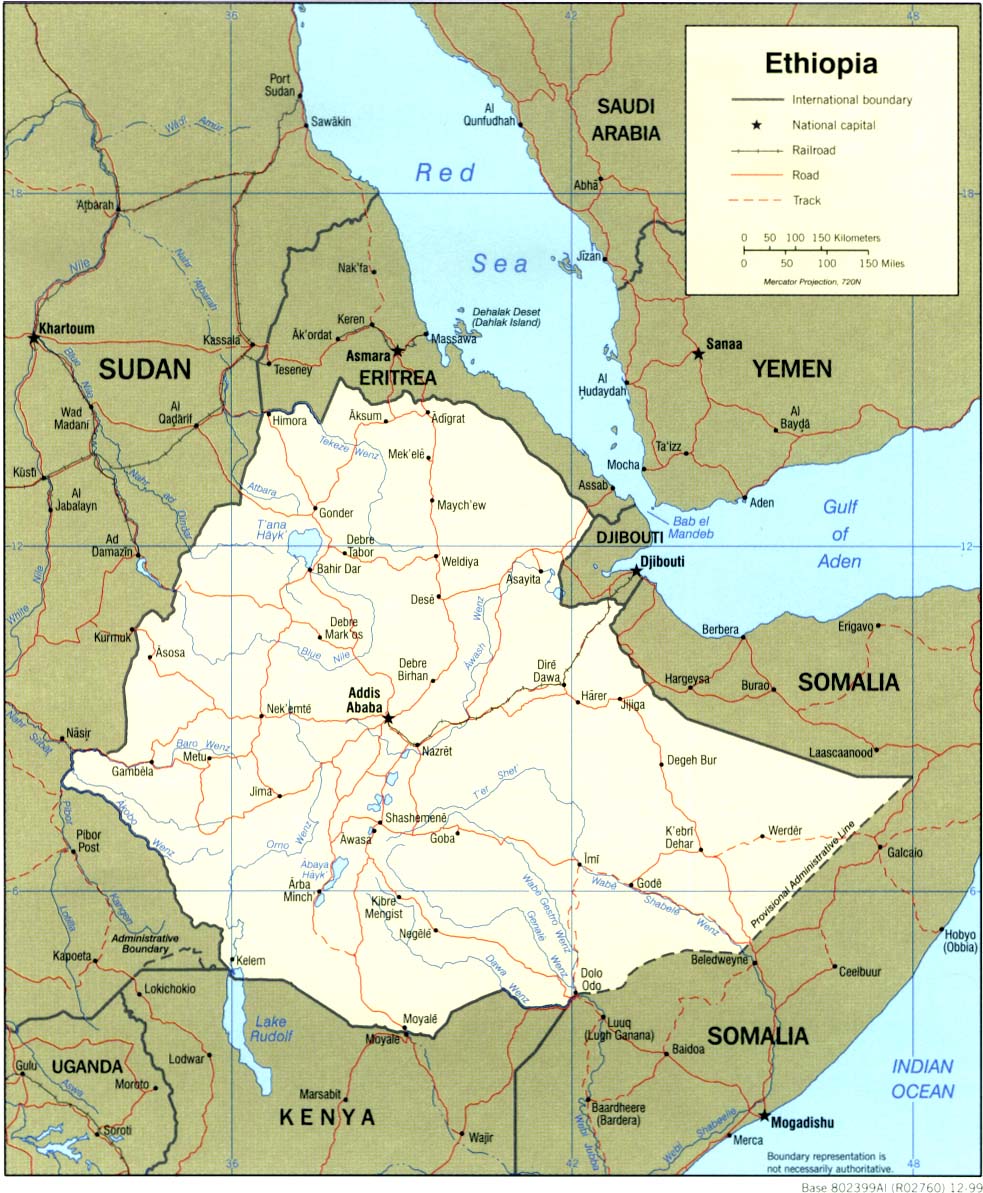
In September 1976 the Ethiopian People’s Revolutionary Party (EPRP), drawing support from the labour unions, teachers and students, all vehemently opposed to military rule, embarked on a campaign of urban terrorism against the Derg and its civilian ally, the All-Ethiopian Socialist Movement, usually known by its Amharic acronym, Meison. An assassination attempt was made on Mengistu in the centre of Addis Ababa in September, the first of nine such attempts. Scores of officials and supporters of the Derg were murdered. The Derg in turn sent out its own murder squads…. By mid-1977 the EPRP was effectively destroyed. In the final phase of the red terror, to establish his own supremacy, Mengistu turned on his Meison allies, destroying them too. The young generation of intellectual activists, who had so avidly supported the revolution were all but wiped out.

Mengistu’s hold over other parts of Ethiopia was nevertheless precarious. By mid-1977 the Ethiopian army in Eritrea had lost most major towns and controlled little more than Asmara and the ports of Massawa and Assab. In July 1977 Somalia, deciding the time was ripe to take advantage of the Derg’s preoccupation with Eritrea and other revolts, launched a full-scale invasion of the Ogaden. By August the Somalis controlled most of the Ogaden. In September they captured Jijiga, an Ethiopian tank base, and pressed on towards the town of Harar and the rail and industrial centre of Dire Dawa, the third largest city in Ethiopia.

What rescued Mengistu from military defeat was massive intervention by Soviet and Cuban forces, determined to prop up his Marxist regime. In November 1977 the Soviets mounted a huge airlift and sealift, ferrying tanks, fighter aircraft, artillery, armoured personnel carriers and hundreds of military advisers to Ethiopia. A Cuban combat force numbering 17,000 joined them. Led by Cuban armour, the Ethiopians launched their counter-offensive in the Ogaden in February 1978, inflicting a crushing defeat on the Somalis. The full force of the Ethiopian army, supported by the Soviet Union, was then turned on Eritrea.

At the fourth anniversary celebrations marking the overthrow of Haile Selassie in 1978, Mengistu sat alone in a gilded armchair covered with red velvet on a platform in Revolution Square in Addis Ababa watching a procession of army units and civilian groups pass before him. Then he returned to his headquarters at the Grand Palace. Having succeeded in holding the old empire together, he liked to portray himself as following a tradition of strong Ethiopian rulers. Indeed, Mengistu came to be compared with the Emperor Tewodros, a nineteenth-century ruler who started his career as a minor local chieftain, fought his way up to take the Crown and then strove to reunite the empire after a period of disintegration. At official functions at the Grand Palace, while members of the Derg stood respectfully to one side, Mengistu chose to preside from the same ornate chair that Haile Selassie had once favoured.

One of his ministers, Dawit Wolde Giorgis, once a fervent supporter of the revolution, recalled his growing sense of disillusionment.

At the beginning of the Revolution all of us had utterly rejected anything having to do with the past. We would no longer drive cars, or wear suits; neckties were considered criminal. Anything that made you look well-off or bourgeois, anything that smacked of affluence or sophistication, was scorned as part of the old order. Then, around 1978, all that began to change. Gradually materialism became accepted, then required. Designer clothes from the best European tailors were the uniform of all senior government officials and members of the Military Council. We had the best of everything: the best homes, the best cars, the best whisky, champagne, food. It was a compete reversal of the ideals of the Revolution.

He recalled, too, how Mengistu changed once he had gained complete control.

He grew more abrasive and arrogant. The real Mengistu emerged: vengeful, cruel and authoritarian. His conduct was not limited by any moral considerations. He began to openly mock God and religion. There was a frightening aura about him. Many of us who used to talk to him with our hands in our pockets, as if he were one of us, found ourselves standing stiffly at attention, cautiously respectful in his presence. In addressing him we had always used the familiar form of ‘you’, ante; now we found ourselves switching to the more formal ‘you’, ersiwo. He moved into a bigger, more lavish office in the Palace of Menelik. He got new, highly trained bodyguards – men who watched you nervously, ready to shoot at any time. We now were frisked whenever we entered his office. He began to use the Emperor’s cars and had new ones imported from abroad – bigger, fancier cars with special security provisions. Wherever he went he was escorted by these cars packed with guards, with more riding alongside on motorcycles.

He concluded: ‘We were supposed to have a revolution of equality; now he had become the new Emperor.’

You get the same result every single time a revolutionary thug promises equality—and begins to deliver it with the help of other revolutionary thugs. Every French Revolution yields a new Robespierre—and then a new Napoleon.

1 Comment

Filed under Cuba, Eritrea, Ethiopia, labor, language, military, USSR, war

Kenya, 1950s: The Mau Mau Civil War?

From The Fate of Africa: A History of Fifty Years of Independence, by Martin Meredith (PublicAffairs, 2005), pp. 84-86:

In postwar years the African population of Nairobi doubled in size. More than half of the inhabitants were Kikuyu, their ranks swelled by a growing tide of desperate, impoverished vagrants. Adding to their numbers were groups of ex-servicemen returning from the war with high expectations of a new life but finding little other than poverty and pass laws. Unemployment, poor housing, low wages, inflation and homelessness produced a groundswell of discontent and worsening crime. Mixing politics and crime, the ‘Forty Group’ – Anake wa 40 – consisting largely of former soldiers of the 1940 age group who had seen service during the war in India, Burma and Ethiopia and other militants were ready to employ strong-arm tactics in opposing the government’s policies and in dealing with its supporters. The trade unions, gathering strength in Nairobi, carried the agitation further, conducting a virulent campaign against the granting of a royal charter to Nairobi. In the African press, too, the tone was becoming increasingly strident. By 1948, the oathing campaign, started by squatters in the Rift Valley and taken up in the Kikuyu reserves and in Nairobi, was in full swing. At fervent gatherings, Kikuyu songs, adapted from church hymns, were sung in praise of Kenyatta and prayers recited to glorify him. In all, several hundred thousand Kikuyu took the oath.

The rising temper of the Kikuyu made little impression on the British governor, Sir Philip Mitchell, a solitary, unapproachable figure from the old colonial school, contemptuous of African nationalists, more preoccupied with the recalcitrant white community than with signs of African discontent, and singularly ill-equipped to deal with the crisis unfolding before him.

Kenyatta, too, found difficulty in controlling the surge of militancy. He favoured constitutional means to oppose colonial rule but was outflanked by militant activists prepared to use violence. In 1951 a hardened group, including two prominent trade unionists, Fred Kubai and Bildad Kaggia, captured control of the Nairobi branch of the KAU [Kenya African Union], proceeded to gain a virtual stranglehold over the national executive and then formed their own secret central committee with plans for an armed uprising. Kaggia, a former staff sergeant in the army, had seen wartime service in Africa, the Middle East and England. Outbreaks of violence – murder, sabotage, arson and forced oathing – became more frequent.

The move towards violence split the Kikuyu people. Both the old Kikuyu establishment – chiefs, headmen and landowners – and the aspiring middle class – businessmen, traders, civil servants and government teachers – opposed violence. So did large numbers of Christian Kikuyu. But by 1952, much of the Kikuyu tribe was caught up in rebellion.

Kenyatta tried to ride out the turbulence, seeking to defuse the crisis rather than to stir it up. Leading activists in Nairobi, while using his name to justify their actions, regarded him with profound suspicion. When the government asked him to denounce Mau Mau publicly, he duly obliged, using a traditional Kikuyu curse. ‘Let Mau Mau perish for ever,’ he told a huge crowd in Kiambu in August 1952, ‘All people should search for Mau Mau and kill it.’ His speech infuriated the central committee. Summoned to a meeting of the central committee at KAU headquarters in Nairobi, he was clearly surprised to discover who its members were. ‘We said, “We are Mau Mau and what you have said at this Kiambu meeting must not be said again”,’ recalled Fred Kubai. ‘If Kenyatta had continued to denounce Mau Mau, we would have denounced him. He would have lost his life. It was too dangerous and he knew it. He was a bit shaken by the way we looked at him. He was not happy. We weren’t the old men he was used to dealing with. We were young and we were serious.’

As the violence grew worse, with daily incidents.of murder, forced oathing and intimidation, a new governor, Sir Evelyn Baring, on the advice of his officials, concluded that the best way to deal with it was to lock up all KAU leaders. In October 1952, shortly after his arrival, Baring declared a state of emergency and ordered the detention of Kenyatta and 150 other political figures, a move taken by Mau Mau activists as tantamount to a declaration of war. In growing panic, white farmers in the Rift Valley expelled some 100,000 squatters, providing Mau Mau with a massive influx of recruits. Many headed straight for the forests of the Aberdares and Mount Kenya to join armed gangs recently established there. Far from snuffing out the rebellion, Baring’s action intensified it. It was only after the emergency was declared that the first white settler was murdered.

The brunt of the war, however, fell not on the whites but on loyalist Kikuyu. They became the target of Mau Mau leaders determined to enforce complete unity among the Kikuyu people before turning on the whites. Nearly 2,000 loyalists died. The official death toll of rebels and their supporters was listed as 11,500, though modern researchers put the real figure far higher. Some 80,000 Kikuyu were detained in camps, often subjected to harsh and brutal treatment. As the tide against Mau Mau turned, gang leaders in the forests tried to keep control by employing ever more perverted oaths, horrifying to the Kikuyu and to whites alike. By comparison, the white community escaped lightly. Though white farmers in isolated farmsteads often lived in fear of attack, after four years only thirty-two white civilians had been killed, less than the number who died in traffic accidents in Nairobi during the same period.

1 Comment

Filed under Britain, democracy, Kenya, nationalism, war

How Modernism Feeds Tribalism

From The Fate of Africa: A History of Fifty Years of Independence, by Martin Meredith (PublicAffairs, 2005), pp. 154-157:

African societies of the pre-colonial era – a mosaic of lineage groups, clans, villages, chiefdoms, kingdoms and empires – were formed often with shifting and indeterminate frontiers and loose allegiances. Identities and languages shaded into one another. At the outset of colonial rule, administrators and ethnographers endeavoured to classify the peoples of Africa, sorting them out into what they called tribes, producing a whole new ethnic map to show the frontiers of each one. Colonial administrators wanted recognisable units they could control. ‘Each tribe must be considered as a distinct unit,’ a provincial commissioner in Tanganyika told his staff in 1926. ‘Each tribe must be under a chief.’ In many cases, tribal labels were imposed on hitherto undifferentiated groups. The chief of a little-known group in Zambia once ventured to remark: ‘My people were not Soli until 1937 when the Bwana D.C. [District Commissioner] told us we were.’ When local government was established under colonial rule, it was frequently aligned with existing ‘tribal areas’. Entirely new ethnic groups emerged, like the Abaluyia or Kalenjin of western Kenya, formed from two congeries of adjacent peoples. Some colonial rulers used tribal identities to divide their subjects, notably the British in southern Sudan and the French in Morocco. Chiefs, appointed by colonial authorities as their agents, became the symbol of ethnicity.

Missionary endeavour added to the trend. In the process of transcribing hitherto unwritten languages into written forms, missionaries reduced Africa’s innumerable dialects to fewer written languages, each helping to define a tribe. The effect was to establish new frontiers of linguistic groups and to strengthen the sense of solidarity within them. Yoruba, Igbo, Ewe, Shona and many others were formed in this way.

Missionaries were also active in documenting local customs and traditions and in compiling ‘tribal’ histories, all of which were incorporated into the curricula of their mission schools, spreading the notion of ethnic identity. African teachers followed suit. In southern Nigeria, young men from Ilesha and Ijebu who attended school in Ibadan or Oyo were taught to write a standard form of the Yoruba language and to identify themselves as Yoruba – a term previously reserved for subjects of the Oyo empire. As mission stations were largely responsible for providing education, educational achievement tended to depend on their locality and thus to follow ethnic lines.

Migration from rural areas to towns reinforced the process. Migrants gravitated to districts where fellow tribesmen lived, hoping through tribal connections to find housing, employment or a niche in trading markets. A host of welfare associations sprang up – ‘home-boy’ groups, burial and lending societies, cultural associations, all tending to enhance tribal identity. Certain occupations – railwaymen, soldiers, petty traders – became identified with specific groups which tried to monopolise them.

It was in towns that ethnic consciousness and tribal rivalry grew apace. The notion of a single Igbo people was formed in Lagos among the local ‘Descendants’ Union’. The Yoruba, for their part, founded the Egbe Omo Oduduwa – a ‘Society of Descendants of Oduduwa’, the mythical ancestor of the Yoruba people; its aim was ‘to unite the various clans and tribes in Yorubaland and generally create and actively foster the idea of a single nationalism throughout Yorubaland’. Ethnic groups became the basis of protest movements against colonial rule.

In the first elections in the postwar era in Africa, nationalist politicians started out proclaiming nationalist objectives, selecting party candidates regardless of ethnic origin. But as the number of elections grew, as the number of voters expanded, as the stakes grew higher with the approach of independence, the basis for campaigning changed. Ambitious politicians found they could win votes by appealing for ethnic support and by promising to improve government services and to organise development projects in their home area. The political arena became a contest for scarce resources. In a continent where class formation had hardly begun to alter loyalties, ethnicity provided the strongest political base. Politicians and voters alike came to rely on ethnic solidarity. For politicians it was the route to power. They became, in effect, ethnic entrepreneurs. For voters it was their main hope of getting a slice of government bounty. What they wanted was a local representative at the centre of power – an ethnic patron who could capture a share of the spoils and bring it back to their community. Primary loyalty remained rooted in tribal identity. Kinship, clan and ethnic considerations largely determined the way people voted. The main component of African politics became, in essence, kinship corporations.

The formation of one ethnic political party tended to cause the formation of others. In Nigeria the National Council of Nigeria and the Cameroons, the first modern political organisation in West Africa launched in 1944, started out with the aim of establishing a broad-based national movement, but after tribal dissension it became an Eastern regional party, dominated by Igbo politicians. Yoruba politicians left to form the Action Group, building it around the nucleus of Egbe Omo Oduduwa. In Northern Nigeria, the Hausa-Fulani, while disdaining the nationalist cause which Southerners espoused, nevertheless formed in 1949 the Northern People’s Congress as a political offshoot of a predominantly Hausa cultural organisation, Jam’yyar Mutanen Arewa – Association of the Peoples of the North. In a more extreme example, in the Belgian Congo rival tribal parties were launched by the score. In most countries, political leaders spent much time on ‘ethnic arithmetic’, working out alliances that would win them power and keep them there.

Few states escaped such divisions. In Tanganyika, Julius Nyerere was helped, as he himself acknowledged, by the fact that the population was divided among 120 tribal groupings, none of which was large enough or central enough to acquire a dominant position. He benefited too from the common use of the Swahili language, spread initially by Arab traders, then taken up by the Germans and the British as part of their education system. Other states had to contend with a variety of languages, sometimes numbering more than a hundred. In all, more than 2,000 languages were in use in Africa.

There was a widespread view at the time of independence that once the new states focused on nation-building and economic development, ethnic loyalties would wither away under the pressure of modernisation. ‘I am confident’, declared Nigeria’s first prime minister, Abubakar Tafawa Balewa, during a 1959 debate over the motion to ask for independence, ‘that when we have our own citizenship, our own national flag, our own national anthem, we shall find the flame of national unity will burn bright and strong.’ Ahmed Sékou Touré of Guinea spoke in similar terms in 1959. ‘In three or four years, no one will remember the tribal, ethnic or religious rivalries which, in the recent past, caused so much damage to our country and its population.’ Yet African governments were dealing not with an anachronism from the past, but a new contemporary phenomenon capable of erupting with destructive force.

It doesn’t seem all that different in kind, only in degree, from what happened in Europe with the spread of vernacular literacy, Protestantism, historical and comparative linguistics, and the scientific subclassification of everything and everyone on earth—and what continues apace in modern universities, prisons, and other political/protective patronage networks that privilege race/ethnicity over social class, religion, or other more mutable cross-cutting categories.

Leave a comment

Filed under Africa, democracy, education, Europe, language, nationalism

A Bad Omen: Nkrumah vs. Cocoa Farmers, 1954-57

From The Fate of Africa: A History of Fifty Years of Independence, by Martin Meredith (PublicAffairs, 2005), pp. 24-27:

After winning the 1954 election, Nkrumah seemed set to make rapid progress towards independence. But he encountered unexpected resistance centred on his conduct of government. In the final stages of colonial rule, the Gold Coast, once a model colony, was riven by such bitterness, division and violence that it appeared in danger of breaking up.

At the core of the crisis was cocoa money. To protect cocoa farmers from price fluctuations, the colonial authorities had established a Cocoa Marketing Board (CMB) which each year fixed a guaranteed price for farmers and acted as the sole buyer, grader, seller and exporter of cocoa. Once in office, Nkrumah instructed the CMB to keep the price as low as possible, aiming to raise funds for development projects. But the CMB soon became notorious for corruption and mismanagement; it was regularly exploited to distribute credit, contracts, commissions, licences and jobs to CPP [Convention People’s Party] supporters. An official investigation revealed that the CPP used a CMB subsidiary to enrich the party’s coffers, to coerce farmers into joining the party and to control petty commerce.

Soon after the 1954 election, Nkrumah announced that the price paid to farmers would be fixed for a period of four years at a level less than one-third of ruling world prices. This decision provoked a surge of anger across Asante, the central forest region where half of the country’s cocoa crop was grown. Not only farmers but cocoa traders, merchants and businessmen based in the Asante capital, Kumasi, resented the loss of income. A new opposition party, the National Liberation Movement (NLM), sprang up, proclaiming to defend Asante interests and culture against a central government it portrayed as corrupt, dictatorial and bent on undermining the beliefs and customs of the Asante people. With the blessing of the Asante paramount chiefs and backed by fervent support in the Asante heartland, the NLM demanded a federal constitution prior to independence, giving Asante and other areas that wanted it a substantial measure of local autonomy.

Nkrumah saw the issue as a struggle between a modern democratic government and the feudal power of traditional chiefs trying to protect the old order. But he misjudged the extent of popular support for Asante institutions. As the NLM and Nkrumah’s CPP struggled for ascendancy, violent disturbances broke out. A bomb attack was made on Nkrumah’s house in Accra. Alarmed by the disorders, the British government refused to set a date for independence and eventually insisted on resolving the issue by calling another general election. At the polls in July 1956, Nkrumah’s CPP won an outright majority, 72 of 104 seats, though only 57 per cent of the votes cast. While the CPP received 398,000 votes, the opposition tally was 299,000 votes. Satisfied with the result, Britain finally pronounced a date for independence: 6 March 1957….

No other African state was launched with so much promise for the future. Ghana embarked on independence as one of the richest tropical countries in the world, with an efficient civil service, an impartial judiciary and a prosperous middle class. Its parliament was well established, with able politicians in both government and opposition. The prime minister, himself, then only forty-seven years old, was regarded as a leader of outstanding ability, popularly elected, with six years of experience of running a government. The country’s economic prospects were equally propitious. Not only was Ghana the world’s leading producer of cocoa, with huge foreign currency reserves built up during the 1950s cocoa boom, but it possessed gold, timber and bauxite.

Leave a comment

Filed under Britain, democracy, economics, Ghana

Fates of Resistance to the Partition of Africa

From The Fate of Africa: A History of Fifty Years of Independence, by Martin Meredith (PublicAffairs, 2005), pp. 3-4:

Scores of African rulers who resisted colonial rule died in battle or were executed or sent into exile after defeat. Samori of the Mandingo was captured and died in exile two years later; the Asantehene, King Agyeman Prempeh, was deposed and exiled for nearly thirty years; Lobengula of the Ndebele died in flight; Behazin of Dahomey and Cetshwayo of the Zulu were banished from their homelands.

In the concluding act of the partition of Africa, Britain, at the height of its imperial power, set out to take over two independent Boer republics, the Transvaal and the Orange Free State, and incorporate them into the British Empire, assuming that a war of conquest would take at most a matter of months. It turned into a gruelling campaign lasting three years, required nearly half a million imperial troops to finish it, and left a legacy of bitterness and hatred among Afrikaners that endured for generations. Faced with guerrilla warfare for which they were unprepared, British military commanders resorted to scorched-earth tactics, destroying thousands of farmsteads, razing villages to the ground and slaughtering livestock on a massive scale, reducing the Boers to an impoverished people. Women and children were rounded up and placed in what the British called concentration camps, where conditions were so appalling that some 26,000 died there from disease and malnutrition, most of them under the age of sixteen. All this became part of a Boer heritage passed in anger from one generation to the next, spawning a virulent Afrikaner nationalism that eventually took hold of South Africa.

Small-scale revolts against colonial rule continued for many years. The Baoulé of Côte d’Ivoire fought the French village by village until 1911; the Igbo of Nigeria were not fully defeated until 1919; the Jola of Senegal not until the 1920s; the Dinka of southern Sudan not until 1927. In the desert wastelands of Somaliland a fiery Muslim sheikh, Muhammad ’Abdille Hassan, dubbed by his adversaries the ‘Mad Mullah’, led Dervish warriors in a holy war against the British for twenty years until his death in 1920. Bedouin resistance against Italian rule in Libya ended only in 1931 after nine years of guerrilla warfare. By the 1930s, however, the colonial states of Africa were firmly entrenched; they had, moreover, acquired a legitimacy in the eyes of their inhabitants.

Leave a comment

Filed under Africa, Britain, France, Italy, nationalism, Netherlands, war

European Horsetrading for Backwaters

From The Fate of Africa: A History of Fifty Years of Independence, by Martin Meredith (PublicAffairs, 2005), pp. 1-2 (reviewed here, here, and here):

During the Scramble for Africa at the end of the nineteenth century, European powers staked claims to virtually the entire continent. At meetings in Berlin, Paris, London and other capitals, European statesmen and diplomats bargained over the separate spheres of interest they intended to establish there. Their knowledge of the African hinterland was slight….

As the haggling in Europe over African territories continued, land and peoples became little more than pieces on a chessboard…. Britain traded the North Sea island of Heligoland with the Germans for Zanzibar, and parts of northern Nigeria with the French for fishing rights off Newfoundland. France exchanged parts of Cameroon with Germany in return for German recognition of the French protectorate over Morocco. By the time the Scramble for Africa was over, some 10,000 African polities had been amalgamated into forty European colonies and protectorates.

Thus were born the modern states of Africa.

Leave a comment

Filed under Africa, Belgium, Britain, France, Germany, Italy, Portugal