Category Archives: Africa

A Linguistic Rediscovery Close to Home

During my dissertation fieldwork in Papua New Guinea over thirty years ago, I discovered that a bunch of Austronesian languages in Morobe Province mark their relative clauses in a manner that is pretty rare from a typological point of view: they mark both the beginning and the end of the clauses. An English equivalent would go something like, “The language [that they were speaking that] sounded vaguely familiar,” or “The language [which they were speaking such] sounded vaguely familiar.”

The only other place where I could find languages that did the same was in Central Africa, and my dissertation cited a 1976 article by the great French linguist Claude Hagège which mentioned by name two Nilo-Saharan languages, Moru and Mangbetu, and two Niger-Congo languages, Mbum and M’baka. Over the years, I lost track of anything pertaining to those languages except their names.

But I got curious again recently as I worked on updating for publication an old paper on clause-bracketing in PNG Austronesian languages. So, yesterday, after googling those names and finding out that Mbum and M’baka (= Ngbaka) are spoken in the Central African Republic, I emailed my historian brother in Strasbourg, whom I recently visited, to ask whether he knew of any CAR languages that bracketed their relative clauses. He had spent years working in the (at that time) Central African Empire for the US Peace Corps and USAID while I was writing my dissertation in linguistics, and he later wrote a dissertation himself on Japan-Africa relations before World War II.

My query didn’t ring any bells with him at first, but after some reflection he came up with some examples in Sango, CAR’s national lingua franca. And then he emailed to ask his linguist friend Raymond Boyd at CNRS whether he could think of Adamawa-Ubangi languages that used such markers for relative clauses. Boyd replied:

Right off, I can’t think of one that DOESN’T. In languages like Sango and Chamba, opener and closer can be the same. In Zande, the opener is etymologically an indefinite and the closer is a locative. I’ve been reading a dissertation on Mambay (an Adamawa language closely related to Mbum and Mundang) where there is only an opener, but I take this to be perhaps a Chadic influence (I’d have to check this on a much larger range of data).

It was a Eureka moment for both of us.

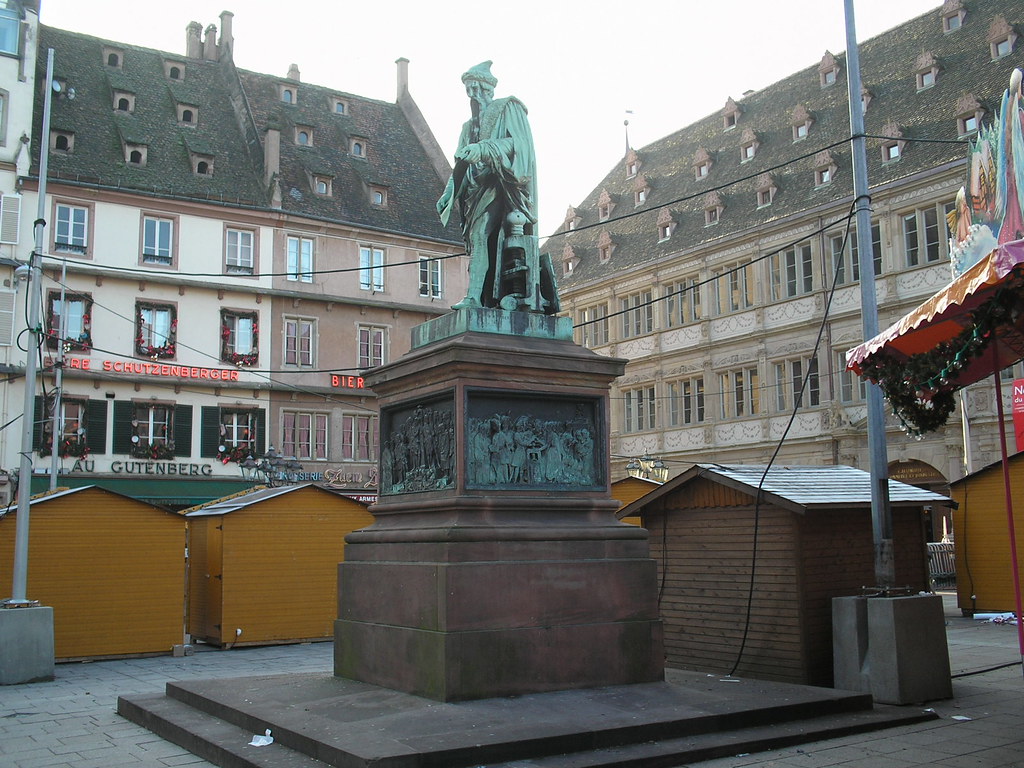
I can’t believe I never thought to ask my own brother before! Back in January, when he took us to the used book vendors in place Gutenberg in Strasbourg, I discovered a book I couldn’t resist buying—despite the 30€ price—for no other reason than that I had mentioned the language it described in my dissertation. It was La Langue des Makere, des Medje et des Mangbetu, par A. Vekens, Dominicain (Editions Dominicaines Veritas, 1928), and the pages were still uncut. But even then, it didn’t cross my mind to quiz my brother about the CAR languages he had worked on.

Here are some examples of bracketed relative clauses.

Mangbetu (Vekens 1928) in Congo

A belu [si kesia né môlô ta kira ne] kambuba e faranga môkôtu.
Les hommes [ceux font le travail avec intelligence ceux-là] gagneront des francs beaucoup.
‘Those who work smart get plenty money.’

Sango (my brother, pers. comm.) in CAR

Tene [so mo tene so] ake nzoni ape.
word [thus you say thus] is good not
‘What you say is no good.’

Jabêm (Dempwolff 1939) in PNG

Lip [tec aê gawa nec] gêjac mocseŋ teŋ.
trap [Dem I I-set Dem] it-catch bushfowl one
‘The trap I set caught a bushfowl.’

South Watut (Holzknecht 1989) in PNG

Jek i-ra jiyaʔ ri naip a [ti ra-gin afu ŋga]
Jack he-cut tree with knife [Dem I-give to Dem]
‘Jack cut the tree with the knife which I gave him.’

Patep (Lauck 1980) in PNG

Ông ob tyoo yii yuu nuhu [wê ob lam ge]
you will dodge spear two arrow [Rel will come Rel]
‘You will dodge the spears and arrows that will come.’

Leave a comment

Filed under Africa, Central African Republic, language, Papua New Guinea

Wordcatcher Tales: gatvol, makwerekwere, utari

I’m still bogged down with obscure linguistic research projects that are not yet bloggable, and already half-blogged books on depressing 20th-century European history that I haven’t finished reading. But I see that two other bloggers, Khanya and No-sword, have explored the social context of some interesting vocabulary from two far-outlying parts of the globe, the northernmost island of Japan and the southernmost country in Africa. So, without further ado, here are snippets of Wordcatcher Tales by proxy.

Steve at Khanya appends the following glossary to a post on Xenophobia – the gatvol factor in South Africa:

1. Gatvol – which being interpreted for the benefit of makwerekwere [2], is Afrikaans, meaning literally “hole full”, or more idiomatically, “Fed up”, or “had enough”, or “had it up to here”.

2. Makwerekwere – which, being interpreted for the benefit of foreigners, means foreigners.

Another South African blogger who in his home country was mistaken for a Nigerian explains the second term more specifically at The Zeleza Post:

Makwerekwere is the derogatory term used by Black South Africans to describe non-South African blacks. It reminds one of how the ancient Greeks referred to foreigners whose language they did not understand as the Barbaroi. To the Black South African, makwerekwere refers to Black immigrants from the rest of Africa, especially Nigerians. I was confounded by the fact that Black South Africa had begun to manufacture its own kaffirs so soon after apartheid.

Meanwhile, Matt at No-sword investigates why the Hokkaido Ainu Association, founded in 1930, changed its name to the Hokkaido Utari Association in 1961, and has now announced it will revert once again to its original name.

Ainu is obviously the name used to refer to the Ainu as a people distinct from other peoples; this is directly from the Ainu word aynu which means, predictably, “man” or “person” (as opposed to “supernatural being”).

Utari is a more interesting word. As a loan word in Japanese, it is usually glossed as “compatriot” (“同胞”, dōhō), which usually implies “fellow Ainu”. Its etymology in Ainu is more interesting.

Leave a comment

Filed under Africa, Japan, language, nationalism

Narratives of the Rise vs. Narratives of the Fall

From: Break Through: From the Death of Environmentalism to the Politics of Possibility, by Ted Nordhaus & Michael Shellenberger (Houghton Mifflin, 2007), pp. 150-151:

There is a very different story [than that in Jared Diamond’s Collapse] that can be told about human history, one that embraces our agency, and that is the story of constant human overcoming. Whereas the tragic story imagines that humans have fallen, the narrative of overcoming imagines that we have risen.

Consider how much our ancestors – human and nonhuman – overcame for us to become what we are today. For beginners, they were prey. Given how quickly and efficiently humans are driving the extinction of nonhuman animal species, the notion that our ancestors were food seems preposterous. And yet, understanding that we evolved from being prey goes a long way toward understanding some of the feelings and motivations that drive us into suicidal wars and equally suicidal ecological collapses.

Against the happy accounts of harmonious premodern human societies at one with Nature, there is the reality that life was exceedingly short and difficult. Of course, life could also be wonderful and joyous. But it was hunger not obesity, oppression not depression, and violence not loneliness that were primary concerns.

Just as the past offers plenty of stories of humankind’s failure, it also offers plenty of stories of human overcoming. Indeed, we can only speak of past collapses because we have survived them. There are billions more people on earth than there were when the tiny societies of the Anasazi in the American Southwest and the Norse in Greenland collapsed in the twelfth and fifteenth centuries, respectively. That there are nearly seven billion of us alive today is a sign of our success, not failure.

Perhaps the most powerful indictment of environmentalism is that environmentalists so often consider our long life spans and large numbers terrible tragedies rather than extraordinary achievements. The narrative of overpopulation voiced almost entirely by some of the richest humans ever to roam the earth is utterly lacking in gratitude for the astonishing labors of our ancestors.

Of course, none of this is to say that human civilizations won’t collapse again in the future. They almost certainly will. Indeed, some already are collapsing. But to focus on these collapses is to miss the larger picture of rising prosperity and longer life spans. Not only have we survived, we’ve thrived. Today more and more of us are “free at last” – free to say what we want to say, love whom we want to love, and live within a far larger universe of possibilities than any other generation of humans on earth.

At the very moment that we humans are close to overcoming hunger and ancient diseases like polio and malaria, we face ecological crises of our own making, ones that could trigger drought, hunger, and the resurgence of ancient diseases.

The narrative of overcoming helps us to imagine and thus create a brighter future. Human societies will continue to stumble. Many will fall. But we have overcome starvation, disease, deprivation, oppression, and war. We can overcome ecological crises.

Leave a comment

Filed under Africa, Asia, Australia, Canada, Europe, Latin America, U.S.

Spreading Chinese Reforms in Africa

The cover story of the March issue of Prospect magazine is China’s new intelligentsia by Mark Leonard. Although interesting in its own right, the part that most grabbed my attention was China’s attempts to export its economic reforms, especially to Africa.

In February 2007, Hu Jintao proudly announced the creation of a new special economic zone complete with the usual combination of export subsidies, tax breaks and investments in roads, railways and shipping. However, this special economic zone was in the heart of Africa—in the copper-mining belt of Zambia. China is transplanting its growth model into the African continent by building a series of industrial hubs linked by rail, road and shipping lanes to the rest of the world. Zambia will be home to China’s “metals hub,” providing the People’s Republic with copper, cobalt, diamonds, tin and uranium. The second zone will be in Mauritius, providing China with a “trading hub” that will give 40 Chinese businesses preferential access to the 20-member state common market of east and southern Africa stretching from Libya to Zimbabwe, as well as access to the Indian ocean and south Asian markets. The third zone—a “shipping hub”—will probably be in the Tanzanian capital, Dar es Salaam. Nigeria, Liberia and the Cape Verde islands are competing for two other slots. In the same way that eastern Europe was changed by a competition to join the EU, we could see Africa transformed by the competition to attract Chinese investment.

As it creates these zones, Beijing is embarking on a building spree, criss-crossing the African continent with new roads and railways—investing far more than the old colonial powers ever did. Moreover, China’s presence is changing the rules of economic development. The IMF and the World Bank used to drive the fear of God into government officials and elected leaders, but today they struggle to be listened to even by the poorest countries of Africa. The IMF spent years negotiating a transparency agreement with the Angolan government only to be told hours before the deal was due to be signed, in March 2004, that the authorities in Luanda were no longer interested in the money: they had secured a $2bn soft loan from China. This tale has been repeated across the continent—from Chad to Nigeria, Sudan to Algeria, Ethiopia and Uganda to Zimbabwe.

But the spread of the Chinese model goes far beyond the regions that have been targeted by Chinese investors. Research teams from middle-income and poor countries from Iran to Egypt, Angola to Zambia, Kazakhstan to Russia, India to Vietnam and Brazil to Venezuela have been crawling around the Chinese cities and countryside in search of lessons from Beijing’s experience. Intellectuals such as Zhang Weiying and Hu Angang have been asked to provide training for them. Scores of countries are copying Beijing’s state-driven development using public money and foreign investment to build capital-intensive industries. A rash of copycat special economic zones have been set up all over the world—the World Bank estimates that over 3,000 projects are taking place in 120 countries. Globalisation was supposed to mean the worldwide triumph of the market economy, but China is showing that state capitalism is one of its biggest beneficiaries.

States are among the worst robber barons on earth, but if state capitalism can build wealth that improves the lives of state citizens, I’m all for it.

via Arts & Letters Daily

Leave a comment

Filed under Africa, China, economics

The Muddled Liberation of French Algeria, 1942

From The Unfree French: Life Under the Occupation, by Richard Vinen (Yale U. Press, 2006), pp. 318-319:

The significance of American landings in North Africa, and particularly in Algeria, was complicated. Parts of the French Empire had rallied to de Gaulle or been conquered by Free French forces ever since 1940. However, these were mostly distant places with small French populations. Algeria was close to the mainland. It contained more than a million French citizens, including a large number of soldiers. Furthermore, Algeria was not a colony, unlike Indochina, nor a League of Nations mandate, unlike Syria where Free French and Vichy forces had fought in 1941, nor a protectorate, unlike Morocco. Algeria was part of France. It returned deputies to the French parliament, and its European population had resented Vichy moves that seemed to blur the distinction between it and the colonies or protectorates.

Operation Torch was, however, a funny kind of liberation. Landings in North Africa did not involve even the token Free French force that went to Normandy with the Allies in 1944. Furthermore, there were no Germans in French North Africa in 1942 and resistance to the American landings came from French forces loyal to the Vichy government. France was being liberated from the French.

Giraud, the Americans’ candidate for the leadership of the French in ‘liberated’ Algeria, missed his rendezvous with an American submarine that was meant to pick him up from southern France, and was still on Gibraltar when the Americans landed in North Africa. If Giraud was unexpectedly absent, another conservative French military leader was unexpectedly present. Admiral Darlan was in Algiers visiting his son, who was seriously ill with polio. Darlan had no advance knowledge of the landings. Even as American warships approached North Africa, he insisted that the Americans would not break their promise not to enter French North Africa uninvited. When American troops landed, Darlan ordered the French to resist—1,368 Frenchmen and 453 Allied soldiers died in the few days before Darlan changed his mind. Eventually, however, a ceasefire was arranged and the Americans suggested that Darlan himself might lead the French in Algeria. This was an attractive suggestion to an ambitious man who had recently been squeezed out of power in Vichy by Laval’s return, and Darlan signed an accord with Clark, the commander of American forces in North Africa. The British were unhappy with Darlan’s rule in Algeria as were American liberals: the journalist Ed Murrow suggested that letting Darlan rule Algeria was like letting Quisling rule a ‘liberated’ Norway.

Pétain was furious at the Clark-Darlan accords and denounced them six times in the week after they were concluded. Darlan did not denounce Pétain. On the contrary, he argued that he was acting in the Marshal’s name and carrying out the policy that the Marshal was unable to announce openly. Darlan’s suggestion that Pétain was not a free agent was made more convincing by the fact that the Germans invaded the free zone of France in response to the American invasion of Algeria.

Darlan’s reign in Algeria ended on Christmas Eve 1942 when he was shot by a young royalist. The assassin was himself executed on Boxing Day, giving conspiracy theorists much food for thought. Now the Americans installed their original candidate, Giraud, in power in Algeria. Unlike Darlan, Giraud had never held office under the Vichy government and, unlike Darlan, he had always been anti-German. However, he had also expressed loyalty to Pétain and shared many of Pétain’s beliefs. Giraud presented himself as a military figure who did not wish to play politics, a classic conservative stance that meant, in practice, that he would not overthrow much of what Vichy had established in Algeria. He had particularly strong views about one piece of Vichy legislation. He had spent his early life serving with North African units of the French army and had developed a deep admiration for Islam. This made him keen not to restore the Cremieux decree, which had given French citizenship to Jews in Algeria and which had been abolished by Vichy. Giraud believed that the Cremieux decree antagonized Muslims in Algeria, and, in fact, Jews in Algeria did not regain French citizenship until May 1943, six months after the Americans arrived.

Leave a comment

Filed under Africa, France, U.S., war

Uganda’s Abayudaya

Nathanael of Europe Endless recently posted a few fascinating excerpts from a long interview on Afropop about the Jews of Uganda. Here are a few excerpts of his excerpts.

Now, in contrast to [other Jewish] communities [in Africa], the Abayudaya, which means “Jewish people of Uganda,” proudly reference their conversion to Judaism in the 1920s, stating that they were drawn to Jewish practice by the truth of the Torah, the five books of Moses. Their founder, Semei Kakungulu, was a powerful Ganda leader, and he considered Christianity and Islam, and then according to community elders, said, “Why should I follow the shoots when I could have the root.”

Presently, the Abayudaya number of approximately 750 people, and live in villages surrounding Mbale in eastern Uganda. Many members scrupulously follow Jewish ritual, observe the laws of the Sabbath, celebrate Jewish holidays, keep kosher, and pray in Hebrew. Since the community’s original self conversion, and through the difficult period of Idi Amin’s rule in the 1970s, the Abayudaya have been distinguished by their commitment to following mainstream Jewish practice, an approach that’s been amplified since their increased contact with Jews from North America and Israel since the mid-1990s.…

I’ll tell one story. I was with the community in 2002, right before their official conversion, and the discussions in the community were really interesting at that point, because here were people who had practiced as Jews, many for four generations. I was sitting in a meeting of the Abayudaya Leadership Council, and one member said, “I have a question. We are talking about conversion here, but I’m Jewish, my father was Jewish, my grandfather was Jewish. Can you tell me exactly what I am converting to?” And the leadership, Gershom Sizomu and J.J. Keki, were very thoughtful here. They said, “We understand. We are not saying that we’re not Jewish. But there are formalities that need to be practiced in order for us to be recognized by world Jewry.” So the community decided not to call this a “conversion.” Internally, they called it a “confirmation” of their Judaism. They were confirming their Jewish identity, but they felt that they had been Jewish since the initial conversion by Semei Kakungulu in the early 1920s….

In many ways, Kakungulu’s self conversion to Judaism was an act of rejection of the British. A rejection of the British. A rejection of colonialism. It was Kakungulu and his followers saying, “No longer will we followed your directions here. We are going to follow our own spiritual path.” The British didn’t know what to make of Kakungulu’s Judaism. The book to read on this is Michael Twaddle’s book, “Kakungulu and the Creation of Uganda—1868 to 1928.” But basically, Kakungulu’s adoption of Judaism was very much him going off on his own path, not only religiously but politically, asserting his separation from the British, who were totally identified with the Anglican Church.

2 Comments

Filed under religion, Uganda

Khanya on African Anglicans and Homosexuality

Through a pingback to my WordPress blog, which attracts a lot more readers interested in religion than my older mirror site on Blogspot thanks to WordPress’s tag aggregator, I discovered Khanya, a South African blogger who converted from Anglicanism to Orthodoxy, and who remains hard to pigeonhole politically. (That last characteristic I find most refreshing.) Khanya notes a very telling piece of historical perspective on African Anglican attitudes toward homosexuality, a perspective that seems little understood by many Anglicans outside Africa (or anybody else):

I’ve been watching from the sidelines as the Anglican Communion is tearing itself apart over homosexuality. The debate seems to generate more heat than light, and both sides seem to be talking past each other.

It seems to be a war of polemical slogans. The African “intransigence” has provoked a storm of racist bigotry in the Western homosexual lobby, with some bloggers being quite free with racist insults. The West [in turn] is accused of immorality and decadence, but very few have looked at the deeper issues.

An exception to this is a piece by Rod Dreher, St Charles Langa and African homosexuality, which looks at some of the missiological underpinnings of the African attitudes at least. Rod Dreher in turn quotes an article [in TNR] by [noted scholar of religious history] Philip Jenkins, in which he says

The Muslim context helps explain the sensitivity of gay issues in one other key respect. In the region later known as Uganda, Christianity first arrived in the 1870s, when the area was already under Muslim influence and a hunting ground for Arab slave-raiders. The king of Buganda had adopted Arab customs of pederasty, and he expected the young men of his court to submit to his demands. But a growing number of Christian courtiers and pages refused to participate, despite his threats, and an enraged king launched a persecution that resulted in hundreds of martyrdoms: On a single day, some 30 Bugandans were burned alive. Yet the area’s churches flourished, and, eventually, the British expelled the Arab slavers. That foundation story remains well-known in the region, and it intertwines Christianity with resistance to tyranny and Muslim imperialism–both symbolized by sexual deviance. Reinforcing such memories are more recent experiences with Muslim tyrants, such as Idi Amin, whose victims included the head of his country’s Anglican Church. For many Africans, then, sexual unorthodoxy has implications that are at once un-Christian, anti-national, and oppressive….

South African Anglicans seem to have been fairly neutral in the battles being waged elsewhere in the Anglican Communion, and the account above gives a lot less information than that of Philip Jenkins. The protagonists in the Anglican battle, on the African side, seem to be Uganda and Nigeria, both countries on the border of Muslim and Christian Africa. South Africa is far removed from the tensions in those countries.

Leave a comment

Filed under Nigeria, religion, U.K., U.S., Uganda

Hans Rosling on Global Trends Since the 1960s

Dr. Hans Rosling, cofounder of the Swedish branch of Doctors Without Borders, has a fascinating video presentation about how much the world—especially Asia—has changed since the days of Mao and Nehru, when many of today’s world leaders (and my generation of baby boomers) formed their increasingly obsolete impressions of global trends.

What sets Rosling apart isn’t just his apt observations of broad social and economic trends, but the stunning way he presents them. Guaranteed: You’ve never seen data presented like this. By any logic, a presentation that tracks global health and poverty trends should be, in a word: boring. But in Rosling’s hands, data sings. Trends come to life. And the big picture — usually hazy at best — snaps into sharp focus.

via Belmont Club

Leave a comment

Filed under Africa, Asia

More Good News about DDT

WASHINGTON (Reuters) – Mosquitoes that carry malaria, dengue fever and yellow fever avoid homes that have been sprayed with DDT, researchers reported on Wednesday.

The chemical not only repels the disease-carrying insects physically, but its irritant and toxic properties helps keep them away, the researchers reported in the Public Library of Science journal PLoS ONE.

They estimate that DDT spray reduced the risk of disease transmission by nearly three-quarters.

Malaria affects more 40 percent of the world’s population, killing more than a million people every year, most of them young children.

DDT use has been discontinued in most countries because of fears the pesticide may cause cancer and because of its potential effects on animals such as birds.

But the World Health Organization last year recommended the use of DDT in places like Africa where malaria is still common, saying the benefits outweighed the risks.

1 Comment

Filed under Africa, disease

A Pack, Not a Herd, Takes on a Pride


An incredible Battle at Kruger via Mississippi to Korea

Leave a comment

Filed under Africa