
Author Archives: Joel

Joel's avatar

About Joel

Executive Editor, Journals Dept. University of Hawai‘i Press

Foreign Outliers in Kyoto 50 Years Ago

Fifty years ago, I was attending second grade at the U.S. Army Base on the grounds of the Kyoto Botanical Garden. I’m not sure whether it might have been called Camp Botanical Garden (Shokubutsuen, 植物園). I remember that some of my military-brat classmates had to ride a school bus from nearby Camp Otsu, which didn’t have its own school at the time.

It was my third school in as many years, and the next year I would enter my fourth. The previous year, while we were on furlough at Southern Seminary in Louisville, Kentucky, I had attended first grade at Greathouse Elementary School in St. Matthews. The year before that, I had attended the Japanese kindergarten on the grounds of Seinan Jo Gakuin, a Baptist girls school where my father served as chaplain.

After we returned from furlough in 1956, my father became chaplain of the newly established Japan Baptist Hospital in Kyoto. The military base closed down the very next year, so the local missionaries hastily organized Kyoto Christian Day School (now KIS), using Calvert School curriculum materials.

The photo above is from a KCDS field trip to the Kyoto police headquarters, maybe in 1958. Our adult chaperone was Mr. Daub, whose eldest son Philip was in my brother’s class (a year behind me). My brother is the disgusted-looking kid in the front row, with Philip to his right. I’m the angry-looking kid in the front row, with my classmate David Thurber to my left. I don’t remember much about David except that he was somehow related to the writer, James Thurber; and that he had a wide-smile contest at his birthday party, which I thought was kind of unfair because he had the widest mouth in the class (and not just because I was such an accomplished frowner).

Behind me are two more of my classmates, Danny Hesselgrave and John Hawley. I remember riding my bike to the Hesselgraves on more than a few weekends, where Danny and I would play with his sets of little plastic cowboy and Indian figures, each of us taking one side or the other. Our games would always start with the question “Peace or War?” I once experimented—only once—with the game-killing answer, “Peace!”

John Hawley was an only child with what we imagined to be a rich grandmother back in England, who used to send him much more impressive sets of little metal figurines: legions of finely crafted toy soldiers in the colors of famous British regiments. I remember only once or twice going out to visit him in a huge mansion on a large estate in Yamashina. To us, he seemed the poor little rich kid. We envied him his toys, but not what we imagined to be his solitude.

AFTERTHOUGHTS: Such, anyway, were my childish impressions at the time. In truth, we were all poor little rich kids relative to our Japanese neighbors at the time. We lived in a large American house on a lot so big that it was later subdivided to accommodate at least half a dozen Japanese houses for employees of the Baptist Hospital. We had a Japanese maid, as did most other American missionaries at the time. And we got presents of various kinds either from relatives or churches back home or from Sears or Montgomery Ward catalogs we ordered from in time for Christmas every year.

At the time, we only knew that John’s father was a writer of some kind, but I’ve just this weekend learned what an extraordinary man he was. Frank Hawley (1906-1961) was a linguist who taught at SOAS, spent the 1930s in Japan, helped found the Japanese language section of the BBC after being repatriated to England during the war, then returned to Japan where he worked as a writer and collector of well over 20,000 books, some of which were destroyed during the war, others first confiscated then purchased by Keio University in Tokyo, and others after his death now housed at the University of Hawai‘i.

It also turns out that Danny Hesselgrave’s father was a very productive author in his own right. I had thought the Hesselgraves were Evangelical Lutheran, but now I’ve found that they belonged to a pietist, congregationalist offshoot of Scandinavian Lutheranism, the Evangelical Free Church, explained further below.

There were also Finnish Lutheran missionaries in Kyoto at the time, and at least two Finnish MKs, John and Eva Kekkonen. Eva taught the kids of KCDS a game that we used to call Finnish Red Rover, where one kid in the middle tried to tag the other kids as they ran between the endzones, turning each person tagged into a tagger until all had been caught. (Eva was also the object of my first secret boyhood crush.)

Thanks to a random, mindful act of Internet archiving [PDF], I’ve discovered more about the first school teacher whose name I remember. Miss Pilcher was the first principal and first credentialed teacher of Kyoto Christian Day School.

Reflecting the keen interest of the denomination to which they belonged, the fledgling church [Evangelical Free Church of Walnut Creek, now known as NorthCreek Church] was very missionary-minded from the start, and this was further demonstrated when Shirley Pilcher left for Japan. Shirley’s folks, Carl and Ada, often had missionaries visit in their home thus exposing their children to the spiritual needs of the wider world.

After high school, Shirley went to Trinity College, the EFCA school in Chicago, and then to San Francisco State where she completed her teaching credential. After a second grade assignment for one year in Walnut Creek, she felt God’s call to overseas work under the Evangelical Free Church Overseas Missions Department, as it was then called. This opportunity had developed on very short notice, so a commissioning service was quickly arranged and held on the evening of July 31, 1958. About 200 people attended. A few days later, with about 100 well-wishers at the airport, Shirley left for Kyoto, Japan, where she spent four years teaching mostly missionary children plus some from U.S. Embassy families. Church records show that the stipend paid to her monthly was $1,287.

Because Shirley would spend her next birthday thousands of miles from home, all in the church family were encouraged to send her appropriate greetings. For those wishing to send money, envelopes were provided. A telephone call to her was initiated from the church during a Sunday school hour; it was probably very early morning in Kyoto. In 1962 she returned home to a public school teaching assignment in Alamo. Later, Shirley met Foster Donaldson and, after they were married, they served for many years in the Philippines with Overseas Crusade where they were engaged in a Bible correspondence ministry and provided literature resources for pastors. They also opened a couple of bookstores there. Shirley lost her life to cancer in January 2004; Fos continues to be active in the church. Following is a reproduction of the farewell program for Shirley’s departure for Japan.

I must confess that, until today, I had never heard of the Evangelical Free Church of America. Here’s a bit of its history, from the document I discovered online.

Scandinavians began streaming to the United States in the late nineteenth century, settling mainly in the East and Midwest. They brought with them all of the thinking, the implements, and the practices of the culture they knew abroad. One big difference was that there was no state church in America. Most Christian immigrants attended a Lutheran Church where their own languages were spoken, Swedish, Norwegian, or Danish. Following their experiences back home, especially where they did not find evangelical messages in the churches here, many began to meet privately for worship, Bible study, and fellowship. In 1884 a Norwegian-Danish Free Church was founded in Tacoma, Washington. It was the first church with “Free church” roots on the West coast. Shortly a group of seven persons formed the next Norwegian-Danish Church, this one in Boston. Those of this European background thus organized two conferences, one “eastern” and one “western.” In time these two joined to form the Evangelical Free Church Association….

Although there were a number of leaders in those early years, the research points to John. G. Princell as the “founder” of the Swedish Evangelical Free Church of America. His counterpart was R. A. Jernberg of the Norwegian-Danish Free Church. Princell attended the University of Chicago, majoring in Latin, Greek, and mathematics. Jernberg graduated from Yale University and the Chicago Theological Seminary. So both of these men were learned and well-trained in the American tradition that the best educated men were those “of the cloth.”

People feared becoming a denomination because that word was associated with Lutheranism in Europe….

In the early history of these Scandinavian free churches, all the preaching was done in the native tongues since the immigrants still spoke them here. But their children were learning English rapidly and so English gradually took over, first in the Sunday schools. And little by little it then followed in the preaching services despite some resistance by the “old timers.” In some churches it was necessary for lay people to provide the pastoral leadership owing to the absence of ordained and capable men. So efforts to unite the two regional Norwegian-Danish associations had taken a long time, and getting those two to agree, despite their long years of political union in Europe, was not accomplished without a lot of discussion. And then there were many further discussions before they united with the Swedes!
3 Comments

Filed under education, family, Japan, religion, U.S.

Riding to Hounds with Eagles: A Reinvented Tradition

Ardent fox-hunters in Merry Old Anglistan are reinventing their traditions in the face of new laws that restrict riding to hounds, the Guardian reports:

Without the bird of prey, it would not be legal to flush out a fox using a pack of hounds. All that would be permissible would be the use of a pair of hounds to flush out a fox to be shot. Some hunts are using the latter exemption, but it is the presence of a bird of prey that permits the hounds to work as a pack of 30 or 40–the essence of hunting, in the view of connoisseurs….

Hunting a fox with a bird of prey is bloody hard, especially in the presence of a pack of 40 hounds, 70 people on horseback and large numbers of car and foot followers. If the hounds and the bird get to the fox simultaneously, mayhem is likely to ensue; or the bird might mistake a small dog for the fox and carry off Miss Ponsonby-Smythe’s Jack Russell; or a bird of prey of lesser stature than a golden eagle might get mauled by a fox.

Colby Cosh, whence came this gem, explains the “Anglistan” angle.

Leave a comment

Filed under U.K.

Sectarian Violence Continues Apace in Sulawesi, Indonesia

From the Jakarta Post, 9 November:

One of three militants charged with beheading three Christian schoolgirls last year in Poso carried out the attack as an “Idul Fitri gift” for Muslims, a Jakarta court heard Wednesday.

Reading out the indictment, prosecutors at the Central Jakarta District Court accused Hasanuddin alias Hasan of instigating the attack to avenge the slaying of Muslims during the sectarian conflict in the Central Sulawesi province between 1998 and 2002.

Hasan was charged under the antiterrorism law and could be sentenced to death if found guilty….

He along with fellow suspects Lilik Purnomo and Irwanto Irano and another six militants currently on the run, allegedly beheaded the three girls as they walked to school along an isolated jungle track leading to Poso. Another girl was also slashed in the cheek, but managed to escape….

Three Catholic militants were executed in September for instigating a deadly attack on a Muslim village in Palu in 2000, killing from between 60 and 190 people.

Tensions in the two regions have risen recently with the shooting of a Christian minister and the killing of a Muslim man by an angry mob.

The police are hunting 29 suspected Muslim militants believed to be responsible for a series of murders and bomb attacks on Christians in Poso and Palu since 2002.

via Colby Cosh

Leave a comment

Filed under Indonesia

Nepal’s Maoists and Monarchists Give Peace a Chance

After exhausting themselves, their nation, and all other possibilities, Nepal’s murderous Maoists and monarchists have finally pledged to give peace and democracy a chance, reports Christian Science Monitor correspondent Bikash Sangraula:

The two sides have also agreed to sign a comprehensive peace accord by Nov. 16, which will include provisions to compensate the families of those killed or maimed during the conflict, rehabilitate displaced civilians, and form a Truth and Reconciliation Commission to deal with cases of serious human rights violations.

Ordinary Nepalese appeared upbeat on Wednesday morning as news of the agreement screamed from the front pages of Nepal’s daily newspapers. “Congratulations to all for the success of peace talks,” wrote Raju Chhettri, general manager of Kawasaki motorcycle outlet in Kathmandu, in a text message forwarded to friends….

“The agreements have cleared all obstacles till constituent-assembly elections,” he says, referring to the body that will write Nepal’s new constitution. “After the elections are held, the rest of the steps for peace will be taken automatically.”

In fact, the violent insurgency first changed course in November 2005, when rebel leaders admitted, after nearly a decade of fighting state forces, that they could not secure political legitimacy through violence alone. The Maoists entered into a loose alliance with seven political parties to end the king’s rule. It was only after this alliance that the popular perception of Nepal’s Maoists shifted from a rebel group with a single-minded focus on violent revolution to a serious democratic political party.

Despite the long-overdue success, Nepal’s civil society leaders remained skeptical of Wednesday’s agreement. While acknowledging that the accord is likely to steer the country toward peace, human rights officials and observers were disappointed at the lack of specific legal protections for ordinary Nepalese.

Leave a comment

Filed under Nepal, war

Ode to Rattus rattus

The black rat first evolved in Asia, probably India, sometime before the last Ice Age. At a weight of four to twelve ounces, it is only half the size of its first cousin, the Norwegian brown rat—also an important vector in human plague—but Rattus more than makes up for its unprepossessing physical stature with incredible powers of reproduction. It has been estimated that two black rats breeding continuously for three years could produce 329 million offspring, as long as no offspring died and all were paired (fortunately, all very big ifs).

Rattus also has some other remarkable qualities that make it a formidable disease vector. One is great agility. A black rat can leap almost three feet from a standing position, fall from a height of fifty feet without injury, climb almost anything—including a sheer wall, squeeze through openings as narrow as a quarter of an inch, and penetrate almost any surface. The word “rodent” derives from the Latin verb rodere, which means “to gnaw,” and thanks to a powerful set of jaw muscles and the ability to draw its lips into its mouth (which allows the incisors, or cutting teeth, to work freely), Rattus can gnaw through lead pipe, unhardened concrete, and adobe brick.

A wary nature also makes Rattus a wily vector; the black rat usually travels by night, builds an escape route in its den, and reconnoiters carefully. This last behavior seems, at least in part, learned. During a foraging expedition, one young rat was observed taking a reconnaissance lesson from its mother. It would scamper ahead a few feet, stop until the mother caught up, then wait as she examined the floor ahead. Only after receiving a reassuring maternal nudge would the young rat advance. Rats also have another rather unusual, humanlike trait: they laugh. Young rats have been observed laughing—or purring, the rodent equivalent of laughter—when playing and being tickled. Rattus is, by nature, a very sedentary animal—usually. A city rat may wonder what lies on the other side of the street, but studies show it won’t cross the street to find out. Urban rats live their entire lives in a single city block. The rural rat’s range is a not much larger—a mile or so. However, if Rattus were phobic about long-distance travel, it would still be an obscure Asian oddity, like the Komodo dragon lizard. Rats do travel, and often for reasons that highlight the role of trade and ecological disaster in plague.

For example, on occasion an entire black rat community will abandon a home range and migrate hundreds of kilometers. Research suggests that what makes the rats override their sedentary impulses is a craving for grain germ—and perhaps more particularly, for the vitamin E in the grain germ. Under normal conditions, rat migrations are infrequent, but under conditions of ecological disaster one imagines that they might become quite common.

For distances beyond the multikilometer range, Rattus relies on its long-time companion, man. The stowaway rat is the original undocumented alien. In modern studies, it has been found in planes, in suit-jacket pockets, in the back of long-haul trailers, and in sacks carried by Javanese pack horses. Trade has also been a boon to Rattus in another, more subtle but very significant way. In the wild, when rat populations grow unstably large, nature can prune them back with a prolonged period of bad weather and scarce food. The advent of camel caravans, pack horses, ships—and, later, trains and planes and trucks—has weakened this pruning mechanism. Once commercial man appeared, the highly adaptable rat was able to escape to places where food was abundant.

SOURCE: The Great Mortality: An Intimate History of the Black Death, the Most Devastating Plague of All Time, by John Kelly (Harper Perennial, 2006), pp. 66-67

Leave a comment

Filed under disease

The ICC: An International (Neo-)Colonial Court?

In June 1998 the treaty for the International Criminal Court was signed in Rome…. Despite the positive publicity the court has already received from the human rights movement, it can only magnify the dangers of the ad hoc tribunals. The standard of justice that will be delivered has already been widely questioned, as the odds will be stacked high against defendants with the court structured to enable close co-operation between the judges and prosecution at the expense of impartiality and even-handed justice. The dependence of the court on the support of the major powers indicates that those brought to account for ‘international crimes’ will be little different than under the present ad hoc system. Like its ad hoc predecessors, it will be little more than the backdrop for show trials against ‘countries like Rwanda and former Yugoslavia where none of the combatants have superpower support’.

The human rights NGOs have been heavily involved in these international institutional developments. Amnesty International and Human Rights Watch led the lobbying of nearly 200 NGOs with delegates involved at the 1998 Rome Conference. The main message of the NGO reports was summed up by Human Rights Watch: ‘Delegates are urged to ensure that the Rules do not add to the burdens of the Prosecutor, create additional procedural steps or further limit the Court’s jurisdiction.’ Even legal commentators supportive of the new court were taken aback by the desire of these groups to abandon judicial neutrality in the search for ‘justice’. Geoffrey Robertson QC notes ‘what was truly ironic was their zeal for a court so tough that it would actually violate the basic human rights of its defendants’. Amnesty International, an NGO that established its reputation by prioritising the rights of defendants, has even called for the abolition of traditional defences, such as duress, necessity and even self-defence, for those accused of crimes against humanity. The rapidity with which established human rights NGOs, such as Amnesty, which previously defended the rights of all defendants, have taken up the agenda of international institutions, illustrates the shift away from universalist approaches to ‘justice’ today….

The developments in international law since 1990 have been greeted by the human rights community as universalising and extending the law, providing greater protections for the least powerful…. In fact, the reverse is true. Attempts to strengthen international law, without the development of any global authority able to stand above powerful nation-state interests, have instead reinforced the political and economic inequalities in the world. Removing the rights of non-Western states to formal equality in international law has not led to a redistribution of power away from the powerful to the weak, but reinforced existing social and economic inequalities, institutionalising them in law and politics. Despite their rhetorical critiques of the old Westphalian order, the advocates of ‘international justice’ have done much to resurrect it. As we have seen in the Middle East, Africa, the Balkans and Afghanistan, the development of new international jurisdictions has heralded a return to the system of open Great Power domination over states which are too weak to prevent external claims against them. As Simon Jenkins notes:

Augusto Pinochet of Chile is seized from the authority of his own people for inquisition by Chile’s former ruler, Spain. President Saddam Hussein [was] being bombed by Iraq’s one-time overlord, Britain … Post-colonial warlords are summoned from Africa to stand trial for ‘war crimes’ in once-imperial European capitals.

What is different in the twenty-first century is that this open domination is not legitimised by a conservative elite, on the basis of racial superiority and an imperial mission, but by a liberal elite, on the basis of ethical superiority and a human rights mission.

SOURCE: From Kosovo to Kabul and Beyond: Human Rights and International Intervention, new ed., by David Chandler (Pluto Press, 2006), pp. 147-148, 155-156 (reference citations removed)

1 Comment

Filed under Afghanistan, NGOs, Spain

Human Rights vs. Human Agency

With little agreement on the substance of human rights, or the means of implementing them, it is easy to see why the claims made are often declared to be normative ‘wish lists’. To achieve the good ends of human rights advocates … is ‘to reshape political and social relations so that this moral vision will be realised’: ‘Human rights thus are simultaneously a “utopian” vision and a set of institutions – equal and inalienable rights – for realizing at least an approximation of that vision.’

The lack of an autonomous human subject means that human rights advocates’ aspirations for a better and more just society must necessarily focus on a beneficent agency, external to the political sphere, to achieve positive ends. There may be a duty to act to fulfil human rights needs but there is no politically accountable institution that can be relied upon. In order to help bridge this gap, between the ideal critique of the real and solutions which are necessarily part of the profane reality, human rights advocates tend to privilege the role of institutions which can stand above politics.

In the world of realist political and international relations theory, the focus is on existing institutional arrangements. This focus makes it difficult to accept the possibility of institutions that stand independent from social and political pressures. When addressing practical alternatives, the advocates of human rights are forced either to take existing political institutions, at state or interstate level, out of the political sphere or to posit some form of alternative institutional arrangement, which is independent of politics. For some theorists of human rights, the solution is to bring the state back into the analysis. But, of course, only if the political sphere is subordinated through the institution of forms of regulation independent of elected government. This can occur through political actors being bound by a bill of rights and, therefore, capable of acting morally, that is, independently from the economic pressure of the world of business and the political pressure of parliamentary competition.

The idea of the state acting morally to guarantee a set of moral ends seems to fly in the face of the democratic political conception of the state, based on the need to achieve consensus between competing interests within society. To justify the subordination of politics to moral ends, human rights theorists often stress the protective and morally progressive role of the state as the guarantor of democratic political rights as well as potential human rights….

What was lost in the promulgation of human rights theory in the 1990s was the connection between rights and subjects who can exercise those rights, which was at the core of political accountability and democracy. Once the historical and logical link between rights and the subjects of these rights is broken, then democracy is a meaningless concept. The epistemological premise of democracy is that there are no final truths about what is good for society that can be established through the powers of revelation or special knowledge…. If we accept that people are the best judges of their own interests, then only self-determination can be the basis for collective self-government. Democracy, therefore, is only a means to an end, to the realisation of the public good because it allows people to define what that good is, as well as to control the process by which it is realised….

All human rights advocates share the view that social justice, the righting of ‘human wrongs’ should stand above the formal political equality of liberal democracy. The protection of women, national minorities, children, the environment, peace, multi-ethnic society and many other rights-causes are considered, by their advocates, to be too important to be left to the traditional instruments of domestic and international government. Whereas representative government works to realise the derivation of the state from the will of the people, human rights theorists seek to subordinate the will of the people to ethical or moral ends established by a less accountable elite. The traditional conservative critique of democracy was that of the ‘despotism of the multitude’; today’s human rights advocates dress these nineteenth century arguments in the twenty-first century garb of normative rights theory….

In place of the democratic participatory society, assumed as the basis of the political conception of rights, the role of the individual is a much less empowered and passive one. In place of politics, we have the moral advocacy of a liberal elite. The voices of the human rights victims and politically excluded are not expressed through the ballot box but are the raw material for their self-appointed liberal advocates in the media, academia and the international NGOs….

Once humans are universalised, not as competent and rational actors capable of determining their own view of the ‘good’, but as helpless victims of governments and the forces of the world market or globalisation, then democratic freedoms and civil liberties appear meaningless. Under the guise of ‘ethical’ universalism the human subject is degraded to the lowest level, in need of paternalist guidance from the ‘great and the good’ who can establish a moral agenda of human rights to guide, educate and ’empower’ the people. The assumptions and processes of representative democratic government are turned on their head.

SOURCE: From Kosovo to Kabul and Beyond: Human Rights and International Intervention, new ed., by David Chandler (Pluto Press, 2006), pp. 110-111, 114, 116, 119 (reference citations removed)

Leave a comment

Filed under NGOs

Japan Missionary Burnout, 1970s

In the early years following the Pacific War … missionaries worked with confidence and optimism among a people bewildered and depressed. By 1970, the situation had reversed. The Japanese were confident and optimistic, and many missionaries were bewildered and depressed. The Protestant missionary force in Japan was declining sharply. Southern Baptists, barely holding their own, were not immune to stress and uncertainty. Upheavals in the Convention were unsettling, and the 1970 world Baptist congress, like the 1963 New Life Movement, was followed by a spiritual and psychic let-down.

In 1971 a charismatic evangelist from Canada, Les Pritchard, conducted a timely series of renewal conferences in Japan that attracted large numbers of missionaries, both Catholic and Protestant. Participants were led to pray for “the baptism of the Holy Spirit,” and many spoke in tongues for the first time. About 12 Southern Baptists were caught up in the movement, somewhat as Edwin Dozier and Max Garrott had been caught up in the Oxford Group Movement that swept Japan in the 1930s. The new Southern Baptist charismatics, claiming that their deepest personal needs had been met, brought their spiritual exuberance to the July 1972 Mission meeting, only to be confronted by others who regarded glossolalia as weird and divisive if not heretical. Providentially, it seems, Bob Culpepper had been chosen to lead the customary time of prayer and sharing. Deeply interested in Pritchard’s ministry, Culpepper had attended charismatic prayer meetings in Tokyo, Kyoto, and Fukuoka, and he had begun a serious theological study that was later developed into the book Evaluating the Charismatic Movement. Himself not a tongues-speaker, Culpepper was able to play a mediating and healing role as testimonies were given from “both sides of the charismatic divide.”

Pritchard visited Japan occasionally over the next several years, conducting well-attended seminars in the major cities. His 1973 seminar in Kyoto, held in an Anglican church, drew about 300 people. “What a wonderful time it was,” exclaimed a Southern Baptist couple, “filled with the anointing of His Holy Spirit and the praises of our Lord Jesus Christ.” The couple joined with pastors andmissionaries of many denominations to form an Agape Kai (“love meeting”) that met monthly for fellowship and prayer. This couple later resigned from the Mission, and some other members ceased speaking in tongues. Southern Baptist participation in Japan’s charismatic movement gradually faded away.

Another 1972-73 visitor to Japan, Everett Barnard, a psychologist from the Sunday School Board, helped missionaries understand and deal with their personal problems from a different perspective. Barnard gave personality profile tests to members of the Mission and met with them privately to interpret the results. He traveled to several areas to render this service and to give counsel when appropriate.

In 1978 missionaries saw themselves through the eyes of Janice and Mahan Siler, counsellors from Winston-Salem, North Carolina, where Mahan was director of the School of Pastoral Care at Baptist Hospital. The Silers spent six weeks in Japan conducting family life enrichment conferences in several areas and one in conjunction with Mission meeting. After returning to America they wrote a follow-up report that identified with professional precision the strengths and weaknesses of the Mission.

The Silers were impressed with the importance of the Mission as a family–an extended, functioning family that satisfied some of the deepest needs of its members. But some members, they noted, especially among the field evangelists, were still searching for their place within the Mission and its work in general. Second- and third-term missionaries seemed to be doing less well than first-termers. The older ones, while subject to “the general mid-life kind of stress,” were far enough into the Japanese language and ministry to experience the severity of their limitations in an alien culture. The Silers described this state as “delayed” or “deferred” shock. Their observations were supported by Foreign Mission Board findings that missionaries were vulnerable to the “middle age syndrome,” a significant factor in resignations.

The Silers called for “more mutuality and partnership” within marriage. Wives especially, they pointed out, wanted more interpersonal fulfillment in their marriage relationship, which often felt more like co-existence. Since there was little opportunity for missionaries to deal with anger and frustration directly with the Japanese, resentment often built up within the marriage and the family, a resentment potentially explosive. Though not mentioned in the Silers’ report, it should be noted that six of the couples who had resigned from the Mission during the previous two decades had also divorced after their return to America. At least three more of the couples divorced later on.

SOURCE: The Southern Baptist Mission in Japan, 1889-1989, by F. Calvin Parker (University Press of America, 1991), pp. 253-254

My parents had earlier resigned in 1961, my father citing both burnout and a feeling “that the work in Japan was too heavily subsidized and too tainted with Southern Baptist and American ways” (p. 218). We spent two and a half years in Winchester, Va., where I had the opportunity to get to know my mother’s side of the family. But my parents were already experiencing marital problems, and those problems got much worse after their five children had left home. They resigned as missionaries at the end of 1975 and divorced a few years later. The divorce came as a surprise to my three youngest siblings, but not to the two eldest, who thought it was long overdue.

Leave a comment

Filed under Japan

The Scent of Sycamores

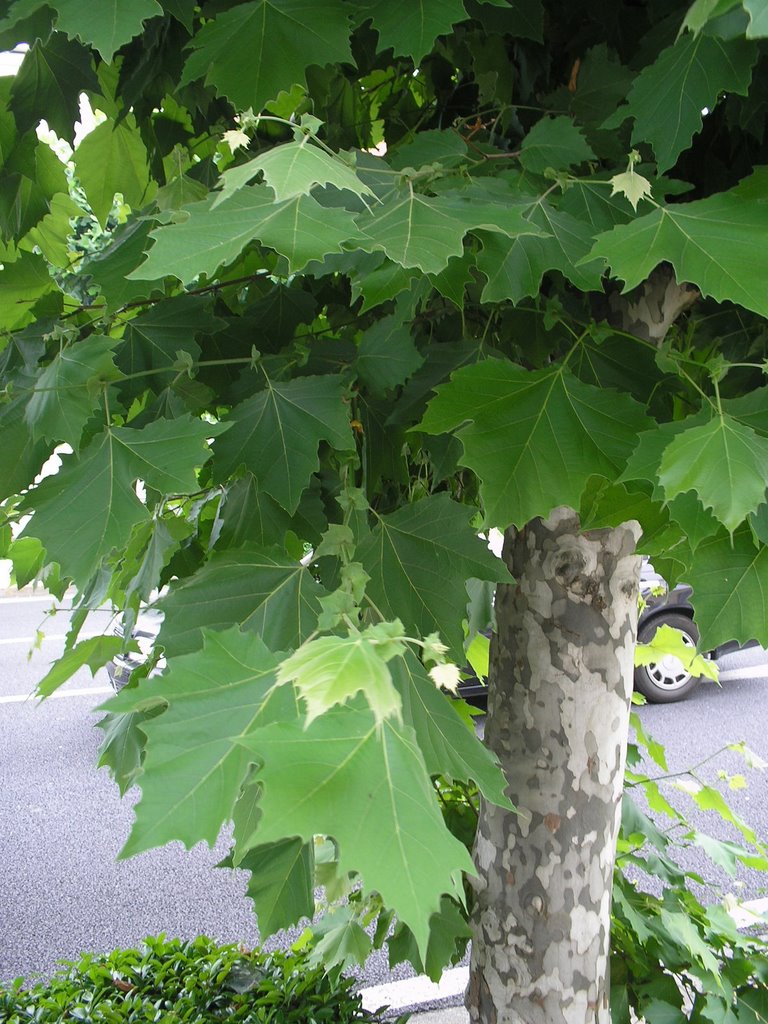
I have a lot of smell memories. One of the most nostalgic for me is the scent of sycamores, a scent I associate both with Japan, where I spent most of my youth, and Virginia, where my parents grew up and I spent several years of my youth. My mother was also sweet on sycamores, as I recall.

When I catch the scent of sycamores, I invariably stop and sniff—like a dog at a curbside tree or fire hydrant—matching the odor against my smell memories from Japan and Virginia. I discovered the same scent along a few sidewalks in Seoul during a visit there in 1995, and wondered whether the Japanese had first planted those hardy trees along those streets. I also caught the scent in the parking lot of the Cincinnati City Museum, during a visit to see my sister when she lived there later in the 1990s. My most recent favorite spot to stop and sniff the sycamores was in Ashikaga, Japan, during my time there last year, where a central city block was lined on both sides with the same trees. I wasn’t there during the heart of winter, but the trees caught my nose during the late summer and early fall (August-September), and then later when I came back in the spring (March-June).

It wasn’t until much later in life that I discovered that the sycamores of my smell memories were the plane trees of my literary memories, whose Latin genus name, Platanus, was borrowed into both Japanese and Korean. The native Japanese name for the tree is suzu-kake-no-ki ‘bell-hanger tree’. The Oriental plane, P. orientalis, is quite hardy, but the American sycamore (P. occidentalis)—also called buttonwood—is more susceptible to a fungus, so the hybrid London plane (Platanus × hispanica or Platanus × acerfolia) is the more likely species to adorn streets in Europe and North America.

The term sycamore has been applied to quite a range of trees, including the biblical fig tree (Ficus sycomorus) and sycamore maple (Acer pseudoplatanus) as well as the plane trees.

UPDATE: The Japanese rendering of Platanus is プラタナス  puratanasu. The Korean name I elicited in Seoul in 1995 sounds very close to that, but I’ve never seen it spelled. The native Korean name for the genus seems to be 식물종 sik-mul-jong (pronounced something like shingmuljong).

Leave a comment

Filed under Japan

The Quagmire Continues — in Kosovo

In a story appropriately timed for Halloween, the International Herald Tribune updates us on the continuing quagmire in Kosovo.

PRISTINA, Kosovo: All expectations are that, in the next few months, Kosovo will claim an internationally sanctioned independence, concluding a titanic struggle by the United Nations and Western governments to close a chapter that began with its bloody ethnic war.

But it is unlikely to be the conclusion the United Nations hoped for, after having invested seven years supervising the enclave at a cost of about $1.3 billion a year. That is because it seems increasingly evident that the West will need to retain far greater responsibilities than it wanted.

The outlook has changed with the failure of both the Albanian and Serbian sides to reach an agreement in nine months of negotiations, in particular since the Serbs are refusing to recognize Albanian-dominated institutions in what has been a territory dear to their religious and cultural heritage.

The negotiations are dragging on, raising the likelihood that a solution will be imposed. That would end a process that began with the breakup of the former Yugoslavia 15 years ago, which led to wars in Croatia, Bosnia and, finally, Kosovo.

For Western Europe, the wish has always been that resolving Kosovo, the last of the three problem areas, would end the risk of violent disputes over borders and alleviate the need to have a heavy international presence – both in troops and in civil administration – on the ground. Planning is already under way for a European Union-led mission to take over from the UN.

“Everybody is anxious to solve this,” said Joachim Rücker, head of the United Nations mission in Kosovo. “It is the last bit of the Balkan puzzle.”

The political calendar in Serbia leaves unclear exactly when a resolution might come: possibly next year, after Serbian elections, although the Americans are eager to conclude things without delay. The Americans are not heavily invested in Kosovo but would be expected to pay some of costs of establishing a more independent state.

Whatever the timing, it seems that foreign officials will retain extensive powers for some time to come, UN and EU officials here say.

With high levels of poverty in Kosovo, the financial costs may continue to be substantial.

“I think the EU is going to be in for a bit of a shock,” said Anthony Welch, coordinator of a UN-commissioned review of Kosovo’s future security needs. “I think their role is going to have to be a little more hands-on. And it is going to cost a lot.”

Kosovo has remained under UN control since the province was prized away in June 1999 from Yugoslav security forces accused of committing atrocities against the majority Albanian population. Its sovereignty remains in limbo: While Kosovo is formally part of Serbia, the six nations overseeing the negotiations on its future say it cannot return to Belgrade’s rule.

I’m sure it won’t take any longer—or any more resources—to resolve Kosovo to everyone’s satisfaction than it will have taken to resolve the division of the Korean peninsula, whenever the latter is finally resolved to everyone’s satisfaction resignation. Perhaps in my daughter’s lifetime. Not mine.

Leave a comment

Filed under Eastern Europe, war