Author Archives: Joel

Joel's avatar

About Joel

Executive Editor, Journals Dept. University of Hawai‘i Press

Black Star Journal on Mugabe’s Zimbabwe

Africa-blogger Black Star Journal notes that the floor just keeps dropping below Mugabe’s Zimbabwe. The death rate in Zimbabwe—at 3,500 every week—now surpasses the death rate in Darfur, Iraq, or Lebanon; and average female life expectancy—at 34 years—is now the world’s lowest.

What makes this disaster more tragic and outrageous is that it’s largely Mugabe-made. The economic and food crises are largely his fault thanks to his attacks on large industrial farmers, food producers who were also significant employers. The AIDS pandemic isn’t necessarily his fault but his oppression and the economic crisis have forced large numbers of qualified medical professionals to flee the country….

3500 black Zimbabweans are dying every single week because of Mugabe’s policies. But Mugabe went after WHITE farmers in his land ‘redistribution’ program (ie: redistributed to his cronies). And Mugabe’s ‘liberation’ movement (from the 1970s) went after white imperial rule.

As a result, Africa’s so-called intelligentsia has largely given him a free pass. I can honestly say that few things enrage me more than when educated and normally reasonable Africans provide nothing more than shameless apologia for this guy.

Never mind that white farmers merely had to flee the country. The worst victims of Mugabeism, the dead and starving, are black….

But with tragic symbolism, at least one profession is booming: undertakers.

A real nail in the country’s coffin.

Leave a comment

Filed under Africa

No Island Is an Island, Not Even Simunul in Tawi-Tawi

Tawi-Tawi lies in the southwesternmost corner of the Philippines, only miles from Sabah, Malaysia. Over three hundred islands are located in this province, most of them small and uninhabited. The island of Tawi-Tawi is the largest of these islands. The Sama are the predominant ethnic group of Tawi-Tawi Province and live along the coast of Tawi-Tawi Island and on the shores of the many small islands that surround it. The island of Bongao (pronounced “Bunggau”), located on the western tip of Tawi-Tawi Island, is the provincial capital and regional center of trade.

Simunul Island is seven miles south of Bongao. The island is only fifteen square miles in size, but it contains fifteen barangay (communities) and is home to over 25,000 people. With its swaying palm trees and turquoise-colored sea, Simunul is picture perfect. There were moments during my fieldwork there when, watching the sun set over the sea and listening to the call to prayer, I believed that Simunul was a timeless, distant place. As a coup was attempted in Manila, as Iraq invaded Kuwait and the Gulf War ensued, and as the Soviet Union collapsed, life went on as usual in Simunul.

Or, I should say, life went on as usual for me. People of Simunul were aware of these world events and understood that they would soon experience the ripples of their effects. After the coup attempt in Manila, more people planted cassava because they realized that political instability in the capital would result in inflated food prices. Likewise, the situation in the Middle East caused the price of gasoline to rise, requiring people to pay another five pesos to travel to Bongao.

The Sama of Simunul, concerned about their kin who work in Middle East, closely followed the events of the war announced over the radio. One man was convinced that if a world war ensued, Simunul would be one of the first places to be bombed, as a result of its strategic importance. This conviction is less absurd when one considers that the Japanese invaded Simunul during the Second World War, that Simunul was the training ground for President Marcos’ covert Operation Merdeka [an attempt to “liberate” Sabah] in 1967, that the people of West Simunul participated in the Moro National Liberation Front from 1972 to 1974, and that the Philippine Navy shelled West Simunul because of this MNLF activity. The people of Simunul do not “go off to war” in foreign lands. Unfortunately, national and international violence has a way of coming to their small island.

While I could thus pretend to be on a remote and isolated island, the Sama with whom I lived could not afford the luxury of such an illusion. The seas I perceived as clear, tranquil, and little-trafficked were actually swirling ocean currents that for centuries have been drawing the Sama into contact with a succession of outside powers. Simunul is not and has never been an isolated enclave.

For centuries the Sama of Simunul Island were subjects of the Sulu Sultanate. This sultanate emerged in the fourteenth century and was dominated by the Tausug people of the island of Jolo (pronounced “holo”). The Sultan of Sulu administered the Tausug, Sama, and Bajau people of the Sulu Archipelago by assigning datu, traditional regional leaders, to specific regions. These datu were usually Tausug men who were subordinate, loyal, and accountable to the sultan.

The Sama also have ties to the Malays of Sabah, Malaysia, with whom they have a lively and profitable trading relationship. This relationship continues today in spite of the national boundaries that separate Malaysia and the Philippines, and the laws that define their trade as smuggling. Currently, almost half of the Simunul population lives and works in Sabah, where they easily find jobs in lumber mills, restaurants, and shops. The wages are quite high in Sabah, and consumer goods are much cheaper than in Tawi-Tawi. When the Malaysian government cracks down on illegal aliens, the Sama are shipped back to Tawi-Tawi, only to return days later aboard the boats of traders/smugglers. There is thus a steady traffic of people and goods between Sabah and Simunul.

The Sama are also oriented toward Mecca. Mecca is the ponsot dunia, or navel of the world, for these Muslims. People pray toward Mecca, sacrifice to travel to Mecca as pilgrims, and, when they die, are buried with their bodies facing Mecca. The Middle East is not only a center of Islam, however. It is also a center of employment. The Sama began sending people abroad in 1975. In 1990 about 14 percent of women from Simunul between the ages of twenty and forty worked in the Middle East as domestic helpers, midwives, and nurses. Seven percent of men of the same age group worked in the Middle East as laborers.

The people of Simunul are oriented toward the United States as well. After the Spanish-American War of 1898, the United States took possession of the Philippines. After many violent military acts, the Americans “subdued” the Muslims of Mindanao and Sulu, a feat the Spanish had failed to accomplish during their three-hundred-year reign in the Philippines. Employing a policy of attraction, the American government instituted public schools throughout the Philippines. In 1918 the United States built an elementary school in Simunul. Shortly thereafter, children continued their studies in a high school located in Jolo. By the 1930s the Sama themselves were becoming teachers and replacing the Americans and Christian Filipinos who taught them. Today, about 30 percent of the adult population of Simunul has had some college education, and half of this number are college graduates. Their ability to speak English fosters an awareness of and participation in world events and discourses.

These seas of strong currents carried Tausug datu to Simunul and brought American teachers and administrators to Bongao. These seas carried furtive traders and workers to Malaysia and brought pilgrims to the Persian Gulf. These seas also brought foreign Muslims, carrying the Word of Islam, to the people of Simunul.

One of the first of these foreign Muslims was a man the sarsila (local histories) identify as Sheik Makhdum. According to the sarsila, Sheik Makhdum arrived in Simunul aboard an iron ship but, once in sight of the island, walked the remaining distance on the water. He taught the people of Simunul about Islam and impressed them with his supernatural abilities. Sheik Makhdum built a mosque for his followers, carrying tree trunks from the jungle to the seashore as if they weighed no more than matchsticks. The pillars of this mosque still stand today, serving as a testament to the presence and the power of Sheik Makhdum. These pillars have been dated to the fourteenth century and support the claim that this is the oldest known mosque in the Philippines.

Many Muslim traders and missionaries followed Sheik Makhdum to Simunul, some of them spending their lives on the island. The descendants of these missionaries have a special status in the community and are believed to be direct descendants of the Prophet Muhammad.

After the Second World War, many Muslim Filipinos were educated in madrasah (schools of Islamic learning) in Jolo and Basilan. These learned men became missionaries and traveled throughout Mindanao and Sulu to teach people about Islam. Four of these missionaries found their way to Simunul and spent years living with and teaching the Sama.

SOURCE: “The Ahmadiyya Movement in Simunul: Islamic Reform in One Remote and Unlikely Place,” by Patricia Horvatich, in Islam in an Era of Nation-States: Politics and Religious Renewal in Muslim Southeast Asia, ed. by Robert W. Hefner and Patricia Horvatich (U. Hawai‘i Press, 1997), pp. 184-187

3 Comments

Filed under Islam, Malaysia, Philippines

Head Heeb on the Rioting in Tonga

As usual, the Head Heeb offers some of the best analysis of unrest in the South Pacific, most recently the riots in Tonga.

If last year’s successful civil service strike was Tonga’s first revolution, then a second and more violent one began yesterday when widespread rioting broke out in the capital. As with the strike, the catalyst for the riots was a combination of economic distress and frustration over stalled political reforms. Unlike last year’s peaceful protests, however, the riots have left much of Nuku’alofa in a shambles – and, in contrast to the civil service walkout, they were targeted not merely at the royal family but at the entire governmental structure….

The final straw came when Prime Minister Feleti Sevele – ironically, Tonga’s first common premier – proposed adjourning parliament without voting on either of the reform packages, and instead establishing another committee to study the situation. Rioting broke out almost immediately in the capital and turned quickly to looting, with much of the commercial district sacked, including Sevele’s office and a shopping center owned by his family. There was also, as in the Solomon Islands this spring, an ethnic cast to the riots, with Chinese businesses reportedly targeted by the looters. Although no deaths or serious injuries have been reported, the violence grew beyond the ability of Tonga’s beleaguered police force to control.

In Tonga, it looks as if the Kiwis will take the lead in outside intervention.

Leave a comment

Filed under Polynesia

Belmont Club on the Overseas Filipino Revolution

At the end of a long post comparing and contrasting insurrection and pacification efforts in Iraq now and the Philippines a century ago, Belmont Club offers an interesting take on the socioeconomic revolution now underway in the Philippines.

What finally weakened the Filipino elite was economic globalization. By the late 20th century the descendants of the illustrados had nearly run their patrimony into the ground. And to cover up their failures they resorted to the time-tested technique of scapegoating their enemies; first blaming the economic role of foreigners; then junking the American-era Constitution modeled largely after that of the US; finally in 1992 closing the last of the American bases …. The one legacy they had not succeeded in completely dismantling was that of the Thomasites [President McKinley’s Peace Corps?]. English remained the official, though declining, medium of higher instruction until 2001 when it was finally replaced by Pilipino at all levels of education. The displacement was to last two whole years.

Even as the “nationalists” put the capstone on their decaying edifice the “peasants” were deserting their structure wholesale. By the early 21st century fully 11% of the entire Filipino population had fled to work abroad, though the percentage was probably higher. As a proportion of population it was a diaspora unprecedented in modern history. There are twelve million overseas Filipinos. By comparison there are only 35 million overseas Chinese. In 2003 the Philippine elite woke to the fact that overseas Filipinos were literally keeping their decaying kingdom afloat, providing 13.5% of total GDP, chiefly in sums sent to relatives. That year the Philippine Department of Education ordered English reinstated as the medium of instruction. Like some strange delayed explosion, the Thomasite weapon had detonated a hundred years into the future. But this time it was not the American teachers who crossed oceans to teach Philippine peasants. It was the Philippine peasants who went overseas to work and to learn.

Contemporary Manila is reeling under the impact of the Overseas Filipino revolution. Some of the changes are subtly cultural. Hundreds of thousands of Filipinos of lower-class origin return for holidays or furlough between contracts with more money than the old social elite. They often return with more sophisticated consumer tastes and better foreign language skills then their social betters, who have never been to anything other than local finishing schools. In particular, many Filipinos of lower-class origin speak American or British standard English learned by immersion overseas unselfconsciously, at a stroke removing the class stigma that often attended the use of fluent English. The ultimate testimony to the return of English has been the widespread rise of that bizarre product of globalization, the Korean-run English academy for Filipinos, pitched at the those desperate to learn enough English to go abroad for a job. One of these unusual academies is shown below beside the another compelling reason to learn English: the Internet Cafe. If anything symbolizes the Overseas Filipino revolution, it is these English academies cheek by jowl with Internet portals.

But if some changes are subtle, others are glaringly obvious. Almost overnight, the ability to stand in line at a ticket booth or at a taxi stand has become a mainstream Filipino value in a country formerly renowned for jumping queues. At a business district in mid-Manila, thousands of call-center workers — another incentive to learn English and hook into the wider world — stop for fast-food meals at restaurants open on a 24 hour basis before manning workstations serving every corner of the globe. Perhaps most importantly, many Filipinos no longer expect the government to do anything for them. They simply go out and do it for themselves. A country in which telephones were until recently a comparative rarity has become a hive of cell phones and the text-messaging capital of the world. Nor does anybody rely on government mail when a private courier can be used. Coup rumors which until recently have set the country on its ears are now greeted with indifference. It is the elites who are treated with a amused condescenscion, as a source of entertainment.

Leave a comment

Filed under Philippines

Japanese Public Art over Holes in the Ground

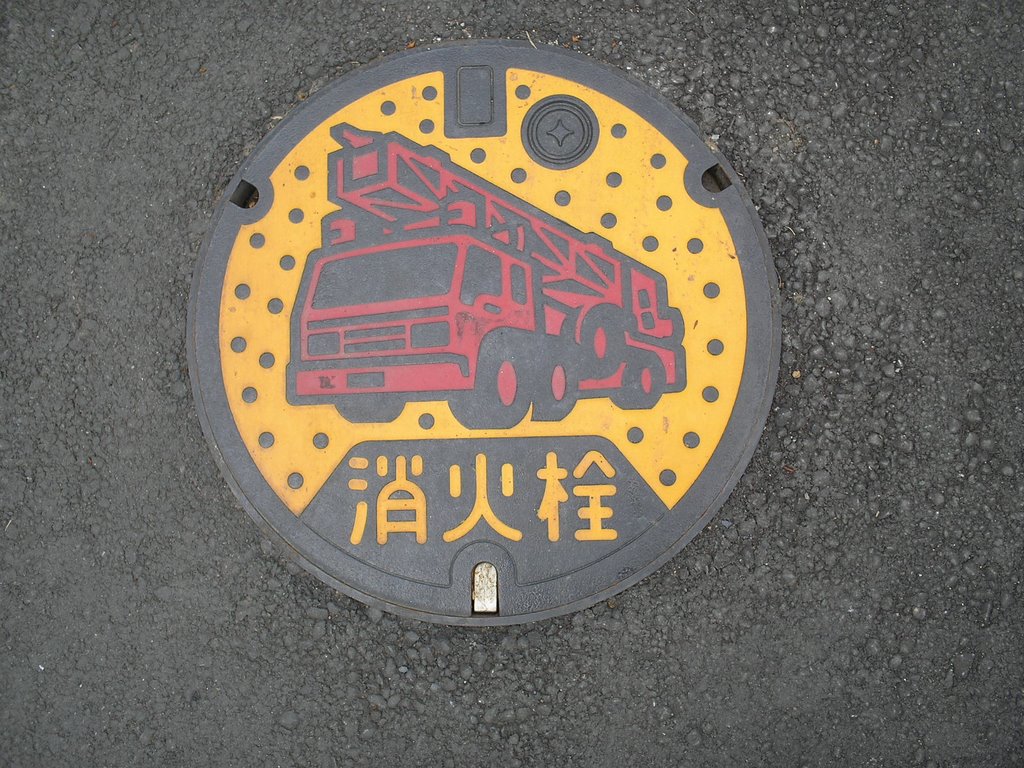
One of the distinctive features of Japan’s public utilities is the wide variety of manhole cover art. The phenomenon is not strictly limited to “manholes” designed to allow humans to enter subterranean conduits; it can also be found on the panels covering Japanese fire hydrants (as pictured here), which are usually under the surface of the street. The link above offers a gallery of over 200 examples of Japanese art over holes in the ground, some quite brightly colored, like this one from Nikko; others rather dull but still locally distinctive, like this one with porpoises from Chichijima in the Ogasawara (aka Bonin) Islands north of Iwo Jima.

Of course, Japan isn’t the only country that indulges in manhole cover art. Take at look at the Russian gallery entitled Sewers of the World, Unite! or the utility cover artist Bobby Mastrangelo at The Grate Works.

Leave a comment

Filed under Japan

Will the Red Sox–Yankee Rivalry Spread to Japan?

Japundit‘s baseball columnist, Mike Plugh, offers some interesting speculation on some possible implications of Boston’s $50 million bid to talk with Japan’s top pitching ace, Daisuke Matsuzaka.

Should those plans fall through, what’s to stop the Red Sox from splashing on Ichiro. It would do two things. One, it would add an All-Star outfielder with a great bat, legs, and throwing arm. Two, it would permanently steal the Japanese spotlight from the Yankees, who are wildly famous and popular, and reposition it on the Red Sox. The Yankees would be famous, but the Red Sox would be Japan’s team. Theo Epstein knows this and I guarantee they are working on a plan to acquire Ichiro already. With Ichiro and Matsuzaka, the Sox would not only be good, they’ll be the most famous franchise in Japan. What kind of dollar figures can you put on that?

The flip side to that situation is that the Yankees know this too. The Yankees could use a centerfielder who hits, runs, and plays defense. Johnny Damon is good, and Melky Cabrera is up and coming, but let’s face it … Damon’s defense is in decline, and Melky is probably better suited to left. If the Yankees choose to counter the Matsuzaka move by spending huge on Ichiro, they will solidify their strong hold on Japan, and perhaps do so irreversibly. That goes double if the Yankees are able to land the Yomiuri Giants’ Koji Uehara in the same 2007 offseason. What is that worth to the Yankees?

In either case, the Red Sox and Yankees rivalry is now global. The frontlines are drawn and they extend all the way around the world. For fans who are already sick of the two teams, it’s more nausea. For Yankees and Red Sox fans, it’s more fuel to the belief that the world revolves around the ebb and flow of Boston against New York. For Mariners fans, it’s something to mourn. Unless Ichiro is so intensely loyal to Mr. Yamauchi, or intent on returning to Japan to end his career, the money that will be out there for him in a year’s time will make A-Rod’s deal look like pocket change.

Coverage of baseball on Japanese TV almost always starts off with footage of individual Japanese players in the U.S. majors—referred to in Japanese as the “Big” (大, Dai) Leagues—before turning to the state of play in Japan. This will only increase the number of Japanese ads in American ball parks.

Leave a comment

Filed under baseball, Japan

Medical Professionalization in Medieval Europe, 1300s

On November 2, 1322, Madame Felicie was convicted of violating an ordinance that prohibited unlicensed healers from visiting, prescribing medications, or performing other duties for a patient, except under the guidance of a university-trained and licensed physician. The conviction was a major victory for the Paris Medical Faculty, a principal architect of the new medical pecking order, which had a pyramid-like shape. At the pinnacle was a relatively small coterie of the university-trained physicians; they practiced what we would call internal medicine. Beneath them were the general surgeons, who usually lacked academic training, although that was changing. By the early fourteenth century surgery was beginning to find a place in the medical schools. A surgeon could treat wounds, sores, abscesses, fractures, and other disorders of the limbs and skin. Beneath the general surgeon “was the barber surgeon, a kind of paramedic, who could perform minor operations, including bleeding, cupping, and applying leeches, as well as cutting hair and pulling teeth; next came the apothecary and the empiric, who usually specialized in a single condition, like hernias or cataracts. At the base of the pyramid were thousands of unlicensed healers like Madame Felicie.

To reflect their new eminence, in the decades prior to the plague, physicians began to adopt a more professional—that is, authoritative—demeanor and code of behavior. A cardinal “don’t” in the new medical etiquette was: don’t jeopardize your professional dignity by visiting patients to solicit business. “Your visit means you are putting yourself in the patient’s hands,” warned William of Saliceto, “and that is just the opposite of what you want to do, which is getting him to express a commitment to you.” A cardinal “do” in the new etiquette was to conduct a comprehensive physical exam on a first visit; the exam should include not just urinalysis, but a detailed medical history and an analysis of the patient’s breath odor, skin color, muscle tone, saliva, sweat, phlegm, and stool. Some physicians also cast a patient’s horoscope on the first visit. Another cardinal “don’t” in the new etiquette was to admit to diagnostic uncertainty. Even when in doubt, said Arnauld of Villanova, a physician should look and act authoritative and confident. For the uncertain physician, Arnauld recommended prescribing a medicine, any medicine, “that may do some good but you know can do no harm.” Another strategy was to “tell the patient and his family that [you are] prescribing this or that drug to cause this or that condition in the patient so that [they] will always be looking for something new to happen.” A third “don’t” in the new etiquette was volubility. Reticence conveyed authority, especially when combined with a grave manner; besides, said one savant, the physician who discusses his medical reasoning with the patient and his family risks letting them think that they know as much as he does, and that may tempt them to dispense with his services.

What made the university-trained physician such an impressive figure to laymen, however, was not only his authoritative bedside manner but his mastery of the arcanae of the New Galenism. Its signature principle was the theory of the four humors. For the ancient Greeks, whose thinking shaped so much medieval medicine, the number four was, like the atom, a universal building block. Everything, the Greeks believed, was made out of four of something. In the case of the physical world, the four elements were earth, wind, water, and fire; in the case of the human body, the four humors were blood, black bile, yellow bile, and phlegm. An important element in the humoral theory were the four qualities of all matter: hot and cold, wet and dry. Thus, blood was said to be hot and moist; black bile, cold and dry; yellow bile, hot and dry; and phlegm, cold and wet.

SOURCE: The Great Mortality: An Intimate History of the Black Death, the Most Devastating Plague of All Time, by John Kelly (Harper Perennial, 2006), pp. 167-169

Leave a comment

Filed under disease, education, Europe

Human Rights Interventionism: A 1990s Flashback

The advocates of coercive interventionism have no qualms about questioning any reluctance to use force on the part of Western governments. Their response has been a consistent one of calling for more military intervention to protect human rights in Africa or the Balkans. Liberal broadsheets, like the Guardian, Independent and Observer, have been more than willing to editorialise on the need for a firmer approach. With editorials like ‘We Must Find the Stomach for Years of War over Kosovo’ and ‘There is No Alternative to This War’ the liberal press have outdone the tabloids in patriotic jingoism (Independent, 1999; Observer, 1999a). For these crusading ‘lap-top bombardiers’ even months of bombing in Kosovo was not enough. They consistently argued for ground troops and the resolve to spend more resources and effort in the struggle for human rights. Ardent interventionist Michael Ignatieff puts the case strongly:

Had we been more ruthlessly imperial, we might have been a trifle more effective. If General Schwarzkopf had allowed himself to become the General MacArthur of a conquered Iraq, the Iraqi opposition abroad might now be rebuilding the country; if the Marines were still patrolling the streets of Mogadishu, the prospects of moving Somalia forward … might be somewhat brighter; and if NATO had defended the Bosnian government with air strikes against the Serbian insurrection in April 1992 … [I]f after the Dayton peace accords of 1995, Western governments had simply taken over the administration of Bosnia … Bosnia might have been reconstructed on a more secure foundation. (1998:94)

SOURCE: From Kosovo to Kabul and Beyond: Human Rights and International Intervention, new ed., by David Chandler (Pluto Press, 2002/2006), p. 168

Leave a comment

Filed under NGOs, war

Dids Rats or Catapulted Cadavers Bring Plague to Caffa?

[In 1346] one Russian chronicle speaks of the plague arriving on the western shore of the Caspian Sea and attacking several nearby cities and towns, including Sarai, capital of the Mongol Principality of the Golden Horde and home to the busiest slave market on the steppe. A year later, while Sarai buried its dead, the pestilence lurched the final few hundred miles westward across the Don and Volga to the Crimea, came up behind the Tartar army in the hills above Caffa, and bit it in the back of the neck.

The Genoese, who imagined that God was born in Genoa, greeted the plague’s arrival with prayers of thanksgiving. The Almighty had dispatched a heavenly host of warrior angels to slay the infidel Mongols with golden arrows, they told one another. However, in de’ Mussis’s account of events, it is Khan Janibeg who commands the heavenly host at Caffa. “Stunned and stupefied” by the arrival of the plague, the notary says that the Tartars “ordered corpses to be placed in catapults and lobbed into the city in hopes that the intolerable stench would kill everyone inside…. Soon rotting corpses tainted the air …, poisoned the water supply, and the stench was so overwhelming that hardly one man in several thousand was in a position to flee the remains of the Tartar army.”

On the basis of de’ Mussis’s account, Janibeg has been proclaimed the father of biological warfare by several generations of historians, but the notary may have invented some of the more lurid details of his story to resolve an inconvenient theological dilemma. Self-evidently—to Christians, at least—the plague attacked the Tartars because they were pagans, but why did the disease then turn on the Italian defenders? Historian Ole Benedictow thinks de’ Mussis may have fabricated the catapults and flying Mongols to explain this more theologically sensitive part of the story—God did not abandon the gallant Genoese, they were smitten by a skyful of infected Tartar corpses, which, not co-incidentally, was just the kind of devious trick good Christians would expect of a heathen people. Like most historians, Professor Benedictow believes the plague moved into the port the way the disease usually moves into human populations—through infected rats.* “What the besieged would not notice and could not prevent was that plague-infected rodents found their way through the crevices in the walls or between the gates and the gateways,” says the professor….

* Khan Janibeg does have one stout modern defender, Mark Wheelis, a professor of microbiology at the University of California. The professor notes that in a recent series of 284 plague cases, 20 percent of the infections came from direct contact—that is, the victim touched an object contaminated with the plague bacillus, Y. pestis. “Such transmissions,” he says, “would have been especially likely at Caffa, where cadavers would have been badly mangled by being hurled, and many of the defenders probably had cut or abraded hands from coping with the bombardment.” Professor Wheelis also thinks the rat scenario favored by many historians ignores a crucial feature of medieval siege warfare. To stay out of arrow and artillery range, besiegers often camped a kilometer (six-tenths of a mile) away from an enemy stronghold—normally beyond the range of the sedentary rat, who rarely ventures more than thirty or forty meters from its nest. (Mark Wheelis, “Biological Warfare at the 1346 Siege of Caffa,” Emerging Infectious Diseases 8, No. 9 [2002]:971–75.)

SOURCE: The Great Mortality: An Intimate History of the Black Death, the Most Devastating Plague of All Time, by John Kelly (Harper Perennial, 2006), pp. 8-9

Leave a comment

Filed under disease, Eastern Europe, Mongolia

Ukraine Remembers While Russia Forgets

In an essay posted on Maidan, a Ukrainian civic action site, Ivan Ampilogov contrasts The Power of Memory in Russia and Ukraine.

We can say that the anti-empire tradition of Soviet dissidents has suffered defeat in the mass consciousness of contemporary Russian, while in Ukraine it can take on new meaning.

In Solzhenitsyn’s novel “The First Circle”, the author writes about camp prisoners, their future and at the same time about the future of the whole country. “Years will pass, and all these people, now oppressed, indignant, despairing and choking with rage will go to their graves, others will become weak, flabby, while a third group will forget it all, renounce it, with relief burying their prison past and a fourth will be turned around, and they’ll even say that it was all reasonable, and not ruthless – and maybe none of them will get around to reminding today’s executioners what they did to the human heart!” In contemporary Russia the idea that the terror was “reasonable” or “required” is gaining ever greater influence, most often they prefer not to remember it at all….

Over recent years many Ukrainians have become convinced that their country is freer than Russia, that their democratic institutions are much more developed and that at the end of the day, the Ukrainian state is more humane or, more accurately, less inhuman than Putin’s regime. The level of freedom both of Ukrainian, and of Russian society can be measured by the weakening or strengthening of the enforcement structures of the state – against its citizens. A Ukrainian feels that living without an omnipresent and all-powerful secret police is possible and very comfortable, whereas Russians loudly declare their attachment to unlimited power of the state and their readiness to endure its police, both secret and open. Modern Ukrainians do not face any dilemma of whether to forget the fate of their grandfathers who were left to rot in labour camps, or the fate of their parents frightened to talk with foreigners – and to forget who made their life like that – or to feel redundant in that colony of fervent patriots which Russia is once again becoming.

In contemporary Ukraine, at least two general groups are implacable opponents of the re-emerging Russian imperial spirit, being able to speak about themselves as victims of Soviet Russia – the descendents of Ukrainian nationalists and the Crimean Tatars. The link between the Crimean Tatar dissidents and the Ukrainian nationalists was strong back in the times of their common struggle with the Soviet regime.

via A Step at a Time

Leave a comment

Filed under Ukraine, USSR