Wordcatcher Tales: Kamataki Sagyou

fishpress-sign

How to turn herring into fertilizer

The Historical Village of Hokkaido in Sapporo had a sign showing a fish press used by Hokkaido herring fishermen to turn their (once) bounteous catches into fertilizer for farms throughout Honshu, where it was highly valued. To make the sign easier for Japanese schoolchildren to read, many words are written in kana rather than kanji, and furigana provide readings for some of the remaining kanji. Here is some of the vocabulary from that sign, starting with the title on the bottom right, then working from the top right down to the bottom left.

釜焚き作業 kama-taki sagyou ‘kettle-firing work’ [the title]

ナガシ [流し] nagashi ‘sink, drainboard’

カマド [竈] kamado ‘cooking stove’

しめ木 shime-ki ‘press-tree’

胴枕 dou-makura ‘frame-pillow’

胴ぶた dou-buta ‘frame-lid’

しめ胴 shime-dou ‘press-frame’

マッカ (しめ木をかける) makka [fork?, notch?, hook?] (shimeki o kakeru ‘to hold the press-tree’)

ロクロ [轆轤] (しめ綱を巻いてしめ木を引き下げる) rokuro ‘capstan’ (shimetsuna o maite shimeki o hikisageru ‘winding the rope to pull down the press-tree’)

toi ‘drainpipe’

ハチゴウ hachigou ‘storage tank’

If anyone has better glosses for these terms, I’d be happy to hear them.

Leave a comment

Filed under industry, Japan, language

Doshisha University’s Debt to Hakodate

From Hokkaido, A History of Ethnic Transition and Development on Japan’s Northern Island, by Ann B. Irish (McFarland, 2009), pp. 93-94:

Hakodate played a small part in the life and adventures of Niijima Jo (westerners have anglicized his name in several ways and have referred to him as Joseph Hardy Neesima). He became a prominent Christian in nineteenth century Japan and is honored today as the founder of a distinguished private university in Kyoto, Doshisha. Niijima grew up in Edo. When he was a youth, a friend who knew of his interest in boats and seamanship told him of a vessel soon to sail to Hakodate. Niijima, who had a secret desire to visit a foreign land, thought he might be able to do so form Hakodate. He knew an influential man who obtained permission for the young man to take a trip north. After arrival in Hakodate in 1864, Niijima’s goal was to meet foreigners who could help him travel abroad. He soon met Father Nikolai, who engaged him as a Japanese language tutor. Meanwhile, an English trader agreed to teach the young Japanese man English.

Niijima desperately wanted to travel outside Japan, despite the government prohibition of this. After several months in Hakodate, his dream took shape. He made arrangements to slip out of the city and secretly board an American ship. Arriving in the United States via China, he studied for some ten years and adopted Christianity. After being baptized, he chose his western name to honor Alpheus Hardy, owner of the ship that had taken him to America. Niijima graduated from Amherst College, the first Japanese student ever to obtain a college degree in the United States. Returning to Japan, he founded the school in 1875 which grew into Doshisha University.

As Niijima’s story shows, because foreigners from several important nations lived in Hakodate, Japanese found the city a good place to study foreign languages and foreign ways, and a number of men who later served as interpreters learned languages there.

Leave a comment

Filed under education, Japan, language, religion, travel, U.S.

Ainu Placenames and Counting System

From Hokkaido, A History of Ethnic Transition and Development on Japan’s Northern Island, by Ann B. Irish (McFarland, 2009), pp. 35-36:

Many, many Hokkaido cities and towns, and even some on Honshu, have names derived from Ainu. “Sapporo” comes from an ancient Ainu name for the river there, either from sat poro pet, which would mean “big dry river” or sari poro pet, a reedy area by the river. The name of Wakkanai evolved from the Ainu term “yam wakkanay,” meaning cold water river.” Some people have thought that even Mt. Fuji’s name comes from an Ainu word, fuchi, the Ainu fire goddess, but linguists today generally dismiss this idea.

Shiraoi, a town on the coast between Muroran and Tomakomai, has long included a sizable Ainu community and now features an Ainu village for tourists. In Ainu, the town’s name may have meant “place with many horseflies.” John Batchelor wrote that it meant “the place where the tide comes out (over the land),” signifying high tides. When place names like this have been adapted into Japanese, they have been given written characters that fit their pronunciation. Shira [白] can mean “white” in Japanese and oi [老い] can mean “old age.” The two characters with these meanings and pronunciations are written today to indicate the town name “Shiraoi.” Near Shiraoi is the hot springs resort city of Noboribetsu. Nobori means “to ascend” or “to climb” in Japanese, and betsu is “special” or “different.” The Ainu name, pronounced in a somewhat similar way, meant merely “turbid river.” In this case, both Ainu and Japanese names are appropriate, for there are mountains in this town located along a river. Betsu, by the way, appears in many Hokkaido place names to represent the Ainu word pet, which means “river.”

The Ainu counting system differs from the Japanese, the number twenty playing a prominent role. The numbers one to five have their own names, as does ten. Six through nine are expressed as ten minus a number and the teens are expressed by numbers added to ten. Larger numbers are expressed as multiples of twenty, subtracting any amounts needed.

Here are some examples of numbers from The Language, Mythology, and Geographical Nomenclature of Japan Viewed in the Light of Aino Studies, by Basil Hall Chamberlain and John Batchelor (Imperial University of Japan, 1887):

p. 9: wan ’10’, shine-pe-wan ‘1 from 10 = 9’, tu-pe-wan ‘2 from 10 = 8’

p. 93: hot ne ’20’, tu hot ne ‘2 score = 40’,
shine ikashima hot ne ‘1 excess score = 21’
shine ikashima, wan e, tu hot ne ‘1 excess, 10 away, 2 score = 31’
tu-pe-san ikashima, wan e, ine hot ne ‘(2 from 10 =) 8 excess, 10 away, 4 score = 78’
tu-pe-san ikashima, ine hot ne ‘(2 from 10 =) 8 excess, 4 score = 88’
ashikne hot ne ‘5 score = 100’
wan e, tu-pe-san hot ne ’10 away, (2 from 10 =) 8 score = 150′

Leave a comment

Filed under Japan, language

Hakodate’s Consular Heyday, 1863-1934

From Hokkaido, A History of Ethnic Transition and Development on Japan’s Northern Island, by Ann B. Irish (McFarland, 2009), pp. 89-90:

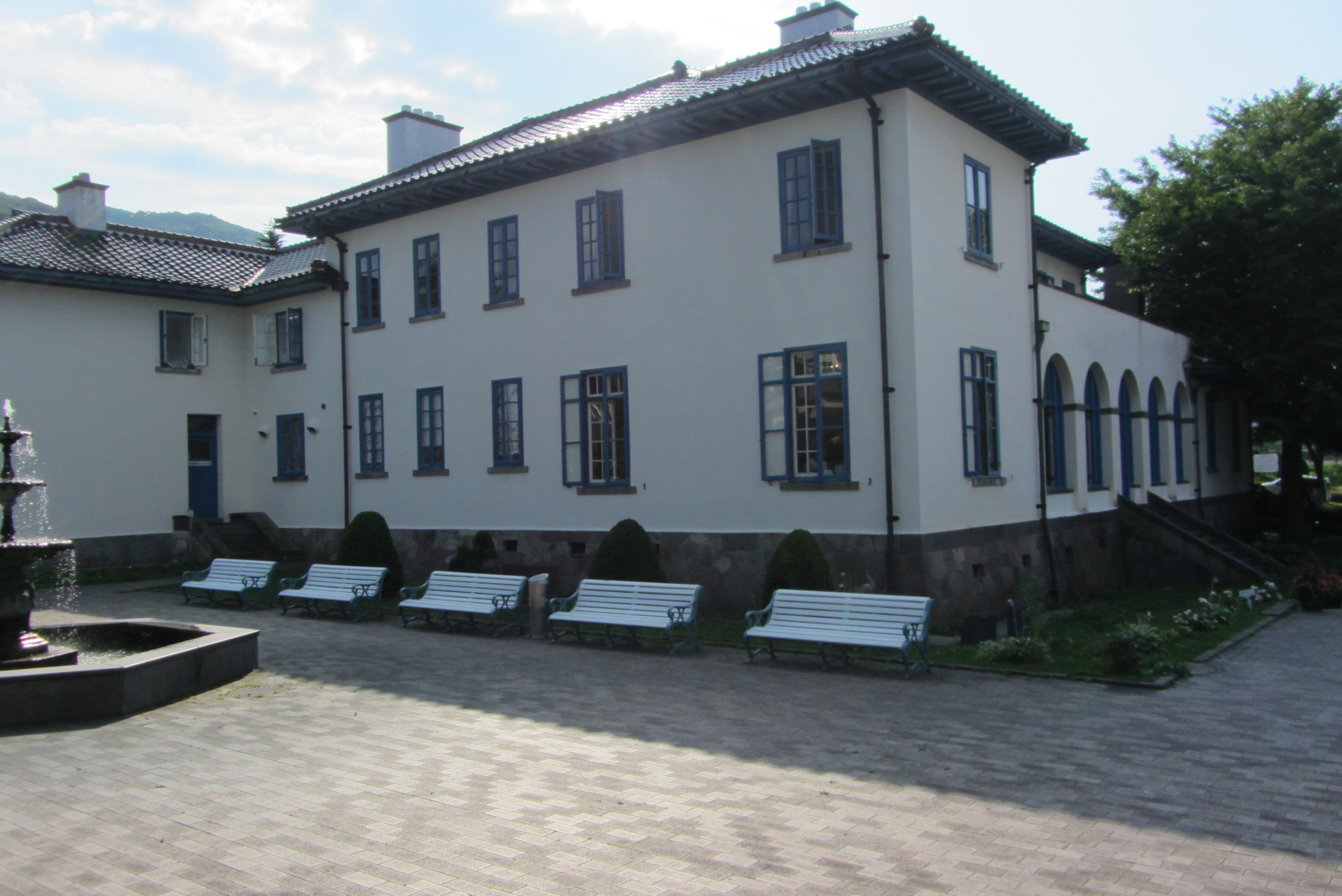
A new British Consulate opened for business in 1863, and Richard Eusden assumed consular duties in 1867, serving here until 1880. He was by far the most effective British consul in Hakodate. Both he and his wife became involved in the community; she helped create the city’s public garden. Over the years several fires damaged the consulate and it burned down in 1907. brit-faroblA few years later, the British government’s Shanghai Construction Bureau built a new consulate, a two-story-high tile-roofed structure on a site a few blocks away. This building still exists, looking rather like a large bungalow transplanted to Asia. Nowadays it is open to tourists, featuring interesting historical exhibits about early western experiences in Hakodate, an English tea room and a souvenir shop carrying articles from Britain. The British ceased consular operations in Hakodate in 1934.

The foreign consuls in Hakodate acted as judicial officials. When an American, Charles H. Smith, was charged in the death of a Japanese, the American, English and Russian consuls, the Hakodate bugyo and other Japanese and western men sat at the court and agreed that the defendant was not guilty, for he had shot in the darkness at a burglar.

Hakodate at different times had consulates representing not only Russia, the United States and Great Britain, but also France, the Netherlands, Portugal, Germany, Switzerland, Denmark, Italy, Austria, Hungary and Spain, though these other nations were mostly represented by men who were consuls of other countries. Even Hawaii, when it was an independent nation, briefly had consular representation in Hokkaido. The foreigners perceived Hakodate as a safe, if sleepy place; they did not feel the need for weapons in Hakodate. “We do not go armed as all foreigners do in Yedo, wrote E. E. Rice and, while Yokohama had a specific area set aside for foreign settlement, Hakodate featured no special area for foreigners, though the various consulates were not far from each other.

Leave a comment

Filed under Britain, Europe, Japan, Russia, U.S.

Wordcatcher Tales: Fuki, Shishiudo

During our Japan Rail Pass travels in Hokkaido last month, we encountered not just hordes of Chinese tourists (mostly from Taiwan) inside the trains, but also hordes of two kinds of large, green, weedy plants in the scenery that passed by our train windows. Wooded areas were often full of plants we recognized from our past travels as fuki ‘butterbur’, while more open areas were often infested with what seemed to be a giant, atomic mutant variety of carrot or Queen Anne’s lace. We didn’t find out what the latter was until we saw a sign identifying it at Cape Nosappu, at Hokkaido’s (and Japan’s) easternmost point.

Fuki (フキ, also written 蕗、苳、款冬、菜蕗) ‘giant butterbur, bog rhubarb’– Petasites japonicus is quite edible after removing some of its astringency. It makes a variety of side dishes to go with rice in both Japan and Korea. (However, too much of it eaten over long periods might damage the liver.) We had encountered it in 2012 at Hikone Castle, where a smaller variety was labeled tsuwabuki, and also at Akita Castle grounds, where we also found butterbur designs on a manhole cover.

noroi-signShishiudo (シシウド, also called アンゼリカ anzerika) ‘angelica’ – Angelica is indeed a genus within the family Apiaceae (or Umbelliferae), which includes carrots, Queen Anne’s lace, and many other plants, so my impressions of its taxonomic status were at least in the ballpark.

However, the Japanese generic name suggests that Angelica is a type of udo ‘Japanese spikenard, mountain asparagas’ (Aralia cordata), in the closely related Araliaceae family, which includes ivy. Indeed, before I found out its name, I thought of it as udo no taiboku ‘great tree of udo’ (implying something useless, of large size but no strength, like ‘all hat, no cattle’ in American, or at least Texan, English).

Two local species were identified on the sign at Cape Nosappu. Both common names are prefixed with ezo ‘Yezo (the old name for Hokkaido)’:

エゾニュウ ezonyuu (Angelica ursina)

エゾノロイグサ ezo no yoroigusa (A. sachalinensis var. sachalinensis)

As the Japanese name of the latter suggests, both species seem closely related to the yoroigusa (Angelica dahurica) that grows elsewhere.

According to Wikipedia, Angelica dahurica is a wildly grown species of angelica native to Siberia, Russia Far East, Mongolia, Northeastern China, Japan, Korea, and Taiwan. It tends to grow near river banks, along streams and among rocky shrubs. The root of the plant is widely used for its medicinal properties and is known to contain furanocoumarins and angelicotoxin. It is also commonly known as Chinese Angelica, Garden Angelica, Root of the Holy Ghost, and Wild Angelica, as well as its Chinese name, Bai Zhi (白芷).

Leave a comment

Filed under food, Japan, language, science

Religion Sparked the Crimean War

From The Crimean War: A History, by Orlando Figes (Metropolitan, 2011), Kindle Loc. 260-275:

In August 1851 the French formed a joint commission with the Turks to discuss the issue of religious rights. The commission dragged on inconclusively as the Turks carefully weighed up the competing Greek and Latin claims. Before its work could be completed, La Valette proclaimed that the Latin right was ‘clearly established’, meaning that there was no need for the negotiations to go on. He talked of France ‘being justified in a recourse to extreme measures’ to support the Latin right, and boasted of ‘her superior naval forces in the Mediterranean’ as a means of enforcing French interests.

It is doubtful whether La Valette had the approval of Napoleon for such an explicit threat of war. Napoleon was not particularly interested in religion. He was ignorant about the details of the Holy Lands dispute, and basically defensive in the Middle East. But it is possible and perhaps even likely that Napoleon was happy for La Valette to provoke a crisis with Russia. He was keen to explore anything that would come between the three powers (Britain, Russia, Austria) that had isolated France from the Concert of Europe and subjected it to the ‘galling treaties’ of the 1815 settlement following the defeat of his uncle, Napoleon Bonaparte. Louis-Napoleon had reasonable grounds for hoping that a new system of alliances might emerge from the dispute in the Holy Lands: Austria was a Catholic country, and might be persuaded to side with France against Orthodox Russia, while Britain had its own imperial interests to defend against the Russians in the Near East. Whatever lay behind it, La Valette’s premeditated act of aggression infuriated the Tsar, who warned the Sultan that any recognition of the Latin claims would violate existing treaties between the Porte and Russia, forcing him to break off diplomatic relations with the Ottomans. This sudden turn of events alerted Britain, which had previously encouraged France to reach a compromise, but now had to prepare for the possibility of war.

The war would not actually begin for another two years, but when it did the conflagration it unleashed was fuelled by the religious passions that had been building over centuries.

1 Comment

Filed under Austria, Britain, France, nationalism, religion, Russia, Turkey, war

Crimea: The 19th Century’s ‘Great War’

From The Crimean War: A History, by Orlando Figes (Metropolitan, 2011), Kindle Loc. 47-82:

Two world wars have obscured the huge scale and enormous human cost of the Crimean War. Today it seems to us a relatively minor war …. Even in the countries that took part in it (Russia, Britain, France, Piedmont-Sardinia in Italy and the Ottoman Empire, including those territories that would later make up Romania and Bulgaria) there are not many people today who could say what the Crimean War was all about. But for our ancestors before the First World War the Crimea was the major conflict of the nineteenth century, the most important war of their lifetimes, just as the world wars of the twentieth century are the dominant historical landmarks of our lives. The losses were immense – at least three-quarters of a million soldiers killed in battle or lost through illness and disease, two-thirds of them Russian. The French lost around 100,000 men, the British a small fraction of that number, about 20,000, because they sent far fewer troops (98,000 British soldiers and sailors were involved in the Crimea compared to 310,000 French).

Nobody has counted the civilian casualties: victims of the shelling; people starved to death in besieged towns; populations devastated by disease spread by the armies; entire communities wiped out in the massacres and organized campaigns of ethnic cleansing that accompanied the fighting in the Caucasus, the Balkans and the Crimea. This was the first ‘total war’, a nineteenth-century version of the wars of our own age, involving civilians and humanitarian crises.

It was also the earliest example of a truly modern war – fought with new industrial technologies, modern rifles, steamships and railways, novel forms of logistics and communication like the telegraph, important innovations in military medicine, and war reporters and photographers directly on the scene. Yet at the same time it was the last war to be conducted by the old codes of chivalry, with ‘parliamentaries’ and truces in the fighting to clear the dead and wounded from the killing fields. The early battles in the Crimea, on the River Alma and at Balaklava, where the famous Charge of the Light Brigade took place, were not so very different from the sort of fighting that went on during the Napoleonic Wars. Yet the siege of Sevastopol, the longest and most crucial phase of the Crimean War, was a precursor of the industrialized trench warfare of 1914–18. During the eleven and a half months of the siege, 120 kilometres of trenches were dug by the Russians, the British and the French; 150 million gunshots and 5 million bombs and shells of various calibre were exchanged between the two sides.

The name of the Crimean War does not reflect its global scale and huge significance for Europe, Russia and that area of the world – stretching from the Balkans to Jerusalem, from Constantinople to the Caucasus – that came to be defined by the Eastern Question, the great international problem posed by the disintegration of the Ottoman Empire. Perhaps it would be better to adopt the Russian name for the Crimean War, the ‘Eastern War’ (Vostochnaia voina), which at least has the merit of connecting it to the Eastern Question, or even the ‘Turco-Russian War’, the name for it in many Turkish sources, which places it in the longer-term historical context of centuries of warfare between the Russians and the Ottomans, although this omits the crucial factor of Western intervention in the war.

The war began in 1853 between Ottoman and Russian forces in the Danubian principalities of Moldavia and Wallachia, the territory of today’s Romania, and spread to the Caucasus, where the Turks and the British encouraged and supported the struggle of the Muslim tribes against Russia, and from there to other areas of the Black Sea. By 1854, with the intervention of the British and the French on Turkey’s side and the Austrians threatening to join this anti-Russian alliance, the Tsar withdrew his forces from the principalities, and the fighting shifted to the Crimea. But there were several other theatres of the war in 1854–5: in the Baltic Sea, where the Royal Navy planned to attack St Petersburg, the Russian capital; on the White Sea, where it bombarded the Solovetsky Monastery in July 1854; and even on the Pacific coastline of Siberia.

The global scale of the fighting was matched by the diversity of people it involved.

1 Comment

Filed under Austria, Britain, Bulgaria, Caucasus, disease, France, Italy, military, nationalism, religion, Romania, Turkey, war

Crimea as Religious Battlefield

From The Crimean War: A History, by Orlando Figes (Metropolitan, 2011), Kindle Loc. 459-495:

But it was in the Crimea [even more than the Caucasus] that the religious character of Russia’s southern conquests was most clear. The Crimea has a long and complex religious history. For the Russians, it was a sacred place. According to their chronicles, it was in Khersonesos, the ancient Greek colonial city on the south-western coast of the Crimea, just outside modern Sevastopol, that Vladimir, the Grand Prince of Kiev, was baptized in 988, thereby bringing Christianity to Kievan Rus’. But it was also home to Scythians, Romans, Greeks, Goths, Genoese, Jews, Armenians, Mongols and Tatars. Located on a deep historical fault-line separating Christendom from the Muslim world of the Ottomans and the Turkic-speaking tribes, the Crimea was continuously in contention, the site of many wars. Religious shrines and buildings in the Crimea themselves became battlefields of faith, as each new wave of settlement claimed them as their own. In the coastal town of Sudak, for example, there is a St Matthew church. It was originally built as a mosque, but subsequently destroyed and rebuilt by the Greeks as an Orthodox church. It was later converted into a Catholic church by the Genoese, who came to the Crimea in the thirteenth century, and then turned back into a mosque by the Ottomans. It remained a mosque until the Russian annexation, when it was reconverted into an Orthodox church.

The Russian annexation of the Crimea had created 300,000 new imperial subjects, nearly all of them Muslim Tatars and Nogais. The Russians attempted to co-opt the local notables (beys and mirzas) into their administration by offering to convert them to Christianity and elevate them to noble status. But their invitation was ignored. The power of these notables had never been derived from civil service but from their ownership of land and from clan-based politics: as long as they were allowed to keep their land, most of them preferred to keep their standing in the local community rather than serve their new imperial masters. The majority had ties through kin or trade or religion to the Ottoman Empire. Many of them emigrated there following the Russian takeover.

Russian policy towards the Tatar peasants was more brutal. Serfdom was unknown in the Crimea, unlike most of Russia. The freedom of the Tatar peasants was recognized by the new imperial government, which made them into state peasants (a separate legal category from the serfs). But the continued allegiance of the Tatars to the Ottoman caliph, to whom they appealed in their Friday prayers, was a constant provocation to the Russians. It gave them cause to doubt the sincerity of their new subjects’ oath of allegiance to the tsar. Throughout their many wars with the Ottomans in the nineteenth century, the Russians remained terrified of Tatar revolts in the Crimea. They accused Muslim leaders of praying for a Turkish victory and Tatar peasants of hoping for their liberation by the Turks, despite the fact that, for the most part, until the Crimean War, the Muslim population remained loyal to the tsar.

Convinced of Tatar perfidy, the Russians did what they could to get their new subjects to leave. The first mass exodus of Crimean Tatars to Turkey occurred during the Russo-Turkish war of 1787–92. Most of it was the panic flight of peasants frightened of reprisals by the Russians. But the Tatars were also encouraged to depart by a variety of other Russian measures, including the seizure of their land, punitive taxation, forced labour and physical intimidation by Cossack squads. By 1800 nearly one-third of the Crimean Tatar population, about 100,000 people, had emigrated to the Ottoman Empire with another 10,000 leaving in the wake of the Russo-Turkish war of 1806–12. They were replaced by Russian settlers and other Eastern Christians: Greeks, Armenians, Bulgarians, many of them refugees from the Ottoman Empire who wanted the protection of a Christian state. The exodus of the Crimean Tatars was the start of a gradual retreat of the Muslims from Europe. It was part of a long history of demographic exchange and ethnic conflict between the Ottoman and Orthodox spheres which would last until the Balkan crises of the late twentieth century.

The Christianization of the Crimea was also realized in grand designs for churches, palaces and neoclassical cities that would eradicate all Muslim traces from the physical environment. Catherine envisaged the Crimea as Russia’s southern paradise, a pleasure-garden where the fruits of her enlightened Christian rule could be enjoyed and exhibited to the world beyond the Black Sea. She liked to call the peninsula by its Greek name, Taurida, in preference to Crimea (Krym), its Tatar name: she thought that it linked Russia to the Hellenic civilization of Byzantium. She gave enormous tracts of land to Russia’s nobles to establish magnificent estates along the mountainous southern coast, a coastline to rival the Amalfi in beauty; their classical buildings, Mediterranean gardens and vineyards were supposed to be the carriers of a new Christian civilization in this previously heathen land.

Leave a comment

Filed under migration, nationalism, religion, Russia, Turkey, war

Catherine the Great Greek Wannabe

From The Crimean War: A History, by Orlando Figes (Metropolitan, 2011), Kindle Loc. 333-351:

More than any other Russian ruler, Catherine identified with the Greek cause. Under the growing influence of her most senior military commander, statesman and court favourite Prince Grigory Potemkin, Catherine even dreamed of re-creating the old Byzantine Empire on the ruins of the Ottoman. The French philosopher Voltaire, with whom the Empress corresponded, addressed her as ‘votre majesté impériale de l’église grecque’, while Baron Friedrich Grimm, her favourite German correspondent, referred to her as ‘l’Impératrice des Grecs’. Catherine conceived this Hellenic empire as a vast Orthodox imperium protected by Russia, whose Slavonic tongue had once been the lingua franca of the Byzantine Empire, according (erroneously) to the first great historian of Russia, Vasily Tatishchev. The Empress gave the name of Constantine – after both the first and the final emperor of Byzantium – to her second grandson. To commemorate his birth in 1779, she had minted special silver coins with the image of the great St Sophia church (Hagia Sophia) in Constantinople, cruelly converted into a mosque since the Ottoman conquest. Instead of a minaret, the coin showed an Orthodox cross on the cupola of the former Byzantine basilica. To educate her grandson to become the ruler of this resurrected Eastern Empire, the Russian Empress brought nurses from Naxos to teach him Greek, a language which he spoke with great facility as an adult.

It was always unclear how serious she was about this ‘Greek Project’. In the form that it was drawn up by Count Bezborodko, her private secretary and virtual Foreign Minister, in 1780, the project involved nothing less than the expulsion of the Turks from Europe, the division of their Balkan territories between Russia and Austria, and the ‘re-establishment of the ancient Greek empire’ with Constantinople as its capital. Catherine discussed the project with the Austrian Emperor Joseph II in 1781. They agreed on its desirability in an exchange of letters over the next year. But whether they intended to carry out the plan remains uncertain. Some historians have concluded that the Greek project was no more than a piece of neoclassical iconography, or political theatre, like the ‘Potemkin villages’, which played no real part in Russia’s foreign policy. But even if there was no concrete plan for immediate action, it does at least seem fairly clear that the project formed a part of Catherine’s general aims for the Russian Empire as a Black Sea power linked through trade and religion to the Orthodox world of the eastern Mediterranean, including Jerusalem.

Leave a comment

Filed under Greece, language, nationalism, religion, Russia, Turkey

The Russian Empire as Orthodox Crusade

From The Crimean War: A History, by Orlando Figes (Metropolitan, 2011), Kindle Loc. 276-288:

More than any other power, the Russian Empire had religion at its heart. The tsarist system organized its subjects through their confessional status; it understood its boundaries and international commitments almost entirely in terms of faith.

In the founding ideology of the tsarist state, which gained new force through Russian nationalism in the nineteenth century, Moscow was the last remaining capital of Othodoxy, the ‘Third Rome’, following the fall of Constantinople, the centre of Byzantium, to the Turks in 1453. According to this ideology, it was part of Russia’s divine mission in the world to liberate the Orthodox from the Islamic empire of the Ottomans and restore Constantinople as the seat of Eastern Christianity. The Russian Empire was conceived as an Orthodox crusade. From the defeat of the Mongol khanates of Kazan and Astrakhan in the sixteenth century to the conquest of the Crimea, the Caucasus and Siberia in the eighteenth and nineteenth centuries, Russia’s imperial identity was practically defined by the conflict between Christian settlers and Tatar nomads on the Eurasian steppe. This religious boundary was always more important than any ethnic one in the definition of the Russian national consciousness: the Russian was Orthodox and the foreigner was of a different faith.

Religion was at the heart of Russia’s wars against the Turks, who by the middle of the nineteenth century had 10 million Orthodox subjects (Greeks, Bulgarians, Albanians, Moldavians, Wallachians and Serbs) in their European territories and something in the region of another 3 to 4 million Christians (Armenians, Georgians and a small number of Abkhazians) in the Caucasus and Anatolia.

Leave a comment

Filed under nationalism, religion, Russia, Turkey