Category Archives: Russia

French vs. British Military, 1854

From The Crimean War: A History, by Orlando Figes (Metropolitan, 2011), Kindle Loc. 3181-3217:

The French army was superior to the British in many ways. Its schools for officers had produced a whole new class of military professionals, who were technically more advanced, tactically superior and socially far closer to their men than the aristocratic officers of the British army. Armed with the advanced Minié rifle, which could fire rapidly with lethal accuracy up to 1,600 metres, the French infantry was celebrated for its attacking élan. The Zouaves, in particular, were masters of the fast attack and tactical retreat, a type of fighting they had developed in Algeria, and their courage was an inspiration to the rest of the French infantry, who invariably followed them into battle. The Zouaves were seasoned campaigners, experienced in fighting in the most difficult and mountainous terrain, and united by strong bonds of comradeship, formed through years of fighting together in Algeria (and in many cases on the revolutionary barricades of Paris in 1848). Paul de Molènes, an officer in one of the Spahi cavalry regiments recruited by Saint-Arnaud in Algeria, thought the Zouaves exerted a ‘special power of seduction’ over the young men of Paris, who flocked to join their ranks in 1854. ‘The Zouaves’ poetic uniforms, their free and daring appearance, their legendary fame – all this gave them an image of popular chivalry unseen since the days of Napoleon.’

The experience of fighting in Algeria was a decisive advantage for the French over the British army, which had not fought in a major battle since Waterloo, and in many ways remained half a century behind the times. At one point a third of the French army’s 350,000 men had been deployed in Algeria. From that experience, the French had learned the crucial importance of the small collective unit for maintaining discipline and order on the battlefield – a commonplace of twentieth-century military theorists that was first advanced by Ardant du Picq, a graduate of the École spéciale militaire de Saint-Cyr, the élite army school at Fontainebleau near Paris, who served as a captain in the Varna expedition and developed his ideas from observations of the French soldiers during the Crimean War. The French had also learned how to supply an army on the march efficiently – an area of expertise where their superiority over the British became apparent from the moment the two armies landed at Gallipoli. For two and a half days, the British troops were not allowed to disembark, ‘because nothing was ready for them’, reported William Russell of The Times, the pioneering correspondent who had joined the expedition to the East, whereas the French were admirably prepared with a huge flotilla of supply ships: ‘Hospitals for the sick, bread and biscuit bakeries, wagon trains for carrying stores and baggage – every necessary and every comfort, indeed, at hand, the moment their ship came in. On our side not a British pendant was afloat in the harbour! Our great naval state was represented by a single steamer belonging to a private company.’

The outbreak of the Crimean War had caught the British army by surprise. The military budget had been in decline for many years, and it was only in the early weeks of 1852, following Napoleon’s coup d’état and the eruption of the French war scare in Britain, that the Russell government was able to obtain parliamentary approval for a modest increase in expenditure. Of the 153,000 enlisted men, two-thirds were serving overseas in various distant quarters of the Empire in the spring of 1854, so troops for the Black Sea expedition had to be recruited in a rush. Without the conscription system of the French, the British army relied entirely on the recruitment of volunteers with the inducement of a bounty. During the 1840s the pool of able-bodied men had been severely drained by great industrial building projects and by emigration to the United States and Canada, leaving the army to draw upon the unemployed and poorest sections of society, like the victims of the Irish famine, who took the bounty in a desperate attempt to clear their debts and save their families from the poorhouse. The main recruiting grounds for the British army were pubs and fairs and races, where the poor got drunk and fell into debt.

If the British trooper came from the poorest classes of society, the officer corps was drawn mostly from the aristocracy – a condition almost guaranteed by the purchasing of commissions. The senior command was dominated by old gentlemen with good connections to the court but little military experience or expertise; it was a world apart from the professionalism of the French army. Lord Raglan was 65; Sir John Burgoyne, the army’s chief engineer, 72. Five of the senior commanders at Raglan’s headquarters were relatives. The youngest, the Duke of Cambridge, was a cousin to the Queen. This was an army, rather like the Russian, whose military thinking and culture remained rooted in the eighteenth century.

Leave a comment

Filed under Britain, democracy, France, military, nationalism, Russia

Russian Grievances vs. Europe, 1853

From The Crimean War: A History, by Orlando Figes (Metropolitan, 2011), Kindle Loc. 2418-2459:

The Tsar’s notes in the margins of a memorandum by Pogodin reveal much about his thinking in December 1853, when he came closest to embracing the pan-Slav cause. Pogodin had been asked by Nicholas to give his thoughts on Russia’s policy towards the Slavs in the war against Turkey. His answer was a detailed survey of Russia’s relations with the European powers which was filled with grievances against the West. The memorandum clearly struck a chord with Nicholas, who shared Pogodin’s sense that Russia’s role as the protector of the Orthodox had not been recognized or understood and that Russia was unfairly treated by the West. Nicholas especially approved of the following passage, in which Pogodin railed against the double standards of the Western powers, which allowed them to conquer foreign lands but forbade Russia to do the same:

France takes Algeria from Turkey, and almost every year England annexes another Indian principality: none of this disturbs the balance of power; but when Russia occupies Moldavia and Wallachia, albeit only temporarily, that disturbs the balance of power. France occupies Rome and stays there several years in peacetime: that is nothing; but Russia only thinks of occupying Constantinople, and the peace of Europe is threatened. The English declare war on the Chinese, who have, it seems, offended them: no one has a right to intervene; but Russia is obliged to ask Europe for permission if it quarrels with its neighbour. England threatens Greece to support the false claims of a miserable Jew and burns its fleet: that is a lawful action; but Russia demands a treaty to protect millions of Christians, and that is deemed to strengthen its position in the East at the expense of the balance of power. We can expect nothing from the West but blind hatred and malice, which does not understand and does not want to understand (comment in the margin by Nicholas I: ‘This is the whole point’).

Having stirred the Tsar’s own grievances against the West, Pogodin encouraged him to act alone, according to his conscience before God, to defend the Orthodox and promote Russia’s interests in the Balkans. Nicholas expressed his approval:

Who are our allies in Europe (comment by Nicholas: ‘No one, and we don’t need them, if we put our trust in God, unconditionally and willingly’). Our only true allies in Europe are the Slavs, our brothers in blood, language, history and faith, and there are ten million of them in Turkey and millions in Austria … The Turkish Slavs could provide us with over 200,000 troops – and what troops! And that is not counting the Croatians, Dalmatians and Slovenians, etc. (comment by Nicholas: ‘An exaggeration: reduce to one-tenth and it is true’) …

By declaring war on us, the Turks have destroyed all the old treaties defining our relations, so we can now demand the liberation of the Slavs, and bring this about by war, as they themselves have chosen war (comment by Nicholas: ‘That is right’).

If we do not liberate the Slavs and bring them under our protection, then our enemies, the English and the French … will do so instead. In Serbia, Bulgaria and Bosnia, they are active everywhere among the Slavs, with their Western parties, and if they succeed, where will we be then? (comment by Nicholas: ‘Absolutely right’).

Yes! If we fail to use this favourable opportunity, if we sacrifice the Slavs and betray their hopes, or leave their fate to be decided by other powers, then we will have ranged against us not one lunatic Poland but ten of them (which our enemies desire and are working to arrange) … (comment by Nicholas: ‘That is right’).

With the Slavs as enemies, Russia would become a ‘second-rate power’, argued Pogodin, whose final sentences were three times underlined by Nicholas:

The greatest moment in Russia’s history has arrived – greater perhaps even than the days of Poltava and Borodino. If Russia does not advance it will fall back – that is the law of history. But can Russia really fall? Would God allow that? No! He is guiding the great Russian soul, and we see that in the glorious pages we have dedicated to Him in the History of our Fatherland. Surely He would not allow it to be said: Peter founded the dominion of Russia in the East, Catherine consolidated it, Alexander expanded it, and Nicholas betrayed it to the Latins.

No, that cannot be, and will not be. With God on our side, we cannot go back.

To get him to embrace his pan-Slav ideology Pogodin had cleverly appealed to the Tsar’s belief in his divine mission to defend the Orthodox as well as to his growing alienation from the West. In his November memorandum to his ministers, Nicholas had declared that Russia had no option but to turn towards the Slavs, because the Western powers, and Britain in particular, had sided with the Turks against Russia’s ‘holy cause’.

Leave a comment

Filed under Austria, Balkans, Britain, France, nationalism, religion, Russia, Turkey

Wordcatcher Tales: Dosanko, Marimo, Pechika

Here are a few more words I picked up from our travels in Hokkaido last month and from my followup reading in Ann Irish’s book Hokkaido (McFarland, 2009).

道産子 Dosanko ‘(Hokkai)do-born-child’ – Originally applied to a particular breed of horse, the Hokkaido Pony (北海道和種 Hokkaidō washu), this term now applies to anyone or anything from Hokkaido: from prefecture-marketing antenna shops to cooking styles to streetcar types. It has become the prefecture’s brand name.

毬藻 marimo ‘ball seaweed’ (Aegagropila linnaei) – We first saw marimo on display in a small aquarium by the souvenir shops in JR Kushiro train station. They are a species of filamentous green algae (Chlorophyta) that forms large and velvety green balls. Colonies of such balls are only known to form in lakes in Iceland, Scotland, Estonia, and in Japan, where they are one of the many attractions of Lake Akan in Kushiro. The Japanese botanist Kawakami Tatsuhiko (川上龍彦) gave it the name marimo in 1898. Ainu names for it include torasampe (‘lake goblin’) and tokarip (‘lake roller’). English names for it include Cladophora balls, Lake balls, or Moss balls. Marimo also gave rise to a whole range of mascot merchandise under the name Marimokkori.

ペチカ pechika ‘Russian stove’ – It was in Hokkaido that I learned that Japanese ikura ‘salmon roe’ was borrowed from Russian икра (ikra), and in Irish’s book I learned of another Japanese borrowing from Russian, pechika ‘Russian stove’ from печка (pechka), the diminutive of (Русская) печь ‘(Russian) oven/stove’. The Japanese who settled Hokkaido adapted some Russian techniques to deal with the harsh northern winters, including horse-drawn sleighs with curved runners and stoves that radiated heat more effectively than the open fireplaces that were standard in traditional Japanese living/dining rooms. Those settlers included not just migrants from Honshu during Meiji times, but also refugees from Sakhalin, the Kuriles, and Manchuria after World War II ended. My impression is that Japanese pechika refers not to the large Russian ovens of clay, brick, or tile, but to smaller iron stoves, like the one in this Japanese fisherman’s workroom. Irish (p. 285) mentions “the Japanese song Pechika, which describes a family telling stories around a stove.”

Leave a comment

Filed under economics, Japan, language, Russia, science

Hakodate’s Consular Heyday, 1863-1934

From Hokkaido, A History of Ethnic Transition and Development on Japan’s Northern Island, by Ann B. Irish (McFarland, 2009), pp. 89-90:

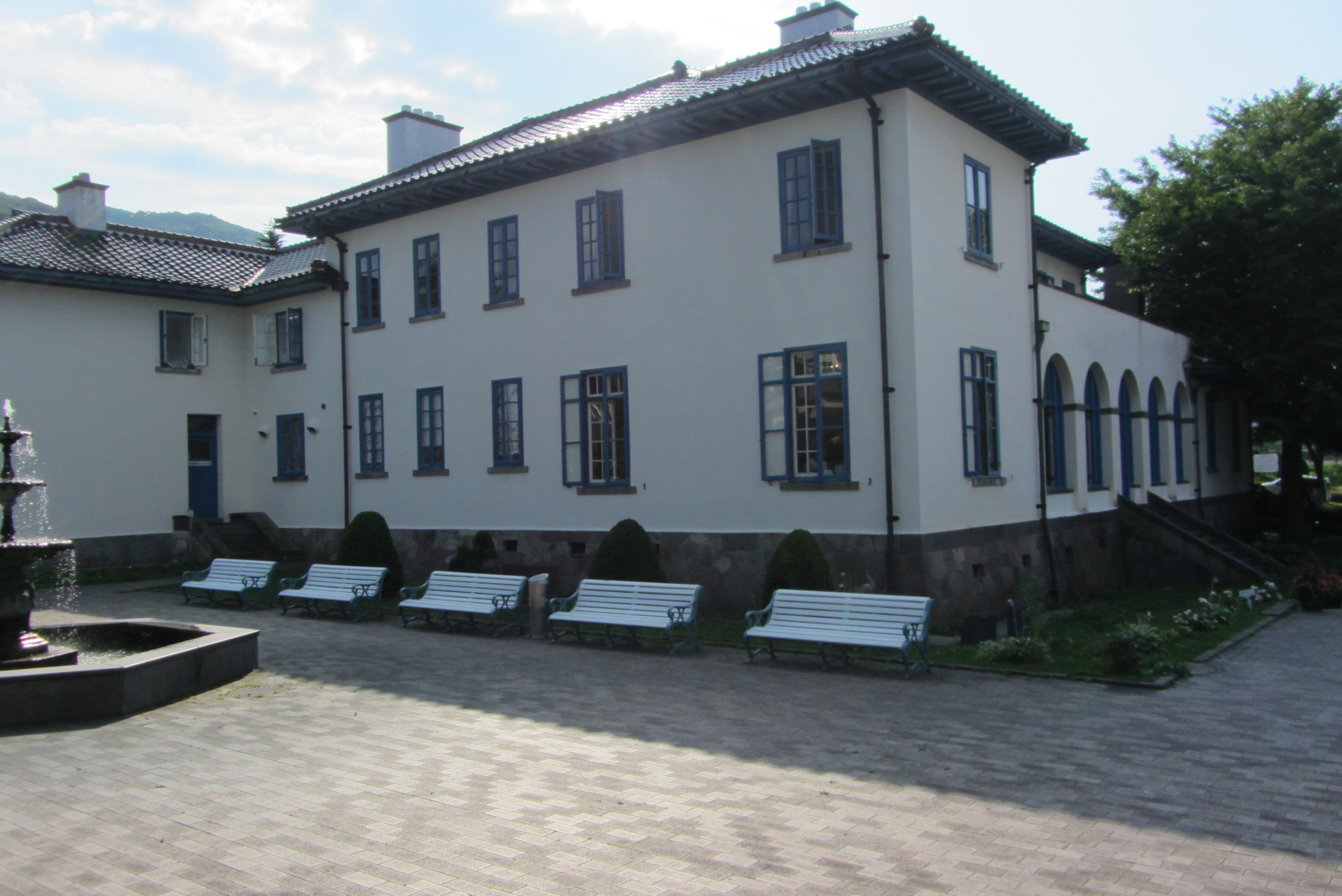
A new British Consulate opened for business in 1863, and Richard Eusden assumed consular duties in 1867, serving here until 1880. He was by far the most effective British consul in Hakodate. Both he and his wife became involved in the community; she helped create the city’s public garden. Over the years several fires damaged the consulate and it burned down in 1907. brit-faroblA few years later, the British government’s Shanghai Construction Bureau built a new consulate, a two-story-high tile-roofed structure on a site a few blocks away. This building still exists, looking rather like a large bungalow transplanted to Asia. Nowadays it is open to tourists, featuring interesting historical exhibits about early western experiences in Hakodate, an English tea room and a souvenir shop carrying articles from Britain. The British ceased consular operations in Hakodate in 1934.

The foreign consuls in Hakodate acted as judicial officials. When an American, Charles H. Smith, was charged in the death of a Japanese, the American, English and Russian consuls, the Hakodate bugyo and other Japanese and western men sat at the court and agreed that the defendant was not guilty, for he had shot in the darkness at a burglar.

Hakodate at different times had consulates representing not only Russia, the United States and Great Britain, but also France, the Netherlands, Portugal, Germany, Switzerland, Denmark, Italy, Austria, Hungary and Spain, though these other nations were mostly represented by men who were consuls of other countries. Even Hawaii, when it was an independent nation, briefly had consular representation in Hokkaido. The foreigners perceived Hakodate as a safe, if sleepy place; they did not feel the need for weapons in Hakodate. “We do not go armed as all foreigners do in Yedo, wrote E. E. Rice and, while Yokohama had a specific area set aside for foreign settlement, Hakodate featured no special area for foreigners, though the various consulates were not far from each other.

Leave a comment

Filed under Britain, Europe, Japan, Russia, U.S.

Religion Sparked the Crimean War

From The Crimean War: A History, by Orlando Figes (Metropolitan, 2011), Kindle Loc. 260-275:

In August 1851 the French formed a joint commission with the Turks to discuss the issue of religious rights. The commission dragged on inconclusively as the Turks carefully weighed up the competing Greek and Latin claims. Before its work could be completed, La Valette proclaimed that the Latin right was ‘clearly established’, meaning that there was no need for the negotiations to go on. He talked of France ‘being justified in a recourse to extreme measures’ to support the Latin right, and boasted of ‘her superior naval forces in the Mediterranean’ as a means of enforcing French interests.

It is doubtful whether La Valette had the approval of Napoleon for such an explicit threat of war. Napoleon was not particularly interested in religion. He was ignorant about the details of the Holy Lands dispute, and basically defensive in the Middle East. But it is possible and perhaps even likely that Napoleon was happy for La Valette to provoke a crisis with Russia. He was keen to explore anything that would come between the three powers (Britain, Russia, Austria) that had isolated France from the Concert of Europe and subjected it to the ‘galling treaties’ of the 1815 settlement following the defeat of his uncle, Napoleon Bonaparte. Louis-Napoleon had reasonable grounds for hoping that a new system of alliances might emerge from the dispute in the Holy Lands: Austria was a Catholic country, and might be persuaded to side with France against Orthodox Russia, while Britain had its own imperial interests to defend against the Russians in the Near East. Whatever lay behind it, La Valette’s premeditated act of aggression infuriated the Tsar, who warned the Sultan that any recognition of the Latin claims would violate existing treaties between the Porte and Russia, forcing him to break off diplomatic relations with the Ottomans. This sudden turn of events alerted Britain, which had previously encouraged France to reach a compromise, but now had to prepare for the possibility of war.

The war would not actually begin for another two years, but when it did the conflagration it unleashed was fuelled by the religious passions that had been building over centuries.

1 Comment

Filed under Austria, Britain, France, nationalism, religion, Russia, Turkey, war

Crimea as Religious Battlefield

From The Crimean War: A History, by Orlando Figes (Metropolitan, 2011), Kindle Loc. 459-495:

But it was in the Crimea [even more than the Caucasus] that the religious character of Russia’s southern conquests was most clear. The Crimea has a long and complex religious history. For the Russians, it was a sacred place. According to their chronicles, it was in Khersonesos, the ancient Greek colonial city on the south-western coast of the Crimea, just outside modern Sevastopol, that Vladimir, the Grand Prince of Kiev, was baptized in 988, thereby bringing Christianity to Kievan Rus’. But it was also home to Scythians, Romans, Greeks, Goths, Genoese, Jews, Armenians, Mongols and Tatars. Located on a deep historical fault-line separating Christendom from the Muslim world of the Ottomans and the Turkic-speaking tribes, the Crimea was continuously in contention, the site of many wars. Religious shrines and buildings in the Crimea themselves became battlefields of faith, as each new wave of settlement claimed them as their own. In the coastal town of Sudak, for example, there is a St Matthew church. It was originally built as a mosque, but subsequently destroyed and rebuilt by the Greeks as an Orthodox church. It was later converted into a Catholic church by the Genoese, who came to the Crimea in the thirteenth century, and then turned back into a mosque by the Ottomans. It remained a mosque until the Russian annexation, when it was reconverted into an Orthodox church.

The Russian annexation of the Crimea had created 300,000 new imperial subjects, nearly all of them Muslim Tatars and Nogais. The Russians attempted to co-opt the local notables (beys and mirzas) into their administration by offering to convert them to Christianity and elevate them to noble status. But their invitation was ignored. The power of these notables had never been derived from civil service but from their ownership of land and from clan-based politics: as long as they were allowed to keep their land, most of them preferred to keep their standing in the local community rather than serve their new imperial masters. The majority had ties through kin or trade or religion to the Ottoman Empire. Many of them emigrated there following the Russian takeover.

Russian policy towards the Tatar peasants was more brutal. Serfdom was unknown in the Crimea, unlike most of Russia. The freedom of the Tatar peasants was recognized by the new imperial government, which made them into state peasants (a separate legal category from the serfs). But the continued allegiance of the Tatars to the Ottoman caliph, to whom they appealed in their Friday prayers, was a constant provocation to the Russians. It gave them cause to doubt the sincerity of their new subjects’ oath of allegiance to the tsar. Throughout their many wars with the Ottomans in the nineteenth century, the Russians remained terrified of Tatar revolts in the Crimea. They accused Muslim leaders of praying for a Turkish victory and Tatar peasants of hoping for their liberation by the Turks, despite the fact that, for the most part, until the Crimean War, the Muslim population remained loyal to the tsar.

Convinced of Tatar perfidy, the Russians did what they could to get their new subjects to leave. The first mass exodus of Crimean Tatars to Turkey occurred during the Russo-Turkish war of 1787–92. Most of it was the panic flight of peasants frightened of reprisals by the Russians. But the Tatars were also encouraged to depart by a variety of other Russian measures, including the seizure of their land, punitive taxation, forced labour and physical intimidation by Cossack squads. By 1800 nearly one-third of the Crimean Tatar population, about 100,000 people, had emigrated to the Ottoman Empire with another 10,000 leaving in the wake of the Russo-Turkish war of 1806–12. They were replaced by Russian settlers and other Eastern Christians: Greeks, Armenians, Bulgarians, many of them refugees from the Ottoman Empire who wanted the protection of a Christian state. The exodus of the Crimean Tatars was the start of a gradual retreat of the Muslims from Europe. It was part of a long history of demographic exchange and ethnic conflict between the Ottoman and Orthodox spheres which would last until the Balkan crises of the late twentieth century.

The Christianization of the Crimea was also realized in grand designs for churches, palaces and neoclassical cities that would eradicate all Muslim traces from the physical environment. Catherine envisaged the Crimea as Russia’s southern paradise, a pleasure-garden where the fruits of her enlightened Christian rule could be enjoyed and exhibited to the world beyond the Black Sea. She liked to call the peninsula by its Greek name, Taurida, in preference to Crimea (Krym), its Tatar name: she thought that it linked Russia to the Hellenic civilization of Byzantium. She gave enormous tracts of land to Russia’s nobles to establish magnificent estates along the mountainous southern coast, a coastline to rival the Amalfi in beauty; their classical buildings, Mediterranean gardens and vineyards were supposed to be the carriers of a new Christian civilization in this previously heathen land.

Leave a comment

Filed under migration, nationalism, religion, Russia, Turkey, war

Catherine the Great Greek Wannabe

From The Crimean War: A History, by Orlando Figes (Metropolitan, 2011), Kindle Loc. 333-351:

More than any other Russian ruler, Catherine identified with the Greek cause. Under the growing influence of her most senior military commander, statesman and court favourite Prince Grigory Potemkin, Catherine even dreamed of re-creating the old Byzantine Empire on the ruins of the Ottoman. The French philosopher Voltaire, with whom the Empress corresponded, addressed her as ‘votre majesté impériale de l’église grecque’, while Baron Friedrich Grimm, her favourite German correspondent, referred to her as ‘l’Impératrice des Grecs’. Catherine conceived this Hellenic empire as a vast Orthodox imperium protected by Russia, whose Slavonic tongue had once been the lingua franca of the Byzantine Empire, according (erroneously) to the first great historian of Russia, Vasily Tatishchev. The Empress gave the name of Constantine – after both the first and the final emperor of Byzantium – to her second grandson. To commemorate his birth in 1779, she had minted special silver coins with the image of the great St Sophia church (Hagia Sophia) in Constantinople, cruelly converted into a mosque since the Ottoman conquest. Instead of a minaret, the coin showed an Orthodox cross on the cupola of the former Byzantine basilica. To educate her grandson to become the ruler of this resurrected Eastern Empire, the Russian Empress brought nurses from Naxos to teach him Greek, a language which he spoke with great facility as an adult.

It was always unclear how serious she was about this ‘Greek Project’. In the form that it was drawn up by Count Bezborodko, her private secretary and virtual Foreign Minister, in 1780, the project involved nothing less than the expulsion of the Turks from Europe, the division of their Balkan territories between Russia and Austria, and the ‘re-establishment of the ancient Greek empire’ with Constantinople as its capital. Catherine discussed the project with the Austrian Emperor Joseph II in 1781. They agreed on its desirability in an exchange of letters over the next year. But whether they intended to carry out the plan remains uncertain. Some historians have concluded that the Greek project was no more than a piece of neoclassical iconography, or political theatre, like the ‘Potemkin villages’, which played no real part in Russia’s foreign policy. But even if there was no concrete plan for immediate action, it does at least seem fairly clear that the project formed a part of Catherine’s general aims for the Russian Empire as a Black Sea power linked through trade and religion to the Orthodox world of the eastern Mediterranean, including Jerusalem.

Leave a comment

Filed under Greece, language, nationalism, religion, Russia, Turkey

The Russian Empire as Orthodox Crusade

From The Crimean War: A History, by Orlando Figes (Metropolitan, 2011), Kindle Loc. 276-288:

More than any other power, the Russian Empire had religion at its heart. The tsarist system organized its subjects through their confessional status; it understood its boundaries and international commitments almost entirely in terms of faith.

In the founding ideology of the tsarist state, which gained new force through Russian nationalism in the nineteenth century, Moscow was the last remaining capital of Othodoxy, the ‘Third Rome’, following the fall of Constantinople, the centre of Byzantium, to the Turks in 1453. According to this ideology, it was part of Russia’s divine mission in the world to liberate the Orthodox from the Islamic empire of the Ottomans and restore Constantinople as the seat of Eastern Christianity. The Russian Empire was conceived as an Orthodox crusade. From the defeat of the Mongol khanates of Kazan and Astrakhan in the sixteenth century to the conquest of the Crimea, the Caucasus and Siberia in the eighteenth and nineteenth centuries, Russia’s imperial identity was practically defined by the conflict between Christian settlers and Tatar nomads on the Eurasian steppe. This religious boundary was always more important than any ethnic one in the definition of the Russian national consciousness: the Russian was Orthodox and the foreigner was of a different faith.

Religion was at the heart of Russia’s wars against the Turks, who by the middle of the nineteenth century had 10 million Orthodox subjects (Greeks, Bulgarians, Albanians, Moldavians, Wallachians and Serbs) in their European territories and something in the region of another 3 to 4 million Christians (Armenians, Georgians and a small number of Abkhazians) in the Caucasus and Anatolia.

Leave a comment

Filed under nationalism, religion, Russia, Turkey

Reactions to Russia Annexing the Crimea, 1783

From The Crimean War: A History, by Orlando Figes (Metropolitan, 2011), Kindle Loc. 403-410:

The Russian annexation of the Crimea, in 1783, was a bitter humiliation for the Turks. It was the first Muslim territory to be lost to Christians by the Ottoman Empire. The Grand Vizier of the Porte reluctantly accepted it. But other politicians at the Sultan’s court saw the loss of the Crimea as a mortal danger to the Ottoman Empire, arguing that the Russians would use it as a military base against Constantinople and Ottoman control of the Balkans, and they pressed for war against Russia. But it was unrealistic for the Turks to fight the Russians on their own, and Turkish hopes of Western intervention were not great: Austria had aligned itself with Russia in anticipation of a future Russian-Austrian partition of the Ottoman Empire; France was too exhausted by its involvement in the American War of Independence to send a fleet to the Black Sea; while the British, deeply wounded by their losses in America, were essentially indifferent (if ‘France means to be quiet about the Turks’, noted Lord Grantham, the Foreign Secretary, ‘why should we meddle? Not time to begin a fresh broil’).

Leave a comment

Filed under Austria, Britain, France, religion, Russia, Turkey, war

Warlordism in Ukraine?

On 30 June, Walter Russell Mead’s blog at The American Interest carried a post on The Sad Status Quo in Ukraine, responding to “must-read” analytical reporting in the Wall Street Journal (behind a paywall). It suggests that Ukraine may be entering an era of Warlordism.

Focusing on the person of one Ihor Kolomoisky, the banking tycoon appointed as Governor of the Dnipropetrovsk region earlier this year. Kolomoisky is reportedly spending as much as $10 million a month to field a well-equipped fighting force a third the size of Ukraine’s own army, with his banking businesses looking to profit handsomely with European integration. His tactics are bare-knuckled, but effective: Dnipropetrovsk had some pro-Russian activism earlier this year, but it quickly dissipated …

In the Warsaw Pact and ex-Soviet countries that moved toward the EU and NATO, the gradual imposition of European law led to a process of state building. This has gone farther in some places than in others—Bulgaria, Romania and some of the ex-Yugoslav republics have made less progress than some others—but states have been built that, with corruption here and there, generally speaking work pretty well. But the farther east you go, the more another model was adopted: a single powerful person ends up establishing himself as the center of a new state. Some of the dictatorships in Central Asia are like this, and Putin has adopted a more advanced form of this in Moscow. Instead of oligarchs, there are autocrats or near-autocrats. Again, think feudal Europe, with a powerful ruler crushing the nobles and establishing firm central control.

Ukraine finds itself somewhere in the middle. There has not been a successful Western-oriented state-building process that creates the kind of institutions and political parties that a modern capitalist society needs. But at the same time, no single oligarch or strongman has broken the power of the rest, establishing himself as the Putin of Kiev….

Ironically, what Putin wants and the oligarchs want is probably similar now: enough Western support for rump Ukraine so it doesn’t fall completely under Russia’s control, but stopping well short of forcing major, deep reform on Ukraine. Putin can live with this because he has got Crimea and a lot of economic and political influence—and because the West will keep funneling enough cash to Russia to pay Ukraine’s gas bill. Ukraine’s oligarchs will once again have used West and East against each other to maintain a precarious independence. And Western leaders can tell themselves that they’ve achieved a glorious victory because they’ve kept Putin out of Kiev.

Leave a comment

Filed under economics, military, nationalism, Russia, Ukraine