Category Archives: religion

Exorcising Radical Islamist Demons in Indonesia

In Tuesday’s Opinion Journal, Bret Stephens profiles an Indonesian who is attempting to preserve the traditions of religious tolerance and syncretism long characteristic of Indonesia.

SENDANG AYU, Indonesia–In the fall of 2005, Abdul Munir Mulkhan returned to his childhood village to exorcise a demon.

Belief in the spirit world persists in this corner of southern Sumatra, as it does throughout most of Indonesia. In this case, however, the demon took human form as an itinerant Islamic preacher named Mun Faasil. He had appeared as if from nowhere the year before and had promptly set about “purifying” the villagers’ religious practices. For instance, he objected to sacrificing water buffalo (a local practice) instead of sheep (an Arab one) for the annual feast of Eid ul-Adha. He also disapproved of the villagers’ custom of giving couples an envelope of cash on their wedding day, on the grounds that there was no Quranic basis for it.

What happened next is a portrait-in-miniature of the assault being waged against traditional Indonesian Islam by its totalitarian variant. “Mun Faasil’s speeches created a crisis of faith,” recalls a village elder. “One group started implying that the others were not true believers.” Things got worse when the preacher began extolling the Prosperous Justice Party (PKS), a radical Islamist party modeled on Egypt’s Muslim Brotherhood, while attacking the Muhammadiyah, the century-old, 30 million-strong, apolitical Islamic social movement to which most of the villagers belong. Soon PKS cadres started arriving in the village.

It was at this point that some of the villagers called on Mr. Mulkhan, 60, to offer a “clarification” on the true teachings of Islam. They were fortunate in their native son. A leading scholar of Islamic theology and history, Mr. Mulkhan had only recently stepped down as vice secretary of the Muhammadiyah and continues to wield influence as a reformer within the organization. It did not take much to persuade his old neighbors that good Muslims do not use narrow theological pretexts to condemn fellow Muslims as infidels. Mun Faasil and his cadres were told to go.

For Mr. Mulkhan, however, what happened in Sendang Ayu was not the end of the matter but only the beginning. If the PKS could reach a remote rural community of 150 people, he reasoned, where had they not penetrated? The problem was compounded by the PKS’s use of clandestine cells to infiltrate the Muhammadiyah’s institutions–hospitals, universities, schools, mosques, charities, student associations–and recruit new members. “We had a situation where people in positions of trust were suddenly revealing themselves as PKS,” he says. “If we had allowed this to continue they would have consolidated their position with a purge of their opponents.”

The rise of the PKS nationally is itself a thing to marvel at. Barely eight years old, it won just 7% of the vote in the 2004 elections and has made itself conspicuous with its support of radical cleric Abu Bakir Bashir. Yet it has already managed to seize key institutions of prestige and patronage throughout Indonesia, including the speakership of the national Parliament, the ministry of agriculture and key municipal posts. As with Hamas in the Palestine Authority, it has burnished a reputation for incorruptibility.

But the Muhammadiyah, with its immense network of social services, is the organization the PKS must first seize if–in the spirit of Antonio Gramsci’s “long march through the institutions”–it is to achieve its longer-term political objectives. As a takeover target, it also helps the PKS that the Muhammadiyah has espoused a relatively strict form of Islam, making its members all the more susceptible to tarbiyeh, the form of Islamic indoctrination practiced by the Muslim Brotherhood and adopted by the PKS.

Leave a comment

Filed under Indonesia, religion

New Religious Terms in Two Pacific Languages

How have local languages in the Pacific handled the new lexical requirements of foreign religious traditions? Much seems to depend on the language and sect of the first foreign evangelists.

The island of Yap in Micronesia was first evangelized by Spanish Catholics long before German Protestants arrived about 1898. Yapese is still largely Catholic, and religious loans are mostly from Spanish. Shinto seems to have left no lexical traces from the Japanese colonial era (1914–1945), but loanwords from Japanese remain well represented in the more profane contexts of the new clothing, containers, diseases, foods, tools, and means of transport introduced during those decades.

The following examples of Christian terms do considerable violence to the vowels of Yap’s new orthography, which would take too long to explain—and would also make the words look more Dutch than Spanish.

  • bibliya ‘Bible’ (Span.)
  • galasya ‘church’ (Span.)
  • kiristiyano ‘Christian’ (Span.)
  • komunyon ‘communion’ (Span.)
  • kuruth ‘cross, crucifix’ (Span.)
  • infiyarno ‘hell’ (Span.)
  • misa ‘(Catholic) mass’ (Span.)
  • padrey ‘priest’ (Span.)
  • rosaryo ‘rosary’ (Span.)
  • baynag ‘Christmas’ (Ger. Weihnacht)
  • næp’ ni-b thothup ‘Christmas Eve, Holy Night’ (lit. ‘night that’s holy’)

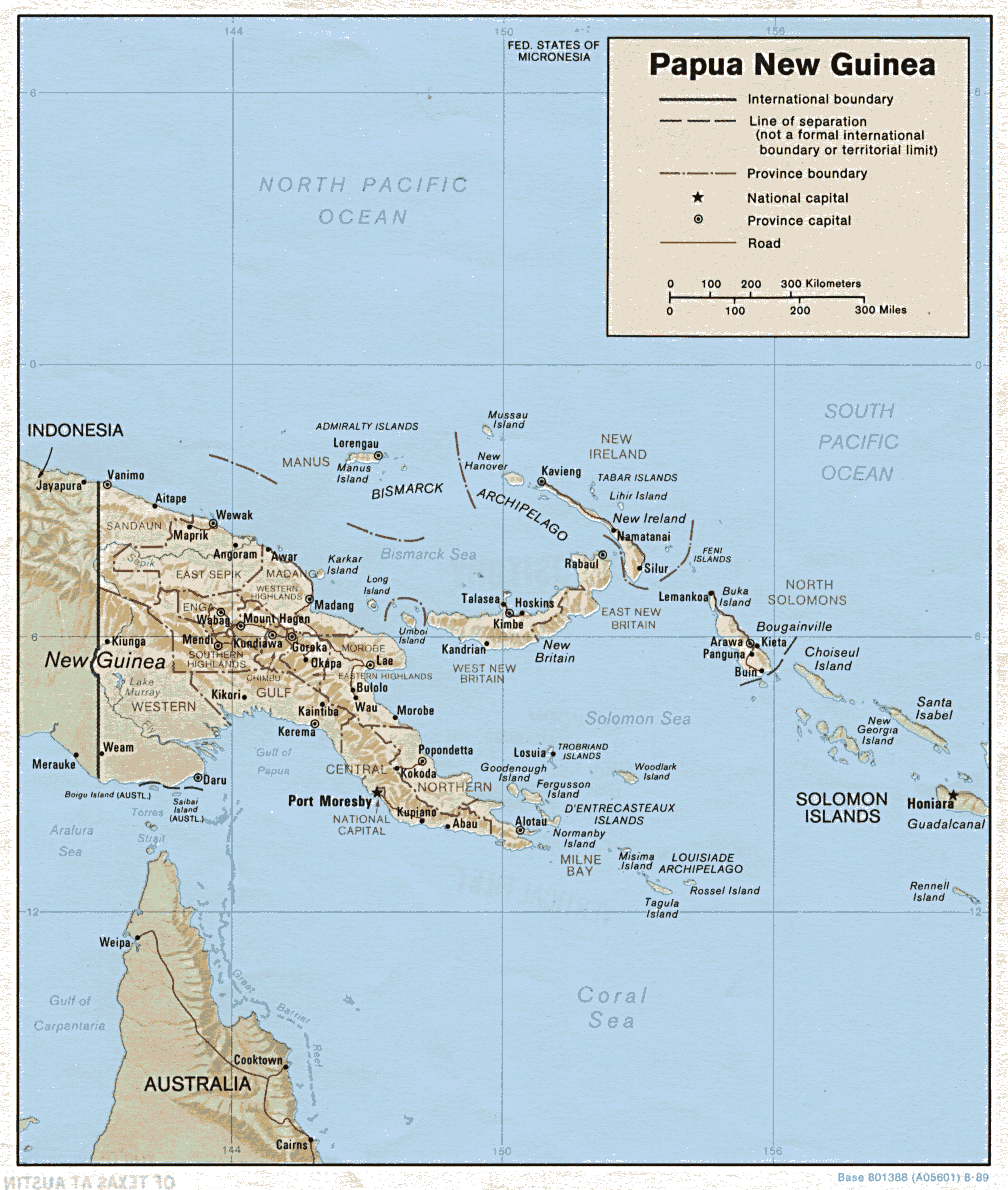
Morobe Province in Papua New Guinea was evangelized by German Lutheran missionaries beginning in 1886. The Germans adapted two local languages for evangelical and educational purposes, Jabêm for the Austronesian circuit along the coast and islands, and Kâte for the Papuan circuit in the interior of the Huon Peninsula. (Many, if not most, of the other interior languages of Morobe Province have since proven to be Austronesian, not Papuan.)

The German Lutheran strategy for communicating new Christian concepts was to adapt the local vernaculars rather than to introduce foreign words—not unlike the strategy of Martin Luther himself during the Protestant Reformation. The following examples are from Jabêm, in whose German-inspired orthography j represents a palatal glide (like English y), ŋ represents a velar nasal (like English -ng), and -c represents a glottal stop.

  • biŋsu ‘foreign missionary’ (also ‘admonition, commandment’)
  • biŋ gôliŋ ‘parable, proverb’ (lit. ‘talk steer’)
  • gôlôàc ‘congregation’ (also ‘clan, relatives, kinfolk’)
  • gêbêcauc dabuŋ ‘Christmas Eve’ (lit. ‘night holy/taboo’)
  • moasiŋ dabuŋ ‘holy communion’ (lit. ‘benefit/blessing holy’)
  • ŋalau dabuŋ ‘Holy Spirit’
  • kêdôŋwaga ‘teacher’ (lit. ‘3sg-teach-agent’)
  • sakiŋwaga ‘minister, servant’ (lit. ‘service-agent’)
  • jàeŋwaga ‘catechist, local missionary’ (lit. ‘message-agent’)

SOURCES: Yapese–English Dictionary, by John Thayer Jensen with the assistance of John Baptist Iou, Raphael Defeg, Leo David Pugram (U. Hawai‘i Press, 1977); Jabêm–English Dictionary, rev. by J. F. Streicher (Pacific Linguistics, 1982).

Leave a comment

Filed under Germany, language, Micronesia, Pacific, Papua New Guinea, religion, Spain

The Mennonites of Filadelfia, Paraguay

Last week, reader Scott Rogers sent me links to interesting accounts of the Mennonite diaspora in Paraguay.

Mennonite settlers came to Paraguay from Germany, Canada, Russia and other countries for a number of reasons: religious freedom, the chance to practice their beliefs without hindrance, the quest for land. Although German immigrants had settled in Paraguay before the turn of the 20th century, it wasn’t until the 1920’s and 30s that many, many more arrived.

Many of the immigrants from Russia were fleeing from the ravages of the Bolshevik Revolution and the later Stalin repressions. They traveled to Germany and to other countries, and eventually joined the emigration to Paraguay.

Paraguay welcomed the emigrants….

The Mennonites had the reputation of being excellent farmers, hard-workers, and disciplined in their habits. In addition, the rumor of oil deposits in the Chaco, and Bolivia’s encroachment on that area, which resulted in the 1932 War of the Chaco, made it a political necessity to populate the region with Paraguayan citizens. (At the end of the war, Bolivia had lost much of its territory back to Paraguay, but both countries suffered loss of life and credibility.)

In return for religious freedom, exemption from military service, the right to speak German in schools and elsewhere, the right to administer their own educational, medical, social organizations and financial institutions, the Mennonites agreed to colonize an area thought to be inhospitable and unproductive due to the lack of water. The 1921 law passed by the Paraguayan congress in effect allowed the Mennonites to create a state within the state of Boqueron.

Three main waves of immigration arrived:

  • a Canadian group from Manitoba founded the the Menno colony in 1926-1927
  • a group from the Ukraine and the area of the Amour river came via China and created the Fernheim colony in 1930
  • a group of Russian refugees founded the Neuland colony in 1947

Conditions were difficult for the few thousand arrivals. An outbreak of typhoid killed many of the first colonists. The colonists persisted, finding water,creating small cooperative agricultural communities, cattle ranches and dairy farms. Several of these banded together and formed Filadelfia in 1932. Filadelfia became an organizational, commercial and financial center. The German-language magazine Mennoblatt founded in the early days continues today and a museum in Filadelfia displays artifacts of the Mennonite travels and early struggles. The area supplies the rest of the country with meat and dairy products.

My wife’s paternal line were Germans from the Ukraine who emigrated to lands around Menno, South Dakota, beginning in the 1880s. If not actual Mennonites, they were certainly pietists.

Read more about Paraguay’s Mennonites here.

1 Comment

Filed under Germany, Paraguay, religion, Russia

Free of Faith at Last! Now What?

Amitai Etzioni thinks the West needs a spiritual surge.

The spell of the Enlightenment so profoundly distracts many Western opinion makers that the worldwide rise of religion is either ignored or it is viewed as major threat rather than an important source for the re-moralization of society. True, many observers have noted, especially after September 11, that the rise of a religiously ferocious Islam is not limited to the Arab world, but is very much in evidence in all Muslim nations from Indonesia to Turkey. But few have paid mind to the importance of the crowded churches in former communist countries in Eastern Europe and Russia; to the many scores of millions who are finding religion in China; and to the rapidly growing followings of a variety of religious denominations, cults and sects all over the world.

The global significance of these developments is highlighted in what otherwise would be an almost trivial development: the U.S. Agency for International Development is revising the textbooks used in Afghan and Iraqi schools. Its staff has been tearing out of these texts the passages that extol the Taliban and Saddam Hussein, but they have been stymied in finding what other values to instill, deciding instead to focus on teaching math, science and English. However, such secular teachings do not address profound issues that religions do speak to: What is a virtuous life? What are our obligations to our family members, friends and other community members? Is death a threatening end we all must fear or merely a passing to a better place? Are we truly better off as we command ever more goods? And can those of us who do not “make it” in the marketplace—still find deep sources of self-respect?

Western secularism largely avoids these issues. Its consumer hedonism has an appeal of its own, but more and more people find that they cannot keep up with the Joneses. Hence the growing alienation in the countryside and among urban migrants—among the majority of the people—in developing nations such as India and China. The West does well when it extols the dignity of the individual, the value of autonomy and human rights. However these are basically ideologies that serve as compelling antidotes to excessive governmental intrusions and celebrate self-government. They do not address the questions that a person faces once he is free to choose, free to set his own course of destiny and purpose.

The lack of responses to these transcendental questions is the main reason the West will continue to fall behind in the global clash of belief systems.

via Peaktalk

Well, I don’t feel I need a spiritual surge. I feel like I got all the religion I’ll ever need during my formative years. But perhaps people who got no religion at all during their youth need some remedial education. I don’t know. The “secular West” these days seems to contain more than an ample supply of pseudosecular religion substitutes (secular saccharins!), many of them redolent of medieval European pietism and demonology—and every bit as condescending and self-righteous as the Pharisees or Sadducees.

Leave a comment

Filed under religion

What Distinguishes Coastal Peoples?

The December 2006 issue of the Journal of World History (Project Muse subscription required) starts off with an interesting article by Michael N. Pearson on littoral society.

Who are the people who live on or near the beach, those who inhabit the coastal zone, not just the beach? They have been called the shore folk, or sea nomads, or members of a littoral society. The place of port cities in littoral society is a matter of dispute. In terms of location they may qualify, though Ashin Das Gupta in his classic book on Surat made an important distinction. “To begin with there was coastal Gujarat, marshy, irregular, often broken by estuaries of the rivers and dotted with tidal flats which were submerged at high tide…. It was peopled by the truly maritime men who fished and who sailed the vessels on which trade depended. The coastal cities usually stood back a little.” On our other two criteria, occupation and culture, definition is more difficult, and things change over time. In premodern times port cities had more of a whiff of ozone about them than is the case today. The occupations of many of the inhabitants were intricately connected to the foreland and hinterland, thus making these people truly littoral. However, their economic functions and influences extended much further than their fellows on the coast, with much more extended forelands and hinterlands. Culturally, the port cities, where populations are more concentrated, are more exposed to external influences, such as élite norms from the inland, or the attentions of seafaring scholars and religious folk. Ibn Battuta traveled around the Indian Ocean, calling at port cities and being recognized for his scholarship. In return he tried to improve the quality of Islam in these places.

One way to separate out littoral from port city is to insist that littoral people live on the coast and seldom travel. Some people in the port cities—sailors, merchants—indeed go to sea and have important maritime experiences, but my concern is with fisherfolk, or people who tend the lighters that go out to meet the big ships. These folk live on shore, but work on the sea: they are very precisely littoral.

Greg Dening wrote, “Beaches are beginnings and endings. They are frontiers and boundaries of islands. For some life forms the division between land and sea is not abrupt but for human beings beaches divide the world between here and there, us and them, good and bad, familiar and strange”—an extravagant claim indeed, even if meant metaphorically. I would argue exactly the opposite, as does Jan Heesterman. He stressed that “The littoral forms a frontier zone that is not there to separate or enclose, but which rather finds its meaning in its permeability.” Braudel wrote evocatively about coastal society, stressing that it was as much land oriented as sea oriented. The life of the coast of the Mediterranean “is linked to the land, its poetry more than half-rural, its sailors may turn peasant with the seasons; it is the sea of vineyards and olive trees just as much as the sea of the long-oared galleys and the round-ships of merchants, and its history can no more be separated from that of the lands surrounding it than the clay can be separated from the hands of the potter who shapes it.”

Several modern scholars have described the shore folk of the Indian Ocean. John Middleton focused on the east African coast. “Part of the coast is the sea: the two cannot be separated. The Swahili are a maritime people and the stretches of lagoon, creek, and open sea beyond the reefs are as much part of their environment as are the coastlands. The sea, rivers, and lagoons are not merely stretches of water but highly productive food resources, divided into territories that are owned by families and protected by spirits just as are stretches of land. The Swahili use the sea as though it were a network of roads.” The very term “Swahili” means “shore folk,” those who live on the edge of the ocean. As Randall L. Pouwels has it, Swahili culture was “a child of its human and physical environment, being neither wholly ‘African’ nor ‘Arab,’ but distinctly ‘coastal,’ the whole being greater than the sum of its parts.”…

Certain languages achieved wide currency, this providing commonality around the shores of the Indian Ocean. In the earlier centuries it was Arabic. There are some five thousand words of Arabic influence in Malay, and more than that in Swahili, and about 80 percent of these are the same in Malay and Swahili, so that we have a “corpus of travelling Arabic words.” Later, a sort of nautical Portuguese and, today, some variant of English, have achieved a quasi-universal status.

Languages know no boundaries, and this also applies to coastal people. For most of history they knew little of political borders. Smuggling was an occupation, not a crime, as was the plunder of ships driven ashore. Dian Murray, an expert on piracy, wrote of a “water world,” where boundaries were indistinct, just like Villiers’s delta region. Robert Antony recently modified Murray slightly, writing of a water world of “shared social, economic, and cultural activities, and patterns that are not easily defined and delimited by ethnic and linguistic differences or by national boundaries.” He and Murray are concerned with the southern China coast, but their findings apply precisely to other coasts.

In a water world, coastal religion is also distinctive. Littoral people, living in a more cosmopolitan environment than those inland, are more likely to convert. In the case of the Indian Ocean, the cosmopolitan, international aspect of Islam has often been cited as a prime motivation for conversion, and while this applied most strongly in the port cities, it also was evident on the coasts between them. Coastal people especially found their indigenous beliefs, localized and very specific, to be inadequate as their world expanded. When they were exposed to a universal faith—Islam as exemplified by visitors from the north—the attraction was obvious, and the results can be seen all over the Indian Ocean world from the early modern period onward. There were and are widespread Islamic religious connections around the coasts. In Zanzibar one group uses a certificate of authenticity and authority issued in Indonesia. In Mayotte, off Madagascar, South Asian Islamic reformers are active. A devotional text in Indonesia was probably originally written in Arabic, either in the Middle East or in Indonesia itself, and is now available in Javanese and Acehinese. In Zanzibar Islamic books, including Qur’ans, come from Egypt, Iran, Saudi Arabia, India, and Pakistan.

Leave a comment

Filed under Africa, India, Indonesia, language, religion

Pamuk on Religion and the Secular Elite

My first trip to a mosque helped confirm my prejudices about religion in general and Islam in particular. It was almost by chance: One afternoon when there was no one home, Esma Hanım took me off to the mosque without asking anyone’s permission; she was not so much burning with a need to worship as tired of being inside. At Teşvikiye Mosque we found a crowd of twenty or thirty people—mostly owners of the small shops in the back streets or maids, cooks, and janitors who worked for the rich families of Nişantaşı; as they gathered on the carpets, they looked less like a congregation of worshipers than a group of friends who had gathered to exchange notes. As they waited for the prayer time, they gossiped with one another in whispers. As I wandered among them during prayers, running off to the far corners of the mosque to play my games, none of them stopped to scold; instead, they smiled at me in the same sweet way most adults smiled at me when I was a young child. Religion may have been the province of the poor, but now I saw that—contrary to the caricatures in newspapers and my republican household—religious people were harmless.

Nevertheless, I was given to understand by the high-handed ridicule directed at them in the Pamuk Apartments that their good-hearted purity carried a price. It was making the dream of a modern, prosperous, westernized Turkey more difficult to achieve. As westernized, positivist property owners, we had the right to govern over these semiliterates, and we had an interest in preventing their getting too attached to their supersititions—not just because it suited us privately but because our country’s future depended on it. If my grandmother discovered that an electrician had gone off to pray, even I could tell that her sharp comment had less to do with the small repair job he had left unfinished than with the “traditions and practices” that were impeding “our national progress.”

The staunch disciples of Atatürk who dominated the press, their caricatures of black-scarved women and bearded reactionaries fingering prayer beads, the school ceremonies in honor of the Martyrs of the Republican Revolution—all reminded me that the nation-state belonged more to us than to the religious poor, whose devotion was dragging the rest of us down with them. But feeling at one with the mathematics and engineering fanatics in our own household, I would tell myself that our mastery did not depend on our wealth but on our modern western outlook. And so I looked down on families that were as rich as we were but not as western. Such distinctions became less tenable later on, when Turkey’s democracy had matured somewhat and rich provincials began flocking to Istanbul to present themselves to “society”; by then my father’s and my uncle’s business failures had taken their toll, subjecting us to the indignity of being outclassed by people who had no taste for secularism and no understanding of western culture. If enlightenment entitled us to riches and privilege, how were we to explain these pious parvenus? (At the time I knew nothing about the refinements of Sufism or the Mevlana or the great Persian heritage.) For all I knew, the new class denounced as “rich peasants” by the political left held views no different from those of our chauffeurs and cooks. If Istanbul’s westernized bourgeoisie gave support to the military interventions of the past forty years, never strenuously objecting to military interference in politics, it was not because it feared a leftist uprising (the Turkish left in this country has never been strong enough to achieve such a feat); rather, the elite’s tolerance of the military was rooted in the fear that one day the lower classes would combine forces with the new rich pouring in from the provinces to abolish the westernized bourgeois way of life under the banner of religion. But if I dwell any longer on military coups and political Islam (which has much less to do with Islam than is commonly thought), I risk destroying the hidden symmetry of this book.

SOURCE: Istanbul: Memories and the City, by Orhan Pamuk (Vintage, 2006), pp. 181-183

Leave a comment

Filed under religion, Turkey

An Evasive Brother of Martyrs in Afghanistan

Seyyed Kerbalahi joined me after dinner. His real name was Rasul. He was called Kerbalahi, he explained, because he had been to Kerbala in Iraq to visit the sacred Shia shrine of Imam Hussein twice in the late 1950s, once for three months and once for five. I asked him why he had not completed the Haj by going on to Mecca.

“It would have been too expensive.”

“But Mecca is quite close to Kerbala by the time you have gone from Afghanistan to Iraq.”

“It would have been a seven-day trip so I came home.”

He tuned the radio to a Pakistani channel broadcasting in Urdu. “Can you understand Urdu?” I asked.

“No,” he said. “I have put it on for your benefit.”

He then began praying. Every minute or so, he interrupted his prayer to throw out a comment such as, “Later I will arrange for someone to dry your socks.” Then he would start his prayers again from the beginning. I suggested gently that he finish his prayers before we spoke.

“But a guest is ordained by God,” he said reprovingly.

“Thank you,” I replied. “Well, there was something I wanted to ask you …”

“I am praying. We should talk later.”When he had finished, he picked up a large Koran and began to mumble over it and then glanced up and asked if I had any photographs.

I handed him the pictures of my family. He frowned at them briefly and handed them back.

“I have walked here from Herat,” I said.

“I’m reading the Koran and your Farsi is not good enough for a conversation,” he replied.

We sat in silence till I decided to lie down and sleep.

At dawn he began his lengthy prayers again. By the time he had finished, a crowd of villagers had gathered in the guest room. Seyyed Kerbalahi picked up my Dari-English dictionary and began looking at it a page at a time. Usually people who wanted to be seen reading my dictionary knew which way up to hold it. Seyyed Kerbalahi didn’t.

He then moved to another position in the room, carefully opened a sandalwood box, and unwrapped a different copy of the Koran. The morning continued with rambling prayers, a little browsing of the Koran, and occasional bad-tempered visits to his balcony to tell anyone who wanted to see him that he was too busy with his religious devotions to be disturbed. I imagined this was the pattern of most of Seyyed Kerbalahi’s days.

Finally I took my leave. On my way out I noticed two faded photographs on the guest room wall.

“They are my brothers,” he said, “martyrs … One was killed in Lal and one on the path to Yakawlang.” They were not dressed like most martyrs as Mujahidin but in neat Russian dress uniforms.

SOURCE: The Places in Between, by Rory Stewart (Harcourt, 2004), pp. 218-219

Leave a comment

Filed under Afghanistan, religion, Russia, war

A Quaker Transition to the Talkies

On New Year’s Day, my father turned 82. His Japanese driver’s license says he was born in the 14th year of Taisho. All during my childhood in Japan, his age advanced in parallel with the Showa reign year. Here’s a short, preliminary tribute to one of his best-honed skills:

Perhaps there’s an element of truth to my teasing claim that Dad left the Quakers to become a Baptist because he just couldn’t keep his mouth shut long enough. But that cheap hypothesis fails to explain why the rest of his siblings also abandoned their Quaker roots.

Of course, Dad didn’t leave all his Quaker values behind. Not even the value of silence. During Wednesday night prayer meetings at the First Baptist Church in Winchester, Virginia (my mother’s home church), where he served as associate pastor one furlough, he made some of the Baptists uneasy enough to speak up when he allowed periods of silent prayer to go on a little longer than they were used to.

But Dad does believe in the value of talk—for preaching, for teaching, for learning, for sharing, to be sure, but most of all for healing. That must be why he chose to concentrate on pastoral counseling at seminary and to serve as an institutional chaplain, rather than a church-planting evangelist, during his first two terms as a missionary in Japan. And later to teach pastoral care at Seinan (‘Southwestern’) Seminary in Fukuoka.

He does preach a good sermon, though. He doesn’t shout, thump the Bible, or silently wait for the Spirit to move him. Nor does he read a dry lecture on comparative theology or religious history. Instead, he keeps his sermons fairly short, fairly conversational, and almost always tells a story to get his message across. He knows that great truths are best conveyed by great stories. His homilies have surely come a long way since he practiced his first sermons while plowing, preaching temperance to the back end of a mule.

Leave a comment

Filed under family, religion

Baghdad Merchant at a Viking Funeral, A.D. 922

When the day arrived on which he and his slave-woman were to be burnt, I went down to the river where his ship lay. It had been dragged on to the shore, and four supporting poles had been cut for it from birch and other wood. Moreover, something that looked like their big wooden sheds had been placed around it. Then the ship was placed on the wooden scaffolding, and people began to walk up and down speaking to each other in a language I did not understand. The dead man was still in his grave as they had not removed him from it. Thereupon they brought a bench, put it in the ship and covered it with silk rugs and cushions with painted patterns from Byzantium. An old woman, whom they call ‘the Angel of Death’, spread the rugs on the bench. She was in charge of the sewing of the clothes for the dead man and in charge of the preparation of his body. She is also the one who kills the slave-women. I saw that she was an old giant of a woman, thickset and sombre of aspect.

When the people came to his grave, they first removed the soil from the wooden palisades and then the palisades. Then they dragged him out in the clothes he had died in. I noticed that he had turned black because of the great cold in that country. Together with him in the grave they had put silk, fruit and a stringed instrument. All of this was removed as well. Oddly, the man did not smell, and nothing had changed about him, except the colour of his skin. So they dressed him in trousers, top trousers, a kind of coat and mantle of painted silk with gold buttons, and on his head they put a cap of silk with sable fur. They carried him into the tent they had put up on the ship, where they placed him on the rug and supported him with the cushions….

Meanwhile, the slave-woman who wished to be killed was walking up and down, and she went into one after another of their tents, and the master of the tent had intercourse with her, saying ‘Tell your master that I only do this out of love for him.’… So they took her to the ship. There she took off the two armbands she was wearing and gave them to the old woman they call the Angel of Death, who was the one who was going to kill her. Then she took off her two ankle rings and gave them to the Angel of Death and her daughters. Thereupon they led her into the ship, but did not let her into the tent. Then the men came and they were carrying shields and wooden batons, and they handed her a beaker of nabîdh [a liquor]. She sang over it and drank it out. The interpreter said to me, ‘She is now taking leave of her friends with it.’ Thereupon another beaker was handed her. She took it and lingered somewhat longer over the song, but the old woman hurried her to make her drink it and enter the tent where her master was.

When I looked at her, she looked utterly confused. She wanted to go into the tent, but put her head between it and the ship. Then the old woman took hold of her head and got her into the tent, and the woman followed her. The men now began to beat the batons against the shields to drown the sound of her screams, so that the other girls should not get frightened and refuse to seek death with their masters. Then six men entered the tent, and they all had intercourse with her. Thereupon they put her next to her dead master. Two of them held her legs and two of them her hands. And the woman called the Angel of Death put a rope around her neck and gave it to two men for them to pull. Then she stepped forward with a dagger with a broad blade and thrust it between the ribs of the girl several times, while the two men strangled her with the rope so that she died.

The one who was next of kin to the dead man thereupon stepped forward. He picked up a piece of wood and set it alight. Then he walked backwards, with his back to the ship and his face to the audience, carrying the torch in one hand, while he held the other behind his back; he was naked. In this way they torched the wood they had placed under the ship, after they had put the slave-woman they had killed to rest next to her master. Then people arrived with wood and kindling. Everyone carried a piece of wood on fire at one end. This they threw on to the pyre, so that the fire caught first in the wood, then the ship, then the tent and the man and the slave-woman and everything in the ship. Thereupon a strong and terrible wind rose, so that the flames grew in strength and the fire blazed even more strongly.

Next to me was a man of al-rûs [the Viking settlers in Russia], and I heard him speaking to the interpreter who was with me. I asked the latter what he had said to him. The interpreter answered, ‘He said you Arabs are stupid.’ I asked why. He answered, ‘Because you throw the one you love and honour the most into the ground, and the soil and worms and bugs consume him. We on the other hand burn him in a moment, so that he goes to Paradise immediately.’ Then he roared with laughter. When I asked him why he laughed, he said, ‘The master of the dead man has sent the wind out of love for him to carry him away immediately.’

And really an hour had not passed before the ship, the wood, the slave-woman and the master had turned to ashes and dust of ashes. Thereupon they built in the place where the ship had stood something that resembled a round mound. In the centre of it they erected a large pole of birch. On it they wrote the name of the dead man and the King of al-rûs, and then they left.

SOURCE: Other Routes: 1500 Years of African and Asian Travel Writing, edited by Tabish Khair, Martin Leer, Justin D. Edwards, and Hanna Ziadesh (Indiana U. Press, 2005), pp. 277-280

Leave a comment

Filed under Europe, Islam, religion

An Irreligious Holy Warrior in Afghanistan

We saw a young boy drawing water and Abdul Haq threatened to kill him. The boy cried. Then Abdul Haq laughed and said, “I drove over the edge of this road three years ago, in a jeep. We crashed into the ditch where the boy is whining. The other six people in the car were killed. But I was thrown over a wall and survived because God loves me.”

An hour later we had to cross the Hari Rud. I took off my boots and overtrousers, tied them around my neck, and waded into the cold water. The river—which in a year of normal rainfall would be impassable without a ferry boat—was now barely two feet deep. Without speaking, Abdul Haq stopped on the bank and stooped, and Qasim climbed onto his back. Then Abdul Haq stepped into the stream, roaring like a bullfrog with delight at his strength and the shock of the cold. Having deposited Qasim on the farther shore, he returned and Aziz clambered on. Midway across, Aziz dropped the sleeping bags. Abdul Haq put him down in the water and charged after the bobbing sacks. When he caught them, he spun and danced on the shore like a paper puppet caught in the wind, shouting, “Man Ghaatar Hastam” (I am a mule). On the flats ahead, a camel loped easily across the sharp gravel.

I opened a packet of Iranian orange cream cookies and offered them to Qasim. He took one, sighed heavily, said, “Allah-u-Akbar” (God is Great), and put it in his mouth.

Abdul Haq looked at me and winked. Qasim, the oldest and least open of my three companions, was also it seemed the most religious. Abdul Haq described himself as a Mujahid, a holy warrior, and his leader, Ismail Khan, had fought an Islamic crusade to expel the atheist Russians before implementing Sharia law in Herat. But Abdul Haq was not very religious. In Iran young city types had talked to me about Nietzsche and said they were atheists. I never met an Afghan who called himself an atheist and Abdul Haq had never heard of Nietzsche. But during the time I was with Abdul Haq, he never prayed, never fasted, never paid a religious tithe, and had no intention of going on a pilgrimage to Mecca. Generally I only heard him refer to God when he fired his Kalashnikov. Then he would sing “Allah-u-Akbar” like a full-throated muezzin in the dawn call to prayer.

Abdul Haq took the packet of cookies from my hands, tipped it out onto a cloth to encourage us to eat more, and threw the wrapper over his shoulder. It was the only piece of trash on the desert plain and the silver foil glittered fiercely among the gentler colors of the soil.

SOURCE: The Places in Between, by Rory Stewart (Harcourt, 2004), pp. 76-77

Leave a comment

Filed under Afghanistan, religion, war