Category Archives: Pacific

Alex Golub on Unfulfilled Consumers in PNG

Another Pacific-area article that caught my fancy is Alex Golub‘s Who Is the “Original Affluent Society”? Ipili “Predatory Expansion” and the Porgera Gold Mine, Papua New Guinea in the latest issue of The Contemporary Pacific at Project Muse (subscription required). Here are a few paragraphs from the introduction and conclusion (some references removed).

In the 1970s, first-world fantasies of “ecologically noble savages” were key to the creation of alliances between indigenous groups, environmentalists, and affluent first-world publics. More recently, however, anthropologists have grown increasingly critical of such stereotypes of indigenous people. In areas as diverse as Amazonia, Australia, North America, and Indonesia, indigenous peoples find their political leverage derives from filling first-world fantasies that are often essentialized and stifling.

This dynamic has taken another interesting twist in Papua New Guinea. Unlike many Commonwealth countries, Papua New Guinea has no settler population, and, unlike many African states, it has no majority ethnic group. Furthermore, Australia’s administration of Papua New Guinea was both well meaning and under-resourced. As a result there has been little alienation of land and it is difficult to recognize Papua New Guineans as “indigenous people” separate from “settler” populations, as is typically done in Australia, Africa, and the New World. At the same time, however, Papua New Guinea is highly reliant on resource rents, and the activities of international logging, mining, and hydrocarbon companies present a picture of a David-and-Goliath struggle between local people and transnational capital that is comfortably familiar to many first-world activists.

Like scholars elsewhere, Melanesianists are increasingly dissatisfied with stereotypes of grassroots Papua New Guineans as ecologically noble savages. A growing literature has, for instance, emphasized the ways in which compensation claims for damage to the environment are part of a complex local politics. Glenn Banks has argued that compensation claims are often a way of expressing a sense of disenfranchisement by people outside of mining lease areas (2002), while Martha Macintyre and Simon Foale have argued convincingly that even for people within mining lease areas, claims of environmental damage are often expressions of dissatisfaction with social concerns couched in environmental idioms (2002).

But there is a danger that these responsible works could be misread by policy elites in Port Moresby, the national capital, who often see landowners as savages more nasty than noble. Papua New Guineans have one of the best track records in the world for extracting concessions from foreign developers and the national government, and the demands of landowners have become so strident that the overall perception nationwide is that they are corrupted opportunists who have given up their traditional culture in order to “go for money” (Filer and others 2000). Thus, at one industry conference in 2000, the president of the Papua New Guinea Chamber of Mining and Petroleum claimed that “people issues are at the forefront of the mining and petroleum industries” in Papua New Guinea. The industry’s biggest challenge, he claimed, were “community problems that could have been avoided” and that were caused by “so-called ‘landowners'” who ripped off the government. “The rip-off is so blatant,” he said, “[that] it penetrates into the fabric of the government” (Golub fieldnotes 2000). Other speakers were more blunt. “Community affairs issues will shut down this country,” said one mining executive, himself from the highlands region (Golub fieldnotes 2000)….

To an audience familiar with stereotypes of noble savages, the reaction of the Ipili to the mine can be startling. Elites in Port Moresby who romanticize a traditional “Melanesian Way” feel betrayed by landowners who fail to conform to their expectations. At the same time, first-world activists interested in finding “guardians of the forest” in Porgera will be disappointed indeed at the alacrity with which the Ipili, as they say, “traded their mountain for development.”

But it may be that the unease the Ipili instill in others is due to the fact that they are driven by concerns remarkably like “our own.” Their desire for new commodities, time-saving devices, and prepared food is in many ways not so different from what one would find in any major city in the United States. Thus it could be said that “they” are not as bad as “we” are, or, to put it another way, that “we” are as good as “they.”

So which is the original affluent society? Just as we see our own weak points in Ipili prodigality, so do Ipili imagine whites, as a version of their present or possible selves. This examination of Ipili culture reveals them to be a bit more like ourselves than we have been led to believe. Sahlins looked to hunters and gatherers to explode the Western, Hobbesian conception of infinite need. Studying the Ipili suggests that the West is not the only place plagued by need and want. Ipili do not denounce consumer society in the name of a pristine, authentic primitivism. They denounce it for failing to make good on its promises. The problem, as they see it, is not enough affluence.

Leave a comment

Filed under Indonesia, Papua New Guinea

Diaspora Month at the Head Heeb

The Head Heeb devoted special attention to diaspora during May. His last post on that topic concerned the Maori diaspora in Australia. Here’s a short extract.

The exact size of the Maori diaspora is difficult to determine, but it appears to be growing rapidly. The New Zealand statistical bureau estimates that, by the mid-1980s, some 27,000 Maori were living in Australia, representing “just over 6 percent of the New Zealand Māori descent population at that time.” By the time of the 2001 Australian census, this number had grown to 72,956. Given that the ancestry question in the Australian national census relies on self-identification and that respondents may select up to two ancestries, this figure may understate or (more likely) overstate the size of the Maori minority in Australia, but it indicates at minimum that 20 percent of New Zealand-born Australians self-identify as Maori. This, in turn, means that (1) Maori form a greater proportion of the New Zealand-born population in Australia than they do in New Zealand, and (2) between 1986 and 2001, Maori emigrated to Australia at a considerably faster rate than white New Zealanders.

Leave a comment

Filed under Australia, New Zealand, Pacific, Polynesia

Saipan Impressions: Chamorro and Carolinian

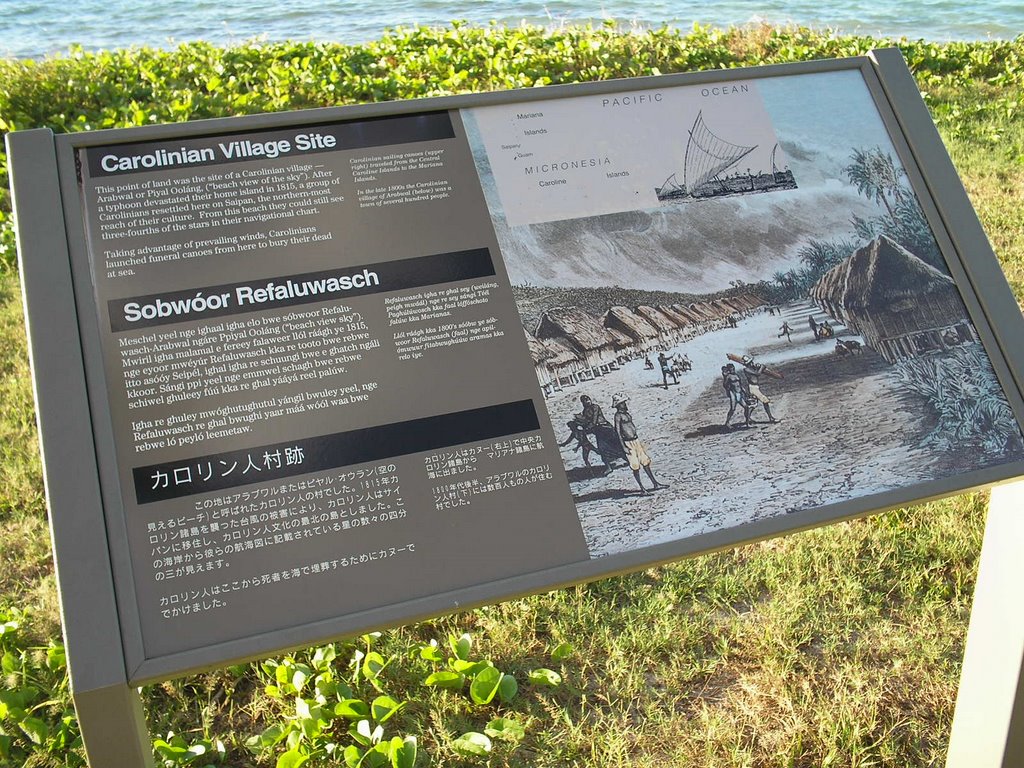
Carolinian village marker, GarapanWhen I went to Saipan I didn’t expect to encounter either of its two indigenous languages: Chamorro and Saipanese Carolinian. And indeed I saw next to nothing written in either language. Nothing in Chamorro but the greeting “Hafa Adai” (on every license plate), and nothing in Carolinian except a plaque (pictured here) in the American Memorial Park that marked the site of the old Carolinian village at Garapan.

But then I found KCNM-FM 101.1 on my rent-a-car radio and stayed tuned to it whenever I was driving. It played a wonderful assortment of contemporary Micronesian music, from Palauan enka to Chuukese country to Gilbertese gospel, which can all be sampled on Jane Resture‘s Micronesian Music Radio on Live365.com.

The music was interrupted periodically by NPR news in English and occasional announcements or classified ads in Chamorro, with prices quoted in English and telephone numbers in Chamorro. The Chamorro number system is now based on Spanish: unu, dos, tres, kuatro, sinko, sais, siette, ocho, nuebi, dies. (According to Wikipedia, the basic set of old Chamorro numbers was hacha, hugua, tulu, fatfat, lima, gunum, fiti, gualu, sigua, manot/fulu—far more Philippine-looking.)

Chamorros and Carolinians on Saipan are fighting an uphill battle to preserve their ancestral languages (and many have already surrendered). The resident population of the Northern Marianas is about 35% Filipino, 20% Chamorro, 10% Chinese, 10% Korean, 5% “Anglo”, with smaller numbers of Japanese, Palauans, and other Micronesians. Most of the retail clerks and wait help I encountered spoke Filipino and Filipino-accented English to each other. Most of the tourists I encountered spoke Japanese, Korean, or Chinese. The signage around Chalan Kanoa, which used to be the main Micronesian barrio when the U.S. Navy controlled most of the island, is now overwhelmingly Chinese and Korean, with some Japanese—and English, of course, one of the official languages of the Commonwealth of the Northern Marianas.

The most ubiquitous signs in Saipan say Poker. Many such signs are lit up round the clock. Almost every little country store has a Poker sign over one door, often next to one above the store entrance that says Food Stamps Accepted.

On 18 March 2005, the Saipan Tribune published three essays from a “contest held by the Department of Community and Cultural Affairs’ Chamorro/Carolinian Policy Commission to promote indigenous languages in the Commonwealth.” Let’s examine a few sentences of each.

Carolinian

Meta e welepakk sibwe kkepasal Refaluwasch rel?

Mwaliyasch Refalawasch nge eghi prisisu sibwe ghuleey bwe iyel yaasch IDENTITY me kkosch me eew malawasch ghisch aramasal Seipel. Sibwe abwaari me amalawa mwaliyasch leel olighat, fatattaral iimw, gangisch nge mwetelo mmwal nge sibwe kki yaali schagh.

When I took linguistic field methods back in grad school, our class worked with a speaker of Saipan Carolinian, which was not well described at the time, although a lot was known about closely related Trukese (now Chuukese). I’ve studied quite a few Austronesian languages, but you really need to be familiar with the Micronesian subgroup of Austronesian before this starts to look very familiar. Nevertheless, here are a few items that strike me.

Ethnonym: The Saipan Carolinian name for themselves is Refaluwasch. The name Carolinian is derived from the Caroline Islands, where the ancestors of today’s Saipan Carolinians came from, probably starting around the 1700s, after the Northern Marianas had been almost entirely depopulated.

Unusual sounds: I believe the Germanic looking sch indicates a retroflex affricate that sounds a bit like Yapese ch or Kosraean sr. The double consonants in word-initial position are a bit unusual and take some getting used to for English speakers who ignore the medial double nn in Japanese konnichi-wa.

Dialects: The Trukic languages form one long dialect chain, where speakers on neighboring islands can understand each other fine, but speakers from farther apart have increasing difficulty. There is no contrast between l and n in most of the dialects. Where this speaker writes aramasal Seipel ‘people of Saipan’, a speaker of a different dialect might write aramasan Seipen. Similarly, the town of Tanapag, settled by a different group of Carolinians, also goes by the name of Tallabwog.

Chamorro

Hafa Na Prisisu Na Ta Praktika I Fino’ Chamorro?

Kumu uniku yu’ na pagton [sic] palao’an gi familia yan todu I dos saina-hu Chamorro, gi anai pa’go mafañagu yu’, hu hungok I sunidon Chamorro despues enao mo’na I fina’na’guen nana-hu yan tata-hu. Este I lengguahen Chamorro impottante na ta tungo’ sa’ I mismo lengguahi-ta dumiklaklara hafa nasion-ta na rasan taotao….

Pot uttimo, prefekto yu’ na patgon Chamorro ya ti bai hu sedi na bai hu maleffa osino bai hu na’ fo’na I otro lengguahi ki I mismo lengguahi-hu Chamorro.

A Spanish reader’s reaction to written Chamorro must be very similar to a Chinese reader’s reaction to written Japanese. The huge number of familiar borrowings let you know the subject matter, but the foreign grammatical framework remains opaque. You know what they’re talking about, but not what they’re saying.

Ethnonym: Many Chamorros prefer to call themselves Chamoru, perhaps especially Guamanian Chamorros, whose orthographic standards (at least at Unibetsidåt Guahan) seem to differ somewhat from those in Saipan.

Unusual sounds: Chamorro ch is pronounced like [ts] (and some capitalize both members of the digraph: CHamoru, like Dutch IJssel); while y is pronounced like [dz]. The apostrophe marks a glottal stop. Spanish syllable-final -r regularly becomes -t and syllable-final -l assimilates to the following consonant.

Grammar: One of my term papers in grad school was an analysis of the historical morphology of Chamorro and Palauan, both of which look more Philippine-like as you go farther back. And both are verb-initial to a significant degree. (So is Yapese, but it’s not very closely related to any other Austronesian language.) But Palauan morphology is far more opaque: with Philippine -in- showing up as -l- and -um- showing up as -o- in some environments. Chamorro is more straightforward. The Spanish loanword diklara, for instance, is both infixed and reduplicated in d-um-iklaklara. Compare Tagalog bili ‘buy’ and one of its inflected forms, b-um-ibili.

Leave a comment

Filed under language, Micronesia, Pacific

Saipan Impressions: Three Meals

No one goes to Saipan or Guam for the cuisine, but I did want to try something localized and not the standard American, Chinese, Japanese, or Korean fare near the major hotels. I had a bit of success, but it wasn’t easy. And I only had three meals to worry about.

Breakfast on the way back to the airport included the obligatory Spam: a Spam & egg sandwich combo (with coffee and donut) at Winchell’s, a U.S. West Coast chain whose menu may have been adapted to Saipan tastes. But I hadn’t expected the huge dollop of mayonnaise that dripped off at every bite (with a little help from me).

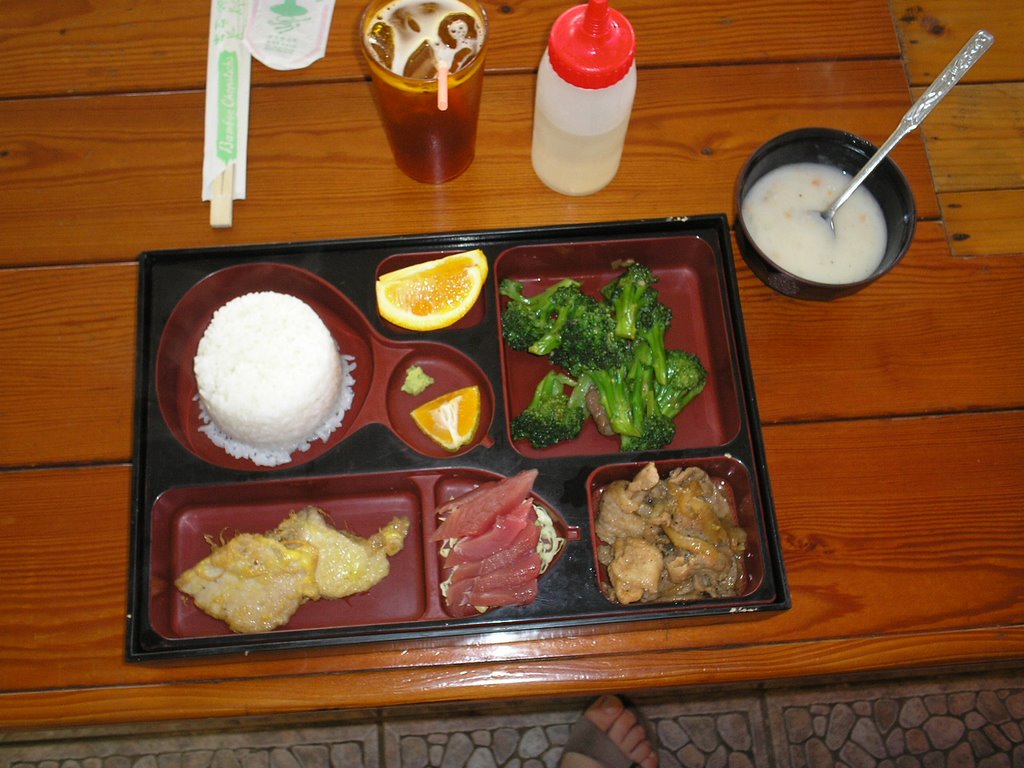
My first meal on Saipan was delayed until I returned from a drive to see the sights at the north end of the island, since there was almost nowhere to eat on that stretch of road. So I turned off into the port area on the way back and found the dowdy Seaman’s Restaurant at the end of a pier past a shipwreck listing in the shallows. It was 11 a.m. and I was the only customer—but a hungry one. The Chinese-run restaurant offered a $5 bento with Saipanese characteristics (pictured above). New England clam chowder substituted for miso soup, served with a Korean soup spoon. The rice and sashimi (with wasabi) were Japanese, the beef broccoli Chinese, and the fish jun vaguely Korean (with a wedge of local citrus to squeeze onto it), while the stewed chicken and onion looked like Philippine adobo, but with little pepper and garlic and even less vinegar or bay leaf. The ice tea was served with a squeeze bottle of sugar water, not packets of sugar or sugar substitute. Two orange slices served as a Chinese final course. It was just the sort of motley Pacific Island cuisine I was looking for.

After driving all over the island most of the day, I decided to see if any place looked promising within walking distance near the hotel. Moby Dick answered the call. A chalkboard listed fish kelaguen, a Chamorro dish of soft chunks of boneless raw fish “cooked” in lemon juice and tossed with slices of green and round onion, and sweet and spicy peppers. It was wonderful—and big enough to serve as an appetizer for two people. But I couldn’t resist ordering the local bottomfish catch of the day, either opakapaka or mafuti. I hadn’t heard of mafuti. When I asked what kind of fish it was, the Filipina waitress didn’t know any other name for it but brought it over to show me. I didn’t recognize it, but ordered it grilled. The whole fish came back to me a little bit overcooked, but I demolished most of it anyway. A Tagalog-speaking waiter later explained that “maputi” got its name from being a white fish. Tagalog for ‘white’ is indeed puti, but the fishname appears to be Chamorro, where the word for ‘white’ is a’paka’. So I don’t know what the story is. (More on Chamorro language later.)

Leave a comment

Filed under Micronesia, Pacific

Aussie Troops Back to the Solomons

Australian troops are heading back to the Solomon Islands to quell another outbreak of violence after the latest elections, the BBC reports.

Some 180 Australian soldiers and police have begun arriving in the country to try to impose order after a written request from the Solomons government. A smaller contingent of additional New Zealand peacekeepers are set to arrive on Thursday.

But the BBC’s Phil Mercer says there are concerns that the presence of more foreign troops could inflame the situation in the troubled city.

About 280 Australian police were already in the country as part of a regional force sent to restore peace in 2003, after violence stirred up by local warlords left hundreds dead and 20,000 displaced.

Wednesday’s rioting came after newly-elected MPs met in secret to elect a new prime minister.

‘Chinese connections’

Mr Rini, 56, beat off two main rivals in Tuesday’s secret ballot for the leadership – former Prime Minister Manasseh Sogavare and Job Dudley Tausinga, leader of the new Rural Advancement Party.

He is accused of being too closely linked to former Prime Minister Allan Kemakeza’s administration, which was tainted by corruption allegations.

As usual, the Head Heeb is already on the case.

Leave a comment

Filed under Australia, Pacific

Language Hat on Mother-in-Law Talk and Fieldwork

I should have mentioned earlier that the always enlightening Language Hat has been running a series of excerpts from R.M.W. Dixon’s Searching for Aboriginal Languages: Memoirs of a Field Worker. His two-part post (here and here) on the special “mother-in-law” language employed by speakers of the Australian language Dyirbal takes me back to my grad school days in linguistics, including more than a few “Eureka!” moments that compensated for the drudgery, discomfort, diseases, and social frustrations of fieldwork (and college classrooms, for that matter).

The many-to-one correspondence between Guwal [everyday language] and Jalnguy [“mother-in-law” language] vocabularies was a key to the semantic structure of Dyirbal. If one Jalnguy word was given as the equivalent for a number of distinct Guwal terms, it meant that the Guwal words were seen, by speakers of the language, to be related. For nouns, it revealed the botanical and zoological classifications which the Aborigines perceived. For instance, bayi marbu “louse”, bayi nunggan “larger louse”, bayi daynyjar “tick”, and bayi mindiliny “larger tick” were all grouped together under a single Jalnguy term, bayi dimaniny.

It could be even more revealing with verbs. The everyday style has four different words for kinds of spearing, and also such verbs as nyuban “poke a stick into the ground (testing for the presence of yams or snails, say)”, nyirran “poke something sharp into something (for example, poke a fork into meat to see if it is cooked)”, gidan “poke a stick into a hollow log, to dislodge a bandicoot”. All seven of these Guwal verbs are rendered by just one word in Jalnguy: nyirrindan “pierce”.

After I returned from doing fieldwork in Papua New Guinea, the three of us who had spent most of 1976 living in little villages along the north coast of New Guinea were invited to share our experiences at a Q&A session for other linguists. At one point, we were asked how our linguistics training had helped prepare us for our fieldwork experiences. I answered something along the following lines: “Well, it substantially increased my boredom threshold, and that proved extremely useful in the field.”

UPDATE: Part III, the exciting conclusion here.

Leave a comment

Filed under Papua New Guinea

My Malaria Tales

In 1976, I got a chance to do linguistic fieldwork in Papua New Guinea. PNG is a malaria zone, so I tried to get antimalarials before I left, but hardly any doctors in Honolulu knew about either malaria or PNG, and they wouldn’t prescribe anything unless it was for treatment, not prevention. So my first day in Sydney, en route, I went to a public hospital and waited a long time to see a doctor. (Australia, like Canada, gives free but limited medical coverage to everybody.) When the doctor finally saw me, he asked me all sorts of questions about PNG because he was to spend part of his residency there, but he said state policy was to give only one week’s worth of medicine at a time free. So I got just two Chloroquine pills, one week’s prophylactic dose. I was due to arrive in PNG within the week.

In PNG I had no trouble buying Chloroquine at a local chemist (pharmacy) and took them faithfully every Sunday. For months, I was fine. The only problem I had was early on, when my intestinal flora were changing to accommodate the local diet. I got the runs one night really bad. The village was maybe 100 yards from end to end, with the women’s outhouse out over the water (flushed twice a day by the tide) near my end of the village and the men’s outhouse clear at the other end of the village, across a coconut log bridge over the stream that served as the village’s only supply of fresh, cold mountain water. The men’s bathing hole was upstream from the women’s bathing, laundry, and dishwashing area, and people were really careful not to shit near the river. That night, I must have walked through the dark village 6 or 8 times, setting off the dogs each time, but not always having much to feed the fish with by the time I climbed up into the four-hole outhouse and squatted over the ocean. So, before long, I’d start the long trek back, setting off the dogs again.

I slept under a mosquito net in the village, although not always when I took trips to the neighboring village where several kids from my host family went to school. (They boarded there.) One day during August (I think), I felt really feverish, with flu symptoms, but the next day I felt better, so I let the village boat, with its loud, 2-stroke, Japanese Yanmar diesel engine, leave for town without me. It was an 8-hour trip up the coast to Lae, where the boat would sell its catch of fish, fill up with ice for the next catch, take on supplies and passengers, and be back in a week. That evening after I went for my customary bath in the stream, I couldn’t stop shivering. My hosts built up the fire and I hunkered down next to it until the shivers turned to sweat. By that time, I figured I’d better take a treatment dose of Chloroquine: 2 pills every 4-6 hours, rather than 2 pills every week. In a day or two the flu symptoms abated and I broke out instead with intense itching under the skin of my hands and feet. It hurt to walk over the rough path to the bathing hole. So the next time the boat came back to load up and take more fish and passengers, I was on board.

The doctor I saw in town thought maybe I had reacted to the Chloroquine, so he put me on milder Camoquine and, sure enough, the next time I came down with malaria symptoms and took a treatment dose, at least I didn’t have that horrible itch. (By now many strains of malaria in PNG are resistent to both.) But the timing was bad. I had come into town about Thanksgiving time, and my host, an American with an MA in ESL from Hawai‘i, had fixed up a real American meal with turkey, deviled eggs, and pumpkin pies. My throat was swollen, it hurt to swallow, and I was too sick to join the crowd for dinner, so I went off to bed. That night my fever broke and I soaked the sheets. The next day I felt much better–and ravenous. Fortunately, there were leftovers of everything except the deviled eggs. I ate a lot, but swallowed carefully.

Back in Honolulu, I got another severe bout of malaria. By this time, I knew the whole cycle real well–24 hours of fever and chills followed by 24 hours of dull headache. It was sure to be Plasmodium vivax, according to Merck’s Manual, so I managed to get referred to a Dr. Berman, the only civilian doctor in town who knew much of anything about malaria. (He had seen plenty of it as an Army doctor in Vietnam.) So I drove to the emergency room of the hospital where he was supposed to start a shift at 7 pm. He took a long time getting to me and I spent the whole time shivering under the air-conditioning vent in the examination room, trying to cover myself with little hand towels.

When Berman finally saw me, I made the mistake of telling him I was suffering from P. vivax and asking for a treatment dose of Camoquine or its equivalent. He sent me for a blood test, but couldn’t find anything, so he sent me away for another 48 hours until I would be in worse shape again. When he couldn’t see anything in that sample, either, he told me to come back when I was really in the throes of fever and chills. So at the peak of the next 48-hour cycle, I was driving shakily through traffic to his downtown office. This time, he managed to find the little buggers under the microscope. He returned with a sarcastic “Congratulations, Dr. Outlier. Your diagnosis is correct. It’s Plasmodium vivax.” Whereupon, I let him have it, telling him each of those 3 lab tests cost me $24 that my grad student health insurance didn’t cover, and that I had been through a week’s worth of the symptoms a 3rd time now, thanks to him. I think he ended up waiving any of his own fees above what my health insurance covered. He also prescribed some very powerful drug that was supposed to clear the creatures out of my liver as well. I’ve never had a relapse since then.

Leave a comment

Filed under Hawai'i, malaria, Papua New Guinea

California Trading, 1830s

Our cargo was an assorted one; that is, it consisted of everything under the sun. We had spirits of all kinds, (sold by the cask,) teas, coffee, sugars, spices, raisins, molasses, hardware, crockery-ware, tinware, cutlery, clothing of all kinds, boots and shoes from Lynn, calicoes and cottons from Lowell, crepes, silks; also shawls, scarfs, necklaces, jewelry, and combs for the ladies; furniture; and in fact, everything that can be imagined, from Chinese fire-works to English cart-wheels — of which we had a dozen pairs with their iron rims on.

The Californians are an idle, thriftless people, and can make nothing for themselves. The country abounds in grapes, yet they buy bad wines made in Boston and brought round by us, at an immense price, and retail it among themselves at a real (12½ cents) by the small wine-glass. Their hides, too, which they value at two dollars in money, they give for something which costs seventy-five cents in Boston; and buy shoes (like as not, made of their own hides, and which have been carried twice around Cape Horn) at three or four dollars, and “chicken-skin” boots at fifteen dollars apiece. Things sell, on an average, at an advance of nearly three hundred per cent upon the Boston prices. This is partly owing to the heavy duties which the government, in their wisdom, with the intent, no doubt, of keeping the silver in the country, has laid upon imports. These duties, and the enormous expenses of so long a voyage, keep all merchants, but those of heavy capital, from engaging in the trade. Nearly two-thirds of all the articles imported into the country from round Cape Horn, for the last six years, have been by the single house of Bryant, Sturgis & Co., to whom our vessel belong.

SOURCE: Two Years Before the Mast, by Richard Henry Dana, Jr., Chapter XIII

Leave a comment

Filed under Pacific, U.S.

Slavery Conviction in Samoa

The Honolulu Star-Bulletin of 23 June 2005 reports on the sentencing of a man convicted of enslaving Vietnamese and Chinese workers in Samoa.

An American Samoa factory owner convicted of what federal prosecutors call the biggest “modern-day slavery” case in U.S. history was sentenced yesterday to 40 years in prison.

In February 2003 after a four-month trial, a jury here found Kil Soo Lee, 52, guilty of 14 counts, including conspiracy, involuntary servitude, extortion and money laundering. The case involved 300 Vietnamese and Chinese immigrant workers, the largest number of victims of involuntary servitude, prosecutors said.

U.S. District Judge Susan Mollway said the 40 years, which reflected consecutive terms well above the guideline range, was appropriate given the physical, psychological and financial harm the workers endured and continue to suffer to this day. Lee was facing a range of 30 years to life.

She also noted Lee showed “greed, arrogance and contempt for American law” for disregarding an order by the U.S. Department of Labor that he run a legal workplace and pay the workers back wages.

Lee recruited Chinese and Vietnamese workers, ranging from their early 20s to their 40s, to work in his factory producing garments for major U.S. retailers. The workers incurred large debts to pay export labor companies up to $5,000 each to work at Daewoosa Samoa Ltd. in Pago Pago from March 1999 to November 2000.

Leave a comment

Filed under Pacific, Polynesia, slavery

Algeria: Recycling Terms from the Last War

Beginning in Algeria in July 1993 there were forests burning once again in the Aurès, Algiers was still living under a curfew, terrorist attacks attributed to Islamists were striking police officers and intellectuals, and hundreds of “suspects” remained in detention, sometimes without trial. The Algerian press had begun to mention the “sweep operations,” and the French press added reports from “the underground.” “Terrorism” and “torture” made their reappearance in the vocabulary of all the triumphant communiques, announcing, on the one hand, the “eradication” of the “last armed groups,” and, on the other, “the imminent victory of the Muslim people.” A strange sensation has developed that this is a remake of the war of independence [1954-62]: an impression of déjà vu or “déja entendu.”

Forty years later, the vocabulary is unifying, consolidating the two eras, making them look alike. Has the country, then, entered a second–and identical–Algerian war?

Nothing is less certain. In the first place, in history, formal analogies have but little pertinence if they confine themselves to highlighting the similarity between certain forms, in this case the resurgence of terrible forms of violence. And, in the second place, the Algeria of the 1990s has only a very distant relation to that of 1962.

The country today is highly urbanized; the rural areas no longer play the same role; more than 60 percent of the population is under thirty; and the rate of schooling is very high. The differences could be multiplied, with, at the center, the end of the colonial system, the massive departure of pieds noirs [French colonists], and the political operation of an independent state. It may therefore seem absurd to assert that the same scenario is being repeated. Yet the protagonists in the confrontation–the followers of the ISF [Islamic Salvation Front], the “democrats,” the army–have intentionally adopted the terms inherited from the past of the Algerian War. And that is what is truly of interest–Islamists speaking of “the valorous mujahideen,” wanting to hunt down “the new pieds noirs” who have appropriated the revolution; “democrats” calling the ISF militants “harkis“ [Muslim colonial auxiliaries] who want to crush the Algerian nation. Some circles within the regime have launched campaigns against the “secular assimilationists,” as during the time of the colonial system, when a lost identity had to be reestablished. And all the camps mention a shadowy “party of France” (Hizb França) supposedly destabilizing Algeria.

This mimicry is striking. The memory of the war of independence operates as a factor in the assignment of the roles to be played. The contemporary actors dress in theoretical garments borrowed from the past. But, if they do not realize the novelty of the present, and if they subjectively replay the old situation, it is because they remain under the automatist influence of a memory fabricated forty years ago.

SOURCE: Algeria, 1830-2000: A Short History, by Benjamin Stora (Cornell U. Press, 2001), pp. 232-233

For a more hopeful follow-up, see this OxDem Report from April 2004.

Leave a comment

Filed under Mediterranean, Micronesia, religion, war