Category Archives: language

Antarctic Cuisine: Skua Piles

From Hoosh: Roast Penguin, Scurvy Day, and Other Stories of Antarctic Cuisine, by Jason C. Anthony (U. Nebraska Press, 2012), p. 185:

Skua piles, named for the kleptoparasitic gull, are a USAP tradition and the clearest sign that we are a transient community. Simply put, departing people leave behind their excess stuff in a heap near their dorm recycling area, and arriving people grab what they need for their season. If you’re in the right place at the right time, you can find anythings: homemade bookshelves, insulated work clothes, flannel sheets, half-filled shampoo bottles or, less usefully, broken pencils, used batteries, and sex toys. Skua piles are so fundamental to the local culture that “skua” is as common a verb as it is a multipurpose noun. Stuff is skuaed, the wise go skuaing, and so on. Much of the food is condiments people are too lazy to return to the galley or odd items that no one really wants to eat but are unwilling to throw away. I saw the same can of fiddlehead ferns from Maine disappear and reappear over several years. Dusty jars of nearly flavorless spices that I twice claimed, never used, and returned years ago may still be snatched excitedly each summer by a desperate home-cooker. But again, anything is possible in the skua piles; I have stumbled upon rafts of cooking supplies and a new electric teakettle that someone didn’t feel like mailing home, as well as quick-cook oats, rice, and other staples there for the taking.

Leave a comment

Filed under food, language, migration, science, U.S.

Wordcatcher Tales: kamoba, kamohikibori, nozokigoya

This summer, during our train trip around Shikoku, the Far Outliers got a chance to visit one of Japan’s most famous gardens, Ritsurin (‘Chestnut Woods’) in Takamatsu. It’s not on the official list of the three most beautiful landscape gardens—Kairakuen in Mito, Kenrokuen in Kanazawa, and Kourakuen in Okayama (all of which I’ve visited)—but it definitely belongs in the same class. Among its unique features is a large pond that used to be used for duck hunting. The untrimmed overgrowth around its edges offers cover for hunters to conceal themselves.

At one end of the pond, there is an artificial structure designed to enable large numbers of ducks to be captured with nets. Called the 鴨場 kamoba ‘duck place’, it consists of a 鴨引き堀 kamohikibori ‘duck moat’ with a 覗き小屋 nozokigoya ‘peeping hut’ (or 小覗き konozoki ‘small peephole’) at one end. The duckcatchers would duck down behind the raised banks along both sides of the duck moat waiting for the signal from the watcher in the duck blind, then leap up in unison and toss their nets over the ducks in the narrow ditch below.

I was familiar with the term 馬場 baba ‘horse place’, meaning ‘race track, hippodrome’ (as in Takadanobaba in Tokyo), but had not encountered the term kamoba ‘duck place’ before. Nor had I ever heard of people hunting animals within the grounds of any of the major landscape gardens in Japan. The bilingual sign explaining the purpose of the kamoba at Ritsurin translated nozokigoya as ‘peeping hut’ but could well have translated it as ‘duck blind’ (or ‘hunting blind’) in this instance.

Leave a comment

Filed under Japan, language

Wordcatcher Tales: Japanese nautical terms

I’ve always been fascinated by the great variety and complexity of nautical terminology, especially on sailing ships. I’ve encountered it mostly in my reading. I don’t really have much sailing experience, except as a passenger aboard ferries and ocean liners, plus the occasional opportunity to go aboard a museum ship. The four-masted, sail training ship Nippon Maru, which I explored last month in Yokohama, was a special treat because it offered a glimpse of sailing-ship terminology in two languages, Japanese and English.

rigging-types-signage

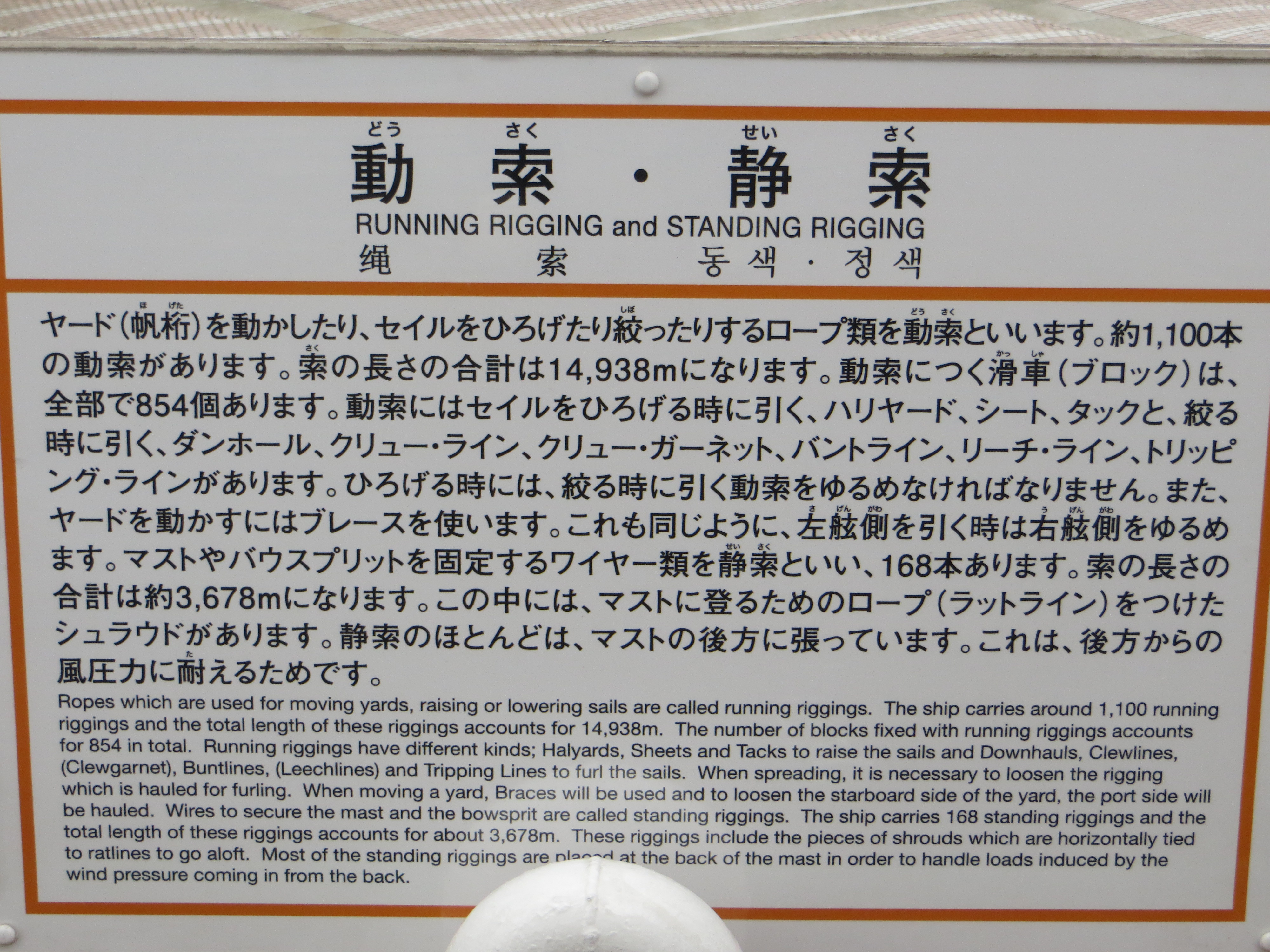
Running rigging and standing rigging


Here’s the text of the English translation on an explanatory sign about the rigging on the Nippon Maru. Though phrased rather awkwardly, it is very clear and instructive.

Running Rigging and Standing Rigging
Ropes which are used for moving yards, raising or lowering sails are called running riggings. The ship carries around 1,100 running riggings and the total length of these riggings accounts for 14,938m. The number of blocks fixed with running riggings accounts for 854 in total. Running riggings have different kinds: Halyards, Sheets and Tacks to raise the sails and Downhauls, Clewlines, (Clewgarnet), Buntlines, (Leechlines) and Tripping lines to furl the sails. When spreading, it is necessary to loosen the rigging which is hauled for furling. When moving a yard, Braces will be used and to loosen the starboard side of the yard, the port side will be hauled. Wires to secure the mast and the bowsprit are called standing riggings. The ship carries 168 standing riggings and the total length of these riggings accounts for about 3,678m. These riggings include the pieces of shrouds which are horizontally tied to ratlines to go aloft. Most of the standing riggings are placed at the back of the mast in order to handle loads induced by the wind pressure coming in from the back.

The Japanese terms for ‘running rigging’ and ‘standing rigging’ are 動索 dousaku ‘moving-rope’ and 静索 seisaku ‘still-rope’, respectively. (The matching Korean terms, dongsaek and jeongsaek, are cognate, and the suo ‘cable, rigging’ in Chinese shengsuo ‘rope-rigging’ is also cognate with J. saku and K. saek.) ‘Starboard’ is 右舷側 u-gen-gawa ‘right-gunwale-side’ and ‘port’ is 左舷側 sa-gen-gawa ‘left-gunwale-side’. (The kanji 舷 gen ‘gunwale’ also occurs in 舷灯 gen-tou ‘gunwale-lamp = running lights’ [on each side of the ship], 舷門 gen-mon ‘gunwale-gate = gangway’, and 舷窓 gen-sou ‘gunwale-window = porthole’.) The bow or fore part of the ship is 船首 sen-shu ‘ship-neck’ and the stern or aft part of the ship is 船尾 sen-bi ‘ship-tail’.

These terms were no doubt in use long before Japanese sailors became familiar with European-style sailing ships (before Date Masamune had his first Spanish galleon built in 1613). The same goes for terms like 帆柱 ho-bashira ‘sail-pillar = mast’ and 帆桁 ho-geta ‘sail-beam = yard(arm)’. Nevertheless, the Japanese text begins with the katakana synonym for ‘yard’ (yaado) followed by its kanji equivalent (帆桁) in parentheses, and employs exclusively katakana terms (borrowed from English) for ‘sail’ (seiru), ‘rope’ (roopu), and ‘mast’ (masuto). Why? Because the names for all the subcategories of nautical masts, sails, and rigging have been imported wholesale from English. At eye-level on each of the four masts is its name in katakana: foamasuto ‘foremast’, meinmasuto ‘mainmast’, mizunmasuto ‘mizzenmast’, and jigaamasuto ‘jiggermast’ (and ‘bowsprit’ is bausupritto). There are ways to write ‘front mast’ and ‘back mast’ in kanji, but it is much harder to differentiate four masts using traditional (Sino-Japanese) terminology.

Similarly, the name for every length of rigging on this modern square-rigged four-master is directly imported from English: ‘halyard’ is hariyaado, ‘sheet’ is shiito, ‘tack’ is takku, ‘downhaul’ is danhooru, ‘clewline’ is kuryuu rain, ‘clewgarnet’ is kuryuu gaanetto, ‘buntline’ is banto rain, ‘leechline’ is riichi rain, ‘tripping line’ is torippingu rain, ‘brace’ is bureesu, ‘ratline’ is rattorain, and ‘shroud’ is shuraudo.

The same goes for the names of every spar among the yards, as the following Yards chart shows. ‘Lower topsail yard’ is rowaa toppuseeru yaado, ‘upper (top)gallant yard’ is appaa geran yaado, ‘royal yard’ is roiyaru yaado, ‘spanker gaff’ is supankaa gafu, ‘spanker boom’ is supankaa buumu, and so on. The Korean translation (yadeu) of the chart title suggests that Koreans have also directly imported this specialized English terminology. (In the Chinese title, ‘yard’ is mistranslated as dui-huo-chang ‘stack-goods-place = freight yard’.)

yards-sign

Names of sailing yards

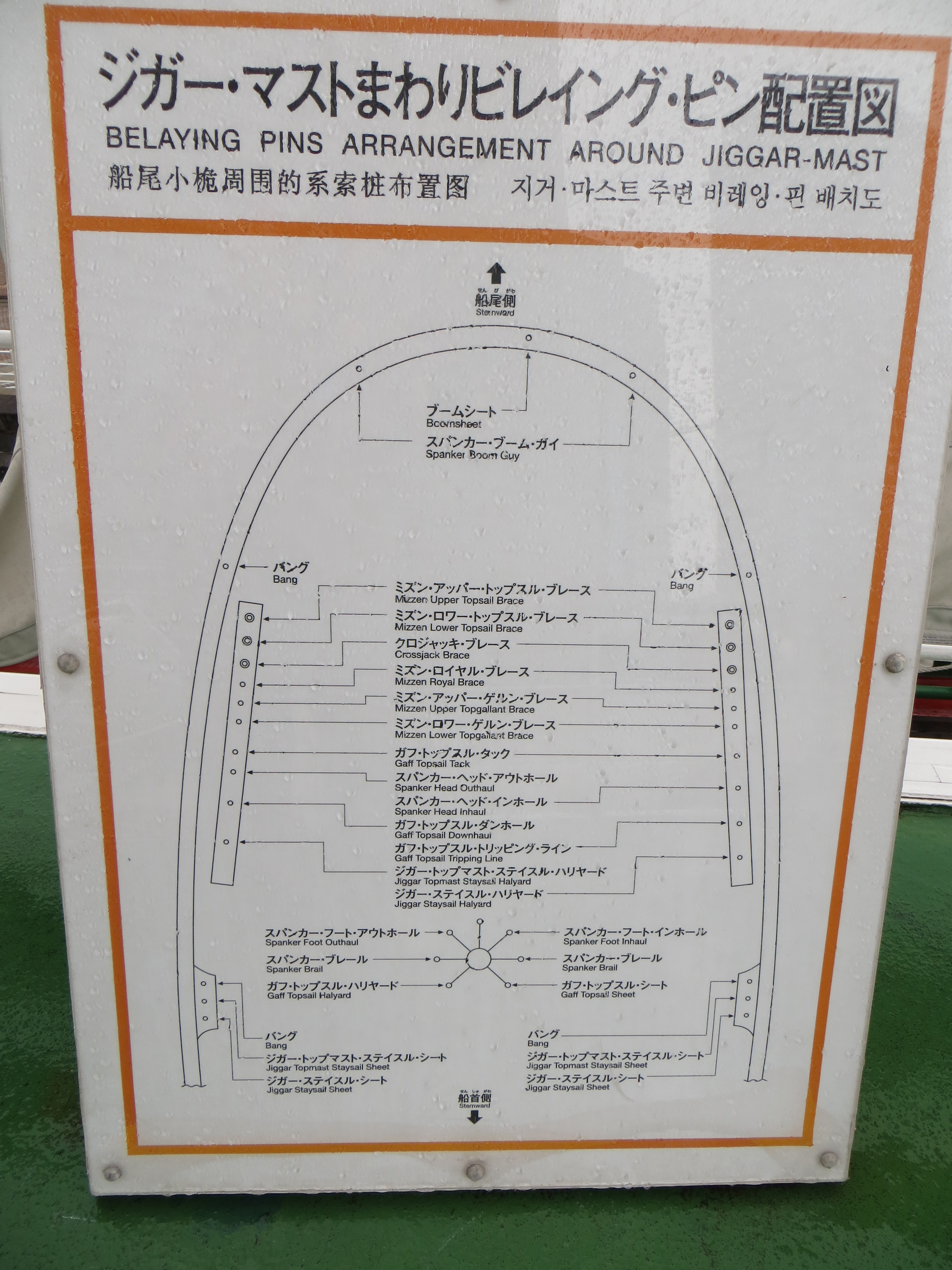
The last chart included here only confirms the extent to which English modern square-rigged sailing ship terminology has been imported wholesale into Japanese naval usage. Its title in Japanese is Jigaa masuto mawari bireingu pin haichizu ‘jigger mast around belaying pin arrangement-diagram’. The nautical terms of English origin, ‘jiggermast’ and ‘belaying pin’, are written in katakana, the native Japanese word for ‘around’ is written in hiragana, and the Sino-Japanese compound translated ‘arrangement-diagram’ is written in kanji. Although the Korean title is written entirely in the Korean alphabet, the breakdown of word origins is the same (and so is the word order): jigeo maseuteu ‘jiggermast’, jubyeon ‘around’, bireing pin ‘belaying pin’, baechido ‘arrangement diagram’.

In the Chinese translation, ‘jiggermast’ is rendered as 船尾小桅 chuanwei xiaowei ‘ship-tail small-mast’ to distinguish it from 后桅 houwei ‘rear-mast’ (= ‘mizzenmast’, cf. 前桅 qián wéi ‘fore-mast’, 主桅 zhuwei ‘main-mast’). ‘Belaying pin’ is translated rather directly as 系索桩 jisuozhuang ‘fasten-rope-stake’. These Chinese nautical terms do not render the English sounds, as the Japanese and Korean equivalents do.

By the way, there is a mistake in the English translation of the directions at the top and bottom of the chart. Both directions are labeled ‘sternward’ in English, but in Japanese only the top arrow points sternward (sen-bi-gawa ‘ship-tail-ward’), while the bottom arrow points foreward (船首側 sen-shu-gawa ‘ship-neck-ward’).

belaying-pin-chart

Jiggermast belaying pin chart

1 Comment

Filed under anglosphere, China, Japan, Korea, language, military, travel

Wordcatcher Tales: kazari moufu, kissuisen

On my most recent trip to Japan, I had the chance to go aboard two museum ships in Yokohama harbor. One was the former Japanese naval sail training ship, the Nippon Maru, a four-masted barque with auxiliary diesel engines. The other was the NYK Hikawa Maru, a former luxury passenger liner built for North Pacific routes between Japan and Seattle/Vancouver. Both ships were built in Kobe and made their maiden voyages in 1930.

kazari moufu

Decorative blanket folding

飾り毛布 kazari-moufu ‘decoration-blanket’ — Last year, when we toured the Hakkoda train ferry museum in Aomori, we noticed some ornamentally folded blankets in some of the ship’s cabins. According to Japanese Wikipedia, the practice of folding blankets into decorative shapes—like origami in wool—originated in 1908 on the ships ferrying passengers across the Seikan Strait between Aomori on Honshu and Hakodate on Hokkaido. (There is no other Wikipedia article in any language on the decorative folding of blankets.) This year I noticed and photographed the same phenomenon in officers’ berths aboard the Nippon Maru and in first-class passengers’ berths aboard the Hikawa Maru. The Japanese Wikipedia article also links to the FAQ page of an OSK passenger liner named Nippon Maru, whose last entry addresses the question of kazari-moufu. The English version of an explanatory sign outside a passenger cabin on the Hikawa Maru follows.

Ornamentally folded blankets, called “decorative blankets (Kazari-mofu)”, were common during the age of passenger ships. The blankets were folded by stewards and placed with care on passengers’ beds. The designs included flowers (Hana-mofu), a sunrise, and even the helmet of a samurai warrior, generating anticipation among many passengers about the day’s creation. The designs of flowers were originally called “floral blankets (Hana-mofu)” but as stewards became more creative with their designs, the name changed to “decorative blankets (Kazari-mofu)” to better reflect their creations.

waterline labels

Waterline inside Hikawa Maru

喫水線 kissuisen ‘waterline’ — On the lowest deck of the engine room, there was a red line just over head-high on the inside of the ship’s hull that marked the normal waterline, labeled in katakana uotaarain (< ‘waterline’) and in kanji as 喫水線 kissuisen, which translates literally as ‘eat/drink-water-line’. The first kanji shows up in compounds such as 喫茶店 kissaten ‘drink-tea-shop (= teahouse, coffee shop)’ and 喫煙室 kitsuenshitsu ‘drink-smoke-room (smoking room)’. But 喫水 kissui also means the ‘draft (of a ship)’, so ‘eat/drink-water’ is probably better glossed here as ‘displace-water’.

1 Comment

Filed under Japan, language, Pacific, travel

Wordcatcher Tales: heeltap, punkah louvre

You never know where you’ll learn a new English usage while traveling abroad. I came across a couple new ones while on vacation in Japan this month.

heeltap sign

Deposit Heeltap & Ice here

An English usage new to me appeared on a trash and recycling receptacle in Cafe Cuore atop Miraishin no Oka, a hill of white Italian marble imported and sculpted by Kazuto Kuetani on the grounds of the Kosanji Temple Museum. The Japanese sign reads nomi-nokoshi ‘drink-leftovers’ and koori ‘ice’, so the meaning was clear enough, but I had not encountered that use of heeltap before. The Kenkyusha Reader’s Plus dictionary in my little Canon Wordtank, however, listed heeltap with two definitions ‘heeled shoes’ and ‘drink-leftovers’.

punkah louvre

Punkah Louvre Instructions

Another phrase new to me appeared in a first-class cabin hallway aboard the NYK Hikawa Maru, a Japanese luxury passenger and cargo ship launched in 1930 to run between Japan and Seattle. It was nicknamed the Queen of the North Pacific, and carried Charlie Chaplin among other famous passengers. It was built to compete with the best at the time, and managed to survive the Pacific War because it was requisitioned to become a hospital ship and because its hull was engineered to withstand heavy northern seas and to stay afloat even after hitting a couple of underwater mines during the war.

From reading about British India, I was familiar with the punkah ceiling fan and the poor punkawallah whose duty was to pull the ropes to keep it in motion while his masters attended to other matters. Wikipedia notes that punkah louvre is used to refer to the air vents in passenger aircraft, but this usage for similar individually controlled air vents in passenger ships looks to be older.

1 Comment

Filed under anglosphere, Japan, language, South Asia, travel

“One thing it ain’t, is black and white”

From Mississippi in Africa: The Saga of the Slaves of Prospect Hill Plantation and Their Legacy in Liberia Today, by Alan Huffman (Penguin, 2004), pp. 104-106, 278-280:

At first glance, Delores’s lineage is difficult to discern. Before now we have spoken only on the phone, after I was given her number by her niece, Laura “Butch” Ross. During my research into the story of Prospect Hill, I have often conducted first interviews on the phone rather than in person, and sometimes have found myself deliberating whether the person I am speaking with is descended from slave or slave owner, because many have similar accents and frames of reference. I wait for their perspective to reveal itself through some telltale sign—a verbal marker such as the use of “aks” in place of “ask” by blacks, or a reference to “faithful slaves” by whites. Sometimes the clue lies in what is left out of their account. The prevailing white version of the story of Prospect Hill always includes the slave uprising, but the prevailing black version never does. In many cases my assumptions have turned out to be entirely wrong, and I might be deep into a conversation before I know for sure.

In Delores’s case, neither her speech nor her perspective gave her away on the phone. Finally she said, “I’ll just be frank with you, it was kind hard growing up in the South with a black mother and a white father.”

After greeting me at the door and inviting me in, Delores launches into one of the more curious genealogies that I have come across.

“I’ll tell you, Roots, the best movie ever made, don’t have nothin’ on the Ross family,” she says. “We’re all over the place. Go way back, all over the place. Here some of ’em started out in Africa, come to Mississippi, then end up back in Africa. And a whole lot of ’em—black, white, you name it, been right here all along—and I’m talkin’ a long, long time.

Delores’s hair is long, wavy, and black, carefully molded with pomade, her skin midway between black and white. Her house is a catchall sort of place, with furniture from the 1960s and 1970s, potted plants and vases of plastic flowers, and every available surface crowded with memorabilia and framed photos of people, both black and white. Many area residents have a tendency to reduce key figures in local history to archetypes and stereotypes—good guys and bad guys, everything black and white, but not Delores. She listens patiently to a summary of the history of Prospect Hill, then leans back on her sofa and takes a long drag off her cigarette. She is unpretentious and self-possessed, and has no qualms about entertaining my questions about her family history—in fact, she relishes the opportunity.

“One thing it ain’t, is black and white,” she says, and blows cigarette smoke toward the ceiling….

“Here, pass me that picture there, Butch,” Delores says, and Butch hands her a framed photograph from among the group clustered on the coffee table. “That’s Thad Ross, my daddy,” Delores says, and passes the photo to me. “He was a descendant of Isaac Ross.” The photo looks to have been taken in the 1930s. A white man is seated on a sofa beside a dark-skinned girl with a black woman seated in a chair nearby. There is no mistaking they are a family. “It was taken down in Jefferson County,” she says. “That’s my father there. The girl is Jimmie, my sister, Butch’s mother. The lady’s Queen Esther Polk, Jimmie’s mother.”

The photo would be right at home in many family albums across the South but for the mix of skin colors. There are many people of mixed race in this part of the country, but they are usually the result of clandestine encounters. Racial mixing is rarely documented for posterity, particularly by members of prominent white families like the Rosses….

Delores points to a group of framed photos on the mantel, and adds, “That’s all my family up there.” She goes down the line, naming names. Most of the faces are black, but some are white, and others are in between. She pulls out her albums and shows me snapshots of blacks and whites intermingling unself-consciously—fishing on a lake, visiting in someone’s living room, gathering for a graduation….”

“Isaac Ross was a unique fella during that time,” James [Belton] says, in typical understatement. “He went along with slavery but his slaves were not slaves in the traditional sense. I doubt seriously if you would find anything written about the slaves before 1870, when blacks were first included in the census. But from word-of-mouth, folklore, what was passed down from generation to generation, it is apparent they were not like other slaves. I was told, you know, that some of those Beltons actually attended Oakland College. They were not free, per se, but they were educated.”

Before the Civil War, Oakland College was a private school for planters’ sons, and Isaac Ross sat on its board. Today it is Alcorn State University, which was founded in 1871 as the first land-grant college for blacks in the United States.

Most historical accounts note that many Prospect Hill slaves were taught to read and write, and that they all enjoyed relative freedom within the confines of the plantation. Ross never sold any slaves, and it appears he kept them sequestered from the slaves on neighboring plantations. When Isaac Ross Wade took over as master of the plantation, however, they were treated like any other group of slaves, James says. “By the time of the burning of the house, from what I gather, all of the slaves but a few were extremely bitter. Isaac Ross had treated them like relatives, and the truth is, a lot of them were relatives. The Belton ladies who worked around Prospect Hill were very light—you couldn’t hardly tell ’em from white ladies, my father said. But after Isaac Wade contested the will [that freed the slaves and offered them emigration to Liberia], they weren’t getting the treatment they had gotten during Ross’s lifetime, and resentment just built up. That was how they came to set fire to the house.”

Why did any of the slaves choose to remain behind when the majority emigrated to Liberia? James has a ready answer. A few were not given the option of being repatriated, he says, “most likely because they were just bad apples, like you have in any community.”

The others, he says, may have been wary of traveling to a distant, unknown land. But Mariah was different. Belton believes she chose to remain behind because her two sons, Wade and Edmond, had fled Prospect Hill to escape being lynched in the aftermath of the uprising, and perhaps she knew their whereabouts.

It may have been the grief she was keeping within over what had happened,” he says. “She knew her sons did not go to Liberia, and perhaps she thought, ‘For me to ever see my sons again, I have to stay in the area.’ So she was sold to Walter Wade and transferred to Rosswood with her son, William. He was my great-grandfather.” He digs through the stack of papers on his kitchen table and pulls out a photo of the young man, which looks to have been taken around the 1850s, with an inscription that identifies him as a carriage driver….

James still has a lot of questions, but most of them concern the genealogical riddle. He has organized the documents pertaining to his family and Prospect Hill on a CD-ROM, complete with images of the portraits of Isaac Ross and his wife, and of tombstones in the graveyard, and he plans to give a presentation on the subject at the next Belton family reunion. Since 1984 the Beltons have held reunions, often several times a year, at various locations. Last year the event drew more than 4,000 people, he says. “I had to get my facts in order,” he says of his Prospect Hill presentation. “I don’t like to lose history, and the first time I mentioned all this at the Belton reunion, the whole place went quiet. People’s mouths dropped. They said, ‘A white man did that before the Civil War—in Mississippi?’ They didn’t believe me. One fella who did believe the story said, ‘Man, you need to get in touch with Spike Lee. It’s make a great movie.’

“There’s a lot about our history people don’t realize,” he says, “Like that a lot of blacks in the South owned slaves.” In his view, the story is complicated, and it is shared. “Some of the white Rosses have helped me put a lot of information together, and the white Beltons, too,” he adds.

When I mention what so many have said about the story not being simply black and white, he smiles. He says there are a lot of gradations between any two extremes, and cites as an example the quasi-ward system that he remembers as a child, which was similar to that which exists in Liberia today.

“It was basically the same way here,” he says. “It wasn’t like slavery, but I grew up with a stepbrother and -sister, who Dad took in and raised ’em, and they worked for the family. They were like family, and they were less fortunate, and they worked for us. I see a lot of that—people who are less fortunate, maybe because they’re darker-skinned, and they weren’t given the same opportunity.”

Leave a comment

Filed under language, Liberia, migration, slavery, U.S.

Wordcatcher Tales: minarai, shashou, tetsuya, akuma no daibensha

I learned a few more interesting Japanese etymologies from reading Delayed Departures, Overdue Arrivals: Industrial Familialism and the Japanese National Railways, by Paul H. Noguchi (U. Hawai‘i Press, 1990).

見習い minarai (lit. ‘see-learn’) ‘apprentice’ – The components of this native Japanese term for ‘apprentice’ are not only much easier to recall, but also far more positive than the standard Sino-Japanese term that renders ‘apprentice’ in many compounds, 徒弟 totei lit. ‘useless-younger.brother’. The kanji 徒 appears in such words as 徒心 adagokoro ‘fickle heart’, 徒物 adamono ‘useless thing’, 徒桜 adazakura ‘ephemeral cherry blossom’, 徒者 tadamono ‘ordinary person’, 徒労 torou ‘wasted effort’, 徒食 toshoku ‘life of idleness’, and 徒論 toron ‘worthless argument’.

車掌 shashou ‘conductor’ (lit. ‘car-handler’) – The native Japanese readings for the kanji 掌 include tsukasado(ru) ‘rule, administer, conduct’ and tanagokoro ‘palm, hollow of the hand’ (< ‘hand-heart’). It also occurs in such learned Sino-Japanese compounds as 掌中本 shouchuubon (lit. ‘palm-middle-book’) ‘pocket edition’ and 掌状 shoujou (lit. ‘palm-shape’) ‘palmate’. Train conductors hold our fates in their hands.

徹夜 tetsuya ‘all-nighter’ (lit. ‘pass-night’) – The tetsu in this compound has nothing to do with 鉄道 tetsudou (lit. ‘iron-road’) ‘railroad’. Its native Japanese reading as a verb is tooru ‘pass (by or through)’, always written with a synonymous kanji, 通る. In the JNR, 徹夜 tetsuya meant a 24-hour shift on duty with only 4 hours of sleep.

悪魔の代弁者 akuma no daibensha ‘devil’s advocate’ – When I first encountered just the romanized shape, daibenmono ‘mouthpiece’, in this book, I really wanted to analyze it as 大便物 (lit. ‘large-convenience-stuff’), rendering ‘mouthpiece’ into ‘(bull)shitter’. But the actual kanji are 代弁者 daibensha (lit. ‘change-speech-person’) ‘spokesperson, proxy’. The kanji 弁 ben can also mean dialect, as in 広島弁 Hiroshima-ben ‘Hiroshima dialect’. The kanji 代 dai has three broad clusters of meanings: (1) ‘age, generation, era, reign’, as in 六十代 rokujuudai ‘in one’s sixties’ or 六十年代 rokujuunendai ‘the 1960s’; (2) ‘change, proxy, substitute’, as in 代母 daibo ‘godmother’ or 代名詞 daimeishi ‘pronoun’ (‘proxy noun’); and (3) ‘rate, fee, price, charge’, as in 代金引き換え daikin hikikae ‘C.O.D.’ (‘charge reversal’). Now, add in one devil and you get 悪魔の代弁者 ‘devil’s advocate’.

Leave a comment

Filed under Japan, language, travel

Wordcatcher Tales: hagitoriya, ekiben daigaku

I learned two new Japanese idioms related to transport in Delayed Departures, Overdue Arrivals: Industrial Familialism and the Japanese National Railways, by Paul H. Noguchi (U. Hawai‘i Press, 1990), on pp. 41 and 46-47, respectively:

Hagitoriya 剝ぎ取り屋 ‘peeling-taking-doer’
or hagashiya 剥がし屋 ‘causing.to.peel-doer’

Commuter culture is a common feature among all transportation systems. However, the JNR worker had to contend with the intensity of this culture in Japan more than his Western counterpart. Twice a day the major urban centers in Japan become transportation madhouses which pale the images of New York’s Grand Central Station. Commuters have acclimated themselves to a high tolerance for discomfort in an over-crowded mass transportation system and have devised complex strategies for coping with these stressful conditions. They have learned the technique of sleeping while standing as well as the best way to fold and read a newspaper to minimize the use of space….

A direct result of this overcrowding on commuter trains was the creation of a specialized occupation, the oshiya ([推し屋] pusher), whose job it is to make sure the commuter is safely shoved into the railroad car before the doors are closed. The counterpart of the oshiya is the hagitoriya [剝ぎ取り屋 ‘peeling.off-taking-doer’, or hagashiya 剥がし屋 ‘causing.to.peel-doer’], or the one who pulls out passengers who insist on boarding an already overcrowded train so it can depart. Some of these trains carry more than than 200 percent of their rated capacity.

Ekiben daigaku 駅弁大学 ‘station-boxlunch-college’

Another part of the culture complex of the railways in Japan is the various box lunches (ekibentō) sold at many stations. For some older Japanese they are symbolic of railroad transportation itself. The box lunch sold at any particular station is distinctive to that station, and some have achieved considerable fame throughout the country…. These box lunches have persisted into modern times; even on the bullet train one can purchase a bentō as the train passes through a geographical region famous for a particular kind of box lunch…. A number of idioms built around ekiben have crept into the Japanese language. For example, in the postwar period after higher education was made more available to the Japanese masses, the nation witnessed a phenomenal growth in the number of colleges and universities under the new educational system. Obviously, these were not of the same calibre as the prestigious national universities and the selective private colleges. As station box lunches could be found almost anywhere, so, too, could these fourth-rate institutions be discovered throughout Japan. Hence they were labeled ekiben daigaku (station box lunch colleges).

Leave a comment

Filed under Japan, language, travel

Wordcatcher Tales: Chuckatuck, Nottoway

During my recent trip to see relatives in southeastern Virginia, I got curious about some of the Native American placenames and the languages they came from. Eventually I came across a very comprehensive article in Wikipedia on Native American tribes in Virginia (whose main contributors have the usernames Til Eulenspiegel, Parkwells, and—early on—Sarah1607). In it, I found that those tribes include not just descendents of Algonquian speakers (like the Powhatan Confederacy), but also a few far outliers who once spoke Iroquian and Siouan languages. The area I was visiting was where the three language types once met.

The village of Chuckatuck is now a borough of the city of Suffolk (the “World’s Largest Peanut Market” and home of WLPM-AM), formed out of what used to be called Nansemond County. As an English colony, Chuckatuck dates back to 1635. Chuckatuck Parish church (now St. John’s Episcopal Church) was established in 1642, and George Fox himself established Chuckatuck Friends Meeting in 1672. (Some of my ancestors show up in Chuckatuck Monthly Meeting records, but there is no longer a Friends Meeting there, as I discovered on this visit.) A Chuckatuck grist mill operated continuously from 1676 to 1972.

Despite being a tiny riverport and crossroads town, it has its own Greater Chuckatuck Historical Foundation, and Chuckatuck Historic District was added to the National Register of Historic Places in 1995. According to the Foundation’s website, the village name comes from Chuckatuck Creek, “or Crooked Creek as the Indians called it” (a tributary of the James River). Those Indians must have been Algonquian-speaking members of the Nansemond tribe. The Virginia Algonquian language is also known as Powhatan, and was the source of such English words as hickory, hominy, opossum, persimmon, and (corn)pone.

Nottoway Parish was the original name of Southampton County, Virginia. It was named after the Nottoway River, which was in turn named for the Nottoway Indians who lived along it. The name Nottoway appears to come from an Algonquian word for peoples who were not Algonquian speakers. The same name shows up elsewhere in two counties named Nottoway in North Carolina and Louisiana, streets named Nodaway in Iowa and Missouri, and Nadoway Point in Michigan, where it faces Iroquois Island in Whitefish Bay, Lake Superior. The wide-ranging Algonquians had many foreigners in their midst.

We know the Nottoway used to speak an Iroquian language because someone collected a wordlist in 1820 from one of the last elderly speakers and sent it to Thomas Jefferson, who shared it with Peter DuPonceau, one of the earliest experts in the indigenous languages of North America. A few more words were added to the list, but they are the only trace we have left of the language. Nevertheless, they suffice to show that Nottoway was closely related to Tuscarora, which is much better documented but now highly endangered.

Two other groups of Northern Iroquian speakers lived in the area. The Meherrin Nation once lived along the Meherrin River in Virginia, but migrated south to North Carolina during the early 1700s. They signed several treaties with the colony and are now one of the eight indigenous nations officially recognized by the state of North Carolina.

The Tuscarora people once lived around the Roanoke, Neuse, and Tar Rivers in North Carolina, but began migrating north after the Tuscarora War of 1711-1713. Those who reached New York became the sixth nation of the Iroquois who are nationally recognized in Canada and the U.S. But other descendants of the Tuscarora have remained in North Carolina, and some have moved to Oklahoma.

Of the eleven tribes recognized by the State of Virginia, only three groups are not of Algonquian heritage. The Nottoway Indian Tribe of Virginia, Inc. and the Choreonhaka (Nottoway) Indian Tribe of Southampton County both descend from people who once spoke the same Iroquoian language.

The third group claims descent from speakers of Eastern Siouan languages (also known as Catawban). The Monacan Indian Nation gets its name from one of two historic tribes, the Monacan and Manahoac (or Mahock), who once lived in Piedmont Virginia and spoke languages (now extinct) closely related to Tutelo. The Tutelo fled north in 1740 and were adopted by the Iroquoian Cayuga in 1753. The ethnologist Horatio Hale, working among the Cayuga in Ontario, was the first to discover that the Tutelo language from Virginia belonged to the Siouan family. (He was also the first to identify the Cherokee language as Iroquoian.) So the Siouan language family once extended as far east as Virginia and the Carolinas and as far south as Biloxi, Mississippi.

Leave a comment

Filed under language, travel, U.S., Virginia

Some Loanwords in Indonesian/Malay: A

From: Loan-Words in Indonesian and Malay, ed. by Russell Jones (KITLV Press, 2007), ignoring the far too numerous loans from Arabic, Dutch, and English.

Chinese

aci (Amoy) elder sister
ahsiu (Amoy) dried, salted duck
a i (Amoy) aunt (addressing younger than speaker’s mother)
akew (Hakka) term of address for boy (‘little dog’)
amah (Amoy) female servant
amho (Amoy) secret sign, password
amoi (Chiangchiu) younger sister; girl
ampai (Amoy) detective
angciu (Amoy) red wine
angco (Amoy) dried Chinese dates (Z. jujuba)
ancoa (Amoy) how can that be?
anghun (Amoy) shredded tobacco
angkak (Amoy) grains of red sticky rice (O. glutinosa)
angki (Amoy) persimmon (D. kaki)
angkin (Amoy) waist belt
angkong (Amoy) grandfather
angkong (Amoy) ricksha
anglo (Amoy) heating stove
anglung (Amoy) pavilion
angpai (Amoy) card game employing 56 cards
angpau (Amoy) present given at Chinese new year
angsio (Amoy) braise in soy sauce
angso (Amoy) red bamboo shoot
apa (Amoy) dad, father
apak (Hakka) old man, ‘uncle’ (lit. father’s elder brother)
apék (Amoy) old man, ‘uncle’ (lit. father’s elder brother)
apiun (Amoy) opium
asuk (Hakka) ‘uncle’, father’s younger brother

Hindi

abaimana anal and urethral orifices (with regard to ablution)
acita fine rice
anggerka gown
antari inner
arwa saw-edged knife
aruda rue (bot.)
ayah Indian nurse

Japanese

anata you
arigato thank you
aza hamlet

Persian

acar pickles
adas fennel
aftab sun
agar in order to
agha nobleman
ahli versed in; member of
aiwan hall
ajaibkhanah museum
akhtaj vassal
almas diamond
anggur grape
anjir fig
arzak beautiful gem
asa mint
asabat nerve
asmani heavenly
atisnyak fiery, glowing
azad faultless

Portuguese

alabangka lever
alketip carpet
alpayaté tailor
alpérés ensign, sublieutenant
andor (obs.) a litter on which images of saints were borne
antero whole
aria lower away (naut.)
arku bow (of a kite)
aria, aris-aris bolt rope, shrouds (naut.)
arkus arches (triumphal, with festoons)
armada armada, squadron, naval fleet
asar roast; barbecue

Sanskrit

acara program, agenda
adi beginning, first, best, superior
adibusana haute couture
adicita ideology
adidaya superpower
adikarya masterpiece
adimarga boulevard
adipati governor
adipura cleanest (etc.) city (chosen annually)
adiraja royal by descent
adiratna jewel, beautiful woman
adisiswa best student
adiwangsa of high nobility
adiwarna glowing with colour
agama religion
agamiwan religious person
ahimsa non-violence
aksara letter
amerta immortal
amerta nectar
amra mango
ancala mountain
anda musk gland
Andoman Hanuman
anduwan foot chain
anéka all kinds of
anékawarna multi-coloured
anggota member
angka number, figure
angkara insolence, cruel
angkasa sky
angkasawan astronaut; broadcaster
angkasawati astronaut; broadcaster (fem.)
angkus elephant-goad
angsa goose
aniaya violation
anjangkarya working visit
antakusuma cloth made from several pieces
antar- inter-
antara (in) between
antarabangsa international
antariksa sky
antariksawan astronaut
antariksawati astronaut (fem.)
antamuka interface (of computer)
antarnegara international
anugerah (royal) favour
anumerta posthumous
apsari nymph
arca image; computer icon
aria a high title
arti meaning
Arya Aryan race
aryaduta ambassador
asmara love
asmaraloka world of love
asrama hostel
asta cubit
asta eight
astagina eightfold
astaka octagonal bench
astakona octagon
astana palace
asusila immoral
atau or
atma(n) soul

Tamil

acaram wedding ring
acu mould, model
andai possibility
anéka various, diverse
anékaragam various kinds
apam rice flour cake
awa- free from
awanama anonymous
awatara incarnation
awawarna blanched, decolorized

1 Comment

Filed under China, India, Indonesia, Iran, Japan, language, Malaysia, Portugal