
Category Archives: language

Broad Scope of Missionary Work

From Protestants Abroad: How Missionaries Tried to Change the World but Changed America, by David A. Hollinger (Princeton U. Press, 2017), Kindle Loc. 224-61:

Missionaries established schools, colleges, medical schools, and other technical infrastructures that survived into the postcolonial era. Missionaries were especially active in advancing literacy. They translated countless books into indigenous languages, produced dictionaries, and created written versions of languages that had been exclusively oral. Some missionary institutions became vital incubators of anti-imperialist nationalisms, as in the case of the American University in Beirut, founded in 1866, and the alma mater of several generations of Arab nationalist leaders. Christianity itself has assumed shapes in the Global South quite different from the contours designed by European and American evangelists. Religious voices purporting to speak on behalf of indigenous peoples have occasionally claimed that the missionary impact was beneficial for endowing local populations with Christian resources that proved to be invaluable. Feminist scholars have called attention to the ways in which African women were able to use Christianity—for all the patriarchal elements in its scriptures—as a tool for increasing their autonomy, especially in choosing their own spouses.

Scholars continue to inquire just where and how the actions of missionaries affected the subsequent histories of the societies they influenced. That inquiry is an important and contested aspect of today’s discussions of colonialism and the postcolonial order that is largely beyond the scope of Protestants Abroad. But not altogether. As scholars come to recognize the interactive dimensions of the missionary project, we can comprehend that project itself as a genuinely global, dialectical event. Missions were part of the world-historical process by which the world we call modern was created.

This book’s cast of characters was involved with missions in three different capacities. The first of these was service abroad as a missionary. People routinely classified as missionaries included not only evangelists, but teachers, doctors, nurses, YMCA leaders, university professors, and social service workers affiliated in any way with institutions and programs sponsored by missionary societies, churches, and missionary-friendly foundations. All were understood to be part of the greater missionary enterprise, even though some would say, “I wasn’t really a missionary,” by way of explaining they were not directly involved in evangelism. A second order of involvement was to grow up as the child of missionaries, often spending many years in the field. The third capacity was the least direct: to be closely associated with missionaries, typically through missionary support organizations.

Although there were persons of both sexes in all three of these categories, the gender ratio was different in each case. In the field, about two-thirds of missionary personnel were women, either unwed or married to male missionaries. Missions afforded women opportunities to perform social roles often denied to them in the United States. Glass ceilings in the mission field were higher and more subject to exceptions than in most American communities. By the 1950s, nearly half of the missionary physicians in India were female. Women led many colleges in China. These included one of the most famous missionaries of all time, Minnie Vautrin, who turned the campus of Ginling College into a fortress during the Nanking Massacre of 1937 and 1938. She is credited with saving several thousand Chinese women from rape and murder at the hands of marauding Japanese soldiers. Women were sometimes allowed to preach in the mission field, even though Paul the Apostle had told the Christians of Corinth, “Let your women keep silent in the churches: for it is not permitted unto them to speak; but they are commanded to be under obedience.” While home on furlough, female preachers were often prohibited from speaking from the pulpits of their own denominations, sometimes even in their home congregations.

Among missionary children, there were of course equal numbers of males and females. In missionary support organizations, women were very prominent. Most denominations had women’s missionary boards that exercised strong influence in church affairs and stood among the largest women’s organizations in the United States in the late nineteenth and early twentieth centuries. These women’s missionary boards were often active on social issues, urging their denominations to take more vigorous stands, especially against racism. A group of 150 women from the various denominational missionary boards picketed a Washington, D.C., hotel in 1945 to protest its refusal to serve black members of the United Council of Church Women.
Leave a comment

Filed under Africa, China, disease, education, Japan, Korea, language, Latin America, Middle East, nationalism, religion, South Asia, Southeast Asia, U.S.

Weaponizing Famine in Ukraine, 1930s

From Red Famine: Stalin’s War on Ukraine, by Anne Applebaum (Doubleday, 2017), Kindle Loc. 194-221:

But the bourgeoisie had not created the famine. The Soviet Union’s disastrous decision to force peasants to give up their land and join collective farms; the eviction of “kulaks,” the wealthier peasants, from their homes; the chaos that followed; these policies, all ultimately the responsibility of Joseph Stalin, the General Secretary of the Soviet Communist Party, had led the countryside to the brink of starvation. Throughout the spring and summer of 1932, many of Stalin’s colleagues sent him urgent messages from all around the USSR, describing the crisis. Communist Party leaders in Ukraine were especially desperate, and several wrote him long letters, begging him for help.

Many of them believed, in the late summer of 1932, that a greater tragedy could still be avoided. The regime could have asked for international assistance, as it had during a previous famine in 1921. It could have halted grain exports, or stopped the punishing grain requisitions altogether. It could have offered aid to peasants in starving regions—and to a degree it did, but not nearly enough.

Instead, in the autumn of 1932, the Soviet Politburo, the elite leadership of the Soviet Communist Party, took a series of decisions that widened and deepened the famine in the Ukrainian countryside and at the same time prevented peasants from leaving the republic in search of food. At the height of the crisis, organized teams of policemen and party activists, motivated by hunger, fear and a decade of hateful and conspiratorial rhetoric, entered peasant households and took everything edible: potatoes, beets, squash, beans, peas, anything in the oven and anything in the cupboard, farm animals and pets.

The result was a catastrophe: At least 5 million people perished of hunger between 1931 and 1934 all across the Soviet Union. Among them were more than 3.9 million Ukrainians. In acknowledgement of its scale, the famine of 1932–3 was described in émigré publications at the time and later as the Holodomor, a term derived from the Ukrainian words for hunger—holod—and extermination—mor.

But famine was only half the story. While peasants were dying in the countryside, the Soviet secret police simultaneously launched an attack on the Ukrainian intellectual and political elites. As the famine spread, a campaign of slander and repression was launched against Ukrainian intellectuals, professors, museum curators, writers, artists, priests, theologians, public officials and bureaucrats. Anyone connected to the short-lived Ukrainian People’s Republic, which had existed for a few months from June 1917, anyone who had promoted the Ukrainian language or Ukrainian history, anyone with an independent literary or artistic career, was liable to be publicly vilified, jailed, sent to a labour camp or executed. Unable to watch what was happening, Mykola Skrypnyk, one of the best-known leaders of the Ukrainian Communist Party, committed suicide in 1933. He was not alone.

Taken together, these two policies—the Holodomor in the winter and spring of 1933 and the repression of the Ukrainian intellectual and political class in the months that followed—brought about the Sovietization of Ukraine, the destruction of the Ukrainian national idea, and the neutering of any Ukrainian challenge to Soviet unity. Raphael Lemkin, the Polish-Jewish lawyer who invented the word “genocide,” spoke of Ukraine in this era as the “classic example” of his concept: “It is a case of genocide, of destruction, not of individuals only, but of a culture and a nation.”

Famine was also an effective weapon of mass destruction in Ethiopia during the 1980s.

Leave a comment

Filed under economics, education, food, language, migration, nationalism, philosophy, Russia, Ukraine, USSR

Bolshevik Attitudes Toward Ukraine

From Red Famine: Stalin’s War on Ukraine, by Anne Applebaum (Doubleday, 2017), Kindle Loc. 652-76:

At the beginning of 1917, the Bolsheviks were a small minority party in Russia, the radical faction of what had been the Marxist Russian Social Democratic and Labour Party. But they spent the year agitating in the Russian streets, using simple slogans such as “Land, Bread and Peace” designed to appeal to the widest numbers of soldiers, workers and peasants. Their coup d’état in October (7 November according to the “new calendar” they later adopted) put them in power amidst conditions of total chaos. Led by Lenin, a paranoid, conspiratorial and fundamentally undemocratic man, the Bolsheviks believed themselves to be the “vanguard of the proletariat”; they would call their regime the “dictatorship of the proletariat.” They sought absolute power, and eventually abolished all other political parties and opponents through terror, violence and vicious propaganda campaigns.

In early 1917 the Bolsheviks had even fewer followers in Ukraine. The party had 22,000 Ukrainian members, most of whom were in the large cities and industrial centres of Donetsk and Kryvyi Rih. Few spoke Ukrainian. More than half considered themselves to be Russians. About one in six was Jewish. A tiny number, including a few who would later play major roles in the Soviet Ukrainian government, did believe in the possibility of an autonomous, Bolshevik Ukraine. But Heorhii Piatakov—who was born in Ukraine but did not consider himself to be Ukrainian—spoke for the majority when he told a meeting of Kyiv Bolsheviks in June 1917, just a few weeks after Hrushevsky’s speech, that “we should not support the Ukrainians.” Ukraine, he explained, was not a “distinct economic region.” More to the point, Russia relied on Ukraine’s sugar, grain and coal, and Russia was Piatakov’s priority.

The sentiment was not new: disdain for the very idea of a Ukrainian state had been an integral part of Bolshevik thinking even before the revolution. In large part this was simply because all of the leading Bolsheviks, among them Lenin, Stalin, Trotsky, Piatakov, Zinoviev, Kamenev and Bukharin, were men raised and educated in the Russian empire, and the Russian empire did not recognize such a thing as “Ukraine” in the province that they knew as “Southwest Russia.” The city of Kyiv was, to them, the ancient capital of Kyivan Rus’, the kingdom that they remembered as the ancestor of Russia. In school, in the press and in daily life they would have absorbed Russia’s prejudices against a language that was widely described as a dialect of Russian, and a people widely perceived as primitive former serfs.

All Russian political parties at the time, from the Bolsheviks to the centrists to the far right, shared this contempt. Many refused to use the name “Ukraine” at all. Even Russian liberals refused to recognize the legitimacy of the Ukrainian national movement. This blind spot—and the consequent refusal of any Russian groups to create an anti-Bolshevik coalition with the Ukrainians—was ultimately one of the reasons why the White Armies failed to win the civil war.

Leave a comment

Filed under democracy, education, food, labor, language, nationalism, philosophy, Russia, Ukraine, USSR, war

Tourism in Singapore

From Singapore: Unlikely Power, by John Curtis Perry (Oxford U. Press, 2017), Kindle Loc. 4689-4718:

As early as the 1960s, Albert Winsemius had seen services like banking and finance as supplementing the port and manufacturing. Tourism too could buttress the economy, offering an experience of the “Instant Orient.” Yet, as he noted, Singapore has no intrinsic attraction to the tourist. It has no scenery, no ancient ruins or buildings of great historic interest, no real sites. In a thoroughly urban environment, wild animals can be found only in the zoo. Winsemius would have found it incredible that ultimately every year Singapore would receive more money from tourists than India does.

The richness of the cuisine certainly draws some visitors as it does to Hong Kong. But Singapore offers even more choice of menu, reflecting its wider cultural mix. Since eating is such a Singaporean delight, both malls and food courts abound to satisfy such pleasure. A rich promiscuity among Indian, Malay, Chinese, and what is simply referred to as “Other” foods, makes ethnically pure cuisines imaginary. Some would judge that the Malay-Chinese Peranakan cuisine draws from the best of each, but much else entices. The late New York Times reporter R. W. Apple, renowned for his journalism, his culinary tastes, and the size of his expense account, traveled widely and reported frequently with gusto about food. In the fall of 2006, he wrote of Singapore, “A Repressed City-State? Not in Its Kitchens.”

Apple found there a new dignity to the term “fusion, that unruly beast.” He speaks fondly of a dinner with “hot seared scallops with prawn ravioli and clam laksa leaf nage, a subtle melody of marine flavors.” Another memorable dish called “Dancing with the Wind,” turned out to be “a steaming soup containing crab, prawns, scallops, mushrooms and (surprise!) red dates in a gentle coconut broth … [served] in a young coconut.” Fried green tea dumplings gloried in the name “Drifting Clouds of the Autumn Sky.”

Ordinary names illustrate the historic roots of Singaporean cosmopolitanism. Sarabat from the Arabic “to drink” became the stall selling drinks. Laksa derives from the Persian laksha, noodle. Satay, related to kebab, comes from the Tamil meaning flesh. The peanut, originating in the New World, so identified with satay, is but a late addition to the sauce. Prawns or bean paste are served with a Peranakan hybrid, roti prata from the Urdu roti and Hindi paratha, bread without yeast.

Rice and noodles remain the basic staples of the Singaporean diet, with chopsticks and hands the chief eating utensils. The hungry can find a wide variety of less poetic dishes than those Apple describes at considerably lower prices in hawker stalls, street foods now carefully inspected and approved by the government. There one can indulge in dumplings of many description as well as a simple meal of “Pig Organ Soup” or fish head curry washed down with “Iron Buddha” tea for less than five dollars.

Beyond the table, the tourist sights tend to be glossy and unseasoned, artificial like Disney, theatrical like Venice but without the patina of charm and character that only age can bring. Nonetheless, many visitors have responded enthusiastically, like those world wide who flock to theme parks, preferring the synthetic to the real thing. “Asia Lite” is the message touted, an experience reassuringly comfortable and safe yet with just a whiff of exoticism.

Leave a comment

Filed under food, language, Southeast Asia, travel

1st Filipino Regiment & Battalion, 1945

From Our Jungle Road to Tokyo, by Robert L. Eichelberger (Gorget Books, 2017; first published 1950), Kindle Loc. 3745-58:

In the main, these island assaults [“52 D-Days” between Dec. 1944 and Aug. 1945] were made with small units of such divisions as the 24th, the 40th, the Americal. One of the colorful outfits which took part in the enterprise was the 1st Philippine Infantry. This was an American regiment made up of American Filipinos (most of them from California) who had volunteered to fight for the homeland. The regiment was organized as the result of a suggestion by the then President Quezon to President Roosevelt. I used the 1st Philippine Infantry also in the subjugation of Samar, and its record was excellent.

As a matter of fact, by this time I had requested that General Irving be assigned to me as the boss of what we called Eighth Army Area Command. This meant that Fred Irving would command combat activities in Samar as well as supervise military areas behind us. Fred fell heir not only to the 1st Philippine Infantry but to an entirely separate outfit of American Filipinos known as the 1st Philippine Battalion. These troops had sound training. When GHQ requested Spanish-speaking American troops to serve as military police in Manila, Irving recruited them from the 1st Philippine Battalion.

Ten amphibious landings were necessary to wipe out the Japanese positions astride the over-water route south of Luzon. Usually we sent Americans ashore for the quick capture of an island and then moved in native irregulars and guerrillas to serve as garrison troops. In this way we were able to use our combat veterans over and over again. Much of the credit for the speed and efficiency of the enterprise belongs to the motor torpedo squadrons of Seventh Fleet. By day and night raids, by constant surveillance, they disrupted interisland traffic and blocked evacuation of enemy units to Luzon.

2 Comments

Filed under Japan, language, migration, military, nationalism, Philippines, U.S., war

Wordcatcher Tales: Gomou, Togakushi, Komoigi

We encountered a few interesting placename etymologies on our recent travels in Japan.

五毛 Gomou ‘Five Hairs’ < 胡麻生 Gomau ‘Sesame Growth’ – I spent my high school years in a dormitory atop Nagamine-dai (‘longridge-heights’) below towering Maya-san in Nada-ku (‘opensea-ward’), Kobe. The neighborhood at the base of our hillside was called Gomou, written as if it meant ‘Five Hairs’ (五毛). I never paid attention to how it got its odd name until I went back by there on this trip. According to its short Wikipedia article, the name Gomou originated as Gomau (胡麻生 ‘sesame-grow’) because the area was not suitable for paddy fields, so the farmers grew sesame instead. (The city in Gunma Prefecture called Kiryu—桐生 < kiri-u ‘Paulownia-grow’—must have got its name for similar reasons.) Over time, the pronunciation of Gomau changed to Gomou, the sesame fields disappeared under dense urban growth, and someone devised entirely new kanji, with no etymological continuity at all, to match its new pronunciation.

戸隠 Togakushi ‘door-hiding’ – In northern Nagano Prefecture, we explored the lovely mountain forests of Togakushi, site of an extensive old Shinto Shrine complex that also served as training grounds for ninja. Togakushi used to be called Togakure, using the shape of the verb kakureru ‘hide’ that appears in the name of the game kakurembo ‘hide-and-seek’. One of the many schools of ninja tradition is called Togakure-ryu. We looked for ninjas, but of course they remained well hidden. (Bears, however, had left many signs of their presence, including claw marks on tree trunks and chewed up patches of their favorite 水芭蕉 mizubashou ‘skunk cabbage’.)

神居木 Kamoigi ‘god-dwell-tree’ – While walking a woodsy stretch of the old Nakasendō (中山道 ‘Central Mountain Route’) between Magomejuku in Gifu-ken and Tsumagojuku in Nagano-ken, we came across signage about some old, famous sawara cypress trees, one of which had acquired the name 神居木 Kamoigi ‘god-dwell-tree’ because a god supposedly rested in it long ago. I wonder where the -o- came from. The morpheme written 木 ‘tree’ is pronounced -ki in Tochinoki ‘horsechestnut-POSS-tree’ but -gi in the prefecture name Tochigi ‘horsechestnut-tree’. In native Japanese placenames, the kanji 神 ‘god’ is most often pronounced either kami- as in Kamiyama 神山 ‘god-mountain’ or kan- as in Kanda 神田 ‘god-paddy’, but it is also pronounced kō- in Kōbe 神戸 ‘god-door’. The kanji 上 ‘upper’, which appears in many placenames old and new, shows similar variation, ranging from 上山 Kamiyama ‘upper-mountain’ to the ancient province names 上総 Kazusa (now Chiba Prefecture) and 上野 Kōzuke (originally 上毛野, now Gunma Prefecture). In such cases, the long -ō- replaces the earlier -am- or -an-; it does not follow after kam- or kan-. So I suspect the -o- somehow comes from the 居 i(ru) ‘reside, dwell’ (as in 居酒屋 izakaya lit. ‘dwell-sake-shop’), which is pronounced o(ru) in several regional dialects of central and southwestern Honshu. In fact, I wonder if the earlier name for the tree might have been pronounced Kami-o(ru)-gi ‘god-dwell-tree’.

Leave a comment

Filed under Japan, language

Wordcatcher Tales: AmePote, Shutsubotsu, ‘Pork Wombs’

During this year’s summer visit to Japan, the Outliers once again encountered a few remarkable new words of interest.

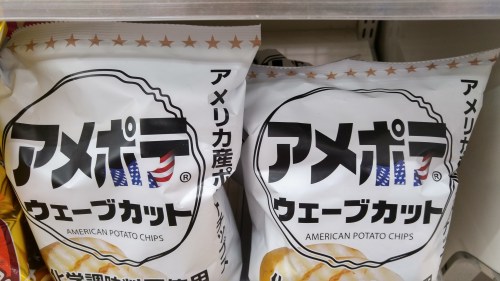
AmePote

アメポテ Amepote ‘American potato’ – On the shelf of a conbini (convenience store) we encountered a new acronym created from the initial two syllables of a longer pair of words. The katakana label on a package of “American Potato Chips” reads Amepote ueebukatto (‘Amer. Pota. wave-cut’), comparable to Amefuto for ‘American football’. This is a very common pattern of abbreviation in Japanese, one we also encountered in a Japanese TV biography about Amekei (雨敬 < Amemiya Keijiro 雨宮敬二郎), a Meiji-era businessman who first persuaded the Japanese government to build the Chūō (中央 Central) railway line into his native Yamanashi Province to enable farmers to get their produce out to the coastal markets.

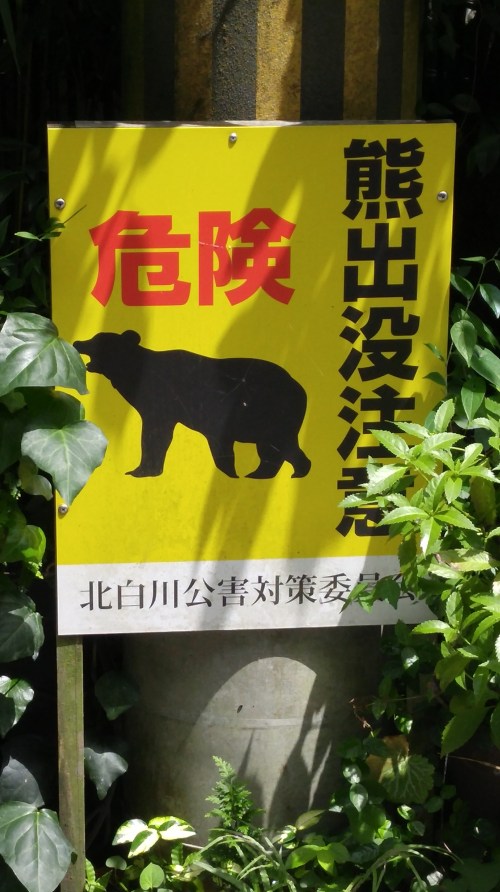
Kuma Shuppotsu Chuui

出没 shutsubotsu ‘haunt, infest, frequent’ – We were not surprised to find signs warning of bears while hiking in the forests of rural Togakushi in Nagano Prefecture, but I was quite surprised to see this sign right next to the Japan Baptist Hospital in Kyoto, warning of bears in the very mountains I used to climb during my childhood there (at the foot of Mt. Hiei). The sign reads 危険 熊出没注意 Kiken: Kuma shutsubotsu chuui ‘Danger: Bear infestation alert’. Such signs are very common along Japanese mountain trails these days. When we hiked a very well-traveled section of the old Nakasendō (中山道 ‘Central Mountain Route’) we saw many such bear warnings near small brass bells that travelers were encouraged to ring to scare the bears away.

Pork wombs
蒜泥生肠 “Pork wombs marinated with hot soysauce”! – In a Chubu Airport (Nagoya) restaurant specializing in Taiwanese food, we encountered a menu item that even this experimental gastronome shied away from. It appears to be a dish unique to Singapore and Taiwan. The Chinese menu item is 蒜泥生肠 suànní shēngcháng ‘garlic-mash birth-intestine (= birth canal/fallopian tube)’. (The kanji 蒜 or 大蒜 can be used to write ninniku ‘garlic’ in Japanese.) I couldn’t find shēngcháng 生肠 in my DeFrancis (1996) ABC Chinese-English Dictionary, and whoever translated it into Japanese and Korean seems not to have known the anatomical term for ‘uterus’ (neither did I), which is 子宮 ‘child-shrine = womb’ (Ch. zǐgōng, Ko. jagung, Jp. shikyuu). So the Japanese menu label for the dish is 子袋 ko fukuro ‘child bag’ and the Korean menu label is ai kabang ‘child bag’. I don’t know how the English translator came up with “marinated in hot soysauce” except by looking at the photo.

Leave a comment

Filed under China, Japan, Korea, language

St. John’s Day, 1908, in High Albania

From High Albania, by M. Edith Durham (Enhanced Media, 2017; originally published 1909), Kindle Loc. 2903-2957:

The evening of the twenty-third of June was quite exciting. The Primæval had spent most of the previous evening filling blank cartridges to greet guests. The Franciscans of Berisha, Shoshi, and Toplana arrived in turn. Each hailed him of Dushmani from a distance, and greeted him with revolver shots. Out we rushed, the Primæval dancing and shrieking like a demon, with a revolver in each hand, both of which he fired at once. We had the liveliest supper – four Franciscans, Marko, and myself. The Padre of Toplana had brought a wonderful attendant with him – an elderly, most wiry creature, brave in a red djemadan, gayer and even more voluble than the Primæval. The two, who were supposed to wait at table, were inimitable – entered into the conversation, corrected their “masters,” smoked, joked, laughed, and had drinks. Old Red Coat talked every one down, and boasted incessantly of his own merits, the chief being his stainless honour. He had shot four men in its defence, had his house burnt down four times, and flourished greatly, and was ready any day to shoot four more. He had rewarded his Martini for its part of the work, with four silver coins driven in between the stock and the barrel. He got on very well with his Padre – was not his servant, but his comrade. Outside, crowds of guests were arriving at various houses near, from Shlaku and Berisha and distant parts of Dushmani, all greeted by volleys of rifle and revolver shots, to which the Primæval replied with a revolverful of blank, and Old Red Coat with ball cartridge out of window, and both with piercing yells. And the little brothers of St. Francis sang songs at the top of their powerful voices. I thought how dull London dinner-parties are, and wondered why people ever think they would like to be civilised. This was as good as being Alice at the Mad Hatter’s Tea-party. And so passed the Eve of St. John. No bonfire-burning took place, and I was assured that the custom is unknown in the mountains, though practised by some of the Scutarenes, which seems to show that it is not an Albanian custom, but brought in from abroad.

A great crowd came to church next day. There were stacks of rifles outside, and within their owners sang “Et in terra pax hominibus.” The Padre of Berisha preached. I could not understand him, but reflected he could have no better subject than “The Voice of One crying in the Wilderness.”

After mass there was a rush for the shooting-ground – the mark was a white stone, and the range short. The Primæval hit often, and a man with a Mauser every time he tried. Those that missed were very close. But it was not difficult, for I hit it myself, with the Primæval’s beloved Martini, which he pressed upon me, adorned as it was with silver coins, to reward it for the lives it had taken.

Drunk with noise, excitement. and the smell of burnt powder, he drew out the hot empty cartridge-cases and breathed in their odour with ecstasy, gasping, “By God, it is good!” It was like blood to a tiger, and made him wild to kill his cousin’s murderer, who had got safe away a year ago, was now in prison in Scutari on another charge, and to be released soon. I asked why he did not tell the Scutari authorities of the murder and let them punish him, but was told he would only get ten years, “and he deserves shooting, as the poor deserve bread.” At this tense moment a rumour spread suddenly that the enemy had been released, and had been seen coming to the feast.

The Primæval dashed off with Martini and revolver, in spite of the shouts of the Franciscans, but it was a false alarm, and he returned unappeased and disappointed – his enemy was still in prison. “Never mind,” said he, “he must come out some day.” And he sat and nursed his Martini, crooning a song, in which he addressed it as his wife and his child, for he wanted no other – his life and his soul—”Not your soul,” said the Padre sharply. “All the soul I want,” said he, incorrigible. His “well-beloved” had cost twelve napoleons, the price of an ordinary wife, and he spent eighty guldens a year – exactly half his income – “feeding” it.

The company discussed weapons. The accuracy and repeating power of the Mauser were admitted, but its bullets were too small to be of any use. “They just go through you and don’t hurt. You can go on fighting all the same.”

A Mirdite had recently taken part in a general squabble, and walked home a long distance. He drank the usual cup of black coffee, and was about to drink a second, when he uttered a cry, collapsed, and died shortly. It was found that he had been shot clean through the body (through the stomach, I believe, from the account); the wound had closed, and there was scarcely any external bleeding. Presumably he was unaware that he had been hit.

To prove the harmlessness of small bullets, a man clapped his right hand against a tree and begged me to fire through the palm with a Mauser pistol; it would make no sort of difference to him. He was quite disappointed at my refusal.

The afternoon passed in paying visits – sitting on heaps of fern in dark dwellings, drinking healths in rakia, chewing sheep-cheese, and firing rifles and revolvers indoors; a noisy joy that peppers oneself and the refreshments with burnt powder and wads. In one yard two girls were slowly turning a whole sheep that, spitted lengthwise, was roasting over a large wood fire. It was stuffed with herbs and sewn up the belly, and of all ways of cooking mutton, this is the most excellent.

By night-time we were all too sleepy to do much sing-song. The Primæval had emptied all his cartridges, and was again busy refilling them.

We had passed a true Albanian day, said the Padre of Toplana: “Duhan, rakia, Pushke, dashtnia” (Tobacco, brandy, guns, and love). I suggested that dashtnia should come first, because maxima est caritas. But they said, not in Albania. And so ended St. John’s Day.

Leave a comment

Filed under Balkans, language, nationalism, religion

The Albanian Vocal Telegraph, 1908

From High Albania, by M. Edith Durham (Enhanced Media, 2017; originally published 1909), Kindle Loc. 1627-1635:

Telegraphing in Albania was far quicker than in any other land. Which is a fact. All news is shouted from hill to hill. “Shouting” gives no idea of it. The voice, pitched in a peculiar artificial note, is hurled across the valley with extraordinary force. Any one that catches the message acts as receiver and hurls it on to its address. And within an hour an answer may be received from a place twelve hours’ tramp distant. The physical effort of the shout is great. The brows are corrugated into an expression of agony, both hands often pressed tight against the ears – perhaps an instinctive counterpressure to the force with which the air is expelled from within – the body is thrust forward and swayed, face and neck turn crimson, the veins of the neck swell up into cords. There are few places where it is harder to keep an event secret than in the mountains of Albania. News spreads like wildfire. The fact that a man has been shot upcountry reaches Scutari next day at latest, often with many details.

“Theft is impossible in Kilmeni,” said the Padre, laughing; “the whole tribe hears the description of an article as soon as it is missed. Every one knows if some one has a few more sheep than yesterday.”

Leave a comment

Filed under Balkans, language

Cross-cutting Tribes, Languages, Religions in Albania

From High Albania, by M. Edith Durham (Enhanced Media, 2017; originally published 1909), Kindle Loc. 1159-1176:

Early marriages make generations rather shorter in Albania than in West Europe.

“The tribe of Hoti,” said the old man, “has many relations. Thirteen generations ago, one Gheg Lazar came to this land with his four sons, and it is from these that we of Hoti descend. I cannot tell the year in which they came. It was soon after the building of the church of Gruda, and that is now 380 years ago. Gruda came before we did. Gheg was one of four brothers. The other three were Piper, Vaso, and Krasni. From these descend the Piperi and Vasojevichi of Montenegro and the Krasnichi of North Albania. So we are four – all related – the Lazakechi (we of Hoti), the Piperkechi, the Vasokechi, and the Kraskechi. They all came from Bosnia to escape the Turks, but from what part I do not know. Yes, they were all Christians. Krasnichi only turned Moslem much later.”

Of these four large tribes, of common origin, Piperi and Vasojevich are now Serbophone and Orthodox. Piperi threw in its lot with Montenegro in 1790, but whether or not it was then Serbophone I have failed to learn. Half of Vasojevich was given to Montenegro after the Treaty of Berlin, the other portion still remains under Turkish rule. Vasojevich considers itself wholly Serb, and is bitter foe to the Albanophone tribes on its borders. Krasnich is Albanophone and fanatically Moslem; Hoti is Albanophone and Roman Catholic.

What turned two tribes into Serbs and two into Albanians, and which was their original tongue, I cannot say; but probably they were of mixed Serbo-Illyrian blood, and their language was influenced by the Church to which either chose to adhere. It is said that the Albanophone Krasnichi were Catholic before turning Turk.

The date three hundred and eighty years ago gives us 1528. In 1463 the Turks conquered and killed the last king of Bosnia; but the whole land was not finally incorporated in the Turkish Empire till 1590 (about). The traditional date of emigration falls well within the period when the Turkish occupation was spreading, so is probably approximately correct. A large communal family, with flocks, would be some time on the way.

Leave a comment

Filed under Balkans, family, language, migration, nationalism, religion, Turkey