Category Archives: Korea

Homelessness in North Korea

From Nothing to Envy: Ordinary Lives in North Korea, by Barbara Demick (Spiegel & Grau, 2009), Kindle Loc. 2613-2626:

It is worth noting here how extraordinary it was for anyone to be homeless in North Korea. This was, after all, the country that had developed the most painstaking systems to keep track of its citizens. Everybody had a fixed address and a work unit and both were tied to food rations—if you left home, you couldn’t get fed. People didn’t dare visit a relative in the next town without a travel permit. Even overnight visitors were supposed to be registered with the inminban, which in turn had to report to the police the name, gender, registration number, travel permit number, and the purpose of the visit. Police conducted regular spot checks around midnight to make sure nobody had unauthorized visitors. One had to carry at all times a “citizen’s certificate,” a twelve-page passport-size booklet that contained a wealth of information about the bearer. It was modeled on the old Soviet ID.

All that changed with the famine. Without food distribution, there was no reason to stay at your fixed address. If sitting still meant you starved to death, no threat the regime levied could keep people home. For the first time, North Koreans were wandering around their own country with impunity. Among the homeless population, a disproportionate number were children or teenagers. In some cases, their parents had gone off in search of jobs or food. But there was another, even stranger, explanation. Facing a food shortage, many North Korean families conducted a brutal triage of their own households—they denied themselves and often elderly grandparents food in order to keep the younger generation alive. That strategy produced an unusual number of orphans, as the children were often the last ones left of entire families that had perished.

1 Comment

Filed under economics, family, food, Korea, labor, migration

Doctors and Patients in North Korea

From Nothing to Envy: Ordinary Lives in North Korea, by Barbara Demick (Spiegel & Grau, 2009), Kindle Loc. 1672-1694:

Making one’s own medicine is an integral part of being a doctor in North Korea. Those living in warmer climates often grow cotton as well to make their own bandages. Doctors are all required to collect the herbs themselves; Dr. Kim’s work unit took off as much as a month in spring and autumn to gather herbs, during which time the doctors slept out in the open and washed only every few days. Each had a quota to fill. They had to bring their haul back to the hospital pharmacy, where it would be weighed, and if the amount was insufficient, they would be sent out again. Often, the doctors had to hike far into the mountains because the more accessible areas had already been scoured by ordinary citizens who sought to sell the herbs or use them for themselves. The most coveted was peony root, which was used as a muscle relaxant and to treat nervous disorders. Wild yam was thought to regulate menstrual cycles. Dandelion was used to stimulate digestion and ginger to prevent nausea. Atractylodes, which is also popular in Chinese medicine to strengthen immunity, was used when it was impossible to get antibiotics.

For years, North Korean hospitals had been using herbal remedies in combination with Western medicine. Instead of painkillers, the doctors used cupping, a technique in which a suction cup is applied to stimulate circulation to parts of the body. Another technique borrowed from the Chinese involved lighting sticks of mug-wort next to the afflicted area. With anesthesia in short supply, acupuncture would be used for simpler surgeries, such as appendectomies.

“When it works, it works very well,” Dr. Kim told me years later. And when it didn’t? Patients would be strapped to the operating table to prevent them from flailing about. For the most part, North Koreans were stoical about enduring pain during medical treatment. “They weren’t like South Koreans, who scream and holler about the slightest little thing,” Dr. Kim said.

For all its shortcomings, North Korea’s public health system provided the public with better care than they’d had in pre-Communist times. The right to “universal free medical service … to improve working people’s health” was in fact written into the North Korean constitution. Dr. Kim was proud to be a part of the health-care system and gratified by the service she provided her patients. But by the early 1990s, the deficiencies in the system became more pronounced. Much of the medical equipment was obsolete and broken down, with spare parts impossible to obtain since the factories in the Communist-bloc countries where they were manufactured were by now privatized. The pharmaceutical factory in Chongjin curtailed its production due to a lack of supplies and electricity. There was little money to import pharmaceuticals from abroad. The bag that Dr. Kim carried on her rounds had gotten progressively lighter until she had nothing inside but her stethoscope. All she could do for patients was write prescriptions and hope that they had a connection in China or Japan, or a stash of money to buy the drugs on the black market.

1 Comment

Filed under disease, drugs, economics, Korea

Private Markets for Food Aid

From Escape from Camp 14: One Man’s Remarkable Odyssey from North Korea to Freedom in the West, by Blaine Harden (Penguin, 2012), Kindle Loc. 1129-1146:

Food aid from the United States, Japan, South Korea, and other donors mitigated the worst of the famine by the late 1990s. But in an indirect and accidental way, it also energized the market ladies and traveling entrepreneurs who would give Shin sustenance, cover, and guidance in his escape to China.

Unlike any other aid recipient in the world, North Korea’s government insisted on sole authority for transporting donated food. The demand angered the United States, the largest aid donor, and it frustrated the monitoring techniques that the U.N. World Food Program had developed around the world to track aid and make sure it reached intended recipients. But since the need was so urgent and the death toll so high, the West swallowed its disgust and delivered more than one billion dollars’ worth of food to North Korea between 1995 and 2003.

During these years, refugees from North Korea arrived in the South and told government officials that they had seen donated rice, wheat, corn, vegetable oil, nonfat dry milk, fertilizer, medicine, winter clothing, blankets, bicycles, and other aid items on sale in private markets. Pictures and videos taken in the markets showed bags of grain marked as “A Gift from the American People.”

Bureaucrats, party officials, army officers, and other well-placed government elites ended up stealing about thirty percent of the aid, according to estimates by outside scholars and international aid agencies. They sold it to private traders, often for dollars or euros, and delivered the goods using government vehicles.

Without intending to do so, wealthy donor countries injected a kind of adrenaline rush into the grubby world of North Korean street trading. The lucrative theft of international food aid whetted the appetite of higher-ups for easy money as it helped transform private markets into the country’s primary economic engine.

Private markets, which today supply most of the food North Koreans eat, have become the fundamental reason why most outside experts say a catastrophic 1990s-style famine is unlikely to happen again.

The markets, though, have not come close to eliminating hunger or malnutrition. They also appear to have increased inequity, creating a chasm between those who have figured out how to trade and those who have not.

Leave a comment

Filed under democracy, economics, food, Japan, Korea, NGOs, U.N., U.S.

Manchuria Again a Promised Land

From Escape from Camp 14: One Man’s Remarkable Odyssey from North Korea to Freedom in the West, by Blaine Harden (Penguin, 2012), Kindle Loc. 1886-1905:

The capacity of the Chinese borderlands to absorb North Koreans is significant—and significantly underappreciated outside of Northeast Asia. The area is not all that foreign—or unwelcoming—to Korean-speaking migrants.

When defectors cross into China, the first “foreigners” they encounter are usually ethnic Koreans who speak the same language, eat similar food, and share some of the same cultural values. With a bit of luck, they can, like Shin, find work, shelter, and a measure of safety.

This has been going on since the late 1860s, when famine struck North Korea and starving farmers fled across the Tumen and the Yalu rivers into northeast China. Later, China’s imperial government recruited Korean farmers to create a buffer against Russian expansion, and Korea’s Choson Dynasty allowed them to depart legally. Before World War II, the Japanese who occupied the Korean Peninsula and northeast China pushed tens of thousands of Korean farmers across the border to weaken China’s hold on the region.

Nearly two million ethnic Koreans now live in China’s three northeast provinces, with the highest concentration in Jilin, which Shin entered when he crawled across the frozen river. Inside Jilin Province, China created the Yanbian Korean Autonomous Prefecture, where forty percent of the population is ethnic Korean and where the government subsidizes Korean-language schools and publications.

Korean speakers living in northeast China have also been an unsung force for cultural change inside North Korea. They have affected this change by watching South Korean soap operas on home satellite dishes, recording low-quality video CDs, and smuggling hundreds of thousands of them across the border into North Korea, where they sell for as little as fifteen cents, according to Rimjin-gang, the Osaka-based magazine that has informants based in the North.

South Korean soaps—which display the fast cars, opulent houses, and surging confidence of South Korea—are classified as “impure recorded visual materials” and are illegal to watch in North Korea. But they have developed a huge following in Pyongyang and other cities, where police officers assigned to confiscate the videos are reportedly watching them and where teenagers imitate the silky intonations of the Korean language as it is spoken by upper-crust stars in Seoul.

These TV programs have demolished decades of North Korean propaganda, which claims that the South is a poor, repressed, and unhappy place, and that South Koreans long for unification under the fatherly hand of the Kim dynasty.

Leave a comment

Filed under China, economics, Japan, Korea, labor, language, migration

Political Implosion Journalism

From Escape from Camp 14: One Man’s Remarkable Odyssey from North Korea to Freedom in the West, by Blaine Harden (Penguin, 2012), Kindle Loc. 178-195:

As a correspondent for the Washington Post in Northeast Asia, I had been searching for more than a year for a story that could explain how North Korea used repression to keep from falling apart.

Political implosion had become my specialty. For the Post and for the New York Times, I spent nearly three decades covering failed states in Africa, the collapse of communism in Eastern Europe, the breakup of Yugoslavia, and the slow-motion rot in Burma under the generals. From the outside looking in, North Korea seemed ripe—indeed, overripe—for the kind of collapse I had witnessed elsewhere. In a part of the world where nearly everyone else was getting rich, its people were increasingly isolated, poor, and hungry.

Still, the Kim family dynasty kept the lid on. Totalitarian repression preserved their basket case state.

My problem in showing how the government did it was lack of access. Elsewhere in the world, repressive states were not always successful in sealing their borders. I had been able to work openly in Mengistu’s Ethiopia, Mobutu’s Congo, and Milosevic’s Serbia, and had slipped in as a tourist to write about Burma.

North Korea was much more careful. Foreign reporters, especially Americans, were rarely allowed inside. I visited North Korea only once, saw what my minders wanted me to see, and learned little. If journalists entered illegally, they risked months or years of imprisonment as spies. To win release, they sometimes needed the help of a former American president.

Given these restrictions, most reporting about North Korea was distant and hollow. Written from Seoul or Tokyo or Beijing, stories began with an account of Pyongyang’s latest provocation, such as sinking a ship or shooting a tourist. Then the dreary conventions of journalism kicked in: American and South Korean officials expressed outrage. Chinese officials called for restraint. Think tank experts opined about what it might mean. I wrote more than my share of these pieces.

Shin, though, shattered these conventions. His life unlocked the door, allowing outsiders to see how the Kim family sustained itself with child slavery and murder. A few days after we met, Shin’s appealing picture and appalling story ran prominently on the front page of the Washington Post.

Leave a comment

Filed under Africa, Asia, Eastern Europe, Korea, publishing, U.S.

Born and Bred in the NK Gulag

From Escape from Camp 14: One Man’s Remarkable Odyssey from North Korea to Freedom in the West, by Blaine Harden (Penguin, 2012), Kindle Loc. 119-134:

In stories of concentration camp survival, there is a conventional narrative arc. Security forces steal the protagonist away from a loving family and a comfortable home. To survive, he abandons moral principles, suppresses feelings for others, and ceases to be a civilized human being.

In perhaps the most celebrated of these stories, Night, by Nobel Prize winner Elie Wiesel, the thirteen-year-old narrator explains his torment with an account of the normal life that existed before he and his family were packed aboard trains bound for Nazi death camps. Wiesel studied the Talmud daily. His father owned a store and watched over their village in Romania. His grandfather was always present to celebrate the Jewish holidays. But after the boy’s entire family perished in the camps, Wiesel was left “alone, terribly alone in a world without God, without man. Without love or mercy.”

Shin’s story of survival is different.

His mother beat him, and he viewed her as a competitor for food. His father, who was allowed by guards to sleep with his mother just five nights a year, ignored him. His brother was a stranger. Children in the camp were untrustworthy and abusive. Before he learned anything else, Shin learned to survive by snitching on all of them.

Love and mercy and family were words without meaning. God did not disappear or die. Shin had never heard of him. In a preface to Night, Wiesel wrote that an adolescent’s knowledge of death and evil “should be limited to what one discovers in literature.”

In Camp 14, Shin did not know literature existed. He saw only one book in the camp, a Korean grammar, in the hands of a teacher who wore a guard’s uniform, carried a revolver on his hip, and beat one of his primary school classmates to death with a chalkboard pointer.

Unlike those who have survived a concentration camp, Shin had not been torn away from a civilized existence and forced to descend into hell. He was born and raised there. He accepted its values. He called it home.

Leave a comment

Filed under Germany, Korea, labor, religion

Wordcatcher Tales: Japanese nautical terms

I’ve always been fascinated by the great variety and complexity of nautical terminology, especially on sailing ships. I’ve encountered it mostly in my reading. I don’t really have much sailing experience, except as a passenger aboard ferries and ocean liners, plus the occasional opportunity to go aboard a museum ship. The four-masted, sail training ship Nippon Maru, which I explored last month in Yokohama, was a special treat because it offered a glimpse of sailing-ship terminology in two languages, Japanese and English.

rigging-types-signage

Running rigging and standing rigging


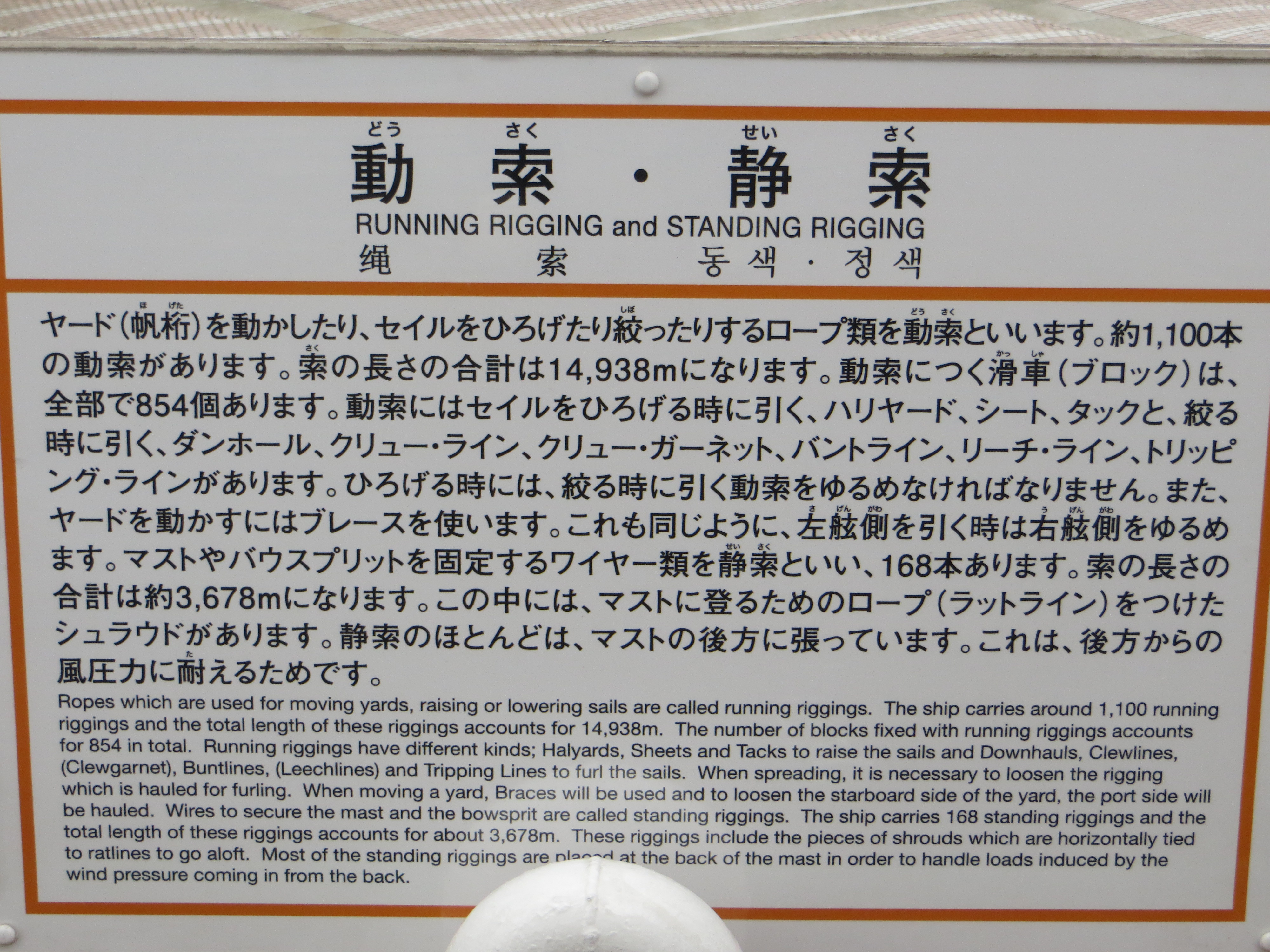
Here’s the text of the English translation on an explanatory sign about the rigging on the Nippon Maru. Though phrased rather awkwardly, it is very clear and instructive.

Running Rigging and Standing Rigging
Ropes which are used for moving yards, raising or lowering sails are called running riggings. The ship carries around 1,100 running riggings and the total length of these riggings accounts for 14,938m. The number of blocks fixed with running riggings accounts for 854 in total. Running riggings have different kinds: Halyards, Sheets and Tacks to raise the sails and Downhauls, Clewlines, (Clewgarnet), Buntlines, (Leechlines) and Tripping lines to furl the sails. When spreading, it is necessary to loosen the rigging which is hauled for furling. When moving a yard, Braces will be used and to loosen the starboard side of the yard, the port side will be hauled. Wires to secure the mast and the bowsprit are called standing riggings. The ship carries 168 standing riggings and the total length of these riggings accounts for about 3,678m. These riggings include the pieces of shrouds which are horizontally tied to ratlines to go aloft. Most of the standing riggings are placed at the back of the mast in order to handle loads induced by the wind pressure coming in from the back.

The Japanese terms for ‘running rigging’ and ‘standing rigging’ are 動索 dousaku ‘moving-rope’ and 静索 seisaku ‘still-rope’, respectively. (The matching Korean terms, dongsaek and jeongsaek, are cognate, and the suo ‘cable, rigging’ in Chinese shengsuo ‘rope-rigging’ is also cognate with J. saku and K. saek.) ‘Starboard’ is 右舷側 u-gen-gawa ‘right-gunwale-side’ and ‘port’ is 左舷側 sa-gen-gawa ‘left-gunwale-side’. (The kanji 舷 gen ‘gunwale’ also occurs in 舷灯 gen-tou ‘gunwale-lamp = running lights’ [on each side of the ship], 舷門 gen-mon ‘gunwale-gate = gangway’, and 舷窓 gen-sou ‘gunwale-window = porthole’.) The bow or fore part of the ship is 船首 sen-shu ‘ship-neck’ and the stern or aft part of the ship is 船尾 sen-bi ‘ship-tail’.

These terms were no doubt in use long before Japanese sailors became familiar with European-style sailing ships (before Date Masamune had his first Spanish galleon built in 1613). The same goes for terms like 帆柱 ho-bashira ‘sail-pillar = mast’ and 帆桁 ho-geta ‘sail-beam = yard(arm)’. Nevertheless, the Japanese text begins with the katakana synonym for ‘yard’ (yaado) followed by its kanji equivalent (帆桁) in parentheses, and employs exclusively katakana terms (borrowed from English) for ‘sail’ (seiru), ‘rope’ (roopu), and ‘mast’ (masuto). Why? Because the names for all the subcategories of nautical masts, sails, and rigging have been imported wholesale from English. At eye-level on each of the four masts is its name in katakana: foamasuto ‘foremast’, meinmasuto ‘mainmast’, mizunmasuto ‘mizzenmast’, and jigaamasuto ‘jiggermast’ (and ‘bowsprit’ is bausupritto). There are ways to write ‘front mast’ and ‘back mast’ in kanji, but it is much harder to differentiate four masts using traditional (Sino-Japanese) terminology.

Similarly, the name for every length of rigging on this modern square-rigged four-master is directly imported from English: ‘halyard’ is hariyaado, ‘sheet’ is shiito, ‘tack’ is takku, ‘downhaul’ is danhooru, ‘clewline’ is kuryuu rain, ‘clewgarnet’ is kuryuu gaanetto, ‘buntline’ is banto rain, ‘leechline’ is riichi rain, ‘tripping line’ is torippingu rain, ‘brace’ is bureesu, ‘ratline’ is rattorain, and ‘shroud’ is shuraudo.

The same goes for the names of every spar among the yards, as the following Yards chart shows. ‘Lower topsail yard’ is rowaa toppuseeru yaado, ‘upper (top)gallant yard’ is appaa geran yaado, ‘royal yard’ is roiyaru yaado, ‘spanker gaff’ is supankaa gafu, ‘spanker boom’ is supankaa buumu, and so on. The Korean translation (yadeu) of the chart title suggests that Koreans have also directly imported this specialized English terminology. (In the Chinese title, ‘yard’ is mistranslated as dui-huo-chang ‘stack-goods-place = freight yard’.)

yards-sign

Names of sailing yards

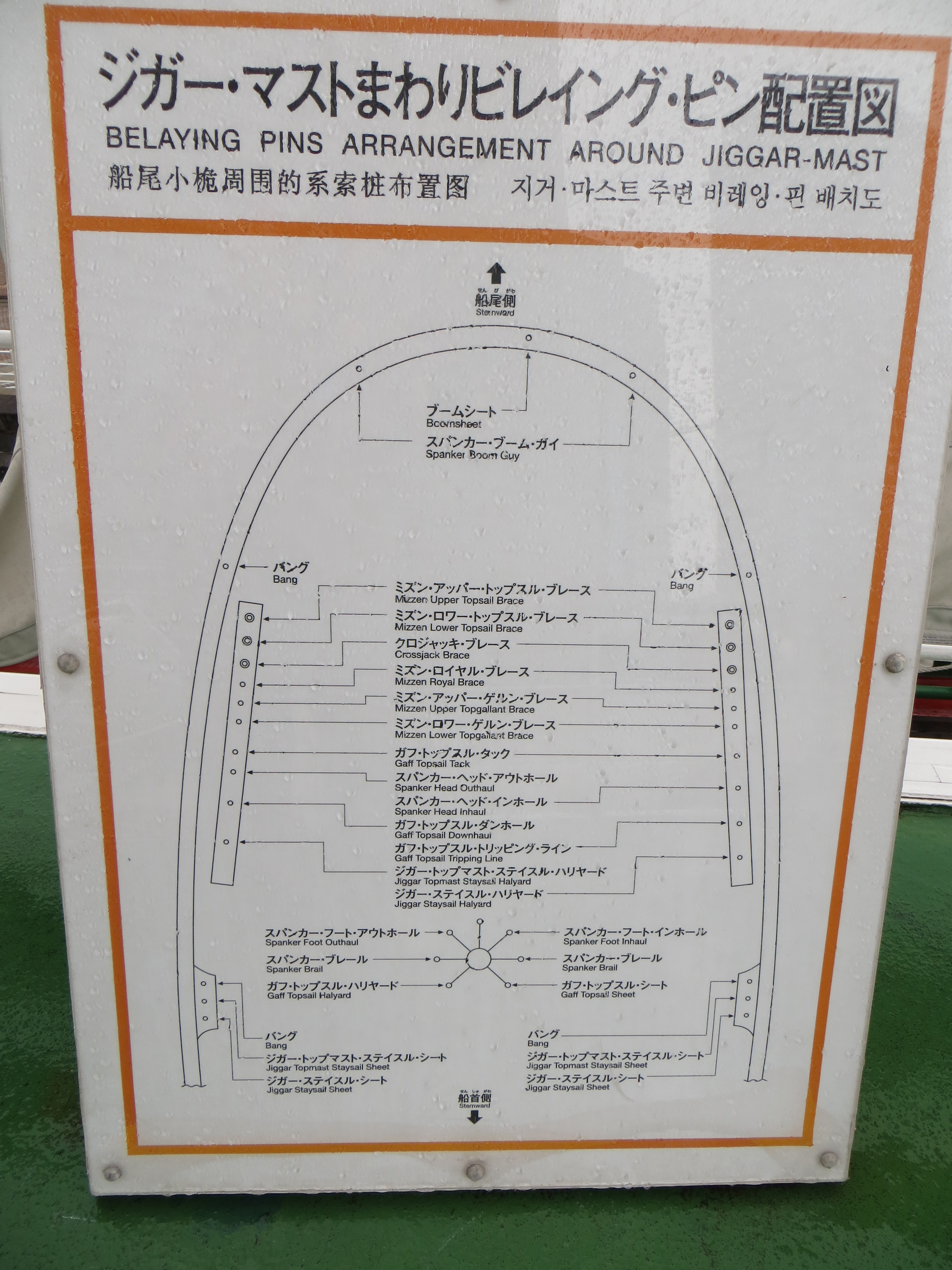
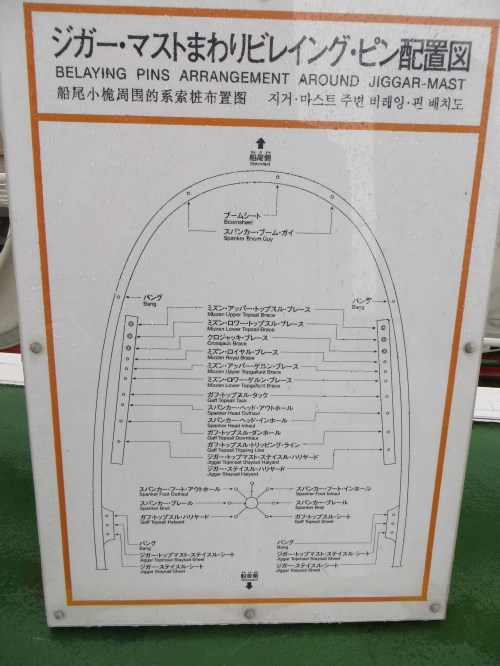
The last chart included here only confirms the extent to which English modern square-rigged sailing ship terminology has been imported wholesale into Japanese naval usage. Its title in Japanese is Jigaa masuto mawari bireingu pin haichizu ‘jigger mast around belaying pin arrangement-diagram’. The nautical terms of English origin, ‘jiggermast’ and ‘belaying pin’, are written in katakana, the native Japanese word for ‘around’ is written in hiragana, and the Sino-Japanese compound translated ‘arrangement-diagram’ is written in kanji. Although the Korean title is written entirely in the Korean alphabet, the breakdown of word origins is the same (and so is the word order): jigeo maseuteu ‘jiggermast’, jubyeon ‘around’, bireing pin ‘belaying pin’, baechido ‘arrangement diagram’.

In the Chinese translation, ‘jiggermast’ is rendered as 船尾小桅 chuanwei xiaowei ‘ship-tail small-mast’ to distinguish it from 后桅 houwei ‘rear-mast’ (= ‘mizzenmast’, cf. 前桅 qián wéi ‘fore-mast’, 主桅 zhuwei ‘main-mast’). ‘Belaying pin’ is translated rather directly as 系索桩 jisuozhuang ‘fasten-rope-stake’. These Chinese nautical terms do not render the English sounds, as the Japanese and Korean equivalents do.

By the way, there is a mistake in the English translation of the directions at the top and bottom of the chart. Both directions are labeled ‘sternward’ in English, but in Japanese only the top arrow points sternward (sen-bi-gawa ‘ship-tail-ward’), while the bottom arrow points foreward (船首側 sen-shu-gawa ‘ship-neck-ward’).
belaying-pin-chart

Jiggermast belaying pin chart

1 Comment

Filed under anglosphere, China, Japan, Korea, language, military, travel

Along the Sumatra Railroad, August 1945

From Chapter VI, The golden spike, in The Sumatra Railroad: Final Destination Pakan Baroe, 1943-1945, by Henk Hovinga, trans. by Bernard J. Wolters (KITLV Press, 2010), pp. 276-281:

It was 15 August 1945. The previous night telexes had spread the news across the world: ‘Japan surrendered. Armistice on 15 August at 00.00 hrs.’ The Japanese officers there in the godforsaken green heart of Sumatra also knew that. They shouted: ‘Banzai Nippon’ while they knew that they had been defeated. But they kept quiet. They only talked about the railway that was finally completed at the cost of immeasurable human suffering. At the cost of more than eighty thousand dead, the vast majority of which were romushas.

The POWs who were waiting motionlessly between the trees, still had no knowledge of the surrender. With sweat dripping down their chins, they did not dare to move. Ignorant of this historical moment in the world’s history, they looked breathlessly at how the bottle on the table was uncorked, how the glasses went around and the biscuits were presented. A short while later the tense ceremony, that had lasted not even half an hour, was abruptly terminated. Tables and chairs were hastily loaded on to the lorries after the emaciated workers had also been offered a biscuit and a swig from a bottle. Then they were ordered back to the trains. One departed to the north, the other to the south, to the camp in the gorge, where fresh rumours had circulated in the meantime….

That evening, shortly before sundown, the POWs were counted and recounted. All men had returned from the railway. The Japanese commander stepped forward in front of the hundreds of almost naked human wrecks. The ribs could be counted on most of them; many were covered in wounds and tropical ulcers. With their hollow eyes they tensely watched the well-fed, arrogant Japanese. Would he announce what they had all for so long desperately wanted to hear? Lieutenant Visser interpreted:

‘Now that the railway is finished, thanks to the efforts of all of you, I have been given the authority in the name of His Majesty, the Emperor, to inform you that all of you are permitted to rest from this moment on. In a short while you will all be relocated to more pleasant parts of the country. As of today all rations of rice, vegetables and meat will be increased. You will be provided with these new rations as soon as we receive new stock. At this moment we do not have any meat or vegetables and we have only a supply of rice for a few days. Pending your relocation, you are not permitted to leave the camp.’

That was all…. The choking uncertainty lasted for over a week, while the men were hanging around the camp with nothing to do. It was probably 24 August when the first train with a real steam powered locomotive stopped at Camp 11…. On August 27 a second contingent of POWs was transferred in the same manner…. The last group from the south departed on 30 August, taking with them the entire inventory of the camp that was now completely abandoned….

‘We obtained complete certainty a little later during roll call. Lieutenant Visser stepped forward and shouted: “Today is 31 August. It is the birthday of our beloved Queen Wilhelmina. That is why together we are now going to sing our national anthem, the Wilhelmus: one, two, three…” But nobody had the courage. “Then I will do it alone”, Visser said as he began to sing. Fearfully, we looked at the Jap, but when he did not move we all joined in one after the other. At first hesitatingly, but then louder, from the heart. It was a very strange moment. I saw the Jap slowly move his legs; he put down his samurai sword and stood up. When the last words of the anthem sounded, he stood directly across from us and saluted. That was when we knew. At last! We hardly dared to believe it, but this time it was true. We were free. We cheered, shouted and cried. We were free. Finally free…’

Without an official Japanese declaration of surrender lieutenant Visser’s group was the last to find out that the war was over. Two weeks earlier the wildest rumours of a possible surrender had already been going around the first camps near Pakan Baroe [‘New Market’]. Mid August hope of an impending liberation was also glimmering in Camp 2 when the usually sadistic Koreans suddenly turned friendly, even inviting a group of prisoners from the camp staff to a meal! That had to occur at midnight and without knowledge of the Japanese. Naturally the place that would be least likely to attract undesired visitors and snoopers was the cemetery on the other side of the stream. There, at the graveyards, the Koreans offered the representatives of their victims a conciliatory meal. They told the captives that the war was almost over and that they, the POWs, should not be too hard on them. After all Korea had also been occupied and suppressed by the Japanese for years, so that the prisoners and the guards were actually partners in adversity….

When a few days later the news of liberation seeped through to everyone, the most heart-warming scenes took place everywhere along the railway. On 25 August at eight o’clock in the morning the POWs in Logas (Camp 9) were informed that the war was over. The Japs disarmed the Koreans, while a Korean non-commissioned officer stood to attention before a Japanese soldier third class. The next day all ducks and chickens of the Japanese camp commander had disappeared. They had been consumed by the prisoners.

2 Comments

Filed under disease, food, Indonesia, Japan, Korea, labor, Netherlands, slavery, war

Lankov on the Soviet-run Popular Revolution in NK

The Sino-NK blog (“Northeast Asia with a China-North Korea Focus”) has an interesting column with the provocative title, A False Dichotomy: Professor Andrei Lankov on a Popular Revolution Imposed from Without. Here’s Prof. Lankov’s conclusion.

The Soviet involvement with the new regime in Pyongyang was considerable. Soviet control far exceeded America’s rather moderate influence in the South. However, the vast majority of Koreans did not know this. One cannot help but wonder, then: had the extent of Soviet control been fully known in the late 1940s, would such a revelation have had a decisive impact on popular attitudes towards Pyongyang’s regime? It is, after all, difficult to imagine that in 1946 North Korean farmers would have rejected free land had they known that this land had been bestowed upon them by the secretive Soviet viceroy and not by this young, plump guerrilla field commander named Kim Il-sung.

It seems that Korean historians are caught in a false dichotomy when they argue about whether the 1945-50 period was a time of foreign occupation or popular revolution. In fact, it was both. Irrespective of the Soviet advisors, who discreetly but firmly controlled developments, the major ideas resonated well with the majority of North Korean people and provided the language of the revolution. The Kim Il-sung regime of the late 1940s might have been a dependent or even a puppet one, but this does not necessarily mean that it was unpopular. Of course, its popularity was to a large extent based on naive expectations and illusions, but it was quite real nonetheless.

via The Marmot’s Hole

Leave a comment

Filed under democracy, Japan, Korea, military, nationalism, scholarship, U.S., USSR

Stalin’s Fears of Japan and Poland, 1937-1939

From Bloodlands: Europe Between Hitler and Stalin, by Timothy Snyder (Basic Books, 2010), Kindle Locs. 2094-2112, 2285-2321 (pp. 105, 116-117):

In 1937 Japan seemed to be the immediate threat. Japanese activity in east Asia had been the justification for the kulak operation. The Japanese threat was the pretext for actions against the Chinese minority in the Soviet Union, and against Soviet railway workers who had returned from Manchuria. Japanese espionage was also the justification for the deportation of the entire Soviet Korean population, about 170,000 people, from the Far East to Kazakhstan. Korea itself was then under Japanese occupation, so the Soviet Koreans became a kind of diaspora nationality by association with Japan. Stalin’s client in the western Chinese district of Xinjiang, Sheng Shicai, carried out a terror of his own, in which thousands of people were killed. The People’s Republic of Mongolia, to the north of China, had been a Soviet satellite since its creation in 1924. Soviet troops entered allied Mongolia in 1937, and Mongolian authorities carried out their own terror in 1937-1938, in which 20,474 people were killed. All of this was directed at Japan.

None of these killings served much of a strategic purpose. The Japanese leadership had decided upon a southern strategy, toward China and then the Pacific. Japan intervened in China in July 1937, right when the Great Terror began, and would move further southward only thereafter. The rationale of both the kulak action and these eastern national actions was thus false. It is possible that Stalin feared Japan, and he had good reason for concern. Japanese intentions were certainly aggressive in the 1930s, and the only question was about the direction of expansion: north or south. Japanese governments were unstable and prone to rapid changes in policy. In the end, however, mass killings could not preserve the Soviet Union from an attack that was not coming.

Perhaps, as with the Poles, Stalin reasoned that mass killing had no costs. If Japan meant to attack, it would find less support inside the Soviet Union. If it did not, then no harm to Soviet interests had been done by preemptive mass murder and deportation. Again, such reasoning coheres only when the interests of the Soviet state are seen as distinct from the lives and well-being of its population. And again, the use of the NKVD against internal enemies (and against itself) prevented a more systematic approach to the actual threat that the Soviet Union faced: a German attack without Japanese or Polish assistance and without the help of internal opponents of Soviet rule.

Officially, the agreement signed in Moscow on 23 August 1939 was nothing more than a nonaggression pact. In fact, Ribbentrop and Molotov also agreed to a secret protocol, designating areas of influence for Nazi Germany and the Soviet Union within eastern Europe: in what were still the independent states of Finland, Estonia, Latvia, Lithuania, Poland, and Romania. The irony was that Stalin had very recently justified the murder of more than one hundred thousand of his own citizens by the false claim that Poland had signed just such a secret codicil with Germany under the cover of a nonaggression pact. The Polish operation had been presented as preparation for a German-Polish attack; now the Soviet Union had agreed to attack Poland along with Germany.

On 1 September 1939, the Wehrmacht attacked Poland from the north, west, and south, using men and arms from annexed Austria and Czechoslovakia. Hitler had begun his war.

In August and September 1939, Stalin was reading maps not just of east Europe but of east Asia. He had found an opportunity to improve the Soviet position in the Far East. Stalin could now be confident that no German-Polish attack was coming from the west. If the Soviet Union moved against Japan in east Asia, there would be no fear of a second front. The Soviets (and their Mongolian allies) attacked Japanese (and puppet Manchukuo) forces at a contested border area (between Mongolia and Manchukuo) on 20 August 1939. Stalin’s policy of rapprochement with Berlin of 23 August 1939 was also directed against Tokyo. The Molotov-Ribbentrop Pact between Germany and the Soviet Union, signed three days after the Soviet offensive, nullified the Anti-Comintern Pact between Germany and Japan. Even more than the battlefield defeat, the Nazi-Soviet alliance brought a political earthquake in Tokyo. The Japanese government fell, as would several more in the coming months.

Once Germany seemed to have chosen the Soviet Union rather than Japan as its ally, the Japanese government found itself in an unexpected and confusing situation. The consensus among Japanese leaders was already to expand southward rather than northward, into China and the Pacific rather than into Soviet Siberia. Yet if the union between Moscow and Berlin held, the Red Army would be able to concentrate its forces in Asia rather than in Europe. Japan would then be forced to keep its best troops in the north, in Manchukuo, in simple self-defense, which would make the advance into the south much more difficult. Hitler had given Stalin a free hand in east Asia, and the Japanese could only hope that Hitler would soon betray his new friend. Japan established a consulate in Lithuania as an observation point for German and Soviet military preparations. The consul there was the russophone spy Chiune Sugihara.

When the Red Army defeated the Japanese, on 15 September 1939, Stalin had achieved exactly the result that he wanted. The national actions of the Great Terror had been aimed against Japan, Poland, and Germany, in that order, and against the possibility of encirclement by these three states working together. The 681,692 killings of the Great Terror did nothing to make encirclement less likely, but diplomacy and military force did. By 15 September Germany had practically destroyed the Polish Army as a fighting force. A German-Polish attack on the Soviet Union was obviously out of the question, and a German-Japanese attack on the Soviet Union also looked very unlikely. Stalin had replaced the phantom of a German-Polish-Japanese encirclement of the Soviet Union with a very real German-Soviet encirclement of Poland, an alliance that isolated Japan. Two days after the Soviet military victory over Japan, on 17 September 1939, the Red Army invaded Poland from the east. The Red Army and the Wehrmacht met in the middle of the country and organized a joint victory parade. On 28 September, Berlin and Moscow came to a second agreement over Poland, a treaty on borders and friendship.

So began a new stage in the history of the bloodlands. By opening half of Poland to the Soviet Union, Hitler would allow Stalin’s Terror, so murderous in the Polish operation, to recommence within Poland itself. Thanks to Stalin, Hitler was able, in occupied Poland, to undertake his first policies of mass killing. In the twenty-one months that followed the joint German-Soviet invasion of Poland, the Germans and the Soviets would kill Polish civilians in comparable numbers for similar reasons, as each ally mastered its half of occupied Poland.

The organs of destruction of each country would be concentrated on the territory of a third. Hitler, like Stalin, would choose Poles as the target of his first major national shooting campaign.

Leave a comment

Filed under China, Germany, Japan, Korea, Mongolia, Poland, USSR, war