Category Archives: Japan

The Last Japanese Holdouts in the Philippines

A little over 30 years ago, in 1974, Lt. Onoda of the Imperial Japanese Army surrendered on Lubang Island in the Philippines.

February 1946 – Post WWII island campaign

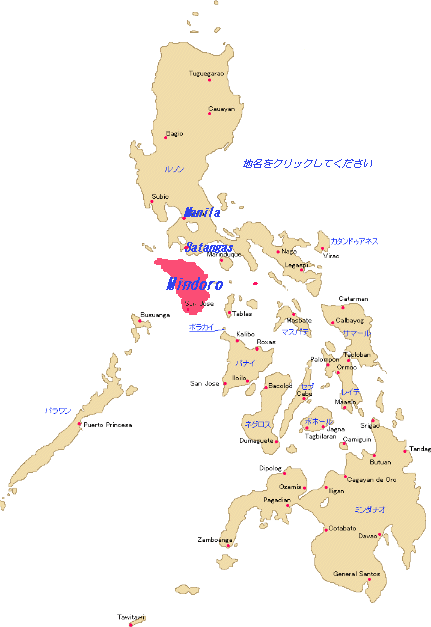
In February 1946 on 74 square mile Lubang Island, 70 miles southwest of Manila Bay a seven week campaign to clear the island was begun by the Filipino 341st and American 86th Division.

February 22, 1946 – Lubang island Allied casualties in a post WWII battle

Intense fighting developed on February 22, 1946 when troops encountered 30 Japanese. Eight Allied troops were killed, including 2 Filipinos. The Filipino and Americans sent for an additional 20,000 rounds of small arm ammunition, but not future battles occurred of this magnitude. In early April, 41 members of the Japanese garrison on Lubang island came out of the jungle, unaware that the war had ended….

March 5, 1974 – Lubang Island – 2nd Lt. Hiroo Onoda Born in the town of Kainan, Japan in 1922 and when he turned seventeen, he went to work for a trading company in China. In May of 1942, Onoda was drafted into the Japanese Army. Unlike most soldiers, he attended a school that trained men for guerilla warfare. On December 26, 1944 (age 23), Hiroo Onoda was sent to the small tropical island of Lubang Island, which is approximately seventy-five miles southwest of Manila in the Philippines. Shortly after Americans landed, all but four of the Japanese soldiers had either died or surrendered. Hiroo Onda was also with three other holdouts, who had different fates:

Private First Class Yuichi Akatsu – (age 22 in 1944) Left the group in September 1949. He managed to live six months on his own before surrendering to the Philippine Army. In 1950, the remaining three found a note left by Akatsu stating that he had been greeted by friendly troops. He even led a group of soldiers into the mountains in search of the remaining men. Onoda and his men quickly concluded that Akatsu was now working for the enemy.

Corporal Shoichi Shimada – (age 30 in 1944) In June of 1953 was shot in the leg during a shootout with some fishermen. Onoda nursed him back to health, but on May 7, 1954, Shimada was killed instantly from a shot fired by another search party sent in to find the men.

Private Kinshichi Kozuka – (age 24 in 1944) Killed by two shots fired by local police on October 19, 1972 when Kozuka and Onoda burned rice that had been collected by farmers, as part of their guerilla activities.

Circumstances of His Surrender

Despite the efforts of the Philippine Army, letters and newspapers left for them, radio broadcasts, and even a plea from Onoda’s brother they did not believe the war was over. On February 20, 1974, Onoda encountered a young Japanese university dropout named Norio Suzuki who was traveling the world and told his friends that he was “going to look for Lieutenant Onoda, a panda, and the Abominable Snowman, in that order.” The two became friends, but Onoda said that he was waiting for orders from one of his commanders. On March 9, 1974, Onoda went to an agreed upon place and found a note that had been left by Suzuki. Suzuki had brought along Onoda’s one-time superior commander, Major Taniguchi, who delivered the oral orders for Onoda to surrender. Intelligence Officer 2nd Lt. Hiroo Onoda emerged from the jungle of Lubang Island with his .25 caliber rifle, 500 rounds of ammunition and several hand grenades. He surrendered 29 years after Japan’s formal surrender, and 15 years after being declared legally dead in Japan. When he accepted that the war was over, he wept openly.

Afterwards

He returned to Japan to receive a hero’s welcome. He was a media sensation and was hounded by the curious public everywhere he went. He was unable to adapt to modern life but wrote his memories of survival in a book, No Surrender: My Thirty-Year War. After publication, he moved to Brazil to raise cattle. He revisited Lubang island in 1996, and still alive today. He then married a Japanese woman and moved back to Japan to run a nature camp for kids.

Actually, the last confirmed surrender was by Captain Fumio Nakahira, who held out until April 1980 near Mt. Halcon in Mindoro Island.

Leave a comment

Filed under Japan, Philippines, war

Naipaul on the Japanese in Malaysia, 1942-45

The Japanese were in Malaysia for three years and eight months. Until they came, Syed Alwi had not seen violent death. Now, near the market in Taiping, where his old English-language school was, he would see staked heads. He was told that they were the heads of Chinese people.

Syed Alwi said, “After the first year things became bad. Food became very short–the basic necessities, rice, sugar. The life in the kampung began to go very bad when disease became rampant. We didn’t have much nourishment. So you got ulcers, skin diseases. We had lost our knowledge of local herbs. We had grown used to hospitals and Western medicine. We couldn’t cope with the breakdown of society.

“Besides, the Japanese had promised that everything was going to be all right, and that there would be abundance of everything. They specifically mentioned that a lot of rice would be coming, because in Japan they grew a lot of rice. Whenever they took anything from us they would say it would be repaid many times over. They would say, ‘I take your bicycle now. I will repay it with five bicycles or more.’ And they would add, ‘Not only bicycles, but other things as well. ‘They mentioned silk. And for months and months the community waited. The Japanese kept that promise alive by circulating rumors that shipments of rice had arrived and people in certain kampungs had already received theirs.

“At the beginning of newsreels, in the mobile cinemas and the theaters, they would say in Japanese, Malay, and English: ‘Thank God Asia has been given back to Asians.’ What followed were images of the greatness of Japan: bundles and bundles of silk and other luxury goods. This had an effect. The first Hari Raya–the festival after the fasting month–we were talking about how everybody would be dressed in Japanese silk.”

But things just went from bad to worse….

Syed Alwi said, “A new way of life, a decayed way of life, began to develop. Right and wrong began to be decided not by any moral or religious or spiritual standard, but by what was good for the self and survival. If moral values were applied you couldn’t survive. What was normal life then? Pain and suffering and starvation and deprivation and disease. If those were things of normal life, why should morality be the deciding factor? What was of value would be what could alleviate your pain. Or what you could find to keep yourself some self-esteem. What was normal was that you saw Japanese soldiers beating up people. You saw people being snatched in all kinds of ways. You saw people being destroyed by torture, or escaping torture or worse by jumping in the river.”

SOURCE: Beyond Belief: Islamic Excursions Among the Converted Peoples, by V.S. Naipaul (Vintage, 1998), pp. 404-405

Leave a comment

Filed under Japan, Malaysia, war

Kamishibai Shrinks but Spreads

Kamishibai–“the picture card show”–is a kind of storytelling that, as late as 1950, was still enormously popular in the Japanese countryside. It has been estimated that at that date there were yet active some 25,000 players. In spite of the poor documentation (as is the case, incidentally, with nearly all other types of folk arts in Japan and elsewhere until recently), the magnitude of their impact on society was tremendous. Satoshi Kako calls kamishibai a type of early-day television. With the advent of that modern electronic device, however, its primitive forerunner faded from the streets with amazing rapidity.

Kamishibai now is to be found, for the most part, only in primary school classrooms as a teaching device and devoid of its traditional associations. Very few Japanese under age forty whom I approached had ever heard of kamishibai as a form of street entertainment.

“Uncle Kamishibai” usually carried with him three sets of pictures for telling separate stories. Each set consisted of approximately ten thick paper sheets or light boards of illustrations. The sheets would be inserted one after another into a box with a large, fixed-frame aperture. The most important words that went along with a given scene would be written on the back of the sheet. The box, during this century, was most often attached to the back of a bicycle. The kamishibai player would ride about from neighborhood to neighborhood, striking his wooden clapper or beating on a small drum to attract the attention of children. When a crowd had gathered, he would sell them sweets or, more rarely, books, medals, and trinkets that even poor children could afford. Those who bought from him would be permitted to stand up front where they could see and hear clearly. This is how the kamishibai player earned his living. One is reminded of the old folk doctor of the American frontier. It is difficult to say which of his wares were more important–the remedies, potions, and appliances or the bombastic rhetoric and showmanship. In both cases, what was important is that a minor entertainment “event” took place that relieved the participants of the tedium of everyday life.

The origins of kamishibai are lost in obscurity but may, perhaps, be traced back to so-called “shadow-pictures” (kage-e). It has also been suggested that they may have been imported from Germany during the nineteenth century. Peep shows … were indeed introduced to Japan from abroad and were known during the Meiji period (1868-1912) as nozoki karakuri (“peep gimmick”) or karakuri-megane (“gimmicky glasses”) (note that puppets and marionettes may be referred to as karakuri-ningyoo “gimmicky dolls”). It would seem, however, that the technique of kamishibai was derived from a combination of influences (etoki [‘picture-explanations’ at temples dating back to Heian times], kage-e, Middle Eastern and European picture boxes, etc.). Be that as it may, kamishibai clearly falls within the general development of Asian picture-storytelling.

SOURCE: Painting and Performance: Chinese Picture Recitation and Its Indian Genesis by Victor H. Mair (U. Hawai‘i Press, 1988; now out-of-print), pp. 115-116. [Mair compares these traditions with Southeast Asian wayang ‘shadow’ plays, Indian bhopo, Chinese pien wen (Buddhist song-tales dating from Tang times), German bänkelsang, Italian cantastorie, and medieval European jongleur traditions.]

While kamishibai has shrunk down to a classroom technique in Japan, it has expanded to classrooms around the world. There is even a kamishibai version of Beowulf.

Leave a comment

Filed under Japan, language

New Missionaries to Japan, 1950

We left for Japan from Winchester, Virginia, in August of 1950. We travelled from Martinsburg by train. We had one child who was one year old and 17 pieces of baggage. We traveled to Cincinnati, Ohio, where we had to change trains for the three day trip to San Francisco where we would debark for Japan. Our cabin was a small one with barely enough room for us to sit or lie down. Joel had problems with being cooped up so long in such a small space. Edith was pregnant and often sick from the motion of the train. It was not the most pleasant trip of my life.

We finally arrived in San Francisco where we stayed in a hotel for two days until the ship left. The several new missionaries who met there took turns baby-sitting each other’s children so that they would have some chance to tour the city and make final preparations for departure. We embarked on the President Cleveland on or about August 12 for the two weeks voyage. Our accommodations were great and the ship provided us plenty of space to move around, laze about, play shuffle board, horseshoes, deck volleyball, and take walks around the ship. Joel had just learned to walk and could not understand why the surface on which he walked kept bobbing around. The food was exquisite. Our waiter complained, “A banquet every meal” and he was right! We could order as many appetizers, entrees and desserts as we wanted. Mealtime was sometimes quite an experience with a one year old and a pregnant, seasick wife, but I mainly remember how good the food was.

We arrived in Japan on August 23, 1950. Japan was a long way from home in Southampton County, Virginia. Except for the trip on a cattle boat to Europe in 1946, including a brief few days in Poland, this was my first experience outside of the United States. I really knew very little about the land which would be my domicile for most of the next twenty years or so. I knew even less of the Japanese language for it was the philosophy of the Foreign Mission Board that foreign languages were best learned in the country where the missionaries would work. A Japanese actress who had spent most of her life in the United States and was on the President Cleveland returning to her native land to play a leading role in Madame Butterfly took the time to teach those of us who were interested a few phrases in Japanese. So, as I have so often in my life I embarked on an adventure for which I was ill prepared.

I did not at that time fully realize that all those Japanese were not the foreigners but we were. Americans often feel that natives of other lands are the foreigners rather than ourselves when we travel to their countries. Everything seemed so “foreign” to me. The language sounded like nothing I had ever studied or heard. Signs in Japanese had no appearance of familiarity as would have Spanish or German for instance. The many unknowns gave the whole experience an aura of excitement but the predominant feeling was one of awe and uncertainty about what lay ahead. I remember seeing an American flag flying on a ship in Yokohama harbor and feeling a sense of security that we would be living under an occupation which would provide some measure of safety in this strange land to which I have come to live. This proved to be true but I do not remember feeling any anxiety about being mistreated by the Japanese even after the Occupation was over. The Japanese people welcomed us and were gracious to us. They were often rude but not more so to us than to each other it seemed. In fact, they treated us better than they treated each other. We learned soon that an outward politeness was often a cloak for negative feelings but on the whole we were pleasantly surprised that these people who not so long ago had been America’s bitter enemies were now so very friendly to Americans and so eager to learn all they could about their former enemies.

1 Comment

Filed under Japan, U.S.

Faubion Bowers: Intoxicated by MacArthur

WWII Japanese translator-interpreter Faubion Bowers recalls his boss during the occupation of Japan:

I am often asked what it was like to work closely with Douglas MacArthur. I was his aide-de-camp. Actually, my official title was Assistant Military Secretary to the Commander-in-Chief. MacArthur never hired anyone and never fired anyone. The people around him just sort of drifted into their jobs. Once, when he was complaining to me about how the press always gunned for him–“It’s only me and Patton they pick on “he moaned–I suggested very timidly that, “Perhaps, sir, it’s the people around you that cause a critical press. He answered unequivocally, “Major, if it’s right at the top, it’s right at the bottom.”

For the two years I was near MacArthur, I was absolutely intoxicated by him. He had a grandeur, a greatness, a magnificence that doesn’t exist anymore. There was a de Gaulle, Churchill, Smuts, Nehru, Stalin and MacArthur, that kind of bigger-than-life, old-fashioned razzmatazz belonging to a past era, another century. Certainly MacArthur belonged to the 19th Century, instead of the 20th. All that invoking of “the Almighty,” the grandiloquent vocabulary (“I would be recreant in my duty not to run for the Presidency”), the fulsome references to his “adored wife” (they didn’t sleep in the same bed, and she always called him “General,” even in private) and his public exaggerations regarding his son, whom he saw only briefly in the mornings and who was asleep by the time he got home in the evenings, were just that, exaggerations. The one and only time the General ever visited a hospital during his 6½ years in Japan was not to visit the wounded but to spend 10 minutes with little Arthur, who had broken his arm….

MacArthur always roused controversy. He brought it all on himself, and then whimpered that everyone was out to get him. His was a nature where pride was mortgaged to vanity. The Japanese liked him, because he kept himself aloof. The Emperor liked him, because he was deferential, excessively polite. MacArthur–a man who delighted in humiliating or trying to humiliate his superiors–was extraordinarily affable to Hirohito, the first time he came to call at the Embassy, September 26, 1945, when I was as terrified of his Japanese as he was scared of my Japanese. After the famous meeting, when the Emperor offered himself, his life, to free all the men in Sugamo Prison, MacArthur was terribly moved. He said to Jean, his wife, and me, “I was brought up in a republic, a democracy, but to see a man once so high now brought down so low, pains me, grieves me.” And both Jean and I knew that he was actually speaking of himself. If defeat in war had humbled Hirohito, it took little Truman, with the stroke of a pen, to bring down the mighty, self-consumed MacArthur, who had deliberately insulted the President on Wake Island in 1951.

Leave a comment

Filed under Japan, U.S., war

WWII Japanese Translators: The Hakujin Experience

Faubion Bowers, The Man Who Saved Kabuki, was a Japanese language translator in World War II. He contributed the following memoir to the Japanese American Veterans Association website.

In 1941, the year war with Japan broke out, there were 25 American Hakujin (Caucasians) who could read, speak and write–more or less–the Japanese language. Most of these were older, scholastic men who had spent years in Kyoto among art treasures or were missionaries who had set their minds on converting the Japanese from their heathen ways. Twenty-five is not much of a number when you are planning on an Army and Navy of five million or so against a nation of 100 million. The idea of using Nisei [2nd generation Japanese immigrants to America] or Kibei [Japanese Americans who had returned to Japan (usually for education)] had only begun to glimmer in 1940, and, even then, the idea was roundly rejected by the Navy. It would later use its own method of developing linguists: it would go to the Ivy League colleges, assemble the cum laudes and phi beta kappas and offer them a commission (instead of the draft) in exchange for a year’s intensive language training at Boulder, Colorado. The idea was a good one, because it produced, among others, Donald Keene, Ed Seidensticker and Robert Ward, some of the best Japanese scholars in the world today.

The Army was sloppier. Anyone, any White man, who went to Washington in 1940 or 1941, and said “Ohayo gozaimus,” (“Good morning”) or said he had been to Japan as a missionary’s son or businessman or whatnot, was immediately given a commission in Military Intelligence. I had spent the year from March, 1940, to March, 1941, in Japan and, since there were no other tourists, and foreigners were scarce in that country which had been ostracized for the Shina Ji[k]en (China “Incident”) since 1937 and the capture of all of China’s main cities, I had no alternative but to learn Japanese or die of loneliness. I learned it so well, thanks again to the absence of English speakers in the country that, when I left Japan (reluctantly, but it had become impossible for an American to remain there, as war was drawing near), and I continued my travels on down to Indonesia, the Dutch there assumed I was a Japanese spy and put me under armed guard until a ship could be found to send me back to America.

Back in America, by September 1941, I was drafted. I didn’t know about that trick of going to Washington and saying “Ohayo gozaimus.” At the induction center, I filled out all the forms, and, when it came to languages, I noted that I knew well French, Russian, Japanese and Malay (as Bahasa Indonesia was known in those days). The Army was so screwed up then, that my language ability went unnoticed. I was a private, trained in the Artillery, and, when Pearl Harbor exploded, I was in basic training in Fort Bragg, given a quick leave and readied to be sent to Africa for eventual landing in Italy.

However, mirabile dictu, when I reported back to camp, a Major Dickey appeared out of nowhere and said “Ohayo gozaimus” to me. I immediately answered in astonishment, rather homesick for the language, the people and the country I had come to love. My Japanese was better than Dickey’s, and we continued in English. From then on, Army life was more pleasant. I was instantly transferred to the Presidio in San Francisco, and was surrounded by Nisei and Kibei. All of us were privates, or at least none of us was an officer.

Then, we were sent to [Camp] Savage in cold Minnesota. Savage had been an Old Folks’ Home before the Army took it over, and it was a mess. All of us worked long and hard to clean it out. Then, as our military training continued — long hikes with full gear on our backs, PT, tattoo and taps — we began, rather continued, our studies in Japanese. If the hikes had been John Aiso’s idea, he was so conscientious, the Japanese lessons were an antidote. The instructors were marvelous. There was Tusky Tsukahira, a civilian. There was Tom Sakamoto, a staff sergeant, if I remember correctly, and others. Our classes consisted of Japanese-Americans and about 5 or 6 Hakujin–Matt Adams, Jurgenson, Charlie Fogg–I can’t remember the rest. Some of the students were simply marvelous in Japanese. Others were simply awful.

The Hakujin officers, aside from Colonel Rassmussen and Major Dickey, were splendid men; those Hakujin who had gotten their commissions by going to Washington ahead of the hot pursuit of the draft, well, their Japanese was terrible, to put it politely. Trouble began to brew. Here were the Nisei, brilliant in Japanese far beyond the ken of the Hakujin officers. They were drafted privates or PFCs at best. Their parents were confined in camps, their worldly goods and homesteads sold at fractions of their value. And here they were, serving their country in the most invaluable way possible–intelligence.

Rasmussen and Dickey were alarmed at the growing resentment. They were, in addition to being regular Army officers, experienced men of the world, having been military attaches at various embassies throughout the world, notably Japan. It became imperative that some–the best–Nisei be commissioned. However, the Army moves on precedent, and never in its history had anyone ever been commissioned on the basis of language. Further complicating matters was the prejudice against the Japanese-Americans, who had yet to prove themselves in battle.

So, Rassmussen decided to make me a test case. I was the best of the Hakujin linguists, and he reasoned with the authorities in Washington, that, to keep this poor private a private was a grave injustice. So, I was commissioned on the basis of language and given my little gold bars. Rank mattered a lot in those days, and I well remember having a little tiff with Paul Aurel, one of those Washington “Okayo gozaimus” officers. He barked at me, “Look here, Faub, I’m a first lieutenant, and you’re only a second lieutenant.” That taught me a lot about human nature and the importance–to some–of having a rank. At any rate, Rassmussen championed me, and, once I was an officer on the basis of language, it became possible for the first time in the U.S. Army for all the more deserving, far better than I, Nisei and Kibei to be commissioned. And a rather sticky moment in Army history passed without incident.

I also remember in Australia, it became urgent for a Nisei to be given a medal of some sort. Morale, again, was low. Their work was so invaluable that it had to be recognized in some public way. Finally, in New Guinea, my friend Kozaki was wounded. He was strafed while ducking in a boat, as a Japanese plane flew over. We were all assembled in formation, and the citation–Purple Heart and Silver Star–for bravery for Kozaki was read out loud to all of us. He was wounded in the Hopoi sector of New Guinea, it said, and for the duration, “Hopoi” and “ass” were synonymous at ATIS.

Leave a comment

Filed under Japan, language, U.S., war

D. Yee on Rise, Ye Sea Slugs!

Danny Yee reviews a book with an irresistible title: Rise, Ye Sea Slugs!, by Robin Gill (Paraverse, 2003), “a collection of a thousand haiku about sea cucumbers (namako), given both in Japanese and in translation, and with extensive commentary.”

An introduction places namako in Japanese culture, defends the use of “sea slug” for what are actually sea cucumbers rather than nudibranchs, surveys their taxonomy, and touches on some issues in defining and translating haiku. The bulk of the book divides up the haiku by aspects of sea slugs: frozen, featureless, protean, do-nothing, agnostic, mystic, scatological, helpless, meek, ugly, lubricious, just-so, tasty, slippery, chewy, drinking, silent, melancholy, stuporous, nebulous, and cold, with a large “sundry sea slugs” chapter for everything else….

And Rise, Ye Sea Slugs! offers a different perspective on Japanese culture, with insights into history, literature, mythology, food, and more. These take the form of scattered details rather than substantial analysis, but they are given context by the haiku they help explain.

“‘Mountain’ and ‘ocean’ are formal antonyms in Japan, where one may still be asked whether one plans to vacation in the former or the latter.”

Gill’s tone is relaxed and informal and he doesn’t take himself too seriously or struggle for academic respectability, but he is still precise in his own way, and insanely erudite.

Kids in Micronesia used sea slugs as water pistols–by picking them out of the water, aiming, and squeezing. The Chinese appetite for sea cucumbers (and sandalwood) brought many Pacific islands into world trade networks. The bêche de mer (‘sea cucumber’) trade gave rise the name of the lingua franca of Vanuatu, Bislama. There’s definitely room for a book by Mark Kurlansky on Sea Cucumber: A Biography of the Slug that Changed the World.

Leave a comment

Filed under Japan, language, Pacific

Japanese-speaking Chicano ‘Pied Piper’ on Saipan, 1944

In the 6 June 2004 Honolulu Star-Bulletin, reporter Gregg K. Kakesako profiles Guy Gabaldon, a Chicano kid raised by a Japanese family in East Los Angeles who single-handedly convinced 1,500 Japanese soldiers to surrender on Saipan in July 1944. Of course, being an American reporter in the 21st century, he emphasizes his subject’s victimhood more than his heroism.

Some say “The Pied Piper of Saipan” never got the proper credit for single-handedly capturing 1,500 Japanese prisoners in World War II….

He corralled more than 800 prisoners on July 8, 1944. Gabaldon was only an 18-year-old Marine Corps private first class who had learned the language while growing up with a Japanese family in East Los Angeles.

“The first night I was on Saipan, I went out on my own,” said Gabaldon, who now lives in Old Town, Fla. “I always worked on my own, and brought back two prisoners using my backstreet Japanese.

“My officers scolded me and threatened me with a court-martial for leaving my other duties, but I went out the next night and came back with 50 prisoners. After that I was given a free rein.”

His pitch simply was that the Japanese would be treated humanely….

“I came from such a large Latino family that no one objected when I moved in with a Japanese family. They were my extended family. It was there I learned Japanese, since I had to go language school with their children everyday.”

But when the war broke out his Japanese family was relocated to a detention camp in Arizona and he went to Alaska and worked in a fish cannery and as a laborer until he decided to enlist in the Marine Corps at the age of 17.

Gabaldon’s story inspired the 1960 motion picture “Hell to Eternity” starring no one that looked Chicano. (But at least the Japanese general was played by the prolific Sessue Hayakawa.)

Leave a comment

Filed under Japan, U.S., war

Muninn at Chanpon on "Losing the Soul of Japan"

The Muninn blogger has an essay up on the Chanpon site (“Multicultural Japan Online”) entitled Losing the Soul of Japan, in which he examines the tendency in Japan to depict foreigners in the role of preserving traditional Japanese values. It starts with him accompanying two Korean friends to a Shinto shrine to pay respects to the Japanese kami and gain assistance in their studies at Tokyo University. To anyone who knows the history of Korea under Japanese rule, this is as shocking as Koreans voluntarily changing their names to Japanese.

Then he sees a poster of “a Hungarian woman wearing an Aikido hakama … standing in the defensive pose of her martial art.”

In large text to the left, the poster quotes from a letter she has supposedly written which begins, “Dear mom, Japan has the Way of the Kami spirits.” The letter, written in Japanese, is shown in full in one corner of the poster …

The primary message of this poster becomes clear in the body of its text. In addition to describing a bit of Shinto culture, the poster notes, “The heart of Nippon that we Japanese have forgotten is for her a natural part of every day life.” (「私たち日本人が忘れかけたニッポンの心が彼女の毎日には当たり前のように息づいている」) The mechanic used to promote Shinto in this poster is one of shame. The Japanese have forgotten their “soul” or core culture, while it has become a natural part of this Hungarian woman’s life. In other words, this foreigner respects, appreciates, and practices that which we, the Japanese, have forgotten: the soul of Japan….

I believe the message of this poster and the lament over the “vanishing” of Japanese culture (again, nothing unique to this country) to be slowly on its way out. There is a newfound pride amongst a younger generation in Japan’s eminently exportable fashion and pop culture. The time will come when the almost derogatory addition of the word “pop,” will no longer be seen as necessary to distinguish it from something elite, pure, and legitimate. Like Japan’s traditional arts, Japan’s newest cultural exports were not “born pure” Japanese, being a derivation of a combination of influences. Unlike Japan’s traditional arts, however, its bastard origins are recognized and celebrated as such, and few would suggest that it is in anyway tied essentially to their identity as Japanese.

I called my friends over to look at the poster in which I had invested so much thought. They simply shook their heads at me and one said, in her characteristically flawless Japanese, “Yuk, I hate those freaky foreigners who love everything about Japanese culture.” I asked them if the Kami of Learning had given its blessing to their graduate studies. My attempt at a comeback went entirely unnoticed.

Leave a comment

Filed under Japan

Ukiyoe Animé

This is just too cool: animated Ukiyoe (‘floating world pictures’) –> Ugokie (‘moving pictures’). The latter consists of a gallery with labels crediting the original artist whose work inspired the animation. The labels are only in Japanese, but you don’t have to know a lot to recognize Hiroshige, Hokusai, the 36 views of Mt. Fuji, the 53 stages of the Tokaido, or even Utamaro and Eizen.

Leave a comment

Filed under art, Japan