Category Archives: Germany

New Religious Terms in Two Pacific Languages

How have local languages in the Pacific handled the new lexical requirements of foreign religious traditions? Much seems to depend on the language and sect of the first foreign evangelists.

The island of Yap in Micronesia was first evangelized by Spanish Catholics long before German Protestants arrived about 1898. Yapese is still largely Catholic, and religious loans are mostly from Spanish. Shinto seems to have left no lexical traces from the Japanese colonial era (1914–1945), but loanwords from Japanese remain well represented in the more profane contexts of the new clothing, containers, diseases, foods, tools, and means of transport introduced during those decades.

The following examples of Christian terms do considerable violence to the vowels of Yap’s new orthography, which would take too long to explain—and would also make the words look more Dutch than Spanish.

  • bibliya ‘Bible’ (Span.)
  • galasya ‘church’ (Span.)
  • kiristiyano ‘Christian’ (Span.)
  • komunyon ‘communion’ (Span.)
  • kuruth ‘cross, crucifix’ (Span.)
  • infiyarno ‘hell’ (Span.)
  • misa ‘(Catholic) mass’ (Span.)
  • padrey ‘priest’ (Span.)
  • rosaryo ‘rosary’ (Span.)
  • baynag ‘Christmas’ (Ger. Weihnacht)
  • næp’ ni-b thothup ‘Christmas Eve, Holy Night’ (lit. ‘night that’s holy’)

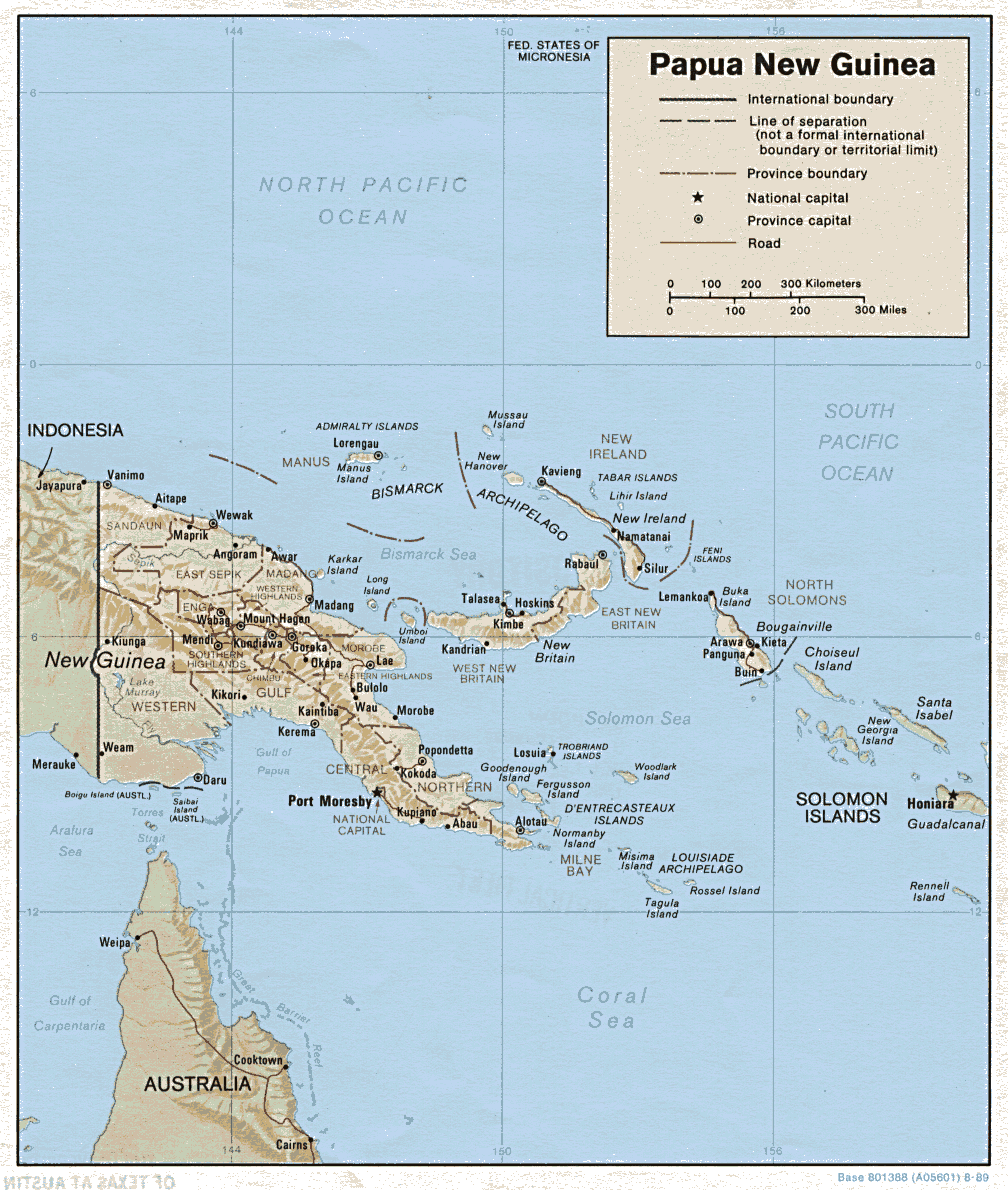
Morobe Province in Papua New Guinea was evangelized by German Lutheran missionaries beginning in 1886. The Germans adapted two local languages for evangelical and educational purposes, Jabêm for the Austronesian circuit along the coast and islands, and Kâte for the Papuan circuit in the interior of the Huon Peninsula. (Many, if not most, of the other interior languages of Morobe Province have since proven to be Austronesian, not Papuan.)

The German Lutheran strategy for communicating new Christian concepts was to adapt the local vernaculars rather than to introduce foreign words—not unlike the strategy of Martin Luther himself during the Protestant Reformation. The following examples are from Jabêm, in whose German-inspired orthography j represents a palatal glide (like English y), ŋ represents a velar nasal (like English -ng), and -c represents a glottal stop.

  • biŋsu ‘foreign missionary’ (also ‘admonition, commandment’)
  • biŋ gôliŋ ‘parable, proverb’ (lit. ‘talk steer’)
  • gôlôàc ‘congregation’ (also ‘clan, relatives, kinfolk’)
  • gêbêcauc dabuŋ ‘Christmas Eve’ (lit. ‘night holy/taboo’)
  • moasiŋ dabuŋ ‘holy communion’ (lit. ‘benefit/blessing holy’)
  • ŋalau dabuŋ ‘Holy Spirit’
  • kêdôŋwaga ‘teacher’ (lit. ‘3sg-teach-agent’)
  • sakiŋwaga ‘minister, servant’ (lit. ‘service-agent’)
  • jàeŋwaga ‘catechist, local missionary’ (lit. ‘message-agent’)

SOURCES: Yapese–English Dictionary, by John Thayer Jensen with the assistance of John Baptist Iou, Raphael Defeg, Leo David Pugram (U. Hawai‘i Press, 1977); Jabêm–English Dictionary, rev. by J. F. Streicher (Pacific Linguistics, 1982).

Leave a comment

Filed under Germany, language, Micronesia, Pacific, Papua New Guinea, religion, Spain

Two Film Roles: Scottish Moron vs. Stasi Mensch

This weekend, the Outliers went to see the excellent, award-winning German film The Lives of Others. Last weekend, we saw The Last King of Scotland, for which Forest Whitaker won a well-deserved Oscar. In between, we watched the German film Der Tunnel (via Netflix), which inspired in me an inchoate train of thought about people who understand living in a world of sometimes deadly moral compromise and those who don’t have a clue. But it was the sharp contrast between two starring roles in The Last King of Scotland and The Lives of Others that finally clarified it for me.

The fictional character in The Last King that most incensed exasperated me was not the disarmingly witty and manipulative, but increasingly brutal and paranoid tyrant. (I had expected him to be a monster.) It was the bloody fool of a Scottish doctor: a cocky, self-satisfied, self-indulgent, self-aggrandizing, culturally ignorant, sexually predatory, criminally naive moron who endangers more lives than he saves–a type all too common on university campuses worldwide (and, of course, in governments). The doctor finds out too late that others play by different rules with more deadly consequences than he has ever imagined. You’d think a real do-gooder might have exercised a little more caution and self-restraint as a guest in someone else’s house. But he is really an adventurer, not a do-gooder. The world is both his oyster and his china shop, and he manages to destroy three pearls he touches–the health minister, one of the dictator’s wives, and a fellow doctor–while leaving other lives shattered as well. You start out sympathizing with him, but when he finally escapes Uganda, my reaction was “Good bloody riddance!”

The Stasi spook at the center of The Lives of Others presents a stark contrast: a pathologically repressed, anal-retentive automaton whose only emotions are vicarious, the sole purpose of whose odious vocation is to incriminate others, not to heal or rescue them. And yet, this meticulously mistrusting drone knows very well how his world works and where its dangers lie. He studies his quarry long and hard before deciding what action to take (or not), finding ever more reasons to doubt the motives of his bosses and to empathize with his prey. In the end, he manages to carry out an anonymous good deed that allows at least one pearl to form in this slimy milieu of universal suspicion, deception, and betrayal. This repellant slimeball turns out to be ein guter Mensch after all. You start out loathing him, but you end up appreciating the self-effacing derring-do of this spook cum guardian angel, and so does the writer he has spied upon. Even though I had anticipated how the writer would convey his thanks, my eyes still flooded over as the moment arrived.

The story in The Lives of Others begins in 1984, and conveys only too well the Romania I encountered in that same year, about which more anon. It will take some time to compose. In the meantime, let me close with an excerpt from John O. Koehler’s Stasi: The Untold Story of the East German Secret Police (Westview, 2000).

“The Stasi was much, much worse than the Gestapo, if you consider only the oppression of its own people,” according to Simon Wiesenthal of Vienna, Austria, who has been hunting Nazi criminals for half a century. “The Gestapo had 40,000 officials watching a country of 80 million, while the Stasi employed 102,000 to control only 17 million.” One might add that the Nazi terror lasted only twelve years, whereas the Stasi had four decades in which to perfect its machinery of oppression, espionage, and international terrorism and subversion.

To ensure that the people would become and remain submissive, East German communist leaders saturated their realm with more spies than had any other totalitarian government in recent history. The Soviet Union’s KGB employed about 480,000 full-time agents to oversee a nation of 280 million, which means there was one agent per 5,830 citizens. Using Wiesenthal’s figures for the Nazi Gestapo, there was one officer for 2,000 people. The ratio for the Stasi was one secret policeman per 166 East Germans. When the regular informers are added, these ratios become much higher: In the Stasi’s case, there would have been at least one spy watching every 66 citizens! When one adds in the estimated numbers of part-time snoops, the result is nothing short of monstrous: one informer per 6.5 citizens. It would not have been unreasonable to assume that at least one Stasi informer was present in any party of ten or twelve dinner guests.

Like a giant octopus, the Stasi’s tentacles probed every aspect of life. Full-time officers were posted to all major industrial plants. Without exception, one tenant in every apartment building was designated as a watchdog reporting to an area representative of the Volkspolizei (Vopo), the People’s Police. In turn, the police officer was the Stasi’s man. If a relative or friend came to stay overnight, it was reported. Schools, universities, and hospitals were infiltrated from top to bottom. German academe was shocked to learn that Heinrich Fink, professor of theology and vice chancellor at East Berlin’s Humboldt University, had been a Stasi informer since 1968. After Fink’s Stasi connections came to light, he was summarily fired. Doctors, lawyers, journalists, writers, actors, and sports figures were co-opted by Stasi officers, as were waiters and hotel personnel. Tapping about 100,000 telephone lines in West Germany and West Berlin around the clock was the job of 2,000 officers.

Stasi officers knew no limits and had no shame when it came to “protecting the party and the state.” Churchmen, including high officials of both Protestant and Catholic denominations, were recruited en masse as secret informers. Their offices and confessionals were infested with eavesdropping devices. Even the director of Leipzig’s famous Thomas Church choir, Hans-Joachim Rotch, was forced to resign when he was unmasked as a Spitzel, the people’s pejorative for a Stasi informant.

UPDATE: Historians of Africa on the H-Africa discussion list have weighed in with a lot of good critical commentary on The Last King of Scotland. Here’s the best take I’ve read so far, by Brian Coyle at UC Berkeley.

In three recent films about African atrocity, The Last King of Scotland, Blood Diamond, and Hotel Rwanda, it interesting what gets said but not shown.

In Hotel Rwanda, an excellent film in my opinion, the conflict’s root cause is briefly posited in a didactic moment among key characters. The fact is given, unquestioned, that Belgians introduced a false distinction within an amorphous African population, granting some the ethnicity Tutsi to dignify a ruling, if non-European, class. The ethnic distinction that Hutu and Tutsi claim to be physical and deep is really a crafty Belgian charade. This neatly fits a dominant paradigm of social construction, but is hardly a scholarly consensus. In Blood Diamond, an average film in my opinion, the European-American-South African root cause is even more pedantically coded, right into the title. Little if any reference is given to the Liberian origin of the conflict, run by invaders from Liberia (though some were Sierra Leonians returning from time spent in the Liberian conflict). The diamond mines were fuel thrown on an already blazing fire. Also, the audience is left to assume that it was diamond-interest mercenaries who finally uprooted the rebels, which is untrue. In Last King of Scotland, a lousy film in my opinion, the English are made unequivocally responsible for Amin’s rise to power, and of course the Scottish doctor plays a key role in causing the deaths of the people we see.

Behind each of these geopolitical explanations is the same dynamic. Causal agency is granted to non-Africans, and removed from Africans. The big-budget films dare to say that the West is the root of African evil, and Africans are history’s mere pawns.

But what isn’t shown? Atrocities. Hotel Rwanda does show scattered corpses, and has a very effective scene where a car rides over bumps that we learn are people. But the Rwandan genocide involved hatcheting people to death, by hundreds and thousands. Film critics agreed the filmmakers chose wisely to refrain from such graphic imagery. Blood Diamond had a brief exposition of chopping off of hands, but the rest of the picture showed splays of machine gun fire and explosions. I can attest, having been in Sierra Leone during the war’s beginning , that guns were plentiful, but not bullets. Children were not given license to waste Rambo-scale rounds of ammunition. The worst violence was again by machete, and again it occurs off camera. In Last King of Scotland, Amin’s atrocities are barely shown. Instead we remain as ignorant as the foolish doctor, getting information from newspaper images he reads.

In all three cases, the films spare audiences from graphic recreations of the actual atrocities. The is rather unusual, since other big-budget movies have no scruples about such displays. Uber-violence is Hollywood’s idea of freedom of expression. Perhaps it takes a special kind of producer/director team to make an African movie, who are temperamentally uninclined to recreate atrocities. Or maybe not. If presented with wide-screen recreations of hundreds of innocents hacked to death in gruesome realistic detail, the audience might “mistakenly” conclude that Africans, by themselves, are capable of epic brutality that stamps history for millennia.

This contrasts sharply with another virtue of many German films like The Lives of Others (or The Harmonists, which we also saw recently): The German films don’t blame everything on the Russians, or the French, or the Brits, or the Americans. They acknowledge that many—if not most—people in East Germany (or Nazi Germany) were complicit to some degree or another.

Leave a comment

Filed under cinema, Germany, Uganda

The Mennonites of Filadelfia, Paraguay

Last week, reader Scott Rogers sent me links to interesting accounts of the Mennonite diaspora in Paraguay.

Mennonite settlers came to Paraguay from Germany, Canada, Russia and other countries for a number of reasons: religious freedom, the chance to practice their beliefs without hindrance, the quest for land. Although German immigrants had settled in Paraguay before the turn of the 20th century, it wasn’t until the 1920’s and 30s that many, many more arrived.

Many of the immigrants from Russia were fleeing from the ravages of the Bolshevik Revolution and the later Stalin repressions. They traveled to Germany and to other countries, and eventually joined the emigration to Paraguay.

Paraguay welcomed the emigrants….

The Mennonites had the reputation of being excellent farmers, hard-workers, and disciplined in their habits. In addition, the rumor of oil deposits in the Chaco, and Bolivia’s encroachment on that area, which resulted in the 1932 War of the Chaco, made it a political necessity to populate the region with Paraguayan citizens. (At the end of the war, Bolivia had lost much of its territory back to Paraguay, but both countries suffered loss of life and credibility.)

In return for religious freedom, exemption from military service, the right to speak German in schools and elsewhere, the right to administer their own educational, medical, social organizations and financial institutions, the Mennonites agreed to colonize an area thought to be inhospitable and unproductive due to the lack of water. The 1921 law passed by the Paraguayan congress in effect allowed the Mennonites to create a state within the state of Boqueron.

Three main waves of immigration arrived:

  • a Canadian group from Manitoba founded the the Menno colony in 1926-1927
  • a group from the Ukraine and the area of the Amour river came via China and created the Fernheim colony in 1930
  • a group of Russian refugees founded the Neuland colony in 1947

Conditions were difficult for the few thousand arrivals. An outbreak of typhoid killed many of the first colonists. The colonists persisted, finding water,creating small cooperative agricultural communities, cattle ranches and dairy farms. Several of these banded together and formed Filadelfia in 1932. Filadelfia became an organizational, commercial and financial center. The German-language magazine Mennoblatt founded in the early days continues today and a museum in Filadelfia displays artifacts of the Mennonite travels and early struggles. The area supplies the rest of the country with meat and dairy products.

My wife’s paternal line were Germans from the Ukraine who emigrated to lands around Menno, South Dakota, beginning in the 1880s. If not actual Mennonites, they were certainly pietists.

Read more about Paraguay’s Mennonites here.

1 Comment

Filed under Germany, Paraguay, religion, Russia

Muninn on Ash on The File

I’m a couple of weeks late in calling attention to another fine essay by Muninn‘s K. M. Lawson on Timothy Garton Ash’s The File: A Personal History (Vintage, 1998). Perhaps partly from his own Norwegian heritage, Lawson has a very finely nuanced take on issues of collaboration and resistance, which tend to get rewritten into dàzìbào (‘big character poster’) or bumpersticker format by nationalist historians. I very much look forward to reading his dissertation on East Asian history. Here are some excerpts from his review essay.

A certain sense of guilt, or at least a deep discomfort pervades the entire book: Ash is at least partly persuaded that the “outing” of Stasi informers and officers, whether it is in lists published in the newspaper, in sensationalist articles targeting a famous figure, or in books such as his own, might destroy more than it can potentially heal. He is especially skeptical of the arguments of the very media he worked for, “When writers or newspaper editors are criticized for publishing details from someone’s private life, they cite ‘the public interest.’ But in practice their definition of ‘public interest’ is often ‘what interests the public’” (p125)

It is not just the careers that can be destroyed, however, he gives us numerous examples of what happens when the files reveal an informing husband, daughter, or best friend. The quote above is taken from a moment when he wonders if his book’s publication might damage an informers relationship with her stepdaughter. Elsewhere we hear of a woman, once jailed for 5 years for trying to escape to the West, who finds out that her husband, who had that same morning wished her a good day in the archives, was the one who denounced her to the Stasi….

I think that Ash mirrors everything I have found to be true in my own reading about collaborators and the agents of wartime atrocities in East Asia when he concludes:

What you find is less malice than human weakness, a vast anthology of human weakness. And when you talk to those involved, what you find is less deliberate dishonesty than our almost infinite capacity for self-deception. [Muninn’s emphasis (and my strong second!)] (p252)

He is also sensitive to the special role this kind of opening of files can have in the aftermath of the unusual process of German unification:

Ironically, the opening of the files, demanded by former dissidents from East Germany, has reinforced Western neocolonial attitudes toward the East. West Germans, who never themselves had to make the agonizing choices of those who live in a dictatorship, now sit in easy judgment, dismissing East Germany as a country of Stasi spies. (p224)

However, in trying to be sensitive to the dangers of this process of confrontation and reflection on the past and being as sensitive as he can to the “agonizing choices” faced by those who lived under the dictatorship and chose to collaborate with the regime, Ash’s bitterness and anger certainly comes through. This is natural for someone who has a long history of working with dissidents throughout Communist Europe. The informers and officers he writes about are not given the last word, and Ash is often willing to present his encounters with them in such a way that reveals the ridiculous nature of the defenses and justifications given for their behavior. In addition to being willing to to mock their excuses for collaboration with the regime Ash also shows (deserved in my opinion) disgust for Leftists in the West who during the Cold War either a) held up the Communist bloc as a model of emancipatory democracy long after the horrors of such regimes were apparent to anyone who gave the evidence a sincere evaluation or, and I think this is just as important because it happens all the time even now (and I have found myself guilty of this): b) tried to make claims of equivalency between the slightest hint of oppression in the liberal democracies of the West and the oppression of dictatorial regimes.

At the end the book, Ash turns his thoughts to intelligence gathering in Britain and is surprised to find out from an anonymous British intelligence officer that he has a “friendly” or non-adversarial file in the records of MI6. He is troubled by the fact that, unlike the United States freedom of information act or the Gauck Authority, Britain provides no way to request information on what the government knows about you. He discusses the problems of “ends justifying the means” to justify the kinds of spying methods the Stasi officers always liked to tell him were “just like” those of the west, and the greater difficulty in justifying domestic surveillance in the West even with and argument about the final goal: In a democracy, “ends and means are almost inseparable. Spying on your own citizens directly infringes the very freedom it is supposed to defend. The contradiction is real and unavoidable. But if the infringement goes too far, it begins to destroy what it is meant to preserve. And who decides what is too far?” (p236) Ultimately however, he wants to emphasize the huge differences between the state of affairs in our own world and that under Stasi or even worse SS/Gestapo oppression: scale matters. Ash despairs at the perhaps inevitable “semantic degradation” (p238) that results when we use the language and terms of a heroic resistance or violent oppression when the scale differs by several degrees of magnitude.

This reminds me of another set of long-overdue blogposts of my own profiling the American members (including myself) of my Romanian language curs de perfecţionare at the University of Bucharest in 1983–84.

Leave a comment

Filed under Eastern Europe, Germany

German Pogroms Before the Black Death, 1348-49

In German-speaking Europe, reaction to the Chillon transcripts [of “confessions” extracted by torture as the plague began to work its way north from the Mediterranean]—and other incriminating docurnents—was swift and furious. “Within the revolution of one year, that is from All Saints Day [November 1] 1348 until Michaelmas [September 29] 1349, all the Jews between Cologne and Austria were burnt and killed,” wrote Heinrich Truchess, Canon of Constance.

In November, barely a month after Balavigny, Belieta, her son Aquetus, and Agimetus were executed, the first pogroms broke out in Germany. The towns of Solden, Zofingen, and Stuttgart killed their Jews in November; and Reutlingen, Haigerloch, and Lindau killed theirs in December. As January 1349 dawned cold and bright along the Rhine, it was Speyer’s turn. The Jews who did not immolate themselves in their homes were hunted down in the winter streets and bludgeoned to death with pikes, axes, and scythes. This happened so frequently, unburied corpses became a public health problem. “The people of Speyer …,” wrote a chronicler, “fearing the air would be infected by the bodies in the streets … shut them into empty wine casks and launched them into the Rhine.” Farther down river in Basel, the city council made a halfhearted attempt to protect the local Jewish community, but when a mob protested the exile of several anti-Semitic nobles, the council lost its nerve. Basel spent the Christmas season of 1348 constructing a wooden death house on an island in the Rhine. On January 9, 1349, the local Jewish community was herded inside. Everyone was there, except the children who had accepted baptism and those in hiding. After the last victim had been shoved into the building and the door bolted, it was set afire. As flames leaped into the cobalt blue sky, the screams and prayers of the dying drifted across the river and into the gray streets of Basel.

In February, when the pogroms reached Strassburg, a bitter winter wind was blowing off the Rhine. The mayor, a tough patrician named Peter Swaber, was a man of conscience and resolve. If the Jews are poisoning wells, he told an angry crowd, bring me proof. The city council supported the mayor, and officials in Cologne sent a letter of encouragement, but in the end, all Swaber had to offer the people of Strassburg was the opportunity to act righteously, while his opponents could promise relief from Jewish debt and access to Jewish property. On February 9, a government more in tune with the popular will unseated Swaber and his supporters. Five days later, on February 14, under a dull winter sun, the Jews of Strassburg were “stripped almost naked by the crowd” as they were marched “to their own cemetery into a house prepared for burning.” At the cemetery gates, “the youth and beauty of several females excited some commiseration; and they were snatched from death against their will.” But the young and beautiful and the converts were the only Jews to see the sun set in Strassburg that Valentine’s Day. Marchers who tried to escape were chased down in the streets and murdered. By one estimate, half of Strassburg’s Jewish population—900 out of 1,884—were exterminated at the cemetery….

According to Canon Truchess, “once started, the burning of the Jews went on increasingly…. They were burnt on 21 January [1349] in Messkirch and Waldkirch … and on 30 January in Ulm, on 11 February in Uberlingen … in the town of Baden on 18 March, and on 30 May, in Radolfzell. In Mainz and Cologne, they were burnt on 23 August …

“And, thus, within one year,” wrote the Canon, “as I have said, all the Jews between Cologne and Austria were burnt. And in Austria they await the same fate for they are accursed of God …. I could believe that the end of the Hebrews had come if the time prophesied by Elias and Enoch were now complete, but since it is not complete, it is necessary that some be reserved.”

SOURCE: The Great Mortality: An Intimate History of the Black Death, the Most Devastating Plague of All Time, by John Kelly (Harper Perennial, 2006), pp. 255-257

Despite all these “preventive measures” in the German lands, the plague rolled on in anyway, hard on the heels of the mass executions.

Leave a comment

Filed under Germany, religion

Moeller, Spengler, and the Rising East

Moeller van den Bruck—a Prussian philosopher and translator of Dostoevsky who committed suicide in 1925—had been obsessed with the coming triumph of “the East,” from bolshevism to Islam over the bankrupt cultures of the West. In Germany the Occident is called Abendland, or “evening land” [just as Arabic al maghreb or Romanian apusul mean ‘the place of the setting sun’ and therefore ‘the west’, as opposed to the Levant ‘rising place, east’], and Moeller—like his friend Oswald Spengler, author of The Decline of the West—thought that the sun was certainly setting on it. The rising sun was in the East, no matter how one defined it. Moeller thought that the right kind of collectivism, so manifestly “natural” among the Russians, offered an antidote to the anomie and selfishness of the Western societies.

Moellerians believed that the “German-Russian side of the world” was meant to do cosmic battle against the forces of Western bourgeois liberalism, with help from sundry other Eastern forces. They saw nations as either young or old. Germany was “young” because it was in an expansionary period, infused with a “leader-idea” (Führergedanke) and relying more on feelings than reason. Russia was in a similar phase, and the Bolshevik Revolution was a manifestation of it. Both Russia and Germany were searching, experimental nations, obsessed with their deep origins in barbarian I conflict; therefore, the Soviet Union was a false enemy. The real enemies lay in the West: they were the victors of Versailles. The United States, however, would be welcome in the coming “Eastern” alliance because it had a youthful spirit, a farm culture, and a lively “inner barbarian.” Moeller’s ideas, at times difficult and fruitlessly obscure, would more than likely have sunk into obscurity after his death, eclipsed by the work of his more media-savvy and self-promoting friend Oswald Spengler.*

([Footnote:] *In fact, Moeller had originally helped Spengler to feel better about the “decline of the West” back in 1919. Spengler had gone into a funk when his book’s publication had coincided with Germany’s defeat in the First World War; though one might think the philosopher of decline and despair would feel vindicated, the decline he had been thinking about was supposed to result from Germany’s victory—and the subsequent decline of its warrior fiber, as it grew fat and complacent—not from something as straightforward as an actual military defeat! Like most Germans, Spengler had not even considered that possibility. Moeller, apparently in a “high” period, convinced Spengler that by losing the war, Germany had won, because by facing the decline first, Germany could embrace its loss and form an “alternate West,” with the “young nations” of the East—in order to deliver a coup de grâce to the west West, so that the real revolution—not the “bourgeois Marxist Revolution”—could succeed at last…. Whatever one thinks of the logic, it apparently cheered Spengler up. The two became fast friends.)

But luckily for the Moellerians, their hero had written one final work before he killed himself and had given it, as an afterthought, a title that would resonate like no other. Moeller was going to call the little volume The Third Force, but at the last minute he changed his mind and called it The Third Reich.

SOURCE: The Orientalist: Solving the Mystery of a Strange and Dangerous Life, by Tom Reiss (Random House, 2005), pp. 244-246

Does this shed a little more light on the pen name of the cold-blooded Asia Times columnist who calls himself Spengler? His latest column, entitled The peacekeepers of Penzance, begins in typical fashion.

Like W S Gilbert’s cowardly policemen in The Pirates of Penzance, Europe’s prospective peacekeepers have decided that “a policeman’s lot is not a happy one”. Europe’s serious exercise in peacekeeping led to the massacre of Bosnian Muslims at Srebrenica, when Dutch soldiers turned over Muslims in their charge to Serb death squads.

France offers no more than 200 engineers to join the peacekeeping force that the United Nations Security Council has mandated as a buffer on the Israeli-Lebanese border. The last time French peacekeepers ventured into Lebanon, a Hezbollah suicide bomber killed 58 paratroopers. Israeli Prime Minister Ehud Olmert has appealed to Italy to lead the 15,000-strong UN force. The last time an Italian army confronted a well-armed and determined force in the region, at the Ethiopian battle of Adwa in 1896, the Italians suffered 70% casualties.

Otto von Bismarck pronounced the Balkans unworthy of the bones of a single Pomeranian grenadier, and Europe’s governments seem unwilling to sacrifice a single soldier to maintain the peace in southern Lebanon. This raises the question: What is Europe’s interest in the Middle East? The answer appears to be: To disappear and be forgotten with the least possible fuss.

Leave a comment

Filed under Eastern Europe, Germany, Russia

"Social Monarchism" in Weimar Germany

Lev [Nussimbaum aka Essad Bey] was not only [a would-be Burkean] conservative, he was a monarchist—as he announced in an article in Die Literarische Welt in 1931. “So why have I remained to this day a monarchist despite my having lived in a republic for years, and why am I becoming more monarchistic every day?” … His answer is simple and even rather sensible: “The world of today faces two great dangers: bolshevism and a nationalism that is overrunning everything. I know of only one means to stave off these two dangers: monarchy.” To which he adds, it must be “true monarchy and not its constitutional, nationally limited, Wilhelmine version.” …

Lev’s eclectic politics led him to ever weirder groups on the fringe of Weimar society. One such was the Soziale Konigspartei—the “Social Monarchist party”—which ran against the spirit of the times in various conflicting ways: it was philo-Semitic and called for a restoration of the kaiser but also wanted to form a kind of “workers’ state.” The idea was to get the kaiser to return with the backing of the proletariat, thus ending the farce of competing extremisms and finger-pointing that parliamentary democracy had brought to Germany. The Social Monarchists attacked everything the Nazis stood for, and didn’t find many allies anywhere else, so they were doomed from the start. It didn’t help that their leaders were an obscure mixture of liberal but penniless nobles and “creative proletarians.”

Lev’s dabbling in such groups evokes something of the disorientation of the time. Many people in the 1920s looked back on the monarchies and could not fathom that it was all over. This was not ancient history—this was life the way it had always been throughout history, back to Charlemagne, Saladin, or King David, and up until last year, or the year before that. This was the world that Lev had over his shoulder. And it had been replaced by—what? Fiends on all sides, bloodthirsty, completely unrestrained by their fathers’ and grandfathers’ traditions of politics, society, and decency. All the groups Lev tried joining in these years would have in common the idea that the only way to avoid bolshevism or fascism was a revival of monarchism with the support of the “people,” however defined. It was really a “happy valley” sort of politics that hoped to achieve something familiar from Robin Hood and King Arthur stories: the world righted by placing the “good” king back on the throne, his people content in their old time-tested traditions. But Lev’s state of mind had something in common, too, with modern libertarianism and its suspicion of central authority (and with a lot more justification). As he commented, “The less a government tried to make me happy, all the better I felt.”

SOURCE: The Orientalist: Solving the Mystery of a Strange and Dangerous Life, by Tom Reiss (Random House, 2005), pp. 246-247

Genius or crackpot? Wingnut or moonbat? Lev or Essad? We excerpt, you decide.

Leave a comment

Filed under Germany

Education of Essad Bay Nousimbaoum, Orientalist

On October 17, 1922, Lev enrolled as a student in classes in Turkish and Arabic in the Seminar for Oriental Languages at the Friedrich-Wilhelms-Universität. On his application, he wrote his name as “Essad Bey Nousimbaoum,” from Georgia. This was the first recorded official use of his new name—which was essentially “Mr. Leo Nussimbaum” transposed into Turkish. (However, the word “Bey” had connotations of Turkish nobility, and his new name helped build the impression that Lev was of princely origin.)

The inconvenient detail that Lev had not yet graduated from high school was not mentioned, and it became his great secret for the next year and a half. At first he was slightly disturbed by the university lectures, for he found that “the professors spoke about their subject matter as though they were speaking about completely ordinary things.” But gradually, he understood that the professors saw the Orient as a professional pursuit, while he was driven by “a mysterious compulsion.” Lev started to figure something out—a neat trick, in fact; a mental survival skill. He found that his love of ancient crumbling walls and winding souks was a guiding light he could shine on almost any landscape, no matter how bleak and intimidating it might seem. He would learn to carry a portable “Orient” inside him, one that he could unpack whenever he found a comfortable spot and the right audience.

He began to keep a crazy schedule. He was determined that no one in the Russian gymnasium find out that he was attending the university (under false pretenses), and at the same time no one at the university must realize that he was still in high school. At 6 a.m. each day, he set out from Charlottenburg and walked all the way to the other side of the city to the university. He would spend the morning in seminars while the gymnasium was still full of German girls. When the Russian school opened, at 3 p.m., he would be there just as if he had been loafing all day like his classmates. “While the teacher was explaining a geometric theorem, the Arabic grammar lay on my knees.”…

Lev’s capacity for hard work and mental focus was something that would drive the rest of his short life. The emigre writers were known for drinking and working like fiends, but Lev would soon astound even them. His clandestine academic activities made him feel at times like he was in an “exclusive club,” and at other times as though he lived in another world. He was glad to have a reason for being separate, however. Both the work and the schedule were a sort of emotional survival strategy. “Most likely I would have perished from this leap into poverty, if it had not been for the love of the ancient Orient that kept me going,” he recalled. Lev also found he enjoyed having a secret life. He was different, he knew, because of what he had done and what he was doing. He was now an Orientalist….

On the day of his final examination at the Russian gymnasium, Lev felt lost and hopeless. He had spent far too much time at night school, studying Arabic, Turkish dialects, and Uzbek geography. There was no hope he could pass in his basic subjects—especially Latin and mathematics. He felt a fool and imagined how his and his father’s prospects would become even worse when he flunked the exam. He would not be able to face the old man, who had experienced so much hardship. It would be more than he could bear.

The chairman of the examination committee, a wrinkled old Romanov prince with a monocle sunk impossibly deep into his face, seemed to take barely any notice of Lev during his exam. Then Lev saw he had written on his pad, “in his melancholy aristocratic handwriting” next to the name Nussimbaum, “a very poor candidate.” During the history examination, the old chairman practically seemed asleep as Lev was quizzed, sitting there indifferently and gazing off into the distance. Suddenly, he raised his head, fixed Lev through his monocle, and said: “Tell us something about the dominion of the Tartars and Mongols over Russia.”

The question would already have been the ultimate gift to Lev, even if he wasn’t in his third semester at the Friedrich-Wilhelms-Universität.

“I saw before us the wide Mongolian steppes and the horsemen … and there was no stopping me,” Lev recalled. I think I even forgot that I was in the middle of the examination. I spoke and spoke, I quoted Arabic, Turkish, Persian authors in the original languages. Indeed, I even knew some Mongolian. The committee was dumbstruck—the prince dropped his monocle. Then suddenly he started posing questions, and lo and behold!—he posed questions in Persian, in Mongolian, he even quoted the classics of Oriental literature…. Only later did I find out that the prince was one of the most renowned Orientalists of Russia. The examination committee sweated; the whole thing went beyond their imagination. The teacher suddenly looked like a little schoolboy. What started out as an examination turned into a discussion in all different languages about all sorts of Oriental problems. I think it lasted two hours and it would have continued into the evening if the person sitting next to the prince, a former Russian privy councilor, hadn’t given him a nudge.

The discussion saved Lev. Whatever other mistakes he made on his examinations, the old prince saw his talent and would not let him fail. In place of “a very poor candidate,” the chairman made sure that all his examiners marked Lev as “average.” He could graduate.

SOURCE: The Orientalist: Solving the Mystery of a Strange and Dangerous Life, by Tom Reiss (Random House, 2005), pp. 193-194, 198-199

Leave a comment

Filed under education, Europe, Germany, Russia

Weimar–Soviet Alliance, 1920s

At the world economic conference in Italy, [German Foreign Minister Walther] Rathenau charmed and negotiated around the clock, trying everything to press the Allies for some concessions on reparations. He wanted Germany to deal with the West, but France was adamantly opposed—and Rathenau was not the sort of man to let the company collapse just because it was unsuccessful in one market. If the Western democracies would not help Germany, he was determined to “play the Russian card.” In a midnight phone call with the Russian delegation, Rathenau arranged a secret meeting in the nearby seaside town of Rapallo. There, he entered into negotiations with none other than Leonid Krasin, the elegant bomb-maker of Baku … Krasin’s terrorist days were over, and he was now helping bolshevism with his smooth negotiating skills and wide knowledge of the oil business. (In fact, his main brief was to sell Baku oil concessions to Western companies on behalf of the new Bolshevik regime …)

The new special relationship between Germany and Soviet Russia was based on their purely negative common affinity—a hatred for the West and the “victors of Versailles”—and would have terrible unforeseen consequences. Its secret codicils would allow the German Army to illegally rearm and train on Russian territory throughout the twenties and thirties. Tens of thousands of German “work commandos” would come to Russia in 1923 and begin experimenting in the new, still theoretical technique of the blitzkrieg, the idea that small, high-quality, mobile forces backed by airpower could overcome a country before it could react. Under the treaty, the Germans built aircraft outside Moscow and manufactured poison gas in a plant in the Russian provinces. Red and German armies trained their aviators and tank officers together at a series of new schools throughout the Soviet Union. Thus, the armies that would slaughter each other in the 1940s in the most massive mechanized battles in history trained together in the 1920s.

SOURCE: The Orientalist: Solving the Mystery of a Strange and Dangerous Life, by Tom Reiss (Random House, 2005), p. 183

A great many alliances based on “purely negative common affinity” seem to have “terrible unforeseen consequences.”

Leave a comment

Filed under Germany, USSR

Holocaust a Contingent Event?

Thus the Holocaust was a contingent event, one not predestined by the intensity of Nazi anti-Semitism, virulent as it was, but facilitated by the exigencies of a world war that threatened to destroy the Nazi state, with the Jews perceived by Hitler as leading a vanguard of that destruction. Each step in the decision-making process concerning the Jewish Question was dependent on critical war-related events. After the defeat of France in 1940, Madagascar, a French colony, was chosen as the future “homeland” of the Jews. When the undefeated British navy made such mass shipping impossible, an area at the fringe of the German empire near Lublin was chosen, to be later changed to an unnamed destination in the soon-to-be-conquered Soviet Union. This harsher decision was made in March 1941 at the same time as the Lend-Lease Agreement between the United States and Great Britain. Difficulties in the invasion of the USSR led to the killing of Jewish women and children after August 15. As these difficulties became increasingly apparent to the Germans, harsher measures including deportations of Jews from Western to Eastern Europe were carried out, to be followed by the ultimate decision to commit genocide after the attack on Pearl Harbor and the first Russian land victory defending Moscow….

The dynamic approach adopted here helps explain an apparent anomaly. While there is clear evidence of virulent German anti-Semitism during the war even among “ordinary” Germans who behaved abominably toward Jews in the death marches from the concentration camps into Germany proper in 1944–45, the evidence of earlier German anti-Semitism is variable. German anti-Semitic political parties had declined precipitously in their share of the Reichstag vote prior to World War I, achieving only 0.86 percent in 1912 compared with 3.70 percent in 1898. Even after World War I and the rapid rise of anti-Semitism, reasons for joining the Nazi Party given by early members generally did not include anti-Semitism among the primary factors. The economic boycott of Jewish businesses called by the Nazi leadership for April 1, 1933, shortly after its accession to power, was generally regarded as a public relations failure, even by the Nazis themselves. Only after the events of World War II and the growing threat to the Nazi – by now identified as German – state did the German population behave in a deeply anti-Semitic manner. Thus one resolution of the apparent inconsistencies between Goldhagen‘s account and the many critics of his emphasis on “eliminationist anti-Semitism” can be found in the dynamics of the confrontation between Nazi Germany and its systemic environment.

SOURCE: The Killing Trap: Genocide in the Twentieth Century, by Manus I. Midlarsky (Cambridge U. Press, 2005), pp. 151-153

Leave a comment

Filed under Germany, war