
Category Archives: education

Reforming the Spanish Church c. 1500

From Imperial Spain: 1469-1716, by J. H. Elliott (Penguin, 2002), 2nd ed., Kindle Loc. 1782-1806:

Isabella‘s faith was fervent, mystical, and intense, and she viewed the present state of the Church with grave concern. It suffered in Spain from the abuses commonly ascribed to it throughout fifteenth-century Europe: pluralism, absenteeism, and low standards of morality and learning in secular and regular clergy alike. Concubinage in particular was accepted as a matter of course, and was no doubt further encouraged by a practice apparently unique to Castile, whereby the child of a cleric could inherit if his father died intestate. In some sections of the Church, however, and especially in the Religious Orders, there was a deep current of discontent at the prevailing laxity; in particular, the Queen’s Jeronymite confessor, Hernando de Talavera, constantly urged upon her the need for total reform. Under Talavera’s guidance, the Queen devoted herself wholeheartedly to the work of raising the moral and intellectual standards of her clergy. As effective nomination to bishoprics came to be increasingly exercised by the Crown, the morals and learning of candidates ceased to be regarded as largely irrelevant details, and high social rank was no longer an essential passport to a diocese. As a result, the standard of the Spanish episcopate rose markedly under the Catholic Kings, although some of Ferdinand’s own appointments still left a good deal to be desired. Cardinal González de Mendoza, who succeeded Carrillo at Toledo in 1482, hardly conformed to the model of the new-style prelate; but the remarkable munificence of his patronage no doubt did something to atone for the notorious failings of his private life. In 1484 he founded at Valladolid the College of Santa Cruz, which set the pattern for further foundations designed to raise educational standards and produce a more cultivated clergy; and he probably did more than any other man to foster the spread of the New Learning in Castile.

While the Queen and her advisers worked hard to raise the standards of the episcopate and the secular clergy, a movement was gaining ground for reform of the Religious Orders. The Franciscan Order had long been divided between Conventuales and Observants, who wanted a return to the strict simplicity of the Rule of St. Francis. Among the Observants was the austere figure of Francisco Jiménez de Cisneros, whom the Queen regarded as a providential substitute for her confessor Talavera, when the latter became first Archbishop of Granada in 1492. Already in 1491 Alexander VI had authorized the Catholic Kings to take in hand the reform of the monastic orders, and two years later Cisneros launched himself with characteristic energy into the work of reform, and continued to direct it with unflagging vigour after his appointment to Cardinal Mendoza’s see of Toledo on the cardinal’s death in 1495. Starting with his own Order, the Franciscans, he set about imposing a strict observance of the Rule in face of the most intense opposition. The Franciscans of Toledo, expelled from their convent, came out in procession beneath a raised cross, intoning the Psalm In exitu Israel Aegypto, while four hundred Andalusian friars preferred conversion to Islam and the delights of domesticity in North Africa to a Christianity which now suddenly demanded that they adandon their female companions. Slowly, however, the reform advanced. It spread to the Dominicans, the Benedictines, and the Jeronymites, and by the time of Cisneros’s death in 1517 not a single Franciscan ‘conventual’ house remained in Spain.
Leave a comment

Filed under education, migration, religion, Spain

Otto von Bismarck: Krautjunker redneck hipster

From: Iron Kingdom: The Rise and Downfall of Prussia, 1600-1947, by Christopher Clark (Penguin, 2007), Kindle Loc. 9771-9814 (pp. 518ff):

Who was Otto von Bismarck? Let us begin with a letter he wrote in the spring of 1834, when he was just nineteen years old. His school-leaving certificate had been delayed; as a result, doubts arose about whether he would be able to matriculate in the University of Berlin. In this transitional moment, forced into idleness and full of uncertainty about what the future held, the young Bismarck was moved to reflect on what would become of him if he failed to gain entry to university. From the family estate at Kniephof he penned the following lines to his school friend Scharlach:

I shall amuse myself for a few years waving a sword at raw recruits, then take a wife, beget children, till the soil and undermine the morals of my peasantry by the inordinate distillation of spirits. So, if in 10 years’ time you should happen to find yourself in the neighbourhood, I invite you to commit adultery with an easy and curvaceous young woman selected from the estate, to drink as much potato brandy as you fancy and to break your neck out hunting as often as you see fit. You will find here a fleshy home-guard officer with a moustache that curses and swears till the earth trembles, cultivates a proper repugnance to Jews and Frenchmen, and thrashes his dogs and domestics with egregious brutality when bullied by his wife. I shall wear leather trousers, make a fool of myself at the Stettin wool market and when people address me as baron I shall stroke my moustache benignly and knock a bit off the price; I shall get pissed on the king’s birthday and cheer him vociferously and the rest of the time I shall sound off regularly and my every other word will be: ‘Gad what a splendid horse!’

This letter is worth citing at such length because it demonstrates how much ironic distance there was in the young Bismarck’s perception of his own social milieu – the milieu of the East-Elbian Junkers. Bismarck often liked to play the part of the red-necked Krautjunker of the Prussian boondocks, but in reality he was a rather untypical example of the type. His father was the real thing: he was descended from five centuries of noble East-Elbian landowners. But his mother’s family carried the imprint of a different tradition. Bismarck’s mother, Wilhelmine Mencken, was the descendant of an academic family from Leipzig in Saxony. Her grandfather had been a professor of law who entered the employ of the Prussian state to serve as cabinet secretary under Frederick the Great.

It was Wilhelmine Mencken who made the key educational decisions for her sons; Bismarck consequently received a rather uncharacteristic upbringing for a member of his class: he began, not with Cadet School, but with a classic bourgeois education as a boarder at the Plammann Institute in Berlin – a school for the sons of senior civil servants. From there he progressed to the Friedrich Wilhelm Gymnasium, and later to the universities of Göttingen (1832–3) and Berlin (1834–5). There followed a four-year period of civil service training in Aachen and Potsdam. Bored by the monotony and the lack of personal autonomy that were the hallmarks of civil service training, young Otto retired, to the astonishment and dismay of his family, to work on his own estate at Kniephof, where he stayed from 1839 to 1845. During this long interlude, he played the Junker in heroic style; these were years of heavy eating and drinking, with epic breakfasts of meat and ale. And yet a closer examination of life at home with Otto von Bismarck reveals some thoroughly unjunkerly pursuits, such as wide reading in the works of Hegel, Spinoza, Bauer, Feuerbach and Strauss.

These observations suggest themes that are important to an understanding of Bismarck’s political life. His background and attitude help to explain the fractured relationship between Bismarck and the conservatives who were – in their own eyes at least – the natural representatives of the landed aristocracy. Bismarck was never really one of them, and they, sensing this, never really trusted him. He never shared the corporatism of the Old Conservatives; he had never been attracted to a world-view that saw the Junker interest as pitted in corporate solidarity against the state. He had little interest in championing the rights of the locality and the province against the claims of the central authority; he did not see revolution and the reforming state as two faces of the same satanic conspiracy against the natural historic order. On the contrary, Bismarck’s remarks on politics and history were always informed by a deep respect for – and even at times a crude glorification of – the absolutist state, and above all of its capacity for autonomous action. ‘When Prussia was invoked in his speeches, it was the Prussia of the Great Elector and of Frederick, never the backward-looking utopia of the corporative state that put a curb on absolutism.’

Like his maternal ancestors, Bismarck would seek his fulfilment as an adult in service to the state. But he would serve the state without being a servant. The link to the Estate was not in itself a destiny – it was too narrow and boring for that – but it represented an assurance of independence. The tie to the Estate, with the sense of mastery and separateness that it brought, was a fundamental strut in Bismarck’s concept of personal autonomy – as he explained in a letter to his cousin at the age of twenty-three, a man who aspired to play a role in public life must ‘carry over into the public sphere the autonomy of private life’. His concept of that autonomy of private life was emphatically not bourgeois; it derived from the social world of the landed estate, whose lord is responsible to none but himself.

1 Comment

Filed under biography, education, Germany

Methods of Social Control in Vietnam

From: Vietnam: Rising Dragon, by Bill Hayton (Yale U. Press, 2010), Kindle Loc. 1550-88:

Since the 1990s, the ‘Cultured Families’ [gia đình văn hóa < 家庭 Ch. jiating, Jp. katei ‘family’ + 文化 Ch. wenhua, Jp. bunka ‘culture’] campaign has become more prominent, mainly because of the failure of a more heavy-handed system. From the earliest days of communist Vietnam, the cornerstone of social control was a system of household registration called the ho khau [= hộ khẩu 户口 < Ch. hukou, like Jp. 户籍 koseki]. It still exists. Every person has to be registered in a specific place at birth. If they want to move, they need the consent of the authorities both where they’re registered and where they want to go. Borrowed from China, the system was initially intended to control anti-communist resistance. Over subsequent decades, even though the central state lacked the resources to ensure it was fully implemented everywhere, it became the basis for economic planning, the provision of social services and the distribution of food and goods.

As the economy liberalised, however, it became easier for people to evade the system. The distribution of state-supplied jobs, food and housing had once been largely dependent on holding a valid ho khau, but as more goods and services became available on the open market, its power was reduced. Villagers left their villages without permission, unregistered housing sprang up in the cities and illegal traders tramped the streets. Daily life could, to a larger extent, bypass the authorities. (Hence the need to augment the ho khau with the ‘Cultured Families’ campaign.) The ho khau survives, however, because it continues to be a useful tool for the state: it reduces migration, provides useful economic data and, above all, helps the police to keep tabs on people. It’s another lever in the official tool kit. Anyone without a valid ho khau is permanently at the authorities’ mercy. Unregistered households have to build a life’s worth of corrupt relationships simply to keep living and working in a particular place. If they misbehave, life can get very difficult.

The consequence for the unregistered can be severe. If an unregistered couple wants to get married, register the birth of their child or even be buried in the cemetery they will find it difficult, sometimes even impossible. They could return to the place where their official ho khau was registered, but if they have been absent for more than six months, they may find that their name has been removed from the register. As a result they will be officially beyond the law. Often the only way to survive is through bribery – paying local officials either to grant them a ho khau or to turn a blind eye whenever they need to do something which requires it. Their births won’t be registered or their marriages licensed, their housing will be illegal and their living conditions precarious. They’re not included in population statistics, poverty calculations or social services provision. More than a quarter of the babies born in 2000 weren’t registered. In just one year that implies 250,000 undocumented children. As a result, the government was forced to adjust the rules to fit reality. New laws and regulations were introduced from 2004 allowing children to be registered where they are born, not where their parents’ ho khau was issued. But local authorities are reluctant to regularise so many new inhabitants whom they would then be obliged to take care of. Consequently communities are growing up across Vietnam, perhaps a few million people in all, who do not officially exist.

In spite of this, and other, clear evidence of the failure of the ho khau system, there’s no sign of it being abandoned. In part, this is because it continues to perform its original function, allowing surveillance of the population. In addition to its more general roles in controlling movement and guiding economic planning, the ho khau is the basis of the Public Security Ministry’s system of political records, known as the ly lich [< 履歴 Ch. lüli, Jp. rireki, as in rirekisho ‘curriculum vitae’]. The ly lich has a long history. In its original incarnation, in the 1950s, individuals were obliged to write their life histories for the police. Those who had worked for the French, been members of non-communist political parties or were part of the landlord class, or whose parents or grandparents did so, could then be kept out of important positions or pushed down the queue for goods and services.

Today the legacies of those old ly lich continue to blight the lives of descendants, particularly among former officials of the old Saigon regime and their children. And new ly lich are still being written. The essay format continues to be used for most people applying for jobs in the public sector and for anyone wanting to join the Communist Party. But the police also compile their own ly lich on those they consider subversive or worth watching – journalists, foreigners, those who have contact with journalists and foreigners, and so on. It may no longer be a universal requirement and it’s no longer such a public procedure but it continues to exist in the processes of the Ministry of Public Security. From secret police files and residency permits to neighbourhood wardens and cultured family campaigns, Vietnam has built a low-tech but effective system of near-total surveillance.

3 Comments

Filed under education, family, migration, philosophy, Vietnam

Punitive Social Work in Vietnam

From: Vietnam: Rising Dragon, by Bill Hayton (Yale U. Press, 2010), Kindle Loc. 1379-1432:

The official response to public prostitution, public drug use and public vagrancy is the same: first of all try to persuade the offender to change their uncivilised lifestyle and then, if they fail to reform, remove them from the city. Control of what the authorities still call ‘social evil’ falls, not to the police, but to the local People’s Committee. Party cadres will visit uncivilised households, Women’s Union activists will try to persuade prostitutes to give up their trade and local neighbourhood wardens will try to organise neighbours to fight antisocial behaviour. But if they fail then the People’s Committee – not the court – will order detention. The campaign to promote civilised living has co-opted the old ways of dealing with social problems: exclusion and re-education.

From political dissidents in the 1950s, to army officers from the defeated south in the 1970s, to prostitutes and drug users now, the Party has long treated ‘deviants’ on the premise that it can change their minds and make them ‘better’ citizens. Re-education is an unsettling combination of liberalism and totalitarianism. On the one hand the regime believes that most of those with unacceptable behaviour can be ‘reformed’, but on the other it has a very rigid definition of acceptable behaviour. In practice, re-education has been far from liberal. Hundreds, perhaps thousands, of former southern soldiers, officials and dissidents died from abuse and neglect in re-education camps after the war and these days the centres set up to reform cases of ‘social evil’ more often harm their inmates than help them.

Male drug users are sent to ‘06 centres’. Female sex workers, who may also be drug users, are sent to ‘05 centres’ and street children to social protection centres. These are usually in remote places and although they are managed by the Ministry of Labour, Invalids and Social Affairs (MoLISA) rather than the Ministry of Public Security, in practice they are run like prisons. There are more than 80 state-run 06 centres in the country, each holding around a thousand inmates. There are few, if any, trained drugs counsellors or social workers in the centres; staff are simply allocated to work there by the Ministry. Inmates are all treated the same; little attempt is made to understand individuals or why they might have become involved with drugs or sex work. Re-education isn’t exactly stimulating. Half the day is spent memorising Party positions and the laws on crime, and chanting slogans such as: ‘The whole nation condemns social evil’. The rest is spent performing manual labour. The inmates wear blue striped pyjamas, conditions are hard and they are frequently beaten.

Unsurprisingly, the centres usually fail. They keep people off the streets for two or three years but then return them to the same neighbourhood and the same social problems, and the result is almost always the same. They’re then likely to be picked up again and sent away for another spell in the camp. While the centres may give the authorities the impression that they’re in control of the problem, in many ways they’ve made it worse. Surveys suggest that 60 per cent of the inmates of 06 centres are now HIV-positive. Though the authorities deny it, intravenous drug use is rampant and there is plenty of unsafe sex between inmates. Given that neither problem is supposed to exist, MoLISA refuses to provide them with clean needles or condoms. Maintaining the Party line has failed to change inmates’ behaviour. Instead it’s just increased the prevalence of HIV.

Party experts and government officials are struggling to find new ideas for ways to cope with the problems of the new society they are building. The top of the hierarchy clings to the utopian idea that socialism can solve everything. Theoreticians still argue over the legacies of social thinkers like Karl Marx, Max Weber and Émile Durkheim and their implications for solving the country’s problems. The lower levels try to cope using whatever resources are to hand. Social work – once abolished on the grounds that it was unnecessary under socialism – is being encouraged again. Religious groups, including the Catholic Church, are being allowed to provide social care; ‘empathy groups’ of families of people with HIV are being allowed to organise autonomously of the Party; and international experts from the UN and other agencies are being invited to advise on new strategies. Western-trained practitioners are turning local NGOs into agencies to try to treat the problems directly.

The problems are tying the Party’s ideologues up in ideological knots. For decades they argued that social evils were the result of foreign and capitalist influence, starting under the French and continuing under the Americans. Trying to explain why they have surged now, under Party leadership, has pitted theorists who hold the line that socialism has the answers against practitioners who work on the assumption that it hasn’t. It seems unlikely that the old line can be held for much longer but it still has powerful supporters. They don’t understand the new world they have created – they still announce strategies calling for a 90 per cent reduction in crime, for example – and for the time being it’s easier to fall back on traditional ideas than seek out new ones. Other arguments are familiar from other countries. Why should money be spent on those who’ve abused the Party, state and nation’s generosity when loyal citizens get by with less? Many people, addicts’ families included, see the re-education camps as a good solution to the problem. Families have been known to imprison their own children at home or bribe the army to send them to bases on remote islands to prevent them using drugs – why should they be opposed to sending them away to an 06 centre?

Similar dilemmas exist over street children. There are few sights which offend urbanites – Vietnamese and foreign – more than seeing children living on the street. Compared with most cities in Asia, the number of visible street children in Vietnam is relatively small, but that doesn’t mean they don’t exist. The authorities in the two big cities take dramatically contrasting approaches. Hanoi tends to be more hard line, regularly rounding up apparently vagrant children. In Ho Chi Minh City they are more tolerant. In Hanoi shoe-shine boys have learnt not to carry the tools of their trade openly. Instead they buy a school uniform and carry the brushes and polish in a rucksack so that the police don’t spot them. They also take less visible jobs, working in the markets rather than selling postcards in the tourist areas. In Ho Chi Minh City, tolerance has allowed well-organised trafficking rings to flourish. They ‘rent’ children from poor families, particularly in the centre of the country, promising to take care of their accommodation and employment. They tell the families the children will be trained and well looked after but the kids are usually put to work as cheap labour; selling flowers, cutting cloth and working in restaurants or as domestic servants. Sixteen-hour days, minimal wages and Dickensian accommodation are the norm.

Leave a comment

Filed under democracy, disease, drugs, economics, education, Vietnam

Vietnamese Disciples of Fukuzawa Yukichi

From A Story of Vietnam, by Truong Buu Lam (Outskirts, 2010), Kindle Loc. 2512-2567:

Phan Chau (or Chu) Trinh (1872-1926), like Phan Boi Chau, had his eyes fixed on independence for his country. Unlike Phan Boi Chau, he was a doctorate (tien si [Ch. 進士 jinshi]) degree holder and had made a short stint of two years in the mandarinate before engaging in a life of a political activist. He went to Japan with Phan Boi Chau, but came back with a completely opposite program of action. He seriously opposed any use of violence in the struggle for independence, and vehemently rejected any interference or assistance, military or otherwise, from any foreign country. He advocated a republican regime in which the people can exert influence over the conduct of public affairs. He promoted a slow but secure march toward independence and civilization, even if need be, under the leadership and guidance of the protecting power that is France.

In 1906, he wrote an open letter to the Governor General of Indochina in which he vented out his frustration in a scathing accusation of the indigenous mandarins who took refuge under the wings of the colonial authorities to abuse with impunity the common people of Vietnam. (An English translation of this document can be found in Colonialism Experienced, Ann Arbor, 2000, p. 125-140.)

In 1907, with a group of Confucian scholars such as Luong Van Can, Nguyen Quyen, Dao Nguyen Pho, Duong Ba Trac, Le Dai and Hoang Tang Bi, he helped create a new type of school modeled after the Keio Gi[j]uku University which was established in Tokyo by a Japanese educator and reformist, Fukuzawa Yukichi. The Vietnamese school was called Dong Kinh Nghia Thuc [東京義塾] (Japanese: Tokyo Gi[j]uku; English: The Eastern Capital Free School). Its existence was sanctioned by a decree of the French colonial government dated March 1907 and its demise was imposed by another decree dated December of the same year.

The school’s life was indeed short, but its influence on the people reached beyond any calculation. It was the first experiment in mass education. Thousands of students of all ages flocked to the school in the evening hours to listen for free to scholars talking frequently about the humanities: morality, human rights; occasionally about the social sciences: economics, political regimes. They taught national history; resuscitated famous personalities of the world; they discussed about the relative advantage of modernization versus westernization; they tried to inculcate into the young minds the virtue of patriotism, loyalty, propriety. Some teachers even introduced to their students rudiments of science and technology. Within a couple of months, branch schools were established in many other cities.

In addition, the teachers adapted dozens of old proverbs and sayings to contemporary situations; they composed songs in verse encouraging their students to learn the quoc ngu, not to hesitate to go abroad to study, to read newspapers everyday, to have their hair cut short, not to smoke opium nor to drink alcohol, not to gamble, not to succumb to female charms.

Such was the success of the school that the French authorities felt threatened and so they decided to shut it down in December of the same year that it opened. The ideal of non violence that had been ardently promoted by Phan Chau Trinh was put to a serious test and it failed.

For this reason, he wanted to experiment with something else. In 1908, in the province of Quang Nam, the people complained that their taxes were too high and the days they had to work without pay for the government too numerous. They took their protest to the provincial capital city in a relatively orderly demonstration. Rapidly, the movement spread to neighboring provinces. The repression came swift, harsh and not too orderly. Many scholars were implicated in the movement. The French executed Tran Quy Cap (1870-1908) a tien si degree holder (1904) and a member of the mandarinate. The monarchical tribunal sent Huynh Thuc Khang (1876-1947), Phan Chau Trinh and Ngo Duc Ke (1878-1929), all three tien si as well, to the infamous penitentiary on the island of Poulo Condore (Con Non or Con Son). Fortunately for Phan Chau Trinh, his resourceful friends alerted the Society for Human Rights which persuaded the government to commute his sentence to exile in France to start in 1911.

While living in exile, Phan Chau Trinh became the patriotic icon around which the Vietnamese community in France rallied itself. During the first world war, he was incarcerated at the Sante Prison, suspected of contacting the Germans for help to liberate his country. He must be innocent of this charge given his revulsion toward violence and his distaste for foreign intervention.

During his stay in France, Phan Chau Trinh wrote several books, among which the best known was a collection of poems he composed during his incarceration at the Sante Prison. Two books of his have been published and confiscated several times right after they were put on the shelves; consequently, they were known only by their titles. One was a Song to Awake the Soul of the Nation (Tinh Quoc Hon Ca [醒国魂歌 Ch. Xingguohunge?]), and the other was a long “epic” poem of 3620 verses written in nom in the style of six and eight syllables. Entitled Giai Nhan Ky Ngo Dien Ca (The Marvelous Encounter of Wonderful People, In Verses) it relates the adventures of a group of friends, belonging to all nationalities, bound together by the virtues of loyalty and friendship, even tinted with some romance. This epic poem was, in fact, an adaptation in verses of a book entitled Jia Ren Qi Yu [佳人奇遇] (Giai Nhan Ky Ngo) that Liang Qichao himself translated from a Japanese work [佳人の奇遇 Kajin no Kigū Strange Encounters with Beautiful Women by Shiba Shirō].

Phan Chau Trinh’s many requests to the Ministry of Colonies for his repatriation were finally granted in 1925. Back in Saigon, he gave a number of public talks on the subjects of monarchy and democracy, virtue and morals in the East and the West.

Leave a comment

Filed under education, France, Japan, language, nationalism, Vietnam

Late Demise of Classical Chinese in Vietnam

From A Story of Vietnam, by Truong Buu Lam (Outskirts, 2010), Kindle Loc. 2744-2761:

The cultural changes of the period under study [1900-1925] are dominated by one phenomenon: the replacement of classical Chinese by quoc ngu [国語 national language] as the official national writing system of Vietnam. The French, already from the beginning of their administration of Vietnam, had encouraged the use of that script to replace the Chinese characters. In their view, that was the most effective way to wean the Vietnamese from China’s multi-millenary cultural influence. Little did they anticipate that the Vietnamese were going to use the quoc ngu to mobilize the country against them.

It was, however, only toward the beginning of the 1920s that the Vietnamese warmed up to it and used it readily in their every day activities. In the early years of the twentieth century, Phan Boi Chau and Phan Chau Trinh still wrote all their works in classical Chinese. Even in 1924, in Paris, Phan Chau Trinh composed his many letters asking the French minister of Colonies to allow him to go home in the purest style of classical Chinese. The Dong Kinh Nghia Thuc [東京義塾 Eastern Capital Free School, named for Fukuzawa Yukichi’s Tokyo Gijuku (later Keio)] published their classic material in Chinese. The proclamation of the Thai Nguyen mutiny was written in Chinese. Classical Chinese survived at least to the middle of the century for two reasons. The last Confucian examinations were held only in 1918 in Hue, and the royal court of Annam will continue to use Chinese in its official documents until 1945, naturally with a great deal of translations into quoc ngu and French, for, to my knowledge, the last Vietnamese emperor had an exclusively French education.

Although sponsored by the French Security Services, the magazine Nam Phong [南風 South Wind] contributed in an important measure to the vernacularization and to the enrichment of the national script. To some extent, Nam Phong did almost exactly what the Dong Kinh Nghia Thuc dreamt of doing a decade earlier. It translated a vast variety of books or articles in philosophy, in natural and human sciences written mostly in French into quoc ngu. Thus, it introduced foreign cultures and sciences to the Vietnamese people while encouraging them to use a medium which is scientific and rich enough to express their ideas. From the 1920s, newspapers, publishing houses mushroomed and put out an impressive number of books in literature, poetry, sociology, political, social, and natural sciences, all written in the national script. A definite break with the Chinese or nom tradition has been imperceptibly effected and new generations will only deal with the alphabetical writing system.

Here are some examples of Vietnamese renditions of Classical Chinese.

Tien hoc le, hau hoc van
(先学理後学文 xian xue li, hou xue wen)
‘First learn rites, then learn culture’

Thien Tu Van (千字文) ‘Thousand Character Classic
Tam Tu Kinh (三字经) ‘Three Character Classic

Four Books and Five Classics (of Confucius)
Đại Học (大學 Dà Xué) Great Learning
Trung Dung (中庸 Zhōng Yóng) Doctrine of the Mean
Luận Ngữ (論語 Lùn Yǔ) Analects
Mạnh Tử (孟子 Mèng Zǐ) Mencius

Kinh Thi (詩經 Shī Jīng) Classic of Poetry
Kinh Thư (書經 Shū Jīng) Classic of History
Kinh Lễ (禮記 Lǐ Jì) Book of Rites
Kinh Dịch (易經 Yì Jīng) Classic of Changes
Xuân Thu (春秋 Chūnqiū) Spring and Autumn Annals

6 Comments

Filed under China, democracy, education, France, language, literature, nationalism, Vietnam

Rosa’s Route to Apostasy

From Looking for History: Dispatches from Latin America, by Alma Guillermoprieto (Vintage, 2001), pp. 33-35:

[Rosa’s] family was well off by the standards of the provincial backwater she was brought up in, but her father, a devout Catholic, had strong sympathy for the labor movement. One of her first memories is of learning the songs of the Fifth Regiment of the Spanish Republican Army from activist priests who taught at her school. They told her about Dolores Ibarruri, “La Pasionaria,” the Basque miner’s daughter who during the Civil War exhorted the Republican troops to fight for liberty and face down death. Rosa was barely a teenager when she took to singing the Civil War hymns herself, to cheer on workers during strikes. At university, swept up in the radical fervor of the times, Rosa and her friends were soon helping campesino organizations coordinate invasions of privately owned ranches, set up roadblocks, and stockpile whatever weapons they could find for the coming revolution.

Although the FARC already existed, it was seen by many as old hat and insufficiently idealistic, and new guerrilla groups, and what used to be called “preparty formations,” multiplied. The Ejército de Liberación Nacional, or ELN, as well as the Quintín Lame, an armed Indian rights group; the Partido Revolucionario de los Trabajadores; the M-19—all came into being. By the late seventies Rosa was closely identified with another of the groups to emerge from the university crucible, the Ejército Popular de Liberación, or EPL. The group was strong in the area of Cordoba, where in those days the population was fairly clearly divided between poor campesinos and the people with money who owned cattle ranches and farms where bananas and oil palms were grown.

How Rosa’s destiny took her from the EPL to the heart of paramilitary power is, in her telling, a long, breathtaking, and not always reliable story, but she is only one of many defectors from the fanatic left to join the ranks of the murderous right. The autodefensas claim that fully one-third of their troops are former guerrillas, and even if one disputes the figures, there is no doubting the general trend. Rosa’s life, however, is unusual even in Colombia, where reality always seems to flow out of someone’s dream, or nightmare.

The first thing that bothered Rosa about her leftist associates was what one might describe as their impact on the political ecology of the departamento of Córdoba. At the height of the revolutionary ferment, there were six different guerrilla organizations prowling around the hills in Rosa’s region, each one demanding that the campesinos pay “taxes” to finance their coming liberation. “If a campesino had five cows, he had to give up one,” Rosa says. “The guerrillas were eating up all the money from the NGOs [nongovernmental organizations]. They were hijacking mules. They were emptying out the community stores.”

None of these organizations, however, was capable of defending the campesinos when the ranchers—including many drug traffickers turned aspiring landed gentry—began organizing assassination squads to deal with guerrilla collaborators. “Those people were terrible masacradores,” Rosa says. “The rank and file were ranch guards, ranchers, drug traffickers, and everything you’ve heard about the [murders committed with] chainsaws, axes, and machetes is true.” Although the guerrillas could not defeat the paramilitary squads, they did rather well when it came to turning on each other. One guerrilla group, the ELN, tried to dispute the EPL’s local hegemony, Rosa recalls. “The ELN wanted to rule,” she says. “And they killed whoever didn’t obey.”

One day the campesinos decided they’d had enough of multiple taxes and the conflicting, deadly demands on their political loyalties. The first one to rebel was a fisherman who turned on an ELN patrol that had approached him for money. In Rosa’s description, the fisherman hacked a young man and a young woman guerrilla to death. “Campesinos don’t know how to kill,” Rosa observes dryly, having dwelt on the scene in some detail. “And when someone kills who doesn’t know how to do it, he kills monstrously.”

As for her own apostasy from the revolutionary cause, Rosa says it took place sometime after she was kidnapped in 1991 by one of the leaders of the antiguerrilla squads, the paramilitares. She had already decided by then that her commitment was to the campesinos and not the guerrillas, she says. Then came the kidnapping. She was abducted, she told me, after participating in a land invasion of a ranch owned by a well-known paramilitar. Her captors took her to a camp where “a fat man” was put in charge of torturing her to get information about the guerrillas. He broke off her teeth with pliers. (She paused in her narrative to show me that all her upper teeth had caps.) She was tied down while the fat man jumped on her stomach. She was forced to stand, bleeding, through the rest of the night, wondering when her execution would take place. At dawn, she was told to start walking. The bullet in the back she was expecting never came (“maybe because I never gave them the information they wanted, and they got tired of torturing me”). She kept walking and eventually found her way to her parents’ house.

The lesson she appears to have drawn from this episode is not what one would expect. “After that time,” Rosa explains, she and her kidnapper respected each other. “Me on this side, you on that one, we both agreed.” “It’s funny how life is,” she said, in conclusion to her narrative. “Because the guy who ordered the fat man to torture me and I are now pretty good friends.” Presumably, this is because a few months after her abduction she crossed over to her enemy’s side.

By then, Rosa says, a majority of the guerrilla group she was involved with, the EPL, had decided that a revolutionary war could not successfully be fought in Colombia, and had turned their weapons in, changing their organization’s name, but not its initials, to Esperanza, Paz y Libertad (Hope, Peace, and Liberty). Peace was not forthcoming, however, because the FARC guerrillas soon appeared with their own guns and tried to establish control in the void they perceived had been created by the despised pacifists. The FARC began executing former EPL guerrillas. The survivors and their campesino supporters felt they had no option except to join forces with the right-wing paramilitary leaders who had tortured Rosa and murdered many other comrades.

This dispatch was dated April 13, 2000.

Leave a comment

Filed under Colombia, drugs, economics, education, military, NGOs, war

Capt. Cook, Guugu Yimidhirr, and Kangaroos

From: Blue Latitudes: Boldly Going Where Captain Cook Has Gone Before, by Tony Horwitz (Picador, 2002), pp. 182-184:

Guns weren’t the settlers’ only weapons. Aborigines had little resistance to Western disease, or to alcohol. Chinese immigrants introduced opium, which Aborigines consumed by mixing the drug’s ash with water and drinking it. The Guugu Yimidhirr, like many Aboriginal clans, appeared headed for extinction—a fate little mourned by white Australians….

In the case of the Guugu Yimidhirr, it was Cook who proved their salvation, albeit indirectly. A German translation of Cook’s voyages inspired a young Bavarian, Johann Flierl, to set off in the 1880s “as a missionary to the most distant heathen land with its still quite untouched peoples.” He created a Lutheran mission near Cooktown that became a refuge for Aborigines. Flierl named the mission Elim, after an oasis the Israelites found during their exodus from Egypt. As oases went, Queensland’s Elim wasn’t much: a sandy, infertile patch north of Cooktown. But it grew into a stable community, and its school educated scores of Aborigines, some of whom became nationally prominent.

One such success story was Eric Deeral, who served in the 1970s as the first Aboriginal representative in Queensland’s parliament. I tracked him down late one afternoon at his daughter’s modest bungalow a few blocks from Cooktown’s main street. A small, very dark-skinned man, he met my knock at the door with a wary expression and a curt “May I help you?” When I burbled about my travels, his face widened into a welcoming smile. “Come in, come in, I love talking about Cook!” After several days of conversing about little except “ferals,” rooting crocodiles, and rugby league, it was a relief to find someone who shared my passion for the navigator.

Eric showed me into a small office he kept at the front of the bungalow. The bookshelf included several volumes about Cook. Like Johann Flierl, Eric had been fascinated since childhood by the image of first contact between Europeans and native peoples untouched by the West. He’d quizzed Aboriginal elders about stories they’d heard of Cook and his men. “At first, our people thought they were overgrown babies,” he said. Aboriginal newborns, Eric explained, are often much paler than adults. But once the Guugu Yimidhirr saw the newcomers’ power, particularly the noise and smoke of their guns, they came to believe the strangers were white spirits, or ghosts of deceased Aborigines. “Lucky for Cook, white spirits are viewed as benign,” Eric said. “If they’d been seen as dark spirits, my ancestors probably would have speared them.”…

Listening to Eric, I felt the giddy thrill of unlocking small mysteries that had been sealed inside the English journals for more than two centuries. Blind Freddy might know the answers, but no books I’d read had provided them. Eric ran his finger down the list of native words Parkinson had collected. “If you read closely, you can almost see these men, groping to understand each other,” he said. Yowall, for instance, meant beach, not sand, as Parkinson had written. “One of our men probably pointed across the river at the sandy shore on the other side,” Eric said. Similarly, wageegee meant scar, not head—perhaps the man who had told it to the English was pointing to a cut brow when he said the word.

As for kangooroo, this was a fair approximation of the Guugu Yimidhirr word, which Eric rendered gangurru. But Aborigines, unlike Maori and Tahitians, didn’t have a shared language; living in small, widely scattered groups, they spoke scores of different tongues. The English failed to recognize this. The result was a comically circular instance of linguistic transmission. Officers of the First Fleet, familiar with the Endeavour‘s journals, used the words Cook and his men had collected in Queensland to try and communicate with Botany Bay Aborigines eighteen years later.

“Whatever animal is shown them,” a frustrated officer on the Fleet reported, “they call kangaroo.” Even the sight of English sheep and cattle prompted the Gwyeagal to cheerfully cry out “Kangaroo, kangaroo!” In fact, the Gwyeagal had no such word in their vocabulary (they called the marsupial patagorang). Rather, they’d picked up “kangaroo” from the English and guessed that it referred to all large beasts. So a word that originated with an encounter between Cook and a small clan in north Queensland traveled to England with the Endeavour, then back to Botany Bay with the First Fleet, and eventually became the universal name for Australia’s symbol. There was an added twist. The Guugu Yimidhirr had ten different words for the marsupials, depending on their size and color. “Gangurru means a large gray or black kangaroo,” Eric said. “If Cook had asked about a small red one, the whole world would be saying nharrgali today.”

5 Comments

Filed under anglosphere, Australia, Britain, education, Germany, language, religion, science, travel

Cameroon Tales: The PTA Meeting

After spending our first night in Cameroon in a hotel in Yaoundé, we changed money with a friendly Nigerian Igbo at the Hilton, went shopping for food at the central market and for baguettes at a suburban bakery, then drove the two hours back to the village where my brother was staying in time for a short rest before the parent-teacher meeting for the local preschool (maternelle) that we were invited to attend that afternoon at 4 p.m.

We had been invited in order to thank my brother for his small monetary donation, which had enabled the teacher to buy some new and much needed school supplies. The meeting was held in the salon of the chief of the village, and my brother and I stopped to buy a half-dozen large bottles of beer and soft drinks for those who attended. We purchased them from the village patriarch’s store, waking him up from his afternoon nap on his front porch.

In the chief’s salon, we found about a dozen parents seated across from the sofa that the chief had reserved for us, and an open box of school supplies on the coffee table in the center of the room. As others were allocating the drinks we had brought, the chief told me my brother had never accepted his offers of homemade oil palm wine (there called vin blanc) but he wondered whether I would like to try it. After a moment’s hesitation, I said I would be happy to, rationalizing that the alcohol in it would help neutralize the residual bacteria. The chief then called for his palm wine and filled two stemmed glasses from his cupboard. The palm wine was palatable, though poorly filtered.

The president then rose to welcome us, asking first whether he could address me in French (rather than switch to English, presumably). My brother assured him I spoke several languages, neglecting to mention my poor speaking ability. In fact, I could follow the proceedings pretty well until they later gave way to more free-flowing conversation and storytelling.

Then the president introduced the maitresse, who did a show-and-tell of the supplies she had bought, which included various (French) literacy and language materials, workbooks and educational activities, and about a dozen rolls of toilet paper to be used in the brick outhouse that had been started behind the school building. She regretted only that she had not been able to obtain materials to teach numeracy as well as literacy. As she finished, she offered to turn over her receipts to my brother, as the donor, but he suggested she turn them over to the president, who had replaced a corrupt predecessor.

The president was a successful businessman who got his start as a chauffeur for Catholic nuns, and my brother’s regular driver would usually rent the president’s car when he hired himself out as a driver. The maitresse was a trained and dedicated teacher who had recently fallen victim to pickpockets in a shared taxi on her way home from a bank in Yaoundé with a loan of 1.5 million francs CFA with which to build a house. She was very slowly paying back the loan from her very modest teacher’s salary.

After the formalities were over, the conversation drifted to other topics. One man asked us why Obama was not (yet) intervening in Libya. (This was an overwhelmingly Christian village less concerned than a largely Muslim village may have been about the delicacy of American relations with the Muslim world.) Later, after somebody else told a story about an encounter with a large snake, this same man said he had seen a show on National Geographic about people handling poisonous snakes without getting bitten. He obviously had access to satellite TV and was concerned to educate himself as well as his children. He and I (and the chief) were the only ones drinking the chief’s palm wine instead of beer.

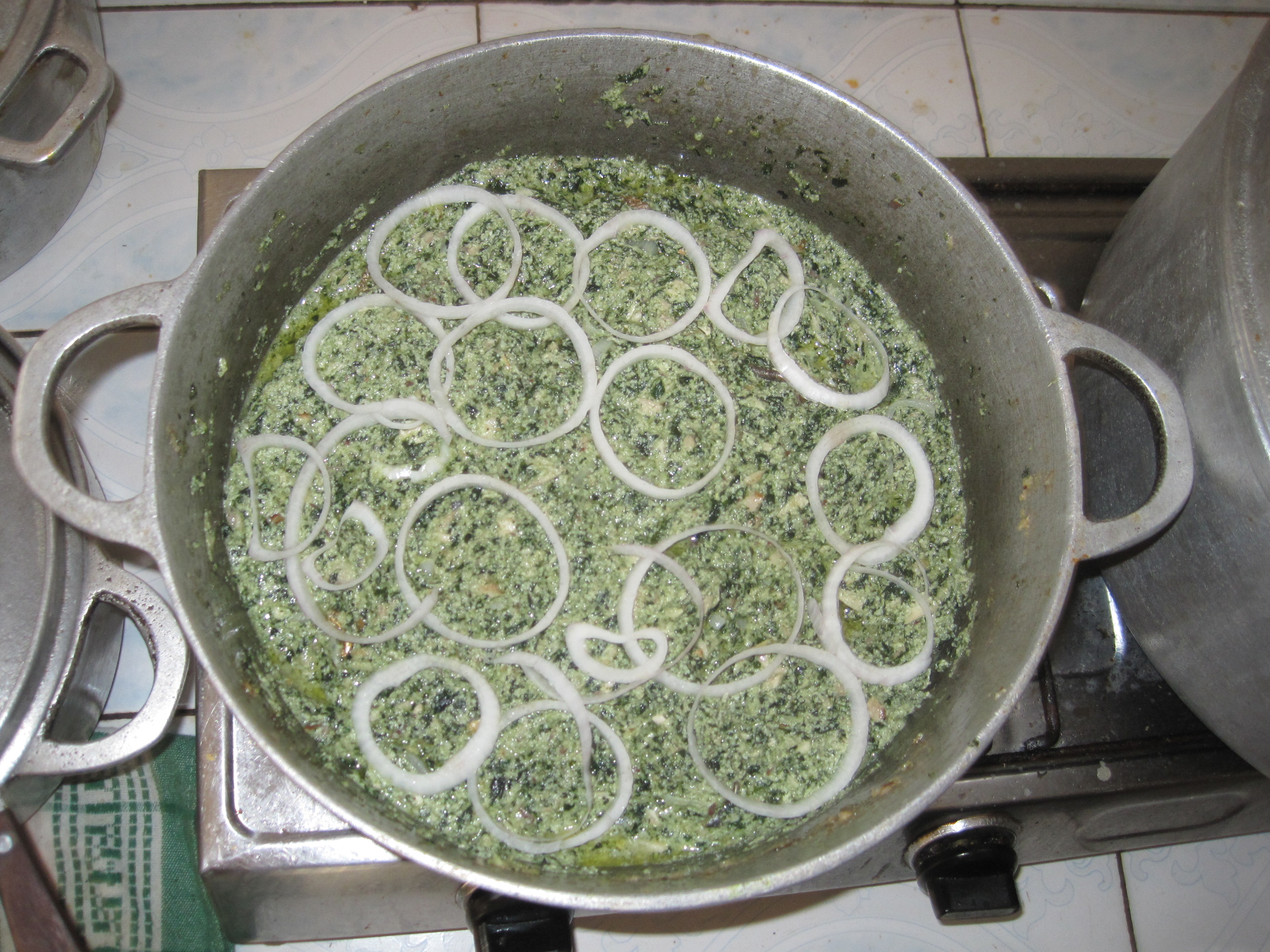
Big pot of ndole

Ndole, a stew of bitterleaf, ground peanuts, and fish

We finally made our exit, explaining that our new cook had made a big pot of ndole, the national dish, to welcome us. This stew of bitterleaf greens, ground peanuts, and fish or meat takes a lot of time and effort, so everyone was impressed. In fact, we had hardly finished eating when the chief showed up at our door, with the village patriarch and another of his drinking buddies, saying they had come to sample our ndole, which their wives rarely made. They pronounced it very well prepared, at which my brother could not resist telling the chief that he could be eating it more often if his son had gone ahead and married the cook after romancing her. They finally left after finding out we had no more beer or wine on hand.

The tale of two cooks will be the next installment.

Leave a comment

Filed under Cameroon, education, food

Kapuscinski meets a member of Ghana’s New Class

From The Shadow of the Sun, by Ryszard Kapuscinski, trans. by Klara Glowczewska (Vintage, 2002), Kindle Loc. 144-179:

Baako enjoys great prestige among the young. They like him for being a good athlete. He plays soccer, cricket, and is Ghana’s Ping-Pong champion.

“Just a minute,” he interrupted, “I just have to place a call to Kumasi, because I’m going there tomorrow for a game.”

He called the post office for them to connect him. They told him to wait.

“I saw two films yesterday,” he told me, as he waited, holding the receiver to his ear. “I wanted to see what they’re showing. They’re playing films schoolchildren shouldn’t go to. I must issue a decree that forbids young people to see such things. And this morning I spent visiting book stalls throughout the city. The government has established low prices for schoolbooks, but the word is that retailers are marking them up. I went to check for myself. Indeed, they are selling them for more than they’re supposed to.”

He dialed the post office again.

“Listen, what are you so busy with over there? How long am I supposed to wait? Do you know who this is?”

A woman’s voice answered, “No.”

“And who are you?” Baako asked.

“I’m the telephone operator.”

“And I am the minister of education and information, Kofi Baako.”

“Good morning, Kofi! I’ll connect you right away.”

And he was talking to Kumasi.

I looked at his books, stacked on a small cabinet: Hemingway, Lincoln, Koestler, Orwell, The Popular History of Music, The American Dictionary, as well as various paperbacks and crime novels.

“Reading is my passion. In England I bought myself the Encyclopaedia Britannica, and now I’m reading it little by little. I cannot eat without reading, I have to have a book lying open in front of me.”

A moment later:

“I’ve got another, even greater hobby: photography. I take pictures all the time and everywhere. I have more than ten cameras. When I go to a store and see a new camera, I immediately have to buy it. I bought a film projector for the children, and show them films in the evening.”

He has four children, ranging in age from three to nine. All of them attend school, even the youngest. It is not unusual here for a three-year-old to be enrolled in school. The mother will send him off, especially if he’s a handful, just to have some peace.

Kofi Baako himself first went to school at three. His father was a teacher and liked being able to keep his eye on his children. When he finished elementary school, he was sent for high school to Cape Coast. He became a teacher, and then a civil servant. At the end of 1947, Nkrumah had returned to Ghana having finished university studies in America and England. Baako listened to his speeches, which spoke of independence. Then Baako wrote an article, “My Hatred of Imperialism.” He was fired from his job. He was blacklisted, and no one would employ him. He hung around the city, eventually meeting Nkrumah, who entrusted him with the position of editor in chief of the Cape Coast Daily Mail. Kofi was twenty years old.

He wrote another article entitled “We Call for Freedom,” and was jailed. Arrested with him were Nkrumah and several other activists.They spent thirteen months behind bars, before finally being released. Today, this group constitutes Ghana’s government.

Now Baako speaks about broad issues. “Only thirty percent of the people in Ghana can read and write. We want to abolish illiteracy within fifteen years. There are difficulties: a shortage of teachers, books, schools. There are two kinds of schools: missionary-run and state-run. But they are all subject to the state and there is a single educational policy. In addition, five thousand students are being educated abroad. What frequently happens is that they return and no longer share a common language with the people. Look at the opposition. Its leaders are Oxford- and Cambridge-educated.”

“What does the opposition want?”

“Who knows? We believe that an opposition is necessary. The leader of the opposition in parliament receives a salary from the government. We allowed all these little opposition parties and groups to unite, so they would be stronger. Our position is that in Ghana, anyone who wants to has the right to form a political party—on the condition that it not be based on criteria of race, religion, or tribe. Each party here can employ all constitutional means to gain political power. But, you understand, despite all this, one doesn’t know what the opposition wants. They call a meeting and shout: ‘We’ve come through Oxford, and people like Kofi Baako didn’t even finish high school. Today Baako is a minister, and I am nothing. But when I become minister, then Baako will be too stupid for me to make him even a messenger.’ But you know, people don’t listen to this kind of talk, because there are more Kofi Baakos here than all those in the opposition put together.”

Leave a comment

Filed under Africa, democracy, education, Ghana, nationalism