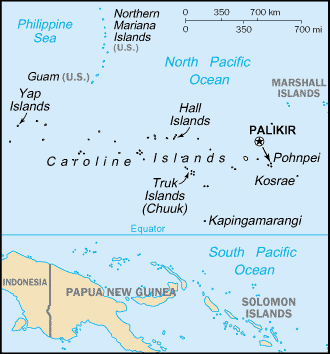
[This email letter was relayed out from Yap, Micronesia, in the wake of Typhoon Sudal, with the author’s permission to reproduce it freely. I’ve done so verbatim, omitting only one paragraph. My own experience of a hurricane on Yap in 1974 is utterly inconsequential by comparison.]
Dear Friends,
Seok Ha and myself are both shaken, but whole and healthy (minus a nasty head cold that doesn’t want to give up) doing much better than OK given the circumstances, but it is with immense sadness I convey these tidings from our tiny little tropical islands to y’all.
Typhoon Sudal may have broken Yap’s back, but not its people’s spirits.
Nobody ever expected the eye of a super typhoon to hit Yap head on. This was not supposed to happen, traditionally, the Yap sorcerers and magicians have had the powers to divert typhoons. And following the old “badness comes in waves” adage (no pun intended), the peak of typhoon intensity naturally happened to coincide with high tide. Add to that an extreme ocean water surge pushed by Sudal, and these here islands found themselves, as the saying goes, in deeper than usual waters.
We were told, and some of us could learn on the Internet typhoon warning pages, that the “outskirts of Sudal” was, maybe, going to affect Yap. Nobody was mentally, or physically, prepared for the assault that hit us shortly after midnight. Typhoon Mitag, that two years ago I thought was mighty scary, was nothing in comparison. Sudal was not classified as a super typhoon (and I don’t know if it was ever officially “upgraded”), but the opinion of everyone here–even people with first hand experience of serious US hurricane damage–is clear: this was, by far, the worst anyone has ever even heard of. Some of the old Yapese people I talked with remembers a strong typhoon that hit in the late forties, but with nowhere near the destructive energy that Sudal packed. But the spirit of the Yapese turns out to be incredibly strong, and resilient. Come to think of it, that may be a mental requirement, in order to live permanently out here.
I know of no actual measurements taken during this intense ordeal, but Sudal was announced as being of typhoon strength, with 120 knots (60+ meter per second) sustained winds, and up to 180 knots (90+ meter per second) gusts. There may be a tendency to overestimate these things when you’re in the middle of it all, but judging from the extreme damage that was delivered to Yap on these Easter holidays, and by how it was absolutely impossible to venture outside during the peak hours (the “eye” stayed over Yap, incessantly delivering one blow after the other, for a good six hours), my guess is that by the time Sudal hit Yap proper full force (about 02:00), it had grown well into super typhoon territory. As if the matter of classification really matters.
Power and water went early, leaving all the islands in virtual darkness, and with no drinking water. Thanks to no less than heroic efforts by Tim and Tim (water and power, respectively) and their crews, we got power back already early this morning, and we’re promised to have our water back by tomorrow. That is only here in Colonia, though (priority one due to the needs of the Yap State Hospital), the complete grid will probably take some time to get back online.
My personal assessment is that 60 percent of all local businesses, 70 percent of all homes, and 80 percent of all schools, are utterly devastated, completely written off. Gone. Can’t even use the rubble left behind as building material, as the pieces are too small. As kindling, yes. Rumung island is reported to be especially hard hit, with zero man-made structures remaining.
The COM [College of Micronesia] campus, as its neighboring Yap High School campus, looks as if a bomb exploded above the area (especially with that old Japanese concrete tower, with all its US battleship and artillery shelling scars from WWII, residing in the middle of it all). Only the admin and the computer lab buildings are still standing. But my guess is that it will be a considerable while before any Yapese students will have any interest in taking night-time computer courses. Rumor has it that the school board has decided to terminate the 2004 school year early.
The airport terminal buildings has sustained some cosmetic damage, but it looks as if there are no structural problems, except for the fire truck shelter (gone) and the PMA hanger (the hanger doors are bulging outwards, from excessive pressure from within). And unfortunately, all the trees and koyengs [shelters] lining the AP parking lot, together with the “Welcome to Yap” sign, succumbed to the awesome powers of Sudal. It looks like a war zone, the aftermath of another bomb attack.
The Save Way store, along with most of Madrich, and all shoreline Baleabaat houses, gone. Videographer Mark Thorpe, who now rents a concrete house across the road from where Save Way used to be, is fine, but his house got a thorough enema administered by seven meter (20+ feet) waves that kept pummeling the shoreline. He considers himself lucky to have lost only a few belongings, while his next door neighbors were being completely wiped out, and with zero means to rebuild. The outer island Madrich residents, already in abysmal conditions in their shantytown, were emergency evacuated to a few schools, and as if to kick them while they were already downed flat, Sudal then proceeded to blow away the roofs of the schoolhouses. When it rains, it pours, indeed.
Seven-to-ten meter waves pounded the Chamorro Bay Bridge for hours (miraculously, it is still standing, with its concrete pillars all knocked to one side or another, and the steel guardrails severely twisted!), and the ocean surges continued past the bridge to seriously damage all houses and businesses lining the Chamorro Bay.
Ace’s Mart, demolished, as was the little yellow church up on the hill, and the kindergarten (pre-school?). Professor Caldwell’s house (where Carl used to rent) next door was left untouched, as was the Baha’i house–it seems to me as if that particular area received some protection from the Nimar hill.
Pathway’s Hotel got lucky, with only thatch damage (on first assessment, anyway), but in need of lots and lots of minor repair work on all eight units, this with their economy already severely strained by recent events.
Many boats were thrown way up on dry land, most smashed useless.
And trees down, everywhere. In many places in massive piles.
Most Yap coconut trees are now asymmetrical, with all fronds facing the head-on direction of Sudal being brutally ripped off. On Guam, not even super typhoon Paka was able to break healthy coconut trunks: here on Yap, there are now many many coconut trees snapped off like so many matches, silent evidence of how much communal power these tiny air molecules are capable of carrying. Many of the steel reinforced concrete power poles are leaning, but only very few got snapped. Incredibly strong wind gusts!
The Angel’s Mart (Chinese store) and the bakery next to the ESA hotel got flushed clean from the bay-side, with *all* merchandise and product spread all over the road and neighboring landscape. I do not know the status of ESA hotel itself, but I hope it is in as good shape as it looks (minus its bayside koyengs [shelters], of course).
Trader’s Ridge Resort looks comparatively good, but I have no details, as I have not yet ventured past the accumulated debris up the Nimar hills.
The courthouse corner was ripped wide open, and law texts from their library are now littering most of downtown Colonia.
The YCA hardware store/warehouse was demolished beyond repair, battered by both waves and high winds. In contrast, the new WAAB Hardware building, obviously well built, stands relatively undamaged.
The Manta Ray Bay hotel got its newly completed seaside (re-)constructions completely washed away (just as was done by typhoon Mitag, two years ago), and here too, enormous waves were crashing through the hotel and exiting on the parking lot. The proud sailing ship S/V Mnuw is now resting at a 45 degree list, half-way up on dry land, with no conceivable way to get it back into the water. So now the Manta Ray Bay hotel has no bar, and no restaurant, and no glass in most room windows. Bill, traveling, was stuck on Guam until yesterday, when he came back on one of the extraordinary Continental flights. Some of their dive boats were taken to the mangroves before Sudal hit, but since nobody was really prepared for what was coming, some of the fleet was left at the dock, as usual. Together with every trace of the dock, and the beautiful new terrace that replaced the old bar washed away by Mitag, they are now gone. Actually, parts of one of the boats (I think it is the remains of “Betelnut”) can be seen sitting on top of the now totally wrecked (sunk in shallow waters) M/V Cecilia–another ugly wreck now permanently lining the Colonia harbor. Sigh.
The Family Chain Bakery is completely leveled. So now Yap has no local commercial source of bread. It is my hope that some Palau bakery will offer increased shipments.
PBC is damaged, but under control. Also, Hiroshi-san (who was also stranded on Guam until yesterday) is one of the very very few that had any form of insurance.
A forty foot container (!) came tumbling through the air (literally, no less!) and came to rest across the road in front of O’Keefe’s, blocking through traffic. And speaking of O’Keefe’s: all Don Evans’ ventures has escaped with only minor damage, as did his house. Don is counting his blessings.
Just past Dugoor village, heading towards Rumuu village, large chunks of the road pavement has been ripped loose and blown clear off the road, and much of the topsoil on the exposed northern shores has been blown off. Yap is bleeding from multiple open and ugly wounds.
Down south, most villages has been flattened, in the true sense of the word. Because I was known to own a digital camera, I was commissioned by the Police Chief to be on the southern damage assessment team, to take early pictures of the mayhem, to try to convince FEMA that this is indeed a disaster area, in great and imminent need of lots of help from the outside. It was a mentally very difficult task, to go from village to village in Chief Cham’s (Gregory) truck, to stare all this heartbreak and helplessness straight in its face, all those crushed dreams. Unfortunately, my camera got some typhoon damage, so the result did not come out the best. But better than nothing, I guess/hope.
The Nimgil (“Nathan’s”) store is demolished, with fifty percent of their betel nut plantation down on the ground, and their pig farm now without a roof (the concrete walls are still standing, and the porkers are scared shitless, but fine). Jim and Debi’s place looks OK, somewhat sheltered by the dense surrounding vegetation, but we never took a close look–it looked too good for a check-out stop. Down in Anoth, the beach has yet again doubled in size, their beautiful newly built peebai [meeting house] is still standing, but now with a distinct slant. The loop road is impassable, and it will take a major effort to hack through the massive multiple walls of intertwined broken coco, betel, and nipa palm trunks, mixed with assorted crushed building debris. Regina Thun’s house lost parts of its roof, but the (long since closed) store escaped with almost no damage.
At the Destiny Resort, even the ruins from typhoon Mitag’s visit two years ago have now been washed away, and Carol and Colin’s “new” house on Maap has taken major wind gust hits. As destinies for visiting lawyers go: Peter (Public Defender) and Theresa Steltzer’s house at the Queen Bee will be out of the rental circuit until massive roof repairs has been done, plus associated water damage dittos has been undertaken. And trying to find a decent place to stay here on Yap will not be easy, for the foreseeable future.
On the west side, our “home village” (Kadai) has been badly damaged. We were unable to take the road down to Sunset Park, too much debris. Berna and Thomas Gorong, just finishing off a renovation of their hilltop house, had to abandon house for the relative safety of brother Theo’s concrete house, but as it turned out their house had sustained very little damage. Wayaan’s “vacation house” (the fruit bat hunting lodge Fillmed built for Guam governor Guiterrez) next door, however, is now spread across a sizeable area. Dave Vasalla’s house, a stone’s throw away, was undamaged, protected by the recess in which it was constructed. Tony Ganngiyang’s blue concrete house also gave evidence to the wisdom of building solidly–not a scratch! Otherwise, all houses visible from the loop road (Colonia – Delipebinaw – Fanif – Colonia) were either completely or partly demolished. Churches, schools, Kingtex, Public Transportation, the whole lot got hammered, but badly.
No big tree has been left standing. All mango and breadfruit trees of any size, that I know of, are gone, many taro patches have been ruined by salt water, practically all banana and papaya trees are gone, it is just so incredibly sad. It will be quite some time before local food supplies are back to normal. This may become another big problem, because so many people here are still depending only on local food, having no money to purchase imported “manufactured” food.
Remember how we always used to say, with some pride, “There are no homeless here on Yap, and nobody is starving.” Over night, a majority of the Yapese has become homeless, and we can only hope that the food situation will be solved, somehow.
In Gachpar, no house along the shores has survived, in most cases with no trace left behind. Of “our” little beach house, until Good Friday occupied by Michelle and Luke, only the concrete pillars upon which it rested remains. They too (Mich and Luke, that is), way too late realizing the urgency of the situation, got completely wiped out, materially.
James Lukan has just completed a flimsy-looking structure (two-by-fours and corrugated tin sheets) to house my pool table, across the road from the Gagil Elementary School (as most other schools were severely hit, this one got away almost scot free, “only” some roofs gone). For some weird reason, the “pool koyeng” was still intact! The small store, ten feet away, plus the supposedly typhoon-proof “waiting for the bus” shelter the same distance away in the other direction, was completely demolished.
Except for the house where the Munn’s used to live (still standing, good solid house: at one point it was standing in water up to the second floor) and the newly-constructed-but-not-yet-moved-into Kensuf main residence (still stands, but with serious roof damage, and with a truckload of cement sacks, for protection brought into the house, now being fused into a single clump of useless concrete, and most of the unlaid tiles crushed and scattered around the surrounding terrain), Kensuf’s whole property was leveled. There is no trace of the house “Little Richard” Overy (our ex-archivist) used to live in. It is all way beyond heartbreaking.
Saint Joseph’s church is demolished. Again miraculously, the Padre’s house, on its dinky stilts, was unscathed (strong message, or fluke?).
Wanyan, same. All houses along the shoreline are gone. Stone money banks, standing for centuries, were broken into by huge waves, breaking and spreading the rai coins and shattered pieces thereof all over the place. The road to Sea Breeze Beach is as yet, and without a major clean-up effort, impassable. I don’t know about Bechyal Culture Center, but judging from its location and what happened to all other structures on the northern shores of Maap, I fear the worst.
The Sports Complex was badly hit, and I’ve already heard rumors about Black Micro being sued for sub-standard construction. Here, too, the “roller” doors were pushed out by pressure from within (just like the hanger doors at the AP). Together with some of the now knocked out schools, the YSC was designated to function as an official “emergency shelter” in case the typhoon happened to hit. People who had taken refuge there were scrambling for their lives as parts of the roof eventually caved in. You know you have a crisis on your hands, when the disaster shelters are getting knocked out by the elements.
Al Ganang, proprietor of the sadly no longer existing Village View Hotel, is happy to be alive. The surge took him completely by surprise. Again, all the buildings along his beautiful beach are gone: the store, the bar, the dive shop, all of the two-unit hotel bungalows. All gone. Insurance? You’re kidding, right?
Wanead village, a little further north, was almost completely obliterated. Johnny Chugan told us that the entire village population is now shacked up in a single relatively undamaged building. The Wanead village path is now their new shoreline, facing a huge new beach. Chugan had just completed renovations and spiff-ups of their beach-side home, financed by an BofFSM loan. The house is no more (and the beautiful house he built for Cathy and PJ was blown away with it), but the bank loan remains. It is so very difficult to not burst out crying.
The Kula Place (just before Wanead village) is ravaged badly, all its koyengs blown to tiny little pieces, and substantial parts of the lovely old shady three has been blown down. Not entirely gone, thank heavens, and I do so hope that what remains of this grand ole tree will be able to survive its almost complete defoliation.
That is another thing, and it looks so weird and unreal: almost all leaves has been ripped of all trees. And I’m sad to say that, if anything, I am understating the damage done: the beautiful rolling green hills of Yap were, within a few hours, transformed to ugly brown hills, reminding me of late autumn in Sweden: no green leaves, no green anything, just bare branches, and the brown forest floor clearly visible–all across all the Yap islands. Very depressing. I don’t know much about resilience of trees and stuff, and I can only hope that this kind of damage is reversible, that somehow the plants can find the strength and resources needed to survive until a new generation of photosynthesizing green leaves has been produced.
Closer to home, here in Gaanelay village in Colonia: The Yap Agriculture facilities are demolished. Black Micro is a mess. As is some of Gilmar’s enterprises (his new pool room, gone), but it looks as if his store and video rental/Laundromat may be salvageable. Do you remember “Yap Wellness Center” just before Gilmar’s store? Well, forget it. The Talguw area was lucky, we could only see some roof damaged there. Behind our YCA townhouses, Libyen’s brand new two-storey house has been blown off its foundation, coming to rest at 40 degrees off the normal, beyond repair. All that can be done is to try to wreck it gently, in order to get to re-use all the expensive building material. Libyen, stoic, said “I’m too old to get upset by this, but the situation for Yap is really bad.” Gurwan was completely wiped out, the concrete sides of her house are still standing, but there is no roof, and nothing is left inside the house (Gurwan said, “It hasn’t been this clean since it was built”–making fun of the unbearable situation). The schoolhouse (temporary home for some 120 Madrich “refugees”) has lost most of its roof, and is generally beyond repair.
A few seconds of my life I believe has gotten permanently etched onto my retinas: at about 0600, as I was looking out our bedroom window, the huge breadfruit tree growing between our house and Libyen’s was finally brought down, and it fell directly towards our house (this tree has been worrying me ever since we moved in, with its potential for wreaking havoc on our house in case it ever fell down in an uncontrolled way). However, and as I watched it, a gust grabbed the huge trunk, raised it back up and then swung it clear in another direction, and nothing came down on our roof. Guardian angel? Maybe, but more likely our luck that the wind direction was away from our house. But it was a remarkable display of typhoon power, I remember it flashing through my head that “this is some kind of special effects trick,” to see a falling huge tree like that change direction in mid-fall. Amazing. And yes, we too are counting our blessings.
Countless cars, representing years of working hours for the average Yapese, has been rendered useless by flying debris and falling/flying tree trunks. “Flying guillotines” (corrugated tin sheets, the omnipresent roofing island material) also have done their share of slicing damage–that big water tank that got sliced clear through could, but for the grace of God, have been my belly, as I was forced out in the middle of the night to reinforce the window boarding material that was coming loose. Those wavy sheets of sharp steel were flying everywhere! It was scary as hell, lemmetellya!…
The Yap FM radio and TV station was knocked out early, as its aerial tower lost its supports early on.
The good news is that, unbelievably, nobody got hurt! And there has been no looting reported (I sincerely hope it stays that way). James Lukan said that one person is missing from Gachpar, but he also said that person may be just wandering around somewhere (the individual is of somewhat diminished mental capacities, and Lukan said, “If it turns out he’s been hiding in order to get attention, I’m gonna beat him up!”). I hope he will be found, and that he will be spared the beating.
The situation is bad. I’ll try again: It is very, very bad. Maybe as many as 5,000 Yapese have lost their homes. A Guam PDN article … mentions that 1,500 people on Yap are in “homeless shelters” (roofless schoolhouses), but says nothing about the fact that the majority of typhoon-struck Yapese much prefer to stay in whatever way they can in their demolished ex-homes, in their villages, with their clansmen.
And all the Yapese I meet say, “we’ll rebuild. Life goes on” and they laugh, and they prepare another betel nut chew.
In all, quite an unforgettable experience. And I sincerely hope that none of you will ever have to go through something even remotely resembling being a mote in the eye of a super typhoon–It is scary.
May your Gods protect, care for, and bless y’all!
Henry and Kim Seok Ha
MicroTech Consulting