Category Archives: travel

Kit Carson’s Skillset

From Blood and Thunder: The Epic Story of Kit Carson and the Conquest of the American West, by Hampton Sides (Anchor, 2007), Kindle Loc. 1271-1293:

If Fremont had become a household name, so had his scout. By 1845, thanks to the expedition reports, Kit Carson’s name, with its sturdy alliterative snap, had crossed the threshold of the national imagination. Fremont painted Carson as an explorer of nearly mythic competence and perspicacity on the trail. He consistently came across as courageous but never rash, a person with a sure presence of mind. And also, crucially, a person who seemed to have enormous stores of luck on his side: Time after time, the stars smiled on Kit Carson. In nearly every contretemps Fremont got himself into, Carson found the way out.

The special thing that Carson had couldn’t be boiled down to any one skill; it was a panoply of talents. He was a fine hunter, an adroit horseman, an excellent shot. He was shrewd as a negotiator. He knew how to select a good campsite and could set it up or strike it in minutes, taking to the trail at lightning speed. (“Kit waited for nobody,” complained one greenhorn who traveled with him, “and woe to the unfortunate tyro.”) He knew what to do when a horse foundered. He could dress and cure meat, and he was a fair cook. Out of necessity, he was also a passable gunsmith, blacksmith, liveryman, angler, forager, farrier, wheelwright, mountain climber, and a decent paddler by raft or canoe. As a tracker, he was unequaled. He knew from experience how to read the watersheds, where to find grazing grass, what to do when encountering a grizzly. He could locate water in the driest arroyo and strain it into potability. In a crisis he knew little tricks for staving off thirst—such as opening the fruit of a cactus or clipping a mule’s ears and drinking its blood. He had a landscape painter’s eye and a cautious ear and astute judgment about people and situations. He knew how to make smoke signals. He knew all about hitches and rope knots. He knew how to make a good set of snowshoes. He knew how to tan hides with a glutinous emulsion made from the brains of the animal. He knew how to cache food and hides in the ground to prevent theft and spoilage. He knew how to break a mustang. He knew which species of wood would burn well, and how to split the logs on the grain, even when an axe was not handy.

These were important skills, all of them, though they were hard to measure and quantify. But in the right person, a person who was also cheerful on a trail he already knew well, who had a few jokes up his sleeve and possessed an absolute honesty—they were invaluable.

Fremont’s nickname, The Pathfinder, was a misnomer several times over. For it was Carson, not Fremont, who had usually “found” the path—and often as not he was merely retracing trails that had already been trod by trappers, Indians, or Spanish explorers. In Cooper’s Leatherstocking Tales series, the main protagonist, Natty Bumppo, a.k.a. Hawkeye, a.k.a. the Pathfinder, wears buckskins, lives with the Indians and follows their ways. It was Carson, not Fremont, who actually lived a life that resembled Cooper’s hero.

He was multilingual but illiterate.

Leave a comment

Filed under economics, education, labor, travel, U.S.

Wordcatcher Tales: Minidoka, Owyhee, Spudnik

On our recent Overland Trail roadtrip through Oregon, Idaho, and other northwest states, the Far Outliers encountered more than a few unusual names. Here are three of them.

hunt-roadsign
Minidoka is a Dakota Sioux word that means ‘water-spring’. The same root meaning ‘water’ occurs in the names Minnesota, Minnetonka, and other places where the Dakota Sioux once roamed. It occurs in several placenames in Idaho, including the name of Minidoka County, the eastern neighbor of Jerome County in south central Idaho. On our way through Jerome County, we got off the Interstate to visit the Minidoka National Historic Site. In 1942, nearly 10,000 people of Japanese ancestry were evacuated from Alaska, Washington, and Oregon and interned in Jerome County at a place locally known as Hunt. The historic marker (above) that directed us to the camp did not call it “Minidoka” but did mention Japanese internment. The internment camp built in Jerome County was soon renamed for neighboring Minidoka County to distinguish it from another Japanese internment camp in Jerome, Arkansas. There is lots of new signage within the Idaho site now, but only the one historic marker to help strangers find their way there.

Owyhee is an old rendering of what is now spelled Hawai‘i, the name of the largest island in the Hawaiian archipelago. How did it come to name so many features of the region where Oregon, Idaho, and Nevada come together? According to the Owyhee County Museum in tiny Murphy, Idaho, the name honors several Hawaiian fur trappers who worked for the North West Company of fur trader Donald MacKenzie, who explored the area between 1818 and 1821. The Hawaiians disappeared, but an echo of their homeland graces Idaho’s first incorporated (and second largest) county, as well as a city, a desert, a mountain range, a river, a lake, and a dam far into the interior of the Pacific Northwest.

Spudnik is a cutesy name for many different things. A few of them even have something to do with potatoes. In the quirky but informative—and sometimes corny—Potato Museum in Blackfoot, Idaho (the “Potato Capital of the World”), we saw an early model of a potato-scooping machine invented by local potato farmers Carl and Leo Hobbs about the time the first Sputnik was launched in 1958. They decided to market their new line of potato harvesting equipment under the name Spudnik. Now they sell the largest-scale potato planting and harvesting equipment in North America.

Leave a comment

Filed under Hawai'i, Japan, language, travel, U.S.

Russian–Papuan First Encounter, 1871

From Mikloucho-Maclay: New Guinea Diaries 1871–1883, trans. & ed. by C.L. Sentinella (Madang, PNG: Kristen Pres, 1975), pp. 17-20:

As I was approaching the hut I heard a rustle and, on glancing round in the direction from which it came, some paces away I saw a man standing as if rooted to the ground. He glanced for a second in my direction and then dashed into the bushes. I went after him, almost at a run, waving a piece of red cloth which I found in my pocket. Looking back, seeing that I was alone and completely unarmed, and that I was making signs to him to approach, he stopped. I slowly approached the savage, silently offering him the red cloth, which he took with obvious pleasure and bound round his head.

He was a Papuan of medium size, of a dark chocolate colour with dull black somewhat curly hair, short like a negro’s, with a broad flat nose, and eyes looking out from under overhanging brow ridges, and a large mouth, almost, however, covered by a bristling moustache and beard. His entire costume consisted of a rag about 8 inches wide, tied firstly in a kind of girdle and drawn down between the legs and attached to the girdle from behind. Two lightly-bound bands of plaited dry grass were placed above the elbows. On one of these bands or bracelets was stuck a green leaf of Piper betel, in the other on the left side was a kind of knife, made of a smooth sharpened piece of bone (a cassowary bone, as I afterwards found out). The savage was well-built, and with a well-built musculature. The facial expression of this, the first of my new acquaintances, seemed quite engaging. I somehow thought that he would obey me, and I took him by the hand, and not without some resistance led him back to the village. At the open space I found my servants Ohlsen and Boy, who were looking for me, and were at a loss as to where I had gone. Ohlsen presented my Papuan with a piece of tobacco—which, however, be did not know what to do with—and silently taking it he thrust it behind the bracelet on his right arm, beside the betel leaf.

Whilst we were standing in the middle of the village, from amongst the trees and bushes, savages began to appear, uncertain whether to approach, and ready at any minute to turn in flight. They were silent and stationary, remaining at a respectful distance but closely watching our movements. Since they would not move, I had to take each one separately by the hand and, in the full sense of the word, drag them into our circle. Finally, having gathered them all in one place, tired out, I sat down among them on a stone, and proceeded to distribute various trifles—beads, nails, fish hooks, and strips of red cloth. They obviously did not know the significance of the nails and hooks, but not one of them refused to accept them.

Around me were gathered eight Papuans. They were of varying sire and showed some, although very insignificant, differences. The colour of the skin did not vary much. The sharpest contrast with the type of my first acquaintance was a man, rather taller than the average size, lean, with a hook-shaped prominent nose and a very narrow forehead pressed in on the sides. His beard and moustache were shaved, and on his head towered a sort of hat of reddish-brown hair, from under which, hanging down on the neck, were twisted plaits of hair, exactly like the tube-shaped curls of the inhabitants of New Ireland. These curls hung behind the ears, down onto the shoulders. Two bamboo combs were sticking out of the hair, one of which, thrust into the back of his head, was decorated with some black and white feathers (cassowary and cockatoo) in the shape of a fan. Some large tortoise shell rings were inserted in his ears, and in the nasal partition a bamboo rod was inserted; the thickness of a very large pencil, it had a pattern carved on it. On his neck, in addition to the necklace of the teeth of dogs and other animals and shells, hung a small bag. On the left shoulder hung another bag reaching down to the waist and filled with various articles.

The upper part of the arm of this native, as of all those present, was tightly bound with plaited bracelets in which were thrust various objects, some of bone, others were leaves or flowers. Some of them had a stone axe slung on their shoulder, some were holding a bow in their hands of considerable size (almost the length of a man) and an arrow more than a metre long. Their hair styles were also different with different colours of the hair, some completely black, others decorated with red clay, some had the hair worn like a hat on the head, and others had it cropped short, while still others had the previously described ringlets hanging round their neck—but all were curly like a negro’s. The hair on the chin was wound in small spirals. There were minor differences in the skin colour. The younger were lighter than the old.

Of these eight Papuans of my first meeting, four appeared sick. Two had legs disfigured by elephantiasis, and one was an interesting case of psoriasis, which had spread over his entire body. The back and neck of the fourth was studded with boils, which formed large, hard protuberances and on his face were several scars, probably of previous such boils.

As the sun was already setting I decided, in spite of the interest of my first observations, to return to the corvette. The whole crowd accompanied me to the beach carrying presents; coconuts, bananas and two very wild piglets, whose legs were tightly bound and who squealed untiringly, all were placed in the boat. In the hope of more firmly strengthening the good relations with the natives and also with the idea of showing my new acquaintances to the officers of the corvette, I suggested to those surrounding me to accompany me to the corvette in their pirogues. After prolonged discussion five men got into two pirogues, the others remained and even, it seemed, strenuously tried to dissuade the courageous ones from their bold and risky undertaking. One of the pirogues I took in tow and we made towards the Vityaz. Halfway, however, the bolder ones had thought it over, and by signs indicated that they did not wish to go further and tried to release the tow rope. At the same time the other pirogue quickly turned back to the shore. One of the men sitting in the pirogue which we were towing behind us even tried to cut through the tow-line with his stone axe. It was only with extreme difficulty that we succeeded in dragging them on deck. Ohlsen and Boy took them up the ship’s ladder practically by force. On deck I took the “prisoners” by the arm and led them down to the quarter-deck. Their whole bodies trembled with fear, and it was only with my support that I could keep them on their legs, supposing, probably, that I was going to murder them. Meanwhile it had grown quite dark and lamps were brought and gradually the savages grew calm. They even brightened up when the officers brought them various objects and treated them to tea, which they drank up straight away. In spite of such a friendly reception they were obviously pleased to go, and went down the ladder with great haste to their pirogue, and quickly rowed back to the village.

On the corvette they told me that, in my absence, natives again appeared and brought with them two dogs, which they killed and whose carcasses they left as a kind of gift on the beach.

Leave a comment

Filed under Australia, Papua New Guinea, Russia, scholarship, science, travel

Wordcatcher Tales: Chouzame, Hogeisen, Zakkoku

蝶鮫 chouzame (lit. ‘butterfly-shark’) ‘sturgeon, Acipenseridae’ – This summer we visited Miyazaki Prefecture, the last of the 46 on the main islands that we hadn’t yet visited. (Maybe we’ll finally visit Okinawa next year.) Halfway up Mt. Aso, in the deep, dark gorges of Takachiho, where the Sun Goddess Amaterasu is said to have been coaxed out of her cave to found the imperial dynasty of Japan, commencing with Emperor Jimmu in 660 B.C., we found some very unusual fish swimming in a large pool that should have been filled with carp. A sign by the fishfood dispensers confirmed that they were chouzame (lit. ‘butterfly-shark’) ‘sturgeon’, and a poster in a nearby souvenir shop confirmed that they were part of a campaign beginning in 1983 to build up Japan’s domestic caviar industry. Unfortunately we didn’t get to sample any of their caviar, although we ate several other kinds of fish roe on that trip.

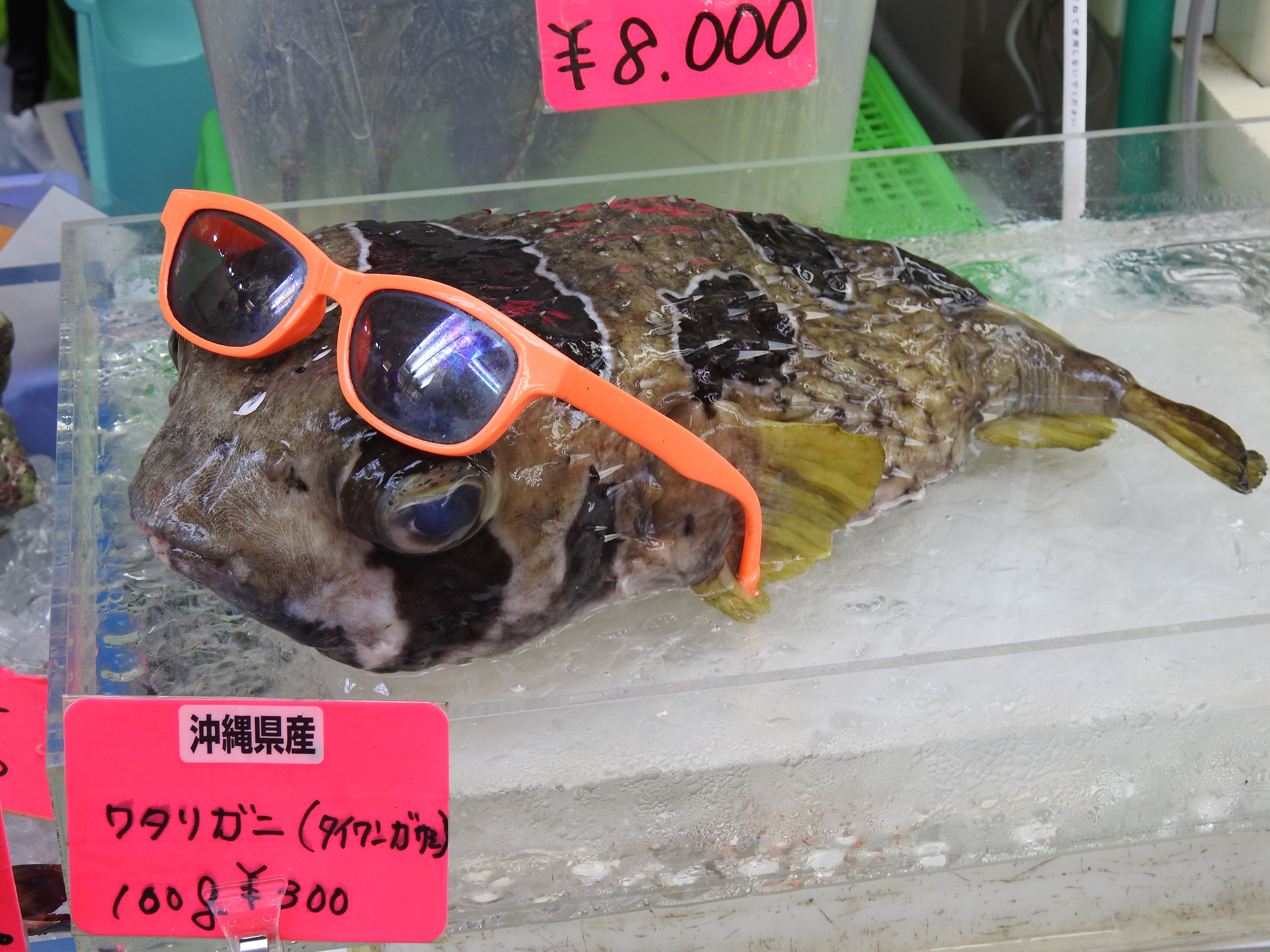
捕鯨船 hogeisen (lit. ‘catch-whale-ship’) ‘whaler’ – Our trip included a day walking the waterfront of Shimonoseki, a major port city whose culinary fame centers around fugu ‘pufferfish, blowfish, globefish’ (usually written 河豚 lit. ‘river-pork’ when written in kanji, but also written with several other kanji), but also includes 鯨 kujira ‘whale’. We ate fugu (cooked, not raw) and we passed a whalegun monument to the whaler (hogeisen ‘catch-whale-ship’) Toshi Maru No. 25.

The kanji for ‘whale’ is composed of two elements, 魚 uo hen indicating the semantic domain of ‘fish’, and 京 ‘capital’, indicating its sound in Chinese (currently jing in Mandarin, as in Beijing and Nanjing). (‘Whale = capital fish’ is an easy mnemonic for the kanji.) The word for ‘capital’ seems to have entered Japanese more than once, so its Sino-Japanese pronunciation varies between kyou as in Kyoto, and kei as in Keihan ‘Kyoto-Osaka’ (or Keihin ‘Tokyo-Yokohama’). The Sino-Japanese pronunciation of 鯨 ‘whale’ is closer to the kei variant, as in 鯨肉 geiniku ‘whale meat’, 鯨脂 geishi ‘whale blubber’, or 鯨飲馬食 geiin-bashoku (lit. ‘whale-drink horse-eat’) ‘heavy eating and drinking’.

雑穀 zakkoku (lit. ‘mixed-grains’) ‘millet, lesser grains’ – Japanese restaurants do not generally offer the choice of brown rice in place of white rice, but at one exceptional tonkatsu restaurant in Miyazaki City, we were offered the option of 十六穀 juurokkoku ’16-grain’ rice. At home we also have little ’16-grain’ packets to add to the cups of rice we cook.

The kanji 穀 koku translates ‘cereal, grain’, as in 穀食 kokushoku ‘cereal diet’ or 穀倉 kokusou ‘granary’, but the ’16-grain’ mixture contains more than we think of as ‘cereal grains’. In addition to barley, maize, sorghum, and various millet grains, it includes soy and adzuki beans, and amaranthus, quinoa, and sesame seeds. The generic term for all these ‘lesser grains’ is 雑穀 zakkoku ‘mixed-grains’ and it also includes pumpkin, sunflower, shiso, and cannabis seeds. The kanji 雑 zatsu, zou ‘mixture, miscellany’ occurs in many compounds where its connotations range from neutral, as in 雑貨店 zakkaten ’emporium, variety store’, 雑誌 zasshi ‘magazine, periodical’, or 雑炊 zousui ‘medley soup’; to derogatory, as in 雑人 zounin ‘low-class people’, 雑物 zoumotsu ‘inferior goods, entrails’, or 雑草 zassou ‘weeds’.

Leave a comment

Filed under food, Japan, travel

Wordcatcher Tales: Goze

From The Roads to Sata: A 2000-Mile Walk Through Japan, by Alan Booth (Weatherhill, 1985), p. 130:

Well into the twentieth century this stretch of coast was the haunt of the goze [瞽女 ‘blind-woman’]—blind wandering shamisen players who trudged through the villages of the old province of Echigo, from wedding to wedding, from festival to festival, begging food and lodging in return for a song. All were women (though the shamisen is an instrument traditionally taken up by the blind of both sexes), and most were members of a strictly hierarchical society that organized them into small dependent bands. The younger and more ambitious of the goze might supplement their pittance of an income by selling their bodies at the village fairs, though if this were known to the society, they would quickly find themselves stripped of companionship and forced to wander through the Back of Japan alone, with only a stick and their songs to survive on.

Leave a comment

Filed under Japan, language, travel

Wordcatcher Tales: Bandori, Quaintify

From The Roads to Sata: A 2000-Mile Walk Through Japan, by Alan Booth (Weatherhill, 1985), pp. 106-107:

Willow trees line the old green streams that crisscross the streets of Tsuruoka, and the streams are walled like the castle moats they once were. The day was immensely hot, with the humidity of gathering rain. In twenty minutes my clothes were soaked, and before I was even out of the city I stopped to cool off in the Chido Museum and dripped my way round a fine collection of ornamental bandori—the backpacks used by country people for humping firewood, vegetables, and kids. The most elaborate of these were the iwai-bandori, designed for carrying wedding trousseaus, and the colors and patterns reminded me of the Navajo rugs I had once seen in New Mexico. (Speaking of the Navajo, I have often wondered why people who strive to depict the Japanese as quaint have never resorted to the Red Indian ploy. The written character for “moon,” for instance, is the same as the written character for “month,” so the Japanese, like the Hollywood redskins, speak of things happening “many moons ago.” To my knowledge, no one—not even the most frantic quaintifier—has ever translated the expression that way, but the quaintifying industry is alive and kicking, and if the Japanese would only start wearing feathers on their heads the oversight could quickly be expunged.)

In the grounds of the museum stood several “old” buildings—a town hall (1881), a police station (1884)—so revered for having survived a century that they had been lugged from their original sites and painstakingly reconstructed. There was also a fine old three-story farmhouse. (It had a warm thatched roof and high paper windows, and on the timber floors of its second and third stories, the old silkworm trays and frames stood intact. This solid old farmhouse had been trundled plank by plank from a little mountain village some sixteen kilometers outside Tsuruoka, and was now fenced off behind a turnstile earning money for the proprietors of the Chido Museum. I wonder what the villagers had had to say, and whether they had put on their war paint.

Leave a comment

Filed under Japan, language, nationalism, travel, U.S.

Wordcatcher Tales: Kampouyaku

From The Roads to Sata: A 2000-Mile Walk Through Japan, by Alan Booth (Weatherhill, 1985), pp. 141-142:

The city of Toyama is nationally famous for the manufacture of patent medicines, usually sold door to door by elderly enthusiasts in small wooden chests (the medicines, not the enthusiasts), and these chests become part of the household furniture. The preparation of and sale of the medicines, called kampoyaku [漢方薬 kan-pou-yaku ‘China-method-medicine’] (Chinese concoctions), bear all the signs of a small-scale cottage industry, but the entrepreneurial genius of the people of Toyama has parlayed this unlikely source of fortune into a business with an annual wholesale value of more than 190 billion yen. The city’s oldest and best-known kampoyaku manufacturer is Kokando, and I arranged to pay them a visit.

The Kokando factory—opened in 1876 and rebuilt shortly after the war—stands in the southern sector of Toyama near the old tram stop named after it. The who showed me round spoke slowly and precisely and with the solemnity of a preacher who has the undivided attention of a disarmed infidel.

“Before the war our ninety-nine medicines—the widest range of kampoyaku in Japan—were manufactured and packed entirely by hand. Nowadays, of course, we use machines, but the traditions and process remain the same, and the recipes continue to derive from thjose which were imparted to Lord Maeda in the seventeenth century.

“The botanical ingredients include Korean ginseng (a very expensive kind of carrot) and the roots of the Indian ginkgo tree. But more highly prized are the items we obtain from the internal organs of animals. There is, for example, the dried glandular fluid of the male musk deer, drawn off during the rutting season and employed in the manufacture of a powerful stimulant. Originally, in order to obtain this fluid, it was unfortunately necessary to slaughter the deer, but nowadays, thanks to the development of new methods, it can be obtained humanely through plastic tubes. Then there is the bile of the Japanese bear, a pain killer and an agent in the reduction of fevers. The secretion from the poison gland of the Chinese toad is mainly used in the treatment of heart diseases, though it, too, kills pain with remarkable efficacy. And gallstones produced in the bladders of cows are a restorative and an antidote to several toxic substances.”

Leave a comment

Filed under China, disease, drugs, food, industry, Japan, language, travel

Doshisha University’s Debt to Hakodate

From Hokkaido, A History of Ethnic Transition and Development on Japan’s Northern Island, by Ann B. Irish (McFarland, 2009), pp. 93-94:

Hakodate played a small part in the life and adventures of Niijima Jo (westerners have anglicized his name in several ways and have referred to him as Joseph Hardy Neesima). He became a prominent Christian in nineteenth century Japan and is honored today as the founder of a distinguished private university in Kyoto, Doshisha. Niijima grew up in Edo. When he was a youth, a friend who knew of his interest in boats and seamanship told him of a vessel soon to sail to Hakodate. Niijima, who had a secret desire to visit a foreign land, thought he might be able to do so form Hakodate. He knew an influential man who obtained permission for the young man to take a trip north. After arrival in Hakodate in 1864, Niijima’s goal was to meet foreigners who could help him travel abroad. He soon met Father Nikolai, who engaged him as a Japanese language tutor. Meanwhile, an English trader agreed to teach the young Japanese man English.

Niijima desperately wanted to travel outside Japan, despite the government prohibition of this. After several months in Hakodate, his dream took shape. He made arrangements to slip out of the city and secretly board an American ship. Arriving in the United States via China, he studied for some ten years and adopted Christianity. After being baptized, he chose his western name to honor Alpheus Hardy, owner of the ship that had taken him to America. Niijima graduated from Amherst College, the first Japanese student ever to obtain a college degree in the United States. Returning to Japan, he founded the school in 1875 which grew into Doshisha University.

As Niijima’s story shows, because foreigners from several important nations lived in Hakodate, Japanese found the city a good place to study foreign languages and foreign ways, and a number of men who later served as interpreters learned languages there.

Leave a comment

Filed under education, Japan, language, religion, travel, U.S.

Basque Pioneers in the Philippines

From Basques in the Philippines, by Marciano R. de Borja (U. Nevada Press, 2012), pp. 40-41:

Discussions of the outstanding Basque missionaries in the Philippines commonly start with reference to the apostolic work of Saint Francis Xavier, a Navarrese and a famous Jesuit missionary, on the island of Mindanao. Standard Philippine history books, however, do not contain any reference to Saint Francis Xavier’s exploits, since the veracity of his travel and missionary work in Mindanao has yet to be confirmed.

What is certain is that the first Spanish cleric, Fray Pedro de Valderrama, arrived in the islands during the Magellan expedition in March 1521. (There were supposed to be two clerics, but the other, a Frenchman, was left on the coast of Brazil.) His achievement was obviously limited. Although he celebrated the first Catholic mass and officiated the first baptisms, the seeds of Christianity never took root. The impact of the new religion on the natives probably dissipated right after the departure of the remnants of the Magellan expedition. The same thing happened with following Spanish expeditions.

It was only after the successful expedition of Legazpi and Urdaneta [both Basques] in 1565 that the Catholic Church was permanently established in the archipelago, starting in Cebu. As previously described, Urdaneta brought with him to the Philippines a contingent of fellow Augustinian missionaries, all of whom were Basques. Andrés de Aguirre, Pedro de Gamboa, Diego de Herrera, and Martín de Rada. Actually, Lorenzo Jiménez, a non-Basque, was also enlisted by Urdaneta, but he died in the port of Navidad before the expedition disembarked. Thus the Basques became the real pioneers in preaching the gospel and teaching catechism in the archipelago.

Leave a comment

Filed under migration, Philippines, religion, Spain, travel

Antarctic Cuisine: Aerovodka and Gristle

From Hoosh: Roast Penguin, Scurvy Day, and Other Stories of Antarctic Cuisine, by Jason C. Anthony (U. Nebraska Press, 2012), pp. 146-148:

One of the exchange scientists who spent a year on a Soviet base [in Antarctica] was glaciologist Charles Swithinbank. At Novolazarevskaya with the 1963–65 Ninth Soviet Antarctic Expedition, he lived a very different life than he used to in England. As Swithinbank relates in Vodka on Ice, he learned while sailing south on a Soviet ship that his diet would be impoverished in both quality and variety. “Apart from feast days,” he wrote bluntly, “the food was not good.” Cabbage soup (borscht or shchi, depending on the type of cabbage), ragout, and compote (“an insipid rust-colored liquid with a faint taste of boiled apples”) became distressingly familiar. The quality of the beef was quite poor, all gristle and bone. Soviet cattle, he learned, fed on sparse grass.

Although the meat was poor, the butter was excellent. So was the black bread. And those feast days really were exceptional. Swithinbank sobered up after a New Year’s celebration full of black and red caviar, pickled herring, pickled mushrooms, sausage, crabmeat, and more. A May Day feast included roast chicken, crab salad, ham, salmon, smoked salmon and sturgeon caviar, apples, oranges, champagne, brandy, and orange juice stoked with airplane de-icing fluid.

Toasts drunk with de-icing fluid, called “aerovodka” by the Russians, were not restricted to holidays. At Molodezhnaya base, where Swithinbank visited en route to Novolazarevskaya, he noted that there was a more frequent aviator’s tradition: “On landing back at base after a long flight, it was the duty of the navigator to drain a litre of fluid from the aircraft’s de-icing system. Unlike some de-icing fluids, this was pure alcohol (ethanol). Once indoors, it was served to the aircrew and passengers.” One observer of a similar U.S. Antartic Program habit—drinking a rocket fuel known as JATO (jet-fuel assisted take-off)—equated the practice to that of a “warrior culture drinking blood.”

At Novolazarevskaya, the dining room was the community social center. One long table fit them all. Here he spent his year of good company, good science, and terrible food. The cook, Ivan Miximovish Sharikov, had spent over thirteen years in the polar regions as a weather observer. “The oldest, tallest, baldest, and humblest man” on staff, Ivan took on the cook’s role at Novolazerevskaya when no weather job was available. For him, as for all Soviet Antarctic staff, the pay was irresistible, since he earned five times what he might make in Russia. Ivan was not much of a cook, though to be fair he had little to work with—much of the better meat left by the previous year’s crew had gone to rot. Ivan was stuck making borcht, shchi, fish soup with bones, boiled potatoes, and lots of ragout, to Swithinbank’s dismay. Ivan’s ragout, he wrote, consisted “of stewed gristle with chips of bone, generally served with macaroni. Aside from the gristle, far, and bone, the amount of lean meat remaining could be held on a teaspoon.”

Ivan at least made a reliable porridge to swallow with the bread and butter each morning. Occasional treats included caviar, sauerkraut, and cheese. Cucumbers and tomatoes grew in window boxes, and ice cream was made from milk powder and freshly drifted snow. Each Russian expedition member also received a monthly five-hundred-gram chocolate ration but married men saved it for their wives, whom they had left behind for a very long time.

After an end-of-year inventory revealed more than one hundred missing bottles of vodka, champagne, and eau de cologne from Novolazarevskaya’s liquor stock, Ivan the cook confessed. He had a habit of taking walks alone after dinner, but Swithinbank “had assumed that it was to get a breath of fresh air as an antidote to the heat of the kitchen.” The eau de cologne was, for some Russians, an “esteemed substitute” when they ran out of vodka.

When Swithinbank returned to England, he had trouble adjusting back to his old diet. Meat, fish, and cheese made him ill. He eventually found a doctor with a good memory of World War II who diagnosed him with prisoner-of-war syndrome. After a year of high-carb meals garnished with stringy meat, Swithinbank’s body could no longer absorb high-protein English food. “The solution,” he wrote, “was simply to wean me slowly from the Russian diet.”

Leave a comment

Filed under England, food, Russia, science, travel, U.K., USSR