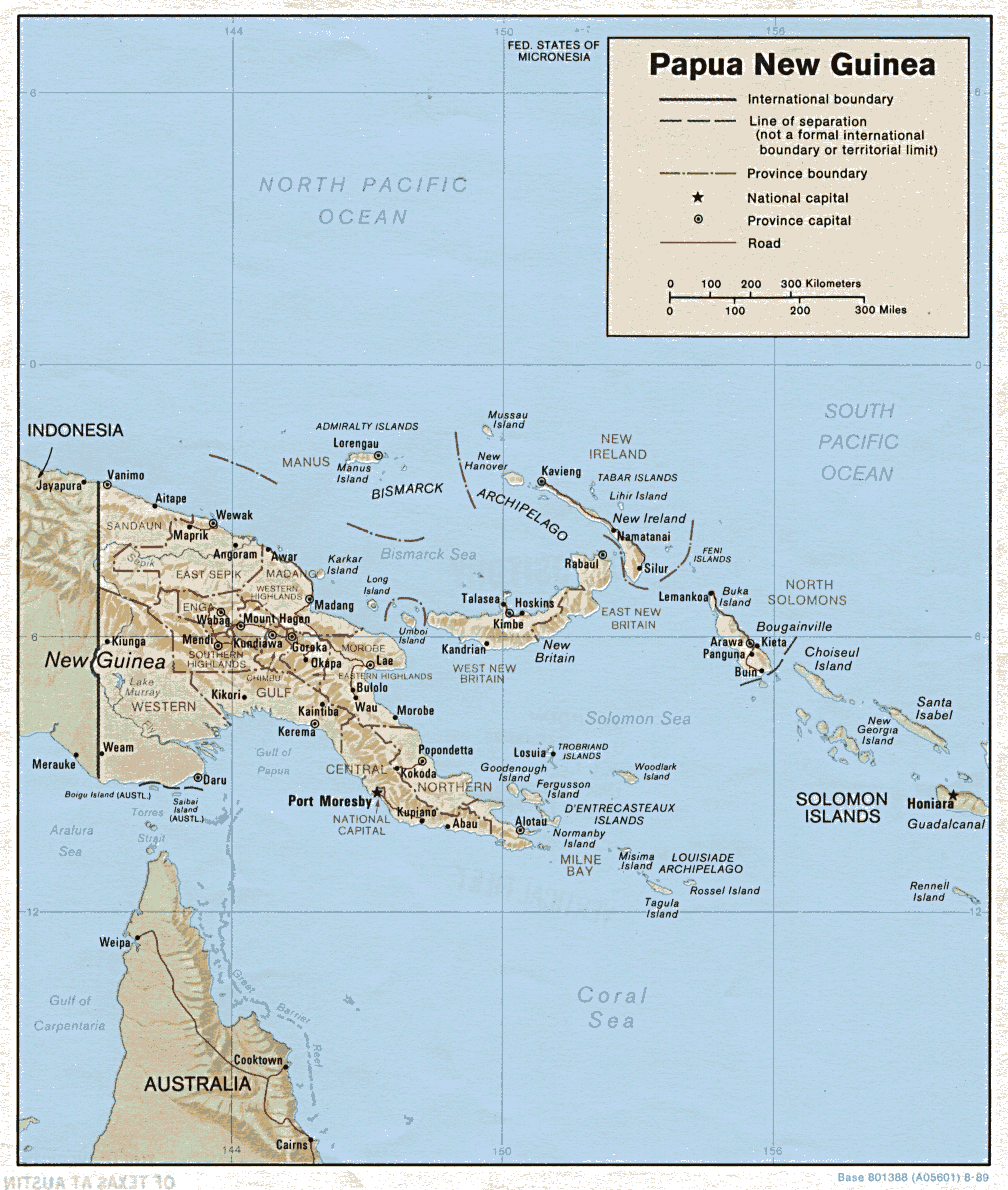
Category Archives: Papua New Guinea

To Save or Not Save a Wife

From Throwim Way Leg: Tree-Kangaroos, Possums, and Penis Gourds—On the Track of Unknown Mammals in Wildest New Guinea, by Tim Flannery (Atlantic Monthly Press, 1998), pp. 96-97 (NYT book review here):

On our last evening in Yominbip we were working restlessly in our hut, packing and repacking the equipment, when Maria, Oblankep’s wife, paid an unexpected visit. As she spoke her voice was low and desperate, and hatred and fear mingled as she told her story in Pidgin.

She had grown up in a small village just outside of Madang; although her family was poor, she was used to the city life and loved it. She met Oblankep in the market at Madang while he was living there. She thought him handsome and took him home to meet her family. He told stories about Yominbip—describing it as a large village not far from a great town and the coast.

Maria’ s parents accepted the marriage offer. Knowing that she was unlikely to see her parents again, she bade them a tearful farewell.

Oblankep’s manner changed when they arrived at Telefomin. He assaulted her and forced her to walk, pregnant, to Yominbip. The journey almost killed her. Since then, alone among strangers, she had borne him a child. She worked daily in the remote gardens. She had grown to hate Yominbip. Those stories about this place—he had told her lies.

She whispered hoarsely, ‘Please take me with you. When the helicopter comes, please take me with you.’

‘But what about your child?’

‘Leave it,’ she said savagely.

When she slipped away I felt a great sense of unease. Should we steal Maria from Yominbip (for that is how Oblankep would doubtless see it), or should we refuse her request? I dared not mention her visit, for she might be severely beaten for what she had done thus far. A failed escape attempt might even result in death.

Most murders in Papua New Guinea result from the theft of women, pigs or land. We would be compromising our own safety were we to attempt to help her escape. And there were other more complex issues to consider. Virtually the entire community of Yominbip had come together as a result of kidnappings. Oblankep had kidnapped his wife, but he himself had been taken by force from his original family. In such a situation it would be useless to try to explain the rights and wrongs of Maria’s case. Morality as I knew it would simply not be understood.

I worried at the problem all morning until a faint mechanical sound announced the imminent arrival of the helicopter. I ran to Oblankep’s hut, and found Maria seated firmly in a corner, her father-in-law standing near her. I could not see her face. With forced jocularity I asked if there were any messages I could take out for anyone. No response. I filled the awkward silence by asking Oblankep to come to my hut so that I could give him some gifts. Everything I was leaving behind I then put in his and his father’s care, to be used by the entire community.

The chopper drew nearer. When it had almost touched down on the new pad I saw Maria crying at the door of Oblankep’s hut. In the din of the rotor blades Lester began loading our specimens and equipment into the cargo hold, unaware of what was going on. I turned back to Maria, her face contorted with tears.

Behind her Oblankep watched, his eyes hard and angry.

The strange title of this book is an anglicized rendition of the Tok Pisin phrase otherwise spelled toromoi lek or tromwe lek, meaning ‘to shake a leg, to get going’.

Leave a comment

Filed under Papua New Guinea, science, travel

New Religious Terms in Two Pacific Languages

How have local languages in the Pacific handled the new lexical requirements of foreign religious traditions? Much seems to depend on the language and sect of the first foreign evangelists.

The island of Yap in Micronesia was first evangelized by Spanish Catholics long before German Protestants arrived about 1898. Yapese is still largely Catholic, and religious loans are mostly from Spanish. Shinto seems to have left no lexical traces from the Japanese colonial era (1914–1945), but loanwords from Japanese remain well represented in the more profane contexts of the new clothing, containers, diseases, foods, tools, and means of transport introduced during those decades.

The following examples of Christian terms do considerable violence to the vowels of Yap’s new orthography, which would take too long to explain—and would also make the words look more Dutch than Spanish.

  • bibliya ‘Bible’ (Span.)
  • galasya ‘church’ (Span.)
  • kiristiyano ‘Christian’ (Span.)
  • komunyon ‘communion’ (Span.)
  • kuruth ‘cross, crucifix’ (Span.)
  • infiyarno ‘hell’ (Span.)
  • misa ‘(Catholic) mass’ (Span.)
  • padrey ‘priest’ (Span.)
  • rosaryo ‘rosary’ (Span.)
  • baynag ‘Christmas’ (Ger. Weihnacht)
  • næp’ ni-b thothup ‘Christmas Eve, Holy Night’ (lit. ‘night that’s holy’)

Morobe Province in Papua New Guinea was evangelized by German Lutheran missionaries beginning in 1886. The Germans adapted two local languages for evangelical and educational purposes, Jabêm for the Austronesian circuit along the coast and islands, and Kâte for the Papuan circuit in the interior of the Huon Peninsula. (Many, if not most, of the other interior languages of Morobe Province have since proven to be Austronesian, not Papuan.)

The German Lutheran strategy for communicating new Christian concepts was to adapt the local vernaculars rather than to introduce foreign words—not unlike the strategy of Martin Luther himself during the Protestant Reformation. The following examples are from Jabêm, in whose German-inspired orthography j represents a palatal glide (like English y), ŋ represents a velar nasal (like English -ng), and -c represents a glottal stop.

  • biŋsu ‘foreign missionary’ (also ‘admonition, commandment’)
  • biŋ gôliŋ ‘parable, proverb’ (lit. ‘talk steer’)
  • gôlôàc ‘congregation’ (also ‘clan, relatives, kinfolk’)
  • gêbêcauc dabuŋ ‘Christmas Eve’ (lit. ‘night holy/taboo’)
  • moasiŋ dabuŋ ‘holy communion’ (lit. ‘benefit/blessing holy’)
  • ŋalau dabuŋ ‘Holy Spirit’
  • kêdôŋwaga ‘teacher’ (lit. ‘3sg-teach-agent’)
  • sakiŋwaga ‘minister, servant’ (lit. ‘service-agent’)
  • jàeŋwaga ‘catechist, local missionary’ (lit. ‘message-agent’)

SOURCES: Yapese–English Dictionary, by John Thayer Jensen with the assistance of John Baptist Iou, Raphael Defeg, Leo David Pugram (U. Hawai‘i Press, 1977); Jabêm–English Dictionary, rev. by J. F. Streicher (Pacific Linguistics, 1982).

Leave a comment

Filed under Germany, language, Micronesia, Pacific, Papua New Guinea, religion, Spain

Birth-order Names in Japan and Papua New Guinea

Most people familiar with Japan are aware of the Japanese birth-order naming system for males, whereby first sons are often called 一郎・太郎 Ichirō/Tarō; second sons 二郎・次郎 Jirō; third sons 三郎 Saburō, and so on. In theory, it would be possible to keep going up to at least the tenth son: 四郎, 五郎, 六郎,七郎, 八郎, 九郎, 十郎. However, I’m not sure how to pronounce the characters for fourth son, can’t find it in my dictionaries, and suspect that it would be an extremely unlucky name because Sino-Japanese shi ‘four’ sounds like shi ‘death’. (Japanese high-rises often lack a 4th floor, for the same reason that my high-rise condo in the U.S. lacks a 13th floor.) [See the correction below.]

Another thing I’m not so sure about is whether this system marks order of issue or order of survival. Back in the old days, many more children died very young. That might account for the naming of Admiral Tōgō Heihachirō, whose name (東郷 平八郎) suggests he might have been his mother’s eighth son, even though he had only three brothers as an adult. (My farm-raised father’s eldest brother and eldest sister also died very young, but he still ended up with five brothers and one sister.)

Birth-order naming systems are also very common in the coastal languages of the Huon Gulf of Papua New Guinea. The naming system in Numbami accommodates up to seven sons and six daughters, and without incorporating any numerals. The order-of-issue names for sons are Alisa, Alinga, Gae, Alu, Sele, Dei, Ase Mou; and for daughters are Kale, Aga, Aya, Damiya, Owiya, Ase Mou. Notice how the names for the seventh son and sixth daughter are the same? That’s because both translate as ‘name none’, or No-Name. My host mother during my fieldwork had seven sons and four daughters, all of whom survived thanks to postwar improvements in public health. The youngest son was called Ase Mou ‘name none’, or Ase ‘name’ for short. Of course, as the kids get older, they tend to go by their baptismal names (often of Biblical origin) or traditional names, depending partly on whether they remain in the village or move to town.

Another coastal language for which birth-order names have been recorded is Labu, which is the only surviving coastal member of the Markham subgroup, which stretches far inland up the Markham River valley. The Labu names for the first five sons are Aso, Amoa, Aŋgi, Aŋgu, Ôlôndi; and for the first five daughters are Ami, Hiya, Aya, Êta, Hênamu. (My source seems a little bit confused about the names farther down the line.) If you compare the Numbami names to the Labu names, only the names of the third daughter match. (However, I’m guessing that Labu Asôlô for both males and females toward the bottom of both lists is the etymological equivalent of Ase Mou ‘name none’, even though the current Labu word for ‘name’ is apaŋa.)

This is typical of the Huon Gulf Sprachbund: the structures match but the sounds often don’t. That facilitates translation, but not lexical retention. Fortunately, human memories can retain enormous amounts of lexical clutter; while human brains are much less efficient at quick translation between languages. (Human RAM far exceeds human CPU capacity. The rise of transformational grammar seems to have been predicated on the opposite assumption: People had to derive one semantically related structure from another; they couldn’t memorize both and then analogize between them.)

UPDATE: For Japanese kanji jocks (or kanji bandits), Matt of No-sword offers some interesting observations of how people have simplified characters by employing ditto marks (or means very similar). Sort of a calligraphic compression algorithm.

CORRECTION: (Slaps forehead.) Matt corrects me (and not for the first time). 四郎 Shirō is neither unlucky nor uncommon. Well, it’s less common than 三郎 Saburō but more common than 五郎 Gorō for the same reason that third sons are more common than fourth, and fourth more common than fifth. Instead of puttering around in my kanji dictionaries, I should have googled up likely names like Suzuki/Tanaka/Yamada Shirō.

Leave a comment

Filed under Japan, language, Papua New Guinea

Puttering About in My Sprachbundesgarten

I’ve been distracted a bit from blogging of late because of a burst of enthusiasm for enhancing Wikipedia’s coverage of Austronesian languages in Papua New Guinea. It’s my own little archival digitization project (as if this blog isn’t obscure enough for my tastes).

Thirty years ago, I did dissertation fieldwork in Morobe Province, PNG. My original goal was to describe just one previously undocumented language that appeared—on the basis of a few wordlists—to be rather conservative, so that my description could provide more and better data for broader-reaching historical and comparative work. However, I found that describing the synchronic grammar of one language in a fairly comprehensive manner was an extremely daunting task (especially the syntax in my verb-serializing language). Few linguists ever try anymore. Every component of any language you attempt to describe is sure to be surrounded by theoretical minefields and earthworks laid out by others. I didn’t have enough fire support, sappers, or élan to storm so many well-entrenched positions at once.

So I elected instead (stretching the military analogy) to deploy a long, thin skirmish line designed to probe the changing shapes of the Austronesian outposts along the coasts of New Guinea—in order to help dispel the “fog of yore,” so to speak. I undertook a historical and comparative study of word order and word-order change across all the Austronesian languages of the New Guinea mainland. The latter was not as difficult as it sounds because (a) only a few dozen of those eight score or so languages were adequately documented at the time, and (b) I could focus on just a few broad questions where data and theory seemed a better fit. The central issue was the extent to which the Austronesian languages have adapted their inherited SVO (Subject Verb Object) typology to the SOV typology that prevails among the demographically dominant Papuan languages on the mainland.

My fellow junior fieldworker on the project exercised more discipline, produced a thick and useful grammatical description of his language (before I finished), and went on to a thriving linguistic career. I attended his dissertation defense, where one professor with his own pet theory of syntax criticized him for being too eclectic in his use of theoretical tools of analysis—in short, for subordinating theory to description. I leapt to my friend’s defense, arguing that it would be a shame to waste the only comprehensive description ever likely to be published on a particular language just to serve the purposes of a particular fly-by-night theory. The professor replied in a huff that his theory had been under development for decades. I asked him how many centuries that language had remained undocumented.

The New Guinea mainland can be considered a sort of Sprachbund, where unrelated Papuan and Austronesian languages have converged toward common structures to varying degrees. For instance, the Austronesian languages of New Guinea are the only ones to display verb-final (SOV) word order, like most of the Papuan languages (and like Hindi, Japanese, or Turkish). Basic word order in Austronesian languages elsewhere, from Madagascar off the coast of Africa to Easter Island off the coast of South America, is either verb-medial (SVO) like Malay or Tok Pisin, or verb-initial (VSO) like most of the Philippine or Polynesian languages.

But the Austronesian languages around the coast of the Huon Gulf, where I did fieldwork, form their own sort of Sprachbund in microcosm, where languages at the borders of four small subgroups exhibit unusual traits more characteristic of their neighbors than their relatives. One of the most extreme examples is Labu (also known as Hapa), spoken in coastal swamps at the mouth of the Markham River, just across the river from the current city of Lae. The city, by the way, takes its name from a linguistic community by the name of Lahe, Lae, or Aribwatsa, whose speakers abandoned their language in favor of Bugawac, the dominant language along the north coast of the Huon Gulf and a crucial piece of the south coast near Salamaua.

Labu shares certain innovations with a larger group of Markham languages that stretch all the way up the Markham River valley. For instance, they regularly reflect Proto-Oceanic *t as a flap /r/ or /l/ and Proto-Huon Gulf *v as either /f/ or /h/. They also reduced their numeral system to ‘one’, ‘two’, and ‘hand’, but added a numeral classifier on the number ‘two’ (sa-lu, se-ruk, le-ruk, depending on the language). Other numbers are composites: ‘2+1’, ‘2+2’, ‘hand+1’, etc. Such severely reduced numeral systems are more typical of Papuan languages.

Labu speakers didn’t forsake their language for Bugawac, but they did remodel some of it on Bugawac lines. They recreated numerals for ‘3’ (si-di) and ‘4’ (sô-ha). So now they can count more like the other coastal languages: 1, 2, 3, 4, 5 (= ‘hand-part’), 5+1, 5+2, … 10 (= ‘hand-both’), … 20 (= ‘person-one’). However, for anything above 5, almost everyone switches to Tok Pisin numerals.

Strangest of all, Labu has acquired a distinctive low “tone” (register tone) on certain words, as in /u/ ‘rain’ vs. /ù/ ‘pot’. None of the other Markham languages exhibit such tone distinctions. Of all the Huon Gulf languages, only Bugawac, Yabêm, and possibly Kela distinguish words on the basis of tone, and its origin in those languages is fairly recent and derives from earlier obstruent voicing contrasts—low tone from /b,d,z,g/, high tone from /p,t,s,k/—with other segments being neutral for tone. Labu tones don’t always match the tones of cognate words in Bugawac or Yabêm, nor do they correlate well with earlier obstruent voicing contrasts, so it’s a bit of a mystery how Labu speakers adopted tonal distinctions.

2 Comments

Filed under language, Papua New Guinea

Rev. Sgt. Usaia Sotutu: Fijian missionary, spy, soldier

One of the most intriguing people whose name keeps popping up in accounts of coastwatching in the Solomon Islands during World War II is Usaia Sotutu, a Fijian missionary who volunteered to help the coastwatchers. His name appears (according to the index) in 18 different passages in the book I just finished reading, Coast Watching in WWII: Operations against the Japanese in the Solomon Islands, 1941–43, by A. B. Feuer (Stackpole, 2006).

Nevertheless, I can find no profile of him anywhere on the web—although there is another Usaia Sotutu born on 20 September 1947, a Fijian athlete who participated in the 1972 Olympics and the 1975 South Pacific Games, whom I presume to be among the children of Usaia and Margaret Sotutu. [They were not. See the correction below.—J.] So, in an effort to get a better sense of this remarkable man, I want to compile as much as I can in a blogpost, beginning with several passages from Feuer’s book.

[April 1942, p. 33] Friendly Fijian natives, led by Usaia Sotutu, hid the AIF [Australian Imperial Force] men from Japanese search parties. Usaia knew every inch of Buka Island and guided the soldiers to the western end of the [Buka] Passage. For several days, the Fijians kept the Army lads concealed until Usaia was able to find a few canoes. Then, under cover of night, he sneaked the coast watchers and their teleradio across the Passage to Soraken.

[June 1942, p. 40] While waiting for the air drop at Kunua, I again met with Father Herbert and Usaia Sotutu. Usaia was still keen on taking an active part in our cause and brought with him a half-caste lad—Anton Jossten. Like Usaia, Anton was very intelligent and spoke English fluently. They had an unusual proposition for me that had immediate appeal. Usaia had a following of educated natives who had been employed as teachers at the Methodist Mission. Usaia and Anton, with the assistance of this group, wanted to establish an espionage network to furnish intelligence regarding Japanese activity around the Buka Passage. The scheme had intriguing possibilities. The teachers were not known to be in any way connected with our coast watching activities. They could move about, within or near enemy lines, without suspicion. I gave Usaia the go-ahead to proceed with his plans. And, although both he and Anton were willing to work voluntarily, I gave them both to understand that I would try and have them enlisted—or put on the payroll in some other capacity.

[January 1943, p. 120] On the night of January 10, Usaia Sotutu and Corporal Sali secretly sneaked down the mountain into Soraken and set fire to every building and wharf. At dawn, the enemy arrived in force to view the gutted ruins…. I am convinced that our action delayed the Japanese occupation of Soraken.

[March 1943, p. 191] After reaching Namatoa, our detachment was split into three parties, each consisting of eight soldiers and a number of trusted natives. I also met Usaia Sotutu—a fine stamp of a man, six feet tall or over, whose wife Margaret and young children passed me as our boat, from the U.S.S. Gato, headed for the beach. Mrs. Sotutu, and her children, were on their way to safety aboard the submarine. I was among the first 12 Army personnel that arrived on this trip.

[July 1943, p. 201] On its second trip to Bougainville the [U.S.S.] Guardfish evacuated 23 people. In addition to Jack Read, the rescued personnel included Captain Eric Robinson, Usaia Sotutu, Anton Jossten, Sergeant Yauwika, Corporal Sali, Constables Sanei and Ena, and 15 other natives. The site chosen for the rescue of Jack Read and his party was at a point south of the Kiviki River. At 4 a.m. on July 30, Read and his men were transferred to a subchaser, and at 7 p.m., they reached Guadalcanal.

The New Zealand Electronic Text Centre‘s Official History of New Zealand in the Second World War 1939–45: The Pacific, chapter 10, section III, Battalions Move to the Solomons offers a glimpse of the Rev. Sgt. Usaia Sotutu’s later exploits.

Almost three years after its formation, 1 Battalion, Fiji Military Forces, sailed for the Solomons on 15 April 1943 in the USS President Hayes. Half the officers and many of the non-commissioned officers were New Zealanders, three of them former instructors lent to Fiji in November 1939. The battalion, commanded by Lieutenant-Colonel J. B. K. Taylor, who had served with the New Zealand Division in Egypt and France during the 1914–18 War and later joined the Fiji administration, reached Guadalcanal on 19 April and occupied a camp at Kukumbona. On 8 May, after the American command had complied with Taylor’s desire not to break up his unit into small groups for action in New Georgia, the battalion moved to a more agreeable camp site in the island of Florida. It remained there for five months, practising jungle tactics and landing exercises and carrying out such routine tasks as beach patrols and coastwatching….

When the Fiji Battalion landed [in Bougainville], American forces had established road blocks on these trails to prevent any surprise attacks from the main Japanese forces occuping the south and north-east coasts of Bougainville, with their principal concentrations round Buin, Kahili, and Kieta. The most disputed of these tracks was the Numa Numa Trail, which led through the mountains from the gorge of the Laruma River. Air observation by aeroplanes based on the Torokina and Piva airstrips, though valuable, was unreliable in country where ground movement could not be accurately discerned, so that all vital intelligence was obtained from patrols working through the rough country beyond the limits of the perimeter. Because of the desire to obtain as much intelligence information as possible without revealing their own strength, patrols were at first instructed not to fight unless they were forced to do so. Enemy patrols, on similar missions, worked down from the forest-clad hills towards the perimeter, so that these alert opposing groups, creeping through the jungle, continually tried to ambush each other and frequently succeeded….

A strong combined patrol from 129 US Infantry Regiment and 1 Fiji Battalion set out from the perimeter, but was driven back soon after it entered the rough hill country towards Sisivie and Tokua, two native villages which gave their names to the forest tracks leading to the garrison area from the rear. Almost simultaneously the Japanese began their attacks on road blocks established along the tracks covering the Ibu post. [Battalion commander Lt. Col.] Upton decided to evacuate the position and withdraw his force down the Ibu-Sisivie trail, which would bring him to the Laruma River and the Numa Numa Trail and so into the perimeter. Early on the morning of 15 February [1944] he despatched [Capt.] Corner from the outpost with the first section of the garrison, which included 120 native carriers with ammunition and radio equipment, and 100 native women and children from mountain villages who feared enemy reprisals….

Corner found his way blocked by determined Japanese attacks on the road posts and retired along the trail he had just traversed, taking up a defensive position at a ravine which offered the only good natural barrier. He was joined there later in the afternoon with the main force under Upton, who was confronted with a disturbing situation. All escape routes were blocked by the Japanese, who greatly outnumbered him, and no help was available from American or Fiji units from the perimeter. He had little time to decide how to get 400-odd men and 200 natives over a mountain range and down to the perimeter unknown to the Japanese, who were now pressing the battalion patrols blocking the tracks along which Upton’s force was extended. A Fijian sergeant, Usaia Sotutu [emphasis added], who had been a missionary on Bougainville for twenty years, saved the day. He remembered an old, disused track near the ravine and led the battalion along it, carefully camouflaging the entrance where it branched off the main trail the force had just used…. On 19 February the force reached the coast intact and with only one man wounded. In those four days, travelling slowly and with the utmost difficulty, the Ibu force climbed 5000 feet through dense forest drenched with rain, and carried arms and equipment, which included Vickers guns, 3-inch mortars, and food for more than 600 people—soldiers and natives.

It’s not clear where he ended up after the war (or even whether he survived it), but a Margaret Sotutu turns up in a photo of teachers at Ratu Kandavulevu School in Fiji in 1962, seated next to a Paula Sotutu, who went on to a distinguished career as a diplomat and public servant. The most recent source I could find on the Rev. Sgt. Usaia Sotutu is a speech on 27 August 2005 by Fijian Prime Minister Laisenia Qarase welcoming Papua New Guinea Prime Minister Michael Somare, whose delegation repatriated the remains of Sefanaia Sukanaivalu, a Fijian soldier who had died on Bougainville in 1944.

In the final decades of the 19th century, Fijian missionaries began to help in taking the Light of Christianity to your islands. We remember those soldiers of God today and give thanks for their service. Many settled, married and became part of village life. This missionary tradition continued until after the last War.

We have with us today Mr Paula Sotutu, a well-known and distinguished citizen of Fiji. Paula has a very personal perspective of the Fijian missionary experience in Bougainville. His father, Reverend Usaia Sotutu, was perhaps the most famous of those pioneering preachers. He spread the Word for 27 years in the Teop and Buin-Siwai areas and had many followers.

Paula, his brother and sisters, were born at the Buka Mission Hospital. He accompanied his father during many pastoral visits to his flock. Paula remembers clearly some of his father’s courageous exploits as a wartime coast watcher and guide to government officials and a small contingent of Australian troops.

Later, when Bougainville was retaken, he made his local knowledge available to Fijian troops, who were part of the invasion force. Mrs Sotutu and the children were smuggled to safety in a submarine in 1943. Reverend Sotutu stayed behind. He still had God’s work to do.

The following year Corporal Sefanaia Sukanaivalu, was awarded the Victoria Cross for giving his life at Bougainville to save his fellow soldiers.

For over 60 years, this dear and brave son of Fiji – our greatest war hero – has been buried at Rabaul.

UPDATE: David Sotutu, son of the Olympian Usaia Sotutu, offers a correction.

In your article you mentioned a Usaia Sotutu that was born on September 20, 1947 and participated in the Olympics and South Pacific Games.

He is my father. His parents were not Usaia and Margaret Sotutu. He is only named after Usaia Sotutu. His parents were Tevita Naiteitei and Akisi Buasega. He was born in the village of Tavea in Bua. He now lives in Tacoma, Washington, USA.

39 Comments

Filed under Fiji, Pacific, Papua New Guinea, war

Propaganda Battles in Bougainville, 1943

Early in January, the native situation began to take a turn for the worse. The people of Ruri really believed my propaganda that the death of their chief was caused by his wearing the armband of Nippon. They spread the story far and wide, and consequently many Japanese armbands were thrown away.

The natives of Sorem Village, three miles south of the [Buka] Passage, were very much pro-Japanese. They considered themselves very important people. They fraternized and drank whiskey with the Japs and were gullible to enemy promises of intermarriage after the war was over. Enticements such as these were standard Japanese methods of currying native favor.

The Sorem residents lured several Ruri men to their village, where they were captured and turned over to the Japanese as being pro-British. The prisoners were flogged and interned at the Passage. I quickly realized that unless this sort of thing was stopped, the Japanese sphere of influence would grow too rapidly and would soon interfere with our coast watching activities. I sent a message to Station KEN asking for Sorem Village to be bombed.

Mackenzie arranged for the attack to take place on the night of January 13. The plan called for a team of my boys to make their way under cover of darkness to the outskirts of town where daylight aerial reconnaissance had revealed a certain grass hut near the village. My men were instructed to lie in wait until they heard a plane approaching, then to set fire to the shack as a guide for the aircraft and to run as fast as possible away from the target area. The natives, led by Sergeant Yauwika, showed a lot of courage in volunteering for the mission, and it was executed to perfection.

A Catalina carried out the raid. The pilot made three runs over the village at 1,500 feet, dropping two 500-pound bombs, a cluster of incendiaries, and a couple of depth charges. This probably sounds like a powerful discharge of explosives on a small native settlement, but fortunately only one person was slightly wounded. However, the gesture and resulting shock value served our purpose.

Much to our astonishment, the surprise bombardment even unnerved the enemy. A few days after the attack on Sorem, the Japanese commander at the Passage summoned all the area native chiefs to Sohano where they were addressed by the commandant. He informed the people that U.S. forces were expected to invade northern Bougainville and that his troops might have to retreat for a few days until they could launch a counterattack.

In case of such an eventuality, the natives were ordered to assist and feed the Japanese soldiers. Beach villages were instructed to institute a system of constant vigilance—reporting anything unusual to Sohano immediately. The chieftains were also warned against sending any information to me, and that henceforth the airfield and all fortified positions were off-limits. Finally, the chiefs were advised to protect their people by building air raid shelters.

While the speech did not enhance Japanese prestige in the eyes of the natives, fear of the consequences weighed heavily on the minds of the village leaders. More importantly, however, was the fact that this display of panic on the part of the enemy was the first intimation to the islanders that their conquerors were not the invincible beings they professed to be. The stern lecture and warnings certainly contradicted earlier Japanese assertions that the war was over and they had won it.

Frightened natives, in the vicinity of the Passage, now tended to migrate toward Soraken and away from the threatened danger. For the moment, at least, we were afforded a breathing spell.

SOURCE: Coast Watching in WWII: Operations against the Japanese in the Solomon Islands, 1941–43, by A. B. Feuer (Stackpole, 2006), pp. 120-122

Leave a comment

Filed under Australia, Japan, Pacific, Papua New Guinea, war

Redskins Trapped in Bougainville, 1942–43

The Japanese remained at Tinputz for three days before embarking for Kieta. Apparently their objective had been to carry out a beach reconnaissance for construction materials and anything else that might be of value to them. After the enemy departed, we resumed the journey to Porapora and reached Lumsis the first day. Besides the Aravia natives, the people of Lumsis remained loyal to us until the very end. I decided to set up a base in the mountains behind Lumsis—a place to fall back on in case Porapora became untenable.

While we were at the village, another problem presented itself. Natives living on the island who were foreign to Bougainville—such as people from New Britain and the other islands, were known locally as “Redskins.” The term derives from the fact that their pigmentation is somewhat lighter than that of the average Buka and Bougainville native. There were a hundred or so of them working in northern Bougainville when the Japanese invaded the islands. The subsequent departure of their employers left the Redskins more or less stranded, and the local natives did not want them hanging around the villages. It was a drain on the food supply and invariably became a cause of domestic strife. The people turned to me to solve their dilemma.

The Aravia and Lumsis natives were very amiable. I was able to purchase a block of fertile land from each community and settled the Redskins on the property. However, in return, I asked them to serve me as carriers or laborers whenever called upon. They willingly agreed to the proposal. Incidentally, practically all my police boys were Redskins.

SOURCE: Coast Watching in WWII: Operations against the Japanese in the Solomon Islands, 1941–43, by A. B. Feuer (Stackpole, 2006), p. 119

Some resentful Bougainvilleans like to observe that the Papua New Guinea flag represents their relationship to the rest of PNG, with black on the bottom and red on top.

Leave a comment

Filed under Australia, Japan, Pacific, Papua New Guinea, war

Operation Bismarck Sea, 2–4 March 1943

One reason I’ve been posting a bit less is that I’ve been reading a book that is not very bloggable—Operation Bismarck Sea, by Lawrence Cortesi (Major Books, 1977)—which I picked up for $1.39 at a used book store. It interested me because it describes a major air–sea battle in the area of Papua New Guinea in which I did fieldwork in 1976, and where I heard many stories about the Pacific War in that neighborhood. I shan’t keep it. There are much better resources online these days.

The little mass-market paperback book has all the accuracy of a TV docudrama by Ollie North. In other words, it has lots of accurate and fascinating facts and figures, but it’s quite one-sided. Among the earliest tipoffs that the Japanese side was badly misrepresented was the improbable name Yukata Tishayuna, a fictional captain subordinate to the real admiral Masatomi Kimura (citing the names in English order). That, plus the fact that the captain addresses his superior as the ‘Honorable Kimura’, and the Japanese speak in orientalized clichés:

“Before the first buds of cherry blossoms seek the sunlight of spring,” the aide said, “we shall destroy the cancer at Wau.”

“Banzai,” Okabe answered softly with a grin.

Other names are also screwed up: a Japanese ship named Arishio (蟻潮 ‘ant tide’?) instead of Arashio (荒潮 ‘rough tide’); and an island called Undoi instead of Umboi (the former somehow distinguished from Rooke Island, the latter synonymous with Rooke Island, and also known as Siassi Island).

Nevertheless, there is one passage that seems worth quoting on pp. 182-183:

The Imperial Japanese Staff had always been too cautious, even when they possessed far superior numbers. They were never willing to commit more troops or planes or ships than necessary, especially in air and sea battles.

At Pearl Harbor, the Japanese had come up short of a true knockout blow because they were too cautious to move in for the kill and perhaps occupy the Hawaiian Islands. In the Battle of the Coral Sea, though their forces far outnumbered the understrength Allies, they retired after suffering the loss of a single carrier, even though they had sunk two American carriers. In the Battle of Midway, although Japan’s air and sea units had suffered losses, they still had a formidable, unscathed striking force in the area; but instead of pressing on against the depleted American carrier force, they again retired.

The same might be said of the Solomons campaign. Japanese caution was the major reason for American success at Guadalcanal. In most of the naval fights during the Solomon campaign, the Japanese task forces did more damage to the American navy than the Americans had meted out. Yet, after successful naval engagements, such as the Battles of Savo Island or Cape Esperance, the Japanese naval units retired after their victories instead of pressing forward. As a result, they had allowed the American navy to lick its wounds and regain its strength.

As to Japan’s aerial strategy, the worst kind of caution prevailed. While American pilots were generally superior to Japanese pilots, and while the American P-38 was superior to the Hamp and Zero fighter plane, the Japanese could muster many more planes. Further, they were superior to the earlier P-39 and P-40 used by the American air force prior to 1943. Yet they never sent more than a squadron or two of fighter planes into an aerial engagement. They thus allowed even terms to inferior numbers of Allied army and navy units, which could rarely muster more than a squadron or two of planes to meet a Japanese challenge. So, because of the superior training of Allied airmen, the Allied pilots usually defeated their opponents.

The Japanese also followed this caution in the use of their bombers. Hundreds of Sally and Betty bombers sat on the many Japanese air bases in the Bismarck Archipelago, especially at Rabaul. Yet they rarely committed more than 20 or 30 bombers to an air attack against an Allied base. Against navy ships, the Japanese only used their light naval fighter-bombers. They rarely sent their heavy and medium bombers that were only a stone’s throw from the Ironbottom Strait [or Sound] in the Solomons where most of the action took place during the Guadalcanal operation. The biggest raid ever conducted by the Japanese in the Southwest Pacific was the 5-plane raid on Port Moresby in February, 1942.

At the conference in Rabaul in February 1943, where the Japanese staff planned operation 157, Admiral Junichi Kasaka of the Imperial Eleventh Naval Air Fleet, boasted of his great airpower. He could count hundreds of planes scattered among the various Japanese airfields in the Bismarck Archipelago. Why then, didn’t Admiral Kasaka maintain a cover of a hundred or even two-hundred planes over the convoy all the way from Rabaul to the Huon Gulf? Kasaka’s land-based aircraft were never more than an hour or two from the route of Kimura’s convoy. And, ironically, Kasaka did maintain heavy air cover over the convoy during the early part of the voyage, when the convoy was far into the Bismarck Sea and out of range of Allied medium or light bombers. But he failed to maintain this cover as the convoy neared Huon Gulf, within range of any Allied plane in New Guinea.

Moreover, Admiral Gunichi Mikawa, commander of the Eighth Outer Sea Fleet, could proclaim that he had all but chased the American navy from the Bismarck Archipelago because of his superior numbers in naval ships. Why then, didn’t he allot one or even two aircraft carriers to escort the hugely important 22-ship convoy into Lae? Again, because the Japanese had an obsession with safeguarding their heavy strength. They kept planes and ships ever in reserve for future emergency.

Leave a comment

Filed under Australia, Japan, Papua New Guinea, U.S., war

Bougainville in Wonderland

The latest issue of The Contemporary Pacific (now online at Project Muse), contains a review (PDF) by Donald Denoon of what looks to be an interesting set of perspectives on Bougainville before, during, and after the worst of the recent conflict. Here’s the beginning and end of the review.

Bougainville: Before the Conflict, edited by Anthony J Regan and Helga M Griffin. Canberra: Pandanus Books and the Research School of Pacific and Asian Studies, The Australian National University, 2005….

Events in Bougainville would challenge even the Queen in Lewis Carroll’s Through the Looking Glass (1873), who sometimes believed as many as six impossible things before breakfast. In 2004 the arch-secessionist Francis Ona, ignoring seven years of peacemaking and the election of an Autonomous Bougainville Government within Papua New Guinea, had himself crowned king of an independent Bougainville. His ally Noah Musingku, another fantasist and creator of fraudulent pyramid schemes, conducted the rites and became Prince David. But when Ona died, he received a state funeral from the state he did not recognize, subsidized (the ultimate insult?) by Australian aid.

Early in 2006, veterans of the Bougainville Revolutionary Army and their once implacable enemies in the Resistance united to denounce Musingku’s dishonest fund-raising. The Autonomous Bougainville Government demanded that the Papua New Guinea Defense Force arrest Noah and disband and deport his Fijian soldiers. Meanwhile, the Bougainvillean minister for mines in the Papua New Guinea government offered to negotiate with multinational companies to resume copper mining at Panguna or elsewhere. Evidently anyone who understood Bougainville politics was misinformed….

It is impossible to summarize the richness of these studies, memoirs, and vignettes. James Tanis’s reflections (“Nagovisi villages”) are unusually eloquent but typical of the analytical and emotional power of these contributions. He left the university to join the Bougainville Revolutionary Army, fought to the end, engaged in peace negotiations, and served as a minister in Bougainville’s postwar government. He parted company with Francis Ona when Ona boycotted the peace process. Tanis reviews the prewar circumstances of Nagovisi and the land disputes that led to Ona’s supremacy—and his tragic descent into mysticism and irrelevance.

This is not a run-of-the-mill monograph. Like many other perceptive writers, Tanis raises more questions than anyone could possibly answer. He asks about the nature of Papua New Guinea’s stake in Bougainville; he ponders Australia’s interests in Panguna; and he wonders what unseen forces—global and regional—contributed to the destruction of the environment and years of civil war in Bougainville. And he concludes with the most radical of all questions: “After gaining political independence from colonial masters, do all third world nations enjoy only brief periods of real independence? Must they all then experience civil wars and revolutions and go bankrupt and join the queue awaiting solutions from elsewhere?”

1 Comment

Filed under Pacific, Papua New Guinea

Alex Golub on Unfulfilled Consumers in PNG

Another Pacific-area article that caught my fancy is Alex Golub‘s Who Is the “Original Affluent Society”? Ipili “Predatory Expansion” and the Porgera Gold Mine, Papua New Guinea in the latest issue of The Contemporary Pacific at Project Muse (subscription required). Here are a few paragraphs from the introduction and conclusion (some references removed).

In the 1970s, first-world fantasies of “ecologically noble savages” were key to the creation of alliances between indigenous groups, environmentalists, and affluent first-world publics. More recently, however, anthropologists have grown increasingly critical of such stereotypes of indigenous people. In areas as diverse as Amazonia, Australia, North America, and Indonesia, indigenous peoples find their political leverage derives from filling first-world fantasies that are often essentialized and stifling.

This dynamic has taken another interesting twist in Papua New Guinea. Unlike many Commonwealth countries, Papua New Guinea has no settler population, and, unlike many African states, it has no majority ethnic group. Furthermore, Australia’s administration of Papua New Guinea was both well meaning and under-resourced. As a result there has been little alienation of land and it is difficult to recognize Papua New Guineans as “indigenous people” separate from “settler” populations, as is typically done in Australia, Africa, and the New World. At the same time, however, Papua New Guinea is highly reliant on resource rents, and the activities of international logging, mining, and hydrocarbon companies present a picture of a David-and-Goliath struggle between local people and transnational capital that is comfortably familiar to many first-world activists.

Like scholars elsewhere, Melanesianists are increasingly dissatisfied with stereotypes of grassroots Papua New Guineans as ecologically noble savages. A growing literature has, for instance, emphasized the ways in which compensation claims for damage to the environment are part of a complex local politics. Glenn Banks has argued that compensation claims are often a way of expressing a sense of disenfranchisement by people outside of mining lease areas (2002), while Martha Macintyre and Simon Foale have argued convincingly that even for people within mining lease areas, claims of environmental damage are often expressions of dissatisfaction with social concerns couched in environmental idioms (2002).

But there is a danger that these responsible works could be misread by policy elites in Port Moresby, the national capital, who often see landowners as savages more nasty than noble. Papua New Guineans have one of the best track records in the world for extracting concessions from foreign developers and the national government, and the demands of landowners have become so strident that the overall perception nationwide is that they are corrupted opportunists who have given up their traditional culture in order to “go for money” (Filer and others 2000). Thus, at one industry conference in 2000, the president of the Papua New Guinea Chamber of Mining and Petroleum claimed that “people issues are at the forefront of the mining and petroleum industries” in Papua New Guinea. The industry’s biggest challenge, he claimed, were “community problems that could have been avoided” and that were caused by “so-called ‘landowners'” who ripped off the government. “The rip-off is so blatant,” he said, “[that] it penetrates into the fabric of the government” (Golub fieldnotes 2000). Other speakers were more blunt. “Community affairs issues will shut down this country,” said one mining executive, himself from the highlands region (Golub fieldnotes 2000)….

To an audience familiar with stereotypes of noble savages, the reaction of the Ipili to the mine can be startling. Elites in Port Moresby who romanticize a traditional “Melanesian Way” feel betrayed by landowners who fail to conform to their expectations. At the same time, first-world activists interested in finding “guardians of the forest” in Porgera will be disappointed indeed at the alacrity with which the Ipili, as they say, “traded their mountain for development.”

But it may be that the unease the Ipili instill in others is due to the fact that they are driven by concerns remarkably like “our own.” Their desire for new commodities, time-saving devices, and prepared food is in many ways not so different from what one would find in any major city in the United States. Thus it could be said that “they” are not as bad as “we” are, or, to put it another way, that “we” are as good as “they.”

So which is the original affluent society? Just as we see our own weak points in Ipili prodigality, so do Ipili imagine whites, as a version of their present or possible selves. This examination of Ipili culture reveals them to be a bit more like ourselves than we have been led to believe. Sahlins looked to hunters and gatherers to explode the Western, Hobbesian conception of infinite need. Studying the Ipili suggests that the West is not the only place plagued by need and want. Ipili do not denounce consumer society in the name of a pristine, authentic primitivism. They denounce it for failing to make good on its promises. The problem, as they see it, is not enough affluence.

Leave a comment

Filed under Indonesia, Papua New Guinea