Category Archives: Papua New Guinea

Varieties of Kamtok (vs. Tok Pisin)

From West African Pidgin-English: A Descriptive Linguistic Analysis with Texts and Glossary from the Cameroon Area, by Gilbert Donald Schneider (Athens, Ohio, 1966), pp. 226-229. Each English phrase is translated into three versions: a. anglicized Kamtok, b. “broad” Kamtok, and c. Tok Pisin of Papua New Guinea (the last being my translations). All varieties here are likely to be somewhat rural and old-fashioned.

ORTHOGRAPHY: Schneider writes the 7 vowels of Kamtok /a, ɛ, e, i, ɔ, o, u/ as a, e, ey, i, o, ow, u. Another source writes them a, eh, e, i, oh, o, u.

1. He married trouble.
a. hi don mari trobu.
b. i don mari trobu.
c. em i maritim trabel.

2. I stay in this town.
a. ay di silip fo dis tawn.
b. a di silip fo dis tong.
c. mi stap long dispela taun.

3. Do you have children?
a. yu get pikin?
b. yu get pikin?
c. i gat pikinini bilong yu?

4. They are pleased with my work.
a. dem di glad fo may wok.
b. dem di glat fo ma wok.
c. ol i laikim wok bilong mi.

5. My strength’s gone.
a. may strong hi don finish.
b. ma trong i don finis.
c. strong bilong mi i go pinis. / mi no strong moa.

6. Our Bible is on the table.
a. wi baybl dey fo tebl.
b. wi bau dey fo tebu.
c. Baibel bilong yumi/mipela i stap long tebol. (‘ours incl. you’/’ours excl. you’)

7. Pineapple is good food.
a. panapl na swit chop.
b. panabu na shwit chop.
c. ananas i switpela kaikai.

8. They’re having a meeting about coffee tomorrow.
a. dem get miting fo kofi tumaro.
b. dem get miting fo kofi tumaro.
c. ol i gat (wanpela) miting bilong kofi tumora.

9. Pardon me.
a. eskiys mi witi dis wan.
b. chus mi fo dis wan.
c. sori ya long dispela. (?)

10. This guava isn’t sweet.
a. dis gwava now di swit.
b. dis gwava now di shwit
c. dispela yambo i no swit.

11. Your oil isn’t good.
a. dat yu oyl now gud.
b. dat wuna oya now fan.
c. wel bilong yu i no gutpela.

12. He’s not speaking the truth.
a. hi now di tok tru.
b. i now di tok tru.
c. em i no tok stret.

13. I can’t sit on that chair.
a. ay now fit sidawn fo dat chea.
b. a now fit sidong fo dat chia.
c. mi no inap sindaun long dispela sia ya.

14. Come and scratch my back.
a. kom skrach mi fo bak.
b. kom kras mi fo bak.
c. kam skrapim baksait bilong mi.

15. We’re going to the town.
a. wi di kamawt go fo tawn.
b. wi di komot go fo tong.
c. mipela i go long taun i stap. (‘we’re on the way to town’)

16. Throw it on the ground.
a. meyk yu trowwey fo grawn.
b. meyk yu trowwey fo grong.
c. tromwe i stap long graun.

17. It has a strong odor.
a. hi di smel plenti.
b. i di simel plenti.
c. i gat strongpela smel (bilong en)

18. Who broke my pot?
a. wichman don browk may pot?
b. husman don browk ma pot?
c. husat i brukim sospen bilong mi?

19. My brother’s in the house.
a. may broda dey fo haws.
b. ma broda dey fo has.
c. Brata bilong mi i stap (insait) long haus.

20. Go and sit down outside.
a. meyk yu gow sidawn fo awtsay.
b. meyk wuna gow sidong fo ausai.
c. go sindaun long arasait / ausait long haus.

21.Who owns that oil?
a. na wichman get dat oyl?
b. na husman get dat oya?
c. dispela wel ya i bilong husat/wanem man?

22. Come and give me another one.
a. kom giv mi oda wan.
b. kom gif mi ada wan.
c. kam givim/bringim mi wanpela moa / narapela (‘more of same’ / ‘different’).
(More polite is: Wanpela moa i kam!)

23. They have many possessions.
a. dem get plenti kagow.
b. dem get plenti kagow.
c. ol i gat planti samting.

24. The medicine causes itching.
a. dat medisin di skrach.
b. dat metsin di kras.
c. dispela marasin i mekim skin i sikrap.

25. Who rang the bell?
a. wichman don ring bel?
b. husman don ring bel?
c. husat i pulim/paitim belo? (‘pull/strike’)

1 Comment

Filed under anglosphere, Cameroon, language, Papua New Guinea

Blogging Sabbatical

I began blogging six years ago this month, in December 2003. Since then, I’ve published over 2,000 blogposts, most of them excerpts from books I was reading. But the number of posts has declined each year—from over 550 in 2004 to under 200 in 2009—as I’ve become involved in a greater variety of online publishing hobbies.

In the spring of 2006, I bought my first digital camera (a little point-and-shoot Olympus), took it with me on a 4-month sabbatical spell in Japan, and soon began building a portfolio of documentary—rather than artistic—photos on Flickr, some of them scans of old photos from my earlier travels. This month I got my third digital camera (a Canon Powershot) and my Flickr portfolio numbers almost 2,500 images. This year I had to replace my trusty old HP flatbed scanner, orphaned by Vista, with a new Canon that I am quite happy with. (A local middle school is now making use of my orphaned scanner and ancient workhorse of a printer—an HP 5MP Laserjet.)

Early in 2009, I discovered major photographic lacunae that I could easily fill in Wikipedia’s coverage of sites on the National Register of Historic Places in Hawai‘i and began a campaign to photograph as many as I could and upload them to Wikimedia Commons, then add the images to the articles. Now I’m rather heavily involved in WikiProject Hawaii and WikiProject NRHP, both as a photographer and an writer/editor.

These online documentation projects have convinced me to put this blog on the back burner in 2010 in order to concentrate on a long-term language documentation project I need to finish: a comprehensive grammatical description of Numbami, the once almost entirely undocumented language whose speakers were my gracious hosts during fieldwork in Papua New Guinea in 1976. I have completed and published many bits and pieces about the language over the intervening years but need to put them all together and fill in many gaps. Unlike other projects described above, it’s more a duty than a hobby—a daunting one, but not unpleasant to contemplate.

3 Comments

Filed under blogging, language, Papua New Guinea, scholarship

Among the Spice Island Sago-eaters

From The Spice Islands Voyage: The Quest for Alfred Wallace, the Man Who Shared Darwin’s Discovery of Evolution, by Tim Severin (Carroll & Graf, 1997), pp. 142-144:

More than a century before Wallace‘s visit, the people of Gorong were still habitual sago-eaters. Toman upon toman of sago flour was stacked up in the little shops of Kataloko. The tomans were the shape of small solid drums wrapped in green palm leaves, or you could buy the sago flour already baked into biscuits and neatly tied with string into bundles of ten. Then they looked exactly like small, hard, light brown floor-tiles. When we asked where all this sago came from, we were told it came from the island opposite, from Pasang where the sago palms [Metroxlon sagu] still grew.

Pasang had a deceptive approach. From the direction we arrived with [our boat] Alfred Wallace, it looked as if the usual fringing coral reef protected a broad lagoon with deeper water; if we could cross the reef and enter the lagoon we would be safe. At least, that is how it appeared, because the water was much darker on the landward side of the reef. In fact, when we crossed the reef we found that we were wrong. The lagoon was dark not because it was deep, but because it was carpeted with brown sea grass. In fact it was barely 50 centimetres deep and studded with rocks. A normal vessel would have been stuck fast, but again Alfred Wallace needed so little water to float that we could pole our way through the shallows for a kilometre or more until we were able to anchor off the main village of the island. From there a guide took us into the sago swamps.

The sago palms appeared to be wild, but were in fact planted as seedlings in the muck and stagnant pools of the swamp. For 12–15 years the palm tree grew until its trunk was approximately one metre thick. Then, quite suddenly, the tree flowered and was ready to harvest. The owner felled the tree, peeled off the skin and chopped his way into the thick white soft trunk. We found a sago harvester at work, sitting inside the tree-trunk as if in a large dugout canoe. In front of him was the unworked face of white sago pith, and he was steadily hacking at it with a long handle which had a tiny sharp metal blade set at right-angles in the end. As he struck, the blade sliced away a sliver of sago pith which fell inside the hollow trunk and on to his feet. The blade also came alarmingly close to his feet with each blow, and it seemed he risked chopping off his toes. Occasionally he wriggled his feet and toes, pushing the growing pile of the sago shavings back down the hollow tree-trunk. When he was tired of chopping, he climbed out of the tree-trunk, filled a sack with sago shavings and carried them off through the squelching mud to a trough which he had set up beside a pool of stagnant swamp water. He dumped the shavings into the upper end of the trough, poured water over them from a bucket, and squeezed the wet pith against a cloth strainer. The water ran out of the sago pith as white as milk, carrying sago flour with it, and drained away into another trough where it was allowed to settle. Within an hour, a thick deposit of pure white edible sago flour had settled in the trough and could be scooped out with the hands. It was ready to bake and eat.

The sago gatherer claimed that in just two days’ work he could produce enough food to feed his family for a month. As for the sago palm, he said, once you had planted the seedling there was no more work involved. You merely had to let it grow. Apart from Joe, who rather liked the taste of sago biscuit, the rest of us wondered if it was even worth that much effort. We compared eating sago with buying a packet of breakfast cereal, throwing away the contents and eating the cardboard packet.

I got to help process a sago palm into starch during my fieldwork in Papua New Guinea in 1976. As unskilled labor, my job was to pound the pith of the felled sago palm trunk into smithereens, using an adze handle with an artillery shell casing on the end. Others carried the pith to the washing chutes near the river where the starch was strained out of the pulp, then drained and formed into large blocks, which were allotted among the households whose members helped with the work. I had never heard the term toman used to name such blocks until I read this book.

1 Comment

Filed under food, Indonesia, Papua New Guinea, travel

Japanese Soldier Ethnographer in Indonesia, 1944-45

From: Peter T. Suzuki and Reiko Watanabe Reiger (2003), A Japanese Soldier’s Ethnography of Molu Island (Tanimbar): Ken Sasaki’s Account (1944-1945), Archipel 66: 161-199 (doi: 10.3406/arch.2003.3789).

Moru Shima Ki: An Account of Molu Island by Ken Sasaki

Following is a description of my time on Molu Island from June 19, 1944 to May 20, 1945. Seven Japanese soldiers, myself included, were stationed there with a cannon. I never thought it would become the subject of my research because we were constantly engaged in the battlefront. My notes and sketches were of necessity brief, taken during times when I had the opportunity. The only things I carried away from Molu were my notes, 200 sketches, and 30 pieces of folk craft from the island. Only now am I attempting to assemble these and my disjointed memories (although I can remember clearly the beauty of the sea, which had the color of emerald green coral reefs) into a coherent account….

Kapala [Mal. kepala] means head or boss, soa means a blood relative. There are class distinctions and associated titles, such as orankaya [Mal. orang kaya] (upper class); kapalasoa [Mal. kepala soa] (head of a kin group); jurutolis [Mal. juru tulis] (his associate); togama (?); kapalakanpon [Mal. kepala kampung] (village chief). Those holding the titles of kapalakanpon or jurutolis are public officers in a village, appointed by family lineage or natural ability. In contrast, orankaya and jurutolis hold feudalistic power among villagers in a family clan and have general authority….

Religion

Seven villages of the eight villages in this island are Protestant. It seems that only Kilon is shunned by others since it is the only Muslim village. Their association with other villages does not seem to be congenial. In the past they followed a primitive religion in which they worshiped the sun and the moon as gods (Ubila) like any other village. They said they made commitments to Ubila. But later new religions such as Islam and Christianity were introduced into the island. It seemed that the power of religions influenced and also renewed everything such as food, clothing, housing, ceremonial occasions, and language.

It is hard to imagine a new religion having this kind of widespread effect in Japan. I could not help realizing how strong religious powers can be….

It is clear Christianity came to this island 35 years ago.

Even though the power of Islam could not change the lifestyle of the villagers much, Christianity rapidly changed people’s lifestyles on Molu, which had not progressed much from a primitive way of living.

People started being very enthusiastic about learning to read and write, wearing shoes, having lamps, wearing pants instead of grass skirts and singing hymns. And they started hiding necklaces and swords. Jacob told me that the younger generation would not believe the ways the older generation used to live, saying, “it is quite different today.”…

Language

The daily language of Molu is called Larat, the island just northeast of Tanimbar, but Larat is also the language of Tanimbar, Sera, and Fordata.

The languages of Tanimbar are divided into three groups : Sera, Yamdena, and Larat. Of course they speak to us in Malay, but since Malay is a second language which was taught at school, it is hard to understand much of high Malay.

High Malay is only used seriously by guru, who are priests and teachers in a village during the celebration of subayan.

They use the alphabet for writing, and since it became widespread, most adults under 50 years old have no trouble spelling….

Food

Rice, corn, bread, potatoes, and sago are served as main dishes. Side dishes are bananas, fish, and coconuts. Vegetables and fruits are melons, eggplant, tomatoes, squash, sweet potatoes, papaya, and pineapples. A large quantity of mangos is also grown….

Sago grows wild, and belongs to the palm tree group; it grows in flocks in damp ground. Mature trees about 20 years old are cut and smashed at the trunk with axes (111. 6), then washed with water, and soaked till the starch is precipitated. This fruit is also prepared in various ways, such as gruel (babeda), like rice (nasi), deep fried goren [Mal. goreng], toasted rice cake, and renpen which is baked (or cooked) in a stone mold. Sago can be substituted for flour. Renpen looks like a Japanese snack ; foxtail millet toasted until crispy. When it is still hot, it is plump and tasty. They steam the stored renpen, until it becomes soft and like konyaku, a Japanese food made of yam which is gelatenous.

Little food is stored in the village. Because they have different crops, harvest time spans the whole year. As long as they gather the food, they do not have to face starvation. Since they do not have to transfer food (sago) from one place to another, they do not trade and they do not store food. But since sago has a short life, its starch must be gathered right away and the juice (toman) from sago is eaten soon, otherwise it is prepared as renpen for a portable meal.

Fresh fish must be eaten the same day it is caught. They do not catch more than they need each day. And yet sometimes small fish are put between chopped branches and smoked on a fire. This is called ian-bata-batan, and used for soup stock. People eat cooked fish, but not raw fish. They do not have knowledge of preserving fish with salt. Making dried fish is not common, but they make dried octopus, which is prepared by cutting and then spreading it open….

Fire

Matches are known by the Moluans, but they are rare and considered valuable. Tobacco is lit by flint, rock, and metal much in the same way as in ancient Japan.

For starting general-purpose fires the Moluans use a method which involves rubbing bamboo :

Split dry bamboo into two and put on the ground or straw surface side up. Make a small crack on the center of the bamboo then shave some surface off from around the crack.

Rub with a bamboo spatula at right angles with the bamboo for about 15 minutes till the bamboo starts to smoke and starts on fire.

It seems this is an excellent way to start a fire since this island has plenty of bamboo. But this method requires two persons and great strength. People usually have a raised floor, which allows them to keep a pilot light burning constantly….

Hunting

Probably the only wild animal on Molu is the wild pig (babi). The garden plots on Molu are surrounded by a four foot-high fence made of logs and is designed to prevent wild pig incursions. Since most villagers are Christian, they hunt and are fond of eating the meat of the wild pig.

Usually a javelin is used for hunting wild pig. It has an iron tip, which is connected to the handle with a strong rope….

Luxury items

Among the islanders one of the most popular goods is tobacco (roko) [Mal. rokok], then chewing sirih comes next. Sirih is a tree leaf, which is similar to a pepper tree. Next in popularity is alcohol (sobi).

All men over the age of 10 years smoke tobacco. But it is common to see old women chewing tobacco also. Tobacco is produced in a mountain field. It is planted in places in the burnt field among the weeds. A weedkiller is used only on the roots of the plant. Of course no fertilizers are used….

Chewing betel nut: kimna is called sirih, sweet corn (betel—J.); only bigger lime is coral reef that is burnt and crushed; sirih-daun [Mal. daun sirih (leaf betel—J.)] is a creeper which is similar to yam (yamaimo in Japanese) leaf. As soon as it is put in one’s mouth and chewed for a while, it will bring a keen cooling sensation to the inside of the head, and will give you a sharp taste on the lips, and when one spits, it appears bloody red. Lips and teeth also take on the red color, and with prolonged use, turn a creepy-looking black. On Molu, it is very popular among both men and women, but only women over 15 years old are seen practicing this habit….

There is a tree, which is called karupatebu, which is similar to a hemp palm tree and a palm tree. This sugar palm tree is grown mainly for gathering sugar, but a wine can be brewed from it, too … By the way, comparing coconut milk to sugar palm tree milk, the latter has a rich white color and thickness like milk, and a greater sweet-sour taste. Nothing can beat its taste, not even the best versions of kalpis, and it has a pleasant intoxicating effect. However, the great taste of this version of kalpis enticed me to drink ten glasses of the tempting drink, and helped me to end up sleeping the night in the jungle.

During the ridiculous war, I secretly kept this wine in a water bottle for the contingency of a suicide attack, and I often gave myself encouragement by sipping it.

1 Comment

Filed under food, Indonesia, Japan, language, Papua New Guinea, scholarship, war

Rediscovering Waigeo: At the Bird’s Head of New Guinea

From The Spice Islands Voyage: The Quest for Alfred Wallace, the Man Who Shared Darwin’s Discovery of Evolution, by Tim Severin (Carroll & Graf, 1997), pp. 155-156:

The small villages of the Moluccas have a habit of relocating suddenly. The villagers – usually no more than a dozen families – frequently change the location of their houses which need only a couple of days to erect on a new site. They may move to find better fishing, to a safer anchorage and – above all – to an easier source of fresh water.

It was well into the afternoon when the last of the large bays opened up. Ahead of us the afternoon thunderstorms were rolling across the forested ridges and slopes of Waigeo. Surges of grey-black cloud flowed across the tree canopy on a broad front. The wind came ahead, whipping the tops off the wavelets in the bay. Lightning flickered in the depths of the cloud, and then the curtain of grey rain blotted out everything. When the rain cleared we had a glimpse of a tiny white dot in the murk at the back of the bay. It might have been a landmark erected for navigators, but there are no such marks in Waigeo. We set course for it, and crossing the broad bay we found the spire of a tiny, white painted church. In front were a dozen or so palm-thatch houses set on stilts on the water’s edge. The jungle came down the hillside to within yards of this tiny village, which looked as if it was about to be swallowed in the vegetation.

We anchored and, minutes later, there was the usual response when four canoes put out from the village to visit us. But these were canoes like nothing we had ever seen before. The central hull was a very narrow dugout log, tapering to a fine bow. From each side sprang delicate outriggers that would have done credit to a modern high technology aircraft. They curved out in a beautiful downward line so that the floats barely kissed the water. There was not a nail nor ounce of metal in the entire construction. The sweeping outriggers had been carved from naturally curved wood, and were bound in place with neat strips of jungle rattan. They were so well made and exquisitely balanced that they flexed like the wings of birds, and the entire canoe floated high and light as it skimmed forward.

The men in the canoes were pure Papuan with not a trace of Malay in their features. They had tightly curled wiry hair, broad nostrils, deep-set eyes, and very dark skins. In the lead canoe the grey-haired headman of the village was obvious from the deference paid to him by the other men. The canoes clustered around the stern of our prahu, and half a dozen men scrambled on deck. Budi and Julia made introductions and explained why we had come there. The villagers were intrigued to know about their unexpected visitors because the last time they had seen a foreigner was seven years earlier when a butterfly hunter had come to their village.

Leave a comment

Filed under Indonesia, Papua New Guinea, travel

Changing Demographics in Pacific Seafaring

From Sailors and Traders: A Maritime History of the Pacific Peoples, by Alastair Couper (U. Hawai‘i Press, 2009), pp. 178-180, 188:

As well as improvements in maritime education and training under IMO regulations, there has also been a veritable social revolution in Fiji. The young generation of Pacific sailors no longer seriously ascribes to the old tradition that females bring “bad luck” to a ship. Pacific women have shown considerable strength of character, as well as new professionalism, in taking charge of crews and in coping with family….

The other change in human relations in Fiji has been an amelioration within the maritime sector of the sensitive issue of race relations. The exclusion of all but indigenous Fijians from the Waterside Workers and Seamen’s Union, which was registered in 1946 with a specific racial limitation clause, continued until a rival unsegregated seamen’s union emerged in 1992. The reasons for the initial segregation are deeply embedded in colonial history. However, with the increase of Fijians as wage earners in ports and shipping, trade union exclusiveness seemed as much a matter of class as race. Ports and shipping had Fijian laborers and ratings, while Europeans and part-Europeans were officials and officers. Capital in turn came from the United Kingdom and Australasia and locally from Indo-Fijian commercial sources. The more class-conscious union organizers saw the Fijians as “workers” and the others as “bosses” who were not eligible for union membership.

The mobility of a few Fijian ratings with sufficient education to junior officer levels and the increase of indigenous Fijians serving as cadets and officers on local vessels have reduced the basis for class resentment. There are still racial problems, but younger Fijian sailors recognize the merits of Indo-Fijians as mariners. For example, the Khan family on the island of Nairai have long been regarded as good sailors, running their own cutters with Fijian officers and crew….

The global hierarchical structure is broadly 40 percent officers from countries in the OECD (Organisation for Economic Co-operation and Development), plus Russia, Poland, and some of the eastern European states, and most of the ratings from eastern Europe and developing countries, including some Pacific islands.

Increasingly, young men and a few women from the Pacific are moving to officer ranks on foreign-flag ships, as there is a dire shortage of officers in the developed ship-owning states. The shortage is due to both declining interest in careers at sea and the losses of trained personnel arising from demands ashore in business, technology, and administration for well-qualified mariners. One of the several advantages to Germany, for example, of recruiting lower-cost sailors in Kiribati and training some of them to officer levels is the lack of well-paid employment in islands for their skills, which would attract officers ashore. Thus there is a minimizing of wastage from manpower training investments. There are twelve maritime training institutions in the Pacific Islands. Only Fiji and Papua New Guinea provide the full range of education and training from pre-sea, rating, and officer courses to Class 1 foreign-going masters and chief engineers. Several other places offer training of ratings and/or junior officers. There is mobility in training, with concentrations for special courses under the coordination of the SPC Regional Maritime Programme….

Kiribati in 1959 (as part of the Gilbert and Ellice Islands crown colony, GEIC) was already supplying seafarers to the China Navigation Company of Britain. There were also crews and a few I-Kiribati nationals serving as officers, usually with European captains, on colony ships sailing on long-distance interisland routes. In terms of distance, Kiribati shipping was virtually foreign-going…. Kiribati is now the principal country in the Pacific island region for supplying seafarers.

Leave a comment

Filed under economics, education, Fiji, labor, Micronesia, Pacific, Papua New Guinea

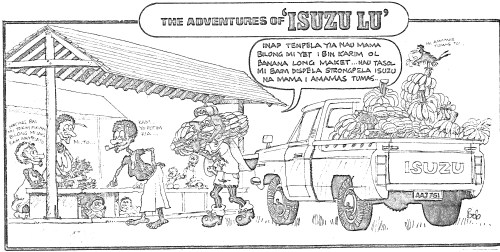
Tok Pisin with Isuzu Lu: Banana long Maket

Isuzu Lu: Banana long Maket

Isuzu Lu: Banana long Maket

Lu: Inap tenpela yia nau mama bilong mi yet i bin karim ol banana long maket … Nau tasol mi baim dispela strongpela Isuzu na mama i amamas tumas ….

Lou: For ten years now my own mother has carried bananas to market … Only now I bought this sturdy Isuzu and mama is very happy …

Bird: Mi amamas tumas tu / I’m very happy too

Mama (with pipe): Kam yu putim hia … / Come put it here …

Sitting lady: Nating bai mi tokim pikinini bilong mi long baim wanpela tu … / I think I’ll tell my kid to buy one too …

Standing lady: Mi, tu / Me, too

This is a scan from a faded old photocopy of a cartoon ad by Bob Browne for New Guinea Motors in the Papua New Guinea Post-Courier, 1976. According to the Foreword in Isuzu Lu Book 5, Browne’s Isuzu Lu ads paved the way for locally created cartoon strips in PNG newspapers. The Phantom was among the most popular strips in 1976.

Leave a comment

Filed under labor, language, Papua New Guinea

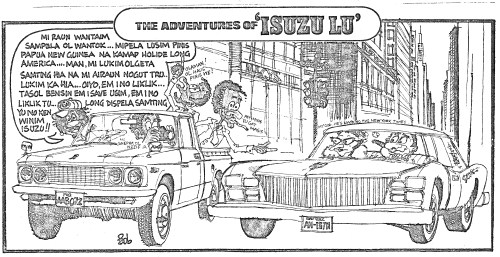
Tok Pisin with Isuzu Lu: Holide long NYC

Isuzu Lu: Holide long NYC

Isuzu Lu: Holide long NYC

Lu: Mi raun wantaim sampela ol wantok … Mipela lusim pinis Papua New Guinea na kamap holide long America … Man, mi lukim olgeta samting hia na mi airaun nogut tru … Lukim ka hia … Oiyo, em i no liklik … Tasol bensin em i save usim, em i no likliki tu … Long dispela samting yu no ken winim Isuzu!!

Lou: I’m traveling with some friends … We have left Papua New Guinea and arrived on holiday in America … Man, I see all the things here and I’m overwhelmed … Look at this car … Wow, it’s not little … but the gasoline it uses, that’s no little bit either … For that you can’t beat Isuzu!!

Photographer: Mi snepim ol netif ia / I’m snapping (photos of) the natives

Man pointing up: Olaman! Ol haus i pinis we? / Oh man! Where do the buildings end? (= How high do they go?)

Man with cigarette: Hey misis, Yu gat masis? / Hey lady, you got a match?

Lady: My God. He’s smoking the New York Times …

This is a scan from a faded old photocopy of a cartoon ad by Bob Browne for New Guinea Motors in the Papua New Guinea Post-Courier, 1976. According to the Foreword in Isuzu Lu Book 5, Browne’s Isuzu Lu ads paved the way for locally created cartoon strips in PNG newspapers. The Phantom was among the most popular strips in 1976.

1 Comment

Filed under language, Papua New Guinea, travel, U.S.

Pacific Annexations, 1840-1906

From Sailors and Traders: A Maritime History of the Pacific Peoples, by Alastair Couper (U. Hawai‘i Press, 2009), pp. 140-141:

The managers of the major merchant companies based at the main entrepôts in the [Pacific] islands were often ex-sailors. Several acted as consuls for their governments and supported the companies in many ways, including evoking gunboat diplomacy. A prime example is John Bates Thurston. He served at sea in the island trades, was wrecked at Rotuma in 1865, became British consul in Fiji in 1867, was highly influential in the negotiations for the ceding of Fiji to Britain in 1874, and became governor of Fiji in 1887. The companies, the new settlers, and their sympathetic consuls pressed for annexations. The French were the first to act [but Waitangi was 1840—J.] and took Tahiti, the Marquesas, and the Tuamotus as French protectorates in 1842 and New Caledonia in 1853. These were declared colonies in 1880, and the Australs and Wallis and Futuna in 1887.

The British annexed Fiji in 1874 and established protectorates over southeast New Guinea in 1884, Gilbert and Ellice in 1892, most of the Solomons soon after, and Ocean Island in 1900. They agreed that New Zealand would exercise authority over the Kermadecs in 1887, the Tokelaus in 1889, and the Cooks and Niue in 1901. The Dutch took western New Guinea in 1848. Germany annexed northeast New Guinea in 1885, along with the Bismarck Archipelago and the northwest Solomons; took possession of most of the Carolines in 1885; and ultimately purchased Yap and other islands in the Carolines and Marianas from Spain in 1899. The Germans also acquired the Marshall Islands in 1884 and took over Nauru in 1888. Chile obtained Easter Island in 1888.

America, after its disastrous Civil War, had not recovered a significant merchant fleet and showed little inclination for acquiring Pacific territory. American guano companies had already secured legislation in 1856–1860 that allowed claims over some small Pacific islands, and the US government went on to secure others, including Baker, Jarvis, Johnson, Midway, Palmyra, and Wake. In 1893 the influential American maritime geostrategist Alfred Mahan wrote that it was “imperative to take possession, when it can be righteously done, of such maritime positions as can contribute to secure command.” In 1898, Hawai‘i was annexed (US citizenships were granted in 1900), as was eastern Samoa with Pago Pago as a main naval coaling station, while Guam was captured from Spain by the US Navy in 1898.

The Pacific was now effectively divided between several colonial powers mainly by agreements. In the final carve-up, it was confirmed that Western Samoa was a German colony separated from American Samoa in the east. In turn Germany agreed to relinquish claims for Tonga. As a result, in the closing days Tonga appeared to survive as the only independent Polynesian kingdom, although not quite. It was declared a British protectorate in 1900, and in 1905 it was decreed mandatory for the king of Tonga to take advice from the British consul on all matters of importance. Finally, in 1906 New Hebrides was divided as a condominium between Britain and France.

I’m not sure why Couper omits the 1840 Treaty of Waitangi, which made British subjects of the Maori. Maybe he considered both New Zealand and Australia to be colonial powers by the 1840s, even though both were earlier annexed by another colonial power. (Like the Americas, of course.)

Leave a comment

Filed under Britain, Fiji, France, Germany, Hawai'i, Micronesia, Netherlands, New Zealand, Pacific, Papua New Guinea, Polynesia, Spain, U.S.

Tok Pisin with Isuzu Lu: Ol Skulmanki

Isuzu Lu: Ol Skulmanki

Isuzu Lu: Ol Skulmanki

Lu: “Ol skulmanki i amamas nogut tru bilong wanem sikul i pinis nau … na ol papamama i amamas long mi kisim ol i go bek long ples … Ol i save dispela ka i no bagarap long dispela rot … Oyes, ol i save Isuzu em i gutpela ka tru …”

Lou: “The schoolkids are awfully happy because school is over now … and the parents are happy for me to bring them back to the village … They know this car won’t break down on this road … Oh yes, they know Isuzu is a very good car …”

This is a scan from a faded old photocopy of a cartoon ad by Bob Browne for New Guinea Motors in the Papua New Guinea Post-Courier, 1976. I’ve got a lot more, but I’ll have to limit my scanning to just a sample because I see that the author/illustrator has published a collection of these cartoons. I just bought the last copy of Isuzu Lu Book 5 available on Amazon.com.

Leave a comment

Filed under education, language, Papua New Guinea