Category Archives: Pacific

Souvenir Hunting on Peleliu, September 1944

During this lull the men stripped the packs and pockets of the enemy dead for souvenirs. This was a gruesome business, but Marines executed it in a most methodical manner. Helmet headbands were checked for flags, packs and pockets were emptied, and gold teeth were extracted. Sabers, pistols, and hari-kari knives were highly prized and carefully care for until they could be sent to the folks back home or sold to some pilot or sailor for a fat price. Rifles and other larger weapons usually were rendered useless and thrown aside. They were too heavy to carry in addition to our own equipment. They would be picked up later as fine souvenirs by the rear-echelon troops. The men in the rifle companies had a lot of fun joking about the hair-raising stories these people, who had never seen a live Japanese or been shot at, would probably tell after the war.

The men gloated over, compared, and often swapped their prizes. It was a brutal, ghastly ritual the likes of which have occurred since ancient times on battlefields where the antagonists have possessed a profound mutual hatred. It was uncivilized, as is all war, and was carried out with that particular savagery that characterized the struggle between the Marines and the Japanese. It wasn’t simply souvenir hunting or looting the enemy dead; it was more like Indian warriors taking scalps.

While I was removing a bayonet and scabbard from a dead Japanese, I noticed a Marine near me. He wasn’t in our mortar section but had happened by and wanted to get in on the spoils. He came up to me dragging what I assumed to be a corpse. But the Japanese wasn’t dead. He had been wounded severely in the back and couldn’t move his arms; otherwise he would have resisted to his last breath.

The Japanese’s mouth glowed with huge gold-crowned teeth, and his captor wanted them. He put the point of his kabar [knife] on the base of a tooth and hit the handle with the palm of his hand. Because the Japanese was kicking his feet and thrashing about, the knife point glanced off the tooth and sank deeply into the victim’s mouth. The Marine cursed him and with a slash cut his cheeks open to each ear. He put his foot on the sufferer’s lower jaw and tried again. Blood poured out of the soldier’s mouth. He made a gurgling noise and thrashed wildly. I shouted, “Put the man out of his misery.” All I got for an answer was a cussing out. Another Marine ran up, put a bullet in the enemy soldier’s brain, and ended his agony. The scavenger grumbled and continued extracting his prizes undisturbed.

Such was the incredible cruelty that decent men could commit when reduced to a brutish existence in their fight for survival amid the violent death, terror, tension, fatigue, and filth that was the infantryman’s war. Our code of conduct toward the enemy differed drastically from that prevailing back at the division CP.

SOURCE: With the Old Breed: At Peleliu and Okinawa, by E. B. Sledge (Oxford U. Press, 1990), pp. 118, 120

1 Comment

Filed under Japan, Micronesia, Pacific, U.S., war

Birth-order Names in Japan and Papua New Guinea

Most people familiar with Japan are aware of the Japanese birth-order naming system for males, whereby first sons are often called 一郎・太郎 Ichirō/Tarō; second sons 二郎・次郎 Jirō; third sons 三郎 Saburō, and so on. In theory, it would be possible to keep going up to at least the tenth son: 四郎, 五郎, 六郎,七郎, 八郎, 九郎, 十郎. However, I’m not sure how to pronounce the characters for fourth son, can’t find it in my dictionaries, and suspect that it would be an extremely unlucky name because Sino-Japanese shi ‘four’ sounds like shi ‘death’. (Japanese high-rises often lack a 4th floor, for the same reason that my high-rise condo in the U.S. lacks a 13th floor.) [See the correction below.]

Another thing I’m not so sure about is whether this system marks order of issue or order of survival. Back in the old days, many more children died very young. That might account for the naming of Admiral Tōgō Heihachirō, whose name (東郷 平八郎) suggests he might have been his mother’s eighth son, even though he had only three brothers as an adult. (My farm-raised father’s eldest brother and eldest sister also died very young, but he still ended up with five brothers and one sister.)

Birth-order naming systems are also very common in the coastal languages of the Huon Gulf of Papua New Guinea. The naming system in Numbami accommodates up to seven sons and six daughters, and without incorporating any numerals. The order-of-issue names for sons are Alisa, Alinga, Gae, Alu, Sele, Dei, Ase Mou; and for daughters are Kale, Aga, Aya, Damiya, Owiya, Ase Mou. Notice how the names for the seventh son and sixth daughter are the same? That’s because both translate as ‘name none’, or No-Name. My host mother during my fieldwork had seven sons and four daughters, all of whom survived thanks to postwar improvements in public health. The youngest son was called Ase Mou ‘name none’, or Ase ‘name’ for short. Of course, as the kids get older, they tend to go by their baptismal names (often of Biblical origin) or traditional names, depending partly on whether they remain in the village or move to town.

Another coastal language for which birth-order names have been recorded is Labu, which is the only surviving coastal member of the Markham subgroup, which stretches far inland up the Markham River valley. The Labu names for the first five sons are Aso, Amoa, Aŋgi, Aŋgu, Ôlôndi; and for the first five daughters are Ami, Hiya, Aya, Êta, Hênamu. (My source seems a little bit confused about the names farther down the line.) If you compare the Numbami names to the Labu names, only the names of the third daughter match. (However, I’m guessing that Labu Asôlô for both males and females toward the bottom of both lists is the etymological equivalent of Ase Mou ‘name none’, even though the current Labu word for ‘name’ is apaŋa.)

This is typical of the Huon Gulf Sprachbund: the structures match but the sounds often don’t. That facilitates translation, but not lexical retention. Fortunately, human memories can retain enormous amounts of lexical clutter; while human brains are much less efficient at quick translation between languages. (Human RAM far exceeds human CPU capacity. The rise of transformational grammar seems to have been predicated on the opposite assumption: People had to derive one semantically related structure from another; they couldn’t memorize both and then analogize between them.)

UPDATE: For Japanese kanji jocks (or kanji bandits), Matt of No-sword offers some interesting observations of how people have simplified characters by employing ditto marks (or means very similar). Sort of a calligraphic compression algorithm.

CORRECTION: (Slaps forehead.) Matt corrects me (and not for the first time). 四郎 Shirō is neither unlucky nor uncommon. Well, it’s less common than 三郎 Saburō but more common than 五郎 Gorō for the same reason that third sons are more common than fourth, and fourth more common than fifth. Instead of puttering around in my kanji dictionaries, I should have googled up likely names like Suzuki/Tanaka/Yamada Shirō.

Leave a comment

Filed under Japan, language, Papua New Guinea

Puttering About in My Sprachbundesgarten

I’ve been distracted a bit from blogging of late because of a burst of enthusiasm for enhancing Wikipedia’s coverage of Austronesian languages in Papua New Guinea. It’s my own little archival digitization project (as if this blog isn’t obscure enough for my tastes).

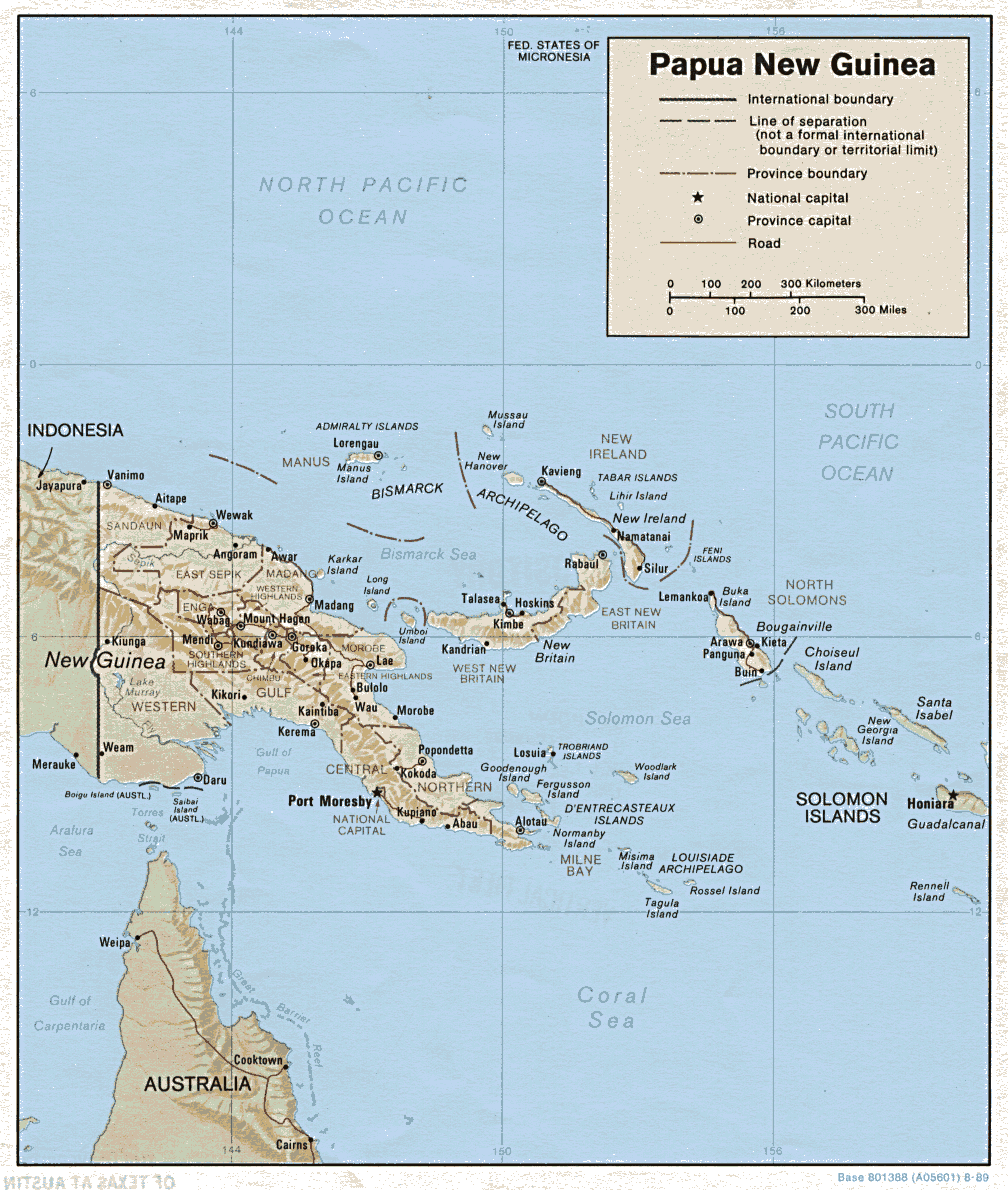
Thirty years ago, I did dissertation fieldwork in Morobe Province, PNG. My original goal was to describe just one previously undocumented language that appeared—on the basis of a few wordlists—to be rather conservative, so that my description could provide more and better data for broader-reaching historical and comparative work. However, I found that describing the synchronic grammar of one language in a fairly comprehensive manner was an extremely daunting task (especially the syntax in my verb-serializing language). Few linguists ever try anymore. Every component of any language you attempt to describe is sure to be surrounded by theoretical minefields and earthworks laid out by others. I didn’t have enough fire support, sappers, or élan to storm so many well-entrenched positions at once.

So I elected instead (stretching the military analogy) to deploy a long, thin skirmish line designed to probe the changing shapes of the Austronesian outposts along the coasts of New Guinea—in order to help dispel the “fog of yore,” so to speak. I undertook a historical and comparative study of word order and word-order change across all the Austronesian languages of the New Guinea mainland. The latter was not as difficult as it sounds because (a) only a few dozen of those eight score or so languages were adequately documented at the time, and (b) I could focus on just a few broad questions where data and theory seemed a better fit. The central issue was the extent to which the Austronesian languages have adapted their inherited SVO (Subject Verb Object) typology to the SOV typology that prevails among the demographically dominant Papuan languages on the mainland.

My fellow junior fieldworker on the project exercised more discipline, produced a thick and useful grammatical description of his language (before I finished), and went on to a thriving linguistic career. I attended his dissertation defense, where one professor with his own pet theory of syntax criticized him for being too eclectic in his use of theoretical tools of analysis—in short, for subordinating theory to description. I leapt to my friend’s defense, arguing that it would be a shame to waste the only comprehensive description ever likely to be published on a particular language just to serve the purposes of a particular fly-by-night theory. The professor replied in a huff that his theory had been under development for decades. I asked him how many centuries that language had remained undocumented.

The New Guinea mainland can be considered a sort of Sprachbund, where unrelated Papuan and Austronesian languages have converged toward common structures to varying degrees. For instance, the Austronesian languages of New Guinea are the only ones to display verb-final (SOV) word order, like most of the Papuan languages (and like Hindi, Japanese, or Turkish). Basic word order in Austronesian languages elsewhere, from Madagascar off the coast of Africa to Easter Island off the coast of South America, is either verb-medial (SVO) like Malay or Tok Pisin, or verb-initial (VSO) like most of the Philippine or Polynesian languages.

But the Austronesian languages around the coast of the Huon Gulf, where I did fieldwork, form their own sort of Sprachbund in microcosm, where languages at the borders of four small subgroups exhibit unusual traits more characteristic of their neighbors than their relatives. One of the most extreme examples is Labu (also known as Hapa), spoken in coastal swamps at the mouth of the Markham River, just across the river from the current city of Lae. The city, by the way, takes its name from a linguistic community by the name of Lahe, Lae, or Aribwatsa, whose speakers abandoned their language in favor of Bugawac, the dominant language along the north coast of the Huon Gulf and a crucial piece of the south coast near Salamaua.

Labu shares certain innovations with a larger group of Markham languages that stretch all the way up the Markham River valley. For instance, they regularly reflect Proto-Oceanic *t as a flap /r/ or /l/ and Proto-Huon Gulf *v as either /f/ or /h/. They also reduced their numeral system to ‘one’, ‘two’, and ‘hand’, but added a numeral classifier on the number ‘two’ (sa-lu, se-ruk, le-ruk, depending on the language). Other numbers are composites: ‘2+1’, ‘2+2’, ‘hand+1’, etc. Such severely reduced numeral systems are more typical of Papuan languages.

Labu speakers didn’t forsake their language for Bugawac, but they did remodel some of it on Bugawac lines. They recreated numerals for ‘3’ (si-di) and ‘4’ (sô-ha). So now they can count more like the other coastal languages: 1, 2, 3, 4, 5 (= ‘hand-part’), 5+1, 5+2, … 10 (= ‘hand-both’), … 20 (= ‘person-one’). However, for anything above 5, almost everyone switches to Tok Pisin numerals.

Strangest of all, Labu has acquired a distinctive low “tone” (register tone) on certain words, as in /u/ ‘rain’ vs. /ù/ ‘pot’. None of the other Markham languages exhibit such tone distinctions. Of all the Huon Gulf languages, only Bugawac, Yabêm, and possibly Kela distinguish words on the basis of tone, and its origin in those languages is fairly recent and derives from earlier obstruent voicing contrasts—low tone from /b,d,z,g/, high tone from /p,t,s,k/—with other segments being neutral for tone. Labu tones don’t always match the tones of cognate words in Bugawac or Yabêm, nor do they correlate well with earlier obstruent voicing contrasts, so it’s a bit of a mystery how Labu speakers adopted tonal distinctions.

2 Comments

Filed under language, Papua New Guinea

Rev. Sgt. Usaia Sotutu: Fijian missionary, spy, soldier

One of the most intriguing people whose name keeps popping up in accounts of coastwatching in the Solomon Islands during World War II is Usaia Sotutu, a Fijian missionary who volunteered to help the coastwatchers. His name appears (according to the index) in 18 different passages in the book I just finished reading, Coast Watching in WWII: Operations against the Japanese in the Solomon Islands, 1941–43, by A. B. Feuer (Stackpole, 2006).

Nevertheless, I can find no profile of him anywhere on the web—although there is another Usaia Sotutu born on 20 September 1947, a Fijian athlete who participated in the 1972 Olympics and the 1975 South Pacific Games, whom I presume to be among the children of Usaia and Margaret Sotutu. [They were not. See the correction below.—J.] So, in an effort to get a better sense of this remarkable man, I want to compile as much as I can in a blogpost, beginning with several passages from Feuer’s book.

[April 1942, p. 33] Friendly Fijian natives, led by Usaia Sotutu, hid the AIF [Australian Imperial Force] men from Japanese search parties. Usaia knew every inch of Buka Island and guided the soldiers to the western end of the [Buka] Passage. For several days, the Fijians kept the Army lads concealed until Usaia was able to find a few canoes. Then, under cover of night, he sneaked the coast watchers and their teleradio across the Passage to Soraken.

[June 1942, p. 40] While waiting for the air drop at Kunua, I again met with Father Herbert and Usaia Sotutu. Usaia was still keen on taking an active part in our cause and brought with him a half-caste lad—Anton Jossten. Like Usaia, Anton was very intelligent and spoke English fluently. They had an unusual proposition for me that had immediate appeal. Usaia had a following of educated natives who had been employed as teachers at the Methodist Mission. Usaia and Anton, with the assistance of this group, wanted to establish an espionage network to furnish intelligence regarding Japanese activity around the Buka Passage. The scheme had intriguing possibilities. The teachers were not known to be in any way connected with our coast watching activities. They could move about, within or near enemy lines, without suspicion. I gave Usaia the go-ahead to proceed with his plans. And, although both he and Anton were willing to work voluntarily, I gave them both to understand that I would try and have them enlisted—or put on the payroll in some other capacity.

[January 1943, p. 120] On the night of January 10, Usaia Sotutu and Corporal Sali secretly sneaked down the mountain into Soraken and set fire to every building and wharf. At dawn, the enemy arrived in force to view the gutted ruins…. I am convinced that our action delayed the Japanese occupation of Soraken.

[March 1943, p. 191] After reaching Namatoa, our detachment was split into three parties, each consisting of eight soldiers and a number of trusted natives. I also met Usaia Sotutu—a fine stamp of a man, six feet tall or over, whose wife Margaret and young children passed me as our boat, from the U.S.S. Gato, headed for the beach. Mrs. Sotutu, and her children, were on their way to safety aboard the submarine. I was among the first 12 Army personnel that arrived on this trip.

[July 1943, p. 201] On its second trip to Bougainville the [U.S.S.] Guardfish evacuated 23 people. In addition to Jack Read, the rescued personnel included Captain Eric Robinson, Usaia Sotutu, Anton Jossten, Sergeant Yauwika, Corporal Sali, Constables Sanei and Ena, and 15 other natives. The site chosen for the rescue of Jack Read and his party was at a point south of the Kiviki River. At 4 a.m. on July 30, Read and his men were transferred to a subchaser, and at 7 p.m., they reached Guadalcanal.

The New Zealand Electronic Text Centre‘s Official History of New Zealand in the Second World War 1939–45: The Pacific, chapter 10, section III, Battalions Move to the Solomons offers a glimpse of the Rev. Sgt. Usaia Sotutu’s later exploits.

Almost three years after its formation, 1 Battalion, Fiji Military Forces, sailed for the Solomons on 15 April 1943 in the USS President Hayes. Half the officers and many of the non-commissioned officers were New Zealanders, three of them former instructors lent to Fiji in November 1939. The battalion, commanded by Lieutenant-Colonel J. B. K. Taylor, who had served with the New Zealand Division in Egypt and France during the 1914–18 War and later joined the Fiji administration, reached Guadalcanal on 19 April and occupied a camp at Kukumbona. On 8 May, after the American command had complied with Taylor’s desire not to break up his unit into small groups for action in New Georgia, the battalion moved to a more agreeable camp site in the island of Florida. It remained there for five months, practising jungle tactics and landing exercises and carrying out such routine tasks as beach patrols and coastwatching….

When the Fiji Battalion landed [in Bougainville], American forces had established road blocks on these trails to prevent any surprise attacks from the main Japanese forces occuping the south and north-east coasts of Bougainville, with their principal concentrations round Buin, Kahili, and Kieta. The most disputed of these tracks was the Numa Numa Trail, which led through the mountains from the gorge of the Laruma River. Air observation by aeroplanes based on the Torokina and Piva airstrips, though valuable, was unreliable in country where ground movement could not be accurately discerned, so that all vital intelligence was obtained from patrols working through the rough country beyond the limits of the perimeter. Because of the desire to obtain as much intelligence information as possible without revealing their own strength, patrols were at first instructed not to fight unless they were forced to do so. Enemy patrols, on similar missions, worked down from the forest-clad hills towards the perimeter, so that these alert opposing groups, creeping through the jungle, continually tried to ambush each other and frequently succeeded….

A strong combined patrol from 129 US Infantry Regiment and 1 Fiji Battalion set out from the perimeter, but was driven back soon after it entered the rough hill country towards Sisivie and Tokua, two native villages which gave their names to the forest tracks leading to the garrison area from the rear. Almost simultaneously the Japanese began their attacks on road blocks established along the tracks covering the Ibu post. [Battalion commander Lt. Col.] Upton decided to evacuate the position and withdraw his force down the Ibu-Sisivie trail, which would bring him to the Laruma River and the Numa Numa Trail and so into the perimeter. Early on the morning of 15 February [1944] he despatched [Capt.] Corner from the outpost with the first section of the garrison, which included 120 native carriers with ammunition and radio equipment, and 100 native women and children from mountain villages who feared enemy reprisals….

Corner found his way blocked by determined Japanese attacks on the road posts and retired along the trail he had just traversed, taking up a defensive position at a ravine which offered the only good natural barrier. He was joined there later in the afternoon with the main force under Upton, who was confronted with a disturbing situation. All escape routes were blocked by the Japanese, who greatly outnumbered him, and no help was available from American or Fiji units from the perimeter. He had little time to decide how to get 400-odd men and 200 natives over a mountain range and down to the perimeter unknown to the Japanese, who were now pressing the battalion patrols blocking the tracks along which Upton’s force was extended. A Fijian sergeant, Usaia Sotutu [emphasis added], who had been a missionary on Bougainville for twenty years, saved the day. He remembered an old, disused track near the ravine and led the battalion along it, carefully camouflaging the entrance where it branched off the main trail the force had just used…. On 19 February the force reached the coast intact and with only one man wounded. In those four days, travelling slowly and with the utmost difficulty, the Ibu force climbed 5000 feet through dense forest drenched with rain, and carried arms and equipment, which included Vickers guns, 3-inch mortars, and food for more than 600 people—soldiers and natives.

It’s not clear where he ended up after the war (or even whether he survived it), but a Margaret Sotutu turns up in a photo of teachers at Ratu Kandavulevu School in Fiji in 1962, seated next to a Paula Sotutu, who went on to a distinguished career as a diplomat and public servant. The most recent source I could find on the Rev. Sgt. Usaia Sotutu is a speech on 27 August 2005 by Fijian Prime Minister Laisenia Qarase welcoming Papua New Guinea Prime Minister Michael Somare, whose delegation repatriated the remains of Sefanaia Sukanaivalu, a Fijian soldier who had died on Bougainville in 1944.

In the final decades of the 19th century, Fijian missionaries began to help in taking the Light of Christianity to your islands. We remember those soldiers of God today and give thanks for their service. Many settled, married and became part of village life. This missionary tradition continued until after the last War.

We have with us today Mr Paula Sotutu, a well-known and distinguished citizen of Fiji. Paula has a very personal perspective of the Fijian missionary experience in Bougainville. His father, Reverend Usaia Sotutu, was perhaps the most famous of those pioneering preachers. He spread the Word for 27 years in the Teop and Buin-Siwai areas and had many followers.

Paula, his brother and sisters, were born at the Buka Mission Hospital. He accompanied his father during many pastoral visits to his flock. Paula remembers clearly some of his father’s courageous exploits as a wartime coast watcher and guide to government officials and a small contingent of Australian troops.

Later, when Bougainville was retaken, he made his local knowledge available to Fijian troops, who were part of the invasion force. Mrs Sotutu and the children were smuggled to safety in a submarine in 1943. Reverend Sotutu stayed behind. He still had God’s work to do.

The following year Corporal Sefanaia Sukanaivalu, was awarded the Victoria Cross for giving his life at Bougainville to save his fellow soldiers.

For over 60 years, this dear and brave son of Fiji – our greatest war hero – has been buried at Rabaul.

UPDATE: David Sotutu, son of the Olympian Usaia Sotutu, offers a correction.

In your article you mentioned a Usaia Sotutu that was born on September 20, 1947 and participated in the Olympics and South Pacific Games.

He is my father. His parents were not Usaia and Margaret Sotutu. He is only named after Usaia Sotutu. His parents were Tevita Naiteitei and Akisi Buasega. He was born in the village of Tavea in Bua. He now lives in Tacoma, Washington, USA.

39 Comments

Filed under Fiji, Pacific, Papua New Guinea, war

Propaganda Battles in Bougainville, 1943

Early in January, the native situation began to take a turn for the worse. The people of Ruri really believed my propaganda that the death of their chief was caused by his wearing the armband of Nippon. They spread the story far and wide, and consequently many Japanese armbands were thrown away.

The natives of Sorem Village, three miles south of the [Buka] Passage, were very much pro-Japanese. They considered themselves very important people. They fraternized and drank whiskey with the Japs and were gullible to enemy promises of intermarriage after the war was over. Enticements such as these were standard Japanese methods of currying native favor.

The Sorem residents lured several Ruri men to their village, where they were captured and turned over to the Japanese as being pro-British. The prisoners were flogged and interned at the Passage. I quickly realized that unless this sort of thing was stopped, the Japanese sphere of influence would grow too rapidly and would soon interfere with our coast watching activities. I sent a message to Station KEN asking for Sorem Village to be bombed.

Mackenzie arranged for the attack to take place on the night of January 13. The plan called for a team of my boys to make their way under cover of darkness to the outskirts of town where daylight aerial reconnaissance had revealed a certain grass hut near the village. My men were instructed to lie in wait until they heard a plane approaching, then to set fire to the shack as a guide for the aircraft and to run as fast as possible away from the target area. The natives, led by Sergeant Yauwika, showed a lot of courage in volunteering for the mission, and it was executed to perfection.

A Catalina carried out the raid. The pilot made three runs over the village at 1,500 feet, dropping two 500-pound bombs, a cluster of incendiaries, and a couple of depth charges. This probably sounds like a powerful discharge of explosives on a small native settlement, but fortunately only one person was slightly wounded. However, the gesture and resulting shock value served our purpose.

Much to our astonishment, the surprise bombardment even unnerved the enemy. A few days after the attack on Sorem, the Japanese commander at the Passage summoned all the area native chiefs to Sohano where they were addressed by the commandant. He informed the people that U.S. forces were expected to invade northern Bougainville and that his troops might have to retreat for a few days until they could launch a counterattack.

In case of such an eventuality, the natives were ordered to assist and feed the Japanese soldiers. Beach villages were instructed to institute a system of constant vigilance—reporting anything unusual to Sohano immediately. The chieftains were also warned against sending any information to me, and that henceforth the airfield and all fortified positions were off-limits. Finally, the chiefs were advised to protect their people by building air raid shelters.

While the speech did not enhance Japanese prestige in the eyes of the natives, fear of the consequences weighed heavily on the minds of the village leaders. More importantly, however, was the fact that this display of panic on the part of the enemy was the first intimation to the islanders that their conquerors were not the invincible beings they professed to be. The stern lecture and warnings certainly contradicted earlier Japanese assertions that the war was over and they had won it.

Frightened natives, in the vicinity of the Passage, now tended to migrate toward Soraken and away from the threatened danger. For the moment, at least, we were afforded a breathing spell.

SOURCE: Coast Watching in WWII: Operations against the Japanese in the Solomon Islands, 1941–43, by A. B. Feuer (Stackpole, 2006), pp. 120-122

Leave a comment

Filed under Australia, Japan, Pacific, Papua New Guinea, war

Redskins Trapped in Bougainville, 1942–43

The Japanese remained at Tinputz for three days before embarking for Kieta. Apparently their objective had been to carry out a beach reconnaissance for construction materials and anything else that might be of value to them. After the enemy departed, we resumed the journey to Porapora and reached Lumsis the first day. Besides the Aravia natives, the people of Lumsis remained loyal to us until the very end. I decided to set up a base in the mountains behind Lumsis—a place to fall back on in case Porapora became untenable.

While we were at the village, another problem presented itself. Natives living on the island who were foreign to Bougainville—such as people from New Britain and the other islands, were known locally as “Redskins.” The term derives from the fact that their pigmentation is somewhat lighter than that of the average Buka and Bougainville native. There were a hundred or so of them working in northern Bougainville when the Japanese invaded the islands. The subsequent departure of their employers left the Redskins more or less stranded, and the local natives did not want them hanging around the villages. It was a drain on the food supply and invariably became a cause of domestic strife. The people turned to me to solve their dilemma.

The Aravia and Lumsis natives were very amiable. I was able to purchase a block of fertile land from each community and settled the Redskins on the property. However, in return, I asked them to serve me as carriers or laborers whenever called upon. They willingly agreed to the proposal. Incidentally, practically all my police boys were Redskins.

SOURCE: Coast Watching in WWII: Operations against the Japanese in the Solomon Islands, 1941–43, by A. B. Feuer (Stackpole, 2006), p. 119

Some resentful Bougainvilleans like to observe that the Papua New Guinea flag represents their relationship to the rest of PNG, with black on the bottom and red on top.

Leave a comment

Filed under Australia, Japan, Pacific, Papua New Guinea, war

Okinawa D-Day + 1, 2 April 1945

On 2 April [1945] (D + 1) the 1st Marine Division continued its attack across the island. We moved out with our planes overhead but without artillery fire, because no organized body of Japanese had been located ahead of us….

During the morning I saw a couple of dead enemy soldiers who apparently had been acting as observers in a large leafless tree when some of the prelanding bombardment killed them. One still hung over a limb. His intestines were strung out among the branches like garland decorations on a Christmas tree. The other man lay beneath the tree. He had lost a leg which rested on the other side of the tree with the leggings and trouser leg still wrapped neatly around it. In addition to their ghoulish condition, I noted that both soldiers wore high-top leather hobnail shoes. That was the first time I had seen that type of Japanese footwear. All the enemy I had seen on Peleliu had worn the rubber-soled canvas split-toed tabi.

We encountered some Okinawans—mostly old men, women, and children. The Japanese had conscripted all the young men as laborers and a few as troops, so we saw few of them. We sent the civilians to the rear where they were put into internment camps so they couldn’t aid the enemy.

These people were the first civilians I had seen in a combat area. They were pathetic. The most pitiful things about the Okinawan civilians were that they were totally bewildered by the shock of our invasion, and they were scared to death of us. Countless times they passed us on the way to the rear with fear, dismay, and confusion on their faces.

The children were nearly all cute and bright-faced. They had round faces and dark eyes. The little boys usually had close-cropped hair, and the little girls had their shiny jet-black locks bobbed in the Japanese children’s style of the period. The children won our hearts. Nearly all of us gave them all the candy and rations we could spare. They were quicker to lose their fear of us than the older people, and we had some good laughs with them.

One of the funnier episodes I witnessed involved two Okinawan women and their small children. We had been ordered to halt and “take ten” (a ten-minute rest) before resuming our rapid advance across the island. My squad stopped near a typical Okinawan well constructed of stone and forming a basin about two feet deep and about four feet by six feet on the sides. Water bubbled out of a rocky hillside. We watched two women and their children getting a drink. They seemed a bit nervous and afraid of us, of course. But life had its demands with children about, so one woman sat on a rock, nonchalantly opened her kimono top, and began breast-feeding her small baby.

While the baby nursed, and we watched, the second child (about four years old) played with his mother’s sandals. The little fellow quickly tired of this and kept pestering his mother for attention. The second woman had her hands full with a small child of her own, so she wasn’t any help. The mother spoke sharply to her bored child, but he started climbing all over the baby and interfering with the nursing. As we looked on with keen interest, the exasperated mother removed her breast from the mouth of the nursing baby and pointed it at the face of the fractious brother. She squeezed her breast just as you would milk a cow and squirted a jet of milk into the child’s face. The startled boy began bawling at the top of his lungs while rubbing the milk out of his eyes.

We all roared with laughter, rolling around on the deck and holding our sides. The women looked up, not realizing why we were laughing, but began to grin because the tension was broken. The little recipient of the milk in the eyes stopped crying and started grinning, too.

“Get your gear on; we’re moving out,” came the word down the column. As we shouldered our weapons and ammo and moved out amid continued laughter, the story traveled along to the amusement of all. We passed the two smiling mothers and the grinning toddler, his cute face still wet with his mother’s milk.

SOURCE: With the Old Breed: At Peleliu and Okinawa, by E. B. Sledge (Oxford U. Press, 1990), pp. 192-193 (reviewed here: “A biology professor after the war at the University of Montevallo in Alabama, Sledge brings an academic style to the text that flows easily from chapter to chapter.”)

Leave a comment

Filed under Japan, Pacific, U.S., war

Kanak Language Academy

NOUMEA, February 27 (Oceania Flash) – New Caledonia’s government has officially appointed late last week its Vice-President, Déwé Gorodey, to the position of Chairman of the newly-created indigenous Kanak language academy.

The cabinet decision follows the inception, late January, by New Caledonia’s legislative assembly, the Congress, of the French territory’s first indigenous Kanak languages Academy.

The main aim of the Kanak languages Academy is to preserve New Caledonia’s rich cultural indigenous heritage of up to 40 indigenous known languages and dialects.

On the institutional level, the new academy’s other task is to “normalise, promote and develop” New Caledonia’s linguistic heritage….

The Kanak Language Academy (KLA) was a concept introduced back in 1998, as part of the autonomy Nouméa Accord that were signed by the French government, as well as pro-French and pro-independence parties.

The pact, which paves the way for a gradual transfer of powers from metropolitan France to local authorities and a possible referendum on independence between 2013 and 2018, also gave special recognition, for the first time, to the indigenous Kanak peoples.

“(Kanak) languages are an essential, but all too often forgotten component of the world’s cultural heritage in so far as they represent not only a means of communication, but also a unique perspective of the world”, New Caledonia’s government said.

New Caledonia’s Kanak indigenous languages are mostly classified as being part of the Austronesian family of human languages.

According to recent population data, it is also estimated that around 60,000 of the some 230,000 inhabitants of New Caledonia speak at least one of these indigenous languages.

See the Head Heeb for a characteristically thorough analysis of the political context and ramifications of the Kanak Academy.

Leave a comment

Filed under France, language, Pacific

Rats, Cats, and Mongooses

The January 2007 issue of Pacific Science (subscription required to either Project Muse or BioOne.2) inaugurates a new series of articles on the Biology and Impacts of Pacific Island Invasive Species with A Worldwide Review of Effects of the Small Indian Mongoose, Herpestes javanicus (Carnivora: Herpestidae) by Warren S. T. Hays and Sheila Conant, who explode a few bits of conventional wisdom.

Abstract: The small Indian mongoose, Herpestes javanicus (E. Geoffroy Saint-Hilaire, 1818), was intentionally introduced to at least 45 islands (including 8 in the Pacific) and one continental mainland between 1872 and 1979. This small carnivore is now found on the mainland or islands of Asia, Africa, Europe, North America, South America, and Oceania. In this review we document the impact of this species on native birds, mammals, and herpetofauna in these areas of introduction.

There is a common story in Hawai‘i that small Indian mongooses failed to control rats in areas of introduction because the mongoose is diurnal and rats are primarily nocturnal (Stone et al. 1994). Most published accounts dispute this story, asserting that the small Indian mongoose served as an excellent cane-field ratter (Pemberton 1925, Barnum 1930, Doty 1945), though it was eventually made obsolete by the development of improved techniques of rat poisoning (Doty 1945).

On Trinidad, Urich (1931) found that rats were rare in cane fields, though they had been a major pest before the introduction of the mongoose in the 1870s. By 1882, a government botanist estimated that the mongoose in Jamaica was saving the colony 100,000 pounds sterling (current value: $8.3 million) per year (Espeut 1882). Spencer (1950, cited by Seaman [1952]), however, found that roof rat populations were as high as 50 per hectare in some parts of St. Croix, despite the presence of mongooses. Seaman (1952) wrote that some cane fields on St. Croix still suffered 25% crop loss due to rats and believed that rats were as much a problem as before the introduction of the mongoose.

Another common story is that mongooses drove rats to become arboreal nesters in areas of introduction (Nellis and Everard 1983). On Hawaiian islands with mongooses, Polynesian rats (Rattus exulans) and Norway rats are terrestrial nesters, whereas roof rats are arboreal nesters. This appears to be true on islands with and without mongooses in Hawai‘i and throughout the world (Baldwin et al. 1952). There is, however, evidence that mongooses alter the relative abundance of rats in favor of arboreal roof rats (Walker 1945). In Puerto Rico, Norway rats are common only in mongoose-free urban areas, whereas roof rats are found in mongoose habitat (Pimentel 1955). Hoagland et al. (1989) made a census of populations of mongooses and rats on St. Croix and Jamaica, and found more roof rats and fewer Norway rats in mongoose habitat.

Nellis (1989) stated that mongooses ‘‘often dominate over’’ cats (Felis catus [domesticus]), though the degree to which they limit the abundance of feral cats in areas of sympatry has not been studied. Feral cats and wild mongooses peacefully share food at artificial feeding sites on O‘ahu, feeding within centimeters of each other (W.S.T.H., pers. obs.). More pertinently, on 3 June 1999, while doing a radio-tracking study, one of us (W.S.T.H.) observed two large male mongooses pass together within 3 m of an adult feral cat, in a relatively undisturbed woodlot and apparently by coincidence, without any of the animals involved showing any sign of excitement or stress even while making eye contact. This anecdotal observation suggests that adults of these species can coexist in peaceful sympatry, at least under some conditions, though it is also possible that they may harry or prey upon each other’s young….

In 1883, sugar planters imported the small Indian mongoose from Jamaica to four Hawaiian islands (Hawai‘i, O‘ahu, Maui, and Kaua‘i) and to the Fijian island of Viti Levu (Gorman 1975, Nellis and Everard 1983). For unknown reasons, the crate of mongooses was kicked off the dock at Kaua‘i, and to date the mongoose has apparently not established there, although a dead mongoose was found in Kaua‘i in 1976 (Tomich 1986). Mongooses were later introduced to the Hawaiian island of Moloka‘i and to the Fijian island of Vanua Levu.

Leave a comment

Filed under Pacific, science

Two Hawaiian Canoes Reach Micronesia

Today’s Honolulu Star-Bulletin reports that two Polynesian voyaging canoes have made landfall in Micronesia.

MAJURO, Marshall Islands » To the sounds of ukuleles and a conch shell, the Hawaiian double-hulled canoes Hokule’a and Alingano Maisu arrived at a dock here today, completing their 2,200-mile journey from Hawaii to Micronesia.

The vessels are on a pilgrimage to Satawal atoll to deliver the Alingano Maisu to renowned navigator Mau Piailug, who taught Pacific way-finding to native Hawaiians and sparked a renaissance in the building of voyaging canoes in the Pacific….

The welcome in Majuro was a celebration of two Pacific cultures that have kept sailing traditions alive, and of their ancient mariners who developed ocean-voyaging methods centuries before Westerners had nautical navigation equipment to cross vast oceans.

Majuro islander Alson Kelon, who escorted the vessels into port, said he felt proud to be a Micronesian and honored to support the voyaging tradition of his ancestors.

Kelon said he helped to found a canoe sailing group in Majuro after witnessing the Hokule’a make its first voyage from Hawaii to Tahiti in 1976.

He said the teaching traditional voyaging integrates all kinds of learning, including mathematics, science, oceanography, astronomy, English and leadership….

The late Big Island canoe builder Clay Bertelmann promised to deliver a double-hulled canoe to Mau about five years ago, and his family has continued to fulfill the promise….

Mau’s son Sesario said his father’s health is waning.

“The main thing is to get it there while he’s still around,” he said.

Sesario said his family has to discuss what to do with the Alingano Maisu, but he hopes that it will be used to carry on his father’s work teaching way-finding navigation.

Sesario, a police officer in Yap, said he would like to use the canoe as a way to reach youths at risk of becoming criminals.

Leave a comment

Filed under Micronesia, Polynesia