Category Archives: Pacific

Linguists Bearing Orthographies, 3: Dempwolff vs. Labialized Labials

One of the things I’ve discovered in puttering about lately in my Sprachbundesgarten of little-known languages in Papua New Guinea is that Otto Dempwolff, the granddaddy of historical and comparative Austronesian linguistics, did not recognize the possibility of labialized labial phonemes (/pʷ/, /bʷ/, /mʷ/), despite how common they are among Oceanic languages. Since Dempwolff was the chief linguistic adviser of most of the German Lutheran missionaries in New Guinea, his theoretical insights as well as limitations influenced many of the new writing systems devised by those missionaries for evangelical and teaching purposes.

I had long been aware of his influence on Jabêm, a Lutheran mission and school lingua franca in Morobe Province, PNG, where I did fieldwork in 1976. (My host father had been a teacher in Jabêm schools.) Dempwolff spent the last months of his life completing a grammatical description of Jabêm, working with a missionary, Heinrich Zahn, who was no mean linguist himself. Dempwolff died in 1938 and the grammar appeared in 1939, a rather inauspicious year that helped condemn that work to undeserved obscurity.

In Jabêm orthography, labialized velars, that is, velar consonants with secondary rounding, are written as kw, gw, ŋgw, but labialized labials are written with an intermediate round vowel before the vowel that forms the nucleus of the syllable. So [mʷa] is written moa, [pʷa] is written poa, [bʷa] is written boa, and [mbʷa] is written mboa. This seems inconsistent to me, but presents no major hurdle for people writing Jabêm. (A much greater nuisance stems from the decision to distinguish the two sets of mid vowels by marking the much more frequent member of each pair with a circumflex: upper-mid ô, ê are far more ubiquitous than lower-mid e, o.)

Jabêm’s closest relative is Bukawa, which has been so long overshadowed by Jabêm’s prestige that its literate speakers wrote in Jabêm rather than in their own far more varied and numerous village dialects. Now, however, a linguist from SIL International has published a grammar of Bukawa, based on a dozen years residing among its speakers. In Bukawa orthography, labialization is uniformly indicated by -w-, whether it follows a labial, velar, or even alveolar consonant (/dʷ/). (Bukawa also has a voiceless lateral, written lh, and voiceless semivowels, written yh and wh. Fascinating, and rather exotic within its Sprachbund.) In other respects, the new Bukawa orthography follows its Jabêm predecessor.

I’ve only recently discovered that the Sio language on the north coast of the Huon Peninsula suffered a far worse orthographic fate. The Sio community should have been assigned to the Jabêm church circuit, which included mostly Austronesian-speaking communities along the southern half of the Huon Peninsula and along the south side of the Huon Gulf. Instead, Sio was assigned to the Kâte circuit, which used a Papuan lingua franca. Worse yet, the orthography of Siâ (as it is written) was based on that of Kâte, which was also greatly influenced by Dempwolff. The dedication page of the Lutheran missionary Pilhofer’s 1933 grammar of Kâte reads Herrn Professor Dr. Otto Dempwolff / in Dankbarheit und Verehrung / Ehrerbietigst Gewidmet.

Both Kâte and Sio have a set of “labiovelar” stops that are written as (voiceless) q and (voiced) q. (My boldfaced q stands for a curly q with hooked serifs that I cannot properly render here.) Each language also has a prenasalized “labiovelar” that is written ŋq in Kâte and mq in Sio. Sio also has a “labiovelar” nasal, written ɱ. Most of the German-era orthographies represent the velar nasal with ŋ and people still seem quite comfortable with it, calling it the ‘long en’.

Michael Stolz, the missionary who first reduced Sio to writing, translated and compiled a book of Bible stories, catechisms, and hymns in the language, which was edited and published posthumously by his successor, Hans Wagner. After Stolz died in 1931 (after 20 years in the field), Dempwolff used his materials to write up a very rough sketch of Sio grammar, which was never published, but was transcribed by “L. Wagner” (perhaps the wife of Hans) in 1936. Dempwolff retained the “labiovelar” class of consonants.

In 1985, an SIL couple, Stephen and Dawn Clark, arrived to work among the Sio people, who soon asked about reforming their orthography to better match the conventions of Tok Pisin and English, with which most villagers were now more familiar. The Clarks discovered that the “labiovelars” were all pronounced as labialized labials ([pʷ], [bʷ], [mbʷ], [mʷ]), even by the oldest villagers they could find. (Judging from his fieldnotes, a colleague of mine discovered the same thing when he collected survey data on Sio in 1976.) The word for ‘snake’, for instance, was spelled ɱâta and pronounced [mʷɔta]. Its cognates are pretty widespread in Oceanic languages.

So the Sio people readily abandoned their old symbols for the labiovelars (the two varieties of q and the long ɱ) in favor of the usual labial consonants with a superscript ʷ. Feeling strongly that the labialized labials were unit phonemes, they at first insisted on writing the labialization with a superscript, but after several years they got used to writing pw, bw, mbw, and mw instead of troubling with superscripts.

So now I’m wondering, could the “labiovelars” in Kâte also be reanalyzed as labialized bilabials? Pilhofer (1933) says quite clearly that his q and curly q are both labiovelar stops, in which kp and gb are coarticulated and simultaneously released. But now I’m suspicious. I wouldn’t question Pilhofer if Kâte were an African language, but I haven’t encountered such coarticulated stops in New Guinea. Then again, I haven’t looked at the phonologies of many Papuan languages.

References and further details on the above are now available in Wikipedia. Earlier disgruntled musings on linguists and Oceanic orthographies can be found here and here.

UPDATE: According to the World Atlas of Linguistic Structures, Eastern New Guinea is one of only two areas of the world with labiovelar stops. The other is Central and West Africa. Kâte is included in their very small sample of such languages, based on a Kâte dictionary published in 1977 (which I have never seen). So Pilhofer appears to have been correct, and Sio appears to have been doubly ill served, first by adopting a mismatched Papuan language for its orthographic model, and second by Dempwolff’s failure to recognize labialized labials.

Leave a comment

Filed under language, Papua New Guinea

Some Unusual Interrogatives

The December 2007 issue of Oceanic Linguistics (on Project Muse) contains a squib by Frank Lichtenberk about a typologically unusual interrogative word in Toqabaqita (wherein q = glottal stop), a language in the southeast Solomon Islands.

In that language, the Proto-Oceanic question word *sapa ‘what?, which?’ has two reflexes: the independent word taa (with one long vowel) ‘what?, which?’ and the suffixed noun tafa- ‘which part of person’s or animal’s body?’ According to Bernard Comrie, the latter type of interrogative is very rare among the world’s languages. However, Lichtenberk shows that it follows quite naturally from the way alienable vs. inalienable possession is grammatically distinguished in many Oceanic languages.

Toqabaqita is typical. Alienable possession is indicated by a separate possessive word, as in waqi qoe ‘basket thy(sg)’, while inalienable possession is indicated by a suffix on the noun denoting the possession, as in gwau-mu ‘head-your(sg)’. (I’ve simplified the glosses here and below.) The types of possession considered to be alienable or inalienable vary a bit from language to language, but whole-part and kinship relations are typically marked as inalienable.

Toqabaqita is a little more unusual in marking the same distinction in questions of ‘what’ and ‘which’.

  • Taa no thathami-a? ‘What you want-it’ = ‘What do you want?’
  • Tafa-mu ne fii? ‘What-your(sg) it hurt’ = ‘Which part of your body hurts?’

However, similar patterns turn up in a few other Oceanic languages, like Nadrogā Fijian (in which c = voiced th):

  • Mu-cā e raci-a? ‘Your(sg)-what it hurt-it’ = ‘Which part of you hurts?’

When the question asks for a kinship term, it often translates into a question like ‘What relation is X to Y’, as in Pohnpeian (where h marks vowel length) and Kiribati (where /t/ is pronounced [s] before /i/).

  • Depehne-i? ‘What.relation.its-my’ = ‘Where/What is it/he in relation to me?’
  • Ra-m Te Mautake ‘What-your ART Mautake’ = ‘What relation is Mautake to you?’

This got me thinking about interrogative verbs, ones that translate into ‘do-what’ or ‘what-happen’. I know of several languages that have such verbs, mostly in the New Guinea region, but when I googled ‘question verbs’, I found (Te taetae ni Kiribati), a Peace Corps textbook for Kiribati, which seems to have the most elaborate set of question verbs I’ve ever encountered. Here’s a quick summary.

  • Ngaa ‘be where’ – E ngaa to kai-ni-b’ati? ‘It be.where the stop-of-bus?’
  • Aera ‘do what’ – Kam na aera? ‘You(pl) will do.what?’
  • Uara ‘be how’ – Ko uara? ‘You be.how?’
  • Nakea ‘go where’ – Ko na nakea? ‘You will go.where?’
  • Kangaa ‘do/be how’ – E kangaa ana taeka? ‘It be.how his words?’ (= said what)
  • Rikea ‘pass where’ – Ko na rikea? ‘You will pass.where?’ (= take which route)
  • Iraanna ‘do how’ – Ko iraanna ni kateia? ‘You do.how of build.it?’

Leave a comment

Filed under language, Pacific

Hijab vs. Koteka: West Papua Culture Clash

From Throwim Way Leg: Tree-Kangaroos, Possums, and Penis Gourds—On the Track of Unknown Mammals in Wildest New Guinea, by Tim Flannery (Atlantic Monthly Press, 1998), pp. 224-225:

From the air, my first view of Wamena was a broad, grassy valley dotted with traditional Dani hamlets surrounded by incredibly neat and extensive sweet potato and vegetable gardens. Then came the town itself: an untidy, rusting conglomeration of tin-roofed buildings whose streets were laid out in a grid pattern. The silver minaret on the mosque gave it a distinctively Javanese appearance, even from above.

In the streets of Wamena, you see an extraordinary mixture of humanity. Proud Dani men, still holding fiercely to their traditional dress of koteka (penis gourd) tied at its base to a protruding testicle, stalk down the street, beards thrust forward and hands clasped behind their backs. Nervous-looking Muslim women, the oval of their face the only flesh visible in a sea of cotton, whisk gracefully by, while military men in immaculate and tight-fitting uniforms swagger confidently down the middle of the road.

Surely it is a perverse twist of fate that has put a nation of mostly Muslim, mostly Javanese, people in control of a place like Irian Jaya. You could not imagine, even if you tried, two more antipathetic cultures. Muslims abhor pigs, while to highland Irianese they are the most highly esteemed of possessions. Javanese have a highly developed sense of modesty. They dress to cover most of their body and are affronted by overt sexuality. For most Irianese, near-nudity is the universally respectable state. Moreover, men from the mountain cultures of western New Guinea wear their sexuality proudly. The long penis gourd often has the erectile crest of the cockatoo attached to its tip, just in case the significance of the upright orange sheath is missed.

Javanese fear the forest and are happiest in towns. They attach much importance to bodily cleanliness, yet pollute their waterways horribly. Irianese treat the forest as their home. Many are indifferent to dirt on the skin, yet, through custom, protect the ecological health of their forests and rivers. Javanese respect of authority is typically Asian in its obsequiousness. Irianese are fiercely intolerant of attempts at domination. No Dani man would ever let another lord it over him as a tuan (prince) does a Javanese petani (peasant).

Leave a comment

Filed under Indonesia, Papua New Guinea, religion

Father Pat’s Old-time Syncretic Religion

From Throwim Way Leg: Tree-Kangaroos, Possums, and Penis Gourds—On the Track of Unknown Mammals in Wildest New Guinea, by Tim Flannery (Atlantic Monthly Press, 1998), pp. 186-187:

Father Pat is an Irishman for whom Gaelic is a first language. He is one of the new style of Roman Catholic missionaries and is a vital force in the lives of the people of the Torricelli Mountains. As we got to know each other, I began to see what motivated Pat. He told me that his own language and culture had been banned and belittled at the hands of the invading English and that he was certainly not going to see that happen to his Papua New Guinea parishioners. They had, unfortunately, been converted in the 1930s by Catholic missionaries of German extraction who had suppressed the local culture. Pat was determined to redress that.

Under Father Pat, the region had experienced a dramatic cultural revival. The Mass was now said in Olo (the local language) by this Irish priest dressed to a turn in Melanesian finery. His cuscus-fur head-dress and bird-of-paradise plume armlets shook gloriously as he sang. Indeed, hearing Mass said by Father Pat dressed in his full regalia was one of the most moving experiences I have ever had in a church.

It was with some pride that Pat told me that the revival of old traditions had gone so far that, as a special favour to the visiting Bishop of Vanimo, parish women had danced bare-breasted in procession through the church while singing hymns.

But the revival had gone much deeper than ceremonial formalities. Pat had questioned the old men closely concerning their pre-Christian customs and had incorporated traditional elements, where appropriate, into the celebration of the sacraments. Thus, traditional words from birth and initiation ceremonies, many long forgotten by the community, were now said at baptisms and confirmations. Pat also bought ochre for decorative purposes and sponsored festivals on these occasions.

For the first time in decades a haus tambaran (ancestral spirit house) had been built in Wilbeitei village and in it were stored the spirit masks, all newly made, for which the area was formerly famous. But the house now had a double purpose. Though great spirit masks, some five metres tall, were hung around its walls, at its centre was parked the new community truck, the result of an investment and savings scheme instituted by Father Pat.

Pat’s revival of the village traditions had come at a critical moment. The Olo had been influenced by Christianity for the best part of sixty years. They were a lot further down the road to westernisation than even the Telefol. It was dismaying to find that Pidgin was commonly used, even in conversations between the Olo themselves, and that only the very oldest members of the community remembered what traditional clothing looked like. Had Father Pat arrived just a decade later, he may have found precious little to preserve.

Leave a comment

Filed under Ireland, language, Papua New Guinea, religion

Telefomin, Barcelona, and Bulmer’s Fruit Bat

From Throwim Way Leg: Tree-Kangaroos, Possums, and Penis Gourds—On the Track of Unknown Mammals in Wildest New Guinea, by Tim Flannery (Atlantic Monthly Press, 1998), pp. 153-154 (NYT book review here):

Afektaman is a pretty little village overlooking the range which lies to the south of Telefomin. It is situated at the entrance to the Sepik Gorge, and is only about thirty kilometres in a straight line from Luplupwintem, which had been, until 1977, the sole roosting place of Bulmer’s Fruit-bat.

On our arrival at Afektaman we immediately asked whether anyone called Woflayo lived there—and were led straight away, so easily, to a man of late middle-age who lived in a tiny collection of huts a kilometre or so from the village itself.

Woflayo invited us into his house, and offered us a cup of tea. As we talked, it became clear that Woflayo’s Pidgin was rather limited. He was a conservative Telefol who clung fiercely to his traditions. He did not deign to learn the new lingua franca.

After we had explained the purpose of our visit, Woflayo commented that it was a good thing we had arrived that day, for later in the week he was leaving for Batalona. I was at first nonplussed as to where exactly Woflayo might be going. Batalona did not sound like any Telefol place name I had heard. After some more discussion it became apparent that Woflayo was off on a very long trip indeed. He was headed for Barcelona, where he would lead a Telefol dance troupe as part of the 1992 Olympic Games celebrations!

Woflayo’s careful observance of tradition had clearly paid off. Of all Telefol, he was renowned as the one who knew the ancient dances best, and was thus the natural choice as leader of the troupe. What, I often wonder, did the good citizens of Barcelona make of Woflayo, bedecked in penis gourd, cane waistband and feathered head-dress, chanting and swaying to his Telefol rhythms?

After we drank our tea, Woflayo took us to a garden at the back of his hut. There, he showed us the stump of a small fig tree. It was in this tiup tree, he said, that he had shot the bat which he had sold to ‘Masta Steve’ [Van Dyke of the Queensland Museum] in 1984.

I was flattened. What an anticlimactic end to a journey which had begun with such excitement months ago and thousands of kilometres away!

A bat which Woflayo had shot in his back yard and thought nothing of had brought strangers to his door from another continent… And in a few days, he would dance to a crowd of tens of thousands on a continent as foreign to him as the far side of the moon.

Leave a comment

Filed under Australia, Papua New Guinea, science, Spain

To Save or Not Save a Wife

From Throwim Way Leg: Tree-Kangaroos, Possums, and Penis Gourds—On the Track of Unknown Mammals in Wildest New Guinea, by Tim Flannery (Atlantic Monthly Press, 1998), pp. 96-97 (NYT book review here):

On our last evening in Yominbip we were working restlessly in our hut, packing and repacking the equipment, when Maria, Oblankep’s wife, paid an unexpected visit. As she spoke her voice was low and desperate, and hatred and fear mingled as she told her story in Pidgin.

She had grown up in a small village just outside of Madang; although her family was poor, she was used to the city life and loved it. She met Oblankep in the market at Madang while he was living there. She thought him handsome and took him home to meet her family. He told stories about Yominbip—describing it as a large village not far from a great town and the coast.

Maria’ s parents accepted the marriage offer. Knowing that she was unlikely to see her parents again, she bade them a tearful farewell.

Oblankep’s manner changed when they arrived at Telefomin. He assaulted her and forced her to walk, pregnant, to Yominbip. The journey almost killed her. Since then, alone among strangers, she had borne him a child. She worked daily in the remote gardens. She had grown to hate Yominbip. Those stories about this place—he had told her lies.

She whispered hoarsely, ‘Please take me with you. When the helicopter comes, please take me with you.’

‘But what about your child?’

‘Leave it,’ she said savagely.

When she slipped away I felt a great sense of unease. Should we steal Maria from Yominbip (for that is how Oblankep would doubtless see it), or should we refuse her request? I dared not mention her visit, for she might be severely beaten for what she had done thus far. A failed escape attempt might even result in death.

Most murders in Papua New Guinea result from the theft of women, pigs or land. We would be compromising our own safety were we to attempt to help her escape. And there were other more complex issues to consider. Virtually the entire community of Yominbip had come together as a result of kidnappings. Oblankep had kidnapped his wife, but he himself had been taken by force from his original family. In such a situation it would be useless to try to explain the rights and wrongs of Maria’s case. Morality as I knew it would simply not be understood.

I worried at the problem all morning until a faint mechanical sound announced the imminent arrival of the helicopter. I ran to Oblankep’s hut, and found Maria seated firmly in a corner, her father-in-law standing near her. I could not see her face. With forced jocularity I asked if there were any messages I could take out for anyone. No response. I filled the awkward silence by asking Oblankep to come to my hut so that I could give him some gifts. Everything I was leaving behind I then put in his and his father’s care, to be used by the entire community.

The chopper drew nearer. When it had almost touched down on the new pad I saw Maria crying at the door of Oblankep’s hut. In the din of the rotor blades Lester began loading our specimens and equipment into the cargo hold, unaware of what was going on. I turned back to Maria, her face contorted with tears.

Behind her Oblankep watched, his eyes hard and angry.

The strange title of this book is an anglicized rendition of the Tok Pisin phrase otherwise spelled toromoi lek or tromwe lek, meaning ‘to shake a leg, to get going’.

Leave a comment

Filed under Papua New Guinea, science, travel

Ogasawara Mixed Language: English in Japanese

From English on the Bonin (Ogasawara) Islands, by Daniel Long (Duke U. Press, 2007; Publication of the American Dialect Society, no. 91; Supplement to American Speech, vol. 81), chap. 10:

At the end of the Pacific War, the U.S. Navy occupied the Ogasawara Islands and permitted only the families of Western descent to return, along with their spouses and children, whether Japanese, Western, or mixed. These families were all bilingual and mixed Japanese and English in their speech. Before the war, monolingual Japanese officials stigmatized the mixed language as “English,” but after the war, monolingual American officials stigmatized it as “Japanese.” However, the islanders took pride in their bilingual heritage, and some of this “Navy generation” of Ogasawara Islands claim they purposely created Ogasawara Mixed Language (OML). Here are some examples from interviews recorded with some of these baby boomers during the 1990s.

Pronouns

  • Me no sponsor no, anō, nan to yū no? Sono French door, anō glass door ga warete, water ga up to the knee datta. ‘My sponsor’s—that, what do you call it? Their French door, that glass door broke and water was up to the knee.’
  • Uchi no Mama was no leg man mo mita-zutta zo. Anoo, heitai no clothes kite. You no ojiisan, too, he had lots of stories. ‘My mama said she even saw a one-legged man, uh, wearing army clothes. Your grandpa too, he had lots of stories.’

Temporal expressions

  • I remember I was only about twelve da kedo. Kinky tachi saa, Kinky to ka aretachi. Guam kara kaette kita ja, sugu. Sou darou? May, May no twentieth da to omou n da yo ne. May twentieth ka May twenty-fourth gurai da to omou. ‘I remember I was only about twelve, but Kinky and them, um, Kinky and all of them had come back from Guam, you know. About May twentieth or May twenty-fourth, I think.’
  • Every year. Mada aru yo, decorations, sukoshi. Twelve years old gurai no toki, chotto Christmas tree kazari hazimete. ‘Every year—I still have them, the decorations, a few. When I was about twelve years old, we started Christmas tree decorating a bit.’

Wraparound structures

  • It’s about three times gurai yatta ne. ‘It did it about three times, huh?’
  • We bought about two pounds gurai katte kita no. ‘We bought about two pounds.’

Basic vocabulary

  • Dakara face to name ga chigau kara. ‘It’s because the face and name don’t match up.’

Phrases as well as words

  • Aa, tsunami no toki? Me to mama wa last one to get out of there, yama ni nobotte. ‘The time of the tsunami? Me and Mama were the last ones to get out of there, climbing up the hill.’

OML versus code-mixing

OML differs in many significant ways from normal code-mixing or code-switching between English and Japanese. When Japanese code-mix, for example, they generally do NOT: (a) ignore honorifics (keigo), (b) ignore polite forms (teineigo), (c) use English pronouns, (d) incorporate English whole phrase structure, (e) use English phonology, or (f) use English counters. These are all significant features of OML.

Passing of a transient language

Since the reversion of the islands to Japan in 1968 and the subsequent incursion of ethnic-Japanese (now outnumbering the Westerners ten fold), OML has fallen deeper and deeper into disuse. For elderly (those raised before the war) and middle-aged (raised in the Navy Era) Westerners, the decreasing usage of OML seems to correspond to a decreasing desire to distinguish themselves from their new and returned ethnic-Japanese neighbors. Even when they do wish to assert their uniqueness, there is less need to rely on language to accomplish that. The Westerners had many things in common with the Navy personnel, but they relied on OML (or on Japanese) to distinguish themselves from the Americans. These days, they have many nonlinguistic aspects which they can employ. These include their non-Japanese given and family names, their participation in the Christian church, their non-Asian physical appearances, and their common heritage and shared experiences.

2 Comments

Filed under Japan, language, Pacific, U.S.

Yap’s Role in the Saipan Campaign, June 1944

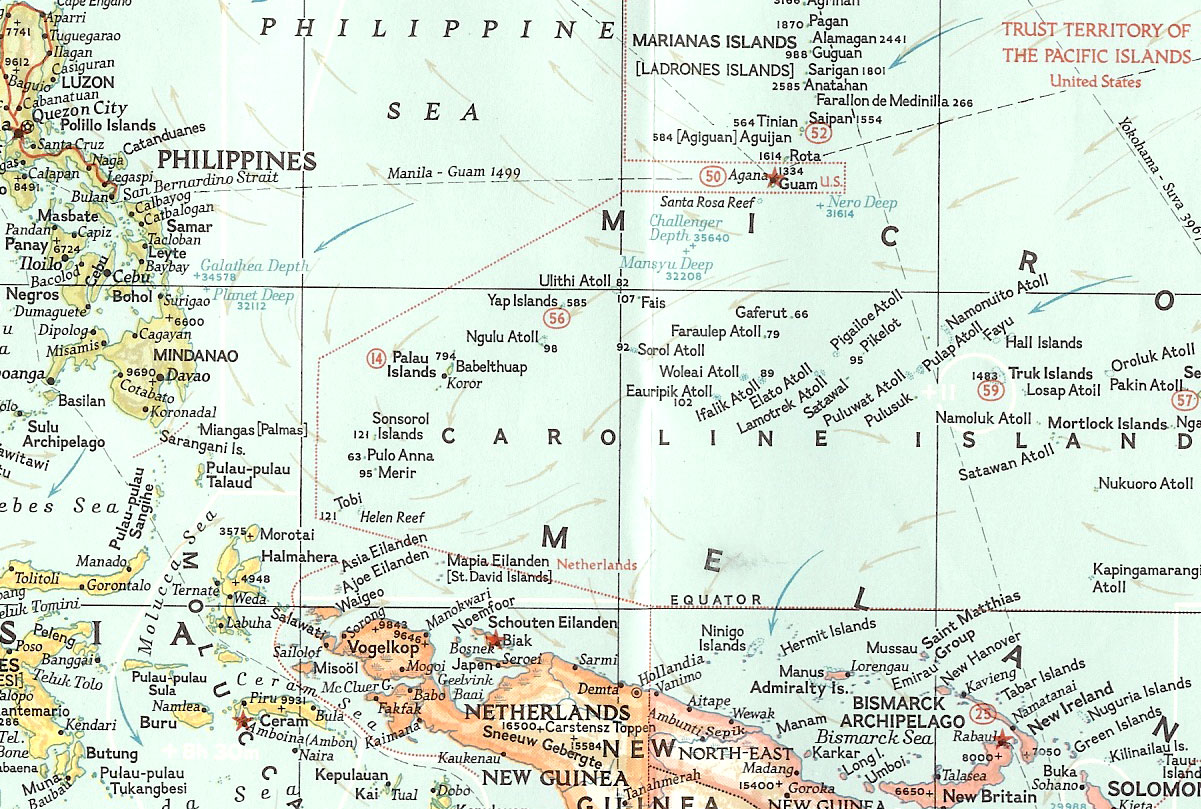
When I was looking up stuff about Yap, Micronesia, for a recent post, I came across a very informative website, with both photographs courtesy of the Micronesian Seminar and the National Archives—and even video—about the bombing of Yap during the Pacific War, about which I heard many stories during my time there in 1974. I have corrected obvious spelling errors in the following extract.

At dawn, on the 15th of June 1944, American amphibious forces swept into Saipan to begin the hard ground fighting that was to bring the Japanese homeland within range of our Superfortresses. For more than two weeks prior to the landings, Thirteenth Air Force Liberators, based on Los Negros, had been pounding Truk to neutralize the strategic Japanese base and to prevent the enemy from reinforcing Saipan by air.

A large Japanese task force, estimated at 40 ships or more, was sighted some distance north of Yap Island, on the 19th of June 1944. Carrier planes from this task force lashed out at the powerful units of the United States Pacific Fleet which were then supporting Allied ground forces on Saipan. The conflict that followed was the first major battle between elements of the Japanese and United States fleets in nearly two years. As at Midway, two years earlier, all of the offensive action was by carrier-based aircraft. By the time the Japanese fleet broke off the engagement, U.S. Task Force “58” had destroyed nearly 400 enemy aircraft and had sunk or damaged 14 Japanese ships.

Liberators of the Thirteenth Air Force were called upon to reach out more than 1,000 statute miles from their Los Negros base to hit Japanese warships that might seek refuge or fuel in Yap Harbor. On 22 June, 33 Liberators were over Yap in the longest mass mission the Thirteenth had yet flown. Trained eyes peered down on the harbor far below. There were no warships to be seen. The heavies wheeled and made their run on the secondary target, Yap Airdrome. Their 33-ton bomb load struck the runway and the dispersal areas with devastating effect.


View a large Yap Area Map

The Japanese were caught completely by surprise; not a single one of the more than 40 planes on the ground was able to take off and fly into the air. Nineteen enemy planes were definitely destroyed, and 15 were damaged; the runway was cratered and rendered unserviceable.

For six consecutive days after the raid of the 22nd of June, the Liberators blasted Yap, keeping the runway unserviceable and preventing its use in ferrying planes from the Philippines to the Marianas to aid the hard-pressed defenders of Saipan.

Leave a comment

Filed under Japan, Micronesia, U.S., war

English as an Indigenous Pacific Island Language

From English on the Bonin (Ogasawara) Islands, by Daniel Long (Duke U. Press, 2007; Publication of the American Dialect Society, no. 91; Supplement to American Speech, vol. 81), pp. 3, 9-10:

IT IS A LITTLE KNOWN LINGUISTIC FACT that among a group of Western Pacific islands English is maintained as a community language of the indigenous population. These are the Bonin Islands. Today, these islands (also called Ogasawara Islands) are part of Japan and their population, Japanese citizens, but the English language has survived there, as both a tool of communication and a marker of their unique identity. This book attempts to provide an outline of the English of the Bonin Islands in its various forms and incarnations from 1830 to the present….

The Bonin Islands appear to have lain completely uninhabited until Pacific Islander women and European and American men of widely varying linguistic backgrounds began to settle there in the early 1800s (see sections 2.1 and 2.2). Evidence from a variety of sources indicates that a Pidgin English (with a substratum formed from the other settlers’ native languages) developed as the community’s common tongue. Later the children born and raised in this language environment are thought to have acquired this as their native language (i.e., creoloidization occurred).

In the 1860s and 1870s, Japan laid claim to the islands and they experienced a huge influx of Japanese settlers. The Japanese established the first-ever schools on the islands, initiating bilingual (English and Japanese) education. Increasingly intense bilingualism initiated the processes of SYNTACTIC CONVERGENCE, leading to the development of a second contact language (a Mixed Language) comprised of a Japanese substratum and a lexicon supplied by the earlier English-based creoloid.

After World War II, the linguistic situation on the islands took another sharp turn when the U.S. Navy took control, allowing only those islanders of “Western” ancestry to live on the islands and subsequently establishing a school conducted in English. This period of American occupation and absolute isolation from Japanese ended abruptly in 1968 when the islands were returned to Japanese rule and the displaced Japanese islanders (living then in mainland Japan for a quarter century) were allowed to return home. The Ogasawara Mixed Language and Ogasawara Creoloid English have long coexisted with Japanese and English acrolects, but increasing mobility and improved communication technology seem to be accelerating decreoloidization and (dare I say) “de-mixed-language-ization.”

In the 170-year linguistic history of the Bonin Islands, the dominant language has shifted from English (from 1830) to Japanese (1876), back to English (1946), and back again to Japanese (1968).

1 Comment

Filed under Japan, language, Pacific, U.S.

Wordcatcher Tales: Huarachudo, Ejido, Municipio, Piloncillo

From True Tales from Another Mexico: The Lynch Mob, the Popsicle Kings, Chalino, and the Bronx, by Sam Quinones (U. New Mexico Press, 2001), pp. 206-210:

The municipio of Turicato [in the State of Michoacán] has always divided along these town-rural lines. The hill folks resented the power, money, and education, relatively speaking, of the people in town. The city folk feared the hillbillies but saw no reason to extend power, or municipal services, to people they considered ignorant and barbaric. In these years the Barajas family—a family of local merchants—dominated Turicato politics….

In this atmosphere “Los Villa,” as the Villaseñor family was known, emerged first as rebels. They took up the cause of the “huarachudos,” the “sandal wearers”—whom they rallied to their cause against the city folk…. The Villaseñores were huarachudos themselves. They were sixteen children whose father, Tomás, had been born a peon on the hacienda San Rafael. In the 1930s President Lázaro Cárdenas ordered a section of the hacienda transformed into a communal farm—an ejido—owned by those who had worked it as peons….

The Villaseñor piloncillo operation also grew. Piloncillo is a small cone of brown sugar about an inch in diameter, processed by a simple mill. It is used to sweeten coffee, in household cooking, or by the soft-drink industry. In the 1990s, piloncillo has all but vanished as a product from the Turicato region. But in the 1970s and 1980s, many sugar cane growers were producing piloncillo. In the Turicato region in the 1970s and 1980s, owning a piloncillo mill was the difference between a life of comfort and one of hopeless poverty….

The emergence of a hillbilly family brought with it the kind of abuses that town residents had feared all along. “What happens is they form into groups,” says Trigo. “There’s one who’s a leader, and around him form people who like to fight and look for trouble. They like to walk into a cantina and throw everybody out. They figure that’s a real achievement. This grows; the group gets larger. Then it becomes, ‘Let’s take over this land.’”…

Yet the Villaseñor family never did fully dominate local politics. They proved in the end to be poor politicians. Their frequent warring—“their bellicose nature” as one man put it—earned them many enemies. By 1989 a significant part of the municipio nurtured in dark silence a pure and vital hatred of the Villaseñores, and among them were many of the same poor peasants—the huarachudos—that the family once rallied to its side….

In 1994 the military put a roadblock between Turicato and Puruarán and set about arresting or killing off the bandit gangs. Others saw that the military meant business and laid down their guns. So five years after the Nueva Jerusalén vote threw Turicato into a civil war, a version of peace came to the municipio.

The chapter from which these excerpts come is a well-told tale, but one sadly familiar in its broad outlines: ambitious évolués (sponsored by distant elites, in this case the PRI) lead others among the oppressed to overthrow and replace an oppressive elite, only to impose a new kind of thugocracy at least as violent and oppressive as the old one. Sort of a Zimbabwe in microcosm. (Zimbabwe, whose independence I long ago celebrated at a big gathering of African students in Honolulu.)

But I want to comment on just two of the four words italicized in the extract.

The Spanish term municipio may have survived in the form of an English calque more than a century after the Spanish ceded Micronesia to the Germans. Each of the Federated States (formerly Districts) of Micronesia is divided into what are now called municipalities, a term that no subsequent German, Japanese, or American administrator would likely have come up with, although the Americans are credited with introducing the term by the anthropologist Lingenfelter, who worked in Yap during the early postwar years. If so, U.S. Navy administrators probably calqued on the basis of usage in the Philippines. Micronesian municipalities have never been centered around a town and its hinterland. Instead, they seem to be more like alliances of contiguous villages.

I’m old enough to have purchased a pair of Mexican huarache sandals in the 1970s, when I was a grad student in Hawai‘i. The dye made my feet break out, so I stayed with rubber slippers (zori). (I hardly owned a pair of shoes all through grad school.) The relation between Spanish huarache ‘sandal’ and huarachudo ‘sandaled’ is parallel to that between English beard and bearded. Spanish and English are both related languages. But the same parallel can be observed between, for example, Chamorro sapatos ‘shoes’ (from Spanish) and sinapatos ‘shod, wearing shoes’, or Chamorro relós ‘wristwatch’ (also from Spanish) and rinelós ‘wearing a wristwatch’. Among its myriad functions, the -in- infix in Philippine languages can form adjectives out of nouns in a manner similar to that of participial affixes in Spanish and English.

UPDATE: The Micronesian Seminar‘s Francis X. Hezel, S.J., weighs in on the antecedents of the term municipality in Micronesia.

The term as used in Micronesia after the war has no direct relationship to the Spanish colonial period in these islands. The Spanish weren’t here long enough and they weren’t influential enough to have the term stick. There are very few Spanish loan words that have made their way into the island languages. Actually, islanders used the Japanese term kumi to describe a segment of the island, even well after the war. Muncipality came into the languages through the English term, via the Navy.

The usage of Japanese kumi ‘club, association, gang’ is very interesting, and seems a much more appropriate term for the traditional political alliances before they were recast by the U.S. Navy as local-government structures. The Yapese dictionary translates municipality into Yapese nuug ‘net’ (presumably meaning ‘network’ of political alliances). Other Micronesian dictionaries I’ve consulted don’t list municipality in the English finder list. So it seems U.S. Navy administrators were influenced by Spanish local-government terminology already long-established in the Philippines.

The U.S. Census Bureau glossary does not list the term municipality at all, but it does list and gloss municipio as: “Primary legal divisions of Puerto Rico. These are treated as county equivalents.” The Wikipedia entry for Municipalities of the Philippines begins thus: “A municipality (bayan, sometimes munisipyo, in Tagalog) is a local government unit in the Philippines. Municipalities are also called towns (which is actually a better translation of bayan).”

SHARP DETOUR: My wife and I taught University of Hawai‘i extension courses on Yap, Micronesia, in the summer of 1983, just before heading off to spend a year in Romania on a Fulbright research grant. In fact, she was still there when I got the word that my nearly forgotten application from a year earlier had been approved and that the orientation in Washington, D.C., would begin before she got back to Honolulu. Trying to place a telephone call through to Yap was not easy in those days.

Anyway, for my introductory linguistics course on Yap I used the first edition of Peter Trudgill’s little Penguin paperback Sociolinguistics: An Introduction to Language and Society. Even the main islands of Yap have a good deal of regional variation in pronunciation and word choice, and the outer islands speak dialects of the far-flung Trukic language continuum, only distantly related to Yapese. The variety of Yapese spoken in the major municipality (Rull) closest to Colonia—the capital and only urban center—provided the basis for the standard orthography, but the pilot school for testing Yapese language curriculum materials (with bilingual education funding from the U.S. DOE) was located in the major municipality (Tomil) with the most divergent pronunciation. The three major municipalities were those chiefly alliances (called kumi in Japanese) dominant at the time the Germans took control: Gagil, Tomil, and Rull.

My wife and I first met while we were both assigned to that school in the fall of 1974—she as a new Peace Corps teacher for two years, me as a visiting linguist for one semester—and we both learned our Yapese in that very rural municipality. (Mine faded much more quickly than hers.) So we were quite aware of regional variation and of the principal shibboleths of Tomil dialect, chief among them being the pronunciation of standard /ae/ as /ee/, as in the pronoun gaeg vs. geeg ‘me’ or the plural marker on verbs -gaed vs. -geed, both high-frequency items.

For my introduction to linguistics course in 1983, I decided that the most important things I should focus on were the respective relationships between writing and pronunciation, on the one hand, and between dialects and standard languages, on the other. One of my assignments was for my students to assemble a list of common words for which there were regional variants, then track down the boundaries between those variants (the isoglosses). The most interesting findings involved variants whose isoglosses failed to align with the existing boundaries between municipalities, perhaps revealing earlier linguistic and political fault lines.

1 Comment

Filed under language, Mexico, Micronesia, Philippines, U.S.