Category Archives: nationalism

Dutch-British Swap in the Gold Coast

From Britain at War with the Asante Nation, 1823–1900: “The White Man’s Grave” by Stephen Manning (Pen & Sword Books, 2021), Kindle pp. 74-76:

The Dutch had first traded on the Gold Coast in 1580 and in 1637 they had attacked the castle at Elmina and seized it from the Portuguese. From Elmina the Dutch continued the slave trade begun by its former owners and developed a strong relationship with both the king of Elmina, who controlled the surrounding lands, as well as the Asantes who supplied the Dutch with slaves in exchange for European goods and weapons. The king of Elmina had secured a supportive relationship with the Asantes over the years, which was based on trade and a mutual distrust of the British. The people of Elmina traded fish and salt to their immediate neighbours, in exchange for food stuffs, such as maize and cassava, as well as cattle. There was also an important trade with much of the Akan hinterland, including the Asante, in which the traders of Elmina exchanged goods, such as cotton cloth, leather goods, powder, ammunition and weapons for palm oil, food stuffs, animal skins and slaves.

Over the following centuries, the Dutch, working alongside Elmina traders, very much concentrated their efforts on economic activity. Although the abolition of slavery severely limited the trade in human cargo, it did not eradicate it and the Dutch continued to play a part in this trade, but not in such an overt manner as before. The Dutch maintained a neutrality in conflicts between the Asante nation and the British and their native allies and this can be partly explained by the fact that the Asantes, through conquest, held the ‘Notes’ to Elmina Castle and the Dutch would pay a yearly rent to the court at Kumasi in return for good relations between the two. Yet, this placid relationship was to alter as the nature of trade changed throughout the nineteenth century. The Dutch found it more and more difficult to make their economic activities along the Gold Coast financially viable and in the 1860s they began to negotiate with the British as to how both countries could benefit by working together.

In March 1867, in the hope of introducing and operating an effective tariff along the whole of the Gold Coast, and to reduce budgetary losses, the Dutch and the British agreed to consolidate their trading interests into two blocks. Elmina was used as the dividing line and the British took the area to the east and the Dutch to the west of the castle. In true imperial style, neither country gave any thought as to how the local population might react to a change in governance and none of the local chiefs were consulted. The treaty came into effect on 1 January 1868 and in its terms the British handed over control of the forts and trading posts of Apollonia, Dixcove, Sekondi and Kommenda and in return gained Dutch Accra, Moree, Apam and Kormantine. Crucially, the British also relinquished to the Dutch the protectorate over the peoples of Eastern and Western Wassa, Apollonia and Denkyira.

Leave a comment

Filed under Britain, economics, Ghana, military, nationalism, Netherlands, slavery

Asante Army Structure, 1800s

From Britain at War with the Asante Nation, 1823–1900: “The White Man’s Grave” by Stephen Manning (Pen & Sword Books, 2021), Kindle pp. 27-32:

The Asante army was not a regular force, although there did exist a small trained cadre stationed in Kumasi to protect the capital and the Asantehene. This formed the nucleus of any expeditionary force. However, in other respects the army was more akin to a feudal levy of the European Middle Ages in that most of the manpower was assembled at the outbreak of war from troops raised by the twenty-four tribal heads and later from tribes that had been annexed into the Asante Empire. At its maximum, the Asante army was said to have been up to 100,000-strong. However, most armies were not as large as this; for example, around 40,000 warriors opposed the British in 1874. The fact that such a force could maintain its cohesiveness and discipline, especially as its ranks did include men taken from recently vanquished tribes, is miraculous and its success can be attributed to several factors.

The Asante military leaders quickly realised the important advantage that firearms gave them over their foes and the leadership generated a winning mentality and even a sense of superiority amongst their troops that they had a share in a glorious military tradition. This went even further in that the Asante nation, with each victory and conquest, rapidly gained amongst its people and from those of other tribes and nations, even European ones, a reputation as a self-governing, independent state that was wholly indigenous and not one that had evolved as a result of outside influences.

Once war was declared against another tribal state the decision to do so would be made by the Asantehene, his privy council, the chiefs of the twenty-four individual states that comprised the nation, and, as time went on, the chiefs of the newly acquired vassal states that had been brought into the Asante nation by conquest.

If war was declared, then the chiefs, who also served as the captains of the various states, would return to their lands and call their people to arms. Every male citizen was a soldier and all able-bodied men were expected to ready themselves for military service. However, a quota system existed so that only a proportion of men were called for action with the remainder left at home to provide security as well as, crucially, manpower to ensure that the farming systems continued, and future famines were avoided.

There was a large element of discipline, even subjugation, which was used to maintain the army’s effectiveness. There were severe punishments, including death, for failure to report for duty, for desertion and cowardice. A military police force armed with whips and swords had to be used to encourage some into battle and those few that refused were despatched on the spot with an axe. Yet, overall the command structure centred on the king, his privy council and the army general staff was incredibly effective not only on the battlefield but also in bringing the army to readiness and for ensuring that logistically it was able to fight and achieve victories. Each army group took its own supplies of food and ordnance on campaign. Uniquely amongst African armies, the Asante boasted a corps of medical orderlies, the Esumankwafo, who accompanied the army into battle. This corps attended to wounded troops as well as removing the dead from the battlefield, for immense trouble was taken to conceal losses from the enemy.

A typical Asante battle column was said to have originated by observing ants on a march and comprised a body of scouts, an advance guard, the main body, in which the army commander was found and secured, left and right wings and a rear or home guard. Certainly, in wars with tribal states the battle could be effectively won if the opposing king or general was either killed or captured so the Asante army ensured that their battlefield commanders were well protected in the centre of the formation. The home guard was tasked either with staying in the capital Kumasi or returning immediately to the capital after a battlefield victory, or a rare defeat, to ensure that the security of the capital was maintained. The scouts would first engage with the enemy who would then be drawn in towards the main body. As this was happening the left and right wings would endeavour to surround the enemy for, although the principal aim was to defeat their foe, the secondary one was to capture as many as possible so as to sell them to the slavers on the coast. In addition, in a society in which fetishism and the worship of ancestors was important a number of the recently captured enemy were diverted to human sacrifice, a practice that continued right up to the late nineteenth century.

The Asante army was composed entirely of infantry for the inhospitable forest zone, and the presence of the tsetse fly there meant that horses and ponies would soon succumb. Most Asante troops were equipped with standard European trade muskets, which were poorly made with a limited range. On the West African coast such weapons had the common name of ‘Long Danes’, supposedly named as it was the Danes who first introduced them to the Gold Coast. This weapon was over 6ft in length and weighed nearly 20lb and a more unsuitable musket for forest warfare could not have been designed. In theory such guns had a range of 200yd but were rarely accurate beyond 30yd and although the enemy might be frightened by the explosive fire, it was unlikely to hurt them unless hit at very close range. Yet, the nature of the jungle fighting meant that if the enemy had not already fled at the sound of the approaching Asante army, then fire would often be at close proximity as the two protagonists were unable to see each other through the near-impenetrable forest.

Leave a comment

Filed under Britain, Ghana, military, nationalism, Scandinavia, slavery, war

Foundation of the Asante Nation

From Britain at War with the Asante Nation, 1823–1900: “The White Man’s Grave” by Stephen Manning (Pen & Sword Books, 2021), Kindle pp. 25-27:

The Asante nation we know today, and that came into conflict with the British in the nineteenth century, is also known as Asanteman; a homogeneous society comprising twenty-four individual states, each with its own chief, serving one king, known as the Asantehene who resides in Kumasi, the capital of the Asante nation. The name Asante seems to have derived from a special red clay the people sent to the dominant tribe, the Denkyira, as a form of payment or tribute of allegiance. The Akans call clay ‘Asan’, therefore the Asantes were differentiated from others with the name ‘Asan-tefo’, or those who dig clay.

The foundation of the Asante nation can be dated to the late seventeenth century with its rise as a military power under the leadership of its first king, Osei Tutu, and the inspiration of a priest, Okomfo Anokye. With the ambition of freeing the Asante people from the dominance and servitude of the paramount Denkyira tribe, and thereby forging a nation rather than simply a tribe, these two men realised the vital importance of both a religious and military system with which to bind a new nation together. As the historian R.S. Rattray has rather cynically written of Okomfo Anokye, ‘with a true insight into the psychology of the people with whom he had to deal, he realised that the only way to unite independent and mutually jealous factions [within the Asante tribe] was by playing upon their superstitious beliefs’. According to Asante tradition a wooden stool covered in gold was summoned from the sky by Anokye and this descended upon the lap of Osei Tutu, who was anointed as king. Anokye declared that the Golden Stool contained the spirits of the Asante ancestors and the strength and wellbeing of the new nation depended on its preservation. Every Asante, and heads of each of the twenty-four tribal states, had to show allegiance to the Golden Stool and its guardian the king, or Asantehene, the head of the Asante nation. The British lack of understanding regarding the paramount importance to the Asante nation of the Golden Stool was to be the central reason for the Anglo-Asante War of 1900.

To consolidate and reaffirm his position the king, Osei Tutu, quickly realised that the energy and resources of his new nation should be directed towards military conquest and this would begin, in 1701, with war waged against the Denkyira tribe. Although the Denkyira, under their king, Ntim Gyakari, initially achieved success against the Asante forces, Osei Tutu was able to draw the Denkyira into a trap and at the Battle of Feyiase the full military might of the Asante nation routed the Denkyira army. Ntim Gyakari was captured and beheaded on the battlefield. Having secured independence from Denkyira servitude, Osei Tutu now turned his focus on expanding his new nation. By the end of the seventeenth century and into the eighteenth century slavery was at its height and it is no coincidence that the rise of the Asante nation occurred at the same time. Osei Tutu and then successive Asantehene, such as Opoku Ware (1720–50) and Osei Kwadwo (1764–77) directed forces against neighbouring tribal states. There was a seemingly never-ending series of wars. For example, the Sefwi, Bono and Gyaman states were added to the Asante nation during Opoku Ware’s reign, whilst Osei Kwadwo defeated the Wassa and Banda peoples, annexing their lands. He also expanded the Asante nation northwards into Dagombaland to slow the southward spread of Islam into the region.

However, the thrust of Asante expansion was primarily southwards and was motivated largely by the desire to sell those captured in battle as slaves directly to European buyers on the coast. Even the passing of the Slave Trade Act in 1807 and then the Slavery Abolition Act of 1833 did not slow Asante expansion for there were always notorious traders and nations who would buy slaves. Furthermore, the Asante army was now dependent on firearms and gunpowder to maintain its supremacy and the various Asantehene and military leaders considered it imperative to have direct access to European suppliers of weapons, powder and ammunition who were based on the coast.

Leave a comment

Filed under Britain, Ghana, military, nationalism, slavery, war

British Military Expansion, 1800s

From Britain at War with the Asante Nation, 1823–1900: “The White Man’s Grave” by Stephen Manning (Pen & Sword Books, 2021), Kindle pp. 16-18:

The truly massive expansion in the British Empire throughout Victoria’s long reign (1837–1901) saw British troops (‘The Soldiers of the Queen’) and naval personnel deployed across the world in such diverse countries as Russia, New Zealand, India, Canada, Egypt and South Africa, to name just a few. Such deployments were made to right a perceived wrong, to defeat a European foe, to stop a competing country securing spoils or simply to expand British prestige and power. On many such occasions British troops were placed in direct conflict with indigenous ethnic tribes or nations and the resulting military actions have become an important part of British colonial history, which some view with immense pride and others with shame or even disgust. Whatever personal views are held there is no doubting the immense bravery and fortitude of the British troops and equally these terms can be applied to their foes.

In most of the colonial wars of the Victorian age the British had a significant technology advantage in terms of weaponry over their enemies and this allowed them to achieve some crushing victories such as at the battles of Magdala (9 April 1868) and Omdurman (2 September 1898). Yet, there were occasions when despite this advantage the British were defeated, most famously at the Battle of Isandlwana (22 January 1879). When the British met defeat at the hands of an indigenous enemy such foes became respected and even achieved mythical status. This is certainly true of the British relationship with the Zulu nation, but it also applies to the Maoris of New Zealand, the Dervishes of Sudan and the Sikhs of Northern India. Less well known are the numerous conflicts that the British fought against the Asante nation in what is now modern-day Ghana in West Africa.

Whilst the Zulus did indeed inflict a crushing defeat upon the British at Isandlwana, a minor one at Intombi Drift (12 March 1879) and a more serious reversal as at the Battle of Hlobane (28 March 1879), the Asante nation was a thorn in the side of both British politicians and the military throughout the nineteenth century. Indeed, the casualties endured by the British in the various campaigns against the Asantes were comparable to those suffered during conflicts with the Zulus and the Dervishes. The Anglo-Zulu War lasted a mere seven months, although the unsatisfactory political settlement that was imposed by the British resulted in lesser conflicts which extended into the beginning of the twentieth century. By contrast, the Asante nation and the British were in both political and military conflict for over seventy years during the nineteenth century and three major wars resulted in which there were significant military reversals for the British. This volume is split into three separate parts to reflect and illustrate these wars, each of which possessed fascinating moments and challenges which are captured in this work. Whether this is the death of the British Governor, Sir Charles McCarthy, at the Battle of Nsamankow (22 January 1824), Sir Garnet Wolseley’s brilliant planned and orchestrated expedition of 1873–4, or the siege of the British fort at Kumasi in 1900, all offer a rich and engrossing history. Indeed, the 1900 siege tells a tale of bravery, fortitude and ineptitude that can stand alongside other more famous sieges of Victoria’s reign, such as Ladysmith and Peking. One particularly fascinating aspect of these three major wars is how the unsatisfactory settlements reached at the conclusion of each were the lifeblood for further conflicts.

Leave a comment

Filed under Africa, Britain, China, economics, migration, military, nationalism, New Zealand, South Asia, war

Simplifying Chinese Characters

From Kingdom of Characters: The Language Revolution That Made China Modern, by Jing Tsu (Riverhead Books, 2022), Kindle pp. 170-171, 174-175, 177-178:

Mao did not speak a word of Putonghua, the common speech derived from the northern-based Beijing Mandarin. Yet Mao went down in history as, among other things, the political figure who guided the Chinese language through its two greatest transformations in modern history. The first was character simplification, which would reduce the number of strokes in more than 2,200 Chinese characters. The second was the creation of pinyin, a standardized phonetic system using the Roman alphabet and based on the pronunciation of Putonghua (“pinyin” means “to piece together sound”). Mao would lead the country through these dramatic changes, but not by example; he would never get used to writing simplified characters in his lifetime, or even Roman letters. Following Mao, the Communists had fought and won a civil war in the name of the people—workers, peasants, and every member of the exploited underclass. At the founding of the PRC, more than 90 percent of the country was still illiterate and communicated in regional dialects. Romanization would be Mao’s way of delivering his promise to the people, and the people to their linguistic destiny. It would be a new bridge to learning Chinese characters, employed in aggressive anti-illiteracy campaigns. The Committee on Script Reform was appointed to orchestrate the effort.

While the Nationalists dawdled, the Communists took up the cause of simplification and made it their own. During the War of Resistance against the Japanese, they began to print simplified characters in the local newspapers that were circulated in the areas under their control. The use of these characters fanned out into the rest of the country after 1949. Simplified writing attracted more and more attention as discussions and debates grew. Eventually the Ministry of Education selected around five hundred simplified characters to be reviewed by experts and linguists. The task was handed over to the Committee on Script Reform for further investigation once it was established in 1952.

The committee completed the first draft of the official simplification scheme by late 1954. A list of 798 characters was formally introduced the following January to great enthusiasm. The Ministry of Education delivered three hundred thousand copies of the Preliminary Draft of Han Character Simplifications to various cultural organizations and educational institutions around the country for comment and feedback. More than two hundred thousand individuals weighed in with opinions. The Committee on Script Reform alone received more than five thousand letters. Up to 97 percent of those polled approved of the preliminary simplification scheme.

While there were reservations and objections to the simplified script—largely for cultural and aesthetic reasons—the rate of illiteracy began to decline under the twin implementation of character simplification and pinyin. By 1982, the literacy rate for people over age fifteen nationwide had risen to 65.5 percent, and it reached 96.8 percent in 2018.

Whatever support there was for character simplification among the Nationalists dwindled after 1949. After losing the mainland to the Communists and retreating to Taiwan, the Nationalists appointed themselves the true guardians of traditional culture and have kept the traditional written characters intact to this day. By distancing themselves from character simplification, they left room for the Communists to claim it as a central platform for New China.

The wounds of this contentious past are still fresh and reopen from time to time. The political weaponization of simplified scripts since 1949 on both sides of the Taiwan Strait, which divides mainland China from the proclaimed Republic of China in Taiwan, has only sharpened the differences between the old and new scripts. Proponents and opponents of simplification continue to hurl jabs and insults at one another. The character for “love” (愛 in traditional form and 爱 in simplified form) is a favorite example. The simplified version replaces the component for “heart” 心 with “friend” 友. What is love, the champions of traditional characters ask, with no heart? One online critic argues that “since the simplification of Han characters, one can no longer ‘see’ one’s ‘relatives’ (親 vs. 亲). . . . The ‘factories’ are ‘emptied’ (廠 vs. 厂 ), while ‘flour’ is missing ‘wheat’ (麵 vs. 面). ‘Transportation’ has no ‘cars’ (運 vs. 运). . . . ‘Flying’ is done on one ‘wing’ (飛 vs. 飞).”

Advocates of simplified characters, in turn, have come up with their own character tales to tell. They argue that simplified “love” is more expansive and modern, extending generously to friends and comrades rather than being narrowly guided by the selfish heart. Another case is “masses.” After some strokes were judiciously pruned away, the character is now composed entirely—and rightly—of “people” (眾 vs. 众). “To destroy” no longer has the superfluous radical of “water” (滅 vs. 灭), which served no semantic or phonetic purpose. And as for the character for “insect,” who wouldn’t want to avoid the creepy-crawly pests as much as possible? At least one is better than three (蟲 vs. 虫).

Leave a comment

Filed under China, democracy, education, labor, language, nationalism, philosophy

Early Chinese Telegraph Codes

From Kingdom of Characters: The Language Revolution That Made China Modern, by Jing Tsu (Riverhead Books, 2022), Kindle pp. 91-92, 106-108, 110-111, 123-124:

In Morse code, the basic symbols were dots and dashes. The system’s twenty-six combinations of dots and dashes, ranging from one to four symbols, were meant to accommodate the twenty-six letters of the alphabet, with another ten combinations of five symbols each for numbers zero to nine.

To send a message, a telegraph operator pressed an electric switch, in the form of a key: a short tap for a dot and a long one for a dash. The message was converted into an electric current that traveled along the wires and was reverse translated into letters and numbers on the receiving end. The sound of clicking patterns could become so familiar that an experienced telegrapher could tell what word was being coded from its distinct rhythm. Telegraph costs were determined by how long they took to transmit—each dot or space was a single unit, and a dash—three times as long as a dot—was three units. As Morse explained early on, his system was designed to be cost-efficient. The most frequently used letter in English, “e,” was also the least expensive: It was represented by a single dot. The high frequency of “e” holds true for most European languages, from Italian to Dutch. But Morse code clearly favored the American English alphabet. An English letter takes up somewhere between one and thirteen units. To add even a single diacritical mark to the letter “a”—as when making the French “à”—required ten more units. So there was already plenty to disagree about among Roman alphabet users.

The inequities of Morse code were on a different scale for the Chinese. International telegraphy recognized only the Roman alphabet letters and Arabic numerals used by the majority of its members, which meant that Chinese, too, had to be mediated via letters and numbers. Whereas English could be English, and Italian mostly Italian, Chinese had to be something other than itself. Every Chinese character was transmitted as a string of four to six numbers, each of which cost more than a letter. The assigned code for a Chinese character first had to be looked up in a codebook before being converted to the dots and dashes of Morse code. Coding and converting Chinese characters into an ordinary telegram of twenty-five words required at least half an hour, whereas a comparable message in English took only about two minutes. Untold opportunity costs accrued with every telegraph that was delayed when the operator had to pause to check a character against its assigned number in a codebook or had to take extra time to correct an error.

[Septime Auguste] Viguier possessed the confidence and skill set that Great Northern [Telegraph Company (大北電報公司 / 大北电报公司 Dàběi Diànbào Gōngsī)] was looking for. He had already worked on developing a code for Chinese telegraphy years earlier for the French government in support of their failed efforts to interest the Chinese Empire in their telegraph cables. He was well versed in early word-copying machines like the Caselli pantelegraph, a precursor to the modern-day fax machine. When the French project was shelved, Viguier ended up in Shanghai—ripe for the Danes’ recruitment. He was the best candidate but not well-liked. Colleagues immediately noted his preening and boastfulness—the French way, they sneered. Viguier later also had a nasty exchange with the managing director Suenson, and his relationship with the company soured over questions of compensation and credit. Nonetheless, Viguier was able to work quickly enough to build out the Danish professor’s incomplete scheme. By June 1870, he had the first version. In 1872, he delivered the final, standardized telegraphic code table for 6,899 characters in The New Book for the Telegraph (Dianbao xinshu).

Viguier came up with a tabular form of twenty rows and ten columns per page. He assigned an arbitrary four-digit code from 0001 to 9999 to each character, with empty spaces left for potentially 3,000 more codes to accommodate customized vocabulary for individual business purposes. Each page contained 200 square spaces for listing 200 characters and their numerical codes. The code only included a relatively small number of characters out of the 45,000 or so that were extant. The mass scaling of telegraphy meant that it was geared toward the common person and the common tongue, so restricting the number of characters was not only efficient but also practical.

But Viguier’s telegraphic code did not go unchallenged. Almost immediately, the Chinese tried to outdo and improve upon it. A quiet young Chinese translator who had been part of that diplomatic mission to Europe in 1868, Zhang Deyi, became the first Chinese to do so. Zhang noted the pain of having to send Chinese messages back to the Chinese office in China in “foreign letters” whenever more urgent service was required. He also saw how Western telegrams were more secure, as secret messages were sent in numbers. That inspired Zhang to construct his own Chinese telegraphic codebook by following a similar format.

While the published version of Viguier’s work was an important landmark, Zhang zeroed in on its sloppiness. Viguier’s numbering of characters did not make them terribly easy to use for the Chinese. The continuous numbers did not separate out characters into groups, which was how the Chinese were accustomed to searching for characters in a dictionary. He decided to trim down the format of Viguier’s system and do some reorganization to make its content clearer. Zhang’s own New Method of Telegraphy (Dianxin xinfa) was published two years after Viguier came up with a draft of his telegraphic code in 1873. It reordered the characters so that the numbers were less arbitrary. Zhang used the same 214 radicals, but reselected about 7,000 characters from the Kangxi Dictionary and assigned them numbers from 0001 to 8000.

Westerners like Viguier had mapped Chinese onto numbers. Then the Chinese themselves had tried to use numbers to remap the alphabet. They kept bending the stick back and forth. Wang [Jingchun] was increasingly of the mind that one could put the Western alphabet in service of Chinese Romanization more permanently. He turned to Bopomofo, the Chinese phonetic alphabet approved at the 1913 National Language Unification Conference in Beijing, and its idea of an auxiliary phonetic alphabet formed from different styles and parts of Chinese characters. Working from this basis, Wang designed a use for Roman letters that was Latin in name but readapted to signal the three linguistic properties of Chinese characters: the phonetic representation of sound, tone, and the radical.

To indicate sound in his New Phonetic System, Wang mapped the sounds of Bopomofo—represented by symbols ㄅ, ㄆ, ㄇ, ㄈ, etc.—onto alphabet letters that shared similar starting consonant sounds. So ㄅ, ㄆ, ㄇ, ㄈ would match the letters “b,” “p,” “m,” and “f.” To show tone, Wang picked five letters to represent the five tones used in traditional and medieval phonology: “B” stands for the level or even tone; “P” marks the second or rising tone; “X” represents the third tone, which falls first then rises; “C” is fourth or falling tone; and “R” denotes the fifth or neutral tone. The last property, the radical, takes up two letters—a consonant and a vowel. Wang used two letters to spell the pronunciation of the radical part of the character only; e.g., tu for 土, li for 力, ko for 口, etc., in a way that was not dissimilar to what Wang Zhao had done with the Mandarin Alphabet. With one letter for sound, another letter for tone, and two more for phoneticizing the radical’s spelling, this system yielded a four-letter code for every character. The Chinese character could then be transmitted via telegraphy without using numbers at all. Wang’s idea took after other Romanization systems of the time, which were developed not for telegraphy per se, but to address the broader question of literacy. He borrowed from that conversation, run by linguists and ethnographers, to design a solution for what he had seen in the diplomatic arena.

During the year the Far Outliers spent in China in 1987-88, we had occasion to send a telegram to fellow teachers who were spending winter holidays in their hometown of Jingdezhen, famous for its pottery. They had written most of the text of the telegram and all we had to do was add the day and time when our train would arrive. So before we boarded the train for Jingdezhen, I handed the text of the telegram to a clerk at the telegraph office who proceeded to rewrite the message in a series of 4 digits for each Chinese character. It was very short and she had probably memorized some of the most frequent codes for ‘arrive’, ‘depart’, and dates and times, but it still looked like a tedious chore.

This interesting chapter includes a very misleading table, shown below. It shows American Morse code (also called Railroad Morse) that was standardized in 1844 and used by American railroads as late as the 1970s. Also called Morse landline code, its variable spacing and variable lengths did not travel well through undersea cables. Central Europeans used a modified code, the Hamburg alphabet, that evolved into the International Morse Code standardized in 1865. Working in the 1870s, Viguier and Zhang almost certainly used the international standard, the one where ‘SOS’ is rendered by the familiar dit dit dit dah dah dah dit dit dit.

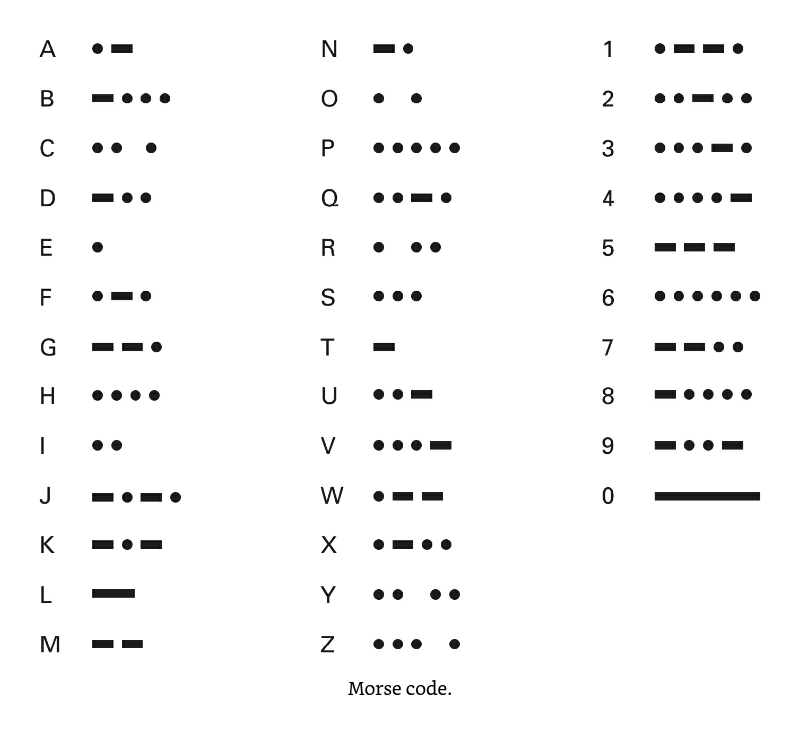
Erroneous Morse Code


Leave a comment

Filed under China, economics, Europe, language, nationalism, North America, publishing, travel

First Chinese Typewriter Designs

From Kingdom of Characters: The Language Revolution That Made China Modern, by Jing Tsu (Riverhead Books, 2022), Kindle pp. 64-69:

Zhou’s breakthrough was figuring out how to correlate the physical act of selecting and retrieving a character in a tray with the mechanical motion of preparing a character, etched onto a cylinder, to be inked and printed. The result was a single coordination of mechanical motions, optimally economized and completed by a human operator. In his article for The Chinese Students’ Monthly, Zhou documented the details of his typewriter and the technical challenges he had to overcome. He had known, of course, that he was not the first. There was Sheffield’s machine and an earlier Japanese prototype, both of which he acknowledged as having arrived at similar ideas independent of his endeavor. It was a respectful nod to those who came before him.

Just as he was preparing to publish his article, though, an unexpected challenger nearly derailed Zhou’s debut. Qi Xuan was a fellow Chinese student studying engineering at New York University. Unbeknownst to Zhou, Qi had been on a parallel track. Relying on a different set of principles for building his own Chinese typewriting machine, he figured out how to do what Zhou, Sheffield, and others thought was impossible: arrange the characters by parts.

In place of Zhou’s character grid, the keyboard of Qi’s machine had only three keys—a back spacer, a forward spacer, and one that selected the character. But Qi’s machine also relied on cylinders of type (two cylinders instead of Zhou’s four). The upper cylinder, with characters inscribed on paper, served as a guide. The lower cylinder, with corresponding characters engraved on a copper surface, made the actual impression. An operator would use a hand wheel to rotate the machine’s upper cylinder until the correct row appeared in a viewfinder on the front of the machine. Then three keys would be used to select the correct character from the row and lock the cylinders in position, aligning the corresponding character cast on the lower cylinder and stamping it on the page.

Though they looked very different, the underlying design and mechanisms of Zhou’s and Qi’s machines were very similar. And Qi’s handled 4,200 actual Chinese characters, just 200 more than Zhou’s core lexicon. Qi’s machine, however, was different in one very important respect: he had broken with the prevailing commitment to reproduce whole, complete characters. Of his 4,200 individual Chinese characters, 1,720 were in the form of character components, radicals, and their possible variant positions in a square space, which allowed his machine to generate, in theory, more versions out of the same parts. In three steps, using these keys, the operator could purportedly produce 50,000 combinations.

Operating his machine, Qi explained, was closer to spelling an English word than producing a Chinese character. If you treat radicals like groups of letters, you can play with different combinations the way you would in a word game. Let’s say you have three English words—“exist,” “expect,” and “submit.” You can generate more words by mixing and matching their parts to form new words like “sum,” “suspect,” “subsist,” “bit,” “mist,” “its,” and “sex.” Unlike modern English words, which have equal spacing for each letter and line up in a neat row, components and radicals can move around from character to character. In print they can occupy different quadrants of the square space that each character fills, which means their position, and consequently their size, can change. For example, the character for “fire,” 火, fills an entire square space when standing alone, but it becomes thinner when it is a radical put on the left of the character “braise,” shao 燒. In turn, it changes form altogether—into four flames—when placed at the bottom of the character for “hot,” re 熱. Qi accounted for possible variant positions like these by giving them separate engravings on the cylinders. Consequently, there are at least three options for “fire” to be combined with other components and thereby form a greater number of characters.

Qi challenged the idea that characters had to be individual, stand-alone units. He thought of them as more modular, like alphabet-based words, things that could be recycled to compose different characters. And once he started tinkering, some of the Kangxi radicals did not sit well with him. He took more liberties and slipped in a few radicals he had devised that he thought worked better. A bigger shift than Zhou’s was creeping in. Others would also start to ask whether exclusively using radicals for character classification still made sense.

For different reasons, Sheffield and Zhou both concluded that characters were the way they were for good reasons and preserving them was of the utmost importance. Qi’s scheme “looked well on the face of it,” Zhou cautioned, “but they forgot, that the same ‘radical’ in different characters differ [sic] not only in size but also in shape, and, furthermore, they occupy different positions in a character.” He named one example, the square-shaped radical meaning “mouth” 口, which shows up in the characters for “ancient” 古 and “cry” 哭 but in each its size and location are quite different. Consequently, one cannot use the same square for “mouth” in both cases, as they were designed to fit into different configurations. If the different sizes of 口 were forced together, they would create absurd-looking characters with overlapping strokes in all the wrong places.

Zhou’s design eventually won out.

Japanese modernizers had a much easier time adapting katakana for use in typewriters, semaphore, and telegraphy.

Leave a comment

Filed under China, economics, education, language, nationalism, U.S.

How Mandarin Became the Standard

From Kingdom of Characters: The Language Revolution That Made China Modern, by Jing Tsu (Riverhead Books, 2022), Kindle pp. 37-39:

As for the best model of this everyday speech, each delegate [to the 1913 Commission on the Unification of Pronunciation] could only see the merits of his own spoken version. They all had a stake in promoting the dialectal or topolectal variant from their home provinces. The Guangdong delegates wanted Cantonese, while those from Sichuan fought hard for Sichuanese. The odds were stacked in favor of the southern speakers. Proportionally speaking, they had more representatives across similar dialect groups.

After the careful inspection of more than 6,500 samples collected from all over the country, factions emerged as the members moved to the more sensitive question of which geographical area would lead the standard pronunciation. Attendance dwindled as the deadlock persisted. It was not a contest for the fainthearted. Those with slightly weaker constitutions or who suffered from tuberculosis—a common affliction at the time—endured a few weeks of contentious lobbying before their health gave out. Some delegates fell ill from exhaustion and had to withdraw from the congress. Others spat up blood during the heated debates, unable to carry on after being cornered and humiliated by their opponents. Wang [Zhou] barely grunted through a violent flare-up of hemorrhoids from sitting for days on end. Blood, he later recalled proudly, soaked through his pants and trickled down to his ankles. Eventually, only the diehards remained.

One of the southern representatives made the appeal that no southerner could go about his business for a single day without using a particular inflection. To be a truly national pronunciation, then, his southern colleague argued, the standard had to bend toward the south. To prove his point, the man broke into an operatic demonstration. Wang had little patience for such theatrics. There was no way that the north, the seat of the nation’s capital, would cede to the south on the national tone question. Wang called a separate meeting less than half a mile away at the oldest Anglican church in Beijing. Inside those thick walls, under the famous three-tiered traditional pagoda bell tower sitting atop the sparse lines of Anglo-Saxon architecture, he carried out his mutiny. He instituted a new rule that carefully rearranged how the votes were counted. Each province would now cast only one vote, regardless of the number of delegates it sent. This maneuver didn’t just level the numerical advantage of the south, it transferred the advantage to the northern vernacular Mandarin-speaking provinces, which were greater in number. The other delegates protested when they found out what Wang had done on the sly, but it was too late.

Leave a comment

Filed under China, democracy, language, nationalism

Slavonic Substrates in Eastern Europe

From The Making of Eastern Europe: From Prehistory to Postcommunism, by Philip Longworth (Lume Books, 2020), Kindle pp. 367-370). Lume Books. Kindle Edition.

Population pressure seems to have been the primary cause of the Slav’s expansion; but, unlike most other barbarian groups who moved in large, warlike, parties, the Slavs seem to have extended their areas of settlement gradually, seeping into more and more territory, moving in little groups along the waterways of Eastern Europe, building small, unfortified villages on river banks, and, when need arose, moving into the forests, slashing, burning and growing grain in the resultant clearings. The idea that the Slavs were peaceful, however, is mythical: they wielded a variety of weapons and were adept at ambush and the use of poisoned arrows. But they mingled with, as well as fought, other peoples, and were sometimes dominated by them. They constituted a significant portion of the subject population of Atilla [sic] the Hun, for example, as they did of the Bulgars.

The Bulgars were Turkic-speaking pastoralists who crossed the lower Danube into Byzantine territory at the end of the fifth century. By the middle of the sixth they had become a menace to Byzantine order in the Balkans and more than once threatened Byzantium itself. To a Byzantine chronicler it seemed that ‘these barbarians, having once tasted the wealth of the Romans, never forgot the road that led to it’.

The Bulgars were soon displaced as the major threat by a people called Avars, who had been driven out of Central Asia to the northern Caucasus. In 557 they proposed an alliance with Byzantium. By 570 they dominated central Europe. The fact that a particular tribal grouping occupied an area, of course, does not imply that its former inhabitants had disappeared. In fact the Avars, like the Bulgars, had, as one scholar expresses it, turned from herding animals to herding men. In doing so they had to ensure that their slaves had sufficient to live on. Such may have been the purpose of the Avars in overrunning Greece together with the Slavs in the 580s. At least, many Slavs remained after the Avars withdrew. It should be noted that the dominant group in any tribal mingling did not necessarily impose its language and customs on those they ruled. It was often the conqueror that was absorbed linguistically by the conquered. The language of the Bulgars, for example, became primarily Slavonic rather than Turkic; and the Slavs in Greece adapted themselves not only to mountains and to an economy dominated by the olive and the vine, but to the Greek language and the Christian religion. On the other hand Greek nationalists who to this day insist that the modern Greeks are the genetic descendents of the ancient Greeks, uncontaminated by Slav blood, conveniently overlook the predominance of Slavonic place names in parts of the Pelepponese [sic].

The spurious association of language, territory and genetic inheritance became a particular curse of the region in the nineteenth century (see Chapter 5), and a study of the early mediaeval period reveals many modern nationalist claims to be romantic invention and embroidery. The nationalities of the modern age were to emerge out of a swirl of dialects and cultures. The ancient Greeks and Romans, like the Thracians and Dacians, left their marks. They are to be found, along with the Illyrian legacy, in modern Albanian.

At the same time Romanian (for all the work of ‘purification’ done on it in the nineteenth century) reveals strong traces of Illyrian, Bulgar, and Slavonic as well as Latin. And Dacians, Romans, Gepids, Goths, Bulgars, and Slavs, among others, contributed to the genetic inheritance of the Romanians, as they did in varying proportions to those of other modern nations of the Balkans. At the same time languages, like peoples, changed and even disappeared. The Russian Primary Chronicle, composed centuries later, was essentially correct in stating that Slavonic was a single language, and that Slavonic and Russian were the same; and this was certainly no less true in the time of the great migrations than it was around 1100 when the Chronicle was composed. In the course of time, however, contacts with different peoples and adaptations to different ways of life in different geographical environments promoted linguistic changes. The West Slavs, including proto-Czechs and proto-Poles, were gradually to draw apart from the East Slavs; and the south Slavs from the others. The arrival in the later ninth century of the Hungarians, who spoke a quite different language, was to accelerate the process because they interposed themselves as a linguistic barrier between the South Slavs and the rest. However, even before this the Slavs did not constitute a homogenous mass geographically. Other linguistic groups, Lithuanians, Prussians and proto-Romanians, constituted barriers of sorts as did the topography of the region: the mountains, the marsh-lands and the forests.

Later still, differentiations were to occur within each major grouping of Slavs so that Ukrainian, under Polish and Romanian influences, drew apart from Russian, and Serbian from Slovene. At the same time the Slavs in Greece were not the only ones to be assimilated, and no doubt distinctive Slavonic dialects, if not languages, disappeared along with them. It was the extinction in the mid-eighteenth century of Polabian, which had been spoken in an area west of the River Elbe in Germany, and the decline of the Sorbian-speaking communities on the banks of the River Spree that was to move Herder so deeply. But for all the differences between them the Slavonic languages which survived remained closely related. Even today Russians do not find great difficulty in understanding Bulgarians or Slovaks, and there are Macedonians and Croats who will admit that speaking to each other is akin to using a different dialect rather than a different language. In the seventh century, as indeed in the ninth, we may be certain that all Slavs could understand each other.

Leave a comment

Filed under Eastern Europe, labor, language, migration, military, nationalism

Eastern Europe After Mohacz

From The Making of Eastern Europe: From Prehistory to Postcommunism, by Philip Longworth (Lume Books, 2020), Kindle pp. 250-252:

The political consequences of the battle of Mohacz were also considerable. Louis II had died childless; and the Habsburgs of Austria, long-sighted dynastic politicians and shrewd diplomatists, became the leading contenders for the thrones of both Hungary and Bohemia, and soon gained both. But in Hungary there was strong backing for a local candidate, John Zapolyai, and he, too, was crowned king. This political division weakened resistance to the Turks, who by the end of 1541 had occupied the southern and central parts of the country, including the capital Buda; and gained suzerainty over the east, which became a largely autonomous principality, Transylvania.

The death of Louis had ended one Eastern European dynasty. Two others failed to survive the sixteenth century. The last Jagiellonian King of Poland-Lithuania died in 1572; the last of Russia’s ancient Riurikid dynasty in 1591. In both instances political hiatus encouraged tumults, though, as we have seen, the long-term outcomes were quite dissimilar. While Russia returned to dynastic rule, Poland abandoned it. In this respect she came to resemble the smaller polities in the region, the Danubian Principalities, self-governing tributaries to the Turk, which also lacked dynastic rule: The instability of their domestic politics is suggested by the fact that, in the course of one century Wallachia had twenty-four, and Moldavia no fewer than forty, changes of ruling prince, or hospodar.

These religious and political changes were obvious to contemporaries. But there were other shifts, no less profound in their effects, which were much less noticeable at the time, or recognized only in retrospect.

Europe’s centre of economic gravity had been moving from the Mediterranean to the countries bordering on the North Atlantic; from the basin of the River Po to that of the Rhine (where it has remained); and from the emporia of Istanbul and Venice to that of Amsterdam. Furthermore, a surge in the population of Western Europe, and in particular of its cities, was stimulating a sharply increasing demand, and hence higher prices, for imported foodstuffs which Eastern Europe was able to supply. This was to have marked social as well as economic effects, especially on those regions with access to the Baltic, not least in encouraging the rise of serfdom.

At the same time the importation of silver from the Americas was promoting a sharp increase in the money supply and hence serious inflation. This was to throw the finely-tuned mechanisms of the Ottoman state out of kilter and prove a major factor in its subsequent decline. And there was one change perceived by very few, if at all, the indirect effects of which were felt by almost everyone. This was ‘the little ice age’, a slight but insidious drop in the average temperature beginning late in the sixteenth century. By restricting the latitude and height at which agriculture was viable this precipitated famines, population movements and the great disorders which were to overtake most of Eastern Europe at the turn of the century, turning the frontier lands especially into a crucible of violence.

And there was a plethora of other factors which intervened at various points with varying intensity to influence the course things took. Linguistic differences, for example, sometimes fed into religious and political struggles; and social classes sometimes gained or lost constitutional rights according to the religion they embraced at a particular moment. Low population density in Poland-Lithuania contributed to the enserfment of the peasant; yet high population density in the Ottoman Empire contributed to the disruption of that state. Sometimes the effects seem paradoxical. The Turkish presence, so often assumed to be a wholly negative influence, slowed down and even reversed the process of enserfment in Hungary for a time. The Baltic grain boom had helped to promoted serfdom, yet the end of the boom around the turn of the century served not to remove serfdom, but to entrench it. And though Protestantism is often associated with the origins of modern science Copernicus was a priest whom Polish Protestants rejected, while the patron of Tycho Brahe and Kepler was a Habsburg. The interactions of circumstances and catalysts that shaped Eastern Europe in the period from 1526 to 1648 far exceeded in complexity the most complicated transmutation process in any alchemists’ laboratory.

Leave a comment

Filed under Britain, Eastern Europe, economics, food, Germany, migration, military, nationalism, Netherlands, religion, science, slavery, Spain, Turkey