Category Archives: language

Japanese Loanwords in Pohnpeian

During the period of Japanese rule (1914–1945) the islands of the Marianas, Palau/Belau and Ponape/Pohnpei were the most intensely colonized areas of Micronesia. By 1938, about nine out of ten people in the Marianas were Japanese colonists (many of them from Okinawa or Korea), and the same was true for about two out of three in Palau and about one out of three in Ponape. As a result, Pohnpeian adopted many words from Japanese, some of which are have fallen out of use or been replaced by words from English as the prewar and wartime generation passes from the scene.

The following lists are presented in my rendition of the current standard Pohnpeian spelling. My linguistic source cites the same forms in a phonemic transcription, but I want to give my readers a feel for the workings of one of the most successful orthographies in Micronesia.

Standard Pohnpeian distinguishes 7 vowels, but only 5 are needed for the Japanese loans, and vowel length is indicated by a trailing h. (The language has no glottal consonants, neither h nor glottal stop.) Palatal glides are written with i, but labiovelar glides are written with w. Pohnpeian makes no distinction between voiced and voiceless obstruents, which are written p, d, t, s, k. Note that d is a dental stop and t is a laminal stop (which sounds a bit like ty to me).

Domestic articles

  • aisara ‘ashtray’
  • asi ‘chopsticks’
  • dama ‘lightbulb’
  • dawasi ‘Japanese brush’
  • dompwuri ‘bowl’
  • kadorsingko ‘mosquito coil’
  • kama ‘sickle’ or ‘pot’
  • manaida ‘cutting board’
  • parikang ‘hair clipper’
  • samusi ‘rice paddle’
  • sarasi ‘bleach’

Food items

  • aiskehki ‘popsicle’
  • ansu ‘star fruit tree’
  • dakuwang ‘pickled radish’
  • kasuwo ‘skipjack tuna’
  • kiarameru ‘caramel’
  • kiuhri ‘cucumber’
  • pihru ‘beer’
  • ramen ‘noodle soup’
  • ramwune ‘marble’
  • samma ‘mackeral’
  • sasimi ‘sashimi’
  • saida ‘soda’
  • soiu ‘soy sauce’
  • sukiaki ‘sukiyaki’

Game/Sports terms

  • anaire ‘marble game’ (sometimes araine)
  • apadopi ‘long jump’
  • damaski ‘pool, billiards’
  • deng ‘score’
  • iakiu ‘baseball’
  • iakumehda ‘hundred meter dash’
  • iohidong ‘ready, set, go’
  • iranai ‘to pass in a card game’
  • kesso ‘to run or swim the final lap in a race’
  • kurop ‘baseball glove’
  • lepdo ‘left field’
  • masuku ‘catcher’s mask’
  • pahsdo ‘first base’
  • rensuh ‘to practice for an athletic event’
  • sahdo ‘third base’
  • sakura ‘hanafuda card game’
  • sandangdopi ‘hop-skip-jump’
  • sansing ‘to strike out [in baseball]’
  • sensuh ‘athlete’
  • suhdo ‘judo’

Personal articles

  • angkasi ‘handkerchief’
  • asmaki ‘headband’
  • kamidome ‘barrette’
  • kapang ‘bag’
  • pwundosi ‘loincloth’
  • sarmada ‘underwear’ (now women’s vs. pirihp ‘men’s underwear’)
  • sohri ‘thongs’ [‘rubber slippers’]
  • depwukuro ‘gloves’

Others

  • aikiu ‘to ration’
  • amimono ‘knitted object’
  • anapi ‘fire cracker’
  • apwunai ‘watch out!’
  • adasi ‘to go barefoot’
  • iddai, eddai, edai ‘ouch!’
  • daidowa ‘World War II, old times’
  • dekking ‘concrete reinforcing bar’
  • dempoh ‘telegram’
  • dengki ‘electricity, light’
  • denso ‘ceiling’
  • dendenmwosi ‘large land snail’
  • dopas ‘quickly, fast, speedy’
  • kairu ‘frog’
  • kakko ‘showing off’
  • kampio ‘to care for an invalid in the hospital’
  • kasdo ‘movie’
  • kenkang ‘porch’
  • kisingai ‘crazy, mad’
  • koiasi ‘fertilizer’
  • kona ‘toothpaste’
  • kukusuh ‘air gun’
  • kuruma ‘cart’
  • makunai ‘unskillful, not tasty’
  • mangnga ‘cartoon, character’
  • mai ‘skillful, good’
  • mwohso ‘appendicitis’
  • ompwu ‘to be carried on another’s back’
  • pariki ‘to go fast’
  • paiking ‘infection’
  • pangku ‘flat tire, broken slipper’
  • pampei ‘security guard’
  • pwohsdo ‘post office’
  • pwuhseng ‘balloon’
  • pwuraia ‘pliers’
  • rakudai ‘failure’
  • sahpis ‘service’
  • sidohsa ‘automobile’
  • sirangkawe ‘to ignore’
  • sohko ‘warehouse’
  • suhmwong ‘to order’

Archaic terms

  • dampwo ‘rice paddy’
  • dane ‘seed’
  • dengwa ‘telephone’
  • deriuhdang ‘hand grenade’
  • impiokai ‘agricultural fair’
  • kansohpa ‘copra drying shed’
  • kikansu ‘machine gun’
  • kinsipakudang ‘atomic bomb’
  • osime ‘diaper’
  • passai ‘to cut grass’
  • pwohkungko ‘air-raid shelter’
  • sendohki ‘fighter plane’
  • simpung ‘newspaper’
  • skohso ‘airport’
  • windeng ‘to drive’

SOURCES: Kimi Miyagi. 2000. Japanese loanwords in Pohnpeian: Adaptation and attrition. Japanese Linguistics 7:114–132. Mark R. Peattie. 1988. Nan’yō: The Rise and Fall of the Japanese in Micronesia, 1885–1945. Pacific Islands Monograph Series, No. 4. Honolulu: University of Hawai‘i Press.

1 Comment

Filed under Japan, language, Micronesia, U.S., war

Rhodesia, 1940: War, Copper, and Race

There had been strikes by white workers in two of the mines in March over pay and conditions, resulting in pay rises which inflamed already tense relations with African mineworkers, who earned in a month about the same as the whites received in a day and got none of their benefits. The public beating of the wife of a black miner after an argument about rations sparked further discontent, culminating in ugly riots in which police opened fire, killing thirteen Africans and injuring many more. Copper was vital to the war effort and Northern Rhodesia was the Empire’s main producer, so the mines had to be kept operating seven days a week, and Gore-Browne had been called in urgently by the Governor to mediate. Summoning up all his courage, with faithful Henry by his side as bodyguard and interpreter, he had braved thousands of angry black miners brandishing spears and broken bottles, all backed by the menacing thump of tribal drums, to enter the compound of the ringleaders on the third day of rioting. Many were Bemba, and seeing ‘Chipembele‘ they had agreed to speak, but it had taken all his persuasive powers to get them to down arms and return to work, having wrangled them a few concessions and got the Governor’s blessing to promise an official British government inquiry into conditions. I thank the Lord for my gift of getting on with people, he wrote to [his aunt] Ethel.

Now the Commission was under way, and, along with Sir John Forster who had come out from England to head it, and Thomas Sandford, the Secretary for Native Interests, he had been meeting managers and workers, trying to get them to work together, and going underground to see conditions in the mines. Visiting native compounds, known as the ‘locations’, he was shocked by the squalid shacks, describing them in his diary as so different to the neat bungalows with the square green lawns of the white workers. European employees had their own club with swimming-pool, tennis courts and golf course, and during the rainy season their residential area was full of purple bougainvillaea, red flame trees, hibiscus and white frangipani.

Gore-Browne hated the Copperbelt, finding it a queer uneasy place, perhaps because of its mixed population dominated by South Africans. Ndola, which he remembered from before the copper boom as a one street place consisting of six corrugated iron huts, was a pleasant enough town with its neat white bungalows and avenues of mahogany trees, trunks painted white to prevent them being eaten by the white ants which devoured everything in the area, though it was hardly the ‘new Johannesburg’ everyone had predicted when the extent of the copper mines had first been realized. The road to Nkana, following an old Arab slave trail, was lined with beautiful thick teak forest. Mine shafts and derricks dominated the skyline, and there was something about the place that created mutual mistrust and suspicion between all the people—black and white, workers and officials, management and government. Gore-Browne was convinced that the situation would never be properly resolved until African workers were put on an equal footing with their white colleagues, a heretical suggestion for the times, and told Ethel, the whole experience has left me feeling rather Bolshevik—the pettiness and narrow-mindedness of the managers (who deal in millions of pounds) is quite unbelievable. The General Manager of Roan and Mufulira mines for example refused to allow the Trade Unions a phone merely out of spite.

SOURCE: The Africa House: The True Story of an English Gentleman and His African Dream (HarperCollins, 2004), by Christina Lamb, pp. 221-223

This is as opportune a time as any to inflict upon my dear readers the following old chestnut I first encountered in a footnote in African Language Structures, by William E. Welmers, which I read during an introduction to African linguistics course one summer at the University of Illinois at Urbana-Champaign. Chibemba, like Kiswahili and most Bantu languages, marks noun classes with prefixes that also mark singular and plural for that class. Thus, bantu is ‘people’, muntu is ‘person’ (for some speakers, this only refers to black people, like kanaka in the Pacific). Similarly, in Setswana, ‘people’ are batswana and ‘a person’ is motswana. The same principle applies to loanwords, so the singular of batenda ‘bartender’ is mutenda, while the plurals of kitabu ‘book’ and kipilefti ’roundabout, traffic circle’ are vitabu and vipilefti, respectively.

Leave a comment

Filed under Africa, language, U.K., war, Zambia

Less Street Theater, More Thought Crime, Please

While the lemming media and political office-seekers fall all over themselves seeking to demonstrate their selectively outraged sensitivities, at least one lucid commentator steps away from the stampede: John McWhorter in the New York Daily News.

What, really, is the goal of these monthly performances over something someone says in passing and usually in jest? If the goal is to stop people from ever uttering anything that can be construed as belittling to people of color, it doesn’t appear to be working.

We have already succeeded in making the outright abusive wielding of racial slurs unacceptable in American society. Nicholas (Fat Nick) Minucci, the Howard Beach, Queens, twentysomething who assaulted a black man with a bat while shouting the N-word, deserved to go to prison.

However, the quest for an America where no one ever makes passing observations that are less than respectful of minority groups is futile. And why are so many of us so obsessed with chasing that rainbow anyway? The truth is that black people who go to pieces whenever anyone says a little something are revealing that they are not too sure about themselves.

Imus hosts a radio show and a lot of people listen to it. During a few seconds last week he said something tacky. The show went on, as did life. Black people continued to constitute most new AIDS cases, black men continued to come out of prison unsupervised. And we’re supposed to be most interested in Imus saying “nappy-headed ho’s”?

What creates that hypersensitivity is a poor racial self-image. Where, after all, did Imus pick up the very terminology he used? Rap music and the language young black people use themselves on the street to refer to one another.

What Imus said is lowdown indeed, but so is the way blacks refer to each other. And life goes on.

Street theater is not strength. It saps energy better put to other uses.

What the world desperately needs now is much less street theater, many fewer witch hunts, far less name-calling, and much less street crime—but far, far, far more productive thought crime in the public sphere.

I don’t have much patience with talk radio, TV talk shows, or opinion-mongering in general, but I find these tedious cycles of talk crimes followed by ginned-up public outrage, struggle sessions, and rectification campaigns in the media far too totalitarian for my tastes. I’ll take thought crimes over mind control and reeducation camps any day.

Leave a comment

Filed under language, U.S.

Japanese Loanwords in Yapese

Japan ruled the island of Yap from 1914 to 1945, introducing many new material goods and cultural practices, which have left a rich legacy of loanwords in the Yapese language. The following list is extracted from a dictionary that uses the new Yapese orthography, which I have undone in order to make it easier for people familiar with Japanese to recognize the source words, some of which are quite archaic (or even obsolete) in contemporary Japan.

  • baru ‘crowbar’
  • bata ‘batter (in baseball)’
  • baydok ‘syphilis’
  • beni ‘lipstick’
  • benikawa/binikawa ‘type of potato’
  • bokdang ‘bomb’
  • chikongki ‘record-player’
  • chiyoseng ‘Korea; Korean’
  • chiyusa ‘shot, injection, hypodermic needle’
  • chiyusa nag ‘to give a shot to someone’ (nag derives verbs, like Jp. suru)
  • chumong ‘order, in the sense of a requisition’
  • chungayri ‘to dive head first’
  • daykusang/daykisang ‘carpenter, builder’
  • dempo ‘telegram; to send a telegram’
  • denchi ‘battery’
  • dengki ‘electricity; flashlight; xray’
  • dengkibasra ‘utility pole, power pole’
  • dok ‘poison’
  • doma ‘checkers, chess; a game’
  • futong ‘mattress’
  • gengkang ‘covered, protruding entranceway to a building’
  • hang ‘seal, stamp’
  • hangngo ‘small Japanese pot’
  • hasra ‘utility pole, power pole’
  • hyakngo ‘type of potato’
  • isobing/usubing ‘type of half-gallon bottle’
  • jori ‘rubber sandals, slippers, zoris’
  • jubong ‘pants’
  • kabang ‘handbag, purse’
  • kachido ‘movie, cinema’
  • kama ‘sickle, scythe’
  • kamoch ‘car, automobile’
  • kangkiri ‘can opener’
  • kayak ‘gunpowder’
  • kayru ‘toad, frog’
  • kech ‘stingy’
  • kich ‘crazy’
  • kitanay ‘dirty’
  • komey ‘rice; type of yam’
  • koyeng ‘rest house on a hilltop’
  • kui ‘marker pole in sea’
  • kyuri ‘type of vine, cucumber’
  • mame ‘beans’
  • mangwa ‘cartoon’ [a spelling pronunciation?]
  • marutobi ‘hopscotch’
  • merikengko ‘[American wheat] flour’
  • mong ‘Japanese ornamental gate or archway’
  • nappa ‘cabbage’
  • nas ‘eggplant’
  • nawa ‘jumprope; to play jumprope’
  • negi ‘onion, green onion’
  • nejimawas ‘screwdriver’
  • nis ‘varnish’
  • niso ‘gallon bottle’
  • nori ‘glue, paste’
  • okas ‘candy, cookies’
  • okinawa ‘Okinawa; type of [sweet] potato’
  • osongach/isongach ‘Christmas’
  • otobay /atobay ‘motorscooter, motorcycle’
  • pachingko ‘slingshot’
  • panchu ‘underwear, pants’
  • ping ‘pin, hairpin, safety pin’
  • pistor ‘pistol, gun’
  • remong ‘lemon, lime, citrus’
  • rengnga ‘concrete block’
  • sakura ‘type of flowering tree; pink plumeria’
  • sarumata ‘underpants’
  • sarukang ‘swivel used to connect leader to fishline and to fishhook’
  • sasing ‘photograph, picture’
  • sasmi ‘raw fish, sashimi’
  • sayda ‘soda, soft drink’
  • semmengki ‘small washbasin’
  • seng ‘wire, line’
  • sensey ‘teacher; to teach’
  • sensey nag ‘to teach’ (nag derives verbs, like Jp. suru)
  • sentak ‘laundry; to do laundry’
  • sentaksekken ‘laundry soap’
  • sigobing ‘bottle about the size of a fifth gallon, the size of a shoyu bottle’
  • sikato ‘skirt’
  • sikidas ‘drawer’
  • sikojo/hikojo ‘airport’
  • sikoki/hikoki ‘airplane’
  • simeng/jimeng ‘to lay out the ground for a house foundation’
  • simi ‘charcoal’
  • sitangi ‘women’s underclothes’
  • supido ‘fast, speedy’
  • tama ‘marbles, the game of marbles; light bulb’
  • tamanegi ‘round, dry onion’
  • tamango ‘egg’
  • tanchyobi ‘birthday party, birthday celebration’
  • taray ‘large washtub’
  • tech ‘steel ball’
  • tempra uta ‘song in different languages mixed together’
  • teng ‘score, mark’
  • tesange ‘purse made of pandanus leaves’
  • togang ‘ash pumpkin’
  • totang ‘boat made out of folded sheet of roofing [tin]’
  • udong ‘noodles’
  • yakyu ‘baseball’
  • yasay ‘green vegetables’
  • yasmi ‘vacation, holiday, rest’
  • yeng ‘dollar’ (cf. piseta ‘quarter dollar’ via Span., mag ‘half dollar’ via Ger.)

SOURCE: Yapese–English Dictionary, by John Thayer Jensen with the assistance of John Baptist Iou, Raphael Defeg, Leo David Pugram (U. Hawai‘i Press, 1977)

To the list above I can add a few more from my own fieldwork in Yap: chichibando ‘brassiere’, hanafudahanafuda card game’, kanggof ‘nurse’, and kawanguchu ‘leather shoes’.

Leave a comment

Filed under Japan, language, Micronesia

New Religious Terms in Two Pacific Languages

How have local languages in the Pacific handled the new lexical requirements of foreign religious traditions? Much seems to depend on the language and sect of the first foreign evangelists.

The island of Yap in Micronesia was first evangelized by Spanish Catholics long before German Protestants arrived about 1898. Yapese is still largely Catholic, and religious loans are mostly from Spanish. Shinto seems to have left no lexical traces from the Japanese colonial era (1914–1945), but loanwords from Japanese remain well represented in the more profane contexts of the new clothing, containers, diseases, foods, tools, and means of transport introduced during those decades.

The following examples of Christian terms do considerable violence to the vowels of Yap’s new orthography, which would take too long to explain—and would also make the words look more Dutch than Spanish.

  • bibliya ‘Bible’ (Span.)
  • galasya ‘church’ (Span.)
  • kiristiyano ‘Christian’ (Span.)
  • komunyon ‘communion’ (Span.)
  • kuruth ‘cross, crucifix’ (Span.)
  • infiyarno ‘hell’ (Span.)
  • misa ‘(Catholic) mass’ (Span.)
  • padrey ‘priest’ (Span.)
  • rosaryo ‘rosary’ (Span.)
  • baynag ‘Christmas’ (Ger. Weihnacht)
  • næp’ ni-b thothup ‘Christmas Eve, Holy Night’ (lit. ‘night that’s holy’)

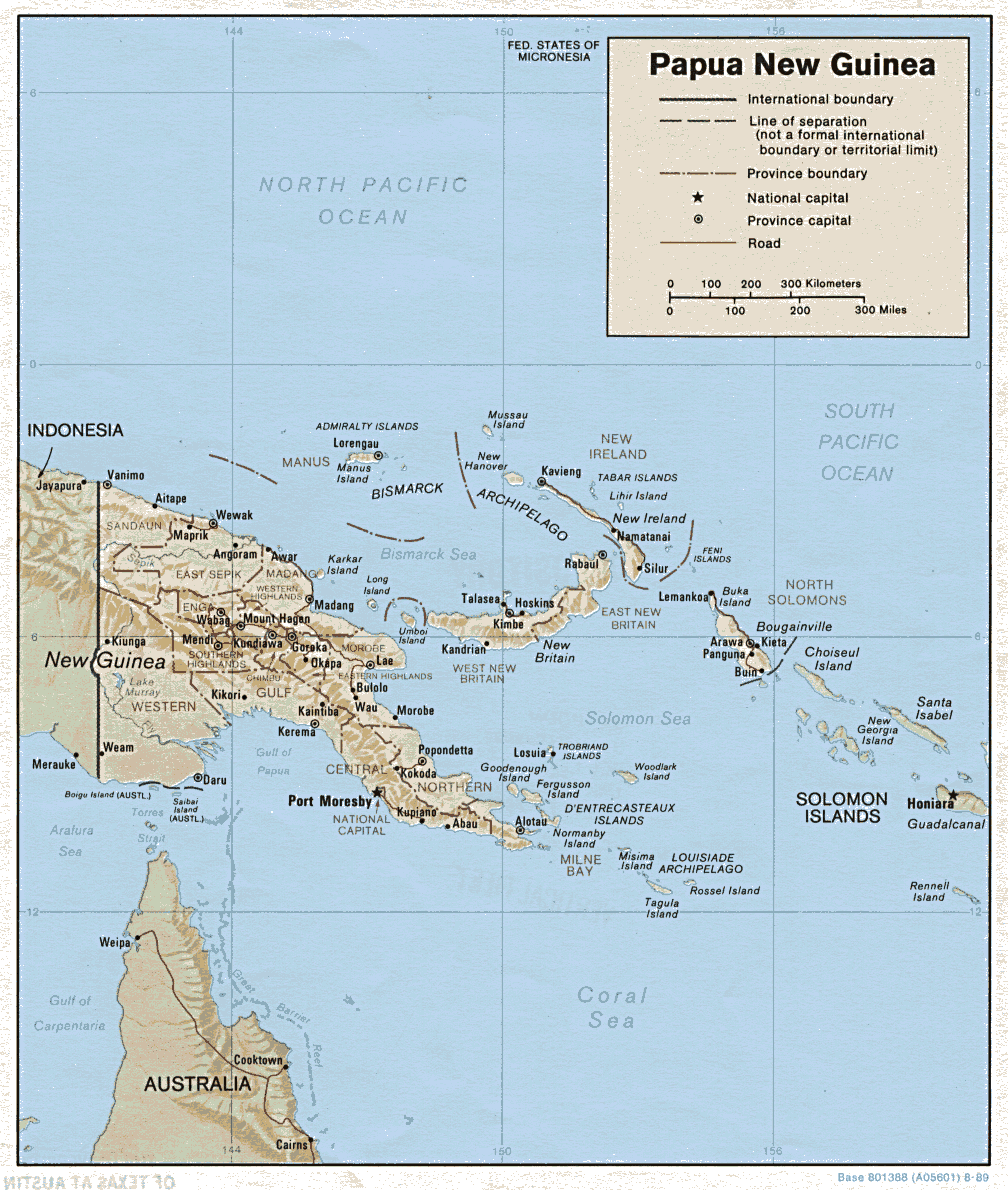
Morobe Province in Papua New Guinea was evangelized by German Lutheran missionaries beginning in 1886. The Germans adapted two local languages for evangelical and educational purposes, Jabêm for the Austronesian circuit along the coast and islands, and Kâte for the Papuan circuit in the interior of the Huon Peninsula. (Many, if not most, of the other interior languages of Morobe Province have since proven to be Austronesian, not Papuan.)

The German Lutheran strategy for communicating new Christian concepts was to adapt the local vernaculars rather than to introduce foreign words—not unlike the strategy of Martin Luther himself during the Protestant Reformation. The following examples are from Jabêm, in whose German-inspired orthography j represents a palatal glide (like English y), ŋ represents a velar nasal (like English -ng), and -c represents a glottal stop.

  • biŋsu ‘foreign missionary’ (also ‘admonition, commandment’)
  • biŋ gôliŋ ‘parable, proverb’ (lit. ‘talk steer’)
  • gôlôàc ‘congregation’ (also ‘clan, relatives, kinfolk’)
  • gêbêcauc dabuŋ ‘Christmas Eve’ (lit. ‘night holy/taboo’)
  • moasiŋ dabuŋ ‘holy communion’ (lit. ‘benefit/blessing holy’)
  • ŋalau dabuŋ ‘Holy Spirit’
  • kêdôŋwaga ‘teacher’ (lit. ‘3sg-teach-agent’)
  • sakiŋwaga ‘minister, servant’ (lit. ‘service-agent’)
  • jàeŋwaga ‘catechist, local missionary’ (lit. ‘message-agent’)

SOURCES: Yapese–English Dictionary, by John Thayer Jensen with the assistance of John Baptist Iou, Raphael Defeg, Leo David Pugram (U. Hawai‘i Press, 1977); Jabêm–English Dictionary, rev. by J. F. Streicher (Pacific Linguistics, 1982).

Leave a comment

Filed under Germany, language, Micronesia, Pacific, Papua New Guinea, religion, Spain

Teaching a Fishy English Lesson, Nhatrang, 1978

Jimmy and I attended the local elementary school, where our studies focused on math, literature, history, and science. All were taught from the Communist point of view. Miss San, who continued to teach my class, decided to hold a free tutorial session at her home every Sunday afternoon. Those were the only lectures in my experience that were not delivered with any political overtone.

Miss San lived in a two-story dwelling several blocks away from my street. She used her first floor as a fish-sauce factory, and three enormous earthenware jars were constantly at work there. Each container could hold two to three hundred pounds of fish, marinating in an equal amount of salt. She explained to us that making fish sauce was her main source of income. Teaching was just a recreational activity. The rancid smell of rotten fish was deadly, like the stench of tooth decay, only stronger. The odor permanently clung to her clothes, seeped into her hair, and like a miasma, spread to her surroundings. The adults, especially men, avoided her. They feared her eccentric nature. Children, however, were drawn to her warm personality, and no one found her more magnetic than I did.

As each Sunday afternoon approached, we eagerly wondered what surprise she had in store for us this week. Sitting on the floor in her rumpled bedroom among her scattered clothes, we waited for her appearance like the audience of a performing artist. One of Miss San’s favorite subjects was English. “The only way for us to grow as a nation is to learn from other countries’ technologies,” she often told us. “How can you learn their technologies? You can start by learning the universal language — English.”

She winked at us with a mischievous smile. “Today, let’s not learn from the textbook. Instead, let’s test our vocabularies, shall we? For the next hour, all of us must speak in English. I know this is a very difficult game, but we can try. Let’s have some fun together.”

We were trembling with excitement. Abandoning our language in a large group discussion such as this one was a forbidden act, yet it seemed so natural and harmless to us in that moment. As if she sensed our uncertainty, Miss San continued, “Let’s keep this our own little secret, children.”

She switched to English and the lesson began. “Duy went out last night,” she said, and I saw my friend sit up a little straighter. Pointing at a small girl in a ponytail, Miss San ordered, “Chi, please finish that thought.”

Chi pondered a few seconds and then said carefully, “Duy went out with a girl last night.”

There were some giggles among the students. The image of Duy with a girl was funny in any language. Miss San turned to me. “Kien, please?” she asked.

“Who was that girl? ” I formed a sentence quickly.

“Yes, that is a good question,” she said. “Tell us who that girl was, Duy.”

Duy stood up. Scratching his ears, he stuttered, searching the room for help. Someone whispered an answer, and he seized it as though he were drowning. “That girl was — was — was — my — mother,” he shouted. His voice cracked from the excitement. We fell into each other’s arms with laughter. Leaning against the wall, Miss San, too, was smiling. In the shadow of the room, I thought she was quite a beautiful lady, almost like a vision.

SOURCE: The Unwanted: A Memoir of Childhood, by Kien Nguyen (Back Bay, 2002), pp. 139-141

Miss San abruptly disappeared soon thereafter.

Leave a comment

Filed under education, language, Vietnam

Finding Burmese Speakers During WW2

On Language Log, Mark Liberman has been excerpting passages from J Milton Cowan‘s brief memoir, “American Linguistics in Peace and at War.”

It is difficult today to visualize some of the obstacles we had to overcome. To illustrate I will tell the Burmese story because it has multiple punch lines. In the lottery of languages William S. Cornyn drew the Burmese straw. This frightened him a bit but Leonard Bloomfield promised to hold his hand. Nobody knew where to find any native speakers of Burmese and the files of the Alien Registration Act were classified. The Department of Immigration and Naturalization said there were no Burmese legally in the country at the time. There were supposed to be some sailors who’d jumped ship in New York and San Francisco but they hadn’t caught up with them yet.

Mortimer sent me to the Pentagon to see a young fellow in G-2 (Military Intelligence), Major Dean Rusk, a name not so well-known in those days, but known to Mortimer. I described the non-existence of known Burmans and why we wanted some. He volunteered to see what could be done with the roster of Alien Registration. He phoned our offices the same afternoon, saying tht he had over a hundred names and he’d call back as soon as he could have them decoded. Next morning he phoned to say there was something funny, there were Abernathys, Browns, Davenports, Fitzgeralds and so on down through the Youngs. It turned out that the Roster listed those foreigners residing in the U.S. who had been born in Burma, regardless of their current nationality. These were the names of children born to business people and missionaries while living in Burma. There were only two names that sounded exotic enough to be possible Burmans.

Read the rest at Language Log

When I was a missionary kid in elementary school in Kyoto, I remember reading a biography of Adoniram Judson, a pioneering Christian missionary in Burma at a time when converts risked death sentences for changing their religion. Judson was no slouch as a linguist, either.

Leave a comment

Filed under Burma, language, U.S.

How Much Longer Will Spoken Manchu Last?

Manchu, one of the official languages of the Qing dynasty, seems to be going mute.

Meng [Shujing] is one of 18 residents of this isolated village in northeastern China, all older than 80, who, according to Chinese linguists and historians, are the last native speakers of Manchu.

Descendants of seminomadic tribesmen who conquered China in the 17th century, they are the last living link to a language that for more than two and a half centuries was the official voice of the Qing Dynasty, the final imperial house to rule from Beijing and one of the richest and most powerful empires the world has known.

With the passing of these villagers, Manchu will also die, experts say. All that will be left will be millions of documents and files in Chinese and foreign archives, along with inscriptions on monuments and important buildings in China, unintelligible to all but a handful of specialists.

“I think it is inevitable,” said Zhao Jinchun, an ethnic Manchu born in Sanjiazi who taught at the village primary school for more than two decades before becoming a government official in the city of Qiqihar, 50 kilometers, or 30 miles, to the south. “It is just a matter of time. The Manchu language will face the same fate as some other ethnic minority languages in China and be overwhelmed by the Chinese language and culture.”

(While most experts agree that Manchu is doomed, Xibo, a closely related language, is likely to survive a little longer. Xibo is spoken by about 30,000 descendants of members of an ethnic group allied to the Manchus who in the 18th century were sent to the newly conquered western region of Xinjiang. But it too is under relentless pressure from Chinese.)

The disappearance of Manchu will be part of a mass extinction that some experts forecast will lead to the loss of half of the world’s 6,800 languages by the end of the century. But few of these threatened languages have risen to prominence and then declined as rapidly as Manchu.

Leave a comment

Filed under China, language

Birth-order Names in Japan and Papua New Guinea

Most people familiar with Japan are aware of the Japanese birth-order naming system for males, whereby first sons are often called 一郎・太郎 Ichirō/Tarō; second sons 二郎・次郎 Jirō; third sons 三郎 Saburō, and so on. In theory, it would be possible to keep going up to at least the tenth son: 四郎, 五郎, 六郎,七郎, 八郎, 九郎, 十郎. However, I’m not sure how to pronounce the characters for fourth son, can’t find it in my dictionaries, and suspect that it would be an extremely unlucky name because Sino-Japanese shi ‘four’ sounds like shi ‘death’. (Japanese high-rises often lack a 4th floor, for the same reason that my high-rise condo in the U.S. lacks a 13th floor.) [See the correction below.]

Another thing I’m not so sure about is whether this system marks order of issue or order of survival. Back in the old days, many more children died very young. That might account for the naming of Admiral Tōgō Heihachirō, whose name (東郷 平八郎) suggests he might have been his mother’s eighth son, even though he had only three brothers as an adult. (My farm-raised father’s eldest brother and eldest sister also died very young, but he still ended up with five brothers and one sister.)

Birth-order naming systems are also very common in the coastal languages of the Huon Gulf of Papua New Guinea. The naming system in Numbami accommodates up to seven sons and six daughters, and without incorporating any numerals. The order-of-issue names for sons are Alisa, Alinga, Gae, Alu, Sele, Dei, Ase Mou; and for daughters are Kale, Aga, Aya, Damiya, Owiya, Ase Mou. Notice how the names for the seventh son and sixth daughter are the same? That’s because both translate as ‘name none’, or No-Name. My host mother during my fieldwork had seven sons and four daughters, all of whom survived thanks to postwar improvements in public health. The youngest son was called Ase Mou ‘name none’, or Ase ‘name’ for short. Of course, as the kids get older, they tend to go by their baptismal names (often of Biblical origin) or traditional names, depending partly on whether they remain in the village or move to town.

Another coastal language for which birth-order names have been recorded is Labu, which is the only surviving coastal member of the Markham subgroup, which stretches far inland up the Markham River valley. The Labu names for the first five sons are Aso, Amoa, Aŋgi, Aŋgu, Ôlôndi; and for the first five daughters are Ami, Hiya, Aya, Êta, Hênamu. (My source seems a little bit confused about the names farther down the line.) If you compare the Numbami names to the Labu names, only the names of the third daughter match. (However, I’m guessing that Labu Asôlô for both males and females toward the bottom of both lists is the etymological equivalent of Ase Mou ‘name none’, even though the current Labu word for ‘name’ is apaŋa.)

This is typical of the Huon Gulf Sprachbund: the structures match but the sounds often don’t. That facilitates translation, but not lexical retention. Fortunately, human memories can retain enormous amounts of lexical clutter; while human brains are much less efficient at quick translation between languages. (Human RAM far exceeds human CPU capacity. The rise of transformational grammar seems to have been predicated on the opposite assumption: People had to derive one semantically related structure from another; they couldn’t memorize both and then analogize between them.)

UPDATE: For Japanese kanji jocks (or kanji bandits), Matt of No-sword offers some interesting observations of how people have simplified characters by employing ditto marks (or means very similar). Sort of a calligraphic compression algorithm.

CORRECTION: (Slaps forehead.) Matt corrects me (and not for the first time). 四郎 Shirō is neither unlucky nor uncommon. Well, it’s less common than 三郎 Saburō but more common than 五郎 Gorō for the same reason that third sons are more common than fourth, and fourth more common than fifth. Instead of puttering around in my kanji dictionaries, I should have googled up likely names like Suzuki/Tanaka/Yamada Shirō.

Leave a comment

Filed under Japan, language, Papua New Guinea

Puttering About in My Sprachbundesgarten

I’ve been distracted a bit from blogging of late because of a burst of enthusiasm for enhancing Wikipedia’s coverage of Austronesian languages in Papua New Guinea. It’s my own little archival digitization project (as if this blog isn’t obscure enough for my tastes).

Thirty years ago, I did dissertation fieldwork in Morobe Province, PNG. My original goal was to describe just one previously undocumented language that appeared—on the basis of a few wordlists—to be rather conservative, so that my description could provide more and better data for broader-reaching historical and comparative work. However, I found that describing the synchronic grammar of one language in a fairly comprehensive manner was an extremely daunting task (especially the syntax in my verb-serializing language). Few linguists ever try anymore. Every component of any language you attempt to describe is sure to be surrounded by theoretical minefields and earthworks laid out by others. I didn’t have enough fire support, sappers, or élan to storm so many well-entrenched positions at once.

So I elected instead (stretching the military analogy) to deploy a long, thin skirmish line designed to probe the changing shapes of the Austronesian outposts along the coasts of New Guinea—in order to help dispel the “fog of yore,” so to speak. I undertook a historical and comparative study of word order and word-order change across all the Austronesian languages of the New Guinea mainland. The latter was not as difficult as it sounds because (a) only a few dozen of those eight score or so languages were adequately documented at the time, and (b) I could focus on just a few broad questions where data and theory seemed a better fit. The central issue was the extent to which the Austronesian languages have adapted their inherited SVO (Subject Verb Object) typology to the SOV typology that prevails among the demographically dominant Papuan languages on the mainland.

My fellow junior fieldworker on the project exercised more discipline, produced a thick and useful grammatical description of his language (before I finished), and went on to a thriving linguistic career. I attended his dissertation defense, where one professor with his own pet theory of syntax criticized him for being too eclectic in his use of theoretical tools of analysis—in short, for subordinating theory to description. I leapt to my friend’s defense, arguing that it would be a shame to waste the only comprehensive description ever likely to be published on a particular language just to serve the purposes of a particular fly-by-night theory. The professor replied in a huff that his theory had been under development for decades. I asked him how many centuries that language had remained undocumented.

The New Guinea mainland can be considered a sort of Sprachbund, where unrelated Papuan and Austronesian languages have converged toward common structures to varying degrees. For instance, the Austronesian languages of New Guinea are the only ones to display verb-final (SOV) word order, like most of the Papuan languages (and like Hindi, Japanese, or Turkish). Basic word order in Austronesian languages elsewhere, from Madagascar off the coast of Africa to Easter Island off the coast of South America, is either verb-medial (SVO) like Malay or Tok Pisin, or verb-initial (VSO) like most of the Philippine or Polynesian languages.

But the Austronesian languages around the coast of the Huon Gulf, where I did fieldwork, form their own sort of Sprachbund in microcosm, where languages at the borders of four small subgroups exhibit unusual traits more characteristic of their neighbors than their relatives. One of the most extreme examples is Labu (also known as Hapa), spoken in coastal swamps at the mouth of the Markham River, just across the river from the current city of Lae. The city, by the way, takes its name from a linguistic community by the name of Lahe, Lae, or Aribwatsa, whose speakers abandoned their language in favor of Bugawac, the dominant language along the north coast of the Huon Gulf and a crucial piece of the south coast near Salamaua.

Labu shares certain innovations with a larger group of Markham languages that stretch all the way up the Markham River valley. For instance, they regularly reflect Proto-Oceanic *t as a flap /r/ or /l/ and Proto-Huon Gulf *v as either /f/ or /h/. They also reduced their numeral system to ‘one’, ‘two’, and ‘hand’, but added a numeral classifier on the number ‘two’ (sa-lu, se-ruk, le-ruk, depending on the language). Other numbers are composites: ‘2+1’, ‘2+2’, ‘hand+1’, etc. Such severely reduced numeral systems are more typical of Papuan languages.

Labu speakers didn’t forsake their language for Bugawac, but they did remodel some of it on Bugawac lines. They recreated numerals for ‘3’ (si-di) and ‘4’ (sô-ha). So now they can count more like the other coastal languages: 1, 2, 3, 4, 5 (= ‘hand-part’), 5+1, 5+2, … 10 (= ‘hand-both’), … 20 (= ‘person-one’). However, for anything above 5, almost everyone switches to Tok Pisin numerals.

Strangest of all, Labu has acquired a distinctive low “tone” (register tone) on certain words, as in /u/ ‘rain’ vs. /ù/ ‘pot’. None of the other Markham languages exhibit such tone distinctions. Of all the Huon Gulf languages, only Bugawac, Yabêm, and possibly Kela distinguish words on the basis of tone, and its origin in those languages is fairly recent and derives from earlier obstruent voicing contrasts—low tone from /b,d,z,g/, high tone from /p,t,s,k/—with other segments being neutral for tone. Labu tones don’t always match the tones of cognate words in Bugawac or Yabêm, nor do they correlate well with earlier obstruent voicing contrasts, so it’s a bit of a mystery how Labu speakers adopted tonal distinctions.

2 Comments

Filed under language, Papua New Guinea