Category Archives: language

Wordcatcher Tales: Nebaneba Land

Start of the Philosopher's Walk (Tetsugaku no michi) near Ginkakuji, Kyoto, JapanI started my second day in Kyoto by taking an early bus to Ginkakuji-guchi, near where I used to live as a kid, then taking the Philosopher’s Walk (哲学の道 tetsugaku no michi) along a ditch above my old neighborhood, most of which has long since been torn down and rebuilt enough to be almost unrecognizable. But when my rechargeable lithium-ion camera battery gave out unexpectedly about 8:30 a.m., I wasted the rest of the morning running errands. First, I tried to find somewhere to recharge (再充電 saijuuden) or replace it. I had to wait until Bikku Kamera at Kyoto Station opened at 10 a.m. to find that (a) they couldn’t recharge it for me, and (b) if I bought a replacement battery, it would have to be charged before use. And they didn’t have any disposable (使い切り tsukaikiri lit. ‘using-up’) digital cameras I could buy. And I had to check out of my hotel before 10 a.m., so I had a full backpack to schlep around, too.

So I gave up taking more pictures and went shopping to replace my overstuffed backpack (ryukkusakku), which had begun to fall apart the previous day on Mt. Hiei. (I had inherited it from my daughter when she upgraded hers after junior high school—nearly a decade ago!) The Isetan department store at the train station had poor selection and high prices, so I headed to Daimaru in midtown, where I still paid more than I wanted to. The helpful sales clerk asked me if I wanted to transfer everything into the new pack (詰め替える tsumekaeru ‘stuff-exchange’) right there (詰め込み教育 tsumekomi kyouiku is education that stresses cramming facts, rote learning). But I wanted to do it over a leisurely and refreshing lunch, so I began hunting for a likely place to eat.

I found the right spot along Nishiki-koji Food Market, a narrow, covered street parallel to Shijo-dori where you can find all sorts of Kyoto specialties. Genzou (元蔵) drew me in with a sign that offered cold nebaneba-bukkake-udon ‘sticky-topping-udon’: noodles in broth topped with slimy natto (fermented soybeans), okra, tororo (grated yam), seaweed (a bit like mozuku), and a runny soft-boiled egg. Sticky food is supposed to give you quick energy on a hot day, and this one served me well. Of course, I also had to sample a few other local kushi-katsu (‘breaded kebab’) seasonal specialties, like 穴子 (anago ‘conger eel’), 鱧 (hamo ‘pike eel’), 賀茂 (= 鴨 ‘Duck’, the name of the main river) Kamo nasubi ‘Kamo eggplant’, and 小柱 kobashira lit. ‘small pillars’, which looked like small scallops (帆立の貝柱 hotate no kaibashira) but were the adductor muscles of a smaller round clam, also called bakagai.

2 Comments

Filed under Japan, language

Wordcatcher Tales: Kuhi, Ayu, Ukai

Our spirits were sagging after a long spell in the steamy, body-temperature heat of Gifu, Japan, during last week’s day trip there from Nagoya. We had arrived in Gifu on an early train, then walked 3 km through still-empty side streets to the cormorant-fishing area near the base of Mt. Kinka, site of Gifu Castle. We spent the morning taking the ropeway to the top, having a look around, then walking down the so-called 100-bend (百曲 hyaku-magari) trail, said to be shorter than the 7-bend trail that started from the same spot at the top. The trail proved to be not only much steeper and rougher, but also more twisted than we had expected. The last 35 bends from the bottom were marked with milestones and signs that counted down from 35 out of 135, rather than 100. We arrived at the bottom overheated and soaked with sweat.

We cooled off in the air conditioning of the wonderful Nawa Insect Museum, founded in 1919 by a Japanese entomologist from Gifu, Yasushi Nawa, who discovered what is now called the Gifu Butterfly, Luehdorfia japonica. Cormorant fishing would not start until nightfall, so we spent much of the afternoon relaxing in two hotel lobbies that overlooked the Nagara River, first the bland new Park Hotel, then the more storied 十八楼 (juuhachi-rou ’18-storey’) hotel.

Nawa Insect Museum sign, Gifu, Japan

句碑 kuhi ‘verse monument’ – On the far side of the lobby, we found a bench by the window looking directly onto a stone monument in a tiny garden beside a low flood wall bordering the river. We were well into our beers, served in bottles with stoneware goblets, when I noticed a small plaque by the window that explained the significance of the monument, into which had been carved a replica of a verse that the famous traveling poet Bashō was said to have composed on that very spot in 1688. The term for such a monument is kuhi: the ku is the same as in haiku (俳句), while the hi can be read in native Japanese as tateishi ‘standing stone’ or ishibumi ‘stone writing’. The monument itself was not erected until much later, during the late Tokugawa period.

Haiku by Basho at the Nagara River, Gifu, JapanThough my opinion matters little, the verse itself does not strike me as Bashō’s best work. The 5-8-5 – rather than 5-7-5 – syllable (or mora) structure is not that important. The haiku tradition was much less rigid in its early days, and Bashō was one of its principal creators. But that verse monument certainly did lend a certain caché to an otherwise unremarkable hotel lobby overlooking a cool river on a hot day. (Of course, the taste of the 啤酒 [Ch. pijiu ‘beer’] also made a vital contribution to all that was refreshing about that spot at that moment.)

このあたり 目に見ゆるものは 皆凉し
kono atari / me ni miyuru mono wa / mina suzushi
this spot / things the eye beholds / all is cool
(= in this place all that meets the eye is cool)

ayu ‘sweetfish’ – Both the cormorants and the humans of Gifu eat a lot of ayu ‘sweetfish’ from the Nagara River. So we rewarded ourselves for a grueling day by eating dinner at a nice restaurant that specialized in ayu, the Kawaramachi Izumiya. We ordered the shortest multicourse dinner and a small bottle of a local sake named 三千盛, which means ‘3,000 peak/prime/zenith’ but sounds like michi sakari ‘the highest point on the road’. The appetizer (前菜 zensai) course included a pungent bit of fish that resembled anchovy, some tiny pickled ayu, and a more subtly fish-flavored breadstick along with some vegetables. Next came a smelt-sized ayu broiled on a skewer, to be eaten whole, from head to tail. The tempura course featured ayu and vegetables, with a salt mixture rather than sauce (dashi) to dip them in. The ayu porridge (zōsui) course also featured a tiny fish steak wrapped in kelp, cabbage pickles, and pickled red turnip (aka kabu). The dessert course was a slightly savory sorbet flavored with mountain vegetables (sansai, 山菜). It was a memorable meal, and much better than what we would have been able to take or buy aboard the riverboat.

Statue of fisherman and cormorant, Gifu, Japan鵜飼 ukai ‘cormorant feeding’ – The actual exhibition of cormorant fishing involved a lot of waiting around interspersed with bits of verbal and video orientation. The word ukai literally means ‘cormorant feeding/raising’, not ‘fishing’. Despite being leashed to prevent them swallowing large fish, the birds do manage to swallow the smallest fish. On the night we attended, the catch itself was not all that impressive. After the exhibition, we were quizzed a bit by a Canadian photographer aboard our boat who was doing a magazine article on cormorant fishing. He was concerned with the animal cruelty angle, but it seems to me that most city people from developed countries have lost touch with the concept of animals as coworkers, and are only able to view animals as pets—as pampered dependents, not working dependents.

UPDATE: The same word for ‘feeding/raising’ (飼い) occurred in a sign imploring citizens to pick up after their dogs and not let them ‘run loose’ (放し飼い hanashigai ‘loose-raise’).

UPDATE 2: Doc Rock quotes another fitting haiku by Onitsura (鬼貫) that I like better than the one Bashō is famous for in Gifu. It’s more visual and kinetic. Here’s Onitsura’s verse, my transliteration, and Donald Keene’s translation.
夕暮は鮎の腹見る川瀬かな
Yuugure wa / ayu no hara miru / kawase kana
At the close of day / you see sweetfish bellies / in the river shallows

3 Comments

Filed under Japan, language

Ichiro’s “English for Special Purposes”

On top of his fine analytical and motor skills on the baseball field, Ichiro seems to possess the motivational skills necessary to manage an American baseball team, or so reports Jeff Passan of Yahoo! Sports, who credits Ichiro’s motivational speeches for the American League’s string of wins in recent All-Star Games. Look for him to manage, say, the Chicago White Sox after he retires from playing.

“It’s why we win,” David Ortiz said.

He pointed to Ichiro Suzuki, the Seattle Mariners’ wisp of an outfielder, a man who still uses a translator to do interviews with English-speaking reporters – and happens to be baseball’s amalgam of Anthony Robbins and George Carlin. Every year, after the AL manager addresses his team, Ichiro bursts from his locker, a bundle of kinetic energy, and proceeds, in English, to disparage the National League with an H-bomb of F-bombs, stunning first-timers who had no idea Ichiro speaks the queen’s language fluently and making returnees happy that they had played well enough to see the pep talk again.

The tradition began in 2001, Ichiro’s first All-Star appearance, and the AL hasn’t lost a game since. Coincidence?

Um. No.

“I know how important it is to the game,” Ichiro said. “I’m more concentrated at that moment than I am in the game.”

A wide grin spread across his face. Ichiro’s secret had been exposed, so, hey, why not have fun with it?

He crafts his public portrayal similar to the image he projects on the field: a technician, a warrior, a Ph.D. in stoicism. In reality, Ichiro’s All-Star teammates love him for his wicked sense of humor and sly deceit, shown with a vocabulary far more expansive than he leads on.

All the first baseman around the AL know Ichiro speaks English, singles accounting for 1,393 of his 1,711 hits since joining Seattle in 2001. Generally, the conversation doesn’t move much past pleasantries, which makes the speech all the more shocking.

via Daniel Drezner

Leave a comment

Filed under baseball, Japan, language, U.S.

Baciu on Writing a “Double Autobiography”

From Mira, by Stefan Baciu (Editura Mele, 1979), pp. v-vii (my translation):

Here is a book that I never in my whole life would have thought to write, or if I had ever thought to write it, I would have imagined something completely different from that which was imposed by the cruel circumstances I lived through from August 1977.

It was a warm night in Assisi, in Italy, where we had gone on a kind of pilgrimage, arriving from Cascia, which we had visited so that Mira could thank Santa Rita, the patron saint of impossible tasks, when I was awakened by the cries of pain from Mira, who always took great care not to “disturb” me. In the course of the events I relate in this book, it will be seen what began to happen from that night in Assisi, and if I refer back to it, it is only to express my conviction that her illness began from that time—and that place, even though four full months plodded by until, in Honolulu, the worst came to pass in all its horror.

No matter how paradoxical it may seem at first glance, this book is very much autobiographical, because from the moment we first got to know each other, in Bucharest in 1941, our lives have united to such an extant that I am unable to separate them.

I write these words after finishing the last page of a work of daily labor over a period of five months, at my worktable in Honolulu, in the house in which we lived from 1967, where Mira installed me in the quietest and most picturesque corner, so that I would have, in her words, “the one place where no one disturbs you.” Inasmuch as I have published since 1946 books written directly in German, Portuguese, and Spanish, I found after I had started this task, that the words I had committed to paper wrote themselves in Romanian, and of course I asked, “Why?”

I did not have to look far for the answer, because it arrived on its own: the pages that follow were written alone, dictated by Mira, with whom I always spoke Romanian, even when we were trying one or two days a week to speak Portuguese, which was—and is—second only to Romanian for us.

I began to write this “double autobiography” at the beginning of August 1978, and only a few days after I had begun to work, I realized that a month had passed since Mira left me, and I wanted her to remain with me—forever. If I had tried to write these words in Spanish or in Portuguese, many of the thoughts and deeds that I was transcribing would not have been written, or would have been written differently, for the good reason that Mira would not have dictated them to me thus, in those languages.

Throughout the final years, every time we talked about my work projects, Mira would tell me, and repeat with insistence, that my “mission” was to write my memoirs, which at her suggestion I entitled (for the years in Romania, 1918–1946) “Dust on the Drum,” a title inspired by my bohemian jeunesse at the Mercury, hearing the words of my “Uncle” Nicu Theodoru-Chibrit, a mythological figure, today, from a past even more mythological. During the summers, when I stayed alone in Honolulu instead of accompanying her on pilgrimages through Greece, Italy, and France, I would fill notebook after notebook of “Dust on the Drum,” work that served as a kind of extenuating circumstance every time she criticized my absence.

Books of memories and books of poetry, such pages cannot be written except in the language in which they were lived, dreamed, and endured. It falls on me to be the stenographer of our love and tragedy, just as I’ve reached 60, on the date Mira would enjoy so much, without being able to foresee that we would not be destined to spend that day together, and that I, “exiled alone on the other shore” in the words of my old friend, the symbolist poet Eugeniu Sperantia, would be forced, even on this day, to be the chronicler of my own misfortune.

Our life together was fundamentally, as they told me so often, 37 years of happiness, even if that happiness was overshadowed more than a few times by hurt and sometimes by illness. If I weigh it here and now, at the end of this ill-fated 1978, I find that sickness and pain were way stations on a long journey, too short, nonetheless, that started on a boulevard in Bucharest and ended on a bed in a convalescent hospital on an island in the Sandwich Archipelago.

Often, when we used to travel by train or by car from Bucharest to Brasov, passing through Câmpina, I thought that we should get off to see the “castle” of Hasdeu, where the bearded savant, the poet full of spirit and the pamphleteer full of vigor, buried his pain, seeking a pathway to the stars. Oh, how many times these days have I envied Hasdeu for his castle in Câmpina, where I know that he “spoke” with his Julia! Sitting on the terrace of our house in Honolulu, from which for so many tens and hundreds of hours we watched together the unparalleled sunsets over the Pacific, a fascinating and winning spectacle, I wish I could, like Hasdeu, talk with Her. It was for that reason that, more than once, I climbed the steps at night that lead from her room onto the terrace, expecting to meet her sitting in her armchair. to see her, or to hear her talk to me! It was not to happen!

It was still two days before Christmas when I visited the cemetery in Makiki where Mira sleeps the eternal sleep alongside the “Nightingale of the Pacific,” Lena Machado. I fastened onto a tropical plant, using a safety pin, the little parchment on which were depicted two wanderers with fur hats and sheepskin cloaks holding up a star, in order to fulfill the wish of her cousin, Ligia, and I thought that the day, or night, may nevertheless come when Mira will come talk with me or tell me something.

Until then, I can do nothing but await these secret dictations, which—alas—are about to end, as the year ends. Nothing remains in her life, in our life, not an episode that will not be relayed with full sincerity and honesty.

Starting life, against her innermost desires, as a pharmacist, Mira was by nature gifted with an extraordinary literary and artistic sensitivity, which sooner or later revealed itself, line by line, in poetry and in prose, in critical research and in teaching. Already near the end of her earthly cycle, she exploded with a richness that amazed everyone, in painting with a force that I regarded, and still regard, as sleepwalking. It lasted just eight months, from April to November 1978.

I do not know if these pages constitute a biography, a love story, or an adventure novel, but I know that they contain not a line, not a word that is not absolutely, precisely the truth. I had for almost four decades the privilege of knowing her and loving her and sharing with her day by day, night by night, moment by moment, bread and water, tears and pain, smiles and happiness. I was, in Bucharest, in Râmnicu Vâlcea, in Brasov, the escort who accompanied her on the most unexpected trails, to Bern and to Lugano, in Senegal and in Honduras, up the Corcovado in Rio de Janeiro and the Grand Canyon of Kauai.

Her disappearance has left me a widower and an orphan and I know that from now on, however life turns out, neither the bread nor the water nor the pain nor the tears will any longer—ever—be the same, that the days without Her will not have the same color or the same flavor.

I cannot entitle this book anything but “Mira,” even though a more fitting title might be found in the German “als wärs ein Stück von mir,” from the ballad of Uhland about “the good comrade” who, struck down by a bullet on the battlefield, falls at the feet of the one who survives “as if it were a piece of myself.” However, those words were borrowed earlier by a German memorialist, the playwright Karl Zuckmayer. On top of that, how would a title in German really sit with Mira, who, wherever and however she might present herself, was always Mira from Râmnicu Vâlcea or “the lass from the Olt” [River], as she wrote me on a photograph on the day she was naturalized as a citizen of the United States?

Of all the books that I have written in 45 years, this one is the most painful and the loftiest, because apart from being Mira’s book, it is at the same time, her life and mine, our life.

Honolulu, 24 December 1978, the first Christmas without Her

NOTES: My ‘cries of pain’ renders vaietele de durere (vai ‘alas, woe’, as in oy vey); ‘arrived on its own’ renders a venit de la sine; ‘bohemian jeunesse’ renders juneţea boemă (usu. junime); ‘Dust on the Drum’ renders Praful de pe tobă; ‘uncle’ renders nea (= nene); ‘more than a few times’ renders nu rareori (lit. ‘not rarely’); ‘way stations’ renders staţii pasagere; Câmpina was formerly a customs point between Transylvania and Wallachia; Hasdeu was a spiritist/spiritualist, as well as a noted historian and philologist; ‘the eternal sleep’ renders somnul de veci (lit. ‘sleep of centuries’); ‘with fur hats and sheepskin cloaks’ renders cu căciula şi suman (the traditional dress of Romanian shepherds); ‘in teaching’ renders în docenţă; ‘however life turns out’ renders oricum ar fi să fie viaţa; ‘the lass from the Olt’ renders lelea de pe Olt (the meaning of lele ranges from ‘sister, aunt’ to ‘libertine, whore’).

Leave a comment

Filed under family, Hawai'i, language, migration, Romania, travel, U.S.

On Translating Baciu’s “Patria”

Barely more than a month after I started blogging, I translated a poem entitled Patria by the Romanian exile, Stefan Baciu, whom I knew from my graduate school days at the University of Hawai‘i. Baciu administered one of my two foreign language reading exams required for my Ph.D. program. My major language (rather useful for research on Pacific languages) was French, for which I took a standardized test, while my minor language (less useful) was Romanian, for which Baciu chose a literary passage for me to translate, one describing a rural homestead after an uprising (or pogrom), with ‘rafters’, ‘sizzling flesh’, and other such vocabulary rare in the usual sorts of academic expository prose. (I was allowed to use a dictionary.)

Before I embarked on my language-rich, linguistics-poor Fulbright postdoc year in Romania in 1983, Baciu also gave me a copy of his (1980) self-published memoirs to take along. I left my copy with a literature professor at the University of Bucharest who showed a particular interest in Baciu, partly because all the exiles were nonpersons in Romania at the time. Nowadays, there is a growing revival of interest in those exiles, as Romanians seek to regenerate some of the historical limbs that were twisted, shriveled, or amputated during the communist and fascist eras of the last century. I think of it as a memory reforestation project, one that I hope does not lead to a revival of too much greenshirting.

Now that I have gained access to another copy of Baciu’s memoirs, I’ve been translating pages and posting them on this blog, doing my little bit to build a small English garden from his memories. In Wikipedia, I find it interesting that Baciu’s biographical entry is longer in the Spanish edition than in either the Romanian or the English edition. I’ve been adding External Links from the English Wikipedia entry to my translations here, but I noticed that the Spanish entry has far more External Links on Baciu, including a link to my English translation of the easiest of the three segments of the poem(s) entitled “Patria” (which I think best translates into ‘Home’ in this context).

So I thought I should try to translate the two harder passages in the bunch. The quatrains in Part II were harder because of the ABAB rhyme pattern, which forced me to swap lines and stray further from the meaning of the original words in several cases, while retaining the original imagery as far as possible. The hardest task in Part III was resisting the temptation to add a footnote to each line noting, for instance, that Time, Torch, and Ancient Beliefs were the names of publishers, or that Buzesti Square (not far from the Bucharest North train station) is now the site of a MacDonald’s and the Turkish restaurant (named “Shark”) where my wife and I shared a pleasant evening with my earlier Romanian cotranslator (of an old German grammar of a New Guinea language) and his wife during our quick visit to Bucharest in January. Networks of all kinds are so much easier to maintain these days.

Baciu’s “Patria” (‘Home’) is in several ways representative of his poetry in exile, which is full of nostalgia, longing, and the merger of mental and physical terrain across time and space. From now on, it’s back to translating memoirs, not quatrains, for me. Somebody else is welcome to translate his last major collection of poetry, entitled Peste o mie de catrene (‘Over a thousand quatrains’).

Home (Patria)

I

Home is an apple
in a Japanese grocery window
on Liliha Street
in Honolulu, Sandwich Islands
or a gramophone record
heard in silence in Mexico
–Maria Tanase beside the volcano Popocatepetl–
home is Brancusi’s workshop in Paris
home is a Grigorescu landscape
on an autumn afternoon in Barbizon
or the Romanian Rhapsody heard on a morning
in Port au Prince, Haiti
and home is the grave of Aron Cotrus
in California
home is a skylark who soars
anywhere
without borders and without plans
home is a Dinu Lipatti concert
in Lucerne, Switzerland, on a rainy evening
home is this gathering of faces
of events and sounds
scattered across the globe
but home is
especially
a moment of silence.

This is home.

II

With home you can talk by telephone,
You can hear it in distant whispers,
Carry it in your pocket, like a comb,
Or find it decapitated in the papers.

It’s not just earth or stone or air,
But a smell, a face, a twirl in the park,
A sound that echoes from anywhere,
A voice that pierces the midnight dark.

Because home is not an anthem bound,
illuminated, decorated, with border.
It’s a shroud, in deepest dreams rewound,
At dawn unraveled, in disorder.

Nor is home revived by boasts,
But by silence, by distance, by sorrow,
Squeezed from dust, on tropic coasts,
Scattered abroad, in hopes for the morrow.

III

The steeple of Saint Nicholas in Schei,
The echo of the train off Mt. Tâmpa at night,
“Kefir Lukianoff” in Cismigiu Park,
New books from “Time! Torch! Ancient Beliefs!”
“Hot corn-on-the-cob! Hot corn!”
Mr. Misu from Romanian Books,
The rainbow scarf of Emil Botta,
Maria Tanase singing at the Neptune in Buzesti Square,
Father commenting on War and Peace,
Or a page of poetry by Nietzsche
(tapping into the book with his index finger),
A cappuccino at the Crown

And this banknote of 500 lei,
Found in the bottom of a yellowed envelope,
Brought I don’t know how,
From Brasov to Brazil,
And then to Honolulu, Hawai‘i,
Island of Oahu,
Sandwich Archipelago

1 Comment

Filed under Hawai'i, language, migration, Romania

Baciu’s Memories of Brasov: Country Cousins

From Praful de pe Tobă: Memorii 1918-1946, by Stefan Baciu (Editura Mele, 1980), pp. 11-12 (my translation):

From the earliest years of my childhood, we would spend part of our holidays, especially at Easter and in summer, together with Father in his native village, Nadeşul Săsesc [Saxon Nades] in Târnava Mică county, where lived Grandmother, an uncle who was a priest, married to my father’s sister, Auntie Elena, and several first and second cousins. We would leave from Braşov for Sighişoara on either the express or the limited express, and from there we would take a suitably dilapidated bus for about an hour, through potholes, dust, or mud, along the road between Sighişoara and Târgul Mureş. At the bus station, which was at the head of the village, would be waiting Uncle Rusu and a few cousins, who would accompany us on the road to the parsonage in the middle of the village, where they lived. We would walk, while the oxcart followed slowly behind with the suitcases and packages we had brought along, with an occasional “haw” or “gee,” which would give me great pleasure. It makes me nostalgic to think of the evenings we spent crammed around the table, chatting over a glass of Târnave wine or, when I was still small, listening to my elders. During the days, we would go for walks through the vineyards or to the neighboring villages, Ţigmandru and Pipea, collecting mushrooms on the road through the woods. In the evening we would roast them with pieces of bacon skewered on spits of hazel wood expertly carved by Uncle Ionel.

Every afternoon around five was a special moment, when the bus delivered the postal sack, which was carried to the Post Office, whose mistress was my cousin, Tiţa Dan. I would attend the undoing of the sack as a kind of ritual, snatching out of her hands envelopes addressed to me. Other cousins would usually attend this “cult”: Elvira and Sabina Dan, Ionel Moldovan, Lucia and Stela Rusu, with whom I would discuss the news in the letters and magazines we received. Sometimes I would go home with Ionel Moldovan and we would sit on a wooden bench under a leafy tree, breaking open large and juicy onions and drinking generously of wine brought by Auntie Aurelia, the mother of Ionel, a newly commissioned second lieutenant in the cavalry.

The last time I was in Nadeş was only for a single day, with Mira, in the spring of 1946, only a few months before leaving the country. Grandmother examined us with her weak eyes under the ever-present headscarf covering her forehead, then took me aside and said, “Bravo, Ştéfane (accented on the first e), fine wife you’ve taken. She’s a real lady!” At parting, she asked me if I had opened an office (she knew that I was licensed in law), and when I was just about to leave she put a question to me that I didn’t realize at the time showed prophetic vision, “What do you think, Ştéfane; will this democracy last a while? Because the kids roam the streets and shout that that’s democracy!”

NOTES: ‘Auntie’ renders Tuşa; ‘express’ renders accelerat and ‘limited express’, rapidul; ‘dilapidated’ renders hodorogit; ‘haw’ renders hăiş and ‘gee’, cea, which steer draft animals to the left or right, respectively; ‘mushrooms’ renders bureţi (also ‘sponges’); ‘cousins’ renders veri şi verişoare (Fr. cousins et cousines); ‘juicy’ renders zămoase (zămos), a word I couldn’t find in my dictionaries (but see zămoşiţă ‘hibiscus’, which has a sticky sap); ‘was just about to leave’ renders eram gata de drum (lit. ‘was road-ready’).

UNSOLICITED PLUG: I’ve bought a motley assortment of Romanian dictionaries in print, none of them either comprehensive enough or bilingual enough to handle this translation. Instead, whenever I translate from Romanian, I now keep open the best Romanian-English dictionary I’ve found in any medium. According to the publisher, it has over 30,000 words in Romanian, along with more than 35,000 translations of common and less common phrases. And it is indeed “extremely fast and easy to use.”

UPDATE: Mulţumesc cititorului Mihai, who pointed me toward zemos ‘juicy’, related to zeama ‘juice’, a word I knew but didn’t think of when I needed it.

7 Comments

Filed under democracy, family, language, Romania

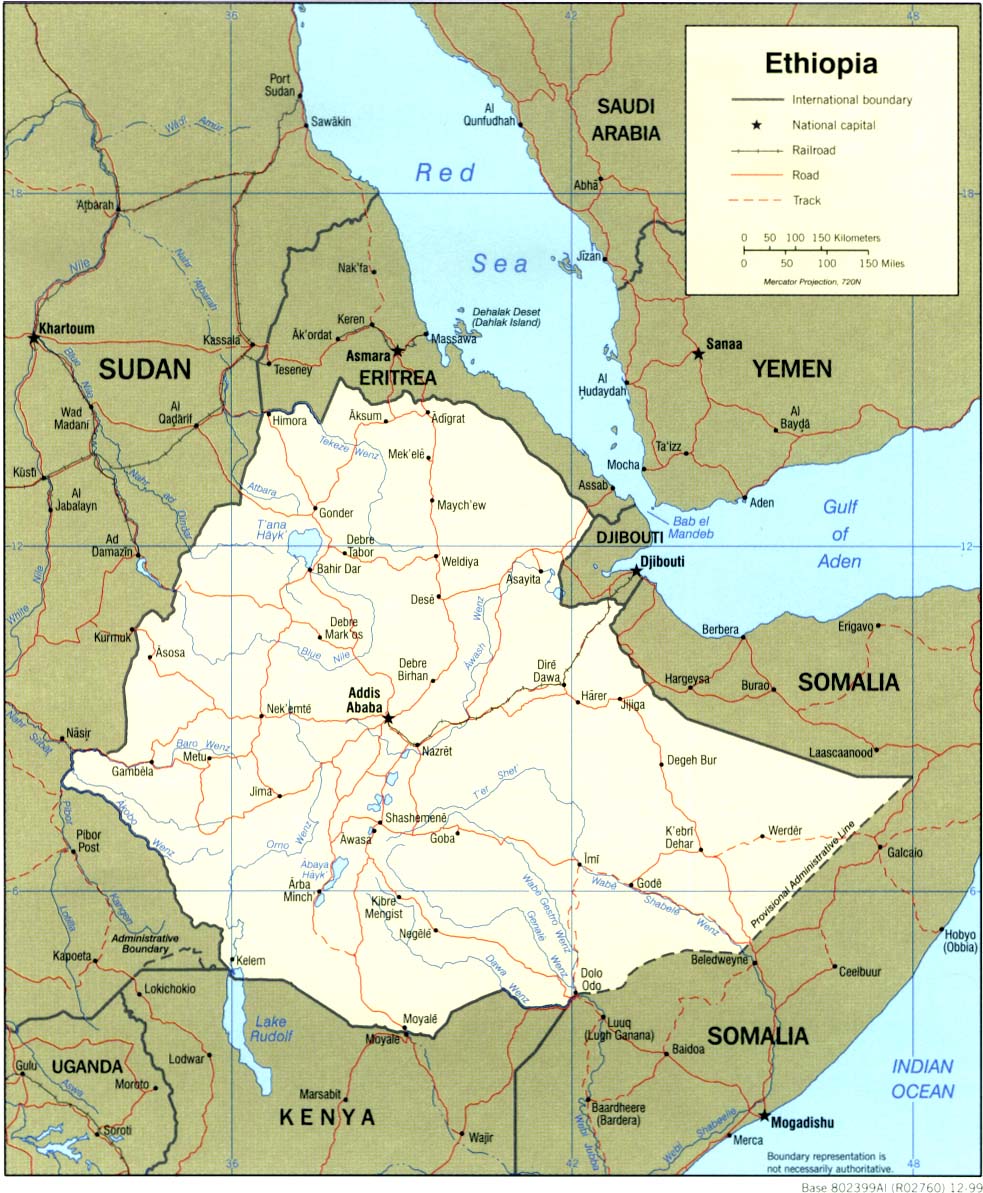
Ethiopia, 1978: One More Equal Than Others

From The Fate of Africa: A History of Fifty Years of Independence, by Martin Meredith (PublicAffairs, 2005), pp. 245-248:

In September 1976 the Ethiopian People’s Revolutionary Party (EPRP), drawing support from the labour unions, teachers and students, all vehemently opposed to military rule, embarked on a campaign of urban terrorism against the Derg and its civilian ally, the All-Ethiopian Socialist Movement, usually known by its Amharic acronym, Meison. An assassination attempt was made on Mengistu in the centre of Addis Ababa in September, the first of nine such attempts. Scores of officials and supporters of the Derg were murdered. The Derg in turn sent out its own murder squads…. By mid-1977 the EPRP was effectively destroyed. In the final phase of the red terror, to establish his own supremacy, Mengistu turned on his Meison allies, destroying them too. The young generation of intellectual activists, who had so avidly supported the revolution were all but wiped out.

Mengistu’s hold over other parts of Ethiopia was nevertheless precarious. By mid-1977 the Ethiopian army in Eritrea had lost most major towns and controlled little more than Asmara and the ports of Massawa and Assab. In July 1977 Somalia, deciding the time was ripe to take advantage of the Derg’s preoccupation with Eritrea and other revolts, launched a full-scale invasion of the Ogaden. By August the Somalis controlled most of the Ogaden. In September they captured Jijiga, an Ethiopian tank base, and pressed on towards the town of Harar and the rail and industrial centre of Dire Dawa, the third largest city in Ethiopia.

What rescued Mengistu from military defeat was massive intervention by Soviet and Cuban forces, determined to prop up his Marxist regime. In November 1977 the Soviets mounted a huge airlift and sealift, ferrying tanks, fighter aircraft, artillery, armoured personnel carriers and hundreds of military advisers to Ethiopia. A Cuban combat force numbering 17,000 joined them. Led by Cuban armour, the Ethiopians launched their counter-offensive in the Ogaden in February 1978, inflicting a crushing defeat on the Somalis. The full force of the Ethiopian army, supported by the Soviet Union, was then turned on Eritrea.

At the fourth anniversary celebrations marking the overthrow of Haile Selassie in 1978, Mengistu sat alone in a gilded armchair covered with red velvet on a platform in Revolution Square in Addis Ababa watching a procession of army units and civilian groups pass before him. Then he returned to his headquarters at the Grand Palace. Having succeeded in holding the old empire together, he liked to portray himself as following a tradition of strong Ethiopian rulers. Indeed, Mengistu came to be compared with the Emperor Tewodros, a nineteenth-century ruler who started his career as a minor local chieftain, fought his way up to take the Crown and then strove to reunite the empire after a period of disintegration. At official functions at the Grand Palace, while members of the Derg stood respectfully to one side, Mengistu chose to preside from the same ornate chair that Haile Selassie had once favoured.

One of his ministers, Dawit Wolde Giorgis, once a fervent supporter of the revolution, recalled his growing sense of disillusionment.

At the beginning of the Revolution all of us had utterly rejected anything having to do with the past. We would no longer drive cars, or wear suits; neckties were considered criminal. Anything that made you look well-off or bourgeois, anything that smacked of affluence or sophistication, was scorned as part of the old order. Then, around 1978, all that began to change. Gradually materialism became accepted, then required. Designer clothes from the best European tailors were the uniform of all senior government officials and members of the Military Council. We had the best of everything: the best homes, the best cars, the best whisky, champagne, food. It was a compete reversal of the ideals of the Revolution.

He recalled, too, how Mengistu changed once he had gained complete control.

He grew more abrasive and arrogant. The real Mengistu emerged: vengeful, cruel and authoritarian. His conduct was not limited by any moral considerations. He began to openly mock God and religion. There was a frightening aura about him. Many of us who used to talk to him with our hands in our pockets, as if he were one of us, found ourselves standing stiffly at attention, cautiously respectful in his presence. In addressing him we had always used the familiar form of ‘you’, ante; now we found ourselves switching to the more formal ‘you’, ersiwo. He moved into a bigger, more lavish office in the Palace of Menelik. He got new, highly trained bodyguards – men who watched you nervously, ready to shoot at any time. We now were frisked whenever we entered his office. He began to use the Emperor’s cars and had new ones imported from abroad – bigger, fancier cars with special security provisions. Wherever he went he was escorted by these cars packed with guards, with more riding alongside on motorcycles.

He concluded: ‘We were supposed to have a revolution of equality; now he had become the new Emperor.’

You get the same result every single time a revolutionary thug promises equality—and begins to deliver it with the help of other revolutionary thugs. Every French Revolution yields a new Robespierre—and then a new Napoleon.

1 Comment

Filed under Cuba, Eritrea, Ethiopia, labor, language, military, USSR, war

Baciu’s Memories of Brasov: Languages, Holidays

From Praful de pe Tobă: Memorii 1918-1946, by Stefan Baciu (Editura Mele, 1980), pp. 8-9 (my translation):

I was sent to a Saxon kindergarten. It seems to me that it would have been on Castle Street, beneath Mt. Tâmpa, but I don’t remember the exact location, even though I can still see before me the dark stairway to the upper floor. Fraülein’s name would seem to have been Liewehr, and I see myself singing, leaping like a pony, hear melodies like “Wulle, wulle, Gänschen” and “Alle Vögel sind schon da,” and see myself sitting on a stool cutting stars out of cardboard for the Christmas tree, on each of which Fraülein had written in gothic letters “Ştefan” and which Mama used to hang from the tree year after year. At about the same time, I went once or twice a week to a nursery school where we learned French with the Grande Dame Staia, singing “Savez-vous planter le chou.”

My education was, from the beginning, trilingual: Romanian at home, German in my earliest schools, Hungarian with the maidservants, because the latter all came from Szekler villages. Hungarian, I haven’t heard since leaving Brasov in 1937, and I’ve almost totally forgotten it, except for the songs I used to hear in the kitchen or on the Promenade, where we used to go for walks, listening to the city orchestra composed of solemn gentlemen in black jackets and stovepipe hats.

Christmases were celebrated at our home, where all the family gathered, but from the morning of Christmas Eve we were sent to my Aunt Jenny, who lived far from us, sometimes on Fork Street (Cuza Voda), sometimes on Postal Orchard. My parents felt bound to resort to this strategy because it was hard for them to restrain me until the arrival of the “Angel.” In those years, Father Christmas didn’t exist in Transylvania, and Saint Nicholas used to come on the evening of the 6th of December.

Otherwise, these traditions were scrupulously respected at home. At Easter came the Bunny, with Father making the sound of speedy steps going into the distance, to show that the Bunny had run past our house, leaving behind red eggs and chocolates, mandarins, and oranges. On the 6th of December came Saint Nicholas, with a big sack on his back, with a fur hat over his eyes and a white beard, in whom I believed with a religious intensity until I discovered that he wore the same gaiters as Father, and which he had bought a few days earlier at Lischka.

Christmas was, of course, the ultimate celebration, with a tree that reached to the ceiling, mountains of presents (the maidservants would carry theirs off in woven clothes baskets), a huge meal, interrupted by carolers who came down from Şchei hillside, or up from Old Brasov, who ended off with the chorus “To Şaguna High School” before being invited to partake of wine and pound cake. Name days were not celebrated; instead, birthdays had a special importance, with a ritual I still follow today, across decades and continents. Speaking of religious celebrations, I cannot forget Epiphany, when on the Twelfth Night came the archpriest Iosif (Sâvu) Blaga or the priests Nae Stinghe and Furnica, who had baptized me, and was now professor of religion at the “Real School” (Liceul Dr. Ioan Meşota).

NOTES: ‘The Grande Dame’ renders doamna maior; ‘stovepipe hats’ renders ţilindru pe cap (usu. cilindru) ‘cylinder on the head’; ‘continents’ renders geografii ‘geographies’; ‘Father Christmas’ renders Mos Crăciun; ‘Epiphany’ renders Bobotează (cf. boteza ‘baptize’); Twelfth Night (= Epiphany) renders Iordanul (the Jordan [River]); archpriest = protopop. I hadn’t realized that the Epiphany holidays came to focus on the baptism of Christ (in the Jordan River) among Eastern-rite Christians but on the coming of the Magi among Western-rite Christians. The Wikipedia entry for the holiday contains an interesting observation that may apply to Transylvanians in general: “Hungarians, perhaps because of their location between East and West, celebrate the coming of the Magi, but refer to the celebration as Vízkereszt or “water cross,” clearly a reference to baptism.”

Leave a comment

Filed under Austria, education, Hungary, language, religion, Romania

Baciu’s Memories of Brasov: Earliest Friends

From Praful de pe Tobă: Memorii 1918-1946, by Stefan Baciu (Editura Mele, 1980), pp. 6-8 (my translation):

On the floor below lived Major Mihailescu, who had two children, Mircea and Coca (the daughter had an air I now recognize as Japanese), with whom I didn’t become friends. The major had an orderly he called Zachariah, with whom the maidservant who used to take me for walks had fallen in love, calling him “Zakarias” and singing a pitiful song that ended with the words “Zakarias szép eletem.” One day, the major had a conflict with Mr. Borescu, apparently having to do with the beating of carpets at unauthorized hours. When the insulted concierge leapt up to hit the major, the latter rushed into his house, from which he appeared in a martial pose, brandishing a saber in the air like a fencer, threatening the head of the typographer, who didn’t know how to respond to this unexpected invitation to a duel. I remember that during the 1940s, as a discharged general, Mihailescu was named inspector of the casino in Sinaia.

In the back of the courtyard lived Doctor Valeriu Negrila, married to a beautiful Polish woman. I was friends with their daughter, Valerica, while I was little, but later, as often happens, we drifted apart and hardly even greeted each other when I became a “Şagunist” and she a student at the Princess (Elena). One day when I was returning from a walk with the maidservant, I saw two people dressed in white carrying a stretcher on which lay a body covered with a sheet, with locks of black hair hanging out from under it. The maidservant later told me that Valerica’s mother had been found to have “taken poison,” but after a few days I saw her passing through the courtyard with Valerica in tow. I don’t recall the other neighbors, but I cannot forget the entrance hallway in the evenings, with gilded metal bars glittering in the light of the bulbs, and marble veneer shining in a way that seemed fairylike.

Just outside the alleyway, on the right and left were two shops: Lischka, men’s clothing; and Books Cooperative Enea, Stinghe, and Ţigoiu, one of whose owners, Professor Sterie (Sterica) Stinghe, had written a few books about the history of Brasov, and whose wife, named Lucia I think, had the habit of strutting around haughty and elegant, the tapping of her high heels audible from far off.

I lived on Customs Street, I believe, until around 1928–29, when I finished primary school, thus eight or nine years, maybe ten. The fact is, I cannot recall exactly when we moved from Spitz Palace, just as I cannot remember exactly when we left Prundul Florilor.

But I have some vivid memories of the building, which during the early years did not yet have electric lights. I recall those autumn days when Mr. Stroescu, the father of my primary school classmate, Elena Stroescu, used to set up his machine in the Graft Valley, beyond the walls, and cut whole cartloads of wood, which after being chopped up was hauled into the cellar on a kind of wooden stretcher by backwoodsmen hired by the day, who at lunchtime would pull out of their knapsacks “pită şi slană” [bread and fatback, usu. slănină] eating slowly and silently.

I recall going with the maidservant to the first silent films I saw at the movie theatre Modern (a wooden shack sitting on the site they later made into the city park), where I enjoyed watching Lia Mara, Maciste, Zigoto, Fatty, Harry Piel, Pat and Patachon, with little Patachonel, and then returning at nightfall to find at the entrance to our apartment dozens of galoshes and overshoes belonging to the “students” at the night classes Father used to teach in the years after unification [of Transylvania and other territories with the Old Kingdom of Romania]: bank directors, officials, attorneys, merchants, who were keen to learn Romanian in those first years of Greater Romania. About that time, Zeidner Books had come out with a grammar of Romanian for foreigners, whose authors were Father and Michael Teutsch. It was a bit slapdash, of a type the Saxons called Zwinkelmisch [lit. ‘twinklemix’], but it sold well and was reprinted several times.

After the students left, Father used to amuse himself by telling stories about the mistakes his “students” would make. Carved in my memory are words like “Berger-leţkia” (lecţia) [lesson], or “tratavitele” in place of tratativele [‘negotiations’], which the Hungarians and Saxons had trouble pronouncing, as they did â as opposed to a. Other friends that I remember from the age of 4 or 5, besides Puiu Borescu and Valerica Negrila, were the sisters Takáts, Tony and Baba, somewhat older than me.

On the Promenade, where I went with the maidservant, I had “friends” who seemed at that time to be over a hundred years old, if not older: “Old Man Snow,” gone completely white, who talked with me as if I was his age, whom they used to call Cipu (Cipariu) or Ţipu, and who I believe was a judge on “penzie” [pensie ‘pension’]. One “friendship” that my parents did not regard well was that with the doctor of law, Aurel Olteanu, who wore a shiny clip on his tie, patent leather shoes with laces, and a long, sturdy cane, with whose handle he would hook my calf, while glaring at me with bulging eyes and shouting: “I’ve got you, you knave! I’ve got you, you bandit!” To me, the words were amusing, as I knew what bandit meant (Tomescu and Munteanu were famous bandits at the time), but I had no idea what knave [şnapan] meant and my parents showed themselves to be less than enchanted by this “enrichment” of vocabulary. The third “friend” was a little, or rather a short, elderly man, Patruţ Pop, wrapped summer and winter in a long overcoat, something between a blanket and a frock, wearing a black hat, who would stroke my head without saying a word. I vaguely remember having heard that Patruţ Pop was from the family of someone who had played a leading role on the Field of Liberty, at Blaj [in 1848]. As I grew and entered primary school, I lost track of those friends of my early childhood.

NOTES: Baciu spelt cearşaf ‘sheet’ as cearceaf—it’s just the difference between English sh and ch. A “Şagunist” is a student at Andrei Şaguna High School. After failing to find clipici in my dictionaries, I translated it ‘slapdash’ (after considering ‘rush job’), despite its relation to a clipi ‘to wink, blink’ (and its Saxon equivalent, Zwinkelmisch). The hardest phrase to translate in this passage was de moţi tocmiţi cu ziua, which didn’t make sense until I found that Moţi designates people from the Western Mountains (Munţii Apuseni) of Transylvania, sometimes known as Ţara Moţilor, known for their pre-Roman features, archaic customs, isolated settlements, and fierce independence—sort of the West Virginians of Transylvania. An explanatory translation like ‘men from Munţii Apuseni hired by the day’ was too long-winded, while ‘hillbilly day-laborers’ was too pejorative. I almost went with ‘itinerant woodcutters’ before settling on ‘backwoodsmen’.

Leave a comment

Filed under Austria, Hungary, language, Romania

POW Language Use, Nagasaki, 1944-45

My sociolinguistics professor in grad school once opined that the best place to learn a foreign language was in a foreign prison. I assume he was thinking of the advantages of a complete immersion environment, total physical response methodology, and very rigorous incentive structures.

He must have been at least half serious, because he later applied for a grant to fund an audacious experiment to see what innate linguistic structures might emerge in an isolated, silently administered camp whose workers were recruited in equal numbers from communities speaking languages of a full range of word-order typologies and in minimal prior contact with typologically different languages. I believe the granting agency’s Committee on Human Experimentation nixed the proposal, for reasons one can well understand.

What makes me recall this is the abundance of fascinating bits of data about foreign language learning in prison that I’ve been finding in one of the books I’m currently reading, First into Nagasaki: The Censored Eyewitness Dispatches on Post-Atomic Japan and Its Prisoners of War, by George Weller (1907-2002), ed. by Anthony Weller (Three Rivers, 2006). Here are some of the insights of the reporter and the prisoners themselves, arranged under a few general headings.

Incentive Structure

Tervald Thorpson (Wadena, Iowa): “I managed to go a whole year without being beaten. Americans worked hard in the mine, but some had difficulty learning Japanese, and misunderstanding commands got them beatings.” (p. 97)

Sergeant Robert Aldrich (Capitan, New Mexico): “I was in the mine ever since it opened, but I was more fortunate than most because I learned Japanese, thus avoiding beatings due to misunderstanding.” (p. 101)

Methodology

Oscar Otero of Los Lunas, a husky New Mexican captured on Bataan, learned Japanese by being chauffeur to a colonel. By refusing to allow him to talk any Filipino [?], the Japanese furnished the coal mine prisoners with their ablest unofficial interpreter. (p. 88)

Bilingual Assistants

Dark-skinned Junius Navardos (Los Angeles): “Pressure in the mine caused me to pass out once while working. When I came around in the hospital I found myself with burned patches all over my skin. The boys told me that the burns had been made by an American-educated interpreter, Yamamuchi [prob. Yamaguchi], whom we called Riverside because he was brought up there. Asked whether he had done the burning, the interpreter told the doctor, ‘Yes, I did this, because I thought he was feigning.'”

Leland Sims (Smackover, Arkansas): “Many guards could speak English. One who we called Long Beach, because he was educated there, caught me smoking and said, ‘It’s all right with me, but don’t let the other guards catch you.'” (p. 96)

Japanese for Special Purposes

Corporal James Brock (Taft, Texas): “I was most often overworked by a boss we called Shitbird, usually with a hammer handle or a mairugi—that’s a small timber [丸木 maruki ’round wood = log’?]. He hit everybody who passed him, whether you belonged to his shift or not. I’m sorry he’s disappeared since the camp was liberated.” (p. 86)

Henry Sublett of Cisco, Texas, a Marine captured on Corregidor: “I was down with pneumonia and worked in the mine both after and before. Our first Buntai Joe [分隊長 buntaichō ‘squad leader’], or overseer, used to be drunk all the time and beat me every day for my first three months. He always used to the day start off with a few savas [サービス = sābisu ‘freebie’]—meaning ‘gifts’—of blows.” (p. 88)

Runge, captured at Singapore, was “an old Aussie,” which means he arrived at the Mitsui camp and entered the coal mine in June 1944, joining the Bataan and Corregidor Americans who had already been toiling for nearly a year underground. By February 1945 Runge was instructing “new Aussies” in the use of a jackhammer. He was showing F. R. Willis and Robert Tideswell how to chip rock, the whole party being under an overman named Katu-san [prob. Katō], when three cars carrying coal ran off the rails, causing Katu-san’s temper to do likewise. Saying “Dummy, dummy, that’s no good,” the Japanese promised that he would report Runge for haitis savis [兵隊サービス heitai sābisu ‘soldier freebie’], meaning “military gifts”—that is, a beating. (p. 104)

The idea of the camp administrator, Captain Yuri, was that a prisoner’s main and only job was to dig coal for the Japanese, and his only reward for twelve hours’ daily labor should be his salary of three-quarters of a cent daily, plus a yassamai [休み yasumi ‘rest’] or rest day every ten days or so. (p. 108)

With the arrival by train from Nagasaki of the first Army-Navy team for the evacuation of Kyushu’s largest prisoner of war camp, the final sinkes [出欠 shukketsu ‘attendance, (take) roll’] (Japanese for roll calls [otherwise 点呼 tenko lit. ‘point call’]) were sounding today over the grimy buildings and meagerly-clad G.I.s. This camp, 1,700 strong—700 being Americans from Bataan and Corregidor—has been thinned already to 1,300 by impatient ex-prisoners, mostly Americans, who have hit the high road for the American airbase at Kanoya in southernmost Kyushu. (p. 92)

So profound is the prisoners’ hatred of Baron Mitsui’s coal mine, the Japanese military police, and the aeso [営倉 eisō] or guardhouse where five Americans have found a violent death, that the entire camp would probably have been deserted had not the Army-Navy team arrived today. Hospitals filled with cases of malnutrition, diarrhea, beriberi, and mutilated men offer special problems. (p. 92)

Graduate Assistants

Pharmacist William Derrick (Leesville, Louisiana): “The Korean straw bosses were decent to us except when the Japs were around, who frightened them.” (p. 96)

Sergeant Wiley Smith (Coushatta, Louisiana): “We looked across the bay toward Nagasaki after emerging from the mine and saw black smoke starting up. The atomic bomb, falling ninety minutes before, had kindled Nagasaki. Our Japanese bosses kept pointing that way and chattering. It was better than Germany’s surrender, which we only heard about from Korean miners.” (p. 91)

Thoughts on Graduation

Navy Cook Laurel Whitworth (Bourne, Texas): “Leaving Japan for me means not having to cook any more dogs to eat. One day I had to cook sixty-nine, another seventy-three, another fifty-five. I hate cooking dogs.” (p. 94)

4 Comments

Filed under anglosphere, Japan, language, U.S., war