Category Archives: Japan

Wordcatcher Tales: biombo, subaru

Biombo – The Spanish term biombo ‘folding screen’ comes from Japanese byōbu (屏風 ‘wallwind’ or ‘screenwind’) for the same item. I first learned the term in the caption to Fig. 9 in the book I’ve been reading, Seven Myths of the Spanish Conquest. The figure shows an oil-painted canvas biombo depicting “The Encounter of Cortés and Moctezuma” as imagined by the artist Juan Correa c. 1683. It goes on to describe biombo as “a popular Mexican artform introduced by the Japanese ambassador to Mexico City in 1614”! This left me skeptical because Tokugawa Japan (1600–1868) is far better known for its policy of national seclusion (sakoku) than for international outreach.

But in fact Tokugawa Japan did engage in a bit of outreach before the 1630s. In 1613, Date Masamune, first lord of Sendai, had Japan’s first galleon built in Ishinomaki (one of the cities hardest hit by the 2011 tsunami). Later christened the San Juan Bautista and laden with ceremonial gifts, it set sail for Acapulco in New Spain with Japan’s first ambassador to the Vatican, Hasekura Rokuemon Tsunenaga (支倉六右衛門常長, also spelled Faxecura Rocuyemon in Spanish sources), who spent time in Mexico City in 1614 and again on his return trip in 1618. About 60 of his Japanese compatriots who remained in Mexico until his return were baptized there as Christians. Hasekura himself waited until he got to Spain before being baptized as Francisco Felipe Faxicura.

Subaru – I was shocked a few months ago to realize that I had never bothered to wonder what the name Subaru means in Japanese. The logo on Subaru cars should perhaps have given me a hint, but I only found out about the Japanese meaning from a linguist friend who was researching whether the position of the Pleiades marks a seasonal cycle in any languages I was familiar with in Papua New Guinea.

In Numbami, the two words used to translate English ‘year’ are damana, which also means ‘Pleiades’, and yala, which comes from German Jahr. According to Streicher’s (1982) Jabêm–English Dictionary entry for dam(o): “The Pleiades are the main constellation seen in Jabêm during the dry season (October to March), and governing their activities in their gardens, i.e. the felling of trees to clear the ground for new gardens; the burning and planting of fields is done according to the position of the Pleiades.”

In Japanese, ‘Pleiades’ is usually rendered into プレアデス星団 Pureiadesu seidan (= ‘star group’), but the older native Japanese name for the cluster is Subaru, and the Chinese character for it is 昴, pronounced BOU in Sino-Japanese. I’m not aware that the Pleiades play any role at all in Japan’s highly conventionalized seasonal cycles, but the constellation may be a convenient symbol of the five divisions of Fuji Heavy Industries that merged to create the Subaru car company.
3 Comments

Filed under art, Japan, language, Mexico, migration, Philippines, scholarship, science, Spain

Vietnamese Disciples of Fukuzawa Yukichi

From A Story of Vietnam, by Truong Buu Lam (Outskirts, 2010), Kindle Loc. 2512-2567:

Phan Chau (or Chu) Trinh (1872-1926), like Phan Boi Chau, had his eyes fixed on independence for his country. Unlike Phan Boi Chau, he was a doctorate (tien si [Ch. 進士 jinshi]) degree holder and had made a short stint of two years in the mandarinate before engaging in a life of a political activist. He went to Japan with Phan Boi Chau, but came back with a completely opposite program of action. He seriously opposed any use of violence in the struggle for independence, and vehemently rejected any interference or assistance, military or otherwise, from any foreign country. He advocated a republican regime in which the people can exert influence over the conduct of public affairs. He promoted a slow but secure march toward independence and civilization, even if need be, under the leadership and guidance of the protecting power that is France.

In 1906, he wrote an open letter to the Governor General of Indochina in which he vented out his frustration in a scathing accusation of the indigenous mandarins who took refuge under the wings of the colonial authorities to abuse with impunity the common people of Vietnam. (An English translation of this document can be found in Colonialism Experienced, Ann Arbor, 2000, p. 125-140.)

In 1907, with a group of Confucian scholars such as Luong Van Can, Nguyen Quyen, Dao Nguyen Pho, Duong Ba Trac, Le Dai and Hoang Tang Bi, he helped create a new type of school modeled after the Keio Gi[j]uku University which was established in Tokyo by a Japanese educator and reformist, Fukuzawa Yukichi. The Vietnamese school was called Dong Kinh Nghia Thuc [東京義塾] (Japanese: Tokyo Gi[j]uku; English: The Eastern Capital Free School). Its existence was sanctioned by a decree of the French colonial government dated March 1907 and its demise was imposed by another decree dated December of the same year.

The school’s life was indeed short, but its influence on the people reached beyond any calculation. It was the first experiment in mass education. Thousands of students of all ages flocked to the school in the evening hours to listen for free to scholars talking frequently about the humanities: morality, human rights; occasionally about the social sciences: economics, political regimes. They taught national history; resuscitated famous personalities of the world; they discussed about the relative advantage of modernization versus westernization; they tried to inculcate into the young minds the virtue of patriotism, loyalty, propriety. Some teachers even introduced to their students rudiments of science and technology. Within a couple of months, branch schools were established in many other cities.

…

In addition, the teachers adapted dozens of old proverbs and sayings to contemporary situations; they composed songs in verse encouraging their students to learn the quoc ngu, not to hesitate to go abroad to study, to read newspapers everyday, to have their hair cut short, not to smoke opium nor to drink alcohol, not to gamble, not to succumb to female charms.

Such was the success of the school that the French authorities felt threatened and so they decided to shut it down in December of the same year that it opened. The ideal of non violence that had been ardently promoted by Phan Chau Trinh was put to a serious test and it failed.

For this reason, he wanted to experiment with something else. In 1908, in the province of Quang Nam, the people complained that their taxes were too high and the days they had to work without pay for the government too numerous. They took their protest to the provincial capital city in a relatively orderly demonstration. Rapidly, the movement spread to neighboring provinces. The repression came swift, harsh and not too orderly. Many scholars were implicated in the movement. The French executed Tran Quy Cap (1870-1908) a tien si degree holder (1904) and a member of the mandarinate. The monarchical tribunal sent Huynh Thuc Khang (1876-1947), Phan Chau Trinh and Ngo Duc Ke (1878-1929), all three tien si as well, to the infamous penitentiary on the island of Poulo Condore (Con Non or Con Son). Fortunately for Phan Chau Trinh, his resourceful friends alerted the Society for Human Rights which persuaded the government to commute his sentence to exile in France to start in 1911.

While living in exile, Phan Chau Trinh became the patriotic icon around which the Vietnamese community in France rallied itself. During the first world war, he was incarcerated at the Sante Prison, suspected of contacting the Germans for help to liberate his country. He must be innocent of this charge given his revulsion toward violence and his distaste for foreign intervention.

…

During his stay in France, Phan Chau Trinh wrote several books, among which the best known was a collection of poems he composed during his incarceration at the Sante Prison. Two books of his have been published and confiscated several times right after they were put on the shelves; consequently, they were known only by their titles. One was a Song to Awake the Soul of the Nation (Tinh Quoc Hon Ca [醒国魂歌 Ch. Xingguohunge?]), and the other was a long “epic” poem of 3620 verses written in nom in the style of six and eight syllables. Entitled Giai Nhan Ky Ngo Dien Ca (The Marvelous Encounter of Wonderful People, In Verses) it relates the adventures of a group of friends, belonging to all nationalities, bound together by the virtues of loyalty and friendship, even tinted with some romance. This epic poem was, in fact, an adaptation in verses of a book entitled Jia Ren Qi Yu [佳人奇遇] (Giai Nhan Ky Ngo) that Liang Qichao himself translated from a Japanese work [佳人の奇遇 Kajin no Kigū Strange Encounters with Beautiful Women by Shiba Shirō].

Phan Chau Trinh’s many requests to the Ministry of Colonies for his repatriation were finally granted in 1925. Back in Saigon, he gave a number of public talks on the subjects of monarchy and democracy, virtue and morals in the East and the West.

Leave a comment

Filed under education, France, Japan, language, nationalism, Vietnam

Wordcatcher Tales: Menbei, Yuzusco, Hakugei

While we were shopping for light, comestible omiyage (souvenirs) to bring back from Japan this summer, we came across three products of linguistic as well as gustatory interest.

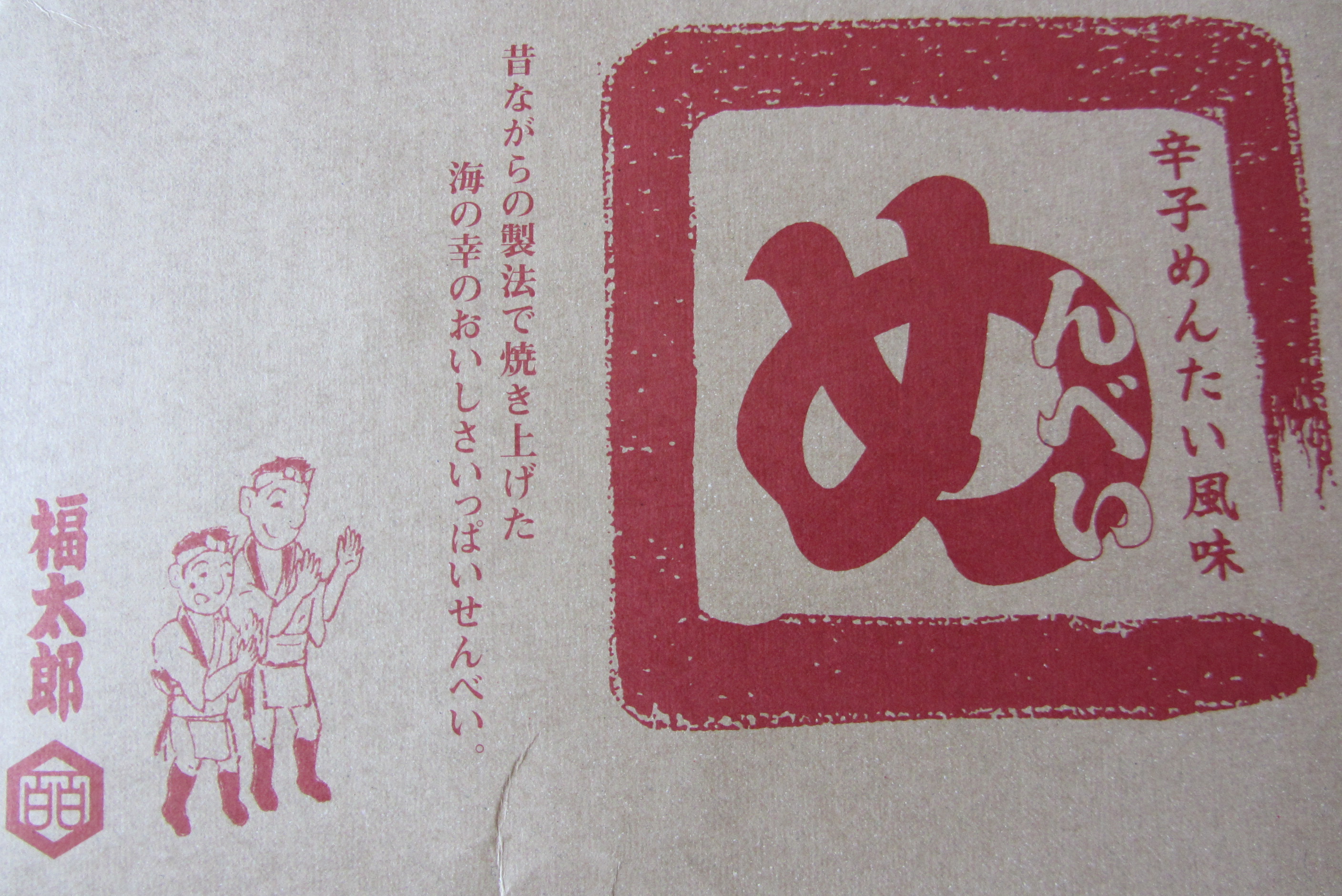
mentai + senbei = menbeiMenbei < mentai senbei – Korea is the source of one well-known item of Hakata (Fukuoka) cuisine, 辛子明太子 karashi mentaiko ‘spicy cod/pollock roe’. The name mentai apparently derives from Korean 명태 myeongtae ‘Alaskan pollock’. Its genus (Theragra) is different from that of the Atlantic pollock (Pollachius), but both fall within the highly prolific family Gadidae (< Gadus ‘cod’) ‘cod, haddock, pollock, whiting’. We bought a few boxes of spicy mentai-flavored rice crackers to share with our colleagues at work. Their pungent aroma caused some comment.

Yuzusco & ShogascoYuzusco < yuzu ‘citrus’ + (taba)sco – The fresh taste of yuzu (柚子) is very popular in Japanese cuisine and is used to flavor many different things: from savory chawanmushi to sweet honey, bitter tea, vinegar, wine, and even bath oil. We brought back some tiny jars of yuzu pepper paste and two hot sauces marketed as under the brand names Yuzusco and Shogasco (< shouga ‘ginger’ + -sco). I’m not sure if the makers of Tabasco have licensed just the last three letters of their registered trademark, but they apparently encourage co-branding. Nor am I sure where these products rank on the Scoville scale of spicyness.

Sampler of five types of shochuHakugei ‘White Whale’ – At a duty-free shop at Fukuoka Airport, we got a sampler of five small bottles of shochu, a longtime Satsuma (Kagoshima) specialty. (The cashier unboxed them and put them in little transparent baggies so we could take them through security!) They included 麦わら帽子 Mugiwara Boushi ‘barley-straw hat’, made from barley; two types of Satsuma 白波 Shiranami ‘white wave’ made from sweet potato (my favorite) with dark and light molds; 白鯨 Hakugei ‘white whale’, made from white rice; and 蕎麦蔵 Sobagura ‘buckwheat granary’, made from buckwheat. Shiranami is perhaps the most famous brand name of Satsuma shochu, but the other brand names were well chosen to reflect their ingredients. As one might expect, Hakugei tasted the most like sake. I prefer sweet potato shochu myself.

Leave a comment

Filed under food, Japan, language, travel

Wordcatcher Tales: Dorui, Kangou, Funkyuubo, Fujo

The first tourist site we visited on our most recent trip to Japan was Yoshinogari Historical Park in Saga Prefecture, on a stretch of open countryside that turned up lots of artifacts from the Yayoi-period (roughly 300 B.C. to A.D. 300), including many large burial jars, when developers began to prepare the ground for a large shopping center. The site was then turned into an historical park featuring “one of Japan’s largest moat-encircled villages and ancient ruins.” In fact, another pair of visitors we met there were from Perth, Australia, a mother and her daughter who had won a national essay contest by presenting the case for Yoshinogari to be designated a UNESCO World Heritage Site.

The signs describing the major features of the park were quadrilingual—in Japanese, English, Korean, and Chinese (simplified characters)—and one of the guides we met was a young lady from Dalian, China, who spoke some English and Russian in addition to Chinese and Japanese. (She was eager to practice her English, which was full of reading pronunciations.) Thanks to the helpful furigana on those signs, I learned a few new Japanese words and readings that were not even in my old Canon Wordtank G55 electronic dictionary. Here’s a sample.

土塁 dorui ‘earth fort, earthworks’ – The earliest forts in Japan apparently consisted of earthworks, palisades, and moats. The character 塁 ‘fort, rampart’ can be a synonym for 砦 toride ‘fort, stronghold, entrenchment’, but is now much more common in baseball, where it means ‘base’, as in 塁審 ruishin ‘base umpire’ or 塁打 ruida ‘base hit’.

環濠 kangou ‘ring trench‘ – The usual word for the ‘moat’ around Japanese castles is 堀 hori ‘ditch, canal’, related to the verb horu ‘to dig’. By itself, 濠 gou is better translated ‘trench’ (also ‘dugout, foxhole’), another product of digging. The character 環 kan ‘ring, circle, loop’ also occurs in 環境 kankyou ‘environment, circumstances’ (lit. ‘circle boundary’) and 環礁 kanshou ‘atoll’ (lit. ‘fringing sunken-rock’).

墳丘墓 funkyuubo ‘mound-hill-grave‘ – The common word for ‘grave’ is 墓 haka (Sino-Japanese bo) as in 墓石 boseki, hakaishi ‘tombstone’ or 墓堀 hakahori ‘grave digger’. A normal-sized grave mound is 墳墓 funbo ‘mound grave, tomb’, but a seriously hill-sized grave mound is 墳丘墓 funkyuubo (with 丘 ‘hill’, read oka in many placenames). Grave-mound building was carried to even greater extremes during the next major period of Japanese history, the Kofun 古墳 (‘old tomb’) period (c. 250–538).

巫女 fujo, miko ‘shaman, sorceress, shrine maiden’ – After immigration from the Korean peninsula began, but before Buddhism was established (during the 8th century), the chief spiritual practitioner in Japanese villages was a shaman, who was usually female, although the etymology of 神子 miko lit. ‘god-child’ is gender-neutral.

Leave a comment

Filed under baseball, Japan, language, military, travel

Wordcatcher Tales: Japanese Fish Names

During our recent travels to far-outlying corners of Japan we came across several local specialties that I had never heard of before. When I solicit the names for new dishes in Japanese, I often end up learning new fish names in English, just as I did long ago doing linguistic fieldwork in a coastal village in Papua New Guinea. Here is a sample of new fish we tried at izakaya last month.

Slender sprat sashimi

At the fine Umaya Restaurant beside JR Kumamoto Station, we ordered kibinago sashimi. After failing to find kibinago in my old Canon Wordtank G55 electronic dictionary, I asked the waitress if she could find out what to call it in English. She came back and showed me the gloss in her electronic dictionary, ‘silver-stripe round herring’. This slender sprat, Spratelloides gracilis, is often used as a bait fish, but also makes a very attractive dish of sashimi.

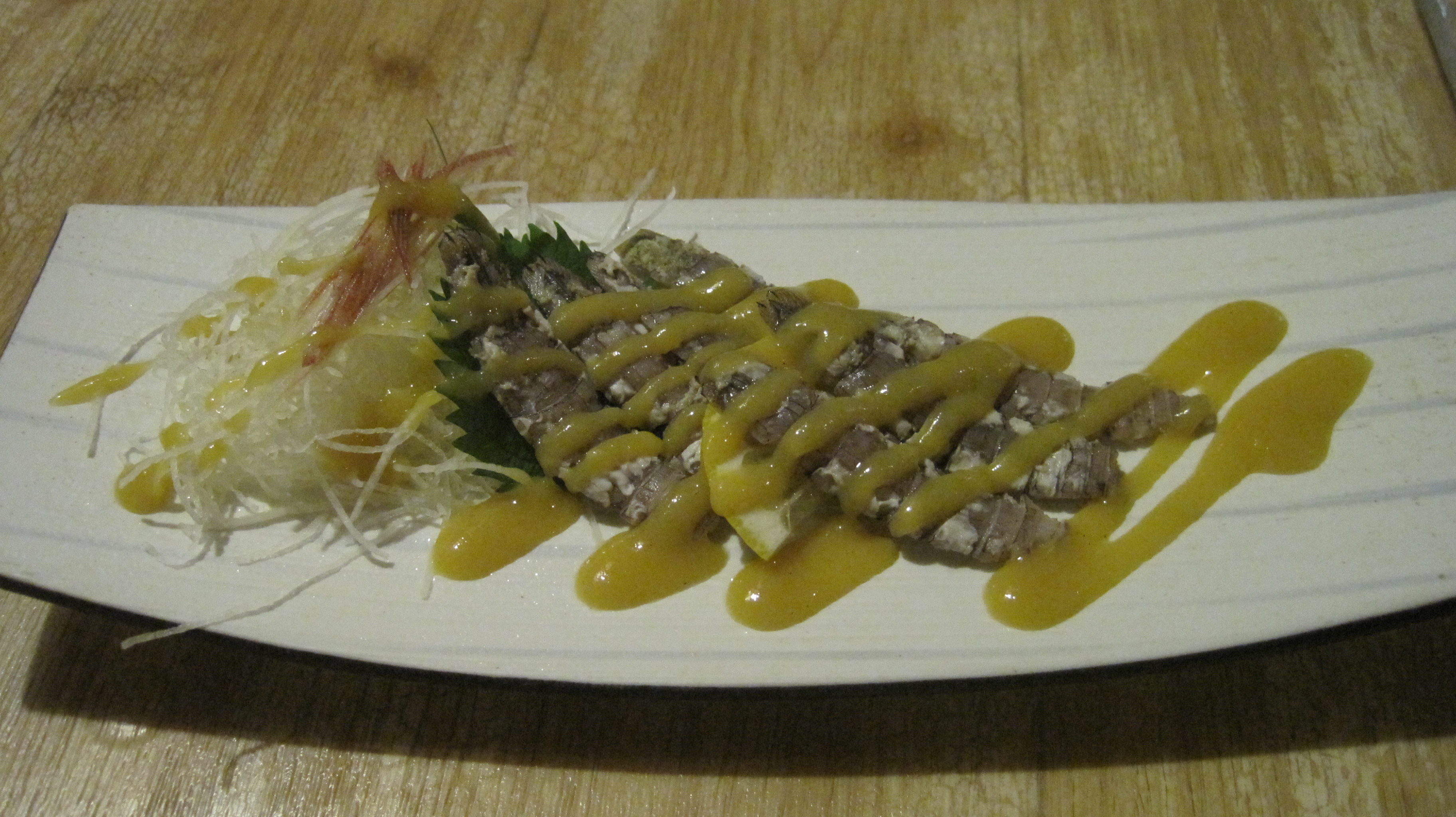
Mantis shrimp sashimi

On the way up from Kyushu, we stopped overnight at Shin-Yamaguchi, an old railway junction city (Ogōri) that was renamed and upgraded to a Shinkansen station but still proudly displays memorabilia from the old days. The owner of the izakaya we had dinner at was a train buff and the walls of our booth were covered with posters and photos of old steam locomotives. Among the novelties we ate there was shako sashimi, mantis shrimp (Squilla sp.) with ginger mustard sauce to counter the fishy taste. This creature I could find in my electronic dictionary, so I tortured the waitress with questions about old trains. We both recalled the days when the steam locomotive whistle would signal an upcoming tunnel, and we would quickly close the window so as not to get a faceful of soot. The next day we boarded the Super-Oki limited express bound for the Japan Sea coast and up the San’in Main Line.

Dojou karaage

Deep-fried dojo loach

After making a quick visit to Tottori’s famous sand dunes just in time for the sunset, our taxi driver called his contacts at Daizen, a busy new izakaya that he recommended when I asked where we could find a place that served local specialties. We ordered fried gobo chips, which are gaining popularity, and we ate two fish that were new to us.

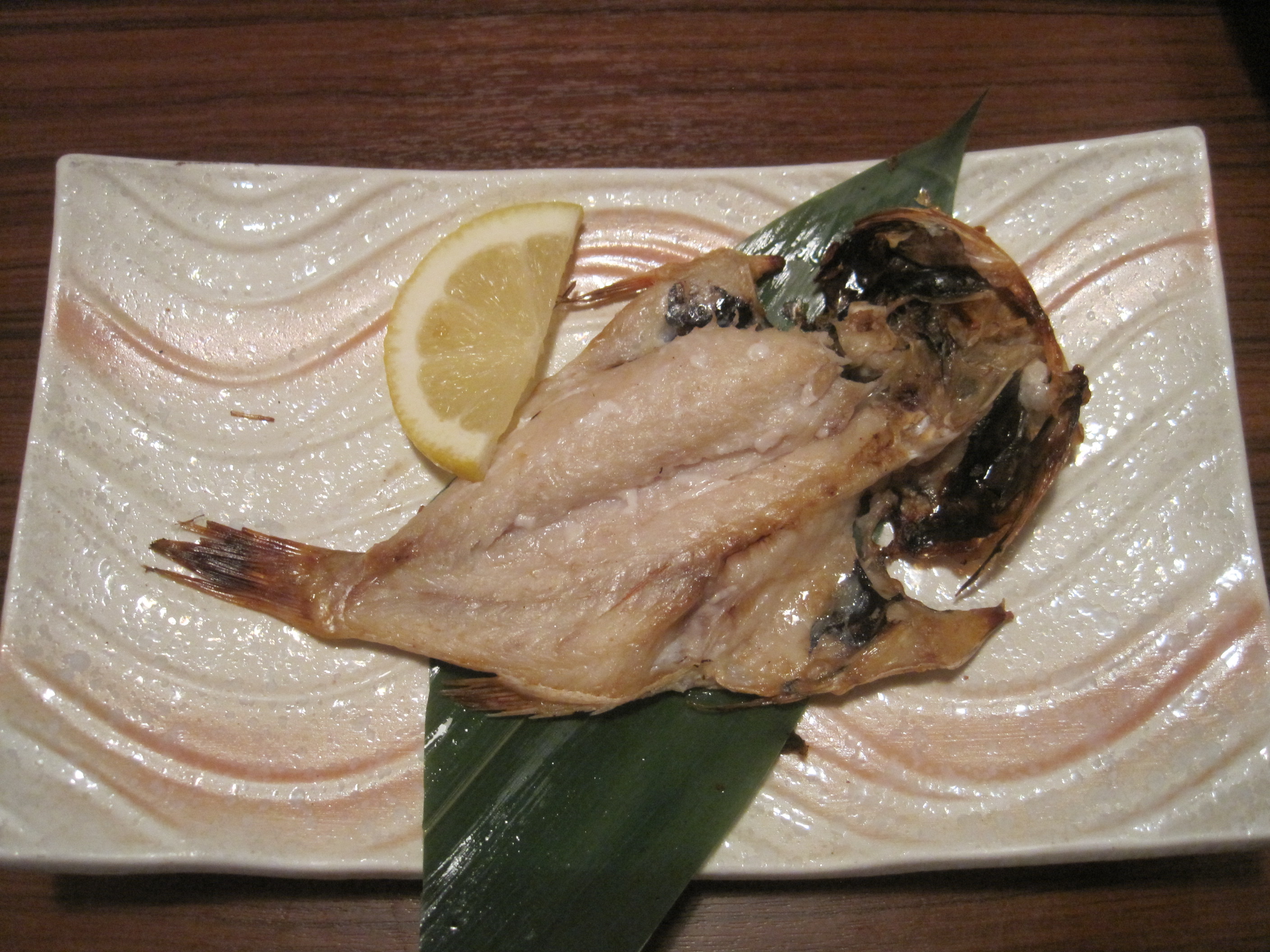
Broiled rosy sea bass

One was loach, 泥鰌 dojou (lit. ‘mud-loach’) ‘dojo loach’, Misgurnus anguillicaudatus, also called ‘weatherloach’, a member of the carp order (Cypriniformes). The other was broiled nodoguro (lit. ‘black throat’) ‘rosy sea bass’, Doederleinia berycoides (also called 赤鯥 akamutsu ‘red gnomefish’) in the family Acropomatidae (lanternbellies, Jp. hotarujako ‘firefly fry’).

Poached nibbler

At a small mamasan-without-papasan izakaya next to our hotel in Tsuruga, we tried mejina nitsuke ‘poached nibbler’. The Japanese name, 眼仁奈 mejina, applies to both the genus Girella and the subfamily Girellinae ‘nibblers’, members of the Kyphosidae (sea chub) family in the order Perciformes. We spent a long time talking with everyone else there: the very hospitable self-employed proprietor, who served as her own buyer, cook, and waitress (and single mother); a very talkative traveling digger and inspector of wells and tunnels; and three ladies from Shikoku on a hiking trip, one of whom had a daughter just back from Ethiopia with JICA.

Sea bass sashimi

Our second evening in Tsuruga we went to a much larger izakaya that had been too busy by the time we showed up the night before. There we had suzuki sashimi, which our waitress described as light and tasty when I asked what kind of fish it was. I hadn’t heard suzuki as a fish name, but in Japanese taxonomy, 鱸 suzuki ‘Japanese sea bass or sea perch‘ Lateolabrax japonicus seems to be the type species or genus for a whole suborder and order of bony fish, the equivalent of Perc- in Percoidei (スズキ亜目) and Perciformes (スズキ目).

Leave a comment

Filed under food, Japan, language, travel

Wordcatcher Tales: Gyorai ‘fish thunder’

One of the most fun things about exploring far-outlying places in Japan is the conversations you fall into. We had several such conversations in Tsuruga, the Japan Sea port city closest to Osaka and Kyoto, which for that reason became the terminus of one of Japan’s first railway lines. (The other two connected the port of Yokohama with Tokyo and the port of Otaru with Sapporo.)

On a visit to the Kehi Matsubara pine grove and beach, we stopped at a shady refreshment stand to get some cool drinks. Near the vending machine sat two elderly men, one grizzled and talkative, the other silent and dignified. The grizzled man seemed to have saved up many things he wanted to share with English-speakers, starting with his futile attempts to learn our language. His teachers had concentrated too much on grammar, he said, and the only English phrase he could reliably remember for all his trouble was “I forgot.” He said Chinese speakers had much greater success learning English because of the similarities in word order between the two languages, and that Mongolian sumo wrestlers learned Japanese much more quickly than the European wrestlers for similar reasons.

He was originally from Kochi (formerly Tosa) in Shikoku, and when I asked about the famous Tosa fighting dogs, he launched into a long disquisition on their virtues (such as silently enduring pain like samurai) and superiority over Akita dogs, which might be larger but lacked the same degree of fighting temperament.

His dignified companion, who never got a word in edgewise, was a former officer in the Imperial Japanese Navy who was recruited by the Occupation authorities to clear mines from the harbor. The word (new to me) that Mr. Grizzly used for ‘naval mine’ was 魚雷 gyorai lit. ‘fish-thunder’, which more commonly refers to torpedoes, as in 魚雷艇 gyoraitei ‘torpedo boat’. (Torpedoes are also called “fish” in anglophone sailor slang.) Aerial torpedoes are 空雷 kuurai ‘air-thunder’ and a torpedo attack is 雷撃 raigeki ‘thunder-attack’.

The generic word for ‘mine’ is 機雷 kirai ‘device-thunder’. Naval mines are 水雷 suirai ‘water-thunder’ and land mines are 地雷 jirai ‘earth-thunder’, as in 地雷原 jiraigen ‘minefield’.

This encounter reminded me of a story my Uncle Murray told for the first time back in April, when I had the chance to attend a brief reunion of my father and his only two surviving brothers. Uncle Murray reached draft age right at the end of World War II and he was on his way to invade Japan in August 1945 when Japan surrendered and his ship put into Midway to await a change of orders. His unit was then rerouted to the Philippines, where they assembled Japanese POWs as they surrendered and then put them to work helping to dismantle and destroy military stockpiles near Manila. His POWs would load electrical equipment onto amphibious ducks, which he would then drive out to sea, where the POWs would drill holes in the batteries and dump them in the ocean, often getting very seasick in the process. Much of Manila had been destroyed during the war, and Uncle Murray said his unit’s battery disposals must have destroyed a lot of life in the surrounding seas as well.

Leave a comment

Filed under Japan, language, military, Philippines, U.S., war

Japanese Hopes for Germany, 1940

From Bloodlands: Europe Between Hitler and Stalin, by Timothy Snyder (Basic Books, 2010), Kindle Loc. 3152-77 (p. 164):

Thirteen months after the Molotov-Ribbentrop Pact had alienated Tokyo from Berlin, German-Japanese relations were reestablished on the basis of a military alliance. On 27 September 1940, Tokyo, Berlin, and Rome signed a Tripartite Pact. At this point in time, when the central conflict in the European war was the air battle between the Royal Air Force and the Luftwaffe, Japan hoped that this alliance might be directed at Great Britain. Tokyo urged upon the Germans an entirely different revolution in world political economy than the one German planners envisioned. Rather than colonizing the Soviet Union, thought the Japanese, Nazi Germany should join with Japan and defeat the British Empire.

The Japanese, building their empire outward from islands, understood the sea as the method of expansion. It was in the interest of Japan to persuade the Germans that the British were the main common enemy, since such agreement would aid the Japanese to conquer British (and Dutch) colonies in the Pacific. Yet the Japanese did have a vision on offer to the Germans, one that was broader than their own immediate need for the mineral resources from British and Dutch possessions. There was a grand strategy. Rather than engage the Soviet Union, the Germans should move south, drive the British from the Near East, and meet the Japanese somewhere in South Asia, perhaps India. If the Germans and the Japanese controlled the Suez Canal and the Indian Ocean, went Tokyo’s case, British naval power would cease to be a factor. Germany and Japan would then become the two world powers.

Hitler showed no interest in this alternative. The Germans told the Soviets about the Tripartite Pact, but Hitler never had any intention of allowing the Soviets to join. Japan would have liked to see a German-Japanese-Soviet coalition against Great Britain, but this was never a possibility. Hitler had already made up his mind to invade the Soviet Union. Though Japan and Italy were now Germany’s allies, Hitler did not include them in his major martial ambition. He assumed that the Germans could and should defeat the Soviets themselves. The German alliance with Japan would remain limited by underlying disagreements about goals and enemies. The Japanese needed to defeat the British, and eventually the Americans, to become a dominant naval empire in the Pacific. The Germans needed to destroy the Soviet Union to become a massive land empire in Europe, and thus to rival the British and the Americans at some later stage.

Japan had been seeking a neutrality pact with the Soviet Union since summer 1940; one was signed in April 1941. Chiune Sugihara, the Soviet specialist among Japanese spies, spent that spring in Königsberg, the German city in East Prussia on the Baltic Sea, trying to guess the date of the German invasion of the Soviet Union. Accompanied by Polish assistants, he made journeys through eastern Germany, including the lands that Germany had seized from Poland. His estimation, based upon observations of German troop movements, was mid-June 1941. His reports to Tokyo were just one of thousands of indications, sent by intelligence staffs in Europe and around the world, that the Germans would break the Molotov-Ribbentrop Pact and invade their ally in late spring or early summer.

Leave a comment

Filed under Britain, Germany, Italy, Japan, Poland, U.S., USSR, war

Stalin’s Fears of Japan and Poland, 1937-1939

From Bloodlands: Europe Between Hitler and Stalin, by Timothy Snyder (Basic Books, 2010), Kindle Locs. 2094-2112, 2285-2321 (pp. 105, 116-117):

In 1937 Japan seemed to be the immediate threat. Japanese activity in east Asia had been the justification for the kulak operation. The Japanese threat was the pretext for actions against the Chinese minority in the Soviet Union, and against Soviet railway workers who had returned from Manchuria. Japanese espionage was also the justification for the deportation of the entire Soviet Korean population, about 170,000 people, from the Far East to Kazakhstan. Korea itself was then under Japanese occupation, so the Soviet Koreans became a kind of diaspora nationality by association with Japan. Stalin’s client in the western Chinese district of Xinjiang, Sheng Shicai, carried out a terror of his own, in which thousands of people were killed. The People’s Republic of Mongolia, to the north of China, had been a Soviet satellite since its creation in 1924. Soviet troops entered allied Mongolia in 1937, and Mongolian authorities carried out their own terror in 1937-1938, in which 20,474 people were killed. All of this was directed at Japan.

None of these killings served much of a strategic purpose. The Japanese leadership had decided upon a southern strategy, toward China and then the Pacific. Japan intervened in China in July 1937, right when the Great Terror began, and would move further southward only thereafter. The rationale of both the kulak action and these eastern national actions was thus false. It is possible that Stalin feared Japan, and he had good reason for concern. Japanese intentions were certainly aggressive in the 1930s, and the only question was about the direction of expansion: north or south. Japanese governments were unstable and prone to rapid changes in policy. In the end, however, mass killings could not preserve the Soviet Union from an attack that was not coming.

Perhaps, as with the Poles, Stalin reasoned that mass killing had no costs. If Japan meant to attack, it would find less support inside the Soviet Union. If it did not, then no harm to Soviet interests had been done by preemptive mass murder and deportation. Again, such reasoning coheres only when the interests of the Soviet state are seen as distinct from the lives and well-being of its population. And again, the use of the NKVD against internal enemies (and against itself) prevented a more systematic approach to the actual threat that the Soviet Union faced: a German attack without Japanese or Polish assistance and without the help of internal opponents of Soviet rule.

…

Officially, the agreement signed in Moscow on 23 August 1939 was nothing more than a nonaggression pact. In fact, Ribbentrop and Molotov also agreed to a secret protocol, designating areas of influence for Nazi Germany and the Soviet Union within eastern Europe: in what were still the independent states of Finland, Estonia, Latvia, Lithuania, Poland, and Romania. The irony was that Stalin had very recently justified the murder of more than one hundred thousand of his own citizens by the false claim that Poland had signed just such a secret codicil with Germany under the cover of a nonaggression pact. The Polish operation had been presented as preparation for a German-Polish attack; now the Soviet Union had agreed to attack Poland along with Germany.

On 1 September 1939, the Wehrmacht attacked Poland from the north, west, and south, using men and arms from annexed Austria and Czechoslovakia. Hitler had begun his war.

In August and September 1939, Stalin was reading maps not just of east Europe but of east Asia. He had found an opportunity to improve the Soviet position in the Far East. Stalin could now be confident that no German-Polish attack was coming from the west. If the Soviet Union moved against Japan in east Asia, there would be no fear of a second front. The Soviets (and their Mongolian allies) attacked Japanese (and puppet Manchukuo) forces at a contested border area (between Mongolia and Manchukuo) on 20 August 1939. Stalin’s policy of rapprochement with Berlin of 23 August 1939 was also directed against Tokyo. The Molotov-Ribbentrop Pact between Germany and the Soviet Union, signed three days after the Soviet offensive, nullified the Anti-Comintern Pact between Germany and Japan. Even more than the battlefield defeat, the Nazi-Soviet alliance brought a political earthquake in Tokyo. The Japanese government fell, as would several more in the coming months.

Once Germany seemed to have chosen the Soviet Union rather than Japan as its ally, the Japanese government found itself in an unexpected and confusing situation. The consensus among Japanese leaders was already to expand southward rather than northward, into China and the Pacific rather than into Soviet Siberia. Yet if the union between Moscow and Berlin held, the Red Army would be able to concentrate its forces in Asia rather than in Europe. Japan would then be forced to keep its best troops in the north, in Manchukuo, in simple self-defense, which would make the advance into the south much more difficult. Hitler had given Stalin a free hand in east Asia, and the Japanese could only hope that Hitler would soon betray his new friend. Japan established a consulate in Lithuania as an observation point for German and Soviet military preparations. The consul there was the russophone spy Chiune Sugihara.

When the Red Army defeated the Japanese, on 15 September 1939, Stalin had achieved exactly the result that he wanted. The national actions of the Great Terror had been aimed against Japan, Poland, and Germany, in that order, and against the possibility of encirclement by these three states working together. The 681,692 killings of the Great Terror did nothing to make encirclement less likely, but diplomacy and military force did. By 15 September Germany had practically destroyed the Polish Army as a fighting force. A German-Polish attack on the Soviet Union was obviously out of the question, and a German-Japanese attack on the Soviet Union also looked very unlikely. Stalin had replaced the phantom of a German-Polish-Japanese encirclement of the Soviet Union with a very real German-Soviet encirclement of Poland, an alliance that isolated Japan. Two days after the Soviet military victory over Japan, on 17 September 1939, the Red Army invaded Poland from the east. The Red Army and the Wehrmacht met in the middle of the country and organized a joint victory parade. On 28 September, Berlin and Moscow came to a second agreement over Poland, a treaty on borders and friendship.

So began a new stage in the history of the bloodlands. By opening half of Poland to the Soviet Union, Hitler would allow Stalin’s Terror, so murderous in the Polish operation, to recommence within Poland itself. Thanks to Stalin, Hitler was able, in occupied Poland, to undertake his first policies of mass killing. In the twenty-one months that followed the joint German-Soviet invasion of Poland, the Germans and the Soviets would kill Polish civilians in comparable numbers for similar reasons, as each ally mastered its half of occupied Poland.

The organs of destruction of each country would be concentrated on the territory of a third. Hitler, like Stalin, would choose Poles as the target of his first major national shooting campaign.

Leave a comment

Filed under China, Germany, Japan, Korea, Mongolia, Poland, USSR, war

Wordcatcher Tales: Tetchan, Mitchan, Noritetsu, Toritetsu

Last month Mr. & Mrs. Outlier made good use of our Japan Rail passes to visit several of the more far-outlying places on Japan’s extensive rail network. We flew in and out of Fukuoka, so we started with JR Kyushu, riding its brand new Shinkansen trains as well as some of the older express trains.

On the way up to Nagoya, we stopped for a night at Shin-Yamaguchi, the starting point for the Yamaguchi Line, which connects the Sanyō Main Line along the Inland Sea with the San’in Main Line along the Japan Sea. Originally called Ogōri, the old station dates from 1913 and now caters to railway nostalgists, among whom I would have to count myself.

The next day we rode the 1-driver, 2-car Super-Oki Limited Express as far as Tottori, famous for its sand dunes. The following day we continued on to Toyooka, where we had to change to the non-JR Kitakinki Tango Railway‘s Miyazu Line in order to cross off my bucket list Amanohashidate, the third of Japan’s three most famous scenic views. Then we hopped back on the KTR to its terminus at Nishi-Maizuru, back on the JR network. Then we rode the local-only JR Obama Line the rest of the way to Tsuruga, the terminus of one of Japan’s earliest railway lines (1882), connecting the port of Osaka to the Japan Sea and crossing Lake Biwa by ship between Ōtsu (‘Big Harbor’) and Nagahama (‘Long Beach’).

In a small railway museum that used to be the Tsuruga Port train station building, we encountered a Japanese railway buff of the first order, a young businessman who was spending holiday time riding trains and visiting railway museums. When I told him we had come from riding the new Kyushu Shinkansen, he told me JR Kyushu had won awards for their new bullet train designs. When I said we were headed for Nagoya, he recommended I visit the new JR SCMAGLEV and Railway Park there. Our paths crossed again when he came out of the Tsuruga City Museum as we were going in, and he and I exchanged a final wave as he was entering and I was leaving the Nagoya Shinkansen station.

It was in Nagoya that Mrs. Outlier learned several words used in Japanese to refer to train buffs. The Japanese word for ‘railroad’ is 鉄道 tetsudou lit. ‘iron-road’, and railroad enthusiasts can be somewhat mockingly referred to as 鉄ちゃん Tetchan ‘railies’ if male and 道ちゃん Mitchan ‘roadies’ if female. (The native Japanese pronunciation of 道 is michi ‘road’.) More neutral terms for them in Japanese are 乗り鉄 nori-tetsu ‘ride-rail’ for those who seek to ride particular trains, or 撮り鉄 tori-tetsu ‘take-rail’ for those who seek to take photographs of particular trains.

3 Comments

Filed under Japan, language, travel

Two Kinds of ‘Missing’ Stats in Japanese News Reports

When natural disasters hit in Japan, it is customary to report the number of people killed, injured, and/or missing. For smaller-scale disasters, the word for ‘missing’ is usually 行方不明 yukue fumei ‘whereabouts unknown’ (lit. ‘movement-direction not-clear’). This term for ‘missing’ seems to imply that rescuers have searched the site of the disaster but failed to find any trace of some of the people they hoped to find there.

But in the widespread aftermath of the Great Tohoku Earthquake and tsunami, the word for ‘missing’ that now appears in Japanese news broadcasts is 安否不明 anpi fumei ‘safety unknown’ (lit. ‘safe-or-no not-clear’). This term for ‘missing’ suggests that rescuers have in most cases not yet arrived on the scene or not yet completed their investigations to determine the condition and whereabouts of all the people they hope to find there.

This distinction between a sort of preliminary (‘unaccounted for’) and postmortem determination of who might be ‘missing’ has not always made it into the English-language headlines about the multiple disasters affecting so many people in Japan right now.

Speaking of which, the term 原発 genpatsu ‘nuclear reactor’ was also new to me, despite having lived in Hiroshima, where I early on learned the term 原爆 genbaku ‘nuclear explosion’, short for 原子爆発 lit. ‘primitive-child (= atom) burst-discharge’.

The character 原 is read hara when it occurs in so many native Japanese proper names, where it means ‘field, plain, prairie, tundra, moor, wilderness’. The ‘wilderness’ sense seems primary in the Sino-Japanese usage of 原 gen to mean ‘original, primitive, fundamental, raw’, as in 原因 gen’in ‘root cause’, 原色 genshoku ‘primary color’, 原油 gen’yu ‘crude oil’, and 原発 genpatsu ‘nuclear reactor’ (or ‘atomic discharge’).

1 Comment

Filed under energy, Japan, language, publishing