Category Archives: Japan

Wordcatcher Tales: Menbei, Yuzusco, Hakugei

While we were shopping for light, comestible omiyage (souvenirs) to bring back from Japan this summer, we came across three products of linguistic as well as gustatory interest.
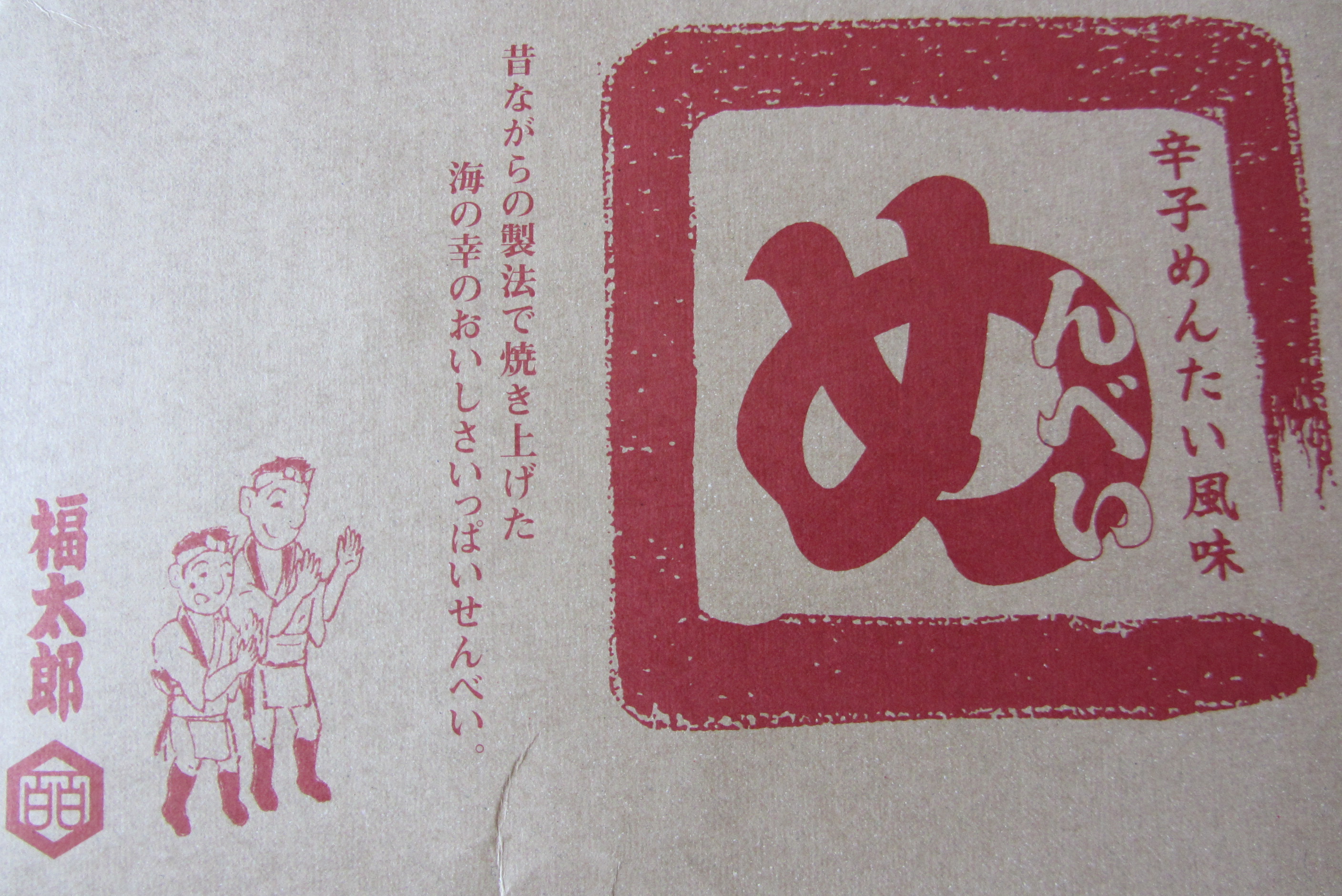
mentai + senbei = menbeiMenbei < mentai senbei – Korea is the source of one well-known item of Hakata (Fukuoka) cuisine, 辛子明太子 karashi mentaiko ‘spicy cod/pollock roe’. The name mentai apparently derives from Korean 명태 myeongtae ‘Alaskan pollock’. Its genus (Theragra) is different from that of the Atlantic pollock (Pollachius), but both fall within the highly prolific family Gadidae (< Gadus ‘cod’) ‘cod, haddock, pollock, whiting’. We bought a few boxes of spicy mentai-flavored rice crackers to share with our colleagues at work. Their pungent aroma caused some comment.

Yuzusco & ShogascoYuzusco < yuzu ‘citrus’ + (taba)sco – The fresh taste of yuzu (柚子) is very popular in Japanese cuisine and is used to flavor many different things: from savory chawanmushi to sweet honey, bitter tea, vinegar, wine, and even bath oil. We brought back some tiny jars of yuzu pepper paste and two hot sauces marketed as under the brand names Yuzusco and Shogasco (< shouga ‘ginger’ + -sco). I’m not sure if the makers of Tabasco have licensed just the last three letters of their registered trademark, but they apparently encourage co-branding. Nor am I sure where these products rank on the Scoville scale of spicyness.

Sampler of five types of shochuHakugei ‘White Whale’ – At a duty-free shop at Fukuoka Airport, we got a sampler of five small bottles of shochu, a longtime Satsuma (Kagoshima) specialty. (The cashier unboxed them and put them in little transparent baggies so we could take them through security!) They included 麦わら帽子 Mugiwara Boushi ‘barley-straw hat’, made from barley; two types of Satsuma 白波 Shiranami ‘white wave’ made from sweet potato (my favorite) with dark and light molds; 白鯨 Hakugei ‘white whale’, made from white rice; and 蕎麦蔵 Sobagura ‘buckwheat granary’, made from buckwheat. Shiranami is perhaps the most famous brand name of Satsuma shochu, but the other brand names were well chosen to reflect their ingredients. As one might expect, Hakugei tasted the most like sake. I prefer sweet potato shochu myself.

Leave a comment

Filed under food, Japan, language, travel

Wordcatcher Tales: Dorui, Kangou, Funkyuubo, Fujo

The first tourist site we visited on our most recent trip to Japan was Yoshinogari Historical Park in Saga Prefecture, on a stretch of open countryside that turned up lots of artifacts from the Yayoi-period (roughly 300 B.C. to A.D. 300), including many large burial jars, when developers began to prepare the ground for a large shopping center. The site was then turned into an historical park featuring “one of Japan’s largest moat-encircled villages and ancient ruins.” In fact, another pair of visitors we met there were from Perth, Australia, a mother and her daughter who had won a national essay contest by presenting the case for Yoshinogari to be designated a UNESCO World Heritage Site.

The signs describing the major features of the park were quadrilingual—in Japanese, English, Korean, and Chinese (simplified characters)—and one of the guides we met was a young lady from Dalian, China, who spoke some English and Russian in addition to Chinese and Japanese. (She was eager to practice her English, which was full of reading pronunciations.) Thanks to the helpful furigana on those signs, I learned a few new Japanese words and readings that were not even in my old Canon Wordtank G55 electronic dictionary. Here’s a sample.

土塁 dorui ‘earth fort, earthworks’ – The earliest forts in Japan apparently consisted of earthworks, palisades, and moats. The character 塁 ‘fort, rampart’ can be a synonym for 砦 toride ‘fort, stronghold, entrenchment’, but is now much more common in baseball, where it means ‘base’, as in 塁審 ruishin ‘base umpire’ or 塁打 ruida ‘base hit’.

環濠 kangouring trench‘ – The usual word for the ‘moat’ around Japanese castles is 堀 hori ‘ditch, canal’, related to the verb horu ‘to dig’. By itself, 濠 gou is better translated ‘trench’ (also ‘dugout, foxhole’), another product of digging. The character 環 kan ‘ring, circle, loop’ also occurs in 環境 kankyou ‘environment, circumstances’ (lit. ‘circle boundary’) and 環礁 kanshou ‘atoll’ (lit. ‘fringing sunken-rock’).

墳丘墓 funkyuubomound-hill-grave‘ – The common word for ‘grave’ is 墓 haka (Sino-Japanese bo) as in 墓石 boseki, hakaishi ‘tombstone’ or 墓堀 hakahori ‘grave digger’. A normal-sized grave mound is 墳墓 funbo ‘mound grave, tomb’, but a seriously hill-sized grave mound is 墳丘墓 funkyuubo (with 丘 ‘hill’, read oka in many placenames). Grave-mound building was carried to even greater extremes during the next major period of Japanese history, the Kofun 古墳 (‘old tomb’) period (c. 250–538).

巫女 fujo, miko ‘shaman, sorceress, shrine maiden’ – After immigration from the Korean peninsula began, but before Buddhism was established (during the 8th century), the chief spiritual practitioner in Japanese villages was a shaman, who was usually female, although the etymology of 神子 miko lit. ‘god-child’ is gender-neutral.

Leave a comment

Filed under baseball, Japan, language, military, travel

Wordcatcher Tales: Japanese Fish Names

During our recent travels to far-outlying corners of Japan we came across several local specialties that I had never heard of before. When I solicit the names for new dishes in Japanese, I often end up learning new fish names in English, just as I did long ago doing linguistic fieldwork in a coastal village in Papua New Guinea. Here is a sample of new fish we tried at izakaya last month.

Slender sprat sashimi

At the fine Umaya Restaurant beside JR Kumamoto Station, we ordered kibinago sashimi. After failing to find kibinago in my old Canon Wordtank G55 electronic dictionary, I asked the waitress if she could find out what to call it in English. She came back and showed me the gloss in her electronic dictionary, ‘silver-stripe round herring’. This slender sprat, Spratelloides gracilis, is often used as a bait fish, but also makes a very attractive dish of sashimi.

Mantis shrimp sashimi

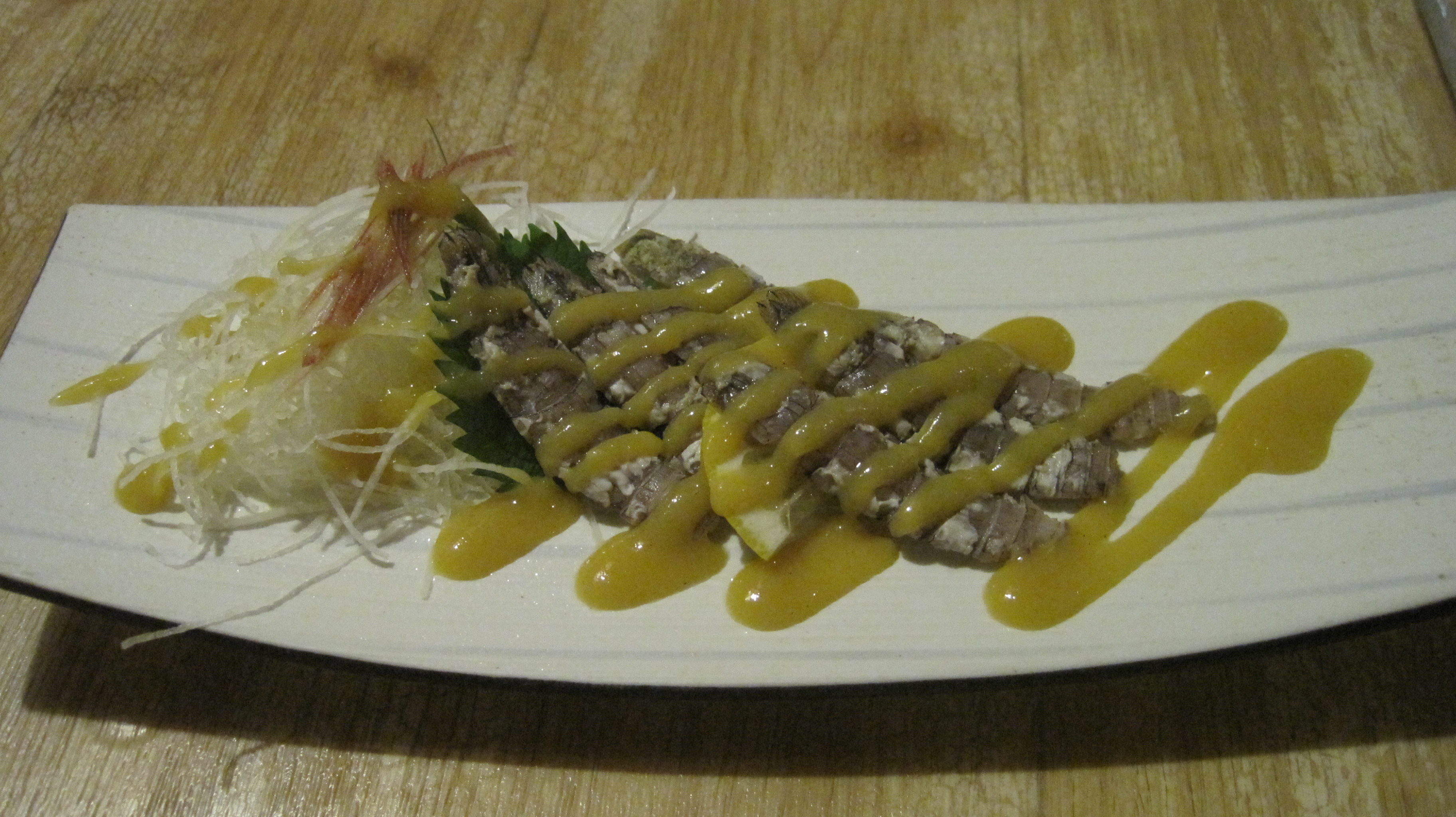
On the way up from Kyushu, we stopped overnight at Shin-Yamaguchi, an old railway junction city (Ogōri) that was renamed and upgraded to a Shinkansen station but still proudly displays memorabilia from the old days. The owner of the izakaya we had dinner at was a train buff and the walls of our booth were covered with posters and photos of old steam locomotives. Among the novelties we ate there was shako sashimi, mantis shrimp (Squilla sp.) with ginger mustard sauce to counter the fishy taste. This creature I could find in my electronic dictionary, so I tortured the waitress with questions about old trains. We both recalled the days when the steam locomotive whistle would signal an upcoming tunnel, and we would quickly close the window so as not to get a faceful of soot. The next day we boarded the Super-Oki limited express bound for the Japan Sea coast and up the San’in Main Line.

Dojou karaage

Deep-fried dojo loach

After making a quick visit to Tottori’s famous sand dunes just in time for the sunset, our taxi driver called his contacts at Daizen, a busy new izakaya that he recommended when I asked where we could find a place that served local specialties. We ordered fried gobo chips, which are gaining popularity, and we ate two fish that were new to us.

Broiled rosy sea bass

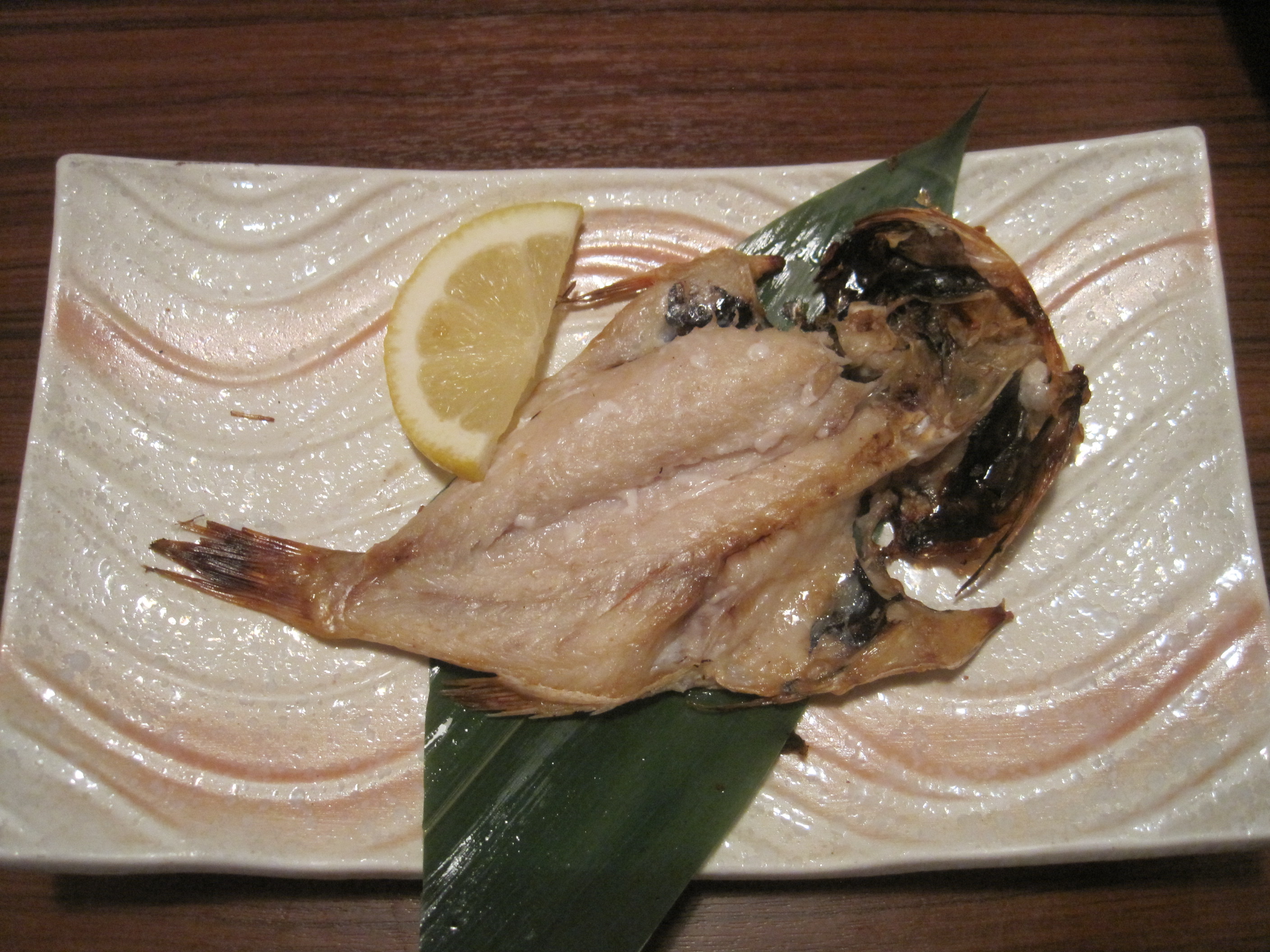
One was loach, 泥鰌 dojou (lit. ‘mud-loach’) ‘dojo loach’, Misgurnus anguillicaudatus, also called ‘weatherloach’, a member of the carp order (Cypriniformes). The other was broiled nodoguro (lit. ‘black throat’) ‘rosy sea bass’, Doederleinia berycoides (also called 赤鯥 akamutsu ‘red gnomefish’) in the family Acropomatidae (lanternbellies, Jp. hotarujako ‘firefly fry’).

Poached nibbler

At a small mamasan-without-papasan izakaya next to our hotel in Tsuruga, we tried mejina nitsuke ‘poached nibbler’. The Japanese name, 眼仁奈 mejina, applies to both the genus Girella and the subfamily Girellinae ‘nibblers’, members of the Kyphosidae (sea chub) family in the order Perciformes. We spent a long time talking with everyone else there: the very hospitable self-employed proprietor, who served as her own buyer, cook, and waitress (and single mother); a very talkative traveling digger and inspector of wells and tunnels; and three ladies from Shikoku on a hiking trip, one of whom had a daughter just back from Ethiopia with JICA.

Sea bass sashimi

Our second evening in Tsuruga we went to a much larger izakaya that had been too busy by the time we showed up the night before. There we had suzuki sashimi, which our waitress described as light and tasty when I asked what kind of fish it was. I hadn’t heard suzuki as a fish name, but in Japanese taxonomy, 鱸 suzukiJapanese sea bass or sea perchLateolabrax japonicus seems to be the type species or genus for a whole suborder and order of bony fish, the equivalent of Perc- in Percoidei (スズキ亜目) and Perciformes (スズキ目).

Leave a comment

Filed under food, Japan, language, travel

Wordcatcher Tales: Gyorai ‘fish thunder’

One of the most fun things about exploring far-outlying places in Japan is the conversations you fall into. We had several such conversations in Tsuruga, the Japan Sea port city closest to Osaka and Kyoto, which for that reason became the terminus of one of Japan’s first railway lines. (The other two connected the port of Yokohama with Tokyo and the port of Otaru with Sapporo.)

On a visit to the Kehi Matsubara pine grove and beach, we stopped at a shady refreshment stand to get some cool drinks. Near the vending machine sat two elderly men, one grizzled and talkative, the other silent and dignified. The grizzled man seemed to have saved up many things he wanted to share with English-speakers, starting with his futile attempts to learn our language. His teachers had concentrated too much on grammar, he said, and the only English phrase he could reliably remember for all his trouble was “I forgot.” He said Chinese speakers had much greater success learning English because of the similarities in word order between the two languages, and that Mongolian sumo wrestlers learned Japanese much more quickly than the European wrestlers for similar reasons.

He was originally from Kochi (formerly Tosa) in Shikoku, and when I asked about the famous Tosa fighting dogs, he launched into a long disquisition on their virtues (such as silently enduring pain like samurai) and superiority over Akita dogs, which might be larger but lacked the same degree of fighting temperament.

His dignified companion, who never got a word in edgewise, was a former officer in the Imperial Japanese Navy who was recruited by the Occupation authorities to clear mines from the harbor. The word (new to me) that Mr. Grizzly used for ‘naval mine’ was 魚雷 gyorai lit. ‘fish-thunder’, which more commonly refers to torpedoes, as in 魚雷艇 gyoraitei ‘torpedo boat’. (Torpedoes are also called “fish” in anglophone sailor slang.) Aerial torpedoes are 空雷 kuurai ‘air-thunder’ and a torpedo attack is 雷撃 raigeki ‘thunder-attack’.

The generic word for ‘mine’ is 機雷 kirai ‘device-thunder’. Naval mines are 水雷 suirai ‘water-thunder’ and land mines are 地雷 jirai ‘earth-thunder’, as in 地雷原 jiraigen ‘minefield’.

This encounter reminded me of a story my Uncle Murray told for the first time back in April, when I had the chance to attend a brief reunion of my father and his only two surviving brothers. Uncle Murray reached draft age right at the end of World War II and he was on his way to invade Japan in August 1945 when Japan surrendered and his ship put into Midway to await a change of orders. His unit was then rerouted to the Philippines, where they assembled Japanese POWs as they surrendered and then put them to work helping to dismantle and destroy military stockpiles near Manila. His POWs would load electrical equipment onto amphibious ducks, which he would then drive out to sea, where the POWs would drill holes in the batteries and dump them in the ocean, often getting very seasick in the process. Much of Manila had been destroyed during the war, and Uncle Murray said his unit’s battery disposals must have destroyed a lot of life in the surrounding seas as well.

Leave a comment

Filed under Japan, language, military, Philippines, U.S., war

Japanese Hopes for Germany, 1940

From Bloodlands: Europe Between Hitler and Stalin, by Timothy Snyder (Basic Books, 2010), Kindle Loc. 3152-77 (p. 164):

Thirteen months after the Molotov-Ribbentrop Pact had alienated Tokyo from Berlin, German-Japanese relations were reestablished on the basis of a military alliance. On 27 September 1940, Tokyo, Berlin, and Rome signed a Tripartite Pact. At this point in time, when the central conflict in the European war was the air battle between the Royal Air Force and the Luftwaffe, Japan hoped that this alliance might be directed at Great Britain. Tokyo urged upon the Germans an entirely different revolution in world political economy than the one German planners envisioned. Rather than colonizing the Soviet Union, thought the Japanese, Nazi Germany should join with Japan and defeat the British Empire.

The Japanese, building their empire outward from islands, understood the sea as the method of expansion. It was in the interest of Japan to persuade the Germans that the British were the main common enemy, since such agreement would aid the Japanese to conquer British (and Dutch) colonies in the Pacific. Yet the Japanese did have a vision on offer to the Germans, one that was broader than their own immediate need for the mineral resources from British and Dutch possessions. There was a grand strategy. Rather than engage the Soviet Union, the Germans should move south, drive the British from the Near East, and meet the Japanese somewhere in South Asia, perhaps India. If the Germans and the Japanese controlled the Suez Canal and the Indian Ocean, went Tokyo’s case, British naval power would cease to be a factor. Germany and Japan would then become the two world powers.

Hitler showed no interest in this alternative. The Germans told the Soviets about the Tripartite Pact, but Hitler never had any intention of allowing the Soviets to join. Japan would have liked to see a German-Japanese-Soviet coalition against Great Britain, but this was never a possibility. Hitler had already made up his mind to invade the Soviet Union. Though Japan and Italy were now Germany’s allies, Hitler did not include them in his major martial ambition. He assumed that the Germans could and should defeat the Soviets themselves. The German alliance with Japan would remain limited by underlying disagreements about goals and enemies. The Japanese needed to defeat the British, and eventually the Americans, to become a dominant naval empire in the Pacific. The Germans needed to destroy the Soviet Union to become a massive land empire in Europe, and thus to rival the British and the Americans at some later stage.

Japan had been seeking a neutrality pact with the Soviet Union since summer 1940; one was signed in April 1941. Chiune Sugihara, the Soviet specialist among Japanese spies, spent that spring in Königsberg, the German city in East Prussia on the Baltic Sea, trying to guess the date of the German invasion of the Soviet Union. Accompanied by Polish assistants, he made journeys through eastern Germany, including the lands that Germany had seized from Poland. His estimation, based upon observations of German troop movements, was mid-June 1941. His reports to Tokyo were just one of thousands of indications, sent by intelligence staffs in Europe and around the world, that the Germans would break the Molotov-Ribbentrop Pact and invade their ally in late spring or early summer.

Leave a comment

Filed under Britain, Germany, Italy, Japan, Poland, U.S., USSR, war

Stalin’s Fears of Japan and Poland, 1937-1939

From Bloodlands: Europe Between Hitler and Stalin, by Timothy Snyder (Basic Books, 2010), Kindle Locs. 2094-2112, 2285-2321 (pp. 105, 116-117):

In 1937 Japan seemed to be the immediate threat. Japanese activity in east Asia had been the justification for the kulak operation. The Japanese threat was the pretext for actions against the Chinese minority in the Soviet Union, and against Soviet railway workers who had returned from Manchuria. Japanese espionage was also the justification for the deportation of the entire Soviet Korean population, about 170,000 people, from the Far East to Kazakhstan. Korea itself was then under Japanese occupation, so the Soviet Koreans became a kind of diaspora nationality by association with Japan. Stalin’s client in the western Chinese district of Xinjiang, Sheng Shicai, carried out a terror of his own, in which thousands of people were killed. The People’s Republic of Mongolia, to the north of China, had been a Soviet satellite since its creation in 1924. Soviet troops entered allied Mongolia in 1937, and Mongolian authorities carried out their own terror in 1937-1938, in which 20,474 people were killed. All of this was directed at Japan.

None of these killings served much of a strategic purpose. The Japanese leadership had decided upon a southern strategy, toward China and then the Pacific. Japan intervened in China in July 1937, right when the Great Terror began, and would move further southward only thereafter. The rationale of both the kulak action and these eastern national actions was thus false. It is possible that Stalin feared Japan, and he had good reason for concern. Japanese intentions were certainly aggressive in the 1930s, and the only question was about the direction of expansion: north or south. Japanese governments were unstable and prone to rapid changes in policy. In the end, however, mass killings could not preserve the Soviet Union from an attack that was not coming.

Perhaps, as with the Poles, Stalin reasoned that mass killing had no costs. If Japan meant to attack, it would find less support inside the Soviet Union. If it did not, then no harm to Soviet interests had been done by preemptive mass murder and deportation. Again, such reasoning coheres only when the interests of the Soviet state are seen as distinct from the lives and well-being of its population. And again, the use of the NKVD against internal enemies (and against itself) prevented a more systematic approach to the actual threat that the Soviet Union faced: a German attack without Japanese or Polish assistance and without the help of internal opponents of Soviet rule.

Officially, the agreement signed in Moscow on 23 August 1939 was nothing more than a nonaggression pact. In fact, Ribbentrop and Molotov also agreed to a secret protocol, designating areas of influence for Nazi Germany and the Soviet Union within eastern Europe: in what were still the independent states of Finland, Estonia, Latvia, Lithuania, Poland, and Romania. The irony was that Stalin had very recently justified the murder of more than one hundred thousand of his own citizens by the false claim that Poland had signed just such a secret codicil with Germany under the cover of a nonaggression pact. The Polish operation had been presented as preparation for a German-Polish attack; now the Soviet Union had agreed to attack Poland along with Germany.

On 1 September 1939, the Wehrmacht attacked Poland from the north, west, and south, using men and arms from annexed Austria and Czechoslovakia. Hitler had begun his war.

In August and September 1939, Stalin was reading maps not just of east Europe but of east Asia. He had found an opportunity to improve the Soviet position in the Far East. Stalin could now be confident that no German-Polish attack was coming from the west. If the Soviet Union moved against Japan in east Asia, there would be no fear of a second front. The Soviets (and their Mongolian allies) attacked Japanese (and puppet Manchukuo) forces at a contested border area (between Mongolia and Manchukuo) on 20 August 1939. Stalin’s policy of rapprochement with Berlin of 23 August 1939 was also directed against Tokyo. The Molotov-Ribbentrop Pact between Germany and the Soviet Union, signed three days after the Soviet offensive, nullified the Anti-Comintern Pact between Germany and Japan. Even more than the battlefield defeat, the Nazi-Soviet alliance brought a political earthquake in Tokyo. The Japanese government fell, as would several more in the coming months.

Once Germany seemed to have chosen the Soviet Union rather than Japan as its ally, the Japanese government found itself in an unexpected and confusing situation. The consensus among Japanese leaders was already to expand southward rather than northward, into China and the Pacific rather than into Soviet Siberia. Yet if the union between Moscow and Berlin held, the Red Army would be able to concentrate its forces in Asia rather than in Europe. Japan would then be forced to keep its best troops in the north, in Manchukuo, in simple self-defense, which would make the advance into the south much more difficult. Hitler had given Stalin a free hand in east Asia, and the Japanese could only hope that Hitler would soon betray his new friend. Japan established a consulate in Lithuania as an observation point for German and Soviet military preparations. The consul there was the russophone spy Chiune Sugihara.

When the Red Army defeated the Japanese, on 15 September 1939, Stalin had achieved exactly the result that he wanted. The national actions of the Great Terror had been aimed against Japan, Poland, and Germany, in that order, and against the possibility of encirclement by these three states working together. The 681,692 killings of the Great Terror did nothing to make encirclement less likely, but diplomacy and military force did. By 15 September Germany had practically destroyed the Polish Army as a fighting force. A German-Polish attack on the Soviet Union was obviously out of the question, and a German-Japanese attack on the Soviet Union also looked very unlikely. Stalin had replaced the phantom of a German-Polish-Japanese encirclement of the Soviet Union with a very real German-Soviet encirclement of Poland, an alliance that isolated Japan. Two days after the Soviet military victory over Japan, on 17 September 1939, the Red Army invaded Poland from the east. The Red Army and the Wehrmacht met in the middle of the country and organized a joint victory parade. On 28 September, Berlin and Moscow came to a second agreement over Poland, a treaty on borders and friendship.

So began a new stage in the history of the bloodlands. By opening half of Poland to the Soviet Union, Hitler would allow Stalin’s Terror, so murderous in the Polish operation, to recommence within Poland itself. Thanks to Stalin, Hitler was able, in occupied Poland, to undertake his first policies of mass killing. In the twenty-one months that followed the joint German-Soviet invasion of Poland, the Germans and the Soviets would kill Polish civilians in comparable numbers for similar reasons, as each ally mastered its half of occupied Poland.

The organs of destruction of each country would be concentrated on the territory of a third. Hitler, like Stalin, would choose Poles as the target of his first major national shooting campaign.

Leave a comment

Filed under China, Germany, Japan, Korea, Mongolia, Poland, USSR, war

Wordcatcher Tales: Tetchan, Mitchan, Noritetsu, Toritetsu

Last month Mr. & Mrs. Outlier made good use of our Japan Rail passes to visit several of the more far-outlying places on Japan’s extensive rail network. We flew in and out of Fukuoka, so we started with JR Kyushu, riding its brand new Shinkansen trains as well as some of the older express trains.

On the way up to Nagoya, we stopped for a night at Shin-Yamaguchi, the starting point for the Yamaguchi Line, which connects the Sanyō Main Line along the Inland Sea with the San’in Main Line along the Japan Sea. Originally called Ogōri, the old station dates from 1913 and now caters to railway nostalgists, among whom I would have to count myself.

The next day we rode the 1-driver, 2-car Super-Oki Limited Express as far as Tottori, famous for its sand dunes. The following day we continued on to Toyooka, where we had to change to the non-JR Kitakinki Tango Railway‘s Miyazu Line in order to cross off my bucket list Amanohashidate, the third of Japan’s three most famous scenic views. Then we hopped back on the KTR to its terminus at Nishi-Maizuru, back on the JR network. Then we rode the local-only JR Obama Line the rest of the way to Tsuruga, the terminus of one of Japan’s earliest railway lines (1882), connecting the port of Osaka to the Japan Sea and crossing Lake Biwa by ship between Ōtsu (‘Big Harbor’) and Nagahama (‘Long Beach’).

In a small railway museum that used to be the Tsuruga Port train station building, we encountered a Japanese railway buff of the first order, a young businessman who was spending holiday time riding trains and visiting railway museums. When I told him we had come from riding the new Kyushu Shinkansen, he told me JR Kyushu had won awards for their new bullet train designs. When I said we were headed for Nagoya, he recommended I visit the new JR SCMAGLEV and Railway Park there. Our paths crossed again when he came out of the Tsuruga City Museum as we were going in, and he and I exchanged a final wave as he was entering and I was leaving the Nagoya Shinkansen station.

It was in Nagoya that Mrs. Outlier learned several words used in Japanese to refer to train buffs. The Japanese word for ‘railroad’ is 鉄道 tetsudou lit. ‘iron-road’, and railroad enthusiasts can be somewhat mockingly referred to as 鉄ちゃん Tetchan ‘railies’ if male and 道ちゃん Mitchan ‘roadies’ if female. (The native Japanese pronunciation of 道 is michi ‘road’.) More neutral terms for them in Japanese are 乗り鉄 nori-tetsu ‘ride-rail’ for those who seek to ride particular trains, or 撮り鉄 tori-tetsu ‘take-rail’ for those who seek to take photographs of particular trains.

3 Comments

Filed under Japan, language, travel

Two Kinds of ‘Missing’ Stats in Japanese News Reports

When natural disasters hit in Japan, it is customary to report the number of people killed, injured, and/or missing. For smaller-scale disasters, the word for ‘missing’ is usually 行方不明 yukue fumei ‘whereabouts unknown’ (lit. ‘movement-direction not-clear’). This term for ‘missing’ seems to imply that rescuers have searched the site of the disaster but failed to find any trace of some of the people they hoped to find there.

But in the widespread aftermath of the Great Tohoku Earthquake and tsunami, the word for ‘missing’ that now appears in Japanese news broadcasts is 安否不明 anpi fumei ‘safety unknown’ (lit. ‘safe-or-no not-clear’). This term for ‘missing’ suggests that rescuers have in most cases not yet arrived on the scene or not yet completed their investigations to determine the condition and whereabouts of all the people they hope to find there.

This distinction between a sort of preliminary (‘unaccounted for’) and postmortem determination of who might be ‘missing’ has not always made it into the English-language headlines about the multiple disasters affecting so many people in Japan right now.

Speaking of which, the term 原発 genpatsu ‘nuclear reactor’ was also new to me, despite having lived in Hiroshima, where I early on learned the term 原爆 genbaku ‘nuclear explosion’, short for 原子爆発 lit. ‘primitive-child (= atom) burst-discharge’.

The character 原 is read hara when it occurs in so many native Japanese proper names, where it means ‘field, plain, prairie, tundra, moor, wilderness’. The ‘wilderness’ sense seems primary in the Sino-Japanese usage of 原 gen to mean ‘original, primitive, fundamental, raw’, as in 原因 gen’in ‘root cause’, 原色 genshoku ‘primary color’, 原油 gen’yu ‘crude oil’, and 原発 genpatsu ‘nuclear reactor’ (or ‘atomic discharge’).

1 Comment

Filed under energy, Japan, language, publishing

Hirohito, the Rare Decider

From the Editor’s Preface by Marius Jansen in Hirohito: The Shōwa Emperor in War and Peace, by Ikuhiko Hata (Global Oriental, 2007), pp. x-xiii:

The emperor’s personal thoughts and inclinations remain shrouded in considerable ambiguity. In the immediate post-surrender days when he broke precedent by responding to four questions posed by a New York Times reporter, he seemed to place responsibility for Japan’s failure to declare war before striking at Pearl Harbor on General Tōjō by saying that that had not been his intention. The suggestion that he was avoiding responsibility by placing it on his official advisers caused so much consternation that the Home Ministry tried to prevent publication of that response in Japan. Two days later, on 17 September 1945, when the emperor first visited General MacArthur, he took a different position by accepting full responsibility for everything that had been done in his name…. This accords with the testimony of the many diaries of court officials that have appeared in recent years. True, the Meiji Constitution of 1889 had given the emperor exclusive control as commander-in-chief of the armed forces, but those forces, too, were structured and bureaucratized…. On the whole, these bodies reported to the emperor, but did not request decisions from him. Actual military decisions had been reached at Liaison Conferences beteween [sic] the Imperial Army and Navy. Those in turn had to be validated by Imperial Conferences, but those were largely ritual; the emperor remained silent, and responses to occasional questions posed by the head of the Privy Council did not constitute real discussion.

Hirohito had accepted those limitations, as was expected of him. On three occasions he had emerged with clear-cut personal opinions. At the very inception of his reign he had been appalled by the indiscipline involved in the Kwantung Army‘s arrangement of the assassination of the Manchurian warlord Chang Tso-lin, and his sharp questioning of Prime Minister General Tanaka Giichi had led to the cabinet’s resignation. But soon afterwards, he recalled, complaints were making the rounds to the effect that unnamed senior statesmen and a palace cabal had brought the government down. Alarmed senior statesmen remonstrated with the young (he was twenty-six) emperor and stressed the restraint expected from a constitutional monarch. He, in turn, had resolved to keep a lower profile in the future.

On two later occasions, Hirohito had departed from this position. The first was in 1936, when young army rebels tried to force a change in government by murdering senior statesmen and surrounding the palace. The emperor’s role in suppressing this, the subject of Professor Hata‘s first chapter, could be explained by the fact that because of the absence of a prime minister, who had been thought to be murdered, it fell to him to govern. The other came in August 1945, when the cabinet was split on the manner of surrender and the prime minister turned to the emperor to ask him to decide.

We are left with puzzles that will probably never be resolved. Clearly, as Professor Hata and others have shown, Emperor Hirohito had immense power, but the condition of retaining it was judicious restraint in exercising it. His role in the normal procedures put in place by the Meiji Constitution made it unlikely that those powers would be tested. With the military, where his will was less explicitly restrained, lines of authority were also institutionalized in General Staff and command functions. It is clear that the military, and particularly the army, authorities frequently flouted his will. It is also true that his disapproval could blight a career, as seems to have been the case with Ishiwara Kanji, the key planner in the Manchurian Incident whose brash behaviour at a Palace function is recorded in the opening chapter. The summary of planning sessions before the occuption [sic] of French Indo-China, recorded in the papers of General Sugiyama Hajime, shows the emperor as an intelligent and worried participant, asking questions about the adequacy of the preparations and about the possible reaction of the democratic powers to that momentous step. But at other times, as with the reinforcement of Guadalcanal, Professor Hata shows that the emperor’s opinion carried little weight with even field-grade officers at headquarters. Yet, as was seen in 1936 and again in 1945, the possibility of his intervention was always there.

In his monologue Hirohito pleaded constitutional restraints as explanation for his failure to intervene in 1941. ‘In truth the (American) embargo on oil placed Japan in a dilemma’, he said, and made the military call for war while it was still possible. ‘Believing at the time that even if I opposed it, it would be pointless, I remained silent.’ And yet, ‘In hindsight, I probably would have tried to veto the decision for war if at the time I had foreseen the future’, but it would have been at the possible cost of coups and violence that would have made it impossible for him to act in the final crisis in 1945; Japan might have been even worse off than it was.

On the other hand, there is every reason to think that Hirohito shared in the national exultation for the initial victories as Japanese armies stormed through Asia. A flurry of rescripts and congratulatory statements greeted the news of Pearl Harbor, Singapore, the East Indies, Manila, Burma and the Coral Sea. In each case, the warriors were assured, Chin wa fukaku kashō su, ‘We are deeply gratified’ [朕は深く嘉賞す? Is kashō 嘉賞 ‘approve’ or 過賞 ‘overpraise’?]. There is also evidence that he remained optimistic of a military victory that would provide leverage for negotiation on surrender long after it was realistic to do so, and that the slowness of his move towards the position of the peace faction, made without advance signals of any sort, lengthened the conflict and the casualty lists.

Leave a comment

Filed under Japan, military, nationalism, U.S., war

Wordcatcher Tales: Jishuku, Hōgyo

From the Editor’s Preface by Marius Jansen in Hirohito: The Shōwa Emperor in War and Peace, by Ikuhiko Hata (Global Oriental, 2007), pp. xvi-xviii:

Hirohito’s final illness began with his collapse in September 1988. His death would end the Shōwa Era, and he was posthumously renamed Emperor Shōwa. As he lay dying a curious mixture of new and old came into play. The Imperial Household Agency kept the public informed with daily bulletins of blood transfusion and blood count with a precision that only modern technology could manage, but at the same time terminology long disused came into play with archaic expressions of awe and respect. Japanese were asked to observe self-restraint, or jishuku [自粛] a term last heard during the darkest days of the Second World War.

Neighbourhood festivals were cancelled one after another, along with weddings in November, the preferred month for matrimony. On field days at school, races began limply without the pistol shot … In addition to the national promotion of ‘self restraint’, numerous preparations were made for the day of the unthinkable itself: movie theatres consulted department stores about whether to close and for how many days, or how to stay open and still convey mourning. Athletic facilities consulted movie theatres. Decisions were made about supervising audience conduct at the instant of the announcement, about the status of the game, depending on the innings. [quoted from Norma Field’s 1993 In the Realm of the Dying Emperor]

Television stations searched for appropriate programming and video rentals soared.

The emperor lingered on beyond the baseball season, however, and his death was announced on 7 January 1989, a Saturday morning with schools in winter recess, the holiday rush over for the stores, and markets closed. Now came forty days of preparation for the state funeral, which received the designation of hōgyo [崩御 ‘collapse/crumble’ + ‘imperial honorific’ (also ‘control, govern’)], a term reserved for emperor and empress, dowager-empress, and grand dowager-empress, and adopted by all newspapers except the two on Okinawa [which Hirohito never once visited] and the Communist Red Flag.

The services combined the present with the past. With the disestablishment of State Shinto, Hirohito’s disclaimer of divinity in 1946, and the 1909 Imperial Household Mourning Ordinance superceded by the 1947 constitution, the Shinto ceremonies were private and paid for by the Imperial Household. A total of 160 world leaders, led by President George H.W. Bush, sat under temporary tents arranged for them on a cold and rainy day to watch on closed television what Japanese watched in the comfort of their homes: fifty-one members of the Imperial Guard, dressed in the style of a millennium before, carried in the one-and-a-half-ton palanquin as Shinto priests made ritual offerings of ‘two-and-a-half cups of rice, twenty quail, seven carrots, three lotus roots, sweet bean paste, sake, nine apples, assorted freshwater fish and bales of silk’ before the ‘geat mourning ceremony’, a purely secular event in which speeches by the new Emperor Akihito, the prime minister, and three other prominent Japanese addressed the departed emperor (who, ‘even after his death … both in the public and in the numerous private rituals, was treated as someone who could be communicated with, a property he would retain, as an imperial ancestor, into the indefinite future’) after which the foreign representatives were called up one by one to bow to the coffin. Thereafter, the procession proceeded to the imperial mound at Hachioji, a suburb of Tokyo, where ceremonies lasting another five hours were attended only by members of the Imperial Household and not televised. All the structures utilized had been put together especially for the occasion.

Leave a comment

Filed under Japan, language, religion