Category Archives: industry

Poland Was Different

From Uncivil Society: 1989 and the Implosion of the Communist Establishment, by Stephen Kotkin (Modern Library Chronicles Series Book 32; Random House, 2009), Kindle pp. 173-175:

Poland was different. Even though peasants fiercely resisted the collectivization of agriculture everywhere, only in Poland did the party abandon the process (in 1956), so that the overwhelming majority of Polish farmland (80 percent) reverted to individual households, with only 1 percent organized as collective farms (and the rest as state farms). Such an independent peasantry was unique in the East bloc (and matched only by China when it disbanded its communes beginning in the 1970s). Further, as a result of Hitler’s murderous war and Stalin’s border shifts, Poland had become an almost universally Catholic country, and most people were churchgoers, including—often on the sly—party members. By 1977, after three decades of continuous administrative and fiscal pressure against it, the Church in Poland counted 20,000 priests and 27,600 nuns—many thousands more than during the pre-Communist interwar period. Communist Poland was organized into nearly 7,000 parishes, as well as 27 dioceses supervised by 77 bishops, with some 10,000 churches along with 4,000 chapels. Almost 5,000 students were enrolled in 44 higher Catholic seminaries, while another 1,400 studied at the Catholic Theological Academy and 2,500 at the Catholic University in Lublin—the only such Catholic institution of higher learning in the Communist world. In 1978, the archbishop of Kraków, Karol Józef Wojtyła (1920–2005), became the first non-Italian pope in 455 years and the first-ever Polish pope.

No less distinctive was Poland’s militant working class (which Communist industrialization had greatly enlarged). Unlike the oneoff explosions in East Germany (1953), Hungary (1956), Czechoslovakia (1968), and (on a smaller scale) Romania (1977), eruptions in Poland recurred. In Poznań in 1956, a strike at the gigantic Josef Stalin Metallurgical Complex against a new system for calculating wages prompted more than 100,000 people (out of the city’s 380,000) to march to Adam Mickiewicz Square, where, in front of Poznań’s old royal castle, they chanted “We are hungry,” “Down with the Red bourgeoisie.” Around seventy were killed and many hundreds wounded when Poland’s uncivil society unleashed one of the bloodiest repressions in the East bloc’s history that did not involve Soviet troops. But more strike waves and demonstrations followed in 1968, 1970, 1976, and 1980 like jolts on an uncivil-society electrocardiogram. Poland’s workers developed powerful organizational forms—above all, elected interfactory strike committees—that would culminate in an independent (non-Communist) trade union known as Solidarity. In a parallel breakthrough in fall 1976, fourteen members of the intelligentsia established a Workers’ Defense Committee (Komitet Obrony Robotników, or KOR). These were men and women of different generations and different political biographies: a well-known elderly writer, a famous actress, a young and an old university professor, two retired attorneys, two officers of the wartime Home Army, a priest, some student activists, and a few hard-core dissidents. Making public their names, addresses, and telephone numbers, they invited victimized workers and their families to contact them for help. “Do not burn down committees,” exclaimed KOR’s Jacek Kuroń (1934–2004) in the aftermath of the 1976 strikes and riots, “set up your own!”

Leave a comment

Filed under democracy, economics, education, industry, labor, military, nationalism, Poland, religion

The Spark that Toppled Ceauşescu

From Uncivil Society: 1989 and the Implosion of the Communist Establishment, by Stephen Kotkin (Modern Library Chronicles Series Book 32; Random House, 2009), Kindle pp. 111-115:

László Tőkés had a history of conflict with Romania’s Reformed (Calvinist) Church authorities as well as with the political authorities; that’s how the pastor had ended up in Timişoara. At previous postings in Braşov and Dej, both in Transylvania (which has a large ethnic Hungarian minority), Tőkés had spoken out against the leadership of the Reformed Church, whose congregation in Romania was entirely ethnic Hungarian, and the condition of Romania’s Hungarians. This had provoked his relocation to Cluj—where his father had been dismissed as deputy bishop—and then, in 1986, to Timişoara (outside Transylvania), a predominantly Romanian Orthodox yet cosmopolitan city of about 350,000. What major trouble could the Hungarian pastor possibly cause there? In Timişoara, Tőkés set about reviving the small local Reformed church with his charisma. He allowed students to recite poetry at services, which was expressly forbidden, and spoke out against Ceauşescu’s unpopular “systematization” (destruction) of villages and their Orthodox churches. The Timişoaran authorities, faced with the prospect of organized dissent, pressured the Reformed Church bishop to remove Tőkés as pastor, which he did in March 1989. On that ground, the authorities set eviction proceedings in motion. Tőkés appealed. At Timişoara’s Reformed church building—three modest stories of grimy brick and stone, lacking even a cross or spire—every window of the pastor’s flat was smashed. In November, Tőkés was slashed in a knife assault by thugs during a break-in; police who were posted outside to keep him under house arrest did nothing. Finally, losing his official appeals, Tőkés appealed to parishioners at Sunday Mass to witness his scheduled “illegal” eviction on the coming Friday, December 15. That’s right: the authorities had informed the pastor of the precise date.

Around forty parishioners, mostly elderly, formed a human chain outside the pastor’s residence. They benefited from a sudden unseasonably warm winter stretch, following a brutal cold snap, but, more important, they defied the conspicuous Securitate. When the Securitate did not disperse the small crowd, more people beyond the pastor’s supporters joined, including ethnic Romanians, Germans, Serbs, Greeks, and, some have said, a few Gypsies. The Hungarian pastor spoke from his windows to the crowd outside in Romanian. Some who joined were from other Protestant denominations, such as the Baptists and Pentecostals, religious minorities that were similarly harassed. Others came from an adjacent stop for the tram that ferried workers to the city’s outlying industrial plants and students to the big local universities. The tram also facilitated the spread of information about the confrontation throughout the town. Timişoara’s inhabitants that winter, as previously, had no electricity for most of the day and often for much of the evening, including during the interval from 6:00 until 9:00 P.M., when people needed it most. Elevators were avoided, since the blackouts, coming without warning, trapped people in them. The strongest lightbulbs sold were only 40 watts. The temperature inside homes was no more than 55 degrees Fahrenheit in winter, and hot water usually came on just once a week.

People in Timişoara, as elsewhere in Romania, were given coupons to buy a few kilos of meat and fifty grams of butter—a month. They queued for hours, and sometimes even the meager allotments their coupons permitted ran out. Meanwhile, as everyone in Timişoara knew, on the outskirts lay one of Europe’s largest pork-processing plants. The town also had large local bread factories and other major food production facilities. Many Timişoarans labored in these plants, and they doubtless told others what was made in them and in what quantities. But much of this locally produced food, like everything else, was being exported for hard currency. The furious townsfolk, spending years shoulder to shoulder in queues, were united in their deprivation. But they could call upon no forms of social organization other than their churches, which were under Securitate surveillance. Their workplaces belonged to the regime. Furthermore, crowds on the streets were permitted only in connection with scripted holidays and soccer matches. In fact, back on November 15, following Romania’s defeat of Denmark in a World Cup qualifier in Bucharest, Timişoara’s streets had filled with elated fans, some of whom had apparently chanted “Down with Ceauşescu!” This unpublicized incident had indicated the potential for a wider conflagration if some thing set it off. That is exactly what the pastor’s principled, stubborn defiance had triggered on December 15.

On December 16, Timişoara’s mayor, summoned to intervene by the Securitate, arrived at the Reformed church with workmen to replace the shattered windows and with doctors to examine the pastor’s pregnant wife. In turn, the mayor requested that Tőkés instruct the crowd to disperse. In order to avoid bloodshed, the pastor agreed. But the crowd, by then much beyond his congregation, was in no mood to go home; some began accusing Tőkés of collaboration. Others assumed that his dispersal request resulted from pressure by the Securitate. Tőkés discovered himself a “prisoner” of the people’s anger. But “in that street,” recalled one eyewitness, “was a tension and a feeling of power that you could almost touch.” Both joyous and apprehensive, the gathering crowd began to relocate from the small church toward the city center, Opera Square, several blocks away. Having initially assembled to defend the ethnic Hungarian pastor, the crowd began singing the 1848 nationalist anthem, “Awake, Romanians.” Shop windows were smashed—the regime’s blackouts enabled some people to hurl rocks without being seen—and some chanted “Down with Ceauşescu!” “Down with tyranny!” “Freedom!” This lightning escalation—precisely what the appearance of the mayor had sought to preempt—had transpired in a single day.

It was the beginning of a political bank run.

Leave a comment

Filed under democracy, economics, energy, food, industry, nationalism, religion, Romania

Roles of Nadzab and Ulithi in 1944

From Asian Armageddon, 1944–45, by Peter Harmsen (War in the Far East, Book 2; Casemate, 2020), Kindle pp. 134-136:

If one were to point to one vital factor that tilted the balance against the Axis across the globe, it was, in addition to the Soviet willingness to shed blood, the juggernaut of American industrial might. To be of any use it had to be taken from the assembly lines in the United States to where it was needed, and by 1944, it was reaching the farthest corners of the Pacific. It was a miracle of transportation, but it did not come easy or cheap: for every combat division that was deployed in the war against Japan, twice the number of service troops was needed to ship it to the region and keep it supplied. This was a feat that probably no other power could accomplish but the United States, skilled in the operation of a modern continent-sized economy, with maritime commercial ties spanning across the globe to match. The war in the Pacific was a logistical contest as much as a military conflict, and America was uniquely prepared for it.

The peculiar nature of the war changed the face of the Pacific, and it brought the 20th century, with all its technological prowess and organized violence, to areas that sometimes were just emerging from the Stone Age. At Nadzab in New Guinea, originally a mission station with a tiny airfield for small planes, one of the world’s largest airports and transportation hubs had emerged from practically nothing. It was the western terminus of the Air Transport Command’s trans-Pacific flights, and by 1944, it was a beehive of frantic activity, as Navy airman Charles Furey later recalled: “During the daylight hours, the sky is filled with hovering airplanes, and airplanes taking off and landing. Hardly a day goes by when there isn’t a fiery crash on one of the runways. We hear a deep rumble, and then an obelisk of black smoke appears in the sky, a brief monument to some unlucky flight crew.”

Later in the year, Ulithi atoll in the Carolines became for a period the world’s largest fleet base. It was seized against no opposition on September 23, and within weeks, it was home to not only harbor facilities, but also an airstrip and a hospital, and shortly afterwards “Radio Ulithi” began broadcasting. The base even boasted modest facilities for rest and recreation for weary soldiers and sailors, on the small island of Mogmog, ruled by the Micronesian King Ueg, who agreed to move his people to the neighboring island of Fassarai for the duration of the war. At one point when the lagoon was particularly crowded, Mogmog was “so full of bluejackets in shoregoing whites that from a distance it looked like one of those Maine islands where seagulls breed,” according to the official US Navy historian. Still, there was little entertainment: “You would sit around and drink beer and that was about it, and maybe try to go for a swim. But the coral was so sharp that it would cut your legs up and you couldn’t even get in the water,” a serviceman recalled.

Michael Bak, quartermaster on board the destroyer USS Franks, remembered the immense size of Ulithi, which seemed large enough to hold the entire US Navy: “One of the interesting things about Ulithi was that there were so many ships in the fleet coming in that everybody aboard ship had a buddy on another ship. They would come up to the bridge, where the signal gang had a record of the ships in the lagoon. The signalmen always knew, because we had to watch our division commander’s mast for signal messages which were given off on the yardarms. And one of the fellows from our crew would come to the bridge and ask if we could call different ships to see if so-and-so was aboard, and maybe get him to talk,” he said.

Leave a comment

Filed under industry, Japan, Micronesia, military, Papua New Guinea, U.S., war

Labor Unrest in Java, 1944

From Asian Armageddon, 1944–45, by Peter Harmsen (War in the Far East, Book 2; Casemate, 2020), Kindle pp. 84-88:

In the summer of 1944, the region of Indramayu on the East Indies island of Java exploded in violence. A student at an Islamic boarding school who was known only by the name of Mi’an began distributing holy water among the peasants in the area, telling them it would make them invulnerable to attacks from non-Muslims. They needed it, for they were preparing an uprising against their Japanese-supported rulers over grain levies that made life almost unbearable. A couple of low-ranking Javanese officials in the village of Bugis were the first to feel the wrath of the peasants. Angry mobs attacked them in their homes, beating them up and destroying everything inside. The Japanese military police rushed to the scene and confronted the protesting crowd. After attempting to threaten the peasants to disperse, the soldiers opened fire, mowing down the men and boys, who were carrying only sticks and machetes. About 200 people died on that blood-soaked day.

Many had expected a clash sooner or later. Tensions had been building up in this part of the former Dutch East Indies since the spring, as village after village had protested at the rising grain acquisitions, and some had openly rebelled. “We would rather die in battle than die of hunger,” they shouted when officials tried to convince them to go home. Instead, the desperate villagers went on rampages, hunting down tax collectors and others who acted as the face of the regime at the grassroots level. One was stabbed to death by a crowd wielding sharpened bamboo sticks, another was killed along with his son.

Anger was directed as much at local officials as at the Japanese, but it was the Japanese who had the power to enforce the unpopular decisions on the poverty-stricken people of Java. Few protesters were killed on the spot. Most individuals deemed to be the ringleaders of the riots were simply driven away, never to be heard from again. Still, even the Japanese did not have the power to rein in the escalating chaos following the riots during the summer months, and as roving bandits moved through the unpoliced countryside, attacking ordinary people and looting their homes, everyone suffered.

The unrest in Java reflected larger problems afflicting the Japanese throughout their vast empire by the middle of 1944. In the Dutch East Indies, the Japanese had ostensibly been attempting a policy of unifying the various ethnicities. On Java, this philosophy of a “fraternal order,” bringing together Japanese, Indonesian, Chinese, Arabs, and Eurasians, was propagated, in direct opposition to the “divide and rule” tactics that the former Dutch colonial masters had carried out, with significant success. In most Asian areas, Japan made the pretense of supporting indigenous government of some form, in conformity with its stated objective of ridding the region of western imperialism. The one exception until the end of the war was Indochina, where the French colonial administration remained in place.

In some cases, regular friendships had evolved between Japanese and representatives of the local population. An Indonesian journalist later explained his relationship with one of the Japanese officials, who had a genuine concern for the fate of the East Indies. “He was a frank and sympathetic friend, almost like a brother to us. His Indonesian was excellent… and we had many discussions with him about politics, Japan’s objectives and Indonesian independence. He helped us in a lot of ways; for instance, sometimes if articles we had written did not pass the censor, he would somehow try to get them in print.”

The reality, however, was often the reverse of the rosy images of inter-racial harmony described in the Japanese illustrated magazines. Since the early days of the occupation in 1942, the requirements of the local population had to yield to the demands of the Japanese military. After all, access to the rich natural resources of the East Indies had formed the entire basic rationale for Tokyo’s decision to unleash the Pacific War. “I had only to know how much exploitation the native population could endure,” said Major Miyamoto Shizuo, an officer in charge of logistics planning.

It was highly ironic that by 1944 Japan was reaping extraordinarily little actual gain from its possessions in Southeast Asia. Prior to Pearl Harbor, Japanese planners had calculated with Indonesian oil meeting most of their 7.9-million-ton oil requirement per year, but Allied sinking of Japanese transport shipping had caused the amount actually shipped to other parts of the Japanese empire to gradually dwindle, and for the fiscal year beginning April 1, 1944, no oil at all was transported from the East Indies. The output of other strategic materials such as rubber and coal also dropped to a fraction of their prewar levels, meaning essentially that the entire war had been in vain, insofar as it had started out as a grab for vital resources.

Only one resource was plentiful and could be exploited directly on the spot: labor. Young men known as romusha or “work soldiers” were recruited, often forcibly, and set to work at various large-scale projects under the supervision of Japanese engineers. They were often promised good treatment before their departure, but many never returned. Of 300,000 from Java who were sent off to islands elsewhere in the huge Indonesian archipelago, only 77,000 made it home again. What happened to the others is clear from an eyewitness account of the scene at a remote mountainside, where hundreds of workers hacked out a tunnel with adzes and hammers. “Their bodies were thin and parched—bone wrapped in skin,” the testimony reads. “Corpses were just like rubbish—walking skeletons no longer shocked people.” Another account detailed the abuse they were subject to: “Because of their weakened condition, they almost did not have enough strength to walk, so that they staggered on their feet like drunkards. To rest for a moment meant running the risk of getting abuse and blows.”

Leave a comment

Filed under economics, Indonesia, industry, Japan, labor, military, nationalism, religion, war

Missouri River Travelogue: SD

Back on the Lewis and Clark National Historic Trail, we followed the Missouri River into South Dakota, stopping first at Vermillion to photograph the fine architecture of the University of South Dakota. We made another stop in downtown Yankton to visit the waterfront before driving across Gavins Point Dam to see the hydroelectric plant and the visitor center on the Nebraska side of the river. After many attempts, I managed to get a clean shot of one of the many pelicans fishing and basking there.

From there, we headed north to visit the Corn Palace and eat lunch at the Cattleman’s Club Steakhouse in Mitchell before stopping for the night at Huron, where Ms. Outlier was born. In Huron, we photographed the world’s largest pheasant and visited the State Fair Grounds, where we found a monument to La Société de Quarante Hommes et Huit Chevaux Grand du South Dakota (a.k.a. French Boxcar), whose history was entirely new to me. After our meaty lunch, we were not very hungry that evening, but the rich aroma of South Asian spices coming from the motel owner’s suite enticed us to walk to a neighboring steakhouse where we ordered salads and wine.

The next day, we drove up to Aberdeen, where we visited the Dakota Prairie Museum and other historic sites downtown, including a building that had collapsed under heavy snowfall in March. We had dinner with cousins and lunch the next day with Ms. Outlier’s last remaining aunt. Our convention-oriented Ramkota Motel was hosting several high school graduation parties. (The Super 8 motel chain originated in Aberdeen, but we were not impressed with it on an earlier visit there.)

On our way to Bismarck, ND, we passed through Leola, SD (Rhubarb Capital of the World), and Eureka, SD (Kuchen Capital), once filled with Germans from Bessarabia. Ms. Outlier’s German ancestors had a farm in Eureka but there was no sign of it now. They immigrated to the Dakotas from Neudorf, now called Carmanova in Transnistria. There is a Neudorf cemetery outside Eureka, but it is not accessible to the public.

On our way back downriver several days later, we overnighted at another, much emptier Ramkota Motel in pleasant little Pierre, SD, the second least populous state capital in the U.S. (Montpelier, VT, is smaller.) Its capitol building is modeled on the one in Helena, MT. We drove across the river to Fort Pierre to visit Oahe Dam, which generates power for Minnesota, Montana, and Nebraska, as well as the Dakotas. The Missouri River usually marks the boundary between the Central and Mountain time zones in the Dakotas, but all businesses in Fort Pierre observe Central time—except the bars, which allow patrons to enjoy another hour of drinking before Mountain closing time.

Leave a comment

Filed under energy, food, industry, labor, migration, travel, U.S.

Missouri River Travelogue: MO

Last month the Far Outliers took a long road trip up the Missouri River and back to visit a few of the old friends, family, and stomping grounds of Ms. Outlier’s youth. We roughly followed the Lewis and Clark National Historic Trail. Our new Honda CR-V hybrid recorded 90 hours of driving time over 4230 miles between the time we picked it up at Nashville airport and the time we turned it back in. Here are a few notes about Missouri, with links mostly to photos on my Flickr site.

From Paducah, KY, we drive I-24, I-64, and I-44 right through St. Louis until we reached the scenic route along the Missouri River, MO100 and MO94, with stops at the well-maintained German  town of Hermann and the once bustling riverboat port of New Haven. We stopped for the night in Jefferson City. The next day we explored historic Arrow Rock, where the Santa Fe Trail crossed the Missouri River, then took I-70 and I-29 right through Kansas City up to the faded glory of St. Joseph, where we had drinks at The Angry Swede and spent the night at the (1885) Whiskey Mansion B&B. Missouri’s many wooded roadsides generated an enormous number of roadkills: not just the occasional deer, but lots of raccoons, opossums, and armadillos!

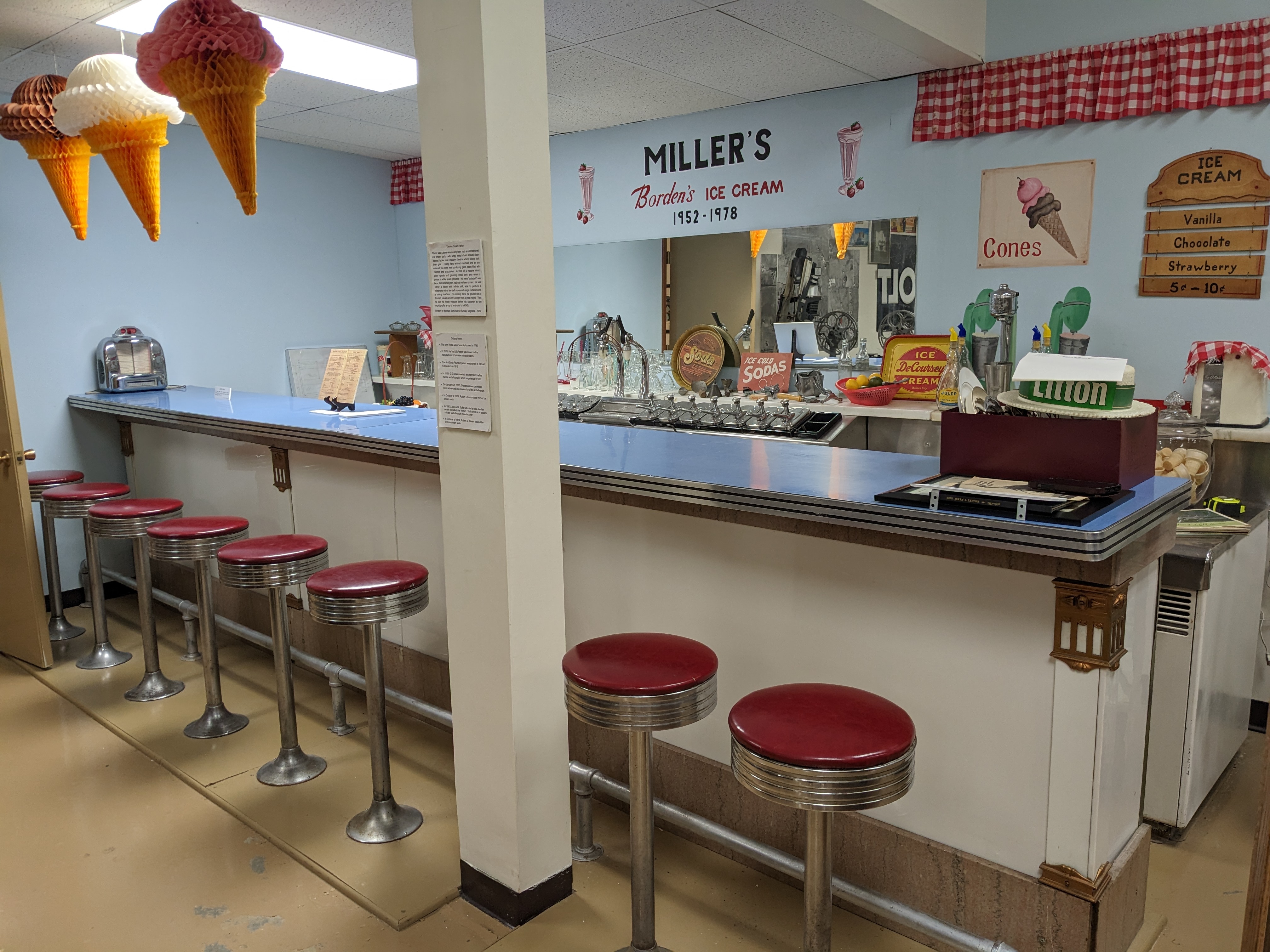
On the way back through Missouri on the Saturday of Memorial Day weekend, ladies at the first Visitor Center on I-29 warned us about traffic through Kansas City, which was hosting a Royals game, and advised us to take US36 from St. Joe across to Macon, then US63 down to Columbia, where we were booked for the night. The drive was far more pleasant than the Interstates, and we very much enjoyed exploring the quirky Grand River Historical Society Museum in Chillicothe, MO, where Otto Rohwedder invented the first automated bread-slicing machine for commercial use. A 1928 model of the Breadslicer was on display, on long-term loan from the Smithsonian. They also had a full display of an old-style ice cream and soda fountain.

Miller's ice cream and soda fountain, 1952-1978Miller’s ice cream and soda fountain, 1952-1978

Leave a comment

Filed under food, industry, migration, travel, U.S.

How the U.S. Disposed of 1.4B Acres

From Homesteading the Plains Toward a New History, by Richard Edwards, Jacob K. Friefeld, and Rebecca S. Wingo (University of Nebraska Press, 2017), Kindle pp. 6-7:

Homesteading was one way in which the federal government transferred parts of America’s enormous public domain to private ownership. The U.S. government acquired nearly 1.5 billion acres in the lower forty-eight states between 1781 and 1853, through the Revolutionary War treaty, the Louisiana Purchase, the Mexican War cessions, the settlement of boundary disputes with the British over Canada, and a few other minor acquisitions. From the outset many individuals, whether landless or the mightiest land barons, mining companies, and speculators, eagerly looked on public land as a source of potential riches for themselves. But the government was also interested in moving public land into private hands for a variety of motives that shifted over time. Initially it sought to use land sales to fund the federal budget, but later it distributed land to stimulate canal and railroad growth, to occupy remote regions and thereby forestall threats from foreign powers, to populate the West in order to foster private economic development, and to create a land-owning, small-farmer middle class that would sustain a democratic society.

We can trace in broad terms the disposition of this 1.442 billion-acre public domain. The national government today continues possession of about 26 percent (380 million acres). It transferred approximately 22 percent (328 million acres) to individual states, most of which was sold, and homesteaders claimed about 19 percent (270 million, or possibly as much as 285 million, acres). The balance, roughly 32 percent (between 449 and 464 million acres) was transferred to private owners through sales, grants to railroad corporations, veterans’ bonuses, agricultural college grants, and other distributions, or it was stolen, misappropriated, reserved, or otherwise caused to disappear from the public land rolls. Homesteading accounted for between a quarter and a third of the public land transferred by the federal government to private owners.

Leave a comment

Filed under democracy, economics, education, industry, labor, migration, nationalism, U.S., war

Angaur: Crucible of Pacific Arts

In researching the origins of modern Palauan music and dance, Jim Geselbracht has assembled many perspectives on the phosphate mine at Angaur, which seems to have served as a crucible where Pacific Islanders from Micronesia, Okinawa, Taiwan, and other parts of the Japanese Empire came together and learned from each other during their few precious leisure hours.

As I discussed in an earlier post, foreign workers who were brought to Palau to mine phosphate brought with them their music and dance, which in turn had a significant influence on the development of modern Palauan music.  This, I believe, was the “big bang” event in Palauan music, where it changed from chants with lyrics that were handed down from the gods (chelid) to modern, composed music (beches el chelitakl).  Let’s first explore the history of the mining operation in Angaur.

According to a USGS report [1]:

Mining of phosphate on Angaur begin in 1909 during German administration of the island and continued from 1914 to 1944 under Japanese administration.  Mechanized methods were introduced just before the start of World War II.  From June 1946 to June 1947 mining was carried out by an American contractor under the control of the US Navy.  Mining was resumed on June 30, 1949, by a Japanese company, the Phosphate Mining Co., Ltd. (Rinko Kaihatsu Kaisha).

The labor for the mining operation consisted of Palauan, Carolinian, Chamorran, Filipino and Chinese workers.  In a book on Micronesian development [2], David Hanlon describes the “troubled history” of phosphate mining on Angaur.  I’ve extracted a portion that describes the labor force used to mine the phosphate:

Begun in February 1909, the mining of phosphate and the environmental havoc it wreaked had quickly turned Angaur into the “hottest place in the Pacific.”  The construction of a railroad, drying plant, sawmill, loading dock, warehouses, thirty-two European residences and eleven workers’ dormitories further blighted a landscape already ravaged by the open-pit technique used to extract phosphate.  German overseers and mechanics drank excessively, fought each other, and openly defied their company supervisors.  The abuse of Carolinian and Chinese laborers brought to mine the island’s phosphate included low wages, frequent payment in the form of near worthless coupons rather than currency, forced purchases with these devalued coupons of overpriced goods in the mining company’s store, physical punishment and extended working hours.  By 1911, the situation had deteriorated so badly that German colonial officials elsewhere in the Carolines were refusing to assist in the recruitment of islander labor for Angaur.

Fr. Francis Hezel extends the story in his book Strangers in Their Own Land [4]:

As the German Phosphate Company made preparations to begin mining operations, the island population of 150 … were moved to a small reservation in the southeast corner of the island.  At first company officials intended to rely on Chinese labor for the Angaur mines, and they brought in eighty workers from Hong Kong.  The Chinese proved as troublesome to the German overseers on Angaur as they were on Nauru.  Dissatisfied with their working conditions and benefits, and insulted by the floggings they received, they killed a German employee and called a general strike during the first year of operations.  To provide “more complaisant material for the company than the Chinese”, the German government began recruiting Carolinians.  With the assistance of chiefs from Yap and its outer islands, a hundred men were sent to Angaur on a one-year labor contract; a second recruiting voyage produced another two hundred laborers, eighty of them from Palau and the rest from Yap.

Fr. Hezel continues:

In the evenings, during their few hours of leisure, they often entertained themselves by singing and dancing, thus passing on the stick dances, German marching dances and other stylized art forms that have come to be widespread in Micronesia today.

These dances are what are known as matamatong in Palau today.  By 1911, the initial 300 Carolinian laborers had doubled in size [4]:

the island now contained a polycultural community of 600:  a few dozen Germans, … Chinese, some Chamorros and Filipinos, and the five hundred Carolinians from various islands who worked there.

During Japanese time, the mining labor importation practices continued.  According to Hanlon [2]:

Japan’s later civilian colonial government assumed supervision of all phosphate mining on Angaur in 1927 and relied upon labor from the Marianas, Palau, Chuuk and Yap.  These island laborers were recruited by village chiefs or headmen who received a small bonus or fee as compensation for the loss of manpower from traditional activities.  Most of these laborers were drafted against their will for a year of “totally exhausting work.”

Hezel [4] describes the mix of workers on Angaur during Japanese times as a continuation of German times:

the 350 islanders at work in the mines … generally served year-long contracts and lived under slightly improved conditions … The mines had always drawn heavily on Yapese, who had the reputation of being the hardest workers in the territory, but their numbers fell off from 200 to 50 during the 1920s because of the serious population decline on the island. Chuukese were called on to provide a proportionately larger share of the labor force, at first under threat of imprisonment, but in time half-voluntarily as the allure of a salary grew among the people.

Virginia Luka describes the impact of the phophate-mining workers in Angaur in a paper written at the Southern Oregon University [3].  In it she cited the observations of Pedro [5]:

Foreign workers from places such as Guam, Saipan, Yap, Chuuk, Pohnpei, Japan and China introduced new plants, animals, food, dancing, singing and lifestyles.  In Angaur they learned how to bake bread, sew, western dance and how to play some musical instruments such as the guitar, harmonica and accordion from the Saipanese.

Based on these accounts, the 300 to 600 Carolinian workers far out-numbered the local Angaur community of 150.  The Palauans observing and participating in the Carolinian dances likely led to the adoption of the matamatong as a Palauan dance.  Junko Konishi [dissertation in English available here] states that the word matamatong likely derives from Pohnpei [7]:

The term [matamatong] seems to have originated from the progressive form of the Pohnepeian word mwadong (mwadomwadong) meaning “to play, to take recreation” and dancing.

In fact, Junko relates that over 400 Pohnpeans were exiled to Palau in 1911 after the uprising in Sokehs and over 100 Pohnpean males were sent to Angaur to work in the mines [8].

However, Konishi developed a detailed explanation [8] of how the Marshall Islands were actually the birthplace of the marching dance, with diffusion of the dance in the early 1900s from the Marshalls to the Eastern Caroline Islands (including Pohnpei) and Nauru.  She states that:

Yapese and Palauan elders recount that Chuukese spread the marching dance in Angaur.

The matamatong dance was also picked up by Japanese settlers in Micronesia.  During the 2004 Festival of Pacific Arts, held in Palau, a Japanese dance group performed [6]:

… a dance style called Nanyo-Odori (South Seas Dance) [links go to Youtube videos of Bonin Islanders, the latter with subtitles in Japanese, with katakana for foreign words], presented as an adaption of the songs and dances from the Pacific brought back to the Ogasawaran islands of Japan by Japanese people who had sailed around the Pacific for trading … [and] lived in Micronesia during the period of Japanese occupation and control … The dance is an adaption of a Micronesian dance called the Matamatong … The dance, which was accompanied by songs in a mixture of Palauan, Japanese and English, is said to have been created in about 1914 at the end of the German era in Micronesia and continues to be popularly danced today.

A fascinating exchange [at the Festival of Pacific Arts] ensued between Palauans … and the Japanese performers, in which they compared the dance steps of the Nanyo-Odori with those of the Matamatong (as well as the words of the accompanying songs, some of which the Japanese did not understand).  A Palauan musician … Roland Tangelbad, noted that the Japanese still danced the old way, with a German soldier’s style of marching step (goose step) whereas the Palauans had since adapted theirs to the marching step of the US soldiers.

The impact of the Eastern Caroline Islanders among the Palauans went beyond the matamatong dance step [8]:

The Chuukese, who had a tradition of love songs, created many dances for love songs in Angaur during the Japanese colonial period.  And those songs, composed with lyrics in Japanese (which was the common language at that time), became popular among different island groups.

I witnessed both marching dances (call maas in Yapese) and stick dances during my fieldwork in Yap in the fall of 1974. One feature that defined both as “modern” was that men and women performed together in the same dance, and not separately as they did in traditional dances.

Leave a comment

Filed under China, economics, Germany, industry, Japan, labor, language, Micronesia, migration, military, music, Philippines, Taiwan

Eastern Europe’s Urban Growth, 1900s

From The Making of Eastern Europe: From Prehistory to Postcommunism, by Philip Longworth (Lume Books, 2020), Kindle pp. 157-158:

Between 1860 and 1900 the population of Eastern Europe almost doubled. Between 1900 and 1914 it increased by at least another 20 per cent to a figure well in excess of 250 million. This was a far higher growth rate than in any Western country, and it has never been adequately explained. In so far as the statistics exclude migration abroad, the situation was worse than it might seem. Mass emigration had gathered pace since 1880. By 1914 nearly 4 million had left Austria-Hungary; the rate of migration from the Russian Empire approached 100,000 a year. But the migration rates from the poorest areas were the lowest (higher for Austria-Hungary than Russia, higher from Russian Poland than the rest of the Russian Empire, and lowest from Romania). However encouraging a development the population explosion might seem to chauvinistic nationalists, it brought rising despair in the countryside (where almost 60 per cent of Austria’s subjects lived, 70 per cent of Hungary’s and over 80 per cent over the remainder of the region). The despair at having to feed more mouths from the same small trough turned to anger in massive peasant disturbances in Russia in 1905–6 and a bloody Romanian uprising of 1907. But the problems of the countryside were also transferred to the cities.

The population growth in most of the major cities exceeded that for the region as a whole because of urban migration. Between 1880 and 1910 the population of Prague rose by almost 40 per cent to nearly a quarter of a million; that of Budapest doubled to reach almost 900,000; those of St Petersburg and Moscow more than doubled (to 2 and 1.5 million respectively), and that of Warsaw more than tripled (to 856,000). But the most alarming increase occurred in Vienna which changed, within the span of a single generation, from a pleasant, orderly, German-speaking city of fewer than 750,000 souls to a polyglot maelstrom of over two million. The city, whose ancient walls had recently been dismantled to make way for the elegant Ringstrasse with its modern palaces and pleasant parks where bands played Strauss waltzes, was suddenly overwhelmed by a new kind of invasion.

It was an irony of this age of nationalism that by 1910 no less than 8 per cent of all Czechs should reside in Vienna (5 per cent of all Slovaks had settled in Budapest by that time). And not only Czechs, but Serbs, Romanians, Slovenes and Ukrainians had flooded in to the new tenements and slums. The city had come to resemble a Tower of Babel, and the indigenous Viennese felt overwhelmed; their culture, their very identity seemed threatened. The popular mood, formerly easy-going, became ugly.

Leave a comment

Filed under Eastern Europe, economics, education, industry, labor, language, migration, nationalism

Eastern Europe’s Failures in 1848

From The Making of Eastern Europe: From Prehistory to Postcommunism, by Philip Longworth (Lume Books, 2020), Kindle pp. 134-137:

At the beginning of March 1848, as news of a revolution in Paris seeped in about a week after the event, crowds took to the streets of Vienna, and before long the entire Empire, from Bohemia to northern Italy, was in turmoil. In the months that followed there were uprisings in Prague, Lemberg [Lviv] and several other cities besides Vienna; Hungary and Venice declared themselves independent; the imperial army was driven out of Lombardy by local insurgents supported by invading forces from Piedmont, and Vienna itself had to be abandoned to the revolutionaries. Within the imperial administration there were six changes of government; two ministers were lynched; another went mad; and the Emperor abdicated. Yet by the autumn of 1849 the old order had been resurrected and the cause of revolution seemed utterly lost. What had the revolutionaries stood for? Why did they lose? And what influence did the events have both on the Empire itself and on the rest of Eastern Europe?

The Revolutions of 1848 are commonly represented as nationalist, and so to a great extent they were. Yet the call for ‘freedom’ as if it were a single entity embraced a variety of aims. Middle-class liberals wanted the abolition of censorship, freedom of speech and assembly, and a judicial system that dispensed justice openly; radicals demanded the replacement of monarchical government by a democracy based on wide suffrage; peasants, and all progressives, wanted the abolition of serfdom; workers protested against unemployment and for more pay. After the first, heady, stages, even more interests forced themselves to the surface. Tenants struck against high rents; artisans took to the streets because new, cheap, factory-produced goods were already threatening their livelihoods; students saw an opportunity for activism, and in Prague there were anti-Jewish riots. Among the educated strata, some, like the great Hungarian landowner Szechenyi, wanted change on the lines of the British model, with economic development as the motor of social and political change. However, the slogans of the French Revolution and of the Romantic movement tended to predominate, and in particular calls for national self-expression.

The demands for national freedom, however, also took different forms. Some were founded on constitutional precedents, such as the ancient powers of the Hungarian Diet or of the Bohemian Estates, which had been sapped or overborne by imperial power. Others were based on what appeared to their proponents to be the self-evident claims of a common language and the national community which it created. And there were further divisions both within the various nationalist camps and between them. Frantisek Palacky, promoter of the Czech national revival, thought in terms of a union of all the Slav peoples of the Empire, predicated on the view that, for all the myriad differences of dialect, they all spoke the same beautiful language.

This, however, was unacceptable, among others, to the Polish nationalists, who, roused by emigres returning from France, wished to resurrect the ancient Polish Republic which had been wiped off the map only half a century before. Furthermore, the claims of one nationalist group encouraged others to assert themselves. Romanians, Serbs, Croats and Slovaks did not take kindly to the prospect of inclusion in a state dominated by Hungarians. The Ruthenes (Ukrainians) resented the Polish claims to domination in Galicia. German Bohemians feared the Czechs and some Austrians were attracted by the idea of a greater Germany.

The fast-declining sense of equality and fraternity among the revolutionaries themselves, a growing popular reaction to their extremism, and the discipline of the imperial army all helped the government to reassert its authority. The promise made on 25 April 1848 to provide a democratic constitution for Austria, and the subsequent undertaking, in response to public demand, to widen the franchise, assuaged the feelings of many democrats; the emancipation of the peasants of Bohemia and Moravia in March, and those of Galicia and the Bukovina later the same year, bought off much social discontent; and the authorities experienced little difficulty in encouraging the Croats, Serbs and Slovaks to attack the Hungarian rebels who had cavalierly rejected their modest claims to linguistic autonomy. For the rest it was a matter of suppression. On 7 June the insurrectionaries in Prague were crushed; Vienna was recaptured at the end of October, and a rising in Lemberg put down two days later. General Windischgraetz was the imperial hero of the hour. Only the Italians and Hungarians held out. The crushing defeat inflicted by General Radetzky on the invading Piedmontese at Novara in March 1849 spelt doom to the revolution in the Italian provinces, though the resurrected ‘republic’ of Venice survived until August. The Hungarian rebellion lasted only a few days longer.

Leave a comment

Filed under democracy, Eastern Europe, economics, education, industry, labor, language, nationalism, war