Category Archives: Hawai’i

Russian Pacific Colony of Atuvai, Nigau, Ovagu, Mauvi?

Here’s a surprising passage from volume 7 (1973) of the Hawaiian Journal of History, whose back volumes are now online at the Oceania Digital Library Project hosted by the University of Hawai‘i Library’s digital repository.

On 21 May (2 June) 1816 G. A. Schäffer apparently achieved the improbable. In a solemn atmosphere Kaumualii—”King of the Sandwich Islands of the Pacific Ocean, Atuvai [Kauai] and Nigau [Niihau], and Hereditary Prince of the Islands of Ovagu [Oahu] and Mauvi [Maui]”—humbly requested “His Majesty the Sovereign Emperor Alexander Pavlovich … to accept the mentioned islands under his protection” and promised eternal allegiance to the “Russian scepter.”

This passage comes from a translation by Igor V. Vorobyoff commissioned by the Kauai Museum of an original publication in Russian: Bolkhovitinov, N. N., “Avantyura Doktora Sheffera na Gavayyakh v 1815-1819 Godakh,” Novaya i Noveyshaya Istoriya, Russian, No. 1, 1972, pp. 121-137. Here is a bit more historical context from the same article.

The history of Russian America is rich with striking events, courageous voyages, grandiose projects, and rather modest practical results. One of the oddest and most exotic episodes in the history of the Russian-American Company (RAC) was the Hawaiian adventure of Dr. Schäffer….

At the start of the 19th Century King Kamehameha (1753-1819), who was referred to as the Napoleon or Peter the Great of Polynesia, became the sovereign of the entire archipelago with the exception of the two northernmost islands, Kauai and Niihau, where his rival Kaumualii was entrenched. Kamehameha’s attempts at organizing an invasion of Kauai in 1796 and 1804 were foiled by natural calamities—first by a violent storm, and latter by a plague epidemic. The superiority of his forces was so obvious, however, that in 1810 Kaumualii decided to officially recognize his vassalage and agreed to pay a modest annual tax….

On 8 May 1819 Kamehameha—the most outstanding Hawaiian ruler, the founder of a united monarchy, and one of the great statesmen of his times—died at an age of about 70. In the summer of 1821 Kamehameha’s son, Liholiho moved Kaumualii from Kauai to Oahu where from that time on he lived as an honored prisoner, but this did not keep him from marrying Kamehameha’s widow, the famous Kaahumanu….

In 1820 an agent from the American Consulate and the first group of missionaries arrived in Hawaii. Sandalwood traders, and later American whalers witnessed increasing business. “The political relations of the people and king,” reported M. I. Murav’yev to St. Petersburg on 15 (27) January 1822, “remain as before; the king squanders, the people suffer, and the Americans get richer, but not for long: Sandalwood is becoming more difficult to get by the hour and, consequently, its price is going up.” … The general conclusion to which the governor of Russian possessions in America came was entirely unequivocal: “In truth I do not know how the Sandwich Islands could be useful to us, especially under the present circumstances. Schäffer performed a humorous comedy for which the company payed very dearly, and I do not think that it could be resumed. But there is no obstacle whatsoever, nor can there be any, simply to finding a berth there while enroute and replenishing the stocks with fresh provisions.”

Words in Kaua‘i dialect of HawaiianLANGUAGE NOTES: During the 1810s, Hawaiian dialects did not yet have a standard dialect or spelling system, so the Russian transcriptions (here transliterated into Latin equivalents) of Hawaiian names represent their own practices, including the representation of foreign /h/ as g (Cyrillic Г) and [w] as v (Cyrillic В), and ignorance of phonemic glottal stops.

Hawaiian /h/ is not guttural like Russian /x/, and there is an established tradition of transcribing foreign /h/ as g, as in gegemoniya ‘hegemony’, gumanizm ‘humanism’, or Gitler ‘Hitler’. Still, it’s a bit amusing to see Hanalei rendered as “Gannarey.”

The Hawaiian [w] sounds transcribed as v in the excerpts cited above do not correspond to the Hawaiian phoneme /w/, which is in fact slightly fricative in some contexts. The [w] sounds written as v in Atuvai, Ovagu, and Mauvi are just predictable transitions between a round vowel /o, u/ and its adjacent unrounded vowel /a, e, i/. But a real /w/ gets the same treatment in “Vegmeyskaya” [Waimea] Valley, which turns up elsewhere in the article.

The western dialects of Hawaiian retained earlier *t, which is reflected in Standard Hawaiian as /k/, the reflex in the eastern end of the archipelago, from which the western islands were subjugated. In many English sources from the early 1800s, the name of Kaua‘i is spelled Atooi or some variant thereof, while the name of Kaumuali‘i is spelled Temoree, Tamoree, and the like, from Teumuali‘i or Taumuali‘i (and the name of his rival Kamehameha is sometimes rendered as Tamehameha, Tamaamaah, etc.).

Leave a comment

Filed under Hawai'i, language, Pacific, Russia, U.S.

Wordcatcher Tales: Hamachi vs. Buri, Pāpio vs. Ulua

A delicious plate of hamachi kama (‘yellowtail collar’ [or ‘sickle’]), pictured below, serendipitously led me to discover that hamachi (魬) and buri (鰤) are merely different sizes of the same fish, the Japanese amberjack (Seriola quinqueradiata). Yellowtail is the usual translation in Japanese restaurants, but that name can also apply to a whole lot of other fishes (as well as other animals). You can tell you’re dealing with a highly commercialized and regulated industry when the difference between the smaller and larger fish is defined so precisely: hamachi weigh less than 5 kg, buri weigh 5 kg or more. The fry are called by yet another name, mojako.

According to Japanese Wikipedia, buri has a plethora of synonyms that vary by size and region. The term hamachi seems to come from Kansai; its match in Kanto seems to be inada. The names used on Japan Sea side are even more varied. (See here for a romanized glossary of Japanese fish names.)

Hamachi kama (yellowtail collar), Hanamaru Restaurant

This put me in mind of other types of jackfish (Jp. 鯵科 ajika, Carangidae) that have different names at different sizes in Hawaiian. Ulua refers to several types of large jackfish weighing 10 lbs or more, including the white ulua, or giant trevally (Caranx ignobilis); the omilu, or bluefin trevally (Caranx melampygus); and the kagami [< Jp. ‘mirror’] ulua or African pompano (Alectis ciliaris). At smaller sizes, the same fish are called papio. (Papio papio is also the genus and species name of the Guinea baboon.) In older Hawaiian usage, the smallest ones were called pāpio(pio); the somewhat larger ones, pā‘ū‘ū; and the largest ones, ulua.

2 Comments

Filed under food, Hawai'i, Japan, language

Ethnic Baseball in Hawai‘i, 1920s–40s

From: Wally Yonamine: The Man Who Changed Japanese Baseball, by Robert K. Fitts (U. Nebraska Press, 2008), pp. 48-49:

The Athletics, previously known as the Asahi, were the elite Japanese American team in the Hawaiian Islands. Founded in 1905 as a team for Japanese thirteen- and fourteen-year-olds, the Asahi soon dominated the AJA (Americans of Japanese Ancestry) Oahu Junior League. Finally, in 1920, league organizers decided that the team was too strong and moved the youths into the adult AJA Honolulu Baseball League. Three years later, the Asahi won the championship.

In 1924 the multiethnic Hawaii Baseball League was formed with six teams. Original members included the Portuguese Braves, the All-Chinese, the All-Hawaiians, the All-Filipinos, the Elks (made up of haoles) and the Asahi. With no age restrictions, Asahi recruited the best players from the AJA leagues throughout the islands. The Japanese team fared well, winning championships in 1925, ’26, ’29, ’30, and ’38. Japanese Hawaiians followed the Asahi’s triumphs closely, and Hawaii’s two Japanese-language newspapers, the Hawaii Times and Hawaii Hochi, covered the games and players in detail. The ballpark also became a meeting place for the community as thousands of ethnic Japanese came to Honolulu Stadium for each game.

With the outbreak of World War II, Japanese Hawaiians strove to show their loyalty to the United States. Many, including Asahi owner Dr. Katsumi Kometani, volunteered for the armed forces. With Kometani’s permission, the team downplayed its Japanese affiliation. John A. Burns, the future governor of Hawaii, ran the team in Kometani’s absence, while future Honolulu mayor Neal Blaisdell managed. The two haoles changed the team’s name to the Athletics and added several non-Japanese to the roster. The club did well and captured the 1942 championship. Kometani returned in 1945, reestablished the team’s all-Japanese American roster, and appointed Allen Nagata as manager. The team, however, remained the Athletics until it retook the Asahi name after the 1949 season.

Okinawans, like half-Okinawan Yonamine, were welcome to play on the AJA teams, but Wally and his wife-to-be got a lot of grief from both sides before they wed (in 1952) for not marrying within their respective Okinawan and Japanese communities.

According to this timeline, Wally went by his given name Kaname (要 ‘pivot, linchpin’) until 1943.

7 Comments

Filed under baseball, Hawai'i, Japan, U.S., war

Baciu on Writing a “Double Autobiography”

From Mira, by Stefan Baciu (Editura Mele, 1979), pp. v-vii (my translation):

Here is a book that I never in my whole life would have thought to write, or if I had ever thought to write it, I would have imagined something completely different from that which was imposed by the cruel circumstances I lived through from August 1977.

It was a warm night in Assisi, in Italy, where we had gone on a kind of pilgrimage, arriving from Cascia, which we had visited so that Mira could thank Santa Rita, the patron saint of impossible tasks, when I was awakened by the cries of pain from Mira, who always took great care not to “disturb” me. In the course of the events I relate in this book, it will be seen what began to happen from that night in Assisi, and if I refer back to it, it is only to express my conviction that her illness began from that time—and that place, even though four full months plodded by until, in Honolulu, the worst came to pass in all its horror.

No matter how paradoxical it may seem at first glance, this book is very much autobiographical, because from the moment we first got to know each other, in Bucharest in 1941, our lives have united to such an extant that I am unable to separate them.

I write these words after finishing the last page of a work of daily labor over a period of five months, at my worktable in Honolulu, in the house in which we lived from 1967, where Mira installed me in the quietest and most picturesque corner, so that I would have, in her words, “the one place where no one disturbs you.” Inasmuch as I have published since 1946 books written directly in German, Portuguese, and Spanish, I found after I had started this task, that the words I had committed to paper wrote themselves in Romanian, and of course I asked, “Why?”

I did not have to look far for the answer, because it arrived on its own: the pages that follow were written alone, dictated by Mira, with whom I always spoke Romanian, even when we were trying one or two days a week to speak Portuguese, which was—and is—second only to Romanian for us.

I began to write this “double autobiography” at the beginning of August 1978, and only a few days after I had begun to work, I realized that a month had passed since Mira left me, and I wanted her to remain with me—forever. If I had tried to write these words in Spanish or in Portuguese, many of the thoughts and deeds that I was transcribing would not have been written, or would have been written differently, for the good reason that Mira would not have dictated them to me thus, in those languages.

Throughout the final years, every time we talked about my work projects, Mira would tell me, and repeat with insistence, that my “mission” was to write my memoirs, which at her suggestion I entitled (for the years in Romania, 1918–1946) “Dust on the Drum,” a title inspired by my bohemian jeunesse at the Mercury, hearing the words of my “Uncle” Nicu Theodoru-Chibrit, a mythological figure, today, from a past even more mythological. During the summers, when I stayed alone in Honolulu instead of accompanying her on pilgrimages through Greece, Italy, and France, I would fill notebook after notebook of “Dust on the Drum,” work that served as a kind of extenuating circumstance every time she criticized my absence.

Books of memories and books of poetry, such pages cannot be written except in the language in which they were lived, dreamed, and endured. It falls on me to be the stenographer of our love and tragedy, just as I’ve reached 60, on the date Mira would enjoy so much, without being able to foresee that we would not be destined to spend that day together, and that I, “exiled alone on the other shore” in the words of my old friend, the symbolist poet Eugeniu Sperantia, would be forced, even on this day, to be the chronicler of my own misfortune.

Our life together was fundamentally, as they told me so often, 37 years of happiness, even if that happiness was overshadowed more than a few times by hurt and sometimes by illness. If I weigh it here and now, at the end of this ill-fated 1978, I find that sickness and pain were way stations on a long journey, too short, nonetheless, that started on a boulevard in Bucharest and ended on a bed in a convalescent hospital on an island in the Sandwich Archipelago.

Often, when we used to travel by train or by car from Bucharest to Brasov, passing through Câmpina, I thought that we should get off to see the “castle” of Hasdeu, where the bearded savant, the poet full of spirit and the pamphleteer full of vigor, buried his pain, seeking a pathway to the stars. Oh, how many times these days have I envied Hasdeu for his castle in Câmpina, where I know that he “spoke” with his Julia! Sitting on the terrace of our house in Honolulu, from which for so many tens and hundreds of hours we watched together the unparalleled sunsets over the Pacific, a fascinating and winning spectacle, I wish I could, like Hasdeu, talk with Her. It was for that reason that, more than once, I climbed the steps at night that lead from her room onto the terrace, expecting to meet her sitting in her armchair. to see her, or to hear her talk to me! It was not to happen!

It was still two days before Christmas when I visited the cemetery in Makiki where Mira sleeps the eternal sleep alongside the “Nightingale of the Pacific,” Lena Machado. I fastened onto a tropical plant, using a safety pin, the little parchment on which were depicted two wanderers with fur hats and sheepskin cloaks holding up a star, in order to fulfill the wish of her cousin, Ligia, and I thought that the day, or night, may nevertheless come when Mira will come talk with me or tell me something.

Until then, I can do nothing but await these secret dictations, which—alas—are about to end, as the year ends. Nothing remains in her life, in our life, not an episode that will not be relayed with full sincerity and honesty.

Starting life, against her innermost desires, as a pharmacist, Mira was by nature gifted with an extraordinary literary and artistic sensitivity, which sooner or later revealed itself, line by line, in poetry and in prose, in critical research and in teaching. Already near the end of her earthly cycle, she exploded with a richness that amazed everyone, in painting with a force that I regarded, and still regard, as sleepwalking. It lasted just eight months, from April to November 1978.

I do not know if these pages constitute a biography, a love story, or an adventure novel, but I know that they contain not a line, not a word that is not absolutely, precisely the truth. I had for almost four decades the privilege of knowing her and loving her and sharing with her day by day, night by night, moment by moment, bread and water, tears and pain, smiles and happiness. I was, in Bucharest, in Râmnicu Vâlcea, in Brasov, the escort who accompanied her on the most unexpected trails, to Bern and to Lugano, in Senegal and in Honduras, up the Corcovado in Rio de Janeiro and the Grand Canyon of Kauai.

Her disappearance has left me a widower and an orphan and I know that from now on, however life turns out, neither the bread nor the water nor the pain nor the tears will any longer—ever—be the same, that the days without Her will not have the same color or the same flavor.

I cannot entitle this book anything but “Mira,” even though a more fitting title might be found in the German “als wärs ein Stück von mir,” from the ballad of Uhland about “the good comrade” who, struck down by a bullet on the battlefield, falls at the feet of the one who survives “as if it were a piece of myself.” However, those words were borrowed earlier by a German memorialist, the playwright Karl Zuckmayer. On top of that, how would a title in German really sit with Mira, who, wherever and however she might present herself, was always Mira from Râmnicu Vâlcea or “the lass from the Olt” [River], as she wrote me on a photograph on the day she was naturalized as a citizen of the United States?

Of all the books that I have written in 45 years, this one is the most painful and the loftiest, because apart from being Mira’s book, it is at the same time, her life and mine, our life.

Honolulu, 24 December 1978, the first Christmas without Her

NOTES: My ‘cries of pain’ renders vaietele de durere (vai ‘alas, woe’, as in oy vey); ‘arrived on its own’ renders a venit de la sine; ‘bohemian jeunesse’ renders juneţea boemă (usu. junime); ‘Dust on the Drum’ renders Praful de pe tobă; ‘uncle’ renders nea (= nene); ‘more than a few times’ renders nu rareori (lit. ‘not rarely’); ‘way stations’ renders staţii pasagere; Câmpina was formerly a customs point between Transylvania and Wallachia; Hasdeu was a spiritist/spiritualist, as well as a noted historian and philologist; ‘the eternal sleep’ renders somnul de veci (lit. ‘sleep of centuries’); ‘with fur hats and sheepskin cloaks’ renders cu căciula şi suman (the traditional dress of Romanian shepherds); ‘in teaching’ renders în docenţă; ‘however life turns out’ renders oricum ar fi să fie viaţa; ‘the lass from the Olt’ renders lelea de pe Olt (the meaning of lele ranges from ‘sister, aunt’ to ‘libertine, whore’).

Leave a comment

Filed under family, Hawai'i, language, migration, Romania, travel, U.S.

On Translating Baciu’s “Patria”

Barely more than a month after I started blogging, I translated a poem entitled Patria by the Romanian exile, Stefan Baciu, whom I knew from my graduate school days at the University of Hawai‘i. Baciu administered one of my two foreign language reading exams required for my Ph.D. program. My major language (rather useful for research on Pacific languages) was French, for which I took a standardized test, while my minor language (less useful) was Romanian, for which Baciu chose a literary passage for me to translate, one describing a rural homestead after an uprising (or pogrom), with ‘rafters’, ‘sizzling flesh’, and other such vocabulary rare in the usual sorts of academic expository prose. (I was allowed to use a dictionary.)

Before I embarked on my language-rich, linguistics-poor Fulbright postdoc year in Romania in 1983, Baciu also gave me a copy of his (1980) self-published memoirs to take along. I left my copy with a literature professor at the University of Bucharest who showed a particular interest in Baciu, partly because all the exiles were nonpersons in Romania at the time. Nowadays, there is a growing revival of interest in those exiles, as Romanians seek to regenerate some of the historical limbs that were twisted, shriveled, or amputated during the communist and fascist eras of the last century. I think of it as a memory reforestation project, one that I hope does not lead to a revival of too much greenshirting.

Now that I have gained access to another copy of Baciu’s memoirs, I’ve been translating pages and posting them on this blog, doing my little bit to build a small English garden from his memories. In Wikipedia, I find it interesting that Baciu’s biographical entry is longer in the Spanish edition than in either the Romanian or the English edition. I’ve been adding External Links from the English Wikipedia entry to my translations here, but I noticed that the Spanish entry has far more External Links on Baciu, including a link to my English translation of the easiest of the three segments of the poem(s) entitled “Patria” (which I think best translates into ‘Home’ in this context).

So I thought I should try to translate the two harder passages in the bunch. The quatrains in Part II were harder because of the ABAB rhyme pattern, which forced me to swap lines and stray further from the meaning of the original words in several cases, while retaining the original imagery as far as possible. The hardest task in Part III was resisting the temptation to add a footnote to each line noting, for instance, that Time, Torch, and Ancient Beliefs were the names of publishers, or that Buzesti Square (not far from the Bucharest North train station) is now the site of a MacDonald’s and the Turkish restaurant (named “Shark”) where my wife and I shared a pleasant evening with my earlier Romanian cotranslator (of an old German grammar of a New Guinea language) and his wife during our quick visit to Bucharest in January. Networks of all kinds are so much easier to maintain these days.

Baciu’s “Patria” (‘Home’) is in several ways representative of his poetry in exile, which is full of nostalgia, longing, and the merger of mental and physical terrain across time and space. From now on, it’s back to translating memoirs, not quatrains, for me. Somebody else is welcome to translate his last major collection of poetry, entitled Peste o mie de catrene (‘Over a thousand quatrains’).

Home (Patria)

I

Home is an apple
in a Japanese grocery window
on Liliha Street
in Honolulu, Sandwich Islands
or a gramophone record
heard in silence in Mexico
–Maria Tanase beside the volcano Popocatepetl–
home is Brancusi’s workshop in Paris
home is a Grigorescu landscape
on an autumn afternoon in Barbizon
or the Romanian Rhapsody heard on a morning
in Port au Prince, Haiti
and home is the grave of Aron Cotrus
in California
home is a skylark who soars
anywhere
without borders and without plans
home is a Dinu Lipatti concert
in Lucerne, Switzerland, on a rainy evening
home is this gathering of faces
of events and sounds
scattered across the globe
but home is
especially
a moment of silence.

This is home.

II

With home you can talk by telephone,
You can hear it in distant whispers,
Carry it in your pocket, like a comb,
Or find it decapitated in the papers.

It’s not just earth or stone or air,
But a smell, a face, a twirl in the park,
A sound that echoes from anywhere,
A voice that pierces the midnight dark.

Because home is not an anthem bound,
illuminated, decorated, with border.
It’s a shroud, in deepest dreams rewound,
At dawn unraveled, in disorder.

Nor is home revived by boasts,
But by silence, by distance, by sorrow,
Squeezed from dust, on tropic coasts,
Scattered abroad, in hopes for the morrow.

III

The steeple of Saint Nicholas in Schei,
The echo of the train off Mt. Tâmpa at night,
“Kefir Lukianoff” in Cismigiu Park,
New books from “Time! Torch! Ancient Beliefs!”
“Hot corn-on-the-cob! Hot corn!”
Mr. Misu from Romanian Books,
The rainbow scarf of Emil Botta,
Maria Tanase singing at the Neptune in Buzesti Square,
Father commenting on War and Peace,
Or a page of poetry by Nietzsche
(tapping into the book with his index finger),
A cappuccino at the Crown

And this banknote of 500 lei,
Found in the bottom of a yellowed envelope,
Brought I don’t know how,
From Brasov to Brazil,
And then to Honolulu, Hawai‘i,
Island of Oahu,
Sandwich Archipelago

1 Comment

Filed under Hawai'i, language, migration, Romania

Baciu’s Memories of Brasov: Introduction

From Praful de pe Tobă: Memorii 1918-1946, by Stefan Baciu (Editura Mele, 1980), pp. 3-4 (my translation):

From the Bank of Flowers to the Sandwich Archipelago

I write this autobiographical sketch in my study in Honolulu, in a spot on the globe where I would never have been able to imagine that I would live thirty years ago, when I was living in what the Nicaraguan poet Salomón de la Selva would call “the Romania of my birth.”

At this moment as I look outside, I hear a parrot sitting on a branch of the lemon tree in front of my window, while on the facing hillside one can see two Chinese cemeteries, their gravestones low and gray, hardly visible in the grass. Only occasionally, at the odd burial or religious ceremony, can one hear crackles and pops of devices designed to drive away bad spirits. In back of the hill rises a volcano long extinct—called Punchbowl in English, Puowaina in Hawaiian—in the crater of which lie the heroes fallen in battles in the Pacific, the Punchbowl National Cemetery. To the left and right of the cemetery stretch the infinite waters of the Pacific.

From below, in Pauoa Valley, where children play baseball and football, one hears the shouts of those leaping into the swimming pool, but the houses are all lost in the gardens of abundant greenery, especially in this year full of heavy and frequent rainfall.

I note these summary facts of a possible autobiography of tomorrow, not to rediscover my old self of yesterday and the day before, of Brasov, Bucharest, Bern, Rio de Janeiro and Seattle, because that I can do more easily through poetry.

I want, on the one hand, to fix certain guideposts for a possible autobiography sometime later, and—more importantly—I do it in order to avoid errors, omissions, misunderstandings or interpretations to which might be subjected the life of a man whose life unfolded over the last decades (1946–1980), in such countries and regions, in such terrains and latitudes, that any confusions could be explained as due primarily to lack of information.

In a world in which even some “experts” say that Mexico lies in “South America,” and in which it is seldom realized that the city of Honolulu is situated on the island of Oahu, it would not be remarkable some time in the future (and perhaps not all that long into the future) for legends to arise that I wish to prevent, at least to the extent I am able.

NOTE: I’ve translated Prundul Florilor, the former name of a street in Brasov, as ‘Bank of Flowers’, since the primary meaning for prund seems to be ‘gravel’ or ‘gravelly bank of a river’. But the German name for the same street in Brasov was Rosenanger ‘Rosemeadow’ (or ‘Rosedale’?). Better suggestions are welcome.

UPDATE: By coincidence, the Brasov county library has just started hosting a literary exhibit entitled Ştefan Baciu între Ulise şi Don Quijote.

3 Comments

Filed under Hawai'i, literature, Romania

Wordcatcher Tales: Lē‘ahi ‘Tuna Point’

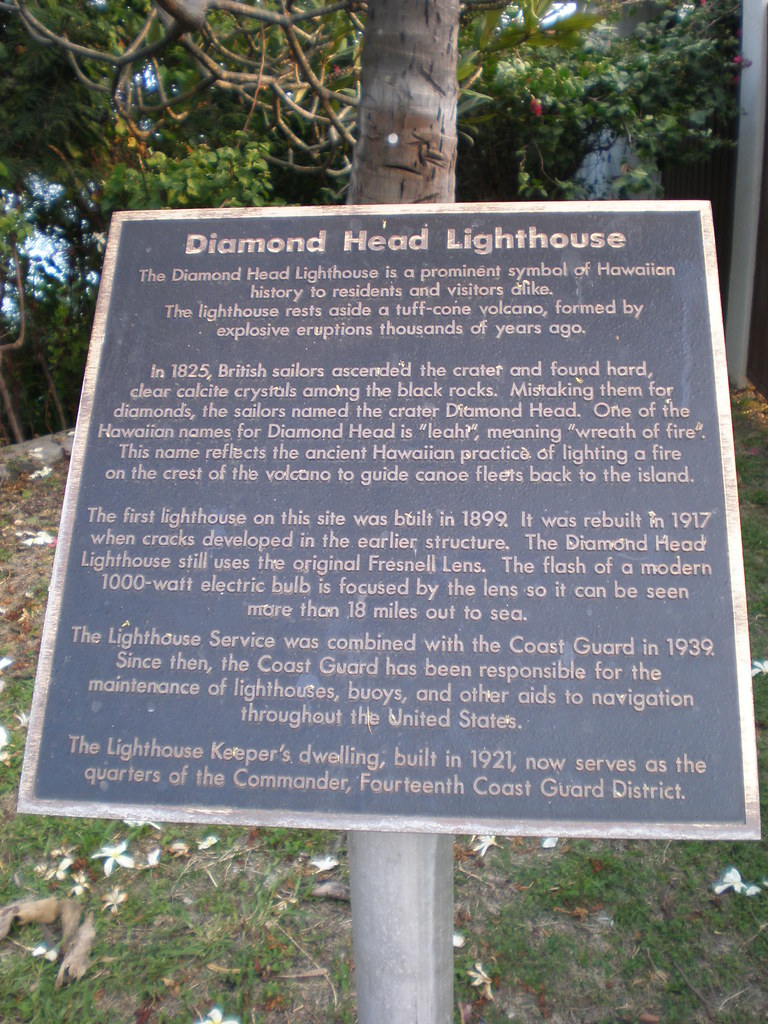
Most people who have lived in Hawai‘i for a while know that Diamond Head crater got its English name from the sparkle of worthless crystals in its rocky exterior, and not from real diamonds. And many know that it got its Hawaiian name, Lē‘ahi, from the resemblance of the crater’s ridgeline to the dorsal fin of a tuna. But the name doesn’t exactly mean ‘dorsal-fin of tuna’.

I gave the etymology a closer look after finding a bogus etymology on the historical plaque that marks Diamond Head Lighthouse. Lē‘ahi does not come from lei ‘wreath’ plus ahi ‘fire’, and thus has nothing to do with Hawaiian practices of navigational bonfires imagined by the builders of the modern lighthouse. Haw. ahi ‘fire’ comes from Proto-Polynesian (PPN) *afi ‘fire’, a good and widely reflected Austronesian root. In Numbami, a language I studied in Papua New Guinea, the word for ‘fire’ is yawi (with the /w/ slightly fricative before front vowels). Even highly aberrant Yapese seems to have a cognate, nifiy ‘fire’. But Haw. ‘ahi ‘tuna’ comes from Proto-Nuclear Polynesian (PNP) *kasi (with *k > /‘/, *s > /h/), which seems not to be so widely attested beyond Polynesia.

The first part of the compound is trickier. According to Place Names of Hawaii, comes not from lei ‘wreath, garland’, but rather from lae, which in place names usually translates ‘cape’ or ‘point’. However, the Hawaiian Dictionary lists a wider range of meanings: ‘forehead, brow; cape, headland, point, promontory; wisdom’ (< *la‘e). So some of the tourist literature now translates Lē‘ahi inappropriately as ‘tuna brow’ or ‘brow of the tuna’. Tuna Head(land) would be just as accurate, but Cape Tuna or Tuna Point would be more in keeping with the glosses in Place Names of Hawaii. (I think we can also rule out Tuna Wisdom!)

UPDATE: But what about Aku Head?

There used to be a well-known radio personality in Hawai‘i who called himself “J. Akuhead Pupule” (= ‘J. Tunahead Crazy’), reputedly after being called as much by irate listeners. I’m not sure why aku-head would be a sharper insult than ‘ahi-head, but it might be because aku is the Hawaiian name for the bonito or skipjack tuna genus Katsuwonus, whose name derives from Japanese katsuo, which in Japan is usually dried into a woodlike block, katsuobushi, from which flakes are shaved off for use as a flavoring. So maybe akuhead = blockhead.

From my fieldwork experience long ago in Papua New Guinea, where I elicited far more fishnames than I had ever heard of before, I would guess that Haw. ‘ahi matches pretty well with the genus Thunnus while Haw. aku names tuna of the genus Katsuwonus (and perhaps a few other similar genera).

In checking Wikipedia entries for other members of the family Scombridae (tunas, bonitos, and mackerals), I see that the one for wahoo, Haw. ono (< PPN *‘ono), offers entirely unsupported speculative etymologies for both names. Wikipedia should not confirm one person’s speculation with that of another. Leave that to the news media.

UPDATE 2: The cape at the southwestern tip of O‘ahu—a long, flat counterpart to Lē‘ahi at the southeastern tip—was for a time called Barber’s Point, but has now reverted to its Hawaiian name, Kalaeloa ‘The Long Point’.

A reader asks why I don’t simply consult a fluent native speaker of Hawaiian. One reason is that native speakers with encyclopedic knowledge are extremely rare in any language, but especially for Hawaiian these days, where most fluent speakers learned the language in a classroom, not from their parents and grandparents long resident on a plot of land. (In fact most have lost the lands of their ancestors.) Another reason is that local residents are usually content to offer folk etymologies and wild guesses when asked about anything not utterly transparent linguistically and historically. At least that is my experience from incessantly asking just such questions of local drivers, store clerks, wait help, baristas, sushi chefs, and random passers-by in my travels to odd parts of the globe over many years.

Leave a comment

Filed under Hawai'i, language

Akebono: From Rikishi to Pro-Wrestler

Japan-based blogger Ampontan backs into a retrospective of former yokozuna Akebono’s spectacular career in sumo and his troubled career afterwards. The story starts with a wrestling match at Yasukuni Shrine and ends up being a requiem for a yokozuna. Here are a few paragraphs to whet your appetite.

There is a long tradition of professional wrestlers fighting at Yasukuni Shrine. The most recent occasion was April 23, 1961, when Japanese wrestling legend Rikidozan presided over a card that featured youngsters Giant Baba and Antonio Inoki, who would become stars in their own right. (Inoki also would later form his own political party and win election to a seat in the upper house.) The event attracted 15,000 people….

Holding wrestling matches for the divinities at a Shinto shrine is not as outlandish as it may seem. There is a very long tradition in Japan of festivals with competitive events at Shinto shrines. In addition to sumo, which is closely linked to Shinto, competitions at shrines include archery, tug-of-war, and, according to my reference, even cock-fighting. The idea is that the divinities will favor the more deserving competitor, and the victors in these events will have good fortune in the year ahead….

The primary draw this year was the appearance in the ring of the former sumo yokozuna Akebono fighting as one member of a six-man tag team match….

Akebono’s career match record was 654 wins and 232 losses. He won 11 tournament championships, ranking him 7th in the modern era at the time. (After Akebono retired, another foreign rikishi, Musashimaru, racked up 12. Today’s fallen superstar, the Mongolian Asashoryu, later broke Akebono’s records for speed of promotion, and won 22 championships to place fourth on the all-time list. But that’s another story.)…

Eight years ago, Akebono appeared in a sumo ritual at Yasukuni at the pinnacle of his professional fame. Last weekend, few even in Japan noticed as he threw his weight around once again to take down his opponents. He said he was nervous at first, but happy to be back.

He seems to have found his niche. He said he wants to continue his career as a professional wrestler as a single instead of being part of a tag team.

Rikidozan and Giant Baba were the first pro-wrestlers I ever saw—and that was on a black and white Sharp TV in Kyoto in the 1950s, the same place I used to catch the end of sumo tournaments after school. Sumo captured my imagination in a way that pro-wrestling never did.

Leave a comment

Filed under Hawai'i, Japan, sumo

Wordcatcher Tales: Shaba, Tekipaki, Baribari

From Life behind Barbed Wire [鉄柵生活 Tessaku Seikatsu]: The World War II Internment Memoirs of a Hawai‘i Issei, by Yasutaro Soga [1873–1957] (U. Hawai‘i Press, 2008), p. 102:

Internees called the world beyond the barbed wire shaba. Although I did not like this word and did not use it, nearly everyone else did because it was convenient. Another word, chokuchi, often used by Mainlanders, was new at first to those of us from Hawaii, but it means to cheat. It probably comes from a Chinese word. Instead of tekipaki (quickly), internees said baribari, which I think is vernacular from somewhere in Japan. Farmers from the Mainland who grew vegetables at the camp said kyukanpo for “cucumber.” Japanese often confuse the p sound with b because there is no p sound in the original Japanese language. My friends from Hawaii often say “blantation” for “plantation” and “Poston” for “Boston.” I thought this strange at first. As the influence of Hawaii internees grew in the camps, the use of Hawaiian words began to spread among the Mainlanders. Soon everyone was using kaukau [‘food’], aikane [‘friend’], and moimoi [moemoe ‘sleep’].

This is a strange passage. It sounds as if the author was interned with Koreans rather than Japanese, since mixing up p and b, t and d, and k and g is one of the markers of Korean-accented Japanese. There was also some new vocabulary for me. I haven’t been able to find chokuchi ‘to cheat’, but the others are worth noting.

娑婆 shaba is ‘the world’ or ‘the world outside’, as in shaba ni deru ‘to go out into the world = to get out of prison’. (I wonder if it also means ‘to leave the priesthood’.) But it also appears in 娑婆気 lit. ‘world feeling’, as in shabaki o suteru ‘to give up worldly ambitions or desires’. The author of the passage cited above was a news reporter interned with a lot of Buddhist priests.

てきぱき tekipaki seems to indicate not just quick, but also brisk, decisive, precise, and prompt, quickness with a military snap to it. All these qualities are presumably implied in the name of a Japanese web-hosting service, tekipaki.jp.

ばりばり baribari, by contrast, stresses not just speed, but energy and even fury, as in ばりばり働く baribari hataraku ‘work like a demon’.

Leave a comment

Filed under Hawai'i, Japan, language, U.S.

Tessaku Seikatsu: Mainland vs. Hawaii Internees

From Life behind Barbed Wire [鉄柵生活 Tessaku Seikatsu]: The World War II Internment Memoirs of a Hawai‘i Issei, by Yasutaro Soga [1873–1957] (U. Hawai‘i Press, 2008), pp. 81-83:

Internees from the Mainland were more rebellious than those from Hawaii. From the point of view of Americans, this kind of behavior was seen as extremely disloyal but, given the pitiful circumstances under which mainland Japanese were placed, it was to be expected. I would not be exaggerating if I said that part of the responsibility for the recalcitrance of these internees rested on the United States government. Japanese in Hawaii were very lucky in comparison. Throughout the war, most were allowed to live comfortably and keep their businesses. For this we must thank Lieutenant General Emmons, a fair and intelligent man, who was commander in Hawaii when the war broke out.

When the first and second Hawaii groups came into contact with internees from the Mainland, they were generally considered inferior. (By the time I arrived at Lordsburg [NM], this was no longer the case.) Japanese from Panama and South America were also held in low esteem, so they felt much closer to internees from Hawaii. Japanese resent being discriminated against, but they themselves are prone to “closing ranks” to exclude others. Few ethnic groups exhibit this kind of behavior: It is definitely one of the shortcomings of Japanese. Those from the Mainland had suffered greatly under anti-Japanese policies and regulations, so they tried, consciously or unconsciously, to gain satisfaction by excluding those whom they considered to be “outsiders”—Japanese from Hawaii, Panama, and South America.

After we had lived together for awhile, the Mainlanders began to think better of us. Hawaii people often took the lead in promoting events and participated in many camp activities: theatricals, exhibitions, and sports, including sumo and softball. They began to realize we were fairly strong in not only number but also character. We received monthly remittances of fixed amounts from home and were the best customers at the canteen (camp store), which gave us a certain amount of clout. What we hated most was being blamed by Mainlanders whenever something went wrong. But in general we were not reproached and maintained a good reputation in the camps. I think this was due to our strong willpower….

Among Mainland Japanese were quite a number of illegal immigrants who had jumped ship in the San Diego area in southern California to work as fishermen or had smuggled themselves into the United States from Mexico. Lured to this land of Canaan, where honey and milk were said to be flowing, hundreds of Japanese and Chinese attempted the crossing. All along the vast, barren border lie the bones of many adventurers who failed. Swindlers offering transport to the United States for several hundred dollars would open their cargo doors while flying and dump their “shipment” in the middle of the desert without a second thought. I heard all of this from a man who lived in Mexico.

1 Comment

Filed under Hawai'i, Japan, Latin America, U.S., war