Category Archives: economics

China Diary, 1988: Cheap Rent, Expensive Food

In 1987–88, the Far Outliers, with their two-year-old daughter in tow, spent a year teaching English at a new community college in Zhongshan City, Guangdong Province, China. The following is one of a series of articles I wrote in 1988. I sent them to a Honolulu newspaper, but they were not interested. So now I offer them as a retrospective on coastal China twenty years before hosting its first Olympics. At the same time, I am scanning in a lot of our old China photos and uploading them to my Flickr account or to my WordPress blog to illustrate this series.

How would you like to spend only ten dollars a month for rent? The only catch is that you have to move to Zhongshan City, Guangdong Province, China, and work at a local company for local wages.

Rent in Zhongshan looks good no matter how you figure it, but comparing the cost of living there with the same in Honolulu is still a bit tricky.

If you convert a Honolulu income of $2,000 per month to Chinese currency at the official rate of 3.7 yuan to the dollar, you would have more money to spend in a month than most people there make in a year. At the blackmarket rate of exchange, you would have twice that much. A couple who wanted to retire in Honolulu and live on their Zhongshan pension of 500 yuan per month would find first that they could not legally convert their yuan to “hard” currency at the official rate. If they then exchanged it on the blackmarket, they would end up with little more than $60 a month to live on.

But of course most people in Zhongshan earn Zhongshan wages and most people in Honolulu earn Honolulu wages. We need to match prices and wages in each place. So let’s compare fairly average working couples with one preschool-age child. Both couples are full-time teachers. Each month, Mr. and Mrs. Zhang in Zhongshan receive 500 yuan between them, if you average in the periodic bonuses they receive. Mr. and Mrs. Hara in Honolulu bring home $2,000 after taxes, union dues, and so forth.

A typical monthly wage in other parts of China would be about 100 yuan. Prices are also lower, as are the choices of goods available.

Public housing, Xian, ChinaEach month the Haras turn over $600, nearly one-third of their take-home pay, to their landlord, Mr. Chong, Zhang’s uncle. The Zhangs’ work unit—their college—provides them housing, but charges them 10 yuan each month for rent, 2 percent of their income. Gas, water, and electricity cost the Zhangs about 30 yuan (6 percent of their income). The Haras pay $40 a month (2 percent) for utilities.

The Zhangs are very lucky to have a telephone. It costs them about 25 yuan per month (5 percent of their income). They pay by the minute even for local calls. One time Zhang called his uncle in Hawaii and talked 10 minutes, at 12 yuan per minute. He’ll wait for his uncle to call him next time. The Haras pay $25 a month for their phone (1.25 percent). They rarely call the mainland but do call the neighbor islands occasionally.

New home, Shiqi, Zhongshan City, GuangdongThe Zhangs pay about 40 yuan per month (8 percent of their income) for full-time daycare for their 3-year-old. That includes breakfast and lunch six days a week and occasional doses of medicine. The Haras pay $300 a month (15 percent), to a private daycare center. That includes lunch and snacks.

Since their work unit furnishes their house, the Zhangs live close to work and pay little for transportation. They own two bicycles. Mrs. Zhang bought hers for 170 yuan (34 percent of their monthly paycheck). The Haras owe one more year of car payments at $170 a month (8.5 percent of their combined net), on the car they bought three years ago. They alternate chauffeuring.

Both the Zhangs and the Haras keep in touch with their relatives by mail. It costs the Zhangs one yuan (0.20 percent of their monthly income) to send ten airmail letters within China. But it costs them 20 yuan (4.0 percent) to send ten airmail letters abroad.

The Haras, by contrast, pay $4.50 (0.225 percent of their monthly net) to send ten airmail letters to Japan. It costs them $2.50 (0.12 percent) to send ten letters to the mainland.

The Zhangs recently made photocopies of family documents to help a relative emigrate. They paid 2.50 yuan for ten pages (0.50 percent of their income that month).

The last time the Haras photocopied ten pages, they paid 50 cents (0.025 percent).
The Zhangs spend about 40 percent of their income on food, 200 yuan per month. The Haras spend about 20 percent of their net on food, $400 per month.

Both couples eat a lot of rice, the Zhangs 50 lbs. a month, the Haras 25 lbs. Each 25-lb. purchase costs the Zhangs 12.50 yuan (2.50 percent), and the Haras $5.00 (0.25 percent). The Zhangs could buy government-ration rice through the state store but the quality is much worse. So they cash in their ration and use the money to offset the cost of the better rice they buy on the private market.

Official fruiterer, Shiqi, Zhongshan City, GuangdongThe Zhangs eat much less meat than the Haras. They pay about 4.50 yuan per pound for pork (0.90 percent of their monthly income), 3.50 per pound for chicken (0.70 percent), and 3.00 yuan for a 12-ounce can of luncheon meat (0.60 percent). The Haras pay about $2.70 per pound for chop suey pork (0.14 percent), 99 cents per pound for chicken (0.05 percent), and $1.30 for a 12-ounce can of luncheon meat (0.07 percent).

Produce such as bananas, bean sprouts, cauliflower, celery and tomatoes cost between .40 and 60 yuan per pound in Zhongshan, 0.07 to 0.12 percent of the Zhangs’ monthly income. Similar produce in Honolulu ranges from 39 to 99 cents per pound, 0.02 to 0.05 percent of the Haras’ monthly net.

Sundries store, Shiqi, Zhongshan City, GuangdongIn proportion to typical local incomes, then, rice and meat cost ten times more in Zhongshan than in Honolulu. But fruits and vegetables only cost two to three times more. Of course, the Zhangs are able to spend much more of their money on food because they spend less than one-tenth as much on rent.

Imported food is outlandishly expensive in Zhongshan. A six-ounce jar of instant coffee costs the Zhangs 20 yuan, two months’ rent (4 percent of their earnings). It costs the Haras about $4.00 (0.20 percent).

1 Comment

Filed under China, economics, Hawai'i

China Diary, 1988: The Allure of Hong Kong

In 1987–88, the Far Outliers, with their two-year-old daughter in tow, spent a year teaching English at a new community college in Zhongshan City, Guangdong Province, China. The following is one of a series of articles I wrote in 1988. I sent them to a Honolulu newspaper, but they were not interested. So now I offer them as a retrospective on coastal China twenty years before hosting its first Olympics. At the same time, I am scanning in a lot of our old China photos and uploading them to my Flickr account or to my WordPress blog to illustrate this series.

When all of China converts to daylight savings time during the summer, Zhongshan stays on Hong Kong time. To people in Zhongshan, Hong Kong and Macau seem at least as important as Guangzhou and Beijing.

It takes about two hours by hovercraft from Zhongshan Port to Hong Kong. There are two boats per day to Kowloon and two to Hong Kong. They are always full. There are also larger, slower, and cheaper ferries between Zhongshan and Shenzhen, the Special Economic Zone directly across the border from Hong Kong.

So when you buy vegetables at markets in Zhongshan, you shouldn’t be too surprised if you find “Golden Boat Gift Shop, New Territories, Hong Kong” written on the plastic bag the vendor puts the potatoes in. (The fact that the vendor supplies the plastic bags is unusual enough in China.)

Private Savings Bank, Shiqi, Zhongshan City, GuangdongBut there is even more traffic across the airwaves. Fewer than ten percent of households throughout China own TV sets, but it seems as if ninety percent do in Zhongshan. Many are tuned to Hong Kong. The special antennas and signal boosters needed to pick up Hong Kong cost extra money but are not hard to get. Televisions imported from Hong Kong have a special switch that toggles between the different audio channels used by Hong Kong and China.

Hong Kong stations present their weekly broadcast schedules on the air. So viewers who don’t read Hong Kong newspapers are still able to keep well abreast of upcoming specials. Rambo, First Blood was a big hit in Zhongshan.

Beauty shop, Shiqi, Zhongshan City, GuangdongThe commercials shown during English-language broadcasts give a strange picture of the desires of English-speaking consumers, many of whom pass through Hong Kong, few of whom live there. A great many ads are for luxury products: cigarettes, watches, furs, cars, fashions, perfumes, electronics, the sorts of things advertised in airline magazines. And the ads themselves are glitzy and expensive-looking.

But if you watch the Chinese-language programming directed at residents rather than travelers, you can witness the Hong Kong equivalents of American low-budget ads for car dealers and furniture stores.

In October 1987, the government launched a campaign to discourage viewers, especially party members, from watching Hong Kong TV. The authorities didn’t want people tuned to Hong Kong while government stations were broadcasting the 13th Party Congress from Beijing in October or the 6th National Games from Guangzhou the following month. The campaign had some success. Everybody watched the National Games. The athletes from Guangdong Province won the most prizes.

In the months before we left, the provincial government was interfering with the Hong Kong TV signals and trying to bring in more clearly the provincial and national broadcast channels from Guangzhou. Some people told us that the officials in charge of public security thought Hong Kong TV helped keep people glued to their TVs and out of trouble, while those in charge of political education thought Hong Kong TV politically unacceptable.

Dragon Tiger Phoenix Restaurant, Shiqi, Zhongshan City, GuangdongAlthough Macau TV is less attractive, the city of Macau is even easier to get to. It takes less than an hour by bus from the center of Zhongshan City to Gongbei, the border town in Zhuhai Special Economic Zone. Every day thousands of people cross the border, carrying fresh food and Chinese medicine to Macau, and returning with as many goods and cigarettes as they can hide in their bags and clothing. Empty cigarette cartons litter the floor inside and outside of the restrooms that stand between the duty-free shops and Chinese Customs.

Public health poster, Shiqi, Zhongshan City, GuangdongOfficials responsible for political education are hard put to counter the allure of these two enclaves of rampant capitalism. A recent film, Escape to Hong Kong, deals directly with the issue. It tells of four people who escaped from Shenzhen during the Cultural Revolution. The only woman among them is forced into prostitution when no one will ransom her from the gangsters who hide the four in Hong Kong. Her husband finds work as a day laborer, they sleep in shifts, and he eventually kills himself. Another escapee finds respectable work as a chauffeur, and the fourth achieves some worldly success, but at the cost of marrying his boss’s idiot daughter.

Many Zhongshan schools bought tickets to this movie for their entire student body. The accompanying short subject had a complementary political message. It was a documentary—with plenty of bare skin and bulging muscles—about New China’s first-ever body-building contest, held in Shenzhen.

Leave a comment

Filed under China, cinema, economics, education

China Diary, 1988: Mao Wore a Zhongshan Suit

In 1987–88, the Far Outliers, with their two-year-old daughter in tow, spent a year teaching English at a new community college in Zhongshan City, Guangdong Province, China. The following is one of a series of articles I wrote in 1988. I sent them to a Honolulu newspaper, but they were not interested. So now I offer them as a retrospective on coastal China twenty years before hosting its first Olympics. At the same time, I am scanning in a lot of our old China photos and uploading them to my Flickr account or to my WordPress blog to illustrate this series.

Zhongshan City is named after Sun Yatsen, better known as Sun Zhongshan in China. His birthplace, Cuiheng Village, is the major local tourist attraction. Tour companies in Macao do a brisk business in one-day tours of Zhongshan. The tourists walk through Dr. Sun’s house, a museum about his life, the Sun Yat-Sen Memorial Middle School, and a model factory or two. Their lunch in the revolving restaurant of either of the international tourist-class hotels may include pigeon, a local specialty, but not dog, another local favorite.

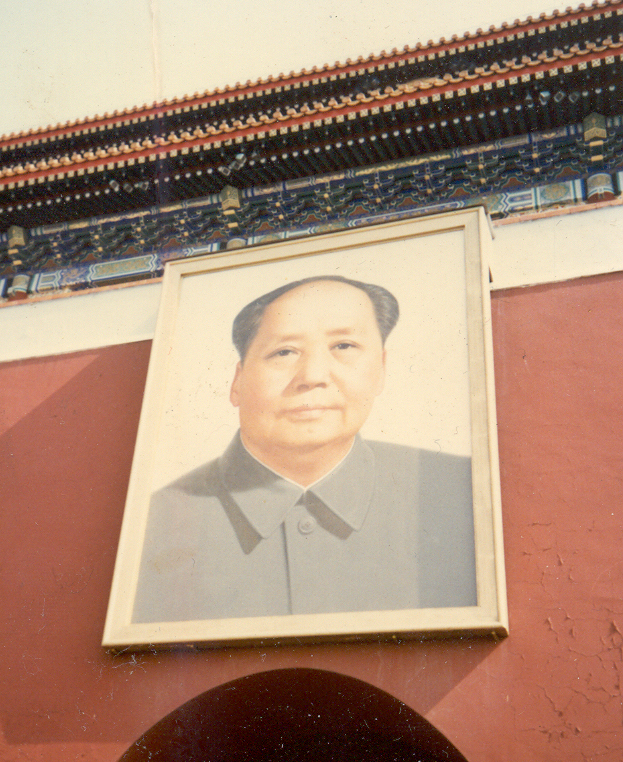
Chairman Mao’s portrait overlooking TiananmenSun Yatsen is the most durable and universally admired national hero in China. He led the struggle to overthrow the Manchu Dynasty in 1911. He also created the style of clothing known in the west as the “Mao jacket” and in China as the “Zhongshan suit.” Almost every major city in China has a Zhongshan Road or a Zhongshan Park. Many also have streets named after Dr. Sun’s Three Principles: minzu, minsheng, minquan, “(people’s) nationhood, livelihood, and civil rights.”

Zhongshan has over one million current residents, and is also the ancestral home of half a million overseas Chinese. So the local stamp collectors already had plenty of the standard U.S. overseas airmail stamps that we received regularly.

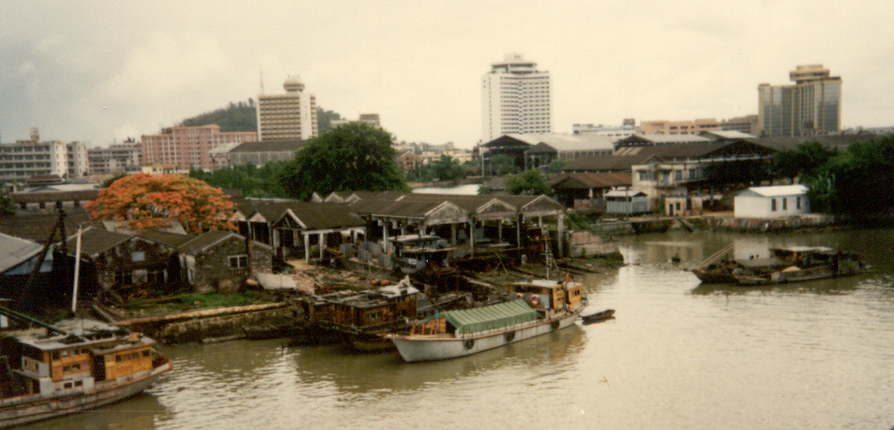
Old wharves and new hotels, Shiqi, Zhongshan City, Guangdong, China, 1988Formerly known as Xiangshan, “fragrant mountain” (a good match for nearby Xianggang “fragrant harbor”), Zhongshan was once an agricultural backwater in the vast and fertile Pearl River Delta. It is still mostly countryside, with an urbanized administrative center at Shiqi.

However, in 1984 the region embarked on an ambitious program of industrial development and foreign trade. It is now officially a prefecture-level city directly under the province administration, no longer a rural county.

Getting local goods to major cities used to take a long time. But now, over the improved roads and new toll bridges, you can get to Macao in about one hour and to Guangzhou in under four hours. From Zhongshan Port you can reach Hong Kong by hovercraft in two hours.

The port can also handle container shipping, and you can occasionally see a huge container truck slowly threading its way among the bicycles down the old narrow streets of Shiqi.

The booming local economy is fueled by:

  1. Government investments in infrastructure, such as 1440 new bridges, over one million square meters of housing, direct-dial telephone lines to Guangzhou, Hong Kong, and Macao, and a brand new college affiliated with Guangzhou’s Zhongshan University.
  2. Overseas infusions of capital and expertise, such as the over $100 million invested in 98 joint Chinese-foreign enterprises.
  3. Earnings from exports of local food and industrial products, the latter earning $185 million in 1986, a fourfold increase over 1978.

Zhongshan City sundries shop, 1988Not all export earnings are reinvested in industrial development. Many private shops offer such imported consumer goods as Coke or Sprite, Marlboro or Kent cigarettes, Mateus wine or Remy Martin cognac, Nestles instant coffee or powdered milk, San Miguel or Pabst Blue Ribbon beer, Kjeldsens Danish butter cookies, Camay and Palmolive soap, Johnson’s baby shampoo, Pears lotion, Kingsford corn starch, even Sunkist navel oranges and California apples and grapes. Japanese tape recorders, stereos, televisions, refrigerators, washing machines, copiers, and motorcycles are also much in evidence. You can buy all of these items in local currency, but the prices are very high.

Construction is everywhere. Every roadside village seems to have a newly painted gate and several big, colorful new houses going up. The flat fields surrounding the town of Shiqi are disappearing under factories and apartment blocs. The noise of the pile drivers is more constant than the periodic bursts of firecrackers. Our two-year-old daughter studied closely all the details of concrete-making. She knows all the ingredients.

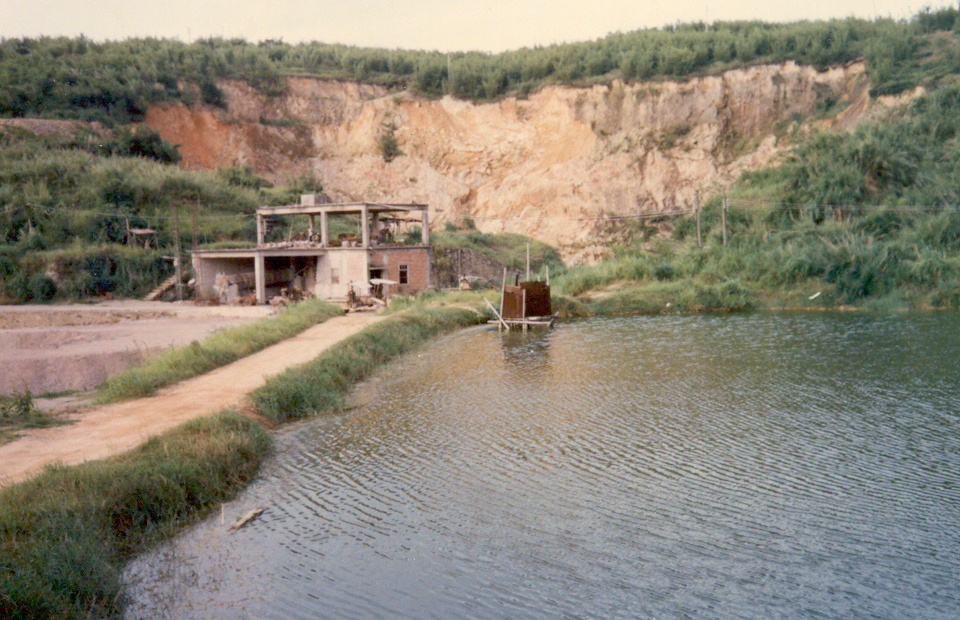
Gravel quarry, Shiqi, Zhongshan City, Guangdong, China, 1988On our college campus, we would wake up and go to sleep to the hum of bulldozers rearranging the landscape. Yesterday’s path to school might be covered with dirt or rubble today. Noon and evening meal times were marked by sharp dynamite blasts from the nearby quarry that is turning a rocky, grave-covered hillside into gravel. Dynamite, bulldozers, and a thousand picks and shovels have taken large bites out of most of the hillsides on the edge of town.

Similar changes are taking place in other parts of China, especially in Guangdong Province, which is a pacesetter for the reform policies and has spawned several special economic zones: Shenzhen, opposite Hong Kong, Zhuhai opposite Macao, and now the entire island of Hainan, which is becoming a separate province with much more flexible economic policies.

Most China-bound tourists come to marvel at the magnificent achievements of the country’s long history. Visitors to Zhongshan will be impressed much more by the direction and speed of change taking place in coastal South China, the bellwether of the country’s future.

UPDATE: The economic growth that was getting a head start in South China in the 1980s seems to be spiraling out of control as it spreads to more isolated parts of the country (via Arts & Letters Daily).

Leave a comment

Filed under China, economics

Judt on Belgian Identity Politics

From Postwar: A History of Europe Since 1945, by Tony Judt (Penguin, 2005), pp. 708-712:

Belgium, in short, combined all the ingredients of nationalist and separatist movements across Europe: an ancient territorial division reinforced by an equally venerable and seemingly insuperable linguistic gulf (whereas many residents of the Dutch-speaking regions have at least a passive acquaintance with French, most Walloons speak no Dutch) and underpinned by stark economic contrasts. And there was a further complication: for most of Belgium’s short history the impoverished communities of rural Flanders had been dominated by their urban, industrialized, French-speaking Walloon compatriots. Flemish nationalism had been shaped by resentment at the obligation to use French, at the French-speakers’ apparent monopoly of power and influence, at the francophone elite’s arrogation to itself of all the levers of cultural and political authority.

Flemish nationalists, then, had traditionally taken for themselves a role comparable to that of Slovaks in pre-divorce Czechoslovakia—even to the extent of actively collaborating with the occupiers during World War Two in the forlorn hope of some crumbs of separatist autonomy from the Nazi table. But by the 1960s the economic roles had been reversed: Flanders was now presented by its nationalist politicians not in the image of backward, under-privileged Slovakia but rather as Slovenia (or—as they might prefer—Lombardy): a dynamic modern nation trapped in an anachronistic and dysfunctional state.

These two self-ascribed identities—repressed linguistic minority and frustrated economic dynamo—were now both woven into the fabric of Flemish separatist politics, such that even after the old injustices had been swept away and the Dutch-speaking provinces of the north had long since won the right to the use of their own language in public affairs, the remembered resentments and slights simply attached themselves to new concerns instead, bequeathing to Belgian public policy debates an intensity—and a venom—which the issues alone could never explain.

One of the crucial symbolic moments in the ‘language war’ came in the Sixties—fully half a century after Dutch had been officially approved for use in Flemish schools, courts and local government, and four decades after its use there was made mandatory—when Dutch-speaking students at the University of Leuven (Louvain) objected to the presence of French-speaking professors at a university situated within the Dutch-speaking province of Flanders-Brabant. Marching to the slogan of ‘Walen buiten!’ (‘Walloons Out!’) they succeeded in breaking apart the university, whose francophone members headed south into French-speaking Brabant-Wallon and established there the University of Louvain-la-Neuve (in due course the university library, too, was divided and its holdings redistributed, to mutual disadvantage).

The dramatic events at Leuven—a curiously parochial and chauvinist echo of contemporary student protests elsewhere—brought down a government and led directly to a series of constitutional revisions (seven in all) over the course of the ensuing thirty years. Although devised by moderate politicians as concessions to satisfy the demands of the separatists,the institutional re-arrangements of Belgium were always understood by the latter as mere stepping stones on the road to ultimate divorce. In the end neither side quite achieved its aims, but they did come close to dismantling the Belgian unitary state.

The outcome was byzantine in its complexity. Belgium was sub-divided into three ‘Regions’: Flanders, Wallonia, and ‘Brussels-Capital’, each with its own elected parliament (in addition to the national parliament). Then there were the three formally instituted ‘Communities’: the Dutch-speaking, the French-speaking, and the German-speaking (the latter representing the approximately 65,000 German speakers who live in eastern Wallonia near the German border). The communities, too, were assigned their own parliaments.

The regions and the linguistic communities don’t exactly correspond—there are German speakers in Wallonia and a number of French-speaking towns (or parts of towns) within Flanders. Special privileges, concessions, and protections were established for all of these, a continuing source of resentment on all sides. Two of the regions, Flanders and Wallonia, are effectively unilingual, with the exceptions noted. Brussels was pronounced officially bilingual, even though at least 85 percent of the population speaks French.

In addition to the regional and linguistic communities, Belgium was also divided into ten provinces (five each in Flanders and Wallonia). These, too, were assigned administrative and governing functions. But in the course of the various constitutional revisions real authority came increasingly to lie either with the region (in matters of urbanism, environment, the economy, public works, transport and external commerce) or the linguistic community (education, language) culture and some social services).

The outcome of all these changes was comically cumbersome. Linguistic correctness (and the constitution) now required, for example, that all national governments, whatever their political color, be ‘balanced’ between Dutch- and French-speaking ministers, with the prime minister the only one who has to be bilingual (and who is therefore typically from Flanders). Linguistic equality on the Cour d’Arbitrage (Constitutional Court) was similarly mandated, with the presidency alternating annually across the language barrier. In Brussels, the four members of the executive of the capital region would henceforth sit together (and speak in the language of their choice) to decide matters of common concern; but for Flemish or Francophone ‘community’ affairs they would sit separately, two by two.

As a consequence Belgium was no longer one, or even two, states but an uneven quilt of overlapping and duplicating authorities. To form a government was difficult: it required multi-party deals within and across regions, ‘symmetry’ between national, regional, community, provincial, and local party coalitions, a working majority in both major language groups, and linguistic parity at every political and administrative level. And when a government was formed it had little initiative: even foreign policy—in theory one of the last remaining responsibilities of the national government—was effectively in the hands of the regions, since for contemporary Belgium it mostly means foreign trade agreements and these are a regional prerogative.

The politics of this constitutional upheaval were just as convoluted as the institutional reforms themselves. On the Flemish side, extreme nationalist and separatist parties emerged to press for the changes and benefit from the new opportunities to which they gave rise. When the Vlaams Blok, spiritual heir to the wartime ultranationalists, rose to become the leading party in Antwerp and some Dutch-speaking suburbs north of Brussels, the more traditional Dutch-speaking parties felt obliged to adopt more sectarian positions in order to compete.

Similarly, in Wallonia and Brussels, politicians from the French-speaking mainstream parties adopted a harder ‘communitarian’ line, the better to accommodate Walloon voters who resented Flemish domination of the political agenda. As a result, all the mainstream parties were eventually forced to split along linguistic and community lines: in Belgium the Christian Democrats (since 1968), the Liberals (since 1972), and the Socialists (since 1978) all exist in duplicate, with one party of each type for each linguistic community. The inevitable result was a further deepening of the rift between the communities, as politicians now addressed only their own ‘kind’.*

*The main newspapers, Le Soir and De Standaard, have almost no readers outside the French- and Dutch-speaking communities, respectively. As a result, neither takes much trouble to report news from the other half of the country. When someone speaks Dutch on Walloon television (and vice versa) subtitles are provided. Even the automatic information boards on interregional trains switch back and forth between Dutch and French (or to both, in the case of Brussels) as they cross regional frontiers. It is only partly a jest to say that English is now the common language of Belgium.

Wow. It’s almost as if Belgium has been governed by a bunch of enlightened North American university administrators with ever-expanding budgets.

UPDATE: Judt provides useful background to the report last month by Elaine Sciolino in the New York Times entitled Calls for Breakup Grow Ever Louder, filed in the wake of a celebration of “100 dagen belgische Chaos” by the Flemish Bloc.

1 Comment

Filed under Belgium, economics, language, nationalism

Mexico’s Fayuca Boom and Bust

From True Tales from Another Mexico: The Lynch Mob, the Popsicle Kings, Chalino, and the Bronx, by Sam Quinones (U. New Mexico Press, 2001), pp. 239-240, 242:

Fayuca. The word meant contraband, illegally imported merchandise: stereos, televisions, calculators, cameras, silk shirts, tennis shoes, blue jeans, blenders, and blouses. The government slapped this stuff with steep tariffs when imported legally as a way of protecting Mexican industry. Tepito brought it in illegally. To Tepito, fayuca meant easy money and lots of it. Despite the official prohibitions, Mexicans gorged themselves on the outside world’s baubles. Tepito was their dinner table. It was a time tailor-made for the Tepito mind-set. In the go-go era of fayuca, what mattered was not what you sold or how you brought it in but how fast it would move. The trickle of suitcases containing small items like perfume, watches, and jewelry in the mid-1970s became, by the 1980s, torrential truckloads of twenty-one-inch televisions and full home stereo systems.

To a government running a desiccated economy, it quickly became clear that the contraband did two things. First, it appeased the middle classes, who didn’t really care where they bought this stuff so long as they could buy it. Second, fayuca also helped dampen inflation. The prices in Tepito were usually well below what the same goods sold for in the stores that had legally imported them. “The authorities wanted to lower prices without really entering the global economy,” says Gustavo Esteva, a sociologist who lived in Tepito for several years during the fayuca boom. “So the government used Tepito and the fayuca to fight inflation.” Though fayuca was illegal, it was bought and sold openly in Tepito. The regime couldn’t appear to allow it in and yet didn’t dare keep it out. Eventually the industry was carved up among Tepito’s fayuqueros, commandants of customs, the judicial police, the highway police, and other government officials. After a while the highway police in San Luis Potosí, midway between Laredo and Mexico City, decided they wanted their cut too. The wife of President José López Portillo, Carmen Romano, was said to be one of the greatest fayuca importers.

The arrival of fayuca was a key moment in Mexico’s economic history. Fayuca was in its own way as important in rocking the regime’s credibility as the 1968 Tlatelolco [student] massacre, the periodic peso devaluations, and the fraud-riven elections of 1988. Its presence showed that the protected, state-run economy no longer had a prayer of providing what Mexicans now expected out of life. Though Mexicans talked economic nationalism, they voted with their feet and mobbed Tepito, looking for the smuggled imports.

And for the first time Tepito got rich. In Tepito the fayuquero took the place of the boxer as the model for economic advancement, though in this case the road to riches was accessible to thousands of people and few of them missed the turnoff Since the fayuca, Tepito has produced no great boxers. Instead Tepito’s fayuqueros took on the status of legendary renegades; at least two B movies were made about them….

Mexico’s entry into GATT, then NAFTA, brought the fayuca boom to an end. The Mexican government began to lower tariffs on consumer goods. Customers began finding what Tepiteros were selling in legitimate stores that offered service, guarantees, and receipts and didn’t have thugs around the corner waiting to rob the clientele. When the peso was devalued in 1994, sales plummeted further. People still go to Tepito, since merchandise is a little cheaper and carries no sales tax. But the fayuca gold rush is a memory.

1 Comment

Filed under economics, Mexico, nationalism, U.S.

The Oaxaca Diaspora’s Protestant Ethic

My rule of thumb is to try to blog no more than about a page per chapter (depending on the lengths of the chapters) from the books I buy and read, but the following excerpt is from my favorite chapter so far in a book where I can hardly resist “reading aloud” every few pages. I was undecided about which of three thematic passages to cite: on Mexico’s Okies (the victim angle), Oaxacan self-help (the agency angle), or religion (the spiritual angle). I ended up concatenating two of the three. So I’ll have to do hard penance by biting my tongue through several other chapters. From True Tales from Another Mexico: The Lynch Mob, the Popsicle Kings, Chalino, and the Bronx, by Sam Quinones (U. New Mexico Press, 2001), pp. 102-103, 110-111:

Mexicans generally view the border and those who live there as only semi-Mexican—too close to the gringo, where too many of his ways are imitated. In truth, that is what shaped the [San Quintín] valley. With drip irrigation farmers saw the potential of growing for both the United States and Mexico and dropped subsistence farming for a very American capitalist ethic. Acres under cultivation went from two thousand in 1980 to almost twenty thousand in 1990. Nighttime electricity came to San Quintín. Then a few stores, a couple of motels, a movie theater, satellite television.

“I have uncles in the state of Zacatecas who grow chile,” says Ruiz Esparza, “They harvest the crop, but only apart of the profits goes back into the fields. They’re afraid of risking it all. Here, it seems they’re a little crazy. They risk it all every year. People here aren’t interested in having money in their wallet. Everything they have goes back into the fields.

“I look at the farmers of Oceanside, Bakersfield, Oxnard battling against the city, high water prices, taxes, and I see them keep going. They’re very brave. I think having those people before us as examples inspires us to do the same. If they can do it, why can’t we?”

From the north, San Quintín had its market, and from there it imported machinery, capital, and an entrepreneurial spirit. What the valley of San Quintín had never had was abundant labor. And that came from the south.

The Dust Bowl in all this became the states of Guerrero and, above all, Oaxaca, both states with enormous Indian populations who retain the customs and languages of their ancestors. Like the northerners with whom they now live, they are considered somewhat less than Mexican, disdained as “dirty Indians.” It was a strange yet perhaps appropriate pairing: two outcasts coming together to create something in the dust of the northern Mexico desert.

Agriculture in Oaxaca, like that in Oklahoma during the Depression, is a limp and stagnant thing. Inefficient farming and the division of land into ever smaller slivers have bequeathed the state a withering poverty, bloody feuds over land ownership, and generations of uneducated children. Hundreds of thousands of Oaxacan Indians—Mixtecos primarily, but also Triquis and Zapotecos—have been leaving home for four decades now. They are Mexico’s migrants, the cheapest labor in a cheap-labor country. “They provided labor that was easily exploited,” said Victor Clark Alfaro, director of the Binational Human Rights Center in Tijuana. “They were docile, didn’t speak Spanish, would accept almost any treatment and work hard.”…

But in Tijuana, migrant Indians also discovered San Quintín’s almost unquenchable thirst for cheap labor. Through the late 1970s and 1980s the valley evolved into a major stop on the Indians’ migrant trail, part of what came to be known informally as “Oaxacalifornia”—the diaspora that starts in San Quintín and runs through North San Diego County and up the state. Entire families came to the valley to live in labor camps designed for transient men. The camps teemed, and the work was tough in the hot sun and choking dust. But it was work, which was something Indians had never had in Oaxaca….

Indians transformed their new home when they came here to live. But just as profoundly, their new home changed them. And the clearest distillation of all those changes is the Protestant Church. “If you take a poll, you’ll find that 80 or 85 percent of those who are established here now are Protestant,” says Meza. That number might be high. But Protestant churches—especially of the more fundamentalist bent—proliferate in the valley. Indians here have become Baptists, Jehovah’s Witnesses, Pentecostals, and scads of obscure denominations to which Luther’s Reformation gave rise. The new churches are symbols of economic success, of modernity, of the monumental power and attraction of the United States. The adoption of a Protestant faith is almost standard issue in leaving Oaxaca for a future.

And that process is best told by one man who, now in his late forties, stands clapping in unison with the rest of the Apostolic Assembly of the Faith in Christ Jesus. Twenty years ago Luis Guerrero took his family and left his Oaxacan Indian pueblo and its traditions, moved to the valley of San Quintín, and hasn’t yet looked back in fondness.

Guerrero, a Mixtec Indian who speaks halting Spanish in a thick Indian accent, faced a brutish dead-end life as a subsistence farmer, depending on unpredictable rains, in the village of Santa María Asuncion, where landholdings were no longer measured in acres but in meters.

In 1972 Guerrero was among fifteen people who had to pay for the village’s traditional party for its patron saint, the Virgin of Asuncion. It was the custom: every year a few people had to become deeply impoverished to throw the three-day party for everyone else. His job was daunting: he had to give 2,000 pesos—the equivalent of two and a half years’ local wages at the time—to buy food and alcohol for everyone, fireworks, candles, and more. The responsibility almost broke him. He borrowed the money at high interest rates, then left his young family and pueblo for that year to pick tomatoes in Sinaloa to pay it back.

In 1974 he began migrating to San Quintín with his family. Finally in 1978 they moved here to live, leaving Oaxaca forever.

Away from the cloistered atmosphere of his Oaxacan village, Luis Guerrero began a religious and secular awakening, one he likes to illustrate by talking about the books he bought.

In San Quintín he bought his first book ever—a Bible. In Oaxaca he had never read a Bible; though the whole village was Catholic, no one owned one. Like everyone else, he depended on a priest to know what it said. “I began reading it and I began to awaken my mind…. I like knowing myself: I went to the Catholic Church, the Apostolic Church, Prince of Peace, Los Olivares, Jehovah’s Witnesses, the Open Door—to see how each denomination preached.” He finally settled on the Apostolic Assembly.

Now thirsting for more, he bought his second book—a copy of the Mexican constitution. “In our pueblos in Oaxaca, we didn’t know the earthly law, or how to defend ourselves [legally]. Also we didn’t know spiritual law. So I searched on my own to discover what constitutional law said. I searched on my own to discover what the Bible said so that I myself could understand earthly law and spiritual law.

“Earthly law allows you to speak up for your rights with the police, the bosses. That’s why I put forth an effort to learn it. [In the villages] people don’t have education. The [local] authorities pressure them to fulfill tradition. They want them to put on traditional parties. [In Oaxaca] you can’t give your children education because the little money you earn you have to spend on parties for the saints. Our children have no shoes because of tradition. We came here to leave all that behind.”

3 Comments

Filed under economics, Mexico, migration, religion, U.S.

Judt on New, Not Old, Fissions in Yugoslavia

From Postwar: A History of Europe Since 1945, by Tony Judt (Penguin, 2005), pp. 670-671:

Kosovo had historic significance for Serb nationalists as the last holdout of medieval Serbia against the advance of the Turks and the site of a historic battlefield defeat in 1389. The local Albanian predominance was thus regarded by some Serb intellectuals and politicians as both demographically troubling and historically provocative—especially since it echoed the Serbs’ displacement by Muslims as the largest minority in the adjacent Bosnian republic. Serbs, it appeared, were losing out-to hitherto subservient minorities who had benefitted from Tito’s rigorous enforcement of federal equality. Kosovo was thus a potentially explosive issue, for reasons linked only tenuously to ‘age-old’ Balkan feuds….

Whereas Serb dislike of Albanians fed on proximity and insecurity, in the far north of Yugoslavia the growing distaste for feckless southerners was ethnically indiscriminate and based not on nationality but economics. As in Italy, so in Yugoslavia, the more prosperous north was increasingly resentful of impoverished southerners, sustained—as it seemed—by transfers and subsidies from their more productive fellow citizens. The contrast between wealth and poverty in Yugoslavia was becoming quite dramatic: and it correlated provocatively with geography.

Thus while Slovenia, Macedonia and Kosovo all had approximately the same share (8 percent) of the national population, in 1990 tiny Slovenia was responsible for 29 percent of Yugoslavia’s total exports while Macedonia generated just 4 percent and Kosovo 1 percent. As best one can glean from official Yugoslav data, per capita GDP in Slovenia was double that of Serbia proper, three times the size of per capita GDP in Bosnia and eight times that of Kosovo. In Alpine Slovenia the illiteracy rate in 1988 was less than 1 percent; in Macedonia and Serbia it was 11 percent. In Kosovo it stood at 18 percent. In Slovenia by the end of the 1980s the infant mortality rate was 11 deaths per 1,000 live births. In neighbouring Croatia the figure was 12 per 1,000; in Bosnia, 16 per 1,000. But in Serbia the figure was 22 per 1,000, in Macedonia, 45 per 1,000 and in Kosovo, 52 per 1,000.

What these figures suggest is that Slovenia and (to a lesser extent) Croatia already ranked alongside the less prosperous countries of the European Community, while Kosovo, Macedonia and rural Serbia more closely resembled parts of Asia or Latin America. If Slovenes and Croats were increasingly restive in their common Yugoslav home, then, this was not because of a resurfacing of deep-rooted religious or linguistic sentiments or from a resurgence of ethnic particularism. It was because they were coming to believe that they would be a lot better off if they could manage their own affairs without having to take into account the needs and interests of underachieving Yugoslavs to their south.

Leave a comment

Filed under Eastern Europe, economics, nationalism

Outburst of Piracy in Southeast Asia, 1754-1838

From Iranun and Balangingi: Globalization, Maritime Raiding and the Birth of Ethnicity, by James Francis Warren (Singapore U. Press, 2002), pp. 53-56:

The Iranun burst quite suddenly into Southeast Asian history in the second half of the eighteenth century with a series of terrifying raids and attacks on the coasts and shipping of the Philippines, the straits of Malacca and the islands beyond Sulawesi. Their primary targets were unprotected coastal settlements and sailing boats that travelled throughout Southeast Asia bringing valuable commodities from China and the West back to the most remote parts of the archipelago. Many of these marauders were sponsored by rulers from the trading states of Cotabato, Sulu, Siak, and Sambas. They were soon described as ‘Lanun’ or ‘Illanoon’—‘pirates’—by those who suffered their depradations or either travelled with or hunted them and wrote about their widespread impact on the Southeast Asian world.

It is estimated that during the last quarter of this century (1774–1798) of maritime raiding and conflict against the Dutch and Spanish, between 100 and 200 seaworthy raiding prahus set out from the Mindanao-Sulu area each year. The sheer size of the vessels—the largest joanga measuring upward of 130 feet in length—and the scale of the expeditions dwarfed most previous efforts, marking a significant departure in the naval strategy of Malay maritime raiding as it had been traditionally understood. The Iranun were far more than mere ‘pirates’ or brigands. The colonial powers and precolonial Malay trading states had to reckon with a dominant force in their own right; a force that was capable of inflicting major defeats on the Spanish and Dutch and toppling local kingdoms. The huge numbers of these skilled sea raiders and slavers that the sultanate of Sulu could mobilize during the heyday of the China trade would henceforth have a profound impact upon Southeast Asia’s history.

The geographical range of Iranun-Balangingi slave raiding activity was enormous, spanning all of Southeast Asia and beyond. Until the latter part of the eighteenth century, the joanga of the Cotabato and Sulu Sultanates were more or less integrated into fleets belonging to the respective sultanates, but by the end of the century many Iranun vessels were also operating independently. Iranun prahus sponsored by both states had their own target areas but inevitably, there was some overlap. Cotabato and Sulu raiding vessels cruised between the Visayas and Luzon, and out into the South China Sea. Those from Tempasuk, on the northwest coast of Borneo, harassed shipping to the west of the huge island itself. Samal Balangingi, situated midway between the Iranun communities in Mindanao and those on Borneo, operated vessels throughout the Philippines and in the central and eastern parts of the Netherlands Indies.

Iranun maritime raids affected virtually the entire coastline of Southeast Asia, and even stretches of New Guinea and the Bay of Bengal were not secure from slave raids. In the east, the Iranun sailed down the Makassar Strait to cross the Java Sea and South China Sea to attack the north coast ports on Java and the large tin mining island of Banka. Iranun raided extensively in the Sangir Islands, Halmahera and, to a lesser extent, in the Moluccas. They also pushed beyond the defended limits of the Southeast Asian world, crossing the South China Sea to attack undefended stretches of the coastlines of Thailand and Cochin China. At the opposite extremity they also raided, but failed to dominate, the dangerous coasts of New Guinea. In the 1790s, Iranun slave hunters in search of captives extended the limits of their known world even further, sailing far into the waters of the Bay of Bengal, touching at the Andaman Islands and perhaps exploring the southern coast of Burma. There seemed no practical way for the colonial powers to link their respective ‘dominions’ together in an island-wide network of defense and communication, and consequently the Iranun made the most of the ill-defended seas and ravaged the coastal populations and commerce….

In the second half of the eighteenth century many Philippine ports, towns, shipyards, and monasteries were not adequately defended while others were totally defenseless. From the mid-1750s onward, the scale, ferocity and unexpected nature of the initial wave of Iranun attacks were deeply disturbing. Thousands of Filipinos perished or were seized as captives; the more so as the Iranun were Muslims and recognized none of the accepted conventions and taboos that were meant to protect the property and personnel of the Catholic Church in times of war between Christians…. This terrifying period of Iranun slave raiding activity, which lasted more than 70 years from roughly 1752 to 1832, severely hampered the overall social and material well-being and growth of the Philippine island world and the colonial state.

4 Comments

Filed under economics, Philippines, piracy, Southeast Asia, war

Industrial Benefits of Downward Social Mobility?

Today’s New York Times carries a story about new research on the causes of the Industrial Revolution.

Gregory Clark, an economic historian at the University of California, Davis, believes that the Industrial Revolution — the surge in economic growth that occurred first in England around 1800 — occurred because of a change in the nature of the human population. The change was one in which people gradually developed the strange new behaviors required to make a modern economy work. The middle-class values of nonviolence, literacy, long working hours and a willingness to save emerged only recently in human history, Dr. Clark argues.

Because they grew more common in the centuries before 1800, whether by cultural transmission or evolutionary adaptation, the English population at last became productive enough to escape from poverty, followed quickly by other countries with the same long agrarian past….

Dr. Clark’s first thought was that the population might have evolved greater resistance to disease. The idea came from Jared Diamond’s book “Guns, Germs and Steel,” which argues that Europeans were able to conquer other nations in part because of their greater immunity to disease.

In support of the disease-resistance idea, cities like London were so filthy and disease ridden that a third of their populations died off every generation, and the losses were restored by immigrants from the countryside. That suggested to Dr. Clark that the surviving population of England might be the descendants of peasants.

A way to test the idea, he realized, was through analysis of ancient wills, which might reveal a connection between wealth and the number of progeny. The wills did that, , but in quite the opposite direction to what he had expected.

Generation after generation, the rich had more surviving children than the poor, his research showed. That meant there must have been constant downward social mobility as the poor failed to reproduce themselves and the progeny of the rich took over their occupations. “The modern population of the English is largely descended from the economic upper classes of the Middle Ages,” he concluded.

As the progeny of the rich pervaded all levels of society, Dr. Clark considered, the behaviors that made for wealth could have spread with them. He has documented that several aspects of what might now be called middle-class values changed significantly from the days of hunter gatherer societies to 1800. Work hours increased, literacy and numeracy rose, and the level of interpersonal violence dropped.

Another significant change in behavior, Dr. Clark argues, was an increase in people’s preference for saving over instant consumption, which he sees reflected in the steady decline in interest rates from 1200 to 1800.

“Thrift, prudence, negotiation and hard work were becoming values for communities that previously had been spendthrift, impulsive, violent and leisure loving,” Dr. Clark writes.

Around 1790, a steady upward trend in production efficiency first emerges in the English economy. It was this significant acceleration in the rate of productivity growth that at last made possible England’s escape from the Malthusian trap and the emergence of the Industrial Revolution.

Well, I don’t know. Sounds like the English became more Scottish and less Irish. But it does seem to me that temporary downward social mobility of many, many ambitious immigrants has made a huge contribution to the continuing health of the North American economy.

Leave a comment

Filed under Britain, economics, England, industry, U.S.

Japan Focus on Ethnic Koreans in Yanbian, China

I’ve been preoccupied with other matters lately and slacked off blogging a bit, but I meant to excerpt a few passages from an interesting portrait of ethnic Koreans in Yanbian, China, that appeared recently in Japan Focus.

The current Korean population in China is of rather recent origin. A wave of migration from the Korean Peninsula began in the 17th century. However, most of the migrants arrived during the tumultuous decades between the middle of the 19th century and the end of the Second World War. Northeast China was first a refuge for poor peasants and later a base for Korean nationalists, who fought against the Japanese colonial rulers in the period 1910–45. After Japan annexed Northeast China in 1931, hundreds of thousands of Koreans migrated to the new Japanese-dominated state of Manzhouguo, including many forcibly sent to work in factories and mines. However, the vast majority of migrants from Korea came allured by the promise of land.

When Japan was defeated in 1945, there were 1.7 million Koreans in Northeast China. When the People’s Republic of China was established in 1949, some 600,000 Koreans returned to the Korean Peninsula, while 1.1 million remained in China. China’s ethnic Korean minority presently totals roughly two million people. Most live in Northeast China, with a dense Korean population in Yanbian on the North Korean border. The number of ethnic Koreans in Yanbian is about 200,000, 38 percent of the prefecture’s population. An estimated 80 percent of the Yanbian Koreans have their roots in contemporary North Korea, and 20 percent have their roots in South Korea….

A closer look at certain elements of Koreanness that Yanbian wished to rely on reflects the complexity of ethnic ties as a resource for promoting economic cooperation. Ethnic background or family ties do not automatically generate business. When the Yanbian Koreans won the opportunity to visit South Korea, they were surprised at not receiving a warmer welcome there. Indeed, South Koreans tended to look down on them. For political and cultural reasons, North Koreans were held in even lower esteem in South Korea. As Korean-Chinese were often mistaken for North Koreans when visiting South Korea, due to similar dialect and appearance, they often met rather harsh treatment.

As contacts between Korean-Chinese and South Koreans intensified, the differences in their habits and values also became quite clear. Korean-Chinese and South Koreans had drifted apart during forty years of separation. The resulting differences led to conflicts over values and other misunderstandings between the two groups….

Some Chinese government officials also wanted to avoid the problems which contacts with South Koreans might create. This, especially, seems to have hindered cadres of Korean origin. Due to the strong South Korean connection with Yanbian, and the pan-nationalistic activities aimed at creating a united Great Korea, including Yanbian, Yanbian was classified as one of the four sensitive regions in China where the Central Government fears separatism. The fear is that pan-nationalistic South Koreans might infiltrate Yanbian in the guise of economic cooperation. Some officials, who wished to render their career secure by avoiding all trouble, chose to block cooperation with South Koreans and other foreigners….

In addition to political ideas, religious activities spread through transnational ties. Christianity was not only perceived by the Chinese leadership as a threat to the “Chineseness” of the Yanbian Korean culture, but Christian congregations were considered to be a disguise for political infiltrators who aimed to disintegrate the country through peaceful means. South Korean missionaries worked not only among Korean-Chinese but also among North Korean migrants and refugees. While in South Korea, many Korean-Chinese encountered Christianity. Until the 1980s, the role of religion had been limited among Korean-Chinese, while in South Korea, one-third of the population were Christians. One contact assumed that the Korean-Chinese migrants were initially attracted to Christianity when they got support from South Korean believers while working under adverse social and economic conditions: Christian organisations provided practical help, like free medical treatment, as well as social and political support. Christian organisations also won support by backing Korean-Chinese demands that South Korean authorities guarantee humane treatment.

Korean churches worked among Korean-Chinese actively not only in South Korea but also in China. They sent both money and personnel to local churches and ran welfare projects. Some churches had established congregations in Yanbian and other areas of China. Many returning migrants joined a local Christian congregation. By the year 1996, the Christian community in Yanbian had grown to include nearly 10 percent of the ethnic Korean population. In addition to return migrants, these congregations also appealed to locals who looked for support in the midst of deteriorating socio-economic conditions.

In order to counteract foreign political and religious infiltrators, three measures were taken in Yanbian in the late 1990s. Firstly, education emphasizing patriotism, socialism and religious policy was intensified. Secondly, leadership was strengthened. Thirdly, control of foreign religious activities was intensified.

via Frog in a Well

4 Comments

Filed under China, economics, Japan, Korea, religion