Category Archives: Eastern Europe

Romanian Synonymy: Romanian and French

The following synonym sets are formed from Romanian and French components.

  • călătorie ~ voiaj ‘trip’
  • întrecere ~ concurs/competiţie ‘competition’
  • convorbire ~ conversaţie/discuţie ‘conversation, discussion’
  • însufleţire/înflăcărare ~ entuziam ‘inspiration, enthusiasm’
  • cleveteală/bârfeală ~ calomnie ‘gossip, slander’
  • indignare ~ revoltă ‘revolt’
  • dovadă ~ argument ‘evidence, argument’
  • putere/tărie ~ forţă ‘power, force’
  • a înfăptui/îndeplini ~ a realiza ‘to fulfill, realize’
  • a zugrăvi/înfăţişa ~ a reda/descrie ‘to depict, render’
  • a contrazice ~ a combate/obiecta ‘to contradict, object’
  • a înapoia ~ a restitui ‘to give back, make restitution’
  • a pregăti ~ a prepara ‘to prepare’
  • a întrece ~ a depăşi ‘to overtake’
  • a înştiinţa ~ a comunica/anunţa ‘to inform, announce’

SOURCE: Section 3.1.5.7 in “Formation of Synonyms” Probleme de sinonimie, by Onufrie Vinţeler (Bucureşti: Editură Sţiinţifică şi Encliclopedică, 1983) [my translation].

In sharp contrast to the mostly rural, earthy Slavic borrowings examined earlier, these adoptions from French seem to reflect usage by cosmopolitan, high-society types, thus conforming to one of the earliest assumptions about why speakers of one language borrow words from another: because the lending language has more prestige. However, note that the Romanian equivalents of French Bon voyage and Bon appétit are Drum bun and Poftă bună, respectively, where the nouns are in both cases of Slavic origin.

Leave a comment

Filed under France, language, Romania

Romanian Synonymy: Latin and Slavic

Romanian synonym sets formed from Latin and Slavic components.

Nouns (Latin ~ Slavic ‘English gloss’):

  • lac ~ iezer ‘lake’
  • cale ~ drum ‘road’
  • călare ~ potecă ‘path’
  • pulbure ~ praf ‘dust’
  • nea ~ zăpadă ‘snow’
  • timp ~ vreme ‘time’
  • secure ~ topor ‘axe’
  • piuă ~ dârstă ‘mortar, fulling vat’
  • mâncare ~ hrană ‘food’
  • stup ~ ulei (regional) ‘beehive’
  • scoarţă ~ coajă ‘bark, crust’
  • vită ~ dobitoc ‘cow, ox, cattle’
  • fiară ~ dihanie ‘beast, monster’
  • vacă ~ ialoviţă (obsolete) ‘cow’
  • corp ~ trup ‘body’
  • cap ~ glavă (obs.) ‘head’
  • faţă ~ obraz ‘face’
  • popor ~ norod ‘people’
  • şerb ~ sclav, rob ‘serf’
  • spaimă ~ groază ‘fear’
  • tristeţe ~ jale ‘sorrow’
  • ştire ~ veste ‘news’
  • ceartă ~ svadă ‘quarrel’

Adjectives (Latin ~ Slavic ‘English gloss’):

  • deşert ~ gol ‘empty, barren’
  • roşu ~ rumen ‘red, ruddy’
  • umed ~ jilav ‘damp, moist’
  • sănătos ~ citov (obs.) ‘healthy’

Verbs (Latin ~ Slavic ‘English gloss’):

  • a lucra ~ a munci/trudi ‘to work, labor’
  • a treiera ~ a îmblăti (regional) ‘to thresh’
  • a săpa ~ a prăşi ‘to dig, weed’
  • a înnegri ~ a cerni ‘to blacken’
  • a păcătui ~ a greşi ‘to sin, err’
  • a se deprinde/învăţa ~ a se obişnui ‘to get used to’
  • a vindeca ~ a lecui ‘to cure’

SOURCE: “Synonymy and dialects” (4.1.1.4) in Probleme de sinonimie, by Onufrie Vinţeler (Bucureşti: Editură Sţiinţifică şi Encliclopedică, 1983) [my translation].

The nature of the borrowings that gave rise to these synonym sets suggests to me intermixed language communities with high degrees of bilingualism, and not contact between old and new technologies at a linguistic frontier, as was typical during the expansion of colonial languages across the globe.

UPDATE: There are also synonym sets of purely Slavic origin, but some of the alternates are rare, regional, or even obsolete:

  • nămol ~ tină ‘mud, silt’
  • mlacă ~ mlaştină ~ mocirlă ‘marsh, swamp, mud’
  • stog ~ claie ~ căpită ‘hayrick, shock (of hair)’
  • coteţ ~ cocină ‘sty, kennel’
  • război ~ stative ‘loom’
  • cobiliţă ~ coromâslă ‘carrying pole’
  • cârpă ~ zdreanţă ~ otreapă ‘rag’
  • lele ~ nană ‘auntie’ (term of address for older women)
  • doică ~ mancă ‘wetnurse’
  • a osteni ~ a obosi ‘to tire’

Leave a comment

Filed under language, Romania

Romanian Synonymy: Horse Traders and Maize

Regional synonyms constitute a “pair” of two or more words identical in sense, known and used by a group in at least one locality at a given moment in time [emphasis in original]. Thus, with regard to regional synonymy as well, the degree to which we accept words as synonyms depends on how they fit in time and place.

Sever Pop (cf. 1929) used to note that, within the territory of Romania, the following terms can be found to denote the concept of ‘horse trader’: barâşnic, craşcadău, cupeţ, factor, fleşer, geambaş, gheşeftar, ghiambabău, gârgez, făznar, hendler, herghelier, hâmbluitor, liverant, mecler, năstrăpaş, negustor, peţer, pilar, potlogar, precupeţ, precupitor, semsar, sfârnar, sfârnăroiu, şmecher, ţânzar, ţigan, tuşer. No one doubts that all the terms listed denote the same concept. The question that arises is the following: can each and every one of these words be considered synonyms? According to some definitions, still in circulation, all words that express the same notion are considered synonyms. Glancing over the list of words above, we observe that only the word negustor, which is the general term, and to a certain degree the word geambaş, are more widely known and can be considered synonyms; the rest are known only in more or less restricted areas. For the great majority of Romanians, words like barâşnic, gârgez, hendler, mecler, tuşer, and so forth do not mean anything; they are just as unintelligible as any others in a foreign language. Of course, in many places negustor can be a synonym of făznar, and geambaş with herghelier [‘herder’], and so on, but this only happens in certain places and not across the whole territory where Romanian is spoken.

These examples prove once again that for two or more words to be considered synonyms it is not sufficient that they express the same notion. And in cases of regional synonymy, the notion of synonym must be localized and made concrete.

Situations like those discussed above are very common in Romanian; they may be found on almost every linguistic map but are not mentioned except sporadically. So, for example, Marius Sala (1958), after analyzing the distribution of terms for ‘maize’, established that porumb is synonymous with păpuşoi [cf. păpuşă ‘doll, puppet’], cucuruz [usu. ‘corncob’; Russian кукурузы, South Slavic kukuruz], mălai [usu. ‘cornmeal’]. All of these words are fairly widely distributed (cf. map 900 in the Atlas of Romanian Linguistics). At present, porumb, being the general, literary term, is synonymous with păpuşoi, cucuruz, mălai in those areas where the latter are used. But the question arises whether păpuşoi, cucuruz, and mălai can be considered synonymous with each other. In the first place, at their points of intersection, they can be completely synonymous, except in cases where certain semantic differences intervene. Second, because of their wide usage, even in literature by great writers, we can admit that they form a set of synonyms at the level of literary language, if not everywhere, at least widely enough. But what do we do with the term tenchi, borrowed from Magyar and recorded at just one locale on the same map? In every other zone, tenchi is a foreign word, and therefore cannot be synonymous with the other words that denote ‘maize’. (Tenchi may eventually become synonymous with porumb or with mălai to the extent that the latter are known and used in the locality where tenchi was recorded.)

SOURCE: “Synonymy and dialects” (4.1.1.4) in Probleme de sinonimie, by Onufrie Vinţeler (Bucureşti: Editură Sţiinţifică şi Encliclopedică, 1983) [my translation].

I don’t have any problem with considering terms in different languages to be synonyms. That’s what translationese, calques, and 直訳 are all about.

UPDATE: In response to Language Hat, I need to clarify that when I accept “synonyms” across separate languages, I’m thinking of communities where nearly everyone speaks at least two languages, and where people switch between them as frequently and as easily as they or others might switch between dialects of the same language. I’ve spent some time in such communities. In fact, my first published paper in graduate school after returning from fieldwork in a New Guinea village whose unique language I had been sent to describe was not a paper just about the new , undocumented language but one on “multilingualism and language mixture” among the people of that village. People borrowed and calqued all the time, and even recreated for my benefit “pure” equivalents (rarely used by anyone else) in their own language by calquing backwards out of either the local church lingua franca, whose usage has since faded to the point that young people are no longer likely to recognize the source of those words; or else Tok Pisin, which supplies nearly every community in New Guinea an extra set of very general synonyms for specific words in their own languages. Romanians did much the same a few centuries ago when they borrowed a load of new vocabulary from French, then creating Romanianized shapes for many of the words. Those pairs became synonyms. Sometimes the synonyms carved up semantic space in complementary fashion, and sometimes one form gave way to the other.

I plan to translate several more chunks from Vinţeler’s chapter on borrowings and synonymy. He compiled a lot of good examples.

Leave a comment

Filed under language, Romania

Sending Cash Home to Eastern Europe, Central Asia

Many newly liberated/orphaned economies of Eastern Europe and Central Asia are now depending more and more on remittances from their citizens working abroad, like so many Pacific Island countries whose economies are based on MIRAB (PDF): MIgration, Remittances, Aid, and Bureacracy.

The largest amount of remittances, as a share of GDP, was sent to Moldova.

The study, using data from 2004, indicated that money sent there by migrants was equivalent to 27% of GDP, an estimated 705 million US dollars. Bosnia and Herzegovina (21%; $1.83bn), Albania (16%; $1.16bn) and Armenia (9%; $336m) were among the larger recipients.

Russia attracted migrants from other parts of the former Soviet Union, while poorer Central Asian workers were drawn to countries such as resource-rich Kazakhstan….

About 80% of Bulgarians and 62% of Romanians said they were not sending cash back to their home countries while working abroad….

While the report focused on the ECA nations, the Bank said that Tonga was the nation which had the largest level of remittance income as a proportion of GDP.

In pure monetary value, the latest World Bank figures show that India was the largest recipient of remittances, with about 22 billion US dollars being sent home in 2005. China and Mexico were also at the top end of the table.

In that year, total remittances globally topped 230 billion US dollars of which developing countries received 167 billion, more than twice the level of development aid from all sources.

via Colby Cosh

Leave a comment

Filed under Central Asia, Eastern Europe, economics

A Far Outlier Favorite Blogpost for the Year

I only recently discovered the fascinating blog Dumneazu, which follows threads of food, family, friends, and folklore wherever they lead across time and space, with plenty of photos from past and present. Its author is one of my favorite commenters on Language Hat. The Dumneazu blogpost on The Dwarf Jewish Theater of Maramures has got to be among the most far-outlying I’ve read all year. Here’s a taste.

There is an extensive wikipedia entry on the Ovitz Family. On arrival, the family members were selected by Dr. Jozef Mengele for genetic experiments. Thus it was that the Ovitz family, which in May 1944 arrived in Auschwitz together – seven dwarfs and the rest of their normal-sized family members – many of whom might have been murdered immediately had they arrived on their own, were not only spared the gas chambers, but were accorded special conditions which helped facilitate their survival. What’s more, they were able to convince the Nazis that their trusted family assistant and coachman Shimon Slomowitz, his wife and six children, as well as two additional neighbors from Rozavlea with no special connections to the family, were also relatives, and as such were allowed to join the Ovitz group. Incredibaly, the Ovitz’ were one of the only families to enter Auschwitz and survive intact, along with most of the other Maramures Jews whom they falsely claimed as relatives – thus attracting the protective umbrella of Mengele’s expermientation.

After the war, the Ovitz family settled in Haifa in the newly established state of Israel, where they called themselves the Seven Dwarfs of Auschwitz and began touring. Their bittersweet cabaret was an enormous success. When they retired they had enough money to buy two cinemas, a café and a large flat where they lived together. the last surviving member of the family troupe, Perla Ovitz, died in 2001 in Haifa after revealing her amazing story to Israeli journalists Koren and Negev. “If I was a healthy Jewish girl, one meter seventy tall, I would have been gassed like the hundreds of thousands of other Jews in my country. So if I ever wondered why I was born a dwarf, my answer would have to be that my handicap, my deformity, was God’s only way to keep me alive.”

I’m a little puzzled by the blogname Dumneazu. When you google it, Google asks whether you might have meant Dumnezeu, lit. ‘Lord God’. Perhaps it’s a dialectal variant.

Whatever it may be, it provides me a good excuse to disquire a bit about Romanian deferential pronouns. The nondeferential second person singular, of course, is the familiar tu. The polite second person singular is dumneavoastră (often abbreviated d-vă), lit. ‘your (plural) lordship’. The “officious” second person singular is dumneata (d-ta), lit. ‘your (singular) lordship’. (The officious second person is the one they taught us at the Defense Language Institute in Monterey—presumably suitable for interrogating people from a position of authority.) There’s even a set of polite third person equivalents: dumnealui (d-lui) ‘his lordship’ and dumneaei (d-ei) ‘her ladyship’.

UPDATE: The blogger himself clarifies the mystery in the comments:

The name Dumneazu is a dialect variant – it is actually the nickname of a friend of mine who is the lead fiddler – the primas – of a Gypsy band in Transylvania. Everybody in the band does exactly what he tells them to do, hence the nickname. In the Transylvanian dialect that they use in Maramures, and even stronger in Moldavia, the -e sounds often get elided into -ye sounds. Pe mine becomes pe minye, etc. In the Boyash (Rudari who speak Romanian, having lost Romani) gypsy dialect of Romanian spoken in Hungary and Croatia the interesting written (mostly used for song lyrics) form – mnye – is used.

Leave a comment

Filed under Israel, language, Romania

Dids Rats or Catapulted Cadavers Bring Plague to Caffa?

[In 1346] one Russian chronicle speaks of the plague arriving on the western shore of the Caspian Sea and attacking several nearby cities and towns, including Sarai, capital of the Mongol Principality of the Golden Horde and home to the busiest slave market on the steppe. A year later, while Sarai buried its dead, the pestilence lurched the final few hundred miles westward across the Don and Volga to the Crimea, came up behind the Tartar army in the hills above Caffa, and bit it in the back of the neck.

The Genoese, who imagined that God was born in Genoa, greeted the plague’s arrival with prayers of thanksgiving. The Almighty had dispatched a heavenly host of warrior angels to slay the infidel Mongols with golden arrows, they told one another. However, in de’ Mussis’s account of events, it is Khan Janibeg who commands the heavenly host at Caffa. “Stunned and stupefied” by the arrival of the plague, the notary says that the Tartars “ordered corpses to be placed in catapults and lobbed into the city in hopes that the intolerable stench would kill everyone inside…. Soon rotting corpses tainted the air …, poisoned the water supply, and the stench was so overwhelming that hardly one man in several thousand was in a position to flee the remains of the Tartar army.”

On the basis of de’ Mussis’s account, Janibeg has been proclaimed the father of biological warfare by several generations of historians, but the notary may have invented some of the more lurid details of his story to resolve an inconvenient theological dilemma. Self-evidently—to Christians, at least—the plague attacked the Tartars because they were pagans, but why did the disease then turn on the Italian defenders? Historian Ole Benedictow thinks de’ Mussis may have fabricated the catapults and flying Mongols to explain this more theologically sensitive part of the story—God did not abandon the gallant Genoese, they were smitten by a skyful of infected Tartar corpses, which, not co-incidentally, was just the kind of devious trick good Christians would expect of a heathen people. Like most historians, Professor Benedictow believes the plague moved into the port the way the disease usually moves into human populations—through infected rats.* “What the besieged would not notice and could not prevent was that plague-infected rodents found their way through the crevices in the walls or between the gates and the gateways,” says the professor….

* Khan Janibeg does have one stout modern defender, Mark Wheelis, a professor of microbiology at the University of California. The professor notes that in a recent series of 284 plague cases, 20 percent of the infections came from direct contact—that is, the victim touched an object contaminated with the plague bacillus, Y. pestis. “Such transmissions,” he says, “would have been especially likely at Caffa, where cadavers would have been badly mangled by being hurled, and many of the defenders probably had cut or abraded hands from coping with the bombardment.” Professor Wheelis also thinks the rat scenario favored by many historians ignores a crucial feature of medieval siege warfare. To stay out of arrow and artillery range, besiegers often camped a kilometer (six-tenths of a mile) away from an enemy stronghold—normally beyond the range of the sedentary rat, who rarely ventures more than thirty or forty meters from its nest. (Mark Wheelis, “Biological Warfare at the 1346 Siege of Caffa,” Emerging Infectious Diseases 8, No. 9 [2002]:971–75.)

SOURCE: The Great Mortality: An Intimate History of the Black Death, the Most Devastating Plague of All Time, by John Kelly (Harper Perennial, 2006), pp. 8-9

Leave a comment

Filed under disease, Eastern Europe, Mongolia

Ukraine Remembers While Russia Forgets

In an essay posted on Maidan, a Ukrainian civic action site, Ivan Ampilogov contrasts The Power of Memory in Russia and Ukraine.

We can say that the anti-empire tradition of Soviet dissidents has suffered defeat in the mass consciousness of contemporary Russian, while in Ukraine it can take on new meaning.

In Solzhenitsyn’s novel “The First Circle”, the author writes about camp prisoners, their future and at the same time about the future of the whole country. “Years will pass, and all these people, now oppressed, indignant, despairing and choking with rage will go to their graves, others will become weak, flabby, while a third group will forget it all, renounce it, with relief burying their prison past and a fourth will be turned around, and they’ll even say that it was all reasonable, and not ruthless – and maybe none of them will get around to reminding today’s executioners what they did to the human heart!” In contemporary Russia the idea that the terror was “reasonable” or “required” is gaining ever greater influence, most often they prefer not to remember it at all….

Over recent years many Ukrainians have become convinced that their country is freer than Russia, that their democratic institutions are much more developed and that at the end of the day, the Ukrainian state is more humane or, more accurately, less inhuman than Putin’s regime. The level of freedom both of Ukrainian, and of Russian society can be measured by the weakening or strengthening of the enforcement structures of the state – against its citizens. A Ukrainian feels that living without an omnipresent and all-powerful secret police is possible and very comfortable, whereas Russians loudly declare their attachment to unlimited power of the state and their readiness to endure its police, both secret and open. Modern Ukrainians do not face any dilemma of whether to forget the fate of their grandfathers who were left to rot in labour camps, or the fate of their parents frightened to talk with foreigners – and to forget who made their life like that – or to feel redundant in that colony of fervent patriots which Russia is once again becoming.

In contemporary Ukraine, at least two general groups are implacable opponents of the re-emerging Russian imperial spirit, being able to speak about themselves as victims of Soviet Russia – the descendents of Ukrainian nationalists and the Crimean Tatars. The link between the Crimean Tatar dissidents and the Ukrainian nationalists was strong back in the times of their common struggle with the Soviet regime.

via A Step at a Time

Leave a comment

Filed under Ukraine, USSR

The Quagmire Continues — in Kosovo

In a story appropriately timed for Halloween, the International Herald Tribune updates us on the continuing quagmire in Kosovo.

PRISTINA, Kosovo: All expectations are that, in the next few months, Kosovo will claim an internationally sanctioned independence, concluding a titanic struggle by the United Nations and Western governments to close a chapter that began with its bloody ethnic war.

But it is unlikely to be the conclusion the United Nations hoped for, after having invested seven years supervising the enclave at a cost of about $1.3 billion a year. That is because it seems increasingly evident that the West will need to retain far greater responsibilities than it wanted.

The outlook has changed with the failure of both the Albanian and Serbian sides to reach an agreement in nine months of negotiations, in particular since the Serbs are refusing to recognize Albanian-dominated institutions in what has been a territory dear to their religious and cultural heritage.

The negotiations are dragging on, raising the likelihood that a solution will be imposed. That would end a process that began with the breakup of the former Yugoslavia 15 years ago, which led to wars in Croatia, Bosnia and, finally, Kosovo.

For Western Europe, the wish has always been that resolving Kosovo, the last of the three problem areas, would end the risk of violent disputes over borders and alleviate the need to have a heavy international presence – both in troops and in civil administration – on the ground. Planning is already under way for a European Union-led mission to take over from the UN.

“Everybody is anxious to solve this,” said Joachim Rücker, head of the United Nations mission in Kosovo. “It is the last bit of the Balkan puzzle.”

The political calendar in Serbia leaves unclear exactly when a resolution might come: possibly next year, after Serbian elections, although the Americans are eager to conclude things without delay. The Americans are not heavily invested in Kosovo but would be expected to pay some of costs of establishing a more independent state.

Whatever the timing, it seems that foreign officials will retain extensive powers for some time to come, UN and EU officials here say.

With high levels of poverty in Kosovo, the financial costs may continue to be substantial.

“I think the EU is going to be in for a bit of a shock,” said Anthony Welch, coordinator of a UN-commissioned review of Kosovo’s future security needs. “I think their role is going to have to be a little more hands-on. And it is going to cost a lot.”

Kosovo has remained under UN control since the province was prized away in June 1999 from Yugoslav security forces accused of committing atrocities against the majority Albanian population. Its sovereignty remains in limbo: While Kosovo is formally part of Serbia, the six nations overseeing the negotiations on its future say it cannot return to Belgrade’s rule.

I’m sure it won’t take any longer—or any more resources—to resolve Kosovo to everyone’s satisfaction than it will have taken to resolve the division of the Korean peninsula, whenever the latter is finally resolved to everyone’s satisfaction resignation. Perhaps in my daughter’s lifetime. Not mine.

Leave a comment

Filed under Eastern Europe, war

A Vlach, Impaled

When they ordered Radisav to lie down, he hesitated a moment and then, looking past the gipsies and guards as if they were not there, came close up to the man from Plevlje and said almost confidentially as if speaking to a friend, softly and heavily:

‘Listen, by this world and the next, do your best to pierce me well so that I may not suffer like a dog.’

The man from Plevlje started and shouted at him, as if defending himself from that too intimate approach:

‘March, Vlach! You who are so great a hero as to destroy the Sultan’s work now beg for mercy like a woman. It will be as it has been ordered and as you have deserved.’

Radisav bent his head still lower and the gipsies came up and began to strip off his cloak and his shirt. On his chest the wounds from the chains stood out, red and swollen. Without another word the peasant lay down as he had been ordered, face downward. The gipsies approached and the first bound his hands behind his back; then they attached a cord to each of his legs, around the ankles. Then they pulled outwards and to the side, stretching his legs wide apart. Meanwhile Merdjan placed the stake on two small wooden chocks so that it pointed between the peasant’s legs. Then he took from his belt a short broad knife, knelt beside the stretched-out man and leant over him to cut away the cloth of his trousers and to widen the opening through which the stake would enter his body. This most terrible part of the bloody task was, luckily, invisible to the onlookers. They could only see the bound body shudder at the short and unexpected prick of the knife, then half rise as if it were going to stand up, only to fall back again at once, striking dully against the planks. As soon as he had finished. the gipsy leapt up, took the wooden mallet and with slow measured blows began to strike the lower blunt end of the stake. Between each two blows he would stop for a moment and look first at the body in which the stake was penetrating and then at the two gipsies, reminding them to pull slowly and evenly. The body of the peasant, spreadeagled, writhed convulsively; at each blow of the mallet his spine twisted and bent, but the cords pulled at it and kept it straight. The silence from both banks of the river was such that not only every blow but even its echo from somewhere along the steep bank could be clearly heard. Those nearest could hear how the man beat with his forehead against the planks and, even more, another and unusual sound, that was neither a scream, nor a wail, nor a groan, nor anything human; that stretched and twisted body emitted a sort of creaking and cracking like a fence that is breaking down or a tree that is being felled. At every second blow the gipsy went over to the stretched-out body and leant over it to see whether the stake was going in the right direction and when he had satisfied himself that it had not touched any of the more important internal organs, he returned and went on with his work.

From the banks all this could scarcely be heard and still less seen, but all stood there trembling, their faces blanched and their fingers chilled with cold.

For a moment the hammering ceased. Merdjan now saw that close to the right shoulder muscles the skin was stretched and swollen. He went forward quickly and cut the swollen place with two crossed cuts. Pale blood flowed out, at first slowly then faster and faster. Two or three more blows, light and careful, and the iron-shod point of the stake began to break through at the place where he had cut. He struck a few more times until the point of the stake reached level with the right ear. The man was impaled on the stake as a lamb on the spit, only that the tip did not come through the mouth but in the back and had not seriously damaged the intestines, the heart or the lungs. Then Merdjan threw down the mallet and came nearer. He looked at the unmoving body, avoiding the blood which poured out of the places where the stake had entered and had come out again and was gathering in little pools on the planks. The two gipsies turned the stiffened body on its back and began to bind the legs to the foot of the stake. Meanwhile Merdjan looked to see if the man were still alive and carefully examined the face that had suddenly become swollen, wider and larger. The eyes were wide open and restless, but the eyelids were unmoving, the mouth was wide open but the two lips stiff and contracted and between them the clenched teeth shone white. Since the man could no longer control some of his facial muscles the face looked like a mask. But the heart beat heavily and the lungs worked with short, quickened breath. The two gipsies began to lift him up like a sheep on a spit. Merdjan shouted to them to take care and not shake the body; he himself went to help them. Then they embedded the lower, thicker end of the stake between two beams and fixed it there with huge nails and then behind, at the same height, buttressed the whole thing with a short strut which was nailed both to the stake and to a beam on the staging.

When that too had been done, the gipsies climbed down and joined the guards, and on that open space, raised a full eight feet upright, stiff and bare to the waist, the man on the stake remained alone. From a distance it could only be guessed that the stake to which his legs had been bound at the ankles passed right through his body. So that the people saw him as a statue, high up in the air on the very edge of the staging, high above the river.

SOURCE: The Bridge on the Drina, by Ivo Andrić (U. Chicago Press, 1977), pp. 48-50 (Reviewed here and here.)

Okay, that’s the last in this series of gruesome Halloween treats.

Leave a comment

Filed under Yugoslavia

Dracula vs. the Transylvanian Germans

In the winter of 1459 Dracula organized one of his most devastating raids on Transylvanian soil, with the clear intention of trying to seize Dan III and his supporters. [The Drăculeşti and the Dăneşti were two factions contending for the crown of Wallachia.] Advancing along the valley of the Prahova River, he delivered his first blows in the vicinity of Braşov [German Kronstadt], where he burned villages, forts, and towns, burned the crops to deprive the population of food, and killed men, women, and children as he progressed. He focused his attention on the exposed Braşovian suburbs, especially the Spenghi and Prund areas, which were located outside the walls of the fortress. This was the Romanian section of town, where Dan III and his dissident boyars resided. Under cover of darkness Dracula’s men burst across the lightly fortified wooden palisade surrounding the section. He then proceeded to burn the whole suburb, including the old chapel of Saint Jacob, built in 1342, located at the foot of Tîmpa Hill; it was never restored. He took as many captives as he could find and impaled them “lengthwise and crosswise,” according to Beheim’s narrative. Their bodies were strung on Tîmpa Hill above the chapel. Dracula meanwhile was seated at a table having his meal; he seemed to enjoy the gruesome scenario of his butchers cutting off the limbs of many of his victims. Beheim tells us the additional detail that the prince “dipped his bread in the blood of the victims,” since “watching human blood flow gave him courage.” The stage was thus set for Dracula’s later reputation as a blood drinker or vampire, and his subsequent fictional reincarnation as Count Dracula. As we will see, this episode at Tîmpa Hill did more to damage Dracula’s reputation than any other act in his whole career. On this occasion Dracula also displayed the perverted black humor that is attributed to him in Russian narratives. A boyar attending the Braşov festivity, apparently unable to endure any longer the smell of coagulating blood, had the misfortune to hold up his nose and express a gesture of revulsion. Dracula immediately ordered an unusually long stake prepared for the would-be victim and presented it to him with the cynical remark: “You live up there yonder, where the stench cannot reach you.” The boyar was immediately impaled….

But these raids and accompanying atrocities against the Germans of Transylvania during the years 1457 and 1460 were to have a long-range impact that reached far beyond the borders of Romanian countries. Those German Catholic monks who were fortunate enough to escape from their monasteries, which had been reduced to ashes, brought with them to the west what in essence became the first Dracula “horror stories.” Thus, Dracula in his own lifetime became a subject of horror literature. At the monastery of Saint Gall in Switzerland, at Lambach near Salzburg, and at the Melk Abbey on the Danube River in Lower Austria — all Benedictine houses — these refugees related their harrowing escapes to the other monks. These stories were copied down, mostly by scribes, and in turn used at the opportune moment as propaganda against the prince by the Hungarian chancellery. Among the refugees who had fled Dracula’s terror was a Bernardine lay brother who is simply referred to as “Brother Jacob.” He was to become the chief informant to the Swabian minnesinger Michael Beheim. Among the later German texts that included Beheim’s account, one printed at Strassburg in 1500 was prefaced by a woodcut showing Dracula seated at a table surrounded by rows of impaled cadavers. This image suggests clearly that the bloodthirsty Count Dracula of fiction and movies was born from the loins of the bloody practitioner of terror in Transylania.

SOURCE: Dracula, Prince of Many Faces: His Life and His Times, by Radu R. Florescu and Raymond T. McNally (Back Bay, 1989), pp. 120, 123-124

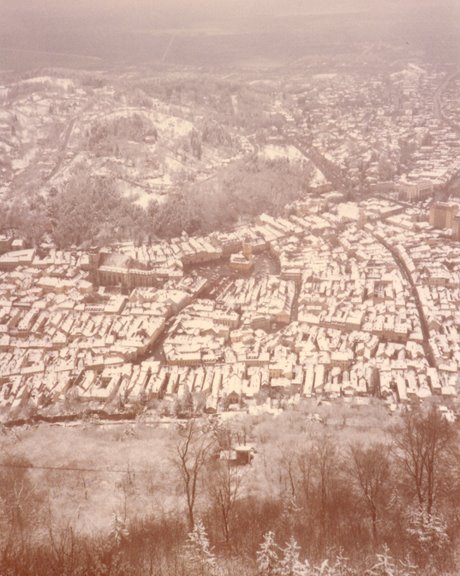
Photo: Fresh snow on the town square of old Braşov, viewed from Mt. Tâmpa, 29 April 1984. The Council House is in the plaza, with the Black Church to its left.

Leave a comment

Filed under Romania