Monthly Archives: April 2007

Exorcising Radical Islamist Demons in Indonesia

In Tuesday’s Opinion Journal, Bret Stephens profiles an Indonesian who is attempting to preserve the traditions of religious tolerance and syncretism long characteristic of Indonesia.

SENDANG AYU, Indonesia–In the fall of 2005, Abdul Munir Mulkhan returned to his childhood village to exorcise a demon.

Belief in the spirit world persists in this corner of southern Sumatra, as it does throughout most of Indonesia. In this case, however, the demon took human form as an itinerant Islamic preacher named Mun Faasil. He had appeared as if from nowhere the year before and had promptly set about “purifying” the villagers’ religious practices. For instance, he objected to sacrificing water buffalo (a local practice) instead of sheep (an Arab one) for the annual feast of Eid ul-Adha. He also disapproved of the villagers’ custom of giving couples an envelope of cash on their wedding day, on the grounds that there was no Quranic basis for it.

What happened next is a portrait-in-miniature of the assault being waged against traditional Indonesian Islam by its totalitarian variant. “Mun Faasil’s speeches created a crisis of faith,” recalls a village elder. “One group started implying that the others were not true believers.” Things got worse when the preacher began extolling the Prosperous Justice Party (PKS), a radical Islamist party modeled on Egypt’s Muslim Brotherhood, while attacking the Muhammadiyah, the century-old, 30 million-strong, apolitical Islamic social movement to which most of the villagers belong. Soon PKS cadres started arriving in the village.

It was at this point that some of the villagers called on Mr. Mulkhan, 60, to offer a “clarification” on the true teachings of Islam. They were fortunate in their native son. A leading scholar of Islamic theology and history, Mr. Mulkhan had only recently stepped down as vice secretary of the Muhammadiyah and continues to wield influence as a reformer within the organization. It did not take much to persuade his old neighbors that good Muslims do not use narrow theological pretexts to condemn fellow Muslims as infidels. Mun Faasil and his cadres were told to go.

For Mr. Mulkhan, however, what happened in Sendang Ayu was not the end of the matter but only the beginning. If the PKS could reach a remote rural community of 150 people, he reasoned, where had they not penetrated? The problem was compounded by the PKS’s use of clandestine cells to infiltrate the Muhammadiyah’s institutions–hospitals, universities, schools, mosques, charities, student associations–and recruit new members. “We had a situation where people in positions of trust were suddenly revealing themselves as PKS,” he says. “If we had allowed this to continue they would have consolidated their position with a purge of their opponents.”

The rise of the PKS nationally is itself a thing to marvel at. Barely eight years old, it won just 7% of the vote in the 2004 elections and has made itself conspicuous with its support of radical cleric Abu Bakir Bashir. Yet it has already managed to seize key institutions of prestige and patronage throughout Indonesia, including the speakership of the national Parliament, the ministry of agriculture and key municipal posts. As with Hamas in the Palestine Authority, it has burnished a reputation for incorruptibility.

But the Muhammadiyah, with its immense network of social services, is the organization the PKS must first seize if–in the spirit of Antonio Gramsci’s “long march through the institutions”–it is to achieve its longer-term political objectives. As a takeover target, it also helps the PKS that the Muhammadiyah has espoused a relatively strict form of Islam, making its members all the more susceptible to tarbiyeh, the form of Islamic indoctrination practiced by the Muslim Brotherhood and adopted by the PKS.

Leave a comment

Filed under Indonesia, religion

Two Essays on Baseball in Japan and the U.S.

Frog in a Well contributor Charles W. Hayford has posted a long and interesting essay on differing perceptions of Japanese baseball entitled Samurai Baseball: Off Base or Safe at Home? An earlier version appeared in Japan Focus under the title Samurai Baseball vs. Baseball in Japan. Here are few inducements to read the whole thing.

Is the difference between the original Yankee baseball and the game in other counties the difference between the real thing and a knock off or between the narrowly conceived original and new versions creatively adapted? Is baseball franchised around the world like MacDonald’s? After all, “a Big Mac is a Big Mac is a Big Mac,” so isn’t baseball just baseball? The dispute over baseball in Japan vs. Japanese baseball involves more than whether the bats are heavier, balls smaller, and training more strenuous. Do these differences represent differences within a system or between systems? Depends on who you ask.

On one side is Robert Whiting. His books are classics of sports writing and hugely influential.

His first book, The Chrysanthemum and the Bat (1977) begins by stating that Japanese baseball “appears to be the same game played in the U.S. – but it isn’t”…

In his Yale class lecture “Professional Baseball,” [Willam] Kelly agrees that some professional baseball in Japan does fit the “samurai” stereotype: “not entirely, not convincingly, not uniquely, but enough to feed the press mills and the front offices and the television analysts.” In fact, he says, this “spin” is part of the game. Our job is “not to dismiss this commentary as misguided (though much of it clearly is)” but to ask who is putting these ideas about, who is believing them, and why they are appealing: “The myths are essential to the reality….” Japanese baseball is “not a window onto a homogenous and unchanging national character, but is a fascinating site for seeing how these national debates and concerns play out – just as in the United States.”

Why did baseball in Japan develop this “samurai” self-image? Baseball in Japan was shaped by the important elements of the nation in the early twentieth century – education, industry, middle class life, the government, and above all the national project. Since baseball was an American sport but Japan was not a colony, baseball in Japan was a way of declaring independence, defiance, and creativity. From early in the century, the middle schools and colleges adopted a “fighting spirit” in athletics (recall that Teddy Roosevelt called for the abolition of college football in the United States when violence had become the hallmark of the game). In the 1930s the newly formed professional leagues adopted that spirit, which styled itself “samurai.” The government, which stepped in to shape local social institutions, used sport to train and manage its citizenry both spiritually and physically; major business corporations turned to college teams to recruit loyal executives; large commercial newspapers competed for readers by telling more and more nationalistic sports stories; transport companies bought professional teams. The Japanese public and media demanded “Japanese style” in sports to distinguish themselves from the foreigners and set models for self-sacrificing workers and citizens….

Karl Friday debunks idea of explaining modern conduct by reference to historical samurai in “Bushido or Bull? A Medieval Historian’s Perspective on the Japanese Warrior Tradition. “Hanging the label of ‘bushidō’ on either the ideology of the Imperial Army or the warrior ethic of medieval Japan,” he says, “involves some fairly overt historian’s sleight-of-hand.” Much of the modern version of bushido was “at odds with the apparent behavioral norms of the actual warrior tradition.” Even the term “bushidō” is the invention of a twentieth century Japanese, Nitobe Inazo (1862-1933), who wrote in English. Ironically, Whiting, without mentioning his role in the invention of the bushido tradition, includes in his history of the game Nitobe 1905 charge that baseball was a “pickpocket’s sport” in which players tried to swindle their opponents and steal bases. In fact, these samurai traditions are contradictory and could be equally well used to explain either “samurai” group ethic or “samurai” individualism, submission to authority or rebellion against it, innovation or traditionalism.

At the same time Kyushu-resident blogger Ampontan posted a lengthy essay on Japanese major leaguers: Now as American as apple pie, with his usual caustic take on American media reporting.

Major League Baseball’s 2007 season got underway last week, and while the media focused on Boston’s 50 million dollar man, Daisuke Matsuzaka, the real story is that there are now 14 Japanese players on major league rosters in such places as Pittsburgh and Tampa Bay instead of the geographically convenient Seattle or LA, or deep pocket teams like the Yankees or Mets.

While Ichiro Suzuki is headed for the Hall of Fame after batting titles, hitting records, and gold gloves, Hideki Matsui is the toast of New York, and modern Japanese pioneer Hideo Nomo is the part-owner of an American minor league team, relatively anonymous players such as So Taguchi of St. Louis and Tadahito Iguchi of the White Sox are the guys with the World Series rings, relief pitcher Shigetoshi Hasegawa has retired after a respectable but unheralded nine-year career in the States, and burnt out former Yomiuri Giants’ star Masumi Kuwata wants to hear one last hurrah, this time for the Pirates….

And here’s an article that originally appeared in the New York Times about Japanese players and their perpetual shadows—their personal interpreters. The focus here is on the Yankees and their two Japanese players: Hideki Matsui, with his interpreter Roger Kahlon, and their new import, Kei Igawa (roundly booed in his Bronx debut Saturday after a bashing by the Baltimore Orioles) with Yumi Watanabe, his interpreter.

Of particular interest is Watanabe’s bloodline. His father was another pioneer in reverse: Takamiyama, the Hawaiian who became the first American to win a Japanese sumo tournament. Before being hired as an interpreter at an annual salary of $300,000 (roughly the minimum salary for a major league rookie) Watanabe had been a Yankee security guard. Now that’s upward mobility. The idea that a person can jump from ID checker to interpreter is probably making all the professional conference interpreters feel faint.

I got the distinct impression reading this article, however, that Japanese players are being treated as if they were a new kind of royalty. The Americans seem to think everyone needs an interpreter, and that part of an interpreter’s job is being a personal assistant and valet….

Every Japanese player in the US has had six years of English by the time they graduate from high school. I’ve made that trip in reverse and acquired a driver’s license, rented an apartment, and opened a bank account in Japan. Even if those players weren’t serious students, there’s no question every one of them knows enough English to handle the daily chores of living.

I remember watching one of Ichiro Suzuki’s first games in the States on TV. He was on second base and the other team decided to change pitchers. During that break in the action, Ichiro struck up a conversation with the other team’s shortstop, a native of Venezuela. They had a high old time laughing and talking with one other, and it’s a good bet they weren’t speaking Spanish or Japanese.

Leave a comment

Filed under baseball, Japan, U.S.

Japanese Loanwords in Yapese

Japan ruled the island of Yap from 1914 to 1945, introducing many new material goods and cultural practices, which have left a rich legacy of loanwords in the Yapese language. The following list is extracted from a dictionary that uses the new Yapese orthography, which I have undone in order to make it easier for people familiar with Japanese to recognize the source words, some of which are quite archaic (or even obsolete) in contemporary Japan.

  • baru ‘crowbar’
  • bata ‘batter (in baseball)’
  • baydok ‘syphilis’
  • beni ‘lipstick’
  • benikawa/binikawa ‘type of potato’
  • bokdang ‘bomb’
  • chikongki ‘record-player’
  • chiyoseng ‘Korea; Korean’
  • chiyusa ‘shot, injection, hypodermic needle’
  • chiyusa nag ‘to give a shot to someone’ (nag derives verbs, like Jp. suru)
  • chumong ‘order, in the sense of a requisition’
  • chungayri ‘to dive head first’
  • daykusang/daykisang ‘carpenter, builder’
  • dempo ‘telegram; to send a telegram’
  • denchi ‘battery’
  • dengki ‘electricity; flashlight; xray’
  • dengkibasra ‘utility pole, power pole’
  • dok ‘poison’
  • doma ‘checkers, chess; a game’
  • futong ‘mattress’
  • gengkang ‘covered, protruding entranceway to a building’
  • hang ‘seal, stamp’
  • hangngo ‘small Japanese pot’
  • hasra ‘utility pole, power pole’
  • hyakngo ‘type of potato’
  • isobing/usubing ‘type of half-gallon bottle’
  • jori ‘rubber sandals, slippers, zoris’
  • jubong ‘pants’
  • kabang ‘handbag, purse’
  • kachido ‘movie, cinema’
  • kama ‘sickle, scythe’
  • kamoch ‘car, automobile’
  • kangkiri ‘can opener’
  • kayak ‘gunpowder’
  • kayru ‘toad, frog’
  • kech ‘stingy’
  • kich ‘crazy’
  • kitanay ‘dirty’
  • komey ‘rice; type of yam’
  • koyeng ‘rest house on a hilltop’
  • kui ‘marker pole in sea’
  • kyuri ‘type of vine, cucumber’
  • mame ‘beans’
  • mangwa ‘cartoon’ [a spelling pronunciation?]
  • marutobi ‘hopscotch’
  • merikengko ‘[American wheat] flour’
  • mong ‘Japanese ornamental gate or archway’
  • nappa ‘cabbage’
  • nas ‘eggplant’
  • nawa ‘jumprope; to play jumprope’
  • negi ‘onion, green onion’
  • nejimawas ‘screwdriver’
  • nis ‘varnish’
  • niso ‘gallon bottle’
  • nori ‘glue, paste’
  • okas ‘candy, cookies’
  • okinawa ‘Okinawa; type of [sweet] potato’
  • osongach/isongach ‘Christmas’
  • otobay /atobay ‘motorscooter, motorcycle’
  • pachingko ‘slingshot’
  • panchu ‘underwear, pants’
  • ping ‘pin, hairpin, safety pin’
  • pistor ‘pistol, gun’
  • remong ‘lemon, lime, citrus’
  • rengnga ‘concrete block’
  • sakura ‘type of flowering tree; pink plumeria’
  • sarumata ‘underpants’
  • sarukang ‘swivel used to connect leader to fishline and to fishhook’
  • sasing ‘photograph, picture’
  • sasmi ‘raw fish, sashimi’
  • sayda ‘soda, soft drink’
  • semmengki ‘small washbasin’
  • seng ‘wire, line’
  • sensey ‘teacher; to teach’
  • sensey nag ‘to teach’ (nag derives verbs, like Jp. suru)
  • sentak ‘laundry; to do laundry’
  • sentaksekken ‘laundry soap’
  • sigobing ‘bottle about the size of a fifth gallon, the size of a shoyu bottle’
  • sikato ‘skirt’
  • sikidas ‘drawer’
  • sikojo/hikojo ‘airport’
  • sikoki/hikoki ‘airplane’
  • simeng/jimeng ‘to lay out the ground for a house foundation’
  • simi ‘charcoal’
  • sitangi ‘women’s underclothes’
  • supido ‘fast, speedy’
  • tama ‘marbles, the game of marbles; light bulb’
  • tamanegi ‘round, dry onion’
  • tamango ‘egg’
  • tanchyobi ‘birthday party, birthday celebration’
  • taray ‘large washtub’
  • tech ‘steel ball’
  • tempra uta ‘song in different languages mixed together’
  • teng ‘score, mark’
  • tesange ‘purse made of pandanus leaves’
  • togang ‘ash pumpkin’
  • totang ‘boat made out of folded sheet of roofing [tin]’
  • udong ‘noodles’
  • yakyu ‘baseball’
  • yasay ‘green vegetables’
  • yasmi ‘vacation, holiday, rest’
  • yeng ‘dollar’ (cf. piseta ‘quarter dollar’ via Span., mag ‘half dollar’ via Ger.)

SOURCE: Yapese–English Dictionary, by John Thayer Jensen with the assistance of John Baptist Iou, Raphael Defeg, Leo David Pugram (U. Hawai‘i Press, 1977)

To the list above I can add a few more from my own fieldwork in Yap: chichibando ‘brassiere’, hanafudahanafuda card game’, kanggof ‘nurse’, and kawanguchu ‘leather shoes’.

Leave a comment

Filed under Japan, language, Micronesia

New Religious Terms in Two Pacific Languages

How have local languages in the Pacific handled the new lexical requirements of foreign religious traditions? Much seems to depend on the language and sect of the first foreign evangelists.

The island of Yap in Micronesia was first evangelized by Spanish Catholics long before German Protestants arrived about 1898. Yapese is still largely Catholic, and religious loans are mostly from Spanish. Shinto seems to have left no lexical traces from the Japanese colonial era (1914–1945), but loanwords from Japanese remain well represented in the more profane contexts of the new clothing, containers, diseases, foods, tools, and means of transport introduced during those decades.

The following examples of Christian terms do considerable violence to the vowels of Yap’s new orthography, which would take too long to explain—and would also make the words look more Dutch than Spanish.

  • bibliya ‘Bible’ (Span.)
  • galasya ‘church’ (Span.)
  • kiristiyano ‘Christian’ (Span.)
  • komunyon ‘communion’ (Span.)
  • kuruth ‘cross, crucifix’ (Span.)
  • infiyarno ‘hell’ (Span.)
  • misa ‘(Catholic) mass’ (Span.)
  • padrey ‘priest’ (Span.)
  • rosaryo ‘rosary’ (Span.)
  • baynag ‘Christmas’ (Ger. Weihnacht)
  • næp’ ni-b thothup ‘Christmas Eve, Holy Night’ (lit. ‘night that’s holy’)

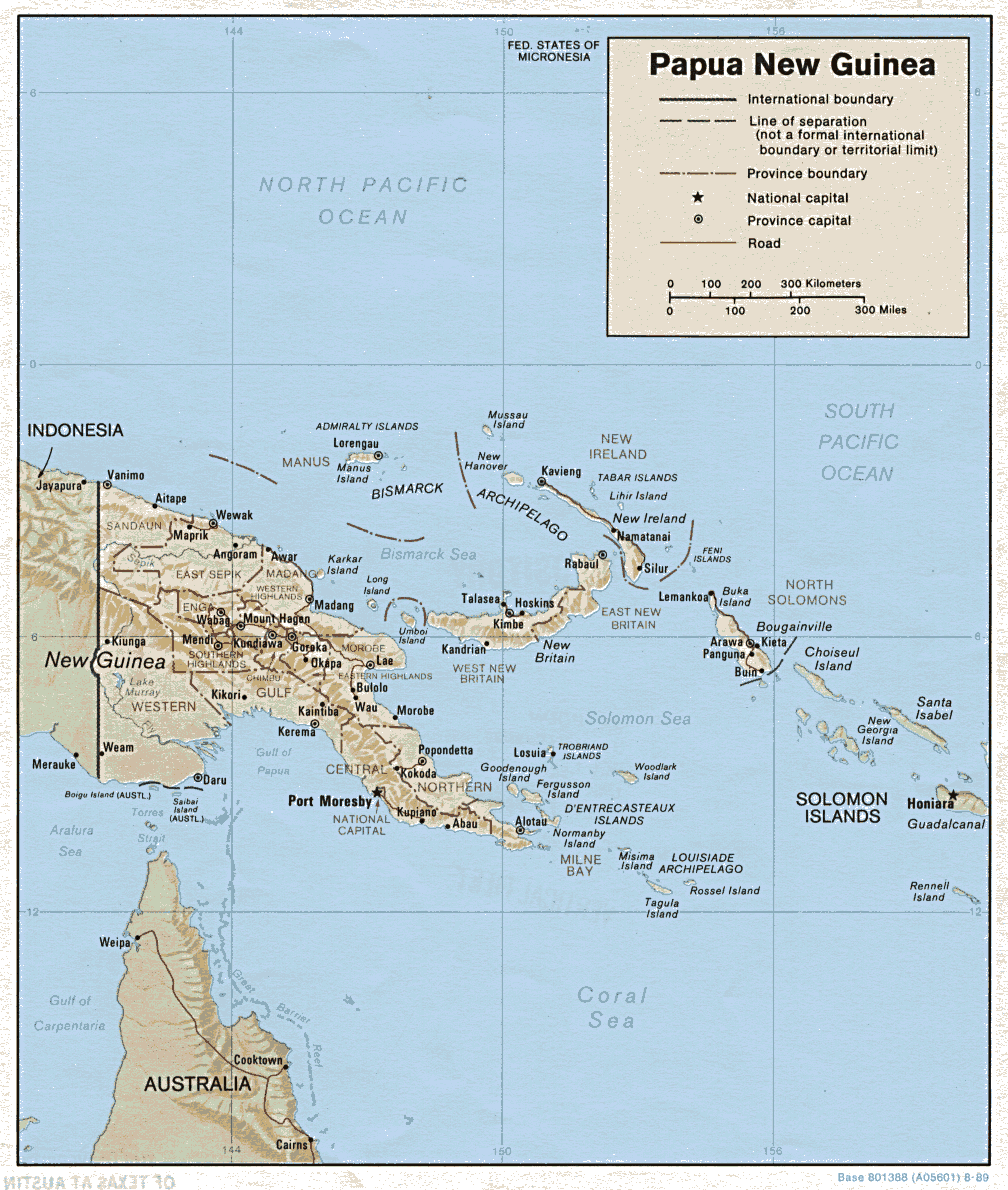
Morobe Province in Papua New Guinea was evangelized by German Lutheran missionaries beginning in 1886. The Germans adapted two local languages for evangelical and educational purposes, Jabêm for the Austronesian circuit along the coast and islands, and Kâte for the Papuan circuit in the interior of the Huon Peninsula. (Many, if not most, of the other interior languages of Morobe Province have since proven to be Austronesian, not Papuan.)

The German Lutheran strategy for communicating new Christian concepts was to adapt the local vernaculars rather than to introduce foreign words—not unlike the strategy of Martin Luther himself during the Protestant Reformation. The following examples are from Jabêm, in whose German-inspired orthography j represents a palatal glide (like English y), ŋ represents a velar nasal (like English -ng), and -c represents a glottal stop.

  • biŋsu ‘foreign missionary’ (also ‘admonition, commandment’)
  • biŋ gôliŋ ‘parable, proverb’ (lit. ‘talk steer’)
  • gôlôàc ‘congregation’ (also ‘clan, relatives, kinfolk’)
  • gêbêcauc dabuŋ ‘Christmas Eve’ (lit. ‘night holy/taboo’)
  • moasiŋ dabuŋ ‘holy communion’ (lit. ‘benefit/blessing holy’)
  • ŋalau dabuŋ ‘Holy Spirit’
  • kêdôŋwaga ‘teacher’ (lit. ‘3sg-teach-agent’)
  • sakiŋwaga ‘minister, servant’ (lit. ‘service-agent’)
  • jàeŋwaga ‘catechist, local missionary’ (lit. ‘message-agent’)

SOURCES: Yapese–English Dictionary, by John Thayer Jensen with the assistance of John Baptist Iou, Raphael Defeg, Leo David Pugram (U. Hawai‘i Press, 1977); Jabêm–English Dictionary, rev. by J. F. Streicher (Pacific Linguistics, 1982).

Leave a comment

Filed under Germany, language, Micronesia, Pacific, Papua New Guinea, religion, Spain

POWs Not Quite Ready for Liberation, 1945

[Robert J.] Body finally got the picture—his planned escape had been trumped by a full-scale rescue. The American Army had beaten him to the draw by no more than a half hour. Yet like many of the other prisoners, Body wasn’t sure where he was supposed to go. Some Rangers were yelling, “Head for the cut fence!” while others were saying, “Head for the main gate!” Not only that, the prisoners were thoroughly confused about what the Rangers meant by the “main gate.” It was a basic orientation problem. For the past three years, the main gate had always meant the gate to the American compound, not the central exit of the entire prison. This ultimate portal to the outside world was generally viewed as a forbidden concept, something one didn’t talk about because it was depressing and futile and could all too easily lead to subversive thoughts that might get a prisoner shot. The area around the main gate was strictly out of bounds, a dangerous piece of real estate, a dangerous idea….

As the precious minutes ticked by, the Rangers became more and more irritated by the strange stubbornness of the POWs. They didn’t seem to understand the urgency of the situation. “I was getting annoyed,” recalled Alvie Robbins. “I’d say to them, ‘Listen, I’ve got a job to do here. I can’t spend a lot of time arguing with you. There’s thousands of Japanese just up the road. We gotta get out of here in a hurry.’ ” In some cases, the Rangers actually had to use physical force. “We just turned them around and booted ’em,” said Lester Malone. “We couldn’t fool around and explain nothing. They just didn’t want to believe we were Americans.” One of the prisoners Malone “booted” was Herbert Ott, the camp veterinarian. “I told him, get the hell out of here. I just turned him toward the gate and kicked him on out.”

Dr. Ralph Hibbs was another prisoner who needed a little physical convincing. “What the hell is going on?” Hibbs shouted at three Rangers who came bounding down the path toward him “with their tommy guns blazing” from their hips. “Where’d you come from? Are you guerrillas?”

“We’re Rangers—General Krueger’s boys.”

“What are Rangers?” Hibbs demanded. He was taxing their patience. Finally, one of them picked up the doctor, muscled him around, and gave him “a ten-foot kick squarely in the ass.”

The most recalcitrant prisoner of all was Hibbs’s immediate superior, Colonel Duckworth, the American commander of Cabanatuan. Duckworth was digging in his heels, refusing to go, even refusing to let the Rangers escort others out. The colonel, who’d been suddenly awakened by the shooting and still seemed perplexed by the whole fracas, was strutting through the compound buttonholing Rangers and shouting in their faces. He seemed unwilling to surrender authority to people whose identities and motives had been inadequately explained to him. Alvie Robbins was almost shocked by Duckworth’s belligerence. “He says, ‘I’m Colonel Duckworth, and I’m in charge here! Who the hell are you!’ I said, ‘We’re Americans. We’ve come for you.’ He said, ‘You can’t do this! You’re going to get us killed. The Japanese told us no escapes! No one leaves here until I say they do.’ I said, ‘You go see Captain Prince,’ and I went on about my business.” Duckworth continued storming about the camp, demanding explanations, imploring the raiders to cease and desist. Finally, another Ranger grabbed him by the arm and said, “With all due respect, you are not in charge here, General MacArthur is. Now I suggest you head to the main gate before we kick your ass there. I’ll apologize in the morning.'” Still grousing about the situation, Duckworth shambled out the American gate. Plagued by night blindness like so many others, he promptly fell into a ditch and fractured his right arm.

SOURCE: Ghost Soldiers: The Epic Account of World War II’s Greatest Rescue Mission, by Hampton Sides (Anchor Books, 2002), pp. 276-278

Leave a comment

Filed under Japan, Philippines, U.S., war

POW Camp Interregnum, Philippines, 1945

For a brief period in early January, the men of Cabanatuan camp ate quite well, principally as a result of their having robbed the Japanese stores [after most of the Japanese garrison moved out]. And eating well, they found, could work miracles. The sap of life was returning. Astonishing things began to happen to their bodies. For some, the sharp throbbing aches of beriberi diminished. Their night blindness improved. With stronger immune systems, the men recovered from all sorts of miscellaneous low-grade infections that had persistently tormented them. Tropical ulcers shrank, rheumy eyes cleared up. Odd sounds—whistling, humming, laughter—were heard around camp. Here and there, one could see small instances of wasted motion, the superfluous dips and gesticulations of a spirit that abides in vitamins and calories. Atrophied interests revived. The men began to think about sex, and in the mornings they noticed with some curiosity that they were occasionally waking up with erections again.

Mainly, though, they put on weight, as much as a pound a day. It seemed impossible that a body could accrue mass and girth so quickly, but nursed on a steady diet of canned fish and syrupy Pet milk, everyone in camp experienced almost miraculous gains. Ralph Rodriguez, who ordinarily weighed 150 pounds but had plummeted to 90, was back to 120 in the two short weeks following the storehouse raids.

With new stamina, the prisoners grew bolder. One day a few of the men spotted a Brahma cow grazing in the fields outside the fence. Its Filipino owner was nowhere in evidence, and the Japanese, cloistered in their barracks, didn’t seem to be paying attention. All the guard towers were empty. The large-humped cow quietly cropped what little grass it could find in the dry field, its hide spasmodically twitching to shoo off the flies. With the peculiar malice of the protein-starved, the men strode out the gate, slipped a rope around the animal’s neck, and pulled it into camp. This first step seemed like a move of Promethean audacity: No one had set foot outside the Cabanatuan fence on his own before and lived to tell of it.

Straightaway, Dr. Ott was summoned. The veterinarian looked the animal over to make sure it wasn’t obviously diseased. The cow was stunned with a large hammer and then Ott slit its throat. A bucket was placed under the dying animal to collect every ounce of blood. A large group of prisoners looked on as the Brahma cow was cut open, and some of the men wept with joy as they joined in the butchering. Dr. Ott inspected the condition of the organs to look for infections or other abnormalities. When he sliced open the liver, trematode worms boiled out by the hundreds. These writhing parasites were better known as liver flukes, common in the Philippines and harmless when ingested as long as the meat was thoroughly cooked.

Dr. Ott gave the cow his seal of approval and a feast was planned on the spot. Standing in a circle around the fire, the men cooked and ate the flesh within a few hours. They prepared an immense vat of beef stew. They fried up the clotted blood or simmered it to make a consomme. They sucked the marrow from the bones, and boiled the hooves to make a broth. By the day’s end, every part had been eaten. “We couldn’t imagine it, a whole animal for five hundred people,” Dr. Hibbs wrote. “The soup even had fat floating on top of it.”

Savoring the foreign sensation of full bellies, some of the men spontaneously threw a party. They sang songs and passed around bottles of confiscated sake. Conversation turned appreciatively to women, their shapes and smells and other attributes. Someone brought out a radio that had been swiped from the Japanese side of the camp and they listened to KGEI out of San Francisco. In the glow of good food and drink, the men of Cabanatuan caught glimpses of a life with grace notes. They were surrounded by Japanese who seemed to wish them no harm. The war was radically tilting in their favor. Even as they listened to a radio signal from home, the vast American armies were coming, after long delay, to fetch them. They were drinking a wine made from a grain they hated, the distillate of a culture they hated even more, and yet somehow they found pleasure in it.

Then a news bulletin on the radio confirmed a rumor they’d been hearing for two days—that General Krueger’s Sixth Army had landed on Luzon and was driving south toward Manila. Liberation could be any day. “There were prayers and tears of rejoicing,” recalled Abie Abraham. “Many people danced, or at least they tried to. It was quite a startling sight to see those skeletons stand up and make brave attempts at clogging and Highland flings as the Japanese radio blared through the night.”

The morning after the party, life at Cabanatuan continued more or less as usual. As welcome as it was, the new dispensation left the prisoners acutely suspicious. They sensed that the favorable situation in camp, the seeming beneficence or at least indifference of the several dozen Japanese in residence, was but a temporary aberration to be enjoyed while it lasted.

And they were right: In mid-January, the picture began to change abruptly. The population on the Japanese side dramatically swelled.

SOURCE: Ghost Soldiers: The Epic Account of World War II’s Greatest Rescue Mission, by Hampton Sides (Anchor Books, 2002), pp. 243-245

Leave a comment

Filed under Japan, Philippines, U.S., war