Monthly Archives: June 2006

Wordcatcher Tales: Tanchou, Momonga, Kuroten

Among the things I’ll miss when I leave Japan at the end of this month are NHK nature shows. The photography is often spectacular, of course, but the spare and clear narrative style, with equally spare but clear captions on screen, are perfect for an obsessive language-learner who watches Japanese TV with denshi jisho in hand—and a mute button within easy reach if it’s a commercial channel. Here are three animal names I learned while watching a show about Hokkaido wildlife recently.

丹頂 tanchouJapanese crane, red-crested white crane’ – The 丹 is ‘red’ (as in cinnabar or vermilion), while the 頂 is ‘crest, peak, summit’, so the prosaic version of the name is ‘red crest’.

ももんが momonga ‘Eurasian flying squirrel’ – A rare, nocturnal creature of the far north whose image graces Estonian postage stamps. It’s possible to write the name much more obscurely in kanji, but I don’t see the point, and neither did NHK.

くろてん kuroten ‘sable’ – There are at least three kinds of てん (a native Japanese word that can also be written 貂): 黒てん kurotensable‘, 白てん shirotenermine‘, 松てん matsutenpine marten‘. (These flesh-and-blood creatures are not to be confused with the animé “Black AngelKuroten. Nor should ermines be confused with ferrets!)

1 Comment

Filed under Japan, language

Genocide as Compensation for Loss

The invasion of Rwanda by the Tutsi-led Rwandese Patriotic Front (RPF; initially based in Uganda) in October 1990 threatened to reverse these Hutu gains. Early RPF military successes led to the convening of the Arusha peace talks beginning in July 1992.

Four factors then led to an extraordinary evocation of the domain of losses. First, very early in the talks, it became clear that the presidential system that had favored Hutu power would be replaced by a parliamentary system combined with a council of ministers. Later in the talks, the strongest advocate of Hutu power, the Coalition pour la Défense de la République (CDR) was to be excluded from any transitional political institutions. At about the same time, it was decided that the number of seats in the new assembly and government ministries would favor the opposition to the Hutu-led government party, the Mouvement Révolutionnaire National pour la Démocratie et le Développement (MRNDD, formerly MRND).

Second, after the massacre of several hundred Tutsi, the RPF renewed its offensive in February 1993, and within two weeks had doubled the amount of territory under its control. Only French intervention prevented the RPF from taking Kigali, the Rwandan capital. A consequence of this success was the agreement to allow 50 percent of the armed command of the RPF to be composed of Tutsi, despite the 10 percent representation of Tutsi in the population at large. Refugees abroad, including of course many Tutsi in Uganda and elsewhere in Africa, were to be allowed back in the country as envisioned by the earlier Dar-es-Salaam declaration on the Rwandan refugee problem.

Third, the assassination on October 30, 1993, of Melchior Ndadaye, the first Hutu president of Burundi by the Tutsi-dominated army began a series of killings of thousands of Hutu in that country. According to Bruce Jones, “The assassination and killings were rich material for the extremists in Rwanda, who used the events to lend credence to their claims that the Tutsi of the RPF were returning to Rwanda to reestablish their historic dominance over the Hutu.”

Finally, as in our other two cases [the Holocaust and the Armenian genocide], the presence of refugees grievously accentuated the dimension of loss. The refugees were of two types, both Hutu, but from different locations. First were the Hutu from Burundi who fled the Tutsi-led massacres of 1972 and again in 1993. In 1988, poor harvests led to near starvation in Burundi, leading to an additional refugee influx. The latest of these, however, was to be the most consequential. After the assassination of President Ndadaye of Burundi in 1993, waves of violence spread that led to some 400,000 refugees from Burundi, mostly Hutu, crowding into Rwanda. Many of the génocidaires would be drawn from this group. According to Gérard Prunier, “The psychological impact of the Hutu President’s murder and the arrival in Rwanda of hundreds of thousands of Hutu refugees spreading tales of terror and massacre at the hands of the Tutsi army of Burundi had enormous negative consequences on the already overcast Rwandese political weather.”

The assassination and refugee arrivals solidified the position of the extremist “Hutu-power” advocates. Supporters of a hardline approach suggesting virtually a “final solution” of the Tutsi now secured additional public support. Many of these Burundi Hutu participated in the genocide, even to the point of committing extraordinary torture and atrocity.

SOURCE: The Killing Trap: Genocide in the Twentieth Century, by Manus I. Midlarsky (Cambridge U. Press, 2005), pp. 163-164

Selah. This concludes Genocide Week here at Far Outliers. On to cheerier thoughts but less frequent postings next week.

Leave a comment

Filed under nationalism, war

Holocaust a Contingent Event?

Thus the Holocaust was a contingent event, one not predestined by the intensity of Nazi anti-Semitism, virulent as it was, but facilitated by the exigencies of a world war that threatened to destroy the Nazi state, with the Jews perceived by Hitler as leading a vanguard of that destruction. Each step in the decision-making process concerning the Jewish Question was dependent on critical war-related events. After the defeat of France in 1940, Madagascar, a French colony, was chosen as the future “homeland” of the Jews. When the undefeated British navy made such mass shipping impossible, an area at the fringe of the German empire near Lublin was chosen, to be later changed to an unnamed destination in the soon-to-be-conquered Soviet Union. This harsher decision was made in March 1941 at the same time as the Lend-Lease Agreement between the United States and Great Britain. Difficulties in the invasion of the USSR led to the killing of Jewish women and children after August 15. As these difficulties became increasingly apparent to the Germans, harsher measures including deportations of Jews from Western to Eastern Europe were carried out, to be followed by the ultimate decision to commit genocide after the attack on Pearl Harbor and the first Russian land victory defending Moscow….

The dynamic approach adopted here helps explain an apparent anomaly. While there is clear evidence of virulent German anti-Semitism during the war even among “ordinary” Germans who behaved abominably toward Jews in the death marches from the concentration camps into Germany proper in 1944–45, the evidence of earlier German anti-Semitism is variable. German anti-Semitic political parties had declined precipitously in their share of the Reichstag vote prior to World War I, achieving only 0.86 percent in 1912 compared with 3.70 percent in 1898. Even after World War I and the rapid rise of anti-Semitism, reasons for joining the Nazi Party given by early members generally did not include anti-Semitism among the primary factors. The economic boycott of Jewish businesses called by the Nazi leadership for April 1, 1933, shortly after its accession to power, was generally regarded as a public relations failure, even by the Nazis themselves. Only after the events of World War II and the growing threat to the Nazi – by now identified as German – state did the German population behave in a deeply anti-Semitic manner. Thus one resolution of the apparent inconsistencies between Goldhagen‘s account and the many critics of his emphasis on “eliminationist anti-Semitism” can be found in the dynamics of the confrontation between Nazi Germany and its systemic environment.

SOURCE: The Killing Trap: Genocide in the Twentieth Century, by Manus I. Midlarsky (Cambridge U. Press, 2005), pp. 151-153

Leave a comment

Filed under Germany, war

External Threats to Serbian Security, 1990s

Serbia, despite its domination of the Yugoslav National Army (JNA), had legitimate security concerns as the dissolution of the former Yugoslavia loomed on the horizon. The July 1991 accord at Brioni stipulated the withdrawal of all JNA units from Slovenia, thereby implying international recognition of that new state. As a consequence, Prime Minister József Antall of Hungary warned Serbia that it could not assume that its province of Vojvodina with its large Hungarian minority would continue to be part of Serbia. “We gave Vojvodina to Yugoslavia. If there is no more Yugoslavia, then we should get it back,” declared Antall, referring to the 1920 Treaty of Trianon. This verbal threat was supported by the earlier sale of at least 36,000 Kalashnikov rifles to the Republic of Croatia in 1990. Serbia, therefore, could legimately feel threatened not only by the newly emerging states of the former Yugoslavia, but by neighboring existing states as well.

German domination of the EC political decision making at this time raised perhaps even deeper security concerns for Serbia. The taking on of Croatian fascist symbols by Franjo Tuđman, the Croatian leader, as the Croatian state emerged, of course, was hardly reassuring to the Serbs. Memories of the mass murder of at least 500,000 Serbs by the fascist Croatian state in alliance with Nazi Germany during World War II were rekindled by Tuđman’s behavior.

The recent German unification and German emergence as the clear economic, even political leader of the EC made matters worse. After considerable lobbying by the Croatian and Slovenian leadership as well as by the Vatican, Hans-Dietrich Genscher, the German foreign minister, emerged as an unequivocal supporter of Croatian and Slovenian independence. When the actual recognition, by Germany, of both new countries came on December 23, 1991 – with agreement of the remaining EC members, apparently bullied by the newly augmented Germany – the Western threat became palpable. With growing economic ties to Germany, the Slovenian and Croatian economies, already burgeoning relative to the remainder of Yugoslavia, and the presence of NATO nearby, the JNA and mainly its Serbian leadership would feel an imminent threat to the Yugoslav state….

Bosnia was also pivotal to the JNA. During the 1980s, 40–55 percent of the Bosnian economy was tied to military industries. “Sixty to 80 percent of the army’s physical assets (armaments factories, supply routes, airfields, mines and basic raw materials, stockpiles, training schools, oil depots) were located in Bosnia-Herzegovina. On the eve of the war, 68 percent of the federal army’s 140,000 troops were stationed in the republic. To the extent that the Yugoslav army was fighting a war for its own integrity and state, it could not easily be a neutral party in Bosnia-Herzegovina or abandon its own economic foundations.

A two-tiered threat to the Serbs emerged from Serbian numerical weakness within Bosnia coupled with the looming presence of the newly united Germany at the head of the EC. The end result of the military clashes and ethnic cleansing was a near-equal division of Bosnia between the Federation of Bosnia-Herzegovina (the Bosnian Muslim–Croat Federation) holding 51 percent of the territory and the Republika Srpska (the Bosnian Serb Republic) occupying 49 percent with corresponding ethnic majorities within each. The two halves together formed the Republic of Bosnia-Herzegovina, but with rights of each half to affiliate with other political entities, if they so wished.

SOURCE: The Killing Trap: Genocide in the Twentieth Century, by Manus I. Midlarsky (Cambridge U. Press, 2005), pp. 131-132

One of Midlarsky’s major themes is that genocides evolve in response to many contingencies: feelings of prior national or ethnoreligious loss or betrayal, threats to communal security, ongoing defeat in war, validation of past massacres, and so on.

Leave a comment

Filed under Eastern Europe, war

Threat of Numbers, Democracy, and Ethnic Cleansing

Threat of numbers also weighed heavily in the ethnic cleansing of Bosnia-Herzegovina between 1992 and 1995. Ethnic cleansing was committed by all major actors in Bosnia – Serbs, Croats, and Muslims – but the greater part of the ethnically cleansed population was victimized by the Serbs. As a consequence, the Bosnian Serbs will be emphasized in the following account. In contrast to the preceding cases [British encouragement of the Irish famine and emigration during the 1840s and 1850s, and newly independent Poland’s attempt to drive out Germans and Jews during the 1920s and 1930s], the Srebrenica massacre incorporates a clear genocidal element within the overall ethnic cleansing.

The demography of Bosnia-Herzegovina underwent a dramatic change in the decades preceding the Yugoslav wars. In 1961, Muslims constituted only 26 percent of the population of Bosnia-Herzegovina, with the Serbs comprising 43 percent. By 1991, virtually a complete reversal had occurred with the Muslims rising to 44 percent and the Serbs dropping to 31 percent. Many Serbs had migrated from Bosnia to Belgrade or other locations inside Serbia proper. A differential birth rate between Muslims and Serbs also favored the former. Thus, from a near majority in 1961 or at least a large plurality, the Serbs now were a distinct minority. One group’s former dominance was exchanged for a secondary status. And all of this was in addition to the genocidal elimination of a large portion of the Bosnian Serb population by the fascist Croatian Ustaše (with some Bosnian Muslim collaboration) in alliance with Nazi Germany.

In Tito’s Yugoslavia under single-party Communist rule, such a reversal of fortune, however dramatic, would not necessarily yield a commensurate diminution of influence. However, by the early 1990s, more than a decade after Tito’s death, democratic reforms ensured that ballots would count very heavily in the power distribution. The desire for electoral victories and the resulting power gain stoked the nationalist fires…. Indeed, ethnic cleansing, and its genocidal corollary, had its roots in a democratization process associated with the emergence of sovereignty in the new post-Cold War period. According to the Badinter Arbitration Commission and the European Community (EC) support of its ruling, international recognition of national sovereignty required a referendum of the residents of a given territory on their choice of a state.

Military control was not sufficient; a vote was required. Thus, the only guarantee of eventual incorporation of a stategically or economically desired territory within the borders of a state was the conformity of the (ethnoreligious) identity of most of the residents of that territory with that of the incorporating state. Ethnic cleansing, therefore, became a preferred modus operandi to maximize the security of the emerging state.

SOURCE: The Killing Trap: Genocide in the Twentieth Century, by Manus I. Midlarsky (Cambridge U. Press, 2005), pp. 129-130

Leave a comment

Filed under democracy, nationalism, war

Role of Altruistic Punishment in Genocide

Ernst Fehr and Simon Gächter have introduced the concept of altruistic punishment to explain cooperation [in group projects for the “public good”]. Following Fehr and Gächter, I define altruistic punishment as punishment inflicted on a defector from cooperation, which is costly to the punisher and without material gain. In a series of public goods experiments that pitted private return against public welfare requiring cooperation in a group project, cooperation was found to flourish when altruistic punishment was possible and to break down when it was ruled out.

Subjects were given the opportunity to invest in a group project with monies handed to them, or to keep the funds. Individually, if they chose to invest, they would receive less than if they kept the money, but collectively the group as a whole would receive more, if all invested…. Subjects could punish others after information was provided as to how much each had invested. But each punishment of another subject was costly. Specifically, subjects who chose to punish were required to forfeit an amount equal to one-third of the monetary punishment imposed on a defector. Thus, the punishment is altruistic. Defectors – those who refused to cooperate – were punished even when material self-interest was sacrificed by cooperators. Participants who chose to punish defectors by withholding monies themselves had to sacrifice monetary rewards….

“Negative emotions towards the defectors are the proximate mechanics behind altruistic punishment.” Concerning altruistic punishment, Fehr remarks, “It’s a very potent force for establishing large-scale cooperation, every citizen is a little policeman in a sense. There are so many social norms that we follow almost unconsciously, and they are enforced by the moral outrage we expect if we were to violate them.” The greater the extent of deviation from cooperation by defectors, the more heavily they were punished by cooperators. It was “punishment per se [that] provided the motivation, not some consequence anticipated by the player.” Instrumentality was not especially relevant….

Altruistic punishment has been robustly established. These findings stem from public goods experiments, but are readily generalizable to social groups seeking a basis for cooperation in the absence of a functioning external authority. Given an extreme, even life-threatening environment, such as massive economic failure followed by war, the particular form of altruistic punishment chosen can be severe.

Even as they were clearly losing their respective wars, Hitler proceeded mercilessly with his extermination campaign, Enver Paşa lent his approval to the Armenian genocide, and the Hutu extremists were rapidly eliminating Rwandan Tutsi. Hitler would die by his own hand, Enver in battle to unite Turkic peoples against the Soviets, and many of the Hutu génocidaires in the refugee camps of northern Congo.

SOURCE: The Killing Trap: Genocide in the Twentieth Century, by Manus I. Midlarsky (Cambridge U. Press, 2005), pp. 108-109

In a chapter somewhat disturbingly redolent of “the freakonomics of genocide” Midlarsky highlights altruistic punishment as a factor that not only motivates followers to cooperate in a genocidal project they otherwise find extremely distasteful (or worse), but also motivates leaders to persist in genocide at the expense of losing larger battles against their enemies.

On a more familiar level, “altruistic punishment” might well describe the motivations of political activists who would rather purge their party of defectors than win the next election.

Leave a comment

Filed under nationalism, philosophy

Utopianism as a Basis for Genocide

In addition to rational choice, utopianism is a current theory that could serve as a starting point for comprehending the onset of genocide. In contrast to rational choice, which provides a social scientific basis, a focus on utopianism would provide an ideological source of genocide as a uniform substratum. This emphasis on ideology is the basis of a recently published well-written comparison of four genocides by Eric Weitz. Focusing on the concept of utopia at the core of genocidal ideologies, Weitz argues for its salience as an explanation of the Soviet, Cambodian, Nazi, and Bosnian atrocities.

In considering Weitz’s argument, though, it is apparent that the Marxist-Leninist cases are conflated with cases that have entirely different etiologies. The Soviets had an elaborate ideational class-based justification for mass murder, as did the Cambodians, while the Nazi and Bosnian instances were based on ethnoreligious criteria without elaborate justification. Thus, the concept of utopia does not go very far in explaining these latter two cases. The Nazis had utopian visions of a distant past including an ostensibly racially pure Ottonian Germany, while the Communists (Soviets and Cambodians) possessed a rigorous, if deeply flawed, ideational structure that predicted a future free of class oppression and conflict.

The consequences of ethnoreligious hostilities are vastly different from those of overtly political ideation. In the former, complete eradication is most frequently the goal, while in the latter elimination of incorrigible political enemies along with reeducation of the remainder constitutes the core of the governmental program. Victimization rates, therefore, differ substantially, ranging from the approximately 67 percent of Jews murdered in Nazi-targeted areas of Europe to at most 10 percent of the Soviet and Chinese populations, and 20 percent of the Cambodian. Moreover, possibilities for reconstituting cultural and religious life were sharply circumscribed for Jews (and Armenians) after their genocides. Such limitations were much less pronounced in the Soviet and Cambodian instances; contemporary Russia, indeed, has seen a massive Orthodox revival after the earlier decimation of church officials by the Bolsheviks….

Even more problematic in applying utopianism is the Armenian genocide. Neither in their past nor in any realistically conceived future could the Young Turks imagine a state “purified” of other nationalities, so that an ideology justifying mass murder could not be used effectively as motivation. Certainly at the time of the Armenian genocide in 1915–16, the Greeks, who were somewhat more numerous than the Armenians in the Ottoman Empire and even more dominant in its economic life, were not subject to genocide….

Beyond the problem of generalizability, difficult as it is, the concept of utopianism itself certainly is not sufficient to explain genocide as a behavioral category. There have been utopian socialists of every stripe, for example, from cosmopolitans in the nineteenth-century United States and Europe, to more nationalistic ones in the kibbutzim in Israel. Hardly any had advocated, let alone participated in, genocide. In other words, utopianism can just as readily invoke benign, even reclusive, visions (e.g., the Hutterites), where the last thing any of these utopians wanted to do was to kill or even bother other people.

Where utopianism does get into trouble is in its juncture with the state and especially with state power. The conjoining of the two can lead to genocidal consequences, but it is the state that is the driving force behind the utopian vision or whatever related genocidal motivation (e.g., state security) may exist at the moment of decision. Utopian belief is neither necessary nor sufficient for understanding the origins of genocide although, if strongly held, it certainly can provide the ideational basis for genocidal thinking.

SOURCE: The Killing Trap: Genocide in the Twentieth Century, by Manus I. Midlarsky (Cambridge U. Press, 2005), pp. 75-76

UPDATE: In a comment, reader Otto Pohl objects:

The percentages compared between Nazi Germany and the USSR and Cambodia are apples and oranges. The total percentage of people under Nazi rule murdered is quite small compared to the Soviet and Cambodian cases. Why compare a targeted minority in one case, Jews, and ignore it in the Soviet and Cambodian cases? Stalin murdered over a third of the Chechen, Crimean Tatar and Mennonite populations of the USSR. In Cambodia the Khmer Rouge completely eliminated the ethnic Vietnamese population. Very high percentages of Chams and Chinese also perished. Socialist racism was quite real and no less deadly than the Nazi variant.

1 Comment

Filed under nationalism, philosophy

Diaspora Month at the Head Heeb

The Head Heeb devoted special attention to diaspora during May. His last post on that topic concerned the Maori diaspora in Australia. Here’s a short extract.

The exact size of the Maori diaspora is difficult to determine, but it appears to be growing rapidly. The New Zealand statistical bureau estimates that, by the mid-1980s, some 27,000 Maori were living in Australia, representing “just over 6 percent of the New Zealand Māori descent population at that time.” By the time of the 2001 Australian census, this number had grown to 72,956. Given that the ancestry question in the Australian national census relies on self-identification and that respondents may select up to two ancestries, this figure may understate or (more likely) overstate the size of the Maori minority in Australia, but it indicates at minimum that 20 percent of New Zealand-born Australians self-identify as Maori. This, in turn, means that (1) Maori form a greater proportion of the New Zealand-born population in Australia than they do in New Zealand, and (2) between 1986 and 2001, Maori emigrated to Australia at a considerably faster rate than white New Zealanders.

Leave a comment

Filed under Australia, New Zealand, Pacific, Polynesia

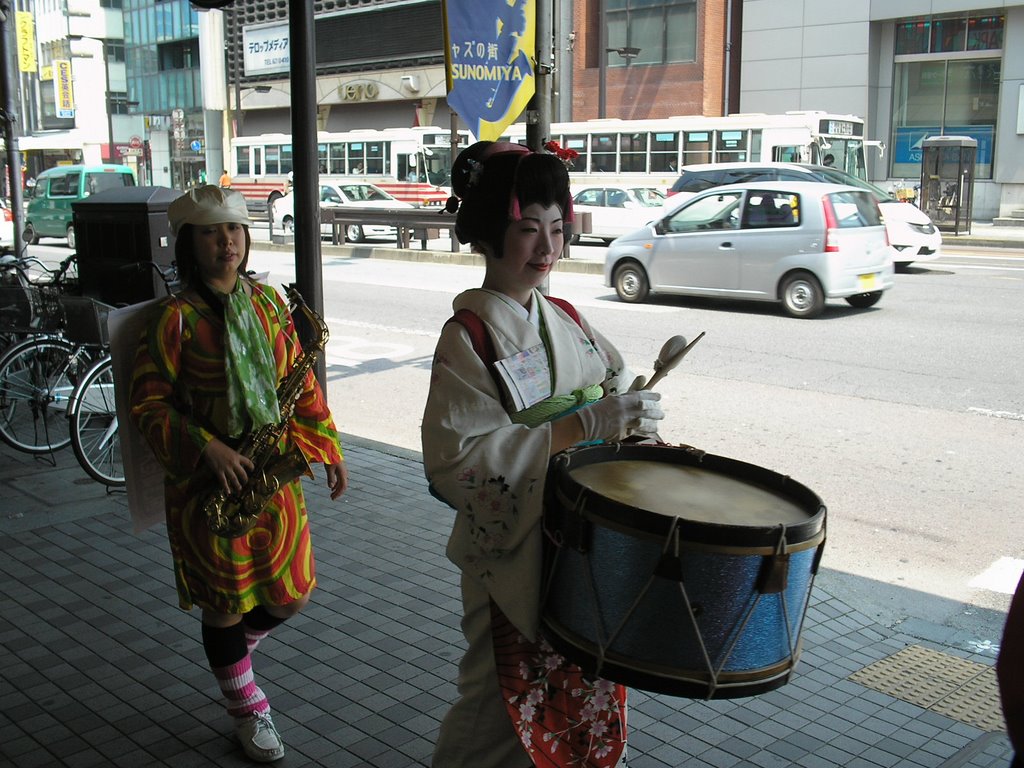
Chindonya with Saxophone in Utsunomiya

utsunomiya chindonyaYesterday I met a friend in Utsunomiya, a city regionally famous for its gyoza and its jazz. (It’s the hometown of Sadao Watanabe and it was the home base of a division deployed to China during Japan’s more warlike days.) It’s awfully hard to find much gyoza or jazz in Utsunomiya before the sun goes down, but we did come across a chindonya troupe that included a saxophonist who did a great job of imparting a Japanese feel to her playing.

Leave a comment

Filed under Japan