Monthly Archives: June 2005

Somalia, 1993: Watching Haiti on CNN

I check in with Heidi at India Base. She’s watching CNN with the American Intel officer who’s been hovering around her lately. Wonder what’s up there. They’re watching breaking news from Haiti. The Intel guy says the USS Harlan County arrived yesterday to deploy American and Canadian peacekeeping troops and a crowd of Haitians came to the dock to greet the ship, shot in the air, shouting “Aidid, Aidid,” and the Harlan County was ordered to retreat. Turned tail. Withdrew.

From Haiti?

I look at the Intel guy. Are you shitting me? We retreated from Haiti? They barely have an army for fucksake. The macoutes will run riot now. Open season. They win. He looks back at me with a cold stare. I try to hold his gaze. There’s an entire doctoral dissertation communicated in the three-second silence of that stare-down. It’s the most coherent articulation of an American foreign policy critique I’ve ever heard in my life, and he didn’t have to say a thing.

I’m ashamed in front of the officer. For being a civilian. Like I personally represent everything that’s wrong with the policies we’re all watching fall apart. Only civilians would imagine that you can keep the peace in a hot war without fighting.

This will never work now. It’s over. I gave this idea everything I had, literally. Why am I taking this all so personally? It’s not about me, I tell myself, even as I talk to myself. This is exactly why Heidi thinks Andrew and I are full of shit: it’s always about us and our ideas, not about individual humans. But an idea died this week, just like a human dies. How many successful peacekeeping missions will never be sent now? How many lives we could have saved will be lost now? The question is palpable as India Base Somalia watches CNN Haiti.

SOURCE: Emergency Sex and Other Desperate Measures: A True Story from Hell on Earth, by Kenneth Cain, Heidi Postlewait, and Andrew Thomson (Miramax Books, 2004), pp. 171-172

Leave a comment

Filed under Africa, Caribbean, NGOs, U.N., war

Lind on Vietnam as an Ideological Symbol

After the Vietnam War ended in 1975, it took on a second life as a symbol in American politics. For the radical left, the war was a symbol of the depravity of the United States and the evils of “capitalist imperialism.” For the neoisolationists and “realists” of the liberal left, the U.S. war in Indochina was a tragic and unnecessary mistake, brought about by American arrogance and an exaggerated fear of the threat posed to U.S. interests by the Soviet Union and communist China. Conservatives, too, had their orthodox view of the conflict. Conservatives joined many military officers in arguing that the United States could have achieved a quick and decisive victory in Indochina, if only the pusillanimous civilian policymakers of the Kennedy and Johnson administrations had not “tied the hands” of the U.S. military and “denied it permission to win.”

One point of view has been missing from the debate over the Vietnam War. The political faction known as liberal anticommunists or Cold War liberals, identified with the Truman, Kennedy, and Johnson administrations, ceased to exist as a force in American politics in the 1970s, more as a result of partisan realignment than of the Vietnam War. One group of former Cold War liberal policymakers and thinkers sought to ingratiate themselves with the antiwar leftists and liberals who were ascendant in the Democratic party after 1968. Among these were the late McGeorge Bundy and his brother William (who, as part of his campaign to rehabilitate himself, recently wrote a harsh and unfair book criticizing Nixon’s and Kissinger’s handling of the war that the Bundys had helped to begin). Former defense secretary Robert McNamara not only recanted his support for the war in his book In Retrospect but endured the abuse of functionaries of the Vietnamese dictatorship during a humiliating pilgrimage to Vietnam in 1997. Another group of former Cold War liberals joined forces with anti-Soviet conservatives, maintaining their support for the Cold War while jettisoning their prolabor liberalism in domestic politics. The number of unreconstructed Cold War liberals thus dwindled in the 1970s and 1980s, making it easy for radical leftists, left-liberals, and conservatives, in their discussions of the Vietnam War and U.S. foreign policy in the 1960s, to caricature and vilify Presidents Kennedy and Johnson and their advisers with no fear of rebuttal.

Almost everything written by Americans about the Vietnam War in the past quarter century has conformed to one of the three scripts of radical leftism, anti-Cold War liberalism, or conservatism. Each of these three partisan schools has drawn attention to evidence that appeared to support its preconceptions, while ignoring evidence that contradicted them. These ritualized debates might have continued for another generation or two. But two historic developments have now [in 1999] made it possible to transcend the thirty-year-old debates about the Vietnam War.

The first development is the end of the Cold War and its aftermath, including the global collapse of communism and the realignment of world politics around the United States as the hegemonic military power. Only now is it possible to view the Cold War as a whole and to evaluate the U.S. strategy of global containment that led to the U.S. wars in defense of South Korea and South Vietnam, as well as the U.S. protectorate over Taiwan–“the three fronts,” according to Mao Zedong, where the communist bloc met the American bloc in East Asia.

The second development is the demise of the radical left in North America and Western Europe as a political force (leftism survives only in pockets in the academy and the press). [This obituary seems a little premature!] In the 1960s and 1970s, the ascendancy of the radical left in the liberal and social democratic parties of the West–the Democrats in the United States, the British Labor Party, and the German Social Democrats–caused western electorates to turn to conservative, anticommunist parties under the leadership of Ronald Reagan, Margaret Thatcher, and Helmut Kohl. The economic difficulties of Swedish social democracy, coming soon after the collapse of the Soviet Union, have discredited western as well as eastern Marxism and permitted the emergence of a new, more moderate center-left, variously described as “the Third Way” or “the New Center” and symbolized by President Bill Clinton and British prime minister Tony Blair. As recently as the Gulf War, which the overwhelming majority of Democrats in Congress voted against, foreign policy debates in the United States pitted anti-American leftists and isolationist liberals against interventionist conservatives. But the subsequent U.S.-led NATO war in the Balkans, supported by many liberals and opposed by a number of conservatives, has helped to rehabilitate the legitimacy of military intervention for many left-of-center Americans.

These developments in global politics and western politics have made it possible to write this book, which could not have been written in the 1970s or 1980s. In this book, I examine the Vietnam War in light of the end of the Cold War, from a centrist perspective more sympathetic to American, Cold War policymakers than that of their critics on the left and the right.

SOURCE: Vietnam, the Necessary War: A Reinterpretation of America’s Most Disastrous Military Conflict, by Michael Lind (Simon & Schuster, 1999), pp. xii-xiv (reviewed in the NYT here and here)

Lind is the author of The Radical Center: The Future of American Politics (with Ted Halstead) (2001, reviewed here); Hamilton’s Republic: Readings in the American Democratic Nationalist Tradition (1997); Up from Conservatism: Why the Right is Wrong for America (1996); and The Next American Nation: The New Nationalism and the Fourth American Revolution (1995). I’m far less comfortable with Lind’s nationalism than I am with his anticommunism.

Finally, Lind is decidedly not for the latest U.S. intervention in Iraq.

Leave a comment

Filed under China, Korea, Vietnam

In a Haiti Hospital, 1993: No Rules

I was debating whether to post excerpts from Emergency Sex and Other Desperate Measures, but after viewing the CBC documentary Shake Hands with the Devil: The Journey of Roméo Dallaire this weekend, I lost any qualms I might have had. (And it has only been six months since I saw Hotel Rwanda when it premiered in NYC.) The abject failure of the U.S. and UN interventions in Somalia and Haiti in 1993 practically guaranteed an even more pusillanimous effort to stop full-on genocide in Rwanda a few months later. So here, without pity, is the first of a short series of excerpts from the memoirs of UN workers in Haiti and Somalia in 1993.

After a short briefing, my new boss sends me straight to the [Port-au-Prince] city hospital. The UN’s mission here is to gather enough evidence of brutality to convince the world to reverse the coup and force the military from power. All over Haiti, 250 unarmed observers are investigating and documenting atrocities against the civilian population. Most of the victims are too terrorized to talk to foreigners or provide any meaningful evidence, but I have an advantage and the boss is happy to exploit it: victims need doctors and doctors get access.

My task at the hospital is to interview a beating victim, see whether there’s anything we can do to help him, and take a statement. The sleepy receptionist thumbs through a grubby admissions book. He’s in the surgical ward, she says in French, throwing her arm in a wide, unspecific arc, in the general direction right. So I head off down a series of endless corridors and soon get lost. Clouds of flies lift off the chipped floor tiles, resettling behind me as I pass. When I finally find the surgical ward, I give the victim’s name to a nurse.

He was here but now he’s not, she says. I look at her, waiting for more, but she just stares off somewhere over my shoulder. She’s uneasy. The ceiling fan turns slowly, cobwebs dangling from its blades. No air moves.

Well, where is he now? I need to talk to him. She shrugs.

I start to lose patience.

I tell her I’m a doctor with the UN and I need to talk to the treating doctor now. She goes away and doesn’t return.

There’s no one around except patients and orderlies. I linger for half an hour until finally a slight man in his fifties appears. It’s the surgeon. He invites me into his office and closes the door behind him.

Look, he says, I know why you want to talk to him, but he’s gone. He was brought in several days ago after they’d beaten him terribly, for hours. He was barely alive when I first saw him, skull fracture, both arms broken, multiple rib fractures, smashed kneecaps, urinating blood. We did what we could for him, he says sighing, set the fractures, dressed the wounds. He did well, but he was weak and couldn’t afford to buy any blood for a transfusion.

So where is he now? I ask. When they heard he was still alive, they came in here last night and just dragged him away again, he tells me.

And no one did anything to stop them? I was in the operating theater when I heard the screams, he says, and I ran down here in my greens and gloves to plead with them. But one of them just stuck his gun in my face and told me he’d turn me into a patient if I didn’t back off. There was nothing I could do, they have all the guns. I have to go, he says wearily, there are patients waiting. A bitter look crosses his face as he opens the door to leave. They should have just finished him off the first time, he adds, it would have been much more humane.

I sit staring through the cracked pane of the office door at the post-op patients in their beds. I should write up a report, but I can’t think straight, so I drive back up to the villa and gaze out past the bougainvillea at the pool. I can’t quite believe what I’ve just heard.

In Cambodia I treated children who stepped on landmines, villagers stabbed in their sleep, shoppers shelled in the marketplace, drivers shot up at roadside checkpoints. The victims all made a beeline for our hospital and I was usually able to help. We didn’t care who they were or how they got there; everyone knew that the killing stopped at the red cross on the front gate. Once you made it past there, you were safe, a custom of war so accepted that I never even heard it discussed. Check your weapons in at reception, get a receipt. Do whatever you must to your enemies out in the killing fields, but do not ever bring that shit inside my hospital.

Maybe there are no rules here.

SOURCE: Emergency Sex and Other Desperate Measures: A True Story from Hell on Earth, by Kenneth Cain, Heidi Postlewait, and Andrew Thomson (Miramax Books, 2004), pp. 112-113

Leave a comment

Filed under Caribbean, NGOs, U.N., war

Two Dilemmas: Kosovo in 1999, Vietnam in 1965

When bombing initially failed to change the enemy’s policy, the pressures on the president to commit ground troops increased. The president, a politician more interested in the mechanics of domestic reform than in foreign policy, pondered his options. To back off at this point would result in devastating humiliation for the United States, with consequences around the world that could not be foreseen but which might well be severe. To escalate the war by introducing ground troops would be to risk a bloody debacle and a political backlash. Every choice presented the possibility of disaster.

THIS IS A description of the situation that confronted President Bill Clinton in the spring of 1999, after the United States and its NATO allies began bombing Serbia with the goal of forcing Yugoslav dictator Slobodan Milosevic to agree to autonomy for the Albanian ethnic majority in the Yugoslav province of Kosovo. It is also a description of the dilemma of President Lyndon Johnson in the spring and summer of 1965, when the failure of U.S. bombing raids against North Vietnam to dissuade Ho Chi Minh’s communist dictatorship from its low-level war against South Vietnam had become apparent. In each case, what was at stake for the United States was its credibility as the dominant global military power and the survival of a regional alliance–NATO in the case of the Balkan war, the Southeast Asia Treaty Organization (SEATO) in the case of the conflict in Indochina. (In fact, SEATO did dissolve, when the United States abandoned Indochina to communist conquest between 1973 and 1975.)

Both Slobodan Milosevic and Ho Chi Minh were communist dictators who manipulated the nationalism of their subjects–Milosevic in the service of his dream of a Greater Serbia dominating the former Yugoslav federation, Ho in the service of the dream of a united Vietnam dominating all of Indochina. Both Milosevic and Ho promoted their goals by supporting guerrilla terror campaigns in other countries. Milosevic armed, supplied, and directed Serb paramilitary units engaged in mass murder and ethnic cleansing in Bosnia, Kosovo, and other parts of the former Yugoslavia; Ho armed, supplied, and directed Viet Cong guerrillas in South Vietnam, Laos, and Cambodia who waged war against South Vietnamese military and police forces and murdered tens of thousands of South Vietnamese officials and civilians. In both cases, the low-intensity wars launched by the communist-nationalist dictators produced tidal waves of refugees. Hundreds of thousands of non-Serbs were forced from their homes in different parts of the former Yugoslavia by Serbian ethnic cleansing. Nearly a million residents of North Vietnam fled Ho Chi Minh’s rule in the 1950s, and following the communist conquest of South Vietnam in the 1970s more than two million others risked their lives in fleeing the country. Of the two communist-nationalist leaders, Milosevic was the less tyrannical; his Serbian regime was far less repressive than the government of Ho Chi Minh. The latter was a strict Stalinist dictatorship that tolerated no political or intellectual dissent and executed more than ten thousand North Vietnamese villagers in cold blood in a few months because they were landlords or prosperous peasants and thus “class enemies,” according to Marxist-Leninist dogma.

Despite these similarities, the U.S. wars in the Balkan and Indochinese peninsulas differed in one fundamental respect. The Yugoslav War was not a proxy war among great powers. Although Russia protested the NATO war against the Serbs and supplied some limited assistance to the Milosevic regime, postcommunist Russia, truncated, impoverished, and weak in the aftermath of the Soviet collapse, did not commit itself to defeating American policy in the Balkans. The situation was radically different in the 1960s. The Vietnam War was a proxy war between the United States, the Soviet Union–then growing rapidly in military power, confidence, and prestige–and communist China. Despite their rivalry for leadership of the communist bloc of nations, the Soviets and the Chinese collaborated to support North Vietnam’s effort to destroy South Vietnam, to promote communist revolutions in Indochina and, if possible, Thailand, and to humiliate the United States. In the 1990s, Serbia was a third-rate military power lacking great-power patrons. In the 1960s, North Vietnam was protected from an American invasion, and equipped with state-of-the-art weapons and air defenses, by the Soviet Union and China, the latter of which sent hundreds of thousands of troops to support Ho Chi Minh’s war effort between 1965 and 1968. By the late 1970s, the Vietnamese communists, after annexing South Vietnam, occupying Cambodia, and breaking with and defeating China in a border war, possessed the third largest army in the world and ruled the most important satellite region of the Soviet empire outside Eastern Europe. At the time of the Vietnam War, the United States was engaged in a desperate worldwide struggle with two of the three most powerful and murderous totalitarian states in history; in 1999, the United States faced no significant challenge to its global primacy by another great power or coalition.

The American wars in defense of Kosovo and South Vietnam, then, differed chiefly in this respect: More–far more–was at stake in Vietnam.

SOURCE: Vietnam, the Necessary War: A Reinterpretation of America’s Most Disastrous Military Conflict, by Michael Lind (Simon & Schuster, 1999), pp. x-xii

“[This] is a necessary book.” –Dan Rather, CBS News

I’m going to excerpt more from this book. It challenges almost every aspect of my received wisdom about the War in Vietnam during the 1960s and 1970s, during which time I spent 996 days in the U.S. Army–all safely Stateside. A degree of survivor guilt impels me to explore another viewpoint about why so many Americans of my generation–and far, far more Vietnamese of all ages–ended up either killed or disabled by that godforsaken conflict.

Leave a comment

Filed under Vietnam

Reporting on the Kosovo War

Why did the [Kosovo] war end when it did? If you believe Nato or any of the alliance governments it ended because the bombing campaign had succeeded. The high-tech weapons performed largely as advertised and Milosevic and the Serb people no longer had the stomach to see their country being destroyed around them. If you believe some of the correspondents, the war ended because during peace talks on June 3 the Russians urged Milosevic to do a deal, threatening to cut gas supplies to Serbia.

It took the BBC’s documentary division to reveal why Russia, which had steadfastly supported their fellow Slavs throughout the war, brought this pressure to bear on Serbia. The second BBC programme on Kosovo called “An Audit of War” broadcast on October 18 said, “Shortly after Serbia accepted the peace deal the International Monetary Fund provided Russia with nearly three billion pounds to payoff the interest on its foreign debts.”

This leaves us with the most intriguing question of all–what was the war really all about? The Spectator doubted if it was actually about the ethnic cleansing of the Kosovars. “In the three years leading up to 25 March 1999, between two and three thousand people had died in Yugoslavia’s latest ethnic conflict,” wrote Mark Steyn, the magazine’s American correspondent. “Not a pretty sight. But let’s say it was the upper number, 3,000. That still gives it a lower murder rate per capita than New Orleans or New York … Washington, Oakland, Houston, Las Vegas, Dallas.

“Sitting in Belgrade browsing through the homicide statistics Slobo must have thought that the Americans of all people would appreciate how some societies can tolerate a level of slaughter others might find excessive.” But, said Steyn, Milosevic failed to understand a crucial distinction–if you kill people in drive-by shootings, liquor store hold-ups and child custody disputes, that was the sign of healthy mature democracy. But if you killed people because of an ongoing blood feud rooted in centuries of history, that was barbaric.

Perhaps President Clinton gave the game away when early into the bombing campaign he tried to ease America’s doubts. “Had we not acted,” he said, “the Serb offensive would have been carried out with impunity.” The bombing, therefore, was to punish the Serbs. Punishment is an established part of U.S. foreign policy [and not that of every country outside of late 20th-century Europe?]. Gary Sick, who was then in charge of Gulf policy at the National Security Council, said after Iran took American hostages in Teheran in 1979, “There was a strong view … that Iran should be punished from all sides.”

But what was Serbia being punished for? “For the humiliation we suffered at their hands in Bosnia,” according to Robert Fisk. “For daring to resist the project of establishing the West’s hegemony” said the celebrated Russian dissident Alexander Zinoviev in Le Monde.

SOURCE: The First Casualty: The War Correspondent as Hero and Myth-maker from the Crimea to Kosovo, by Phillip Knightley, with an introduction by John Pilger (Johns Hopkins U. Press, 2000; first published in 1975), pp. 517-518

Interesting that, when it comes to the Kosovo War, the Telegraph/Spectator’s Mark Steyn appears to have kept company with the Guardian/Observer’s John Pilger and the Independent’s Robert Fisk.

Leave a comment

Filed under Eastern Europe, publishing, war

Romania’s Role in Freeing Hostages in Iraq

Jim Hoagland’s column in last Thursday’s Washington Post exposed an unusual angle on the hostage-taking business in Iraq.

Three haggard Romanian journalists appeared on al-Jazeera television April 22, in handcuffs and with guns pointed at their heads, to beg for their lives. They would be killed if Romania did not immediately withdraw its 860 troops from Iraq, their captors announced to the world….

There is a happy ending to this particular story: The Romanian government, which rejected any troop withdrawals, managed to win the journalists’ freedom a month after their suffering was exploited on al-Jazeera. With the help of Iraq’s besieged authorities, Bucharest has also unraveled many details of the kidnapping plot.

That investigation in turn contributed to the freeing Sunday of French journalist Florence Aubenas and her Iraqi translator, Hussein Hanoun Saadi. They and the Romanians were held on a “hostage farm” north of Baghdad by one of the local networks that traffic in foreign and Iraqi hostages. French Prime Minister Dominique de Villepin publicly thanked Romania on Tuesday for its help.

Criminality became ingrained in Iraqi society during the long and brutal rule of Saddam Hussein, and it did not disappear with the U.S. invasion. Many of those who finance or commit the bombings and other atrocities that flash nightly on American television screens, where the violence is interpreted uniformly as a political phenomenon, fight to be able to return to crime-as-usual in Iraq.

The Romanian case also casts new light on the strong connections that united the Iraqi dictator — and other Arab leaders — with the intelligence services and political establishments of the Soviet bloc for three decades. As they made cause against the United States together, they also made money together.

The U.N. oil-for-food scandal is in many ways only a small strand in the vast web of international corruption and violence spun around the Middle East’s oil riches….

The [Romanian] election last December of a democratic government headed by President Traian Basescu [who ran as an anticorruption candidate] has finally opened the files of the Romanian Intelligence Service …

O să fie foarte interesant, cred eu.

Leave a comment

Filed under Romania

Growth of Papuan Nationalism, 1961-2004

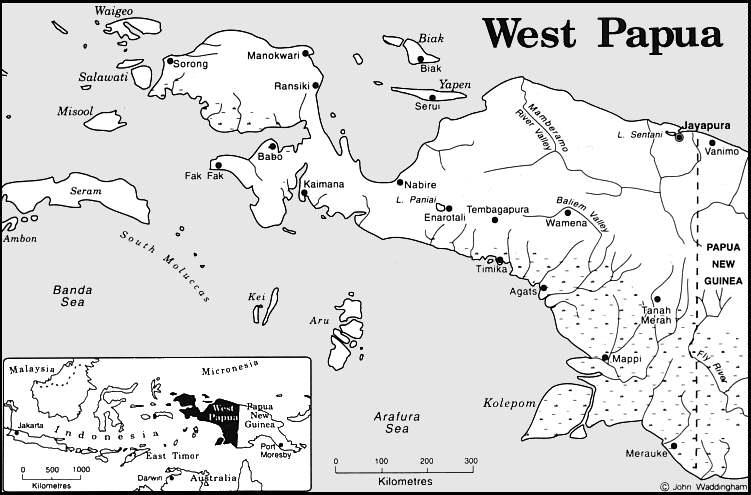
Honolulu-based East-West Center has issued a policy study that is of particular interest to me, for its focus both on Papua and on the construction of national identity.

Pan-Papuan identity is much more widespread and the commitment to a Papuan nation much stronger in 2004 than it was in 1963, when Indonesia thought it was liberating the Papuans from the yoke of Dutch colonialism. Rather than feeling liberated from colonial rule, Papuans have felt subjugated, marginalized from the processes of economic development, and threatened by the mass influx of Indonesian settlers. They have also developed a sense of common Papuan ethnicity in opposition to Indonesian dominance of the local economy and administration, an identity that, ironically, has spread in part as a result of the increasing reach of Indonesian administration. These pan-Papuan views have become the cultural and ethnic currency of a common Papuan struggle against Indonesian rule. Yet the sharp ethnic distinctions Papuans make between themselves and Indonesians reflect the various and complex relationships Papuans have had with the latter.

Despite the sharp distinctions they draw between themselves and Indonesians, the Papuans are themselves diverse. Papuan society is a mosaic of over three hundred small, local, and often isolated ethno-linguistic groups, whose contacts with each other and with non-Papuans has varied significantly. The evolution of Papuan nationalism has therefore gone hand in hand with the creation of a pan-Papuan identity. The first generation to begin thinking of themselves as Papuans were the graduates of the mission schools and colleges established by the Dutch to train officials, police, and teachers after the Pacific War. The study examines two regions to illustrate something of Papua’s ethnic and religious diversity as well as the different ways in which regions have interacted with the world outside Papua. These two regions, Fakfak [on the lower beak of the Bird’s Head] and Serui [on Yapen Island], had displayed some of the strongest pro-Indonesian sentiment prior to 1961. Today, the choice between Papuan and Indonesian identity is a hotly contested issue in Fakfak, while Serui has become anti-Indonesian. The analysis in these case studies sheds additional light on the ways Papuans have negotiated their ways through choices of identity and political orientation.

SOURCE: Constructing Papuan Nationalism: History, Ethnicity, and Adaptation, by Richard Chauvel.

Leave a comment

Filed under Indonesia

Beijing’s (and Washington’s) Policies toward the Uyghurs

Honolulu-based East-West Center has just issued a policy study that sounds two notes worth repeating.

Both Beijing and Washington are about to lose crucial political opportunities in this far-flung territory. Beijing’s new hard-line stance, which restricts even language and culture, has galled the many moderate Xinjiang citizens who once grudgingly accepted Chinese political restrictions as a price of regional economic development. The PRC government still has an opportunity to win back these people with a more pluralistic cultural policy that emphasizes support for Uyghur and other policy-relevant minority languages and that eases other cultural restrictions, particularly on religion. Without such a policy shift, as Beijing well knows, Xinjiang could become China’s Kashmir. Yet if current PRC policy stays on course, any change is likely to be even more restrictive, since the government considers its cultural accommodation of the 1980s and 1990s to be a cause of unrest, rather than a solution to it.

The United States, for its part, must make clear to Beijing that current U.S. political imperatives will not distract U.S. policy from supporting human rights, including cultural rights. The Uyghurs have been among the most pro-American citizens in China. They also happen to be Muslims. If the United States wants international partners in fighting terrorism, it should cultivate a cooperative partnership with China, including the Uyghurs. If the Xinjiang region is to be involved in an initiative against international terrorism, then the United States can urge China and its allies to cultivate the Uyghurs—with their knowledge of the language and cultures of Central Asia—as partners rather than as opponents. As Washington has begun to realize, its anti-Uyghur policies, even those targeted only at violent fringe groups, have already generated negative sentiment in Xinjiang towards the United States. Policies perceived as anti-Uyghur or anti-Muslim could well radicalize previously apolitical Uyghurs, pushing them into militant or radical Islamic groups.

SOURCE: The Xinjiang Conflict: Uyghur Identity, Language Policy, and Political Discourse, by Arienne M. Dwyer (2005).

Leave a comment

Filed under China

Algeria: Split by the Gulf War

Initially, the Gulf crisis, set off by Iraq’s invasion of Kuwait on August 2, 1990, drew increasingly marked lines of separation within the Algerian political class. Although all the parties condemned the Western reaction–the massing of troops and weapons in Saudi Arabia–whose aim, according to some, was only to “preserve their interests,” or even “seize control of hundreds of billions of Arab dollars and threaten the Islamic and Arab nation in its security,” the position toward Saddam Hussein’s regime was far from unanimous.

The ISF [Islamic Salvation Front] Islamists proved to be increasingly embarrassed. How ought one to “protect” Saudi Arabia’s appeal for Western troops? Response: “Let us brandish the torch of Islam. Let us brandish the jihad. Down with the servants of colonialism! No to Iraqi intervention in Kuwait, no to the intervention of unbelievers in Saudi Arabia, no to the governments that have compromised with the West. Yes to the peace dialogue. My dear brothers, we reject all intervention in our affairs.” The ISF preacher who gave this speech in Constantine ended it with the search for the inevitable scapegoat, “the Jews, who occupy all the holy places of Islam” (Sigau 1991).

The rejection of “the American war,” which increased after the air offensive by the coalition against Iraq on January 17, 1991, did not signify adherence to the doctrine of Iraq’s sole party, the Baas [= Baath]. From one end of the Maghreb to the other, the violence of the conflict provoked the return in force of the tradition of revolutionary populism, of a movement of unanimity without any possible differences in points of view. And yet, in the many pro-Iraqi demonstrations that occurred in Rabat, in Algiers, and in Tunis, a rift appeared.

On the one hand, there were those who demanded peace, an immediate cease-fire. They spoke of safeguarding the unity of the “Arab nation.” They adopted the tone of the Third World movement of the 1960s, supported in the past by the Moroccan Mehdi Ben Barka and the West Indian writer Frantz Fanon: they denounced the oppression of the peoples of the “Arab nation” by a regime resolved to establish its hegemony over it. The rejection of US intervention against Iraq was accompanied by a denunciation of the petroleum monarchies in the Gulf. They were accused of placing their capital in Western financial institutions when, in the overwhelming majority of Arab countries, social progress remained very slow. But that effort at social clarification collided with the power of consensus based on identity, the sense of belonging to the same “Arab camp.” And the “Palestinian cause” further united people. Some, however, particularly the heads of the human rights leagues, attempted to explain the necessary distinction between Saddam Hussein’s totalitarian regime and the suffering of the Iraqi people.

On the other hand, in Morocco and Algeria the Islamist movement championed the jihad. The Western view of the Arab world, simplified to the point of caricature, encouraged this movement. Feeding the worship of a fixed past, the Islamist movement assimilated democracy (seen simply as a product of European history) to irreligion, that is, to one of the weapons in the vast conspiracy fomented by the enemies of the Prophet.

The West, out of habit or laziness, has relegated all the Arab countries to a global otherness–a homogeneous whole, sometimes invaded by abrupt fits of fever–without understanding that these peoples, in mobilizing against the war, aspired not to a return to military nationalism, but only to a greater degree of justice.

Public opinion brandished the democratic argument with the slogan “two weights, two measures.” The Algerians emphasized the glaring inequality in the application of UN resolutions. But the majority of them did not embrace Saddam Hussein’s regime. In Rabat and Tunis as well, there was a demand for more rights and not for the withdrawal of the international community.

The tragedy lay in the refusal by the “North” to take these considerations into account. It has then been easy for the Islamists to demonize the idea of democracy, understood as a product of the West and not as a universal principle.

SOURCE: Algeria, 1830-2000: A Short History, by Benjamin Stora (Cornell U. Press, 2001), pp. 208-209

Leave a comment

Filed under Mediterranean, Middle East, war

Algeria: From Pan-Arabism to Islamism

The collapse of the FLN and the ISF‘s rise to power lay in the continuing failures of pan-Arabism and the development of political Islamism.

The Arab defeats by Israel (in 1967 and 1973) led to the crisis in Arab nationalism. The volatile mixture of Islamism and oil led to new conflicts, while the state apparatus originating in Arabism defended itself with concessions and repressions. Given the Iran-Iraq war (1980-1988) and its parade of atrocities, the persistence of underdevelopment, the lack of resolution of the Palestinian question, and the Israeli invasion of Lebanon in 1982, people in the 1980s were troubled by a queasy sinking sensation and the certainty that the collapse of values would ineluctably be punished. Gradually, for some, the hope of a return to original Islam was carved out. The new power acquired by the Gulf states (especially Saudi Arabia) after the oil crisis appeared to many faithful as a sign of divine providence. Compared to the patent failures of the secular states, which had fashioned their industrial development model on that of Eastern Europe, the international weight acquired by Riyadh gave fundamentalism a new credibility.

In the early 1980s, the landscape of the Maghreb was transformed. With the urban riots in Morocco in 1981 and 1984 and in Tunisia in 1984, and the Algerian outbreak in October 1988, social frustrations were laid bare. The organs for controlling and organizing societies were no longer adequate to stifle their expression. The rise of the individual and the slow acquisition of personal freedoms were translated into the creation of associations (the human rights leagues, for example) and public demonstrations to demand new rights.

That approach required the end of the single-party system, which had failed in its curious mixture of universalism and specificity (Islam and national socialism). The Algeria of 1990, with the multi-party system and elections planned for 1991, opened the way to the nation/society’s appropriation of the freedoms until then confiscated by the party/state. That desire for democracy, which opposed the “forced modernity” proposed by the military, fractured the vision of Arab nationalism, especially since every state baldly obeyed its own logic, its own interests. In practice, every instance of nationalism developed at the expense of pan-Arabic propaganda. The borders, even the most artificial ones coming out of colonization, produced the same state allegiances in the territories they circumscribed, the same networks of sympathies and behaviors that gradually became fixed and institutionalized. Positions were taken, choices made, which the bureaucratic cadres in the states were reluctant to abandon.

Political Islamism emerged as a major factor, and took its place in the void left by Arab nationalism (Peuples méditerranéens, 1990). The populations were barely gathering up the detritus of modernity. They felt that yawning gap–between the rulers and the ruled, between the very rich and the very poor, and between the “North” and the “South”–as an injustice. The rise of Islamism, experienced as the hope for a return to ethics, in combination with the bankruptcy of the single-party system, brought about a need for individual responsibility, which would go hand in hand with the search for a new kinship.

At the same time, the crisis of “Arab Socialism” made a need for personal freedom, or individualized responsibility, appear. Human rights leagues, but also new unionist organizations, women’s movements, cultural associations, and a series of journals began the work of criticism: how could the state become disengaged from the economy? How could individuals assert themselves as political subjects and as citizens? How could the culture, and in particular the representations of Islam, transform itself? That reflection on democracy was still very fragile when the Gulf crisis erupted, with Iraq’s invasion of Kuwait on August 2, 1990.

SOURCE: Algeria, 1830-2000: A Short History, by Benjamin Stora (Cornell U. Press, 2001), pp. 201-202

Leave a comment

Filed under Mediterranean, Middle East, religion